Disclosure: airfryerkitchensupply.com is reader-supported. When you buy through links on our site, we may earn an affiliate commission at no extra cost to you.
Where to buy
Every machine in this guide to the best coffee makers for lazy people is sold on Amazon, and each verified pick links to its listing so you can check the current price on Amazon. We do not print prices — they change too often to stay honest — and every model below was matched against Amazon’s product data feed for this site before it earned a link.
- Keurig K-Express — check the current price on Amazon
- Cuisinart Grind & Brew DGB-800 — check the current price on Amazon
- Keurig K-Mini — check the current price on Amazon
- Nespresso Essenza Mini by Breville — check the current price on Amazon
- Hamilton Beach The Scoop Single Serve — check the current price on Amazon
- Fellow Aiden Precision Coffee Maker — check the current price on Amazon
The best coffee makers for lazy people are not the best coffee makers with a marketing wink — laziness is a legitimate engineering brief, and this roundup takes it seriously. The lazy drinker’s enemies are specific: measuring, waiting, cleaning, refilling, and deciding, all before caffeine. Every pick here eliminates most of that list, and each eliminates a different part of it — pods delete measuring and cleanup, a grind-and-brew deletes the morning entirely, a smart scheduled brewer deletes remembering. Choose by which chore you hate most.
Honesty corner: no machine deletes descaling, and any list that promises zero maintenance forever is lying to you. What these machines do is move the effort to where lazy people can tolerate it — a monthly ten minutes instead of a daily ten minutes. Every pick was verified against Amazon’s product data for this site before earning a link, and no prices are printed; check the current price on Amazon from each pick.
If your laziness is actually about mornings with a newborn, a dorm room, or a household of one small cup, the sibling guides at the end cover those special cases. This list is for the general condition: a person, a kitchen, and a deep unwillingness to work before coffee.
In this guide
Quick Picks
- Best Overall Lazy: Keurig K-Express — best for the proudly lazy who want coffee in a minute with near-zero cleanup
- Best Wake-Up-to-Fresh: Cuisinart Grind & Brew DGB-800 — best for lazy mornings with fresh-ground standards and a set schedule
- Best Minimal Everything: Keurig K-Mini — best for single-cup minimalists in small spaces
- Best One-Touch Espresso: Nespresso Essenza Mini by Breville — best for lazy espresso drinkers who value speed and a tiny footprint
- Best No-Pod Lazy: Hamilton Beach The Scoop Single Serve — best for pod-free lazy drinkers who want grounds economics with pod-level effort
- Best Set-and-Forget Premium: Fellow Aiden Precision Coffee Maker — best for quality-first drinkers who will trade one setup evening for effortless mornings
How These Picks Were Chosen
Candidates were verified against the site’s Amazon product feed — model, listing, and every printed spec — then scored on a laziness audit: steps from bed to cup, decisions required, cleanup minutes per week, refill frequency, and failure modes when the user is at their least competent. Machines that were merely small or merely cheap did not pass; each survivor removes real friction.
The six picks span pods, capsules, grounds, and one smart scheduled brewer, because lazy people are not one tribe — they are several, united only by what they refuse to do before caffeine.
The 6 Best Coffee Makers for Lazy People

Keurig K-Express — Best Overall Lazy
The K-Express suits the honestly lazy: pod in, button pressed, coffee in about a minute, with a 42-ounce reservoir that removes even the daily water refill from the ritual. It does not suit pot drinkers, households of many, or anyone for whom per-cup pod cost is a principle.
Strengths
- The complete lazy loop: no measuring, no filters, no carafe to wash
- 42 oz reservoir covers days of cups between refills
- Strong Brew button rescues the cup from pod blandness
Trade-offs
- Pod cost and pod waste are the standing rent for this convenience
- One cup at a time — guests queue
- Descaling still exists; laziness is reduced, not abolished
| Format | Single-serve K-Cup pods |
| Sizes | 3 brew sizes |
| Reservoir | 42 oz removable |
| Extras | Strong Brew button, travel-mug friendly |
Laziness, properly understood, is a design brief: minimise decisions, motions, and cleanup between waking and coffee. The K-Express is the purest execution of that brief at a sane price — a reservoir big enough to forget, a pod library that includes every flavor of giving up on grinding, and a brew cycle shorter than the time spent finding a mug. The Strong button matters more than it sounds: it is the difference between pod coffee you drink and pod coffee you apologise for. Nothing here will impress a coffee hobbyist, and that is entirely beside the point. This machine’s job is to make coffee happen on the mornings when you are least capable of making coffee happen, and it has never once needed you to be a better person first.
Keep the pod carousel or drawer within arm’s reach of the machine, stocked. The lazy system fails at exactly one point — the morning the pods are in a different room — so engineer the stockpile like you engineer the machine: zero steps.
K-Express ownership is a stocking habit and a descale reminder: pods in the drawer, water in the reservoir, a descale on the calendar. The machine’s drip tray and pod bin rinse in the sink in under a minute weekly, and that is genuinely the whole ledger. Its failure mode is social, not mechanical — the morning a guest wants a second cup while you want yours — and households solve it by simply accepting the queue or stepping up to a carafe for weekends. For the solo lazy drinker, it is close to a solved problem in product form.
Best for: the proudly lazy who want coffee in a minute with near-zero cleanup / Not suited for: pot households or pod-cost objectors

Cuisinart Grind & Brew DGB-800 — Best Wake-Up-to-Fresh
The DGB-800 suits the lazy person with standards: load beans and water the night before, set the timer, and wake to a pot that ground its own beans minutes before brewing. It does not suit the cleanup-averse in one specific way — the grinder parts want a regular rinse — or pod people.
Strengths
- Burr grinder inside: the timer produces fresh-ground coffee while you sleep
- Full 12-cup programmability with strength control
- Charcoal water filter and permanent brew filter — nothing disposable to stock
Trade-offs
- Grinder chamber and chute need periodic cleaning or the convenience decays
- Grinding at 6 a.m. is an alarm clock the household did not agree to
- Glass carafe on a plate: the pot’s freshness window is the first hour
| Capacity | 12-cup glass carafe |
| Grinder | Built-in burr grinder, whole-bean hopper |
| Programming | 24-hour fully automatic |
| Filters | Permanent brew filter, charcoal water filter |
Every lazy-coffee solution trades something away; the Grind & Brew’s trade is the cleverest. It accepts a small weekly cleaning duty in exchange for eliminating the daily ones — no measuring grounds each morning, no separate grinder to haul out and put away, no stale pre-ground coffee — and it performs the whole production unattended on a timer. Waking to fresh-ground coffee that nobody had to make is the closest legal experience to having staff. The burr grinder is a real one, not a blade afterthought, so the cup quality is a clear class above the pod picks here. Choose it if your laziness is about mornings specifically; the machine is honest that its convenience is scheduled, not spontaneous.
Grind-and-brew owners: brush the chute weekly, without exception. Ground coffee dust compacts in the chute, the dose quietly shrinks, and the coffee weakens over a month — a two-minute brush keeps the machine’s promise intact.
Grind & Brew ownership has one standing appointment: the weekly grinder-chute brush and hopper check, five minutes that protect the entire value proposition. Miss it for a month and the dose drifts and the coffee thins — the machine does not break, it fades, which is worse because nobody schedules a repair for a fade. Owners who calendar the brush describe the machine as life-changing; owners who do not describe it as disappointing. Both are reporting accurately on the same appliance, separated by one habit.
Best for: lazy mornings with fresh-ground standards and a set schedule / Not suited for: the cleaning-averse or light sleepers in earshot

Keurig K-Mini — Best Minimal Everything
The K-Mini suits the minimalist lazy: one cup of water in, one cup of coffee out, a machine the size of a paperback that stores its own cord. It does not suit anyone who drinks three cups before leaving — the per-cup refill ritual will find them — or households.
Strengths
- The smallest, simplest Keurig: add water, add pod, press, done
- One-cup reservoir means fresh water every time and nothing to descale as often
- Cord storage and a tiny footprint suit counters, desks and dorms
Trade-offs
- Every single cup requires its own fill — high-frequency drinkers will tire of it
- No reservoir convenience of its bigger siblings
- Strictly one cup, one person, one pace
| Format | Single-serve K-Cup pods |
| Brew size | 6 to 12 oz, one cup at a time |
| Reservoir | Single-cup, fill per brew |
| Design | Cord storage, compact footprint |
The K-Mini strips the pod concept to its skeleton and finds the skeleton charming. There is no reservoir to grow stale, no menu, no settings to be wrong about; the machine is a heated needle with excellent manners. For the single person in a small space — the studio, the dorm, the desk — it is arguably the most honest lazy machine here, because its laziness is matched to a life that only ever wants one cup at a time. Its limits are the same fact viewed from the other side, and this review will not soften them: if your mornings involve a second cup, buy the K-Express and its reservoir instead. Within its brief, the Mini is perfect, and its brief is written on its name.
Keep a reusable pod basket with it and a small jar of your own grounds beside it. Even committed pod drinkers hit a morning when the pods run out; the basket turns a crisis into a slightly more manual cup.
K-Mini ownership is the lightest in this roundup: no reservoir to refresh, a descale occasionally, a footprint that never needs defending. Its consumable discipline is per-cup by design — water in, pod in — so the only stockpile is the pod drawer. It also travels: owners move it between kitchen, desk, and dorm without ceremony, and its cord storage means it packs like it was designed by someone who has actually carried a coffee maker. For a one-cup life, there is nothing here to resent.
Best for: single-cup minimalists in small spaces / Not suited for: multi-cup mornings or households
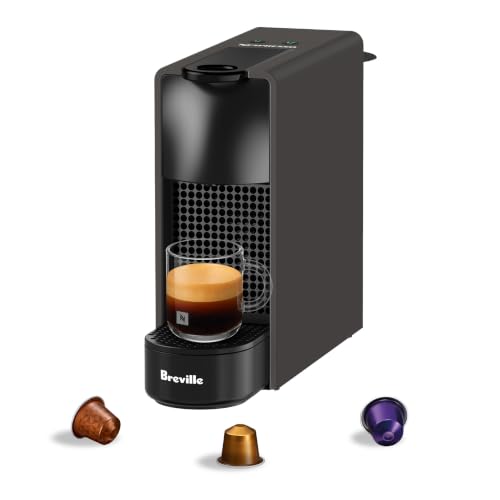
Nespresso Essenza Mini by Breville — Best One-Touch Espresso
The Essenza Mini suits the lazy espresso drinker: capsule in, one button, a genuine 19-bar espresso in under a minute from cold, in the smallest serious footprint in coffee. It does not suit milk-drink makers without adding a frother, or anyone who wants a mug-sized coffee without a lungo or an added-water workaround.
Strengths
- 25-second heat-up — faster than the kettle, faster than your patience
- True capsule espresso with zero technique and near-zero cleanup
- The smallest counter footprint of any pick here
Trade-offs
- Espresso and lungo sizes only — no big mugs, no pots
- Milk drinks need a separate frother
- Capsule costs and the Original-line ecosystem commitment
| Format | Nespresso Original capsules |
| Pressure | 19-bar pump |
| Heat-up | About 25 seconds |
| Sizes | Espresso and lungo, programmable |
Speed is a form of laziness-respect, and the Essenza Mini is the fastest honest coffee in this roundup: from cold and off to a finished espresso in well under a minute, with the capsule carrying the entire burden of dosing and grinding. The result is not a compromise beverage — the Original system’s extraction is the real thing, which is why this tiny machine anchors so many small kitchens. Its laziness has one boundary: it makes espresso, full stop. The drinker whose order is a large milky coffee should look at the frother-included picks in the iced-latte roundup or add Nespresso’s frother here. For the straight-shot drinker, nothing lazy is better built.
Program the lungo button to your actual mug once, on day one. The Essenza’s two buttons are programmable for a reason, and owners who set them never think about volume again — which is the whole philosophy of this list in one gesture.
Essenza Mini ownership is capsule minimalism: a water tank to top up every few days, a capsule bin to empty weekly, a descale on the calendar, and nothing else — the shortest care list of any espresso machine made. Its small tank is the one rhythm to learn; a morning check while the machine warms (twenty-five seconds) covers it. The machine’s longevity story is Nespresso’s: a mature system, available capsules everywhere, and a design that has been refined rather than reinvented for years.
Best for: lazy espresso drinkers who value speed and a tiny footprint / Not suited for: big-mug drinkers or milk-drink households without a frother

Hamilton Beach The Scoop Single Serve — Best No-Pod Lazy
The Scoop suits the lazy drinker who refuses pods on cost or principle: its filter is a scoop — measure with the tool that is already the filter, drop it in, brew. It does not suit anyone who wants a carafe, or precision: the scoop method is gloriously approximate.
Strengths
- The scoop is the filter: no paper filters to buy, no pods to stock
- 40 oz reservoir brings big-machine convenience to a grounds brewer
- Brews an 8–14 oz cup in minutes with regular or bold settings
Trade-offs
- Scoop dosing is approximate — cup strength varies with your morning coordination
- Single servings only
- Grounds disposal is a rinse, not a pod’s clean ejection
| Format | Single-serve, ground coffee |
| Brew sizes | 8 to 14 oz cups and travel mugs |
| Reservoir | 40 oz removable |
| Filter | Built-in scoop filter, no paper or pods |
Hamilton Beach identified the exact friction that pushes grounds drinkers toward pods: not the brewing, but the stuff around it — filters to stock, grounds to measure, a basket to assemble. The Scoop deletes the stuff. The measuring scoop is the brew basket; you scoop from the bag, level it on the rim, and brew into your cup through a 40-ounce reservoir’s worth of stored water. The coffee is real drip coffee at real drip economics, with a bold setting for the heavy-handed. It is the lazy machine for people whose objection to pods was never effort but economics and waste — a distinction this roundup respects, because it describes a great many actual humans.
Adopt the two-scoop rule or the one-scoop rule and never improvise between them. Approximate dosing is fine; inconsistent dosing is what makes a simple machine seem unreliable. Pick your scoop count the first week and let muscle memory take over.
The Scoop’s ownership replaces the pod ledger with a grounds ledger: beans in the cupboard, a scoop to rinse after each brew (ten seconds, genuinely), a reservoir to keep filled, and a descale on schedule. The scoop-filter never needs replacing and never runs out, which quietly removes the two recurring errands of its rivals. Its cup varies a little with the hand that scoops — owners converge on a personal standard within a week and stop thinking about it, which is the machine’s design working as intended.
Best for: pod-free lazy drinkers who want grounds economics with pod-level effort / Not suited for: carafe households or precision brewers

Fellow Aiden Precision Coffee Maker — Best Set-and-Forget Premium
The Aiden suits the lazy connoisseur — an apparent contradiction it resolves with scheduling: set the app once, and precision-brewed coffee (with bloom cycle and custom profiles) appears on your timetable into a thermal carafe. It does not suit the setup-averse; its laziness is front-loaded into configuration.
Strengths
- App-enabled scheduling: the pot brews itself, to a profile, on your calendar
- Precision brewing with bloom cycle and custom profiles — quality without morning effort
- Thermal carafe holds the scheduled pot without a plate
Trade-offs
- Premium tier, and the app setup is a real first-evening project
- Depends on your Wi-Fi and your follow-through in configuring it
- No pods: grounds loading remains a human job
| Capacity | 1–10 cups, thermal carafe |
| Control | App scheduling, custom brew profiles |
| Brewing | Bloom cycle, precision temperature control |
| Extras | Cold brew preset |
Every other pick here reduces effort per cup. The Aiden reduces effort per week: an evening of configuration — profiles for weekday and weekend, a schedule matched to the alarm — purchases months of mornings where excellent coffee simply exists when you arrive in the kitchen. The brewing underneath the automation is genuinely precision-grade, with a bloom cycle and profile control that specialty drinkers recognise, and the thermal carafe means the scheduled pot waits patiently instead of cooking. It is the premium expression of this entire keyword: not doing less badly, but arranging for the work to happen without you. Buyers who will not finish the setup should buy the K-Express instead, and this review means that as respect for both machines.
Schedule the weekday pot to finish ten minutes before the alarm, into the thermal carafe. The coffee rests, the carafe’s holding clock starts from a full pot, and the first cup is at drinking temperature rather than scalding — the schedule serving the drink, not just the clock.
Aiden ownership is a configuration relationship: profiles tuned in the first week, a schedule adjusted when the household’s does, and an app that either becomes invisible infrastructure or — if the setup was skipped — an expensive ornament on a good brewer. Fellow’s audience maintains its machines well, and the thermal carafe and precision parts reward the standard descale-and-wash routine. The honest ownership split is binary: households that finished the setup describe it as the best lazy machine they have owned; households that did not, describe a very good drip machine. Choose with your follow-through in mind.
Best for: quality-first drinkers who will trade one setup evening for effortless mornings / Not suited for: the setup-averse or pod households
Comparison Table
| Pick | Badge | Key spec | Best for |
|---|---|---|---|
| Keurig K-Express | Best Overall Lazy | Single-serve K-Cup pods | the proudly lazy who want coffee in a minute with near-zero cleanup |
| Cuisinart Grind & Brew DGB-800 | Best Wake-Up-to-Fresh | 12-cup glass carafe | lazy mornings with fresh-ground standards and a set schedule |
| Keurig K-Mini | Best Minimal Everything | Single-serve K-Cup pods | single-cup minimalists in small spaces |
| Nespresso Essenza Mini by Breville | Best One-Touch Espresso | Nespresso Original capsules | lazy espresso drinkers who value speed and a tiny footprint |
| Hamilton Beach The Scoop Single Serve | Best No-Pod Lazy | Single-serve, ground coffee | pod-free lazy drinkers who want grounds economics with pod-level effort |
| Fellow Aiden Precision Coffee Maker | Best Set-and-Forget Premium | 1–10 cups, thermal carafe | quality-first drinkers who will trade one setup evening for effortless mornings |
How to Choose a Coffee Maker for Lazy People
Count the Steps, Not the Features
Evaluate every machine by the same stopwatch-and-checklist test: from standing in the kitchen to holding the cup, how many actions, and how many of them require thought? A pod machine asks for about four actions and no thought. A grind-and-brew asks for zero actions in the morning and all of its thought the night before. A smart brewer asks for one evening of thought and then behaves like the grind-and-brew with better coffee. Feature lists obscure this; the step count reveals it. The best lazy machine is the one whose step count you will still be happy with on your worst Monday, not your best Saturday.
The Cleanup Ledger Is the Real Price
Lazy buyers fixate on brew effort and are ambushed by cleanup. Tally it honestly: pod machines ask for a drip tray rinse and an occasional descale; grounds machines add grounds disposal and basket washing; grind-and-brews add a weekly grinder-chute brush; espresso capsules add almost nothing. None of these is large, but they are different in kind — daily small tasks versus weekly medium ones. Know which rhythm your laziness prefers. Most self-aware lazy people choose the weekly medium task, because daily tasks are the ones that quietly stop happening.
Reservoirs, Hoppers, and the Refill Horizon
A machine that needs water for every cup reintroduces a chore at the exact moment of maximum unwillingness. Size your refill horizon to your consumption: the K-Express’s 42-ounce reservoir covers days; the K-Mini’s cup-at-a-time design suits only true single-cup lives; bean hoppers and pod stockpiles obey the same logic. The rule of lazy systems design is that a consumable should run out rarely and obviously — a visible reservoir near empty beats a hidden one discovered empty at 6 a.m.
Timers and Apps: Laziness, Scheduled
The deepest laziness is not a faster machine but a finished one: coffee that exists before you do. Timers deliver this for drip coffee (the Grind & Brew’s whole thesis), and app scheduling delivers it with profiles and precision (the Aiden). The catch is symmetrical: scheduled coffee requires a scheduled human the night before. If your evenings are as unstructured as your mornings, a 60-second pod machine will serve you better than a timer you never set. Be honest about which half of the day your discipline lives in.
Where Lazy Coffee Quality Actually Caps Out
Set expectations by format. Pod coffee tops out at ‘pretty good’ and costs the most per cup forever. Capsule espresso is genuinely good. Scheduled fresh-ground drip can be excellent. The lazy drinker’s real choice is not quality versus effort in the abstract — it is which specific quality ceiling you accept in exchange for which specific effort deleted. This roundup’s badges are written in those terms deliberately, so the trade you are making is the trade you intended.
The Lazy Spectrum: Which Kind of Lazy Are You?
Lazy is not one preference; it is at least four, and the machines divide along them. The Minimalist Lazy wants the fewest objects and the fewest steps per cup — the K-Mini and the K-Express are their machines. The Delegator Lazy wants the work to happen without them, on a schedule — the Grind & Brew and the Aiden. The Ritual-Averse Lazy will do a small weekly chore to protect a zero-chore morning. And the Decision Lazy hates choosing — grind size, ratio, roast — more than doing, which is the pod and capsule systems’ deepest appeal: the decision was made by whoever designed the pod.
Misdiagnosis is the common purchase error. A Delegator who buys a pod machine still faces a daily ritual; a Minimalist who buys a grind-and-brew inherits a weekly cleaning they will resent. Read the badges in this roundup against your type honestly — the review verdicts are written in exactly these terms — and the machine you buy will still be the machine you use in month nine.
Travel, Desks, and Second Locations: Laziness Away From the Kitchen
The lazy routine often needs a second outpost: a desk that is far from the kitchen, a workshop, a guest room, a small apartment’s only counter. The machines that travel between these roles are the compact single-serves — the K-Mini’s cord-storage footprint was designed for exactly this — and their economics work because a second location does not need the flagship; it needs a cup to happen with no infrastructure.
Dorms and shared housing add a social clause: a personal single-serve machine is also a boundary, keeping your coffee yours without a household negotiation. The lazy analysis holds in all these places because the metric never changes — steps, decisions, cleanup — only the address does. Buy the outpost machine to the same audit as the kitchen one and it will earn its shelf.
The Two-Machine Lazy Household
It sounds like a contradiction and is often the optimum: a scheduled drip machine owns the weekday morning pot, and a pod machine owns everything else — the afternoon cup, the decaf, the guest’s flavored drink, the 10 p.m. whim. Each machine does the shift it is best at, neither is asked to compromise, and the total effort is lower than either machine’s attempt to cover the whole day alone.
The pairing that recurs in real kitchens is the Grind & Brew pattern plus a compact Keurig — scheduled fresh coffee when the day is predictable, instant variety when it is not. Counter space is the honest cost, and the small footprints in this roundup are chosen partly to make the pairing physically possible. If your household keeps failing to love a single machine, consider that the household may be a two-machine household that has not admitted it yet.
What Lazy Coffee Drinkers Should Still Do Themselves
A short, non-negotiable list, offered in the spirit of the category: descale the machine on schedule, because scale is the one failure laziness cannot delegate away. Keep the consumable stockpile stocked, because no machine brews an absent pod. Wipe the milk or grounds path when the machine asks, because residue compounds faster than any other neglect. And taste your coffee critically once a month — palates drift, beans change, and a thirty-second monthly check keeps a lazy routine from quietly becoming a bad one.
That is the entire contract: perhaps twenty minutes a month of deliberate attention, in exchange for a daily routine that asks almost nothing. Lazy systems are not no-maintenance systems; they are maintenance-concentrated systems, and the concentration is the whole value. Honor the small contract and the machines in this roundup will honor theirs for years.
Gift-Giving for the Lazy Drinker: A Note for Their Families
If you are reading this guide to buy for someone else, the lazy audit becomes a gift audit: do not give a lazy drinker a ritual. The pour-over set, the manual espresso lever, the precision scale — these are gifts for hobbyists, and in a lazy kitchen they become beautiful shelf guilt. Give the machine that deletes the chore the recipient complains about, or give the consumables for the machine they already love: a stocked pod drawer or a subscription of the beans their grinder uses is a gift that lands every single morning.
And if the recipient’s current machine is merely old rather than wrong, the highest-value gift in this category is a descale, a deep clean, and a fresh stockpile — the lazy drinker’s equivalent of a spa day, performed on the appliance that serves them before they are fully awake.
Lazy Coffee While Working From Home
The home worker’s coffee problem is not the morning — it is the 3 p.m. cup, made in a fugue state between meetings, where any friction at all routes the drinker to a café app instead. The machines that win the afternoon are the instant ones (pods, capsules) and the holders (a thermal pot from the morning, still honest at three). The scheduled machines that owned breakfast are irrelevant to this cup, which is why so many home offices quietly acquire a second, smaller machine for the desk.
The desk outpost obeys the same audit as the kitchen: steps, decisions, cleanup. A K-Mini on a desk with a pod drawer beneath it is a complete afternoon system in one square foot. Judge your own afternoons honestly when you buy the morning machine — the household that plans for both cups keeps both cups at home.
Before You Buy: The Honest Laziness Interview
Ask yourself four questions and answer them as the person you are before coffee, not the person you are while shopping. One: will I measure anything — grounds, water, beans — at 6 a.m.? If no, pods or capsules are your format and the drip picks are decoration. Two: will I do a small chore the night before? If yes, the scheduled machines unlock the best coffee-per-effort ratio in this guide. Three: will I do a ten-minute chore monthly? Everyone must say yes to this one — it is descaling, and there is no format without it — so the question is really whether you will calendar it.
Four: what actually annoyed me about my last machine? Name the specific friction — the refill, the filter stock-outs, the carafe scrubbing, the wait — and buy the pick whose design deletes that friction, even if another pick wins on abstract quality. Lazy purchases fail by solving the wrong annoyance elegantly.
Score your answers against the badges and the shortlist writes itself: no-measuring points to Keurig, night-before points to Cuisinart or Fellow, espresso points to the Essenza, pod-refusal points to the Scoop. The interview takes four honest minutes, and it is worth more than any comparison table — including the one in this article — because the variable that decides lazy purchases is not in the machines. It is in the mornings.
When Lazy Meets Guests: Entertaining Without Effort Inflation
The lazy household’s stress test is the guest: suddenly the one-cup routine faces an audience, and the host feels the pull of performing coffee rather than serving it. Resist with systems. Pod and capsule picks serve guests at the same effort as the host’s own cup — that is their hidden entertaining virtue — and a thermal pot from a scheduled drip machine covers the brunch crowd without the host leaving the table to brew.
The deeper principle is that a lazy routine should scale by repetition, not by escalation: the guest’s cup is the host’s cup, made again. Keep a small guest stock — a decaf option, a flavored pod, the good beans for the grinder — and the performance anxiety evaporates, because there is nothing to perform. The machines in this roundup were chosen for mornings; it turns out they were also chosen, quietly, for hospitality.
A Final Word in Defense of the Lazy Drinker
The lazy coffee drinker is not a failed hobbyist; they are a person who has correctly identified that coffee is a means — to waking, to working, to a morning that starts kindly — and declined to make it an end in itself. The machines in this roundup honor that identification. They ask for a calendar reminder and a stocked drawer, and in exchange they return a small daily certainty: the coffee will happen, it will be good enough to glad about, and it will cost almost nothing in the currency lazy people actually keep, which is morning effort. That is not a compromise. For most households, it is the correct engineering of a daily pleasure.
How to Build a Zero-Effort Morning Coffee Routine
- Co-locate everything: machine, mugs, pods or beans, sweetener, and the water source within one step of each other. A lazy routine fails at geography before it fails at machinery — if the mugs live across the kitchen, the system has a daily tax built in.
- Stage the night before whatever your machine allows: water filled, pod or grounds loaded, mug waiting under the spout. Morning-you performs one action (a button) because evening-you performed the rest at a civilised hour.
- Put descaling on a calendar reminder the day you unbox, at the interval the manual suggests for your water. Lazy systems survive on scheduled maintenance; unscheduled maintenance is how good machines die of scale while their owners feel betrayed.
- Stock consumables in bulk and store the stock at the machine. Running out of pods or beans converts a zero-effort routine into a shopping trip at dawn; a visible backup supply is part of the appliance.
- Review the routine after two weeks and delete one more step. There is always one — a lid that can stay open, a mug that can live on the tray, a setting that can become permanent. Laziness, maintained properly, compounds.
Common Buying Mistakes
- Buying a hobby machine for a lazy life. The manual espresso setup, the pour-over ritual, the precision scale — beautiful objects that a lazy drinker will abandon by February. Buy for the person you are at 6 a.m., not the person you are in the store.
- Choosing zero-cleanup marketing over a real cleanup ledger. Every machine needs descaling and some washing. The honest comparison is minutes per week; the dishonest one is the word ‘effortless’ on a box.
- A timer you never set. Programmability only helps households with an evening routine. If that is not you, spend the money on brew speed instead — a minute from cold beats a pot that was scheduled for a morning that changed.
- Undersizing the reservoir. Refilling water daily is the chore that makes pod owners nostalgic for drip machines. Match reservoir size to cups per day, with margin.
- Letting the pod or bean stockpile run dry. The machine is not the system; the stockpile is. A lazy routine with no consumables is just furniture. Keep the backup supply where the machine can see it.
Final Recommendation
The Keurig K-Express is the lazy recommendation for most people: the fewest steps, the fewest decisions, a reservoir that minds its own business. Lazy-with-standards goes to the Cuisinart Grind & Brew and its wake-up pot; lazy-with-taste-and-budget goes to the Fellow Aiden’s scheduled precision; and the smallest lives get the K-Mini or the Essenza Mini, depending on whether their drink is coffee or espresso.
Pod-refusers are not forgotten: the Hamilton Beach Scoop delivers grounds economics at near-pod effort. For the adjacent conditions, see the sibling guides: Best Coffee Makers For Less Cups for one- and two-cup households, Best Coffee Makers For New Parents, Best Coffee Makers For College Students, Best Coffee Makers For Home Use, and Best Coffee Makers For Iced Lattes.
Start your comparison with the three reader favourites: the Keurig K-Express, the Cuisinart Grind & Brew DGB-800 and the Keurig K-Mini — check the current price on Amazon on each before you decide.
Frequently Asked Questions
What is the absolute easiest coffee maker to use?
A pod machine with a large reservoir — the K-Express pattern. Pod in, button pressed, coffee in about a minute, and almost nothing to wash. It is the fewest steps and fewest decisions of any format, which is the honest definition of easiest.
Is there a coffee maker with truly no cleaning?
No. Every machine that heats water accumulates scale and needs descaling, and every machine that touches coffee needs occasional washing. The lazy-optimised machines in this roundup compress that into a short monthly routine rather than daily chores — that is the real promise, and it is enough.
Can a lazy person still get good coffee?
Yes, at two addresses: capsule espresso (the Essenza Mini) is genuinely good with zero skill, and a scheduled grind-and-brew or smart brewer produces fresh-ground coffee with the effort moved to the night before. What laziness cannot have is the hobbyist’s last five percent — a fair trade most drinkers happily sign.
Are pod machines worth the running cost?
They are worth it if the alternative is buying coffee out, which is the comparison most pod households are actually making — a pod at home beats a café queue on both price and effort. If the alternative is a drip pot you would happily make, pods are an expensive way to avoid a small chore.
What about coffee quality with a scoop-style grounds brewer?
Better than its simplicity suggests: it is real drip brewing with approximate dosing. Cup strength varies slightly with the scoop, which most drinkers stop noticing within a week. The Scoop exists for people who want grounds economics without pod prices or filter stocking.
How do I keep a lazy routine working long-term?
Calendar the descale, stock consumables in bulk at the machine, and stage the night before. Lazy routines fail from logistics, not from machines — the routine is the product, and these three habits are its maintenance schedule.


