Disclosure: airfryerkitchensupply.com is reader-supported. When you buy through links on our site, we may earn an affiliate commission at no extra cost to you.
Where to buy
Every machine in this guide to the best coffee makers for keeping coffee hot is sold on Amazon, and each verified pick links to its listing so you can check the current price on Amazon. We do not print prices — they change too often to stay honest — and every model below was matched against Amazon’s product data feed for this site before it earned a link.
- BUNN CSB3T Speed Brew Platinum Thermal Coffee Maker — check the current price on Amazon
- Breville Luxe Brewer Thermal BDC465 — check the current price on Amazon
- Cuisinart 10-Cup Thermal Classic Coffeemaker DCC-1170BKNAS — check the current price on Amazon
- Technivorm Moccamaster KBT — check the current price on Amazon
- Zojirushi EC-YTC100XB 10-Cup Coffee Maker — check the current price on Amazon
- BLACK+DECKER 12-Cup Thermal Coffeemaker CM2046S — check the current price on Amazon
The best coffee makers for keeping coffee hot all share one design decision: they refuse the warming plate. A plate keeps coffee hot the way a stove keeps soup hot — by cooking it — and the stewed, bitter second hour of a plate-kept pot is a flavor everyone recognises and nobody ordered. The machines in this roundup instead brew into vacuum-insulated thermal carafes that hold heat passively, so the coffee at hour two tastes like the coffee at minute ten, only slightly cooler. That single difference is the whole category.
Two honest caveats shape the list. First, no carafe holds coffee at peak forever: the realistic prime window is two to three hours for most thermal carafes, up to four for the best-rated, and any claim beyond that is marketing. Second, holding can only protect the heat the brew created — which is why this list includes machines chosen for hot brewing as well as strong insulation. Every pick was verified against Amazon’s product data for this site; no prices are printed, so check the current price on Amazon from the picks.
If your problem is instead that the coffee never gets hot enough in the first place, that is the sibling problem — brew temperature — and its roundup is linked at the end. This guide assumes the brew is hot and asks how to keep it that way.
In this guide
Quick Picks
- Best Overall: BUNN CSB3T Speed Brew Platinum Thermal Coffee Maker — best for brew-once, drink-all-morning households that value speed and holding
- Best Long Holding: Breville Luxe Brewer Thermal BDC465 — best for slow drinkers who want the longest rated hold plus precision brewing
- Best Programmable Thermal: Cuisinart 10-Cup Thermal Classic Coffeemaker DCC-1170BKNAS — best for scheduled households that drink across the morning
- Best Premium Thermal: Technivorm Moccamaster KBT — best for purists who want the hottest brew feeding a thermal hold
- Best for Slow Mornings: Zojirushi EC-YTC100XB 10-Cup Coffee Maker — best for slow-morning households that trust insulation pedigree
- Best Budget Thermal: BLACK+DECKER 12-Cup Thermal Coffeemaker CM2046S — best for budget households upgrading from a warming plate
How These Picks Were Chosen
Candidates were verified against the site’s Amazon product feed — model, listing, and every printed spec — then screened on holding method first: thermal carafe or nothing. Glass-and-plate machines were excluded by definition, however good their brewing. Survivors were ranked on realistic holding window, the temperature of the brew entering the carafe, carafe sealing and lid design, and programmability for households whose mornings run on a schedule.
The six picks span a commercial-style speed brewer, the longest rated hold in the class, the mainstream programmable benchmark, a premium purist option, an insulation specialist, and a budget thermal — because ‘keeping coffee hot’ is one problem with several legitimate budgets.
The 6 Best Coffee Makers for Keeping Coffee Hot

BUNN CSB3T Speed Brew Platinum Thermal Coffee Maker — Best Overall
The CSB3T suits the household that brews once and drinks across the whole morning: BUNN’s always-hot tank brews a full thermal pot in minutes, and the vacuum-insulated carafe holds it without a watt of plate power. It does not suit timer-dependent households — there is no clock — or anyone bothered by a machine that keeps water hot around the clock.
Strengths
- Commercial-style internal hot-water tank: a full 10-cup pot in about four minutes
- Vacuum-insulated stainless thermal carafe holds heat for hours with no plate
- BUNN build quality and parts support are the class standard
Trade-offs
- The always-ready tank draws standby power to stay hot
- No programmability — speed is its answer to the timer
- Thermal carafe is hand-wash and hides the coffee level
| Capacity | 10-cup thermal carafe |
| Brew system | Internal hot water tank, Speed Brew |
| Brew time | About 4 minutes, full pot |
| Carafe | Vacuum-insulated stainless steel |
Keeping coffee hot is a two-stage problem — make it fast, then lose heat slowly — and BUNN is the only maker here that attacks the first stage with commercial hardware. The internal tank holds water at brewing temperature permanently, so the pot starts the instant you pour in fresh water and finishes before a conventional machine has finished heating up. Less time in the brew basket and the open air means the coffee lands in the carafe with more of its heat intact. Then the vacuum-insulated carafe does the patient work: no plate cooking the flavor, no reheating, just a sealed steel vessel losing degrees slowly enough that the last cup of a long morning is still a hot cup. For this search, it is the complete system.
Keep the carafe’s lid closed between pours — every opening trades the carafe’s hot air cushion for cold kitchen air, and across a dozen pours that discipline is worth a noticeable number of degrees in the final cup.
BUNN ownership has a commercial flavor: the tank wants a deliming routine on the maker’s schedule, the carafe wants its weekly soak, and parts — spray heads, seals, carafes — are orderable from a company that supports machines for decades. The standby tank is the one standing cost, measurable on a smart plug and modest beside a second daily brew. Owners describe the machine less as an appliance and more as plumbing that makes coffee, and they replace it, when they finally do, with another BUNN.
Best for: brew-once, drink-all-morning households that value speed and holding / Not suited for: timer households or standby-power minimalists

Breville Luxe Brewer Thermal BDC465 — Best Long Holding
The Luxe Brewer Thermal suits the slow household that also cares how the pot was brewed: precision drip brewing into a thermal carafe rated to keep coffee warm for up to four hours. It does not suit budget buyers or anyone who wants a visible coffee level.
Strengths
- Thermal carafe keeps coffee warm for up to four hours — the longest rated hold in this roundup
- Precision brewing with customizable settings, plus a cold brew mode
- Premium build and the best-looking counter presence here
Trade-offs
- Premium tier pricing
- Thermal carafe care: hand wash, hidden level
- Four hours is the rating, not a promise in a cold kitchen with constant pouring
| Capacity | 12-cup / 60 oz thermal carafe |
| Holding | Thermal carafe keeps coffee warm up to 4 hours |
| Modes | Hot drip with custom settings, cold brew |
| Carafe | Double-wall insulated stainless steel |
Most thermal carafes in this category hold a prime window of about two hours. Breville rates this one at up to four, and the engineering shows: a heavy double-wall carafe with a well-sealed brew-through lid, fed by a brewer that itself is a precision instrument with adjustable settings and a cold-brew mode for summer. The honest reading of any holding rating is ‘under good conditions’ — full carafe, lid closed, room-temperature kitchen — and the guide below explains how to give any carafe those conditions. But starting from the longest rated hold in the class is the right way to win this search, and the Luxe is also the machine here that hot-coffee enthusiasts would choose for the brewing alone.
Brew the full carafe on long mornings even if you expect to drink less. A full thermal carafe holds temperature dramatically longer than a half-full one, and leftover coffee in a sealed carafe beats a small batch reheated later.
Breville ownership is the premium routine done well: the carafe’s interior rewards a weekly tablet soak, the brewer’s settings invite a seasonal revisit as beans change, and the build quality makes the daily interaction — lid, pour, seal — feel engineered rather than assembled. The cold-brew mode gives the thermal investment a summer job. Support and spares run through Breville’s established channels, and the machine’s price buys entry into that ecosystem as much as it buys the four-hour hold.
Best for: slow drinkers who want the longest rated hold plus precision brewing / Not suited for: budget buyers or visible-level devotees

Cuisinart 10-Cup Thermal Classic Coffeemaker DCC-1170BKNAS — Best Programmable Thermal
The DCC-1170 suits the scheduled household that grazes: program the pot for the alarm, then let the thermal carafe — not a plate — keep it honest through the morning. It does not suit households needing more than 10 cups or buyers who want certified-temperature brewing.
Strengths
- Full programmability with a thermal carafe — the schedule and the hold in one machine
- Brew Pause lets the first impatient cup pour mid-cycle
- Double-wall thermal carafe keeps coffee hot without cooking it
Trade-offs
- 10-cup ceiling
- Mainstream heater: good temperature, not laboratory temperature
- Carafe lid channels need the rinse routine described in the care section
| Capacity | 10-cup thermal carafe |
| Programming | Fully programmable, 24-hour |
| Carafe | Double-wall stainless thermal |
| Extras | Brew Pause, auto shutoff |
The programmable-thermal combination is rarer than it should be, because it solves the actual weekday problem: coffee ready at 6:30 and still worth drinking at 8:45, without a plate stewing it in between. The DCC-1170 is the mainstream benchmark for that combination — Cuisinart’s complete scheduling pattern, a proper double-wall carafe, and a brew-through lid so the pot never sits open losing heat while it brews. Its brewing is mainstream-good rather than certified-great, and this review will not pretend otherwise; but for the keeping-hot brief, the system around the brew matters as much as the brew, and the system here is exactly right.
Program the brew to finish five minutes before the alarm rather than at it. The carafe’s best holding starts from a full, settled pot, and the first pour lands at the perfect moment instead of mid-drip.
Cuisinart ownership is the mainstream contract at its best: a descale reminder, a lid rinse after each pot, and a carafe soak weekly. The DCC-1170’s parts — carafes, lids, charcoal filters — are stocked everywhere Cuisinart is sold, which is everywhere. Its thermal performance depends on the lid’s channels staying clean, the one non-obvious habit; build it and the machine delivers its designed window for years. Households upgrading from a glass Cuisinart will find every habit transfers except the plate anxiety, which retires.
Best for: scheduled households that drink across the morning / Not suited for: 12-cup families or temperature purists

Technivorm Moccamaster KBT — Best Premium Thermal
The KBT suits the drinker who wants the Moccamaster’s certified-hot brewing delivered straight into a thermal carafe — the purist’s answer to this entire keyword. It does not suit anyone wanting a timer, an automatic drip-stop, or change from a premium budget.
Strengths
- Copper element brews at the proper hot band — coffee enters the carafe at full temperature
- Thermal carafe holding backed by the best brew in the roundup
- Hand-built, repairable, five-year warranty — the decade-long answer
Trade-offs
- Manual drip-stop basket asks a small amount of attention
- No programmability of any kind
- Premium pricing, full stop
| Capacity | 10-cup / 40 oz (1.25 L) thermal carafe |
| Heating | Copper boiling element |
| Carafe | Stainless steel thermal, brew-through lid |
| Brew time | About 6 minutes, full pot |
Heat retention can only protect the heat the brew created, which is why the KBT belongs near the top of this list: no machine here puts hotter, better-extracted coffee into its carafe, because the copper element holds the proper band while others approximate it. The thermal carafe then does unglamorous, excellent work. The ownership pattern is pure Technivorm — a manual basket you set yourself, parts you can replace yourself, and a machine that will plausibly be doing this job in ten years. If the budget reaches, this is the buy-once answer to keeping coffee hot: the hottest start and an honest hold, with nothing electronic to go obsolete.
Set the basket to the closed position for the last minute of the brew on small batches; the brief steep deepens a half pot noticeably, which is the one adjustment this deliberately simple machine invites.
KBT ownership is Technivorm ownership: nothing to update, nothing to pair, parts listed and orderable, and a descale rhythm as the entire service department. The manual basket becomes second nature within a week — owners describe it as the machine’s one honest demand. The thermal carafe’s lid seals by design rather than by latch, and a monthly deep clean keeps the pour clean. This is the pick for the buyer who measures appliance lifespans in decades and is willing to pay once for the privilege.
Best for: purists who want the hottest brew feeding a thermal hold / Not suited for: timer households or budget buyers

Zojirushi EC-YTC100XB 10-Cup Coffee Maker — Best for Slow Mornings
The Zojirushi suits the unhurried household that trusts the brand’s insulation science — this is the company that built its name on vacuum bottles — applied to a 10-cup thermal coffee maker. It does not suit feature hunters; its virtues are thermal and quiet.
Strengths
- Vacuum-insulation expertise from the category’s most trusted thermal brand
- Thermal carafe keeps coffee hot through a long, slow morning
- Thoughtful details: drip prevention, easy-clean carafe design
Trade-offs
- Understated feature set beside similarly priced rivals
- 10-cup capacity only
- Less programmability depth than the Cuisinart pick
| Capacity | 10-cup thermal carafe |
| Carafe | Stainless steel vacuum-insulated |
| Design | Drip-prevention spout, removable parts for cleaning |
| Brand focus | Vacuum insulation specialist |
There is a case for buying insulation from an insulation company. Zojirushi’s thermal engineering — vacuum walls, tight seals, heat-retentive lids — has been refined across decades of bottles and air pots, and the EC-YTC100 applies it to the morning pot: coffee that stays properly hot across the kind of slow weekend morning where a plate would have ruined it by the second hour. The brewing side is competent and honest rather than showy, and the machine’s small kindnesses (a spout that does not dribble the last of the heat onto the counter, parts that actually come apart for washing) compound across years of mornings. For the keeping-hot brief, pedigree in the exact science at issue is a rational thing to buy.
Store the carafe with its lid loosely on rather than sealed between uses; a sealed carafe keeps yesterday’s coffee aroma as faithfully as it keeps heat, and a quick rinse then starts each morning neutral.
Zojirushi ownership borrows the brand’s bottle discipline: rinse the carafe daily, soak it weekly, and the vacuum interior rewards you by staying bright and neutral-tasting for years. The brewer side is standard care — descale, wash the basket — and the machine’s drip-prevention design keeps the counter, and therefore the household’s temper, clean. Zojirushi’s support for its thermal products is a quiet strength; seals and lids are the kind of parts this company actually stocks.
Best for: slow-morning households that trust insulation pedigree / Not suited for: feature maximizers or 12-cup families
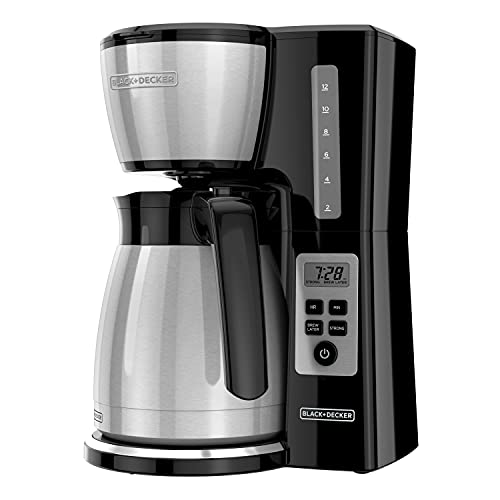
BLACK+DECKER 12-Cup Thermal Coffeemaker CM2046S — Best Budget Thermal
The CM2046S suits the budget household that wants the thermal system — programmable brewing into an insulated 12-cup carafe — without the premium toll. It does not suit temperature perfectionists or anyone expecting a four-hour hold.
Strengths
- True 12-cup thermal capacity at a budget tier
- Programmable with brew-strength control and Vortex shower distribution
- Thermal holding without a plate, at the lowest cost in this roundup
Trade-offs
- Hold is a solid couple of hours, not the Breville’s rated four
- Budget materials and finish
- Vortex brewing is good distribution, not certified extraction
| Capacity | 12-cup thermal carafe |
| Programming | Programmable with auto shutoff |
| Brewing | VORTEX shower technology, brew-strength control |
| Carafe | Insulated thermal carafe |
The budget question for this search is whether cheap thermal is real thermal, and the CM2046S answers yes with an asterisk worth understanding. The carafe genuinely insulates — coffee stays hot and un-cooked through a normal morning — and the programming and strength control are the full mainstream pattern rather than a stripped imitation. The asterisk is duration and refinement: plan on a two-hour prime window rather than four, and on brewing that is honestly good rather than certified. For a household upgrading from a plate machine on a budget, the transformation in the second cup is the entire argument, and this machine delivers it for the least money here.
Pre-heat this carafe religiously. Budget insulation benefits most from the hot-rinse habit, because the coffee is not asked to warm the carafe walls out of its own heat — it is worth a visible slice of extra holding time.
BLACK+DECKER ownership is the value routine: descale on schedule, soak the carafe weekly, and expect the machine to repay its modest price well before its mainstream lifespan ends. The programmable electronics are the standard pattern, the carafe is replaceable without a special order, and nothing about its care requires a dealer’s number. Budget thermal asks one extra habit — religious pre-heating, as the review notes — because at this tier the carafe’s insulation works best when the coffee is not warming the walls. Build the habit and the gap to pricier carafes narrows to the last hour of the window.
Best for: budget households upgrading from a warming plate / Not suited for: four-hour holders or extraction purists
Comparison Table
| Pick | Badge | Key spec | Best for |
|---|---|---|---|
| BUNN CSB3T Speed Brew Platinum Thermal Coffee Maker | Best Overall | 10-cup thermal carafe | brew-once, drink-all-morning households that value speed and holding |
| Breville Luxe Brewer Thermal BDC465 | Best Long Holding | 12-cup / 60 oz thermal carafe | slow drinkers who want the longest rated hold plus precision brewing |
| Cuisinart 10-Cup Thermal Classic Coffeemaker DCC-1170BKNAS | Best Programmable Thermal | 10-cup thermal carafe | scheduled households that drink across the morning |
| Technivorm Moccamaster KBT | Best Premium Thermal | 10-cup / 40 oz (1.25 L) thermal carafe | purists who want the hottest brew feeding a thermal hold |
| Zojirushi EC-YTC100XB 10-Cup Coffee Maker | Best for Slow Mornings | 10-cup thermal carafe | slow-morning households that trust insulation pedigree |
| BLACK+DECKER 12-Cup Thermal Coffeemaker CM2046S | Best Budget Thermal | 12-cup thermal carafe | budget households upgrading from a warming plate |
How to Choose a Coffee Maker That Keeps Coffee Hot
Why Thermal Beats the Plate, Every Time
A warming plate holds temperature by continuously adding heat to the bottom of the pot. Coffee is not soup: sustained heat drives off aromatics, concentrates bitterness, and produces the unmistakable stewed flavor of the office pot at 11 a.m. A thermal carafe adds no heat at all. Vacuum insulation — two steel walls with the air removed between them — slows heat’s escape so effectively that coffee coasts down gently from brewing temperature through the drinking range over hours. The flavor at hour two is not ‘still acceptable’; it is recognisably the same coffee. That is the entire case, and it is decisive for anyone who drinks past the first half hour.
The Realistic Holding Windows, Honestly Stated
Under good conditions — full carafe, lid closed, kitchen at room temperature — expect roughly this: budget thermal carafes hold a prime window of about two hours; mid-range carafes two to three; the best-rated designs up to four. ‘Prime’ means properly hot and full-flavored; coffee remains drinkably warm beyond those windows while slowly declining. Conditions matter as much as the carafe: a half-full carafe in a cold kitchen, opened for twelve pours, can halve its rated window. Anyone promising all-day peak coffee from a carafe is selling something, and it is not coffee science.
The Brew Temperature Half of the Equation
A carafe cannot add heat; it can only slow the loss of what the brewer delivered. A machine that brews at the cool edge of the proper band hands its carafe a head start in the wrong direction, and no insulation recovers it. This is why two picks here — the BUNN with its always-hot tank and the Moccamaster KBT with its copper element — earn their places on brewing hardware as much as carafe design. When you shop this category, read the brewer’s temperature story before the carafe’s holding claim; the sequence is cause and effect.
Lids, Seals, and the Pour Problem
More heat escapes through a thermal carafe’s lid than through its vacuum walls. Brew-through lids that seal automatically after brewing, and pour designs that do not require fully opening the carafe, preserve the hot air cushion above the coffee — a real component of the insulation system. Judge a carafe by its lid as much as its walls: Does it seal? Does pouring require breaking the seal completely? Does it dribble, tempting you to leave it ajar? The picks here were chosen partly on these unglamorous details, because over a thousand mornings they are the holding performance.
Programmable Thermal: The Weekday Combination
For scheduled households, the ideal system brews itself at 6:30 and holds passively until the last drinker leaves — no plate, no reheating, no second pot. That combination (a real timer plus a real thermal carafe) is the Cuisinart DCC-1170’s and the BLACK+DECKER CM2046S’s reason for being on this list. The alternative philosophy is BUNN’s: no timer, but a tank that is always ready, so brewing takes four minutes whenever the household actually wakes. Both are coherent answers; choose the one that matches whether your mornings run on a clock or on contact with reality.
The Physics of a Vacuum Carafe, Explained Simply
Heat escapes a vessel three ways: conduction through the walls, convection through the air inside and above the liquid, and radiation. A vacuum-insulated carafe attacks conduction by removing the air between its double steel walls — with almost nothing between the walls, heat has almost no path through them. The lid and the neck are the remaining bridges, which is why lid design dominates real-world holding differences between carafes whose walls are all, by now, competently made.
Convection is the drinker’s department: the hot air cushion above the coffee is part of the insulation, and every pour that leaves the lid open trades it away. Radiation is the minor term at coffee temperatures, handled by the steel itself. Understanding the three paths converts ‘keeping coffee hot’ from a product claim into a set of habits — full carafe, closed lid, warm start — that this guide’s how-to section turns into routine.
Glass on a Plate Versus Thermal: The Two-Hour Experiment
Brew the same coffee into both systems and taste at intervals, and the divergence is not subtle. At thirty minutes the two cups are cousins. At one hour the plate cup has begun its slide — aromatics flattened, bitterness forward — while the thermal cup is recognisably the morning’s coffee. At two hours the plate cup is the flavor people describe when they say they ‘don’t really like coffee,’ and the thermal cup is merely a bit cooler than ideal.
This experiment is worth running once in any household debating the switch, because it converts an abstract claim into a tasted fact. It also explains the office-pot phenomenon: the stewed flavor blamed on ‘work coffee’ is plate-and-time chemistry, and it follows glass carafes home faithfully. The thermal picks in this roundup are not a luxury preference; they are the difference between coffee that ages and coffee that waits.
Travel Mugs and Desk Systems: Keeping One Cup Hot
Not every keeping-hot problem is a pot problem. The single drinker at a desk has a simpler one: a mug cooling across a meeting. The honest solutions are personal-scale thermal — a quality insulated travel mug filled from the morning pot holds a serving through hours of work — and, for the truly committed, a mug warmer, which holds a ceramic mug’s temperature at the cost of the same gentle cooking a plate applies, in miniature.
The system that serves most home workers best pairs the roundup’s tools: brew into a thermal carafe, decant the morning’s servings into an insulated mug, and let each technology do the half it is good at. The carafe protects the pot; the mug protects the serving; nothing is reheated and nothing is cooked. It is an unglamorous arrangement, and it quietly outperforms every gadget marketed at the problem.
When a Plate Is Actually Fine
Honesty requires the exception: for coffee drunk within about thirty minutes of brewing, a warming plate does no meaningful harm, and glass carafes bring real advantages — visibility, dishwasher ease, lower cost. Breakfast-service households that brew, pour, and finish are plate households, and they should not let this category talk them into thermal guilt.
The plate is also the right answer for serving at a table where the pot is the centerpiece and the meal is the event — brunch moves fast enough that holding physics never gets a vote. The rule is duration, not doctrine: under half an hour, choose freely; beyond it, insulation wins on flavor every time. Most households, examined honestly, live on both sides of that line in the same week — which is why a thermal machine plus the household’s existing glass habits is usually the complete answer.
Extending Any Carafe’s Prime: The Conditions Checklist
Manufacturers rate holding under friendly conditions; households supply unfriendly ones. The checklist that closes the gap: start with a pre-heated carafe; brew a full batch; keep the lid sealed between decisive pours; rest the carafe on an insulating surface rather than stone or steel; keep it out of drafts and away from the cold window; and serve the last cup without apology at the edge of the window rather than reheating the pot.
Each item is worth a small slice of temperature, and together they are worth more than the gap between the mid-range and premium carafes in this roundup. That is the encouraging truth of this category: the best holding system is a good carafe operated well, and the operation is free. Buy the carafe your budget likes from the picks above, then run the checklist like you mean it.
Keeping Coffee Hot at Gatherings: Brunch, Holidays, and the Long Table
Gatherings stretch a pot across hours and people, and the thermal system scales to them with one addition: a second vessel. Brew into the machine’s carafe for the first service, then decant refills into a pre-heated insulated server at the table — the pot at the table stays closed and hot, the machine is free for a second batch, and nobody performs the carafe relay through a crowded kitchen.
For the biggest home occasions, the honest tool is the one from the office roundup: a modest urn, borrowed or owned, holding a batch sized to the guest list. Home thermal machines serve the household’s mornings; gatherings are an event problem, and events reward event equipment. The principle connecting both scales is this guide’s whole thesis — insulate, do not cook — and it scales from a two-mug carafe to a hundred-cup urn without changing its mind.
Before You Buy: Timing Your Own Morning
The keeping-hot category rewards one measurement above all others: the time between your first pour and your last. Get it from your actual mornings for a few days, not from your intentions. Under thirty minutes, and this entire category is a solution in search of your problem — buy on brewing quality and let the carafe be glass. Between thirty minutes and two hours is the thermal heartland, where every pick here transforms the second cup. Beyond two hours regularly, and you should be reading the holding ratings as the primary spec — the Breville’s four-hour window, the full-batch discipline, the works.
Also count the pours. A pot opened twice holds its heat like a different appliance from a pot opened ten times by a grazing household, and high-pour households should buy one class up in holding to compensate. Finally, note where the carafe will sit: a cold stone counter by a winter window is a measurable tax, and the insulating-mat habit in the how-to section is the refund.
With your window, your pour count, and your counter known, the picks sort themselves: BUNN for the fast-and-long morning, Cuisinart for the scheduled one, Breville for the longest window, BLACK+DECKER for the budget version of the same transformation. The measurement takes three mornings; the machine serves three thousand. It is the best trade in this guide.
The Carafe as Tableware: Serving From Thermal Gracefully
A thermal carafe at the table is doing two jobs — insulation and presentation — and the second is underrated. A steel carafe poured at the table keeps the host seated, the coffee closed between pours, and the conversation unbroken by kitchen relays; it is the brunch upgrade guests notice without naming. The manners are simple: bring the carafe full and pre-heated, pour decisively, close the lid as a reflex, and let the vessel’s quiet competence replace the warming plate’s apologetic presence.
Households that entertain often find this tips the purchase: the same carafe that protects a Tuesday’s second mug performs at Sunday’s table without a costume change. When a pick in this roundup lists a brew-through lid and a clean pour among its virtues, this is the scene those virtues are for — the pot as a member of the table, not a refugee from the kitchen.
A Final Word on the Second Cup
Everything in this category reduces to a single scene: the second cup, poured an hour or two after the first, in a kitchen where the day has already started making its demands. If that cup is hot and tastes like the first, the system worked — brewer, carafe, and habits together. If it is lukewarm or stewed, no specification on any box will comfort you. Buy for that scene, run the routine this guide lays out, and the second cup becomes the quiet daily evidence that you chose well. It is a small scene, repeated thousands of times, which is exactly why it is worth engineering for.
How to Keep Brewed Coffee Hot Longer: The Full Routine
- Pre-heat the carafe. While the machine brews — or just before — fill the thermal carafe with hot tap water, let it stand two minutes, and empty it. Coffee poured into pre-warmed walls keeps the heat in the drink instead of donating it to cold steel; this single habit is worth a visible extension of the prime window.
- Brew full when you can. A full carafe is its own insulation partner: more hot mass, less air space, slower cooling. On days when you will drink across hours, brewing the full pot and finishing it beats brewing small and reheating — in flavor, not just temperature.
- Keep the lid closed between pours, and pour decisively. Every opening exchanges the carafe’s hot air cushion for kitchen air. Pour the cup, close the lid, and resist the grazing habit of leaving the carafe open on the counter ‘for convenience.’
- Move the carafe off cold surfaces. A stone countertop or a windowsill in winter is a heat sink working against the insulation from outside. A folded towel or a cork mat under the carafe is a legitimate part of the system on cold mornings.
- Never microwave the pot back to glory and call it the same coffee — reheat single cups gently if you must, and treat a pot that has gone flat as information: next time, brew the size your morning actually drinks, or step up to the longer-hold pick in this roundup.
Common Buying Mistakes
- Believing the plate is ‘keeping it fresh’. The plate keeps it hot and makes it worse, simultaneously, for as long as it sits. If your mornings run long, the plate is the problem this entire category exists to solve.
- Judging a thermal carafe by its first hour. Almost any insulated carafe holds the first hour well. The differences that matter appear at hour two and three — which is exactly what rated windows and reviews should be interrogated about.
- Leaving the carafe lid open or ajar. An open thermal carafe is just a steel jug. The seal is the system; treat lid discipline as part of the machine you bought.
- Brewing small batches into a big cold carafe. Two cups of coffee in a cold 12-cup carafe lose their heat to the walls and the air space before the second pour. Pre-heat, or match carafe size to batch size.
- Reheating yesterday’s leftovers. Coffee that has cooled completely and sat overnight does not come back. Brew fresh; if waste is the concern, brew smaller — the less-cups roundup linked below is built for exactly that household.
Final Recommendation
The BUNN CSB3T is the keeping-hot recommendation for most households: the fastest hot brew in the list feeding a proper vacuum-insulated carafe. The longest mornings belong to the Breville Luxe Brewer Thermal and its four-hour rated hold; purists get the same system at its finest in the Moccamaster KBT; and scheduled households get the complete weekday answer in the Cuisinart DCC-1170.
Insulation loyalists have the Zojirushi, and budget upgraders from a plate have the BLACK+DECKER CM2046S. If the real issue is that the coffee starts out lukewarm rather than cooling too fast, read the brew-temperature companion next: Best Coffee Makers For Hot Coffee, with Best Coffee Makers For Home Use, Best Coffee Makers For Office Use, Best Coffee Makers For Drip Brewing, and Best Coffee Makers For Fewer Cups.
Start your comparison with the three reader favourites: the BUNN CSB3T Speed Brew Platinum Thermal Coffee Maker, the Breville Luxe Brewer Thermal BDC465 and the Cuisinart 10-Cup Thermal Classic Coffeemaker DCC-1170BKNAS — check the current price on Amazon on each before you decide.
Frequently Asked Questions
How long does a thermal carafe actually keep coffee hot?
Realistically, a prime window of about two to three hours for most quality carafes, and up to four hours for the best-rated designs like the Breville in this roundup — assuming a full carafe, a closed lid, and a room-temperature kitchen. Coffee stays warm beyond that, but peak flavor and heat live inside the window.
Is a thermal carafe better than a warming plate?
For flavor across time, decisively yes. The plate holds heat by cooking the coffee, which turns bitter and stewed; the carafe holds heat by insulation and leaves the flavor alone. The plate’s only wins are visibility of the coffee level and dishwasher-friendly glass.
Why does my thermal carafe coffee go cold faster than advertised?
Usually conditions, not defects: a half-full carafe, a cold carafe that was never pre-heated, a lid opened for every pour, or a cold countertop underneath. Run the routine in the how-to section for a week before concluding the carafe is at fault.
Can I put a thermal carafe on a warming plate for extra holding?
No — thermal carafes are not designed for plate heat, and the practice can damage the carafe’s base and vacuum seal while cooking the coffee anyway. The carafe is the system; let it work.
Does pre-heating the carafe really make a difference?
Yes, measurably in the only currency that matters — the temperature of the last cup. Hot water standing in the carafe for two minutes before brewing means the coffee’s own heat stays in the coffee. It is the highest-value thirty seconds in this entire category.
What is the best option for coffee that must stay hot for a full workday?
No carafe honestly peaks for eight hours. The realistic systems are a thermal machine for the morning plus a fresh half-batch later, or a commercial-style urn for groups. Within one home brew, the longest-rated thermal pick here is the honest ceiling.


