Disclosure: airfryerkitchensupply.com is reader-supported. When you buy through links on our site, we may earn an affiliate commission at no extra cost to you.
Where to buy
Front-of-office coffee is a hospitality decision as much as an appliance purchase, so every machine below was verified against Amazon’s catalog data in the exact configuration described — capacity, carafe and warmer setup included. Check the listing for the current price, and confirm whether airpots or decanters are included or sold separately before ordering for a workplace.
- BUNN VP17-1SS Pourover Coffee Brewer — Best Commercial Workhorse: check price on Amazon
- BUNN CSB3T Speed Brew Platinum — Best for Fast Back-to-Back Pots: check price on Amazon
- Cuisinart DCC-3200 PerfecTemp 14-Cup — Best Large Glass Carafe: check price on Amazon
- Ninja CE251 Programmable Brewer — Best Programmable: check price on Amazon
- BUNN VPR APS Airpot Brewer — Best with Airpot Service: check price on Amazon
- Hamilton Beach 2-Way Programmable Coffee Maker 49980RG — Best Budget Flexibility: check price on Amazon
The best coffee makers for front of office use have a different job from a home brewer. This machine makes the coffee a client, patient or guest is handed in your reception area — which makes it part of your firm’s first impression, brewed fresh every morning. It has to look presentable, brew a full pot fast enough that nobody waits, hold that coffee at serving quality without a staff member babysitting it, and survive being operated by whoever happens to be nearest when the pot runs dry. The six machines here were chosen against exactly those duties.
Front-of-office is a specific niche, and it is not the same as back-office or break-room coffee. Volume is moderate but spiky — quiet at 10 a.m., three visitors at 10:15. The coffee must be good without being fussy, because the person making it may be a receptionist between phone calls, not a barista. And the machine sits in view, which rules out the stained plastic brewer that would be perfectly fine in a stockroom.
This list deliberately spans the realistic options: true commercial pourover machines from BUNN that need no plumbing, a fast home-commercial hybrid, a large programmable glass-carafe machine, and a flexible budget dual brewer. What unites them is verification — each model was confirmed against Amazon’s catalog data — and a fit for the strange, spiky, public-facing rhythm of a front desk.
In this guide
Quick Picks
Best Commercial Workhorse — BUNN VP17-1SS Pourover Coffee Brewer: a true commercial pourover brewer in stainless steel — no plumbing needed, brews a 12-cup decanter fast, and keeps it warm on its single warmer.
Best for Fast Back-to-Back Pots — BUNN CSB3T Speed Brew Platinum: BUNN’s Speed Brew keeps water hot in an internal tank, delivering a full 10-cup thermal carafe in about four minutes — no warmer, no burnt coffee.
Best Large Glass Carafe — Cuisinart DCC-3200 PerfecTemp 14-Cup: a 14-cup programmable brewer with hotter PerfecTemp brewing and an adjustable warming plate — the biggest single batch here, with brew-strength control.
Best Programmable — Ninja CE251 Programmable Brewer: a 12-cup programmable brewer with Classic and Rich strength settings and a 70 oz removable reservoir that makes reception refills clean and easy.
Best with Airpot Service — BUNN VPR APS Airpot Brewer: a commercial pourover brewer that brews directly into airpots — coffee leaves the machine in a pump dispenser that stays hot for hours and travels to any room.
Best Budget Flexibility — Hamilton Beach 2-Way Programmable Coffee Maker 49980RG: a dual brewer with a 12-cup glass carafe on one side and a single-serve side for grounds or soft pods — full pots for meetings, single cups for solo moments.
How These Picks Were Chosen
Selection weighted four front-of-office criteria above home concerns. First, speed to a full pot: visitors cannot be asked to wait through a twelve-minute brew cycle, so fast machines and pre-heated designs scored heavily. Second, hold quality: reception coffee sits, so warmers, airpots and thermal strategies were judged on how the last cup tastes, not the first. Third, operational simplicity for non-specialists — if a machine needs a manual to make coffee, it fails a reception desk. Fourth, presentability and footprint in a public space.
We excluded plumbed-in commercial lines (most small offices have no water line at reception) and pod-only systems (cost per cup and waste both argue against them at visitor volume, though one flexible dual machine earned a place for offices whose guests ask for variety). Every candidate was verified against Amazon’s catalog data for model and configuration accuracy before inclusion — workplace buyers cannot afford to receive the wrong warmer configuration.
Two categories were deliberately excluded, and the exclusions are guidance in themselves. Pod-only systems were left out because visitor volume makes their per-cup cost and waste indefensible at a front desk, and because a queue of guests cannot be served one capsule at a time. Plumbed high-volume commercial lines were left out because most reception areas have no water line and no appetite for installation. What remains is the realistic middle: machines a small firm can buy this week, place on a counter, and serve from this month — verified, presentable and matched to how visitors actually arrive.
The 6 Best Coffee Makers for Front of Office

BUNN VP17-1SS Pourover Coffee Brewer — Best Commercial Workhorse
The VP17-1SS is the machine small professional offices actually standardize on, and one look explains why: stainless steel everywhere, a silhouette that reads ‘serious business,’ and a pourover design that needs nothing but a counter and an outlet — you fill the reservoir by hand, so no plumber, no water line, no installation project. It brews a standard 12-cup decanter quickly, commercial style, and the single warmer holds it at serving temperature for the next visitor.
Strengths
- Commercial build and stainless finish that look right in a client-facing space
- Pourover design installs anywhere — no plumbing or water line required
- BUNN commercial parts and service support across the country
Trade-offs
- Decanters are typically sourced separately — confirm what is in the box
- Warmer-held coffee should be refreshed every hour or so for quality
- Commercial footprint and height need a dedicated reception coffee station
| Type | Commercial pourover brewer |
| Warmers | 1 warmer |
| Finish | Stainless steel |
| Model | 13300.0001 VP17-1SS |
In front-of-office terms, the VP17’s real feature is predictability. It does one thing — a fast, hot, full decanter — the same way for years, operated by anyone, with a service network behind it if anything ever wears. Reception coffee is infrastructure, and infrastructure should be boring in the best way. The stainless body also wipes clean in seconds, which matters when the machine lives in public view.
Choose it when your office serves visitors daily and wants the question settled permanently. It is more machine than a two-person studio needs and less flexible than the dual brewers below — but for a steady stream of guests, it is the professional answer.
A note on decanters for VP17 buyers: the commercial ecosystem runs on standard 12-cup decanters, available in glass and in shatter-resistant materials, and most offices keep two — one brewing or serving, one washed and ready. That two-decanter rhythm is the unglamorous secret of offices whose coffee never ‘runs out’ in front of a guest. Budget for the pair and a bottle of urn cleaner when you order the machine, and the system is complete from day one.
Best for: law firms, clinics, agencies and salons serving visitors all day / Not suited for: tiny offices where coffee is an occasional courtesy
Check on Amazon — check the current price on Amazon before you decide.

BUNN CSB3T Speed Brew Platinum — Best for Fast Back-to-Back Pots
The CSB3T solves the front desk’s spikiest problem: the unexpected group. Because its internal stainless tank keeps water at brewing temperature around the clock, a fresh 10-cup pot is about four minutes away at any moment — fast enough that ‘let me put on a fresh pot’ is a pleasantry, not an apology. The thermal carafe then holds the coffee at serving quality without a warmer, so the last cup poured for a late visitor tastes like the first.
Strengths
- Fastest fresh-pot response in this guide — ideal for unannounced guests
- Thermal carafe means no scorched coffee from sitting on a warmer
- Home-scale footprint fits a reception counter better than full commercial gear
Trade-offs
- Always-hot tank draws standby power and should stay plugged in
- 10-cup capacity per brew; very large groups need a second cycle
- Requires the one-time internal tank setup before first use
| Capacity | 10 cups |
| Carafe | Thermal |
| Body | Stainless steel / black |
| System | Internal hot water tank |
Think of the CSB3T as the diplomat of this list: commercial BUNN speed and brewing quality in a machine sized and priced for a small office. Reception staff do not need to learn it — pour water in, coffee comes out fast — and the thermal carafe removes the classic reception failure mode, the pot that has been quietly burning since 9 a.m. being served to the 2 p.m. client.
It is the pick when visitor flow is unpredictable and the office is small enough that a full commercial brewer is overkill. The standby tank is the honest cost: keep it plugged in and it is always ready; that readiness is exactly what a front desk is buying.
The CSB3T has a second front-office talent: silence of operation. There is no grinder, no pump drama, no beeping menu — hot water meets grounds and coffee appears, in a machine whose stainless-and-black dress reads as professional equipment rather than kitchen overflow. In a reception area where the machine is seen and heard by waiting clients, that composed behavior is part of the product. It behaves like it belongs in a business, because its maker builds for businesses.
Best for: small professional offices with unpredictable visitor flow / Not suited for: offices that close for weeks at a time (the tank prefers to stay on)
Check on Amazon — check the current price on Amazon before you decide.

Cuisinart DCC-3200 PerfecTemp 14-Cup — Best Large Glass Carafe
Some front desks serve meetings, not just walk-ins, and for them batch size is the headline. The DCC-3200 brews a genuine 14 cups into a glass carafe — enough for a conference room run — with Cuisinart’s PerfecTemp hotter brewing for proper extraction and an adjustable warming plate so the pot can be held warm without being cooked at maximum heat. Programmability means the first pot of the day can be ready before the first appointment arrives.
Strengths
- Largest capacity in this guide — one brew covers a meeting
- Adjustable warming plate temperatures protect held coffee
- Programmable start plus brew-strength control suits office routines
Trade-offs
- Glass carafe in a public area is a breakage risk to manage
- Warming plate still degrades coffee over hours — plan fresh batches
- Home-appliance build; heavier daily duty favors the BUNN commercial units
| Capacity | 14 cups |
| Carafe | Glass |
| Brewing | PerfecTemp hotter brewing |
| Warmer | Adjustable warming plate |
The DCC-3200 is the pragmatic middle path: familiar to anyone who has used a home Cuisinart, big enough for the meeting calendar, and presentable in stainless-accented trim. The adjustable plate deserves emphasis for reception use — holding at a gentler temperature stretches a pot’s good life noticeably compared with the scorch-or-nothing plates on basic machines.
Pick it when the front desk’s coffee duty is really ‘keep the office and its meetings supplied’ and the budget is a home-appliance budget. If the machine will run back-to-back all day for walk-in traffic, step up to a BUNN.
For the DCC-3200, assign the carafe a home and a rule: it lives on the machine, and the last person to empty it starts the next pot or tells the owner. Fourteen-cup machines die socially before they die mechanically — by becoming the office’s monument to an empty pot. The machine itself, with its timer for the morning pot and its strength control set once to the office’s taste, will happily run the system; the system just needs the rule.
Best for: offices whose reception brewer also feeds meetings and staff / Not suited for: high-traffic walk-in service all day, every day
Check on Amazon — check the current price on Amazon before you decide.

Ninja CE251 Programmable Brewer — Best Programmable
The CE251 earns its place on a detail anyone who has run a front desk will appreciate: its 70-ounce water reservoir lifts off. Refilling at the sink — instead of pouring water into a machine wedged under reception shelving — is faster, tidier and spill-free, and in a public-facing space, spills are impressions. Beyond that, it is a solid programmable 12-cup brewer with two strength settings, so the morning pot can be scheduled and the office’s preferred strength dialed in once.
Strengths
- Removable 70 oz reservoir makes refills clean in a public space
- Programmable scheduling plus Classic/Rich strength choice
- Mid-size footprint and clean styling suit reception counters
Trade-offs
- Glass carafe and warmer — standard hold-quality limits apply
- Home brewer build, not commercial duty
- Two strength modes are useful but basic compared with premium machines
| Capacity | 12 cups |
| Carafe | Glass |
| Reservoir | 70 oz, removable |
| Strengths | Classic and Rich brew styles |
Programmability at a front desk is really about the first impression of the day: the 8:55 appointment should smell fresh coffee, not watch it being made. The CE251’s timer handles that, and the removable reservoir handles the midday top-up without a jug-balancing act over the machine. These are small things that compound into a reception area that feels run by competent people.
It is the balanced buy for offices that want scheduling and tidiness without commercial pricing or a commercial footprint. Heavy daily volume still argues for BUNN; for the typical small office, the Ninja is the sweet spot of this list.
The CE251’s Rich setting turns out to be the office peacemaker. Reception coffee must please the widest palate, and the classic failure is a pot the bold drinkers call weak and the mild drinkers call fine. Setting the Ninja to Rich for the house pot satisfies the bold camp without crossing into bitterness for the mild one — a small diplomatic victory, available at the touch of a button, that saves the office from the two-pot schism.
Best for: small offices wanting scheduled pots and tidy refills / Not suited for: very high-volume visitor service
Check on Amazon — check the current price on Amazon before you decide.
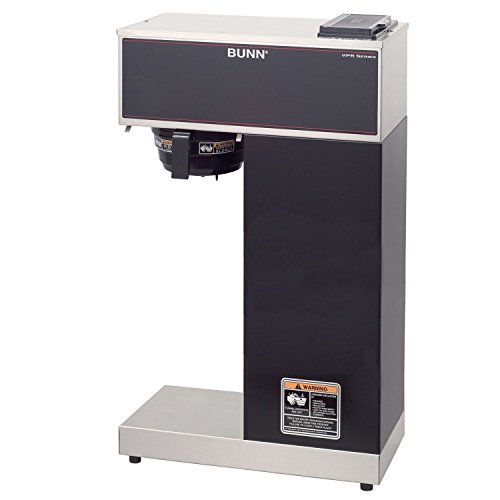
BUNN VPR APS Airpot Brewer — Best with Airpot Service
The VPR APS rethinks reception coffee service: instead of a glass decanter on a warmer, it brews into an airpot — an insulated pump dispenser. The coffee stays hot and fresh-tasting for hours with no warmer at all, the airpot can be carried to a conference room or set on the reception counter for self-service, and there is no glass anywhere near your visitors. For offices that host, this is how hotels and caterers do it, scaled to a pourover machine that needs no plumbing.
Strengths
- Airpot service keeps coffee fresh for hours with zero warmer burn
- Self-service pump dispensing frees reception staff from pouring duty
- No glass decanters — safer, tidier, and portable to meeting rooms
Trade-offs
- Airpots are a separate line item if not bundled — verify before ordering
- Less familiar to staff used to home machines; a short learning curve
- Commercial size and price for an office that may only need a simple pot
| Type | Commercial pourover airpot brewer |
| Service | Brews into airpots (pump dispensers) |
| Model | 33200.0010 VPR APS |
| Power | 120V commercial |
Airpot service quietly fixes three reception problems at once: coffee quality over a long morning (insulation beats warmers), staff time (guests serve themselves), and logistics (the coffee goes to the meeting instead of the meeting coming to the coffee). The VPR APS itself is BUNN commercial hardware — pourover-simple, stainless, and supported like the VP17.
Choose it when your office hosts regularly — trainings, closings, consultations, open houses — and wants coffee service that feels like hospitality rather than an appliance. For a quiet two-room office it is more system than you need; for a hosting office, it is the professional standard for a reason.
Airpots repay a labeling habit: a small tag on each pump — regular, decaf, and the brew time — turns self-service from a guessing game into a system guests trust. Offices that adopt airpots for events often end up adopting them for daily reception too, because the coffee simply stays better longer than any warmer-kept pot. The VPR APS brews into the system natively; it is the only machine here designed around how coffee is actually served at gatherings.
Best for: offices that host meetings and events and want self-serve coffee / Not suited for: small quiet offices making one pot a day
Check on Amazon — check the current price on Amazon before you decide.

Hamilton Beach 2-Way Programmable Coffee Maker 49980RG — Best Budget Flexibility
Not every front desk needs a full pot all day. The Hamilton Beach 2-Way covers both rhythms of a small office: brew the 12-cup carafe for the morning and meetings, then use the single-serve side — with your own grounds or soft pods — when one visitor or one staff member wants a fresh cup at 3 p.m. without brewing a pot that will die on the warmer. It is programmable on the carafe side and priced like the budget appliance it honestly is.
Strengths
- Two service styles in one footprint: full pot and single cup
- Single-serve side cuts waste during quiet hours
- Programmable carafe side for the scheduled morning pot
Trade-offs
- Home-appliance build and plastics; not commercial duty
- Single-serve side uses grounds or soft pods, not the full pod ecosystem
- Two systems to clean and descale
| Capacity | 12 cups (carafe side) |
| Carafe | Glass |
| Single serve | Grounds or soft pods |
| Accents | Black with stainless steel |
The 2-Way’s front-office logic is waste avoidance. Reception coffee waste is not the coffee — it is the three-quarter pot dumped at noon because it has stewed since 9. A single-serve side means the quiet hours run on fresh cups made to order, and the carafe comes out when volume justifies it. Over a year, that rhythm saves real money and serves better coffee.
It is the right pick for small offices watching budget and waste at once, and the wrong pick for a lobby with a line. Know your traffic, and this machine either fits it perfectly or not at all.
The 2-Way’s single-serve side has a diplomatic use beyond waste: the decaf problem. Every office has the 3 p.m. decaf drinker and the guest who cannot have caffeine, and brewing a full decaf pot for them is wasteful while refusing is inhospitable. A grounds-or-soft-pod single side solves it cup by cup. In small offices, that one recurring courtesy — handled gracefully, daily — is worth as much goodwill as the morning pot.
Best for: small offices with a busy morning and quiet afternoons / Not suited for: steady all-day visitor traffic
Check on Amazon — check the current price on Amazon before you decide.
Comparison Table
| Pick | Badge | Key spec | Best for |
|---|---|---|---|
| BUNN VP17-1SS Pourover Coffee Brewer | Best Commercial Workhorse | Commercial pourover, 1 warmer, stainless steel | law firms, clinics, agencies and salons serving visitors all day |
| BUNN CSB3T Speed Brew Platinum | Best for Fast Back-to-Back Pots | 10-cup thermal, ~4-minute brew from hot tank | small professional offices with unpredictable visitor flow |
| Cuisinart DCC-3200 PerfecTemp 14-Cup | Best Large Glass Carafe | 14-cup glass, adjustable warming plate, programmable | offices whose reception brewer also feeds meetings and staff |
| Ninja CE251 Programmable Brewer | Best Programmable | 12-cup glass, removable 70 oz reservoir, programmable | small offices wanting scheduled pots and tidy refills |
| BUNN VPR APS Airpot Brewer | Best with Airpot Service | Commercial pourover, brews into airpots | offices that host meetings and events and want self-serve coffee |
| Hamilton Beach 2-Way Programmable Coffee Maker 49980RG | Best Budget Flexibility | 12-cup carafe plus single-serve side, programmable | small offices with a busy morning and quiet afternoons |
How to Choose a Coffee Maker for the Front of Office
Begin with your traffic pattern, honestly observed for a week. How many visitors, on which days, in what clusters? A steady trickle favors a warmer-held decanter (BUNN VP17) refreshed on a rhythm. Spiky, unpredictable arrivals favor speed (BUNN CSB3T’s hot tank). Meetings favor batch size (Cuisinart’s 14 cups) or portability (BUNN VPR APS airpots). Quiet offices with occasional guests favor flexibility (Hamilton Beach 2-Way). The machine should be bought for the pattern, not the logo.
Second, decide the coffee-holding strategy before the machine, because it determines how the last cup tastes. Warmers are simple and visible but degrade coffee within the hour; thermal carafes protect flavor but hide quantity; airpots protect flavor, enable self-service and travel to rooms. Most polished front-of-office setups end up thermal or airpot for exactly these reasons — the warmer is the technology of the break room, not the reception desk.
Third, plan the whole station, not just the brewer: a water source routine, a visible supply of cups and lids, a discreet bin, and a cleaning rhythm owned by a named person. The best machine in this guide will embarrass you if it sits beside an empty cup stack and a stained counter. Front-of-office coffee is a small system; buy and run it like one.
- Match the machine to observed visitor traffic, not guesses
- Choose the holding strategy (warmer vs thermal vs airpot) before the brand
- Pourover commercial machines need no plumbing — ideal for reception areas
- Programmability exists for the first appointment of the day
- Assign a named owner for supplies, cleaning and descaling
Presentation Standards: The Reception Coffee Station
Guests judge the station before they taste the coffee. Keep the machine wiped down — stainless commercial bodies like the BUNNs reward a ten-second wipe with a showroom look — and keep the area around it clear of the domestic clutter that creeps in: personal mugs, staff lunches, charging cables. Supplies should look stocked, not scavenged: matching cups, lids that fit them, sweeteners in a holder rather than a torn box.
Freshness is the other half of presentation. Put a small card by the pot with the brew time — good cafés do this because it signals care and quietly enforces the refresh rhythm. A pot older than an hour on a warmer should be replaced without debate; the cost of a fresh pot is trivial against the impression of serving a client coffee that tastes like it has been waiting longer than they have.
Running Costs and Duty Cycles, Honestly
Commercial pourover machines cost more upfront and less over time: they are built to be serviced, parts are stocked for years, and they tolerate back-to-back brewing that ages home machines quickly. Home brewers cost less upfront and are the rational choice below roughly two pots a day — above that duty cycle, their pumps, plates and plastics start living a harder life than they were designed for, and replacement becomes the hidden cost.
Per-cup consumables matter at visitor volume. Ground coffee in standard filters is the cheapest respectable service there is; single-serve pods cost several times more per cup and generate daily waste in a public space where waste is visible. The flexible middle path — carafe for volume, grounds-based single serve for quiet hours — is why the Hamilton Beach earns its place despite its home-appliance build.
Coffee Etiquette at the Front Desk: Serving Guests Well
Offer, do not assume: ‘Can I get you a coffee while you wait?’ is hospitality; a pot pointed at vaguely is furniture. Serve in a real cup when the setting allows — the difference between a mug and a paper cup is the difference between a firm that hosts and a firm that processes — and keep lids available for guests who are leaving. Know the state of your own pot before you offer: offering coffee and then discovering an empty or ancient pot is worse than not offering at all, which is why the refresh rhythm in our setup guide matters.
Handle preferences without theater. Keep decaf genuinely available (a small single-serve option solves this), know where the sweeteners and milk live, and never comment on how a guest takes their coffee. The front desk’s coffee is a small stage on which the firm performs competence and warmth simultaneously — the machine is a prop, and like all props, it works best when nobody has to think about it.
When the Front-Office Machine Should Be Replaced
Machines rarely die dramatically; they fade, and at a front desk the fading is public. Replace the brewer when brew times stretch noticeably despite descaling (the heater or pump is tiring), when the carafe or decanter system becomes hard to source, when the body is stained or cracked beyond what a wipe restores, or when the office’s pattern has outgrown it — the two-pot mornings becoming four-pot mornings is a capacity signal, not a discipline problem. A planned replacement, ordered when the signs accumulate, beats the emergency purchase made the morning the machine fails in front of a waiting room.
Budget the replacement as part of the station’s running cost from the start: a small monthly accrual against the machine’s expected life — three to five years for a hard-worked home-duty unit, a decade for the commercial BUNNs — turns replacement from a surprise into a line item. Front-of-office polish is mostly this: nothing in the visitor’s sightline is ever at the end of its life, including the coffee maker.
How to Set Up a Front-of-Office Coffee Station, Step by Step
A reception coffee setup succeeds or fails as a system. This sequence takes a new machine from delivery box to a station that runs itself.
Step 1: Place the machine for workflow, not just looks. Position the brewer where staff can reach it without crossing the visitor seating area, with clearance above for filling (pourover machines and reservoir lids need headroom) and a water source within a short carry. Keep the coffee station out of the direct sightline of the entrance if possible — guests should see it second, after the greeting.
Step 2: Run the manufacturer’s first-use routine. Commercial pourover machines need their internal tank filled and heated before the first brew; tank-style machines like the BUNN Speed Brew have a specific one-time setup. Do this the day before the machine goes live, run a full water-only cycle, and discard it. First impressions apply to first pots too.
Step 3: Standardize the recipe and post it. Pick one coffee, one dose — for example a measured scoop count per full pot — and tape the recipe inside a cabinet door where the person brewing can see it. Consistency is what makes office coffee taste ‘professional’: the same pot regardless of who made it. Change the coffee deliberately, not by whoever shops.
Step 4: Set the refresh rhythm. Write down the rule: warmer-held pots are refreshed every hour, thermal and airpot coffee every three to four hours, and a fresh pot goes on before any scheduled meeting. Put the brew time on a card by the pot. Rhythms, not intentions, keep reception coffee fresh.
Step 5: Stock the station like a system. Cups, lids, stirrers, sweeteners, napkins and a lidded bin, checked on a fixed day each week by a named owner. Running out of cups in front of a client undoes every dollar spent on the machine. Keep one full backup of everything on site.
Step 6: Schedule the invisible maintenance. Descale on a calendar — monthly in hard-water areas, quarterly otherwise — wipe the warmer plates and spray heads weekly, and wash carafes and airpots with proper urn cleaner, not just a rinse. Coffee oils go rancid invisibly; a station that looks clean but tastes stale is failing at its only job.
Set up this way, the coffee station becomes what it should be: a quiet asset that makes the office feel competent and welcoming, maintained by rhythm rather than by heroics.
Revisit the station quarterly with fresh eyes — ideally by walking in as a visitor would. The machine, the supplies, the smell of fresh coffee at the door: if the walk-through would impress you as a guest, the system is doing its job.
Common Buying Mistakes
Buying a break-room machine for a reception job. The stained, slow, noisy brewer that is fine beside the microwave is a liability in front of clients. Front-of-office machines are seen and tasted by the people your business courts — buy for the audience.
Serving warmer-burnt coffee to guests. A pot that has sat on a warmer for two hours tastes like neglect. Refresh on a rhythm, or move to thermal or airpot holding where the last cup respects the visitor as much as the first.
No owner for the station. When everyone owns the coffee, no one does: supplies run out, descaling never happens, and the machine slowly becomes an embarrassment. Name one person and a weekly checklist.
Choosing pods for visitor volume. Pods at reception scale mean high per-cup cost, a visible stream of waste, and one-cup-at-a-time queues when three visitors arrive together. Batch brewing exists because groups exist.
Forgetting the water. Office coffee made from a neglected filter or heavily chlorinated tap water tastes off no matter the machine. If the office has filtered water, brew with it; if not, a simple filtration pitcher at the station pays for itself in taste.
Final Recommendation
For most professional offices, the BUNN VP17-1SS is the definitive answer: commercial, presentable, plumbed-in nowhere, and supported everywhere. Offices with spiky visitor patterns should take the BUNN CSB3T and its four-minute fresh pot; meeting-heavy offices, the Cuisinart’s 14-cup batch or the BUNN VPR APS airpot system if coffee needs to travel and self-serve. The Ninja CE251 is the tidy, programmable middle ground, and the Hamilton Beach 2-Way is the honest budget flexible option.
Whichever machine you choose, run the station like you mean it: a posted recipe, a refresh rhythm, stocked supplies and a named owner. The machine makes coffee; the system makes the impression — and at the front of the office, the impression is the product.
A closing thought on what this purchase really is. A front-of-office coffee maker is one of the few appliances a business buys that its clients will personally consume from — closer to the chairs in the waiting room than to the printer in the back. Chosen well and run as a system, it returns its cost in the currency front desks trade in: guests who feel expected, meetings that start warm, a firm that seems to have its details handled. Chosen carelessly, it taxes the same account daily. The six machines above are all defensible choices; the system you build around the one you pick — the recipe, the rhythm, the named owner — is what turns a defensible choice into a daily asset.
Set a date, thirty days after installation, to review the choice with the people who run the station daily. They will know by then whether the batch size fits the traffic, whether the refresh rhythm holds, and whether guests are being served coffee the firm is proud of. A machine adjusted — or, rarely, exchanged — at day thirty serves well for years; a machine never reviewed serves its first impression forever, whatever that impression happens to be.
Short on time? Start with these three: BUNN VP17-1SS Pourover Coffee Brewer · BUNN CSB3T Speed Brew Platinum · Cuisinart DCC-3200 PerfecTemp 14-Cup.
Best Coffee Makers For Large Office
Best Coffee Makers For Office Use
Best Coffee Makers For Hard Water
Best Coffee Makers For Drip Brewing
Best Coffee Makers For Ground Coffee
Frequently Asked Questions
Do front-of-office coffee makers need a water line?
No. Every machine in this guide is pourover or reservoir-fed — you add water by hand or with a removable tank — so they install on any reception counter with an outlet. Plumbed commercial brewers exist for high-volume sites, but for most offices the pourover design delivers the same coffee without the installation cost.
How much coffee should a front desk brew at once?
Match the batch to the next hour’s expected guests, not the whole day. A 12-cup decanter covers a typical morning’s visitors; brew a second pot rather than letting one sit. Coffee held on a warmer is at its best within the first hour, so smaller, fresher batches beat one heroic morning pot.
Is it unprofessional to serve coffee from a home coffee maker?
Not automatically — a clean, presentable home brewer like the Cuisinart or Ninja in this guide serves perfectly well in a small office. What reads as unprofessional is a stained, slow or empty station, or coffee that has sat too long. Commercial machines like the BUNNs add durability, speed and a more businesslike presence, which larger or busier offices genuinely need.
Warmer, thermal carafe or airpot — which is best for reception?
For held quality, airpot and thermal win: they keep coffee hot without cooking it, and an airpot adds self-service and portability to meeting rooms. Warmers win on simplicity and visibility — you can see the coffee level at a glance. Many polished offices brew into airpots for exactly the combination of freshness and tidiness.
How often should a front-of-office coffee maker be cleaned?
Carafes and airpots should be washed daily with proper coffee equipment cleaner, spray heads and warmer plates wiped weekly, and the machine descaled monthly in hard-water areas or quarterly with soft water. Put it on a checklist with a named owner — in a client-facing space, a stale-tasting pot is a reputation issue, not just a taste issue.
What coffee should we serve visitors?
A fresh, medium-roast coffee from a reputable roaster, bought in quantities the office finishes within a few weeks, brewed at a consistent posted dose. Medium roasts please the widest range of guests. Consistency matters more than exotic sourcing: the same good pot every time is what makes an office’s coffee feel professional.
Should a front office offer decaf?
Yes — a meaningful share of guests cannot or will not drink caffeine, especially in afternoon and medical or legal settings. The economical way is a small single-serve option (a dual brewer like the Hamilton Beach in this guide, using grounds or soft pods) rather than a second full pot that mostly gets discarded. Offering decaf gracefully is a small, noticed courtesy.
How much should a small office budget for reception coffee?
Beyond the machine, the recurring costs are coffee itself, filters, cups and cleaning supplies — for a typical small office serving a handful of guests daily, the coffee line usually runs to a modest monthly figure that is trivial beside the value of one well-received client visit. The expensive failure mode is not the coffee; it is the neglected station. Budget a named owner’s fifteen minutes a week alongside the beans.
Can we put the coffee maker in the waiting area for self-service?
You can, and airpot systems are built for exactly that — guests pump their own cup, coffee stays fresh for hours, and there is no glass or hot plate near the public. If you do, keep the station compact and visibly maintained, put the brew time on a card, and check it on a rhythm: an unattended station that runs dry or stale argues against the firm that placed it there.
What should we do when the office coffee maker breaks before a big meeting day?
Have the plan before the day: a named backup — a neighboring office’s kitchen, a café within a short run, or a catering order — plus a small reserve machine if coffee is truly mission-critical to your client experience. The humble backup is a simple 12-cup brewer kept in a cupboard; it costs little, asks nothing while stored, and converts a crisis into a story. Offices that host daily eventually buy the backup after exactly one bad morning; buying it before that morning is the entire trick.


