Disclosure: airfryerkitchensupply.com is reader-supported. When you buy through links on our site, we may earn an affiliate commission at no extra cost to you.
Where to buy
The fastest way to shop for best coffee makers for coffee shop is on Amazon, where every pick below is sold with full specifications and configuration options on the product page. Start with our top recommendation, the BUNN VP17-1SS Pourover Coffee Brewer with 1 Warmer — check price on Amazon — then compare it with the other picks below.
Every model below was matched to a live Amazon listing before it was included. Prices in this category move constantly, so treat any price you remember as out of date and check price on Amazon for the exact machine you choose.
- BUNN VP17-1SS Pourover Coffee Brewer with 1 Warmer — check price on Amazon
- BUNN VPR APS Commercial Pour Over Air Pot Coffee Brewer — check price on Amazon
- Hamilton Beach Commercial 60 Cup Coffee Urn D50065 — check price on Amazon
- Breville Dynamic Duo Espresso Machine Bundle BEP920BSS — check price on Amazon
- Diletta Alto Espresso Machine — Dual Boiler, PID (Black) — check price on Amazon
- West Bend 100-Cup Commercial Coffee Urn NSF — check price on Amazon
Shopping for the best coffee makers for coffee shop service is a different job from buying a machine for a kitchen counter, and the difference is duty cycle. A home brewer makes two pots on a Sunday; a shop brewer makes its fortieth pot before lunch, in the hands of three different staff members, while a queue watches. Commercial machines are built around that reality: bigger heating systems that recover instantly, parts that can be cleaned and replaced, and controls simple enough that a new hire brews correctly on their first shift.
A second reality shapes this guide: most small shops do not need one machine, they need a small system. A batch brewer handles the drip program. An espresso station handles milk drinks. An urn handles the catering and event peaks that would otherwise break the batch brewer’s rhythm. The six picks below are organized as that system — two commercial BUNN pourover brewers at the core, two espresso stations at different ambitions, and two commercial urns for volume — so you can assemble the combination your menu actually requires rather than overbuying a single flagship.
One honest warning before the picks: Amazon sells genuine commercial brewers like the BUNN machines below alongside heavy-duty home machines wearing the word ‘commercial’ in their titles. The test is the details — NSF listings where they matter, warmer and airpot configurations, tank recovery, and a manufacturer service network. Every pick here was matched to a live listing, and where a machine is prosumer rather than certified-commercial, the review says so plainly and explains the volume at which that distinction starts to matter.
In this guide
Quick Picks
Best Overall: BUNN VP17-1SS Pourover Coffee Brewer with 1 Warmer — A true commercial pourover brewer with a stainless housing, a single warmer and the fast recovery cafés depend on during a morning rush. — check price on Amazon
Best for Airpot Service: BUNN VPR APS Commercial Pour Over Air Pot Coffee Brewer — Brews directly into airpots, so coffee stays hot and fresh at a self-serve station without sitting on a warmer. — check price on Amazon
Best for Catering Volume: Hamilton Beach Commercial 60 Cup Coffee Urn D50065 — A 60-cup commercial urn for the café side-hustles — events, church halls and weekend catering — where drip demand arrives all at once. — check price on Amazon
Best Espresso Station: Breville Dynamic Duo Espresso Machine Bundle BEP920BSS — A dual-boiler espresso machine bundled with the Smart Grinder Pro — a complete, compact espresso station for a small shop or café corner. — check price on Amazon
Best for a Serious Espresso Program: Diletta Alto Espresso Machine — Dual Boiler, PID (Black) — A dual-boiler machine with PID control, a shot timer and adjustable OPV for shops that want café-grade shot control in a compact footprint. — check price on Amazon
Best for Banquet Peaks: West Bend 100-Cup Commercial Coffee Urn NSF — An NSF-listed 100-cup commercial urn for the biggest service days — banquets, festivals and conference coffee breaks. — check price on Amazon
How These Picks Were Chosen
We chose these machines the way a café consultant would: by service role first and specifications second. For the drip core we required a commercial pourover platform with a heated tank, because tank recovery — not headline capacity — is what decides whether batch four tastes like batch one. For espresso we required dual boilers or dual thermoblocks, because a single-boiler machine forces a queue to wait between steaming and extraction. For urns we required genuine commercial listings and, at the largest size, an NSF mark.
We also weighed the unglamorous criteria that decide whether a shop keeps a machine for five years: Can a new employee brew correctly after ten minutes of training? Can the spray head, faucet and seals be cleaned on a closing checklist? Does the manufacturer publish parts and service? Machines that failed those tests — however impressive their home specifications — did not make this list.
Finally, a note on what is not here. Fully plumbed, high-volume brewers from the big commercial catalogs are usually sold through restaurant-supply channels with installation, and large two-group espresso machines follow the same route. If your projected volume is hundreds of espresso drinks a day, that channel — with its service contracts — is the honest recommendation. This guide serves the much larger group of small shops, bakery cafés, food trucks and catering side-businesses whose volume fits countertop commercial equipment bought outright.
The 6 Best Coffee Makers for Coffee Shop Service

BUNN VP17-1SS Pourover Coffee Brewer with 1 Warmer — Best Overall
The VP17-1SS is the machine behind the counter at thousands of small cafés for a simple reason: it is a pourover commercial brewer with no plumbing requirement, a stainless steel body and a brew cycle fast enough that a barista can start a second batch while the first is still being served. You pour cold water in the top, and the internal tank — kept at brewing temperature around the clock — pushes it through the grounds almost immediately.
In a shop setting the VP17’s real advantage is training: the workflow — filter, grounds, pour water, brew — can be taught in minutes and audited at a glance, which is why this platform anchors so many small drip programs.
Strengths
- Commercial pourover design needs no water line, so it can go anywhere with an outlet
- Internal hot-water tank recovers fast, keeping back-to-back batches at proper brewing temperature
- Stainless construction and simple controls survive years of daily service and are easy to train staff on
Trade-offs
- Pourover workflow means staff must measure and pour water for every batch — no plumbed automation
- A single warmer limits you to one regular batch holding at a time unless you add airpots
- It brews drip coffee only; espresso drinks need a separate station
| Specification | Detail |
|---|---|
| Format | Commercial pourover drip brewer, 1 warmer |
| Housing | Stainless steel |
| Plumbing | None — manual fill |
Operationally, the pourover format is the VP17’s defining trade. No plumber, no water line, no installation appointment — but also no automation of the water itself, so your recipe discipline lives in a measured pitcher and a trained hand. Most small shops accept that trade happily, because it also means the brewer can move to a patio station, a market stall or a catering van with nothing but an outlet. Keep a spare spray head and a descaling schedule in the closing routine and this class of machine routinely serves for years.
Best for: small cafés and bakeries building a drip program without plumbing work / Not suited for: high-volume shops that need plumbed, fully automatic batch brewing
Check on Amazon — check price on Amazon for the current configuration.
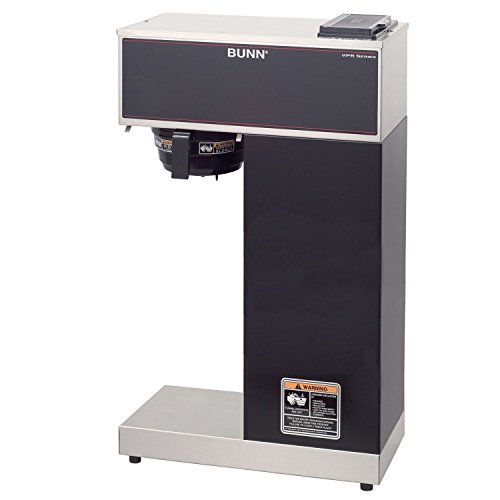
BUNN VPR APS Commercial Pour Over Air Pot Coffee Brewer — Best for Airpot Service
The VPR APS takes the same pourover commercial platform and aims it at airpot service: brew straight into a tall airpot, carry it to a self-serve counter, a meeting room or a farmers-market stall, and the coffee inside stays hot for hours without the cooked flavor a glass pot picks up on a warmer. For shops whose drip business is grab-and-go, this is usually the smarter configuration.
Airpot service also changes your labor math. Because the coffee travels to the customer, one staff member can keep a self-serve station stocked while another runs the register, instead of both crowding the brewer during a rush.
Strengths
- Brewing into airpots keeps coffee hot without warmer stewing, protecting flavor through a service period
- Airpots are portable — one brewer can supply a counter, a patio station and a catering tray
- Same simple pourover operation and fast tank recovery as the rest of the BUNN commercial line
Trade-offs
- Airpots are sold separately and add an ongoing replacement and cleaning obligation
- No warmers, so it is the wrong choice if your service style is glass pots on deck
- Pourover filling still depends on a staff member measuring water accurately every batch
| Specification | Detail |
|---|---|
| Format | Commercial pourover brewer for airpots |
| Plumbing | None — manual fill |
The airpot workflow has a quality argument as well as a labor one. Coffee held in a sealed, insulated airpot deteriorates far more slowly than coffee held on a warmer, where evaporation concentrates bitterness by the hour. A shop that brews smaller, fresher batches into airpots through the morning will pour a better 11 a.m. cup than a shop nursing one big warmer pot from 7 a.m. — and will throw away less stale coffee at close.
Best for: cafés running self-serve stations, offices-with-café counters and market stalls / Not suited for: traditional diners that hold coffee in glass pots on warmers
Check on Amazon — check price on Amazon for the current configuration.

Hamilton Beach Commercial 60 Cup Coffee Urn D50065 — Best for Catering Volume
Not every coffee shop pour comes from the main brewer. Weekend events, gallery nights, wedding tastings and the shop’s own catering arm all create sudden demand for dozens of cups at once, and that is urn work. The Hamilton Beach Commercial D50065 brews and holds 60 cups in a polished stainless body with a cup-a-minute class brew pace, a ready light and a dispensing lever guests can operate themselves.
Treat the urn as revenue equipment, not a backup. Shops that own one can say yes to the office party, the school fundraiser and the wedding tasting — orders a drip-only shop has to refuse or rent equipment for.
Strengths
- 60-cup capacity absorbs event-scale demand that would swamp a 12-cup batch brewer
- Brews and holds in one vessel — no transferring, no second warmer to manage
- Simple lever dispensing suits self-serve event stations with minimal staff attention
Trade-offs
- Percolator-style urn coffee is a step below a well-run batch brewer in clarity and nuance
- Large footprint and a full, heavy vessel need a dedicated station and careful handling
- Overkill — and slow to justify — for a shop whose peak is six cups at a time
| Specification | Detail |
|---|---|
| Capacity | 60 cups |
| Housing | Polished stainless steel |
| Service style | Lever dispensing urn |
Urn coffee has a reputation problem among specialty drinkers, and it is partly earned: percolation recirculates brewed coffee over the grounds, which can push extraction toward bitterness. The working answer is context. At an event, guests want hot, fresh, plentiful coffee with cream and sugar nearby — and a well-timed urn with fresh beans delivers exactly that. Use your batch brewer for the cup that carries your shop’s name, and the urn for the hundred cups that carry your catering invoice.
Best for: cafés with catering, events or self-serve volume on the side / Not suited for: specialty bars where every cup is brewed to order
Check on Amazon — check price on Amazon for the current configuration.

Breville Dynamic Duo Espresso Machine Bundle BEP920BSS — Best Espresso Station
A coffee shop that sells lattes needs an espresso station, and for a small shop, food truck or café corner that cannot fit or finance a full commercial group machine, the Dynamic Duo is the pragmatic answer: Breville’s dual-boiler machine — steam and extraction at the same time, with precise temperature control — bundled with the Smart Grinder Pro so the station arrives complete.
Volume honesty matters here: a small shop pulling thirty to sixty milk drinks a day will find this station comfortable. If your morning rush is a continuous line of lattes, price a true two-group commercial machine before committing.
Strengths
- Dual boilers allow steaming milk and pulling shots simultaneously, keeping a small queue moving
- Bundled grinder means one purchase completes the station, with matched dosing tools included
- Precise, adjustable extraction temperature gives a trained barista real control over the house espresso
Trade-offs
- It is a prosumer machine, not a certified commercial workhorse — duty cycle suits small shops, not rush-hour chains
- Single group head means one drink at a time; a two-group machine serves a queue twice as fast
- Home-style water tank needs refilling through the day instead of a plumbed supply
| Specification | Detail |
|---|---|
| Format | Dual-boiler espresso machine + grinder bundle |
| Model | BEP920BSS with Smart Grinder Pro |
Setting up the Dynamic Duo as a shop station takes more than unboxing. Budget counter depth for the grinder’s hopper clearance, a knock box, a tamper station, milk pitchers and a small refrigerator within reach — the choreography of a milk drink is mostly walking, and a tight station is a fast station. Also plan water: the tank-fed design means a staff member refills through the day, and using filtered water from the start protects the boilers from scale, the number-one killer of machines in this class.
Best for: small cafés, bakery counters and food trucks adding a real espresso program / Not suited for: busy espresso bars pulling back-to-back drinks all morning
Check on Amazon — check price on Amazon for the current configuration.

Diletta Alto Espresso Machine — Dual Boiler, PID (Black) — Best for a Serious Espresso Program
The Diletta Alto is aimed at the shop owner who has outgrown appliance-grade espresso but does not have the counter — or the budget line — for a full-size Italian commercial machine. Dual boilers, PID temperature control, a shot timer and an adjustable over-pressure valve give the barista the variables that actually decide shot quality, in a machine sized for a single-station bar.
The Alto rewards a shop that treats espresso as a craft product: weigh doses, time shots, adjust the OPV for a lighter roast. Shops selling that story can charge for it — the machine supports the claim.
Strengths
- PID control plus adjustable OPV lets you dial in a recipe and repeat it shot after shot
- Dual boilers keep milk service and extraction running in parallel during a rush
- Shot timer built in supports consistent recipes and staff training
Trade-offs
- Demands a capable separate grinder and a barista who understands dialing in — it will not rescue untrained workflow
- Compact tank and footprint still cap true high-volume throughput
- Premium prosumer class machine: budget for maintenance and water treatment from day one
| Specification | Detail |
|---|---|
| Format | Dual-boiler espresso machine |
| Controls | PID, shot timer, adjustable OPV |
The Alto’s adjustability cuts both ways, and the review would be incomplete without saying so. A shop that assigns one trained lead to own the espresso recipe — dose, yield, time, temperature — will get café-grade consistency from it. A shop where five people adjust five variables will get chaos. Write the recipe on a card taped to the machine, lock it in, and let the PID and OPV do the repeating. That discipline, more than any single specification, is what separates a serious espresso program from an expensive hobby.
Best for: specialty-leaning small shops building a quality-first espresso menu / Not suited for: hands-off operators who want one-button drinks
Check on Amazon — check price on Amazon for the current configuration.

West Bend 100-Cup Commercial Coffee Urn NSF — Best for Banquet Peaks
Every café business eventually meets the day that breaks its normal equipment: the 200-person conference break, the holiday market, the wedding for the whole town. The West Bend 100-cup commercial urn exists for that day. It is NSF-listed, built in polished aluminum for commercial service, and brews and holds a hundred cups with automatic temperature control — the largest single vessel in this guide.
Buy this urn before you need it, not after. The first banquet booking usually arrives with two weeks’ notice, and learning an urn’s brew timing on the client’s big day is an avoidable risk.
Strengths
- 100-cup capacity handles banquet and festival peaks no batch brewer can match alone
- NSF listing matters when health inspectors or venue contracts ask about your equipment
- Automatic temperature control holds coffee at serving temperature without staff babysitting
Trade-offs
- A full urn is extremely heavy — plan the station so it never needs moving while full
- Percolated urn coffee trades nuance for volume; keep it for events, not your signature drip
- Storage space between events is a real cost for a small shop
| Specification | Detail |
|---|---|
| Capacity | 100 cups |
| Certification | NSF approved |
| Housing | Polished aluminum |
One practical note on the 100-cup class: brew timing and holding change at this scale. Start the urn earlier than feels necessary, taste before service, and never top up a half-finished urn with fresh coffee — the blend of old and new satisfies nobody. Shops that run urns well treat each batch as a single service: brew, serve, empty, rinse, and brew again if the event demands it.
Best for: café caterers and venues facing triple-digit cup counts / Not suited for: daily counter service in a small shop
Check on Amazon — check price on Amazon for the current configuration.
Comparison Table
| Pick | Badge | Key spec | Best for |
|---|---|---|---|
| BUNN VP17-1SS Pourover Coffee Brewer with 1 Warmer | Best Overall | Pourover commercial brewer, 1 warmer | small cafés and bakeries building a drip program without plumbing work |
| BUNN VPR APS Commercial Pour Over Air Pot Coffee Brewer | Best for Airpot Service | Brews into airpots, pourover | cafés running self-serve stations, offices-with-café counters and market stalls |
| Hamilton Beach Commercial 60 Cup Coffee Urn D50065 | Best for Catering Volume | 60-cup commercial urn | cafés with catering, events or self-serve volume on the side |
| Breville Dynamic Duo Espresso Machine Bundle BEP920BSS | Best Espresso Station | Dual boiler, bundled grinder | small cafés, bakery counters and food trucks adding a real espresso program |
| Diletta Alto Espresso Machine — Dual Boiler, PID (Black) | Best for a Serious Espresso Program | Dual boiler, PID, adjustable OPV | specialty-leaning small shops building a quality-first espresso menu |
| West Bend 100-Cup Commercial Coffee Urn NSF | Best for Banquet Peaks | 100-cup NSF commercial urn | café caterers and venues facing triple-digit cup counts |
How to Choose Coffee Makers for a Coffee Shop
Start with your menu, not with machines. Count what you actually sell — or honestly project selling — in three buckets: drip cups per hour at peak, espresso drinks per hour at peak, and event cups per occasion. Those three numbers map directly onto the three equipment roles in this guide. A shop projecting twenty drip cups and ten lattes an hour needs the BUNN core and the compact espresso station. A shop projecting five drip cups and eighty lattes has the opposite problem and should spend its money on the espresso side first.
Next, walk your space with a tape measure and an electrician’s eye. Pourover brewers need only an outlet, which is why they dominate small shops; plumbed machines need a water line, a drain plan and often a dedicated circuit. Espresso stations need counter depth, milk storage within arm’s reach and a circuit that is not already sharing load with an oven. The cheapest machine is the one that fits the building you already have.
Finally, budget the whole station, not the headline machine. Grinders, airpots, water filtration, pitchers, knock boxes, spare seals and a descaling program routinely add a third to the cost of ‘just the brewer.’ Shops that budget honestly at the start avoid the classic failure: a beautiful machine making bad coffee from an inadequate grinder and unfiltered water.
Batch Brewers, Espresso Stations and Urns: Dividing the Work
Each format in this guide exists because the others do something badly. A batch brewer makes excellent drip coffee in 12-cup cycles but cannot steam milk. An espresso machine makes superb milk drinks one or two at a time but is a terrible way to produce forty cups of drip for a meeting. An urn produces those forty cups effortlessly but cannot match a batch brewer’s clarity. Professional shops do not ask which machine is ‘best’ — they ask which machine owns which job, and they buy accordingly.
The drip core deserves the first dollar because drip is usually the highest-margin, highest-volume line in a small shop and the one regulars judge you by daily. Espresso comes second, sized honestly to your drink mix. Urns come third and pay for themselves episodically — a single season of catering bookings can retire the cost of the 60-cup class, after which every event is margin.
Water, Power and Workflow: The Invisible Specifications
Water is an ingredient and a maintenance program at the same time. Coffee is mostly water, so your drip and espresso can never taste better than your supply; and mineral scale is the leading cause of commercial brewer failure. At minimum, filter the water feeding every machine in this guide and descale on a calendar, not on a symptom. Shops in hard-water areas should treat a proper filtration cartridge as part of the machine purchase, not an accessory.
Power and workflow are the other invisible specs. Tank-heated brewers draw current continuously to stay ready — confirm your circuits before the morning you discover the breaker cannot hold the brewer, the urn and the oven together. And stand where your barista will stand: if making a latte requires crossing the drip station, your layout, not your staff, is the bottleneck. Arrange the station so drinks flow in one direction, from grinder to machine to handoff, without backtracking.
How to Set Up a Small Coffee Shop Brewing Station
Setting up the station well takes an afternoon and pays back every single service. Work through these steps in order, before your first paying customer.
- Place the batch brewer first, at the position closest to the register, since drip is your fastest transaction; leave clearance above for pouring water and changing filters.
- Install water filtration feeding every machine, note the cartridge date on a label, and set a calendar reminder for replacement and descaling.
- Build the espresso station as a one-direction line: grinder, tamping mat, machine, knock box, milk fridge, and handoff point, with no step requiring a turn-around walk.
- Dial in the house drip recipe — coffee dose, water volume, and brew time — taste it, and write the recipe card that lives at the brewer permanently.
- Dial in the espresso recipe with your lead barista: dose, yield, shot time and temperature, recorded on a second card at the machine.
- Position airpots or the urn at the self-serve point, with cups, lids, sweeteners and a small waste bin arranged so guests never cross staff workflow.
- Run a full mock rush with staff: two drip batches, four milk drinks and an airpot swap, timed — then fix every collision point the drill reveals.
- Write the closing checklist: dump and rinse airpots, backflush and wipe the espresso machine, descale on schedule, and restock filters and beans for the morning.
A station set up this way makes average staff look fast and good coffee look easy — which is precisely the point of buying commercial equipment in the first place.
Maintenance Schedules That Keep a Shop Brewer Alive
Commercial equipment rewards calendar-based care and punishes symptom-based care: by the time a brewer tastes off or slows down, scale has been building for months. A working shop rhythm divides maintenance into daily, weekly and monthly layers, assigns each layer to a shift, and writes it where the closer cannot miss it. Daily care is wiping the spray head area, emptying and rinsing airpots and decanters, and wiping the espresso machine’s group and steam wand after service. Weekly care is a proper wash of airpot interiors with a brush, a backflush cycle for the espresso station with detergent, and a check of the water filter’s life indicator.
Monthly care is where machines are actually saved. Descale or verify the filtration system before scale forms rather than after; inspect faucet washers, spray heads and seals for wear while replacements are still a choice rather than an emergency; and run a full test batch on each brewer, tasting it against your written recipe. Shops that keep a simple maintenance log — date, task, initials — discover that staff actually complete tasks that are recorded, and that warranty conversations go better with a paper trail.
Build the same discipline around the urns, which are easy to forget between events. An urn stored wet or unwashed becomes next event’s off-flavor. After every service: empty, wash, dry fully, store with the lid ajar. Before every service: rinse, run a water-only cycle if it has sat for weeks, and taste the first cup yourself before a guest does. That two-minute ritual is the difference between a catering asset and a catering apology.
- Keep spare spray heads, faucet washers and one spare airpot in the shop at all times — the parts that fail are cheap, and the day without them is not.
- Assign espresso machine backflushing to the closing shift and log it; group-head buildup is invisible until extraction turns harsh.
- Date your water filter cartridges with a marker on installation day, and set the replacement reminder the same day, not when flow slows.
- Taste one cup from every brewer at opening, before the first customer: the cheapest quality control in the entire business.
Building the Drinks Menu Around Your Equipment
Equipment and menu should be designed together, because each constrains the other in ways that show up as profit or waste. A shop with the BUNN pourover core and airpots can honestly offer two drip roasts, a rotating single origin and a decaf — variety that costs nothing but a second airpot and a label. A shop with a single-group espresso station should build a menu of drinks that station can sequence well: espresso, americanos and milk drinks in modest sizes, rather than a wall of large flavored lattes that turn every order into a two-minute project during the rush.
Price the menu from the equipment outward. Drip from a batch brewer is your margin engine — fast, consistent and inexpensive to produce — so it should be the drink your pricing encourages. Espresso drinks carry the craft premium and the labor; urn-based catering carries the volume premium. Shops that understand which machine makes which money stop discounting the wrong drinks and start featuring the right ones, and the equipment effectively pays its own lease.
Finally, let the menu grow at the speed of competence. Add the second roast when the first is dialed in and selling; add the specialty drink when the barista team can make it identically on a Saturday rush. The machines in this guide can support a menu well beyond a new shop’s opening list — the limiting factor is never the equipment, and pretending otherwise is how good cafés become inconsistent ones.
What a Year of Ownership Actually Looks Like
Month one with commercial equipment is honeymoon and adjustment at once: the BUNN brews faster than the staff expects, the espresso station’s rhythm is still being choreographed, and the urn sits in storage awaiting its first event. By month three the recipes are written, the closing checklist is muscle memory, and the machines have disappeared into the shop’s routine — which is exactly where commercial equipment belongs. Owners consistently report that the drip program’s consistency is what regulars notice first, usually phrased as the coffee tasting the same every day, which in café language is the highest available praise.
The year’s real tests are seasonal. The first hot week reveals whether iced and cold offerings were planned or improvised; the first holiday rush reveals whether the batch brewer’s pace and the espresso station’s single group can carry the queue, or whether the urn needs to join daily service as a drip supplement. Shops that watch those weeks honestly — and adjust the menu, the staffing or the station rather than blaming the equipment — end the year with a setup tuned to their actual business instead of the business they imagined in the lease-signing optimism of month one.
Budget-wise, year one teaches the maintenance arithmetic this guide has repeated: filtration cartridges and descaling cost a small, predictable amount; a scaled boiler or a failed heating element costs a large, unscheduled one. The shops still running their original brewers in year five are not luckier than other shops. They are simply the ones whose closing checklist never got optional.
- Keep a one-page equipment log per machine: install date, filter changes, descaling, repairs — it pays for itself at the first warranty or resale conversation.
- Review the drinks menu against the equipment every season; what the station makes easily should be what the menu features prominently.
- Train every new hire on the recipe cards, not on a senior barista’s habits — cards scale, habits drift.
Training Staff to Brew Identically on Every Shift
A coffee shop’s real product is not coffee; it is the same coffee, produced by different people at different hours, tasting identical. That outcome is a training system, not a talent pool. The recipe cards described earlier are its foundation — dose, water, time, and the taste of correct — but cards only work when every hire is trained against them in the same order: watch a correct batch, brew one supervised, brew one alone and have it tasted, then join the rotation. Fifteen minutes of structure at hiring prevents a year of drift that customers experience as inconsistency and owners experience as mystery.
Espresso training deserves its own ladder because its variables multiply. New baristas start on milk — steaming to temperature and texture on water and then on milk — before they are trusted with extraction, because a ruined milk pitcher costs pennies while a morning of badly extracted shots costs regulars. The lead barista owns the recipe and the grinder’s adjustment; everyone else owns execution and cleanliness. Shops that blur that ownership get five interpretations of the house espresso. Shops that respect it can put any trained pair of hands on the station during a rush and serve the same drink.
Finally, taste together on a schedule. A weekly five-minute staff tasting — one drip batch, one espresso, discussed plainly — aligns palates the way tuning aligns instruments. It also surfaces equipment problems early, because a team that knows the correct taste notices the off day before the reviews do. Training is the cheapest equipment a shop owns, and the only kind that appreciates with use.
- Write recipes in grams and seconds, not scoops and glances — numbers survive staff turnover, habits do not.
- Keep a training log per employee per station; it protects quality and the employee alike when questions arise.
- Never let an untrained hire close alone with the espresso machine — the morning-after cleanup is how shops learn this rule.
Common Buying Mistakes
Buying one flagship machine instead of a system. A single expensive machine cannot be in two roles at once. Shops do better with a competent brewer, a right-sized espresso station and an urn than with one spectacular machine and gaps everywhere else.
Ignoring the grinder budget. Espresso quality is capped by the grinder, not the machine. A dual-boiler machine fed by an inadequate grinder produces expensive, mediocre shots; budget the grinder as a first-class purchase.
Skipping water filtration to save money. Scale damage is the most common and most preventable cause of commercial machine failure. Filtration is not an upsell — it is the warranty on your investment, paid in cartridges instead of repairs.
Sizing for the average day instead of the peak hour. Equipment fails businesses at the peak, not the average. Size the drip core and espresso station for your busiest honest hour, and let urns absorb the exceptional days.
No written recipes or closing checklist. Without a recipe card and a closing routine, quality depends on who is working. Commercial equipment rewards documented routine — that is what you are actually buying.
Final Recommendation
For most small shops, the build is this: the BUNN VP17-1SS as the drip core, the Breville Dynamic Duo as the espresso station, and the Hamilton Beach Commercial 60-cup urn for events. That trio covers the menu of a typical neighborhood café at a fraction of the cost of plumbed, dealer-installed equipment. Shops leaning specialty should swap the espresso station to the Diletta Alto and assign a lead barista to own its recipe. Shops whose drip business is self-serve should choose the VPR APS and brew into airpots from day one, and caterers facing triple-digit events should add the West Bend 100-cup urn before the season starts. Compare the remaining picks directly: Diletta Alto Espresso Machine — Dual Boiler, PID (Black) and West Bend 100-Cup Commercial Coffee Urn NSF.
Whichever combination you choose, spend the saved money where customers can taste it: fresh beans, a real grinder, filtered water and staff training. Machines make coffee possible; those four things make it worth buying. Explore the rest of our coffee coverage for the home and specialty angles: Best Coffee Makers For Coffee Snobs Best Coffee Makers For College Students Best Coffee Makers For Dorms Best Coffee Makers
Frequently Asked Questions
Does a small coffee shop really need a commercial brewer for drip coffee?
In practice, yes — not because home machines cannot brew a good single pot, but because they cannot brew the fortieth pot of the day at the same temperature as the first. Commercial tank-heated brewers hold water at brewing temperature continuously, so back-to-back batches stay consistent through a rush. That consistency, plus cleanable and replaceable parts, is what the commercial premium actually buys.
Can a prosumer espresso machine handle a real café?
It can handle a small café’s espresso volume — a counter doing dozens of milk drinks a day rather than hundreds. The honest limits are the single group head, the tank-fed water supply and a duty cycle designed for enthusiast rather than continuous commercial use. Shops expecting an unbroken morning line of lattes should buy a true commercial two-group machine through a dealer with a service contract.
What is the advantage of brewing into airpots instead of glass pots on warmers?
Flavor and flexibility. Coffee in a sealed insulated airpot stays hot for hours without the stewed, concentrated taste that warmer-held coffee develops, and the airpot can travel — to a self-serve counter, a meeting room or an off-site event. The trade is that airpots cost money, need their own cleaning routine, and must be replaced when their seals and pumps wear.
When does an urn make more sense than a batch brewer?
When demand arrives in dozens of cups at once: events, conferences, church services, market days. A batch brewer producing 12 cups per cycle cannot chase a 100-cup break, while a 60- or 100-cup urn brews and holds the whole service in one vessel. For everyday counter drip, the batch brewer’s coffee tastes better; the urn is a volume tool, and shops that do events should own both.
How important is water filtration for shop equipment?
It is the single highest-value maintenance decision you will make. Scale from hard water is the leading killer of commercial brewers and espresso machines, and it degrades flavor long before it stops a machine outright. Filter every machine’s supply, replace cartridges on schedule, and descale on a calendar. Compared with a boiler replacement, filtration is nearly free.
What should a brand-new shop buy first if the budget only stretches to one machine?
Buy the machine that matches your dominant drink. If drip and batch drinks will carry the menu, start with the BUNN pourover core — it needs no plumbing and starts earning immediately. If your concept is espresso-led, start with the strongest espresso station you can support and serve drip from a small quality brewer until volume justifies the commercial core. Add the urn when the first catering inquiry arrives, not before.


