Disclosure: airfryerkitchensupply.com is reader-supported. When you buy through links on our site, we may earn an affiliate commission at no extra cost to you.
Where to buy
Shopping for the best can openers for seniors? Every pick in this guide was verified against Amazon listings before writing, and you can check price on Amazon for each one before you decide: Hamilton Beach Smooth Touch 76606AG · Kitchen Mama Auto Electric (Red) · Kitchen Mama Auto 2.0 (Navy Blue) · OXO Good Grips Smooth Edge Can Opener · GoodCook Safe-Cut Can Opener · Zyliss EasiCan Electric. Prices and stock move often, so the live listing — not any number printed in a guide — is the figure to trust on the day you buy.
The best can openers for seniors are chosen on comfort, not novelty. Opening a can should not require a strong grip, a hard squeeze, a twisting wrist or a wrestle with a sharp lid — and for many older cooks, the classic butterfly opener fails on all four counts. The good news is that modern openers have quietly solved this problem in several different ways: electric models that do the work at the press of a lever, hands-free automatics that walk around the can on their own, and thoughtfully designed manual openers with large soft handles and smooth-edge cuts that leave no sharp rim. This guide ranks six verified openers by how little effort they ask and how safely they finish the job, written for older cooks and for the family members who shop with them in mind.
A note on language and honesty: this guide talks about comfort, grip effort and ease of use — the things a product can genuinely deliver. It makes no medical claims. Hands differ enormously in later life; some cooks have full strength and simply prefer an easier tool, others plan around stiff or tender joints. Where an opener suits lighter grip strength or one-handed use, we say so in practical terms, and we flag the models that still ask for a firm squeeze so nobody buys the wrong thing on a hopeful headline.
Edge style matters more than marketing suggests. Traditional openers cut inside the rim and leave a sharp-edged lid and can; smooth-edge openers cut from the side, below the rim, leaving edges you can touch safely and a lid that lifts off whole. For households where a sharp lid is a real worry — thinner skin, grandchildren helping in the kitchen — the smooth-edge designs in this guide deserve their prominence.
In this guide
Quick Picks
Hamilton Beach Smooth Touch 76606AG — Best Overall. A countertop electric opener that starts with an easy push-down lever and opens standard, extra-tall and pop-top cans — no squeezing, no twisting, no gripping the can hard. Check the current price on Amazon
Kitchen Mama Auto Electric (Red) — Best Hands-Free. A small battery-operated opener that sits on top of the can, walks itself around the rim at the press of a button and leaves a smooth edge — true hands-free opening. Check the current price on Amazon
Kitchen Mama Auto 2.0 (Navy Blue) — Best Cordless Refined. The second-generation Kitchen Mama: a cordless automatic opener with a refined blade for a cleaner smooth-edge cut, still fully hands-free and battery operated. Check the current price on Amazon
OXO Good Grips Smooth Edge Can Opener — Best Manual. A manual smooth-edge opener with soft, easy-grip handles and a side cut that leaves no sharp edges — the gentlest traditional opener, and the listing itself notes its senior-friendly design. Check the current price on Amazon
GoodCook Safe-Cut Can Opener — Best Budget Manual. An affordable safe-cut manual opener with an easy-turn knob and ergonomic handle that leaves no sharp edges — described in its listing as perfect for seniors. Check the current price on Amazon
Zyliss EasiCan Electric — Best One-Touch Electric. A battery electric opener with one-touch automatic operation, a hands-free design and a magnet that holds the lid for safe, touch-free removal. Check the current price on Amazon
How These Picks Were Chosen
Every opener was verified through Amazon listing, confirming operating style, edge type and power source as actually sold. The senior-specific filter then scored four comfort factors: grip and squeeze effort, wrist twisting required, how the lid is handled at the end — the moment most cuts happen — and stability, meaning whether the can stays put or must be held and chased around the counter.
Openers were marked down for stiff butterfly handles, small knobs that demand a hard pinch grip, and designs that drop the lid into the food. Battery and corded electrics were judged on how they start and stop — a senior-friendly electric should begin with one clear press and stop on its own, not require holding a button down with sustained pressure. The six survivors cover three philosophies: countertop electric, portable automatic, and gentle manual.
The 6 Best Can Openers for Seniors

Hamilton Beach Smooth Touch 76606AG — Best Overall
The Hamilton Beach Smooth Touch takes the top spot because it removes effort at every step. The can sits on the counter under its own weight, an easy push-down lever starts the cut — a press, not a squeeze — and the machine does the turning while you rest a light hand nearby. It handles standard, extra-tall and pop-top cans, which covers a real pantry.
Strengths
- Push-down lever replaces grip strength with a simple press
- Countertop stability — the can does not need to be held or squeezed
- Handles tall cans and pop-tops that defeat smaller openers
Trade-offs
- Needs counter space and an outlet — it is a stay-at-home appliance
- Corded design will not travel to picnics or cabins
- Costs more than any manual opener here
| Type | Countertop electric |
| Action | Easy push-down lever |
| Cans | Standard, extra-tall and pop-top |
| Finish | Black and chrome |
The lever is the whole story, and it is a good one. Traditional manual openers concentrate all their effort into the two hardest actions for older hands — the initial puncture squeeze and the sustained turning grip. A push-down lever spreads the starting effort across the whole hand or even the heel of the palm, and the motor takes over from there. For a cook who opens cans daily for soups, beans and pet food, that difference is the difference between a tool that gets used and a task that gets avoided.
The smooth-touch cutting style leaves a lid that lifts away without the razor rim of old-fashioned openers, and the machine’s weight keeps everything planted — no can skidding across the counter mid-cut. Keep it near the outlet it will live by, wipe the cutter after tomato or tuna cans, and it asks nothing else of you. For a senior kitchen that opens cans most days, this is the most complete answer in the guide.
Best for: older cooks who open cans daily and want near-zero hand effort / Not suited for: small kitchens with no spare counter or outlet
Check the current price on Amazon

Kitchen Mama Auto Electric (Red) — Best Hands-Free
The Kitchen Mama Auto is the opener that feels like a magic trick the first time: place it on the can, press the button, and it travels around the rim by itself, cutting from the side and stopping with a smooth-edged lid you can lift off safely. No grip, no twist, no holding on — your hands are free the entire time.
Strengths
- Fully automatic — press once and it opens the can unaided
- Smooth-edge cut leaves no sharp rim on can or lid
- Compact and battery-powered, so it lives in a drawer and travels
Trade-offs
- Batteries are an ongoing errand — keep spares in the drawer
- Slower than a countertop electric on a stack of cans
- Small body can be misplaced in a busy drawer
| Type | Automatic electric, battery operated |
| Cut | Smooth edge, side cut |
| Operation | Hands free, one-button start |
| Colour | Red (range varies) |
Hands-free operation changes who can open a can independently. A cook with one hand occupied — or one hand that simply does not grip well — places the unit, presses, and waits. The side-cut leaves the lid sealed to lift off by its edge and the can’s rim smooth to the touch, which also means the lid does not fall into the food. For independence in the kitchen, that combination of automation and safe edges is exactly what this category exists to provide.
The practical notes are simple: it runs on batteries, so a spare set in the same drawer prevents the one frustrating failure mode, and it works at its own steady pace rather than a countertop machine’s brisk one. On a single can that pace is a non-issue; on a dozen cans for a big recipe, the Hamilton Beach above is faster. Judge by your typical session — for most senior kitchens, one or two cans at a time, the Kitchen Mama is the most liberating tool here.
Best for: cooks wanting fully hands-free, one-button opening / Not suited for: households opening many cans in one session
Check the current price on Amazon

Kitchen Mama Auto 2.0 (Navy Blue) — Best Cordless Refined
The Kitchen Mama Auto 2.0 refines the original formula — a cordless, battery-operated automatic opener with a refined blade that tracks the rim more cleanly and leaves the same safe smooth edge. If the hands-free concept appeals and you want the tidier, updated version of it, this is the one.
Strengths
- Refined blade follows the rim for a cleaner, more reliable cut
- Cordless and compact — no counter space, no outlet needed
- Smooth-edge finish keeps lids and rims safe to handle
Trade-offs
- Battery operation still means keeping spares handy
- Costs more than the original version for refinement, not revolution
- Not the fastest choice for batch opening
| Type | Automatic electric, cordless |
| Cut | Smooth edge |
| Operation | Automatic, hands free |
| Colour | Navy blue (range varies) |
Second-generation products earn their premium in the details you feel on the tenth can, not the first: a blade that engages the rim more positively, fewer hesitant restarts on dented or unusual cans, a cut that completes the full circle cleanly. For a senior user, reliability of engagement matters — an opener that occasionally fails to catch the rim asks for exactly the fiddling and force the design exists to avoid. The 2.0’s refinement is aimed squarely at that moment.
Everything else that made the original a senior favourite carries over: place, press, wait, lift a safe lid. Between the two Kitchen Mama models, the choice is budget versus polish — the original for value, the 2.0 for the smoothest version of the experience. Either way, the drawer-friendly size means the opener lives where the cans are, not in a garage box of forgotten gadgets.
Best for: buyers wanting the most polished hands-free opener / Not suited for: value shoppers happy with the original’s performance
Check the current price on Amazon

OXO Good Grips Smooth Edge Can Opener — Best Manual
Not everyone wants a battery or a motor, and the OXO Good Grips Smooth Edge is the manual opener designed for that cook. Large soft-grip handles cushion the squeeze, the side-cut mechanism leaves no sharp edges on can or lid, and the whole action is a steady turn rather than a fight.
Strengths
- Soft, cushioned handles are kinder to hands than bare metal designs
- Smooth-edge side cut — no sharp lid to handle or drop in food
- No batteries or outlets; works anywhere, forever
Trade-offs
- Still a manual tool — some grip and turning effort remains
- Two hands are needed: one to hold, one to turn
- Slower than any electric on multiple cans
| Type | Manual, smooth edge |
| Handles | Soft grip, easy-grip design |
| Cut | Side cut, no sharp edges |
| Lid | Safe-cut lid removal |
Good manual design respects the hand in specific ways. The handles are thick enough to fill the palm instead of digging into fingers, the grip material does not slip when hands are damp from cooking, and the gearing is smooth enough that turning is a rhythm rather than a strain. The smooth-edge cut completes the senior case: the lid lifts off whole, the can’s rim can be touched safely, and there is no sharp disc to fish out of a soup pot.
Be honest about the remaining effort: a manual opener still asks you to squeeze the handles together and turn the knob. For cooks whose hands manage that comfortably and who prefer a tool with no batteries, no charging and no moving parts to fail, this is the best manual answer we verified — the listing itself describes the design as arthritis-friendly and senior-suited, in comfort terms. For hands that cannot squeeze reliably, the electrics above exist precisely for you.
Best for: cooks who prefer manual tools but want comfort and safe edges / Not suited for: hands that cannot manage a sustained squeeze and turn
Check the current price on Amazon

GoodCook Safe-Cut Can Opener — Best Budget Manual
The GoodCook Safe-Cut is the budget route to a kinder manual opener: a safe-cut design that leaves no sharp edges, an easy-turn knob sized for a comfortable grip, and an ergonomic handle — with a listing that names seniors directly as the cooks it was made for.
Strengths
- Lowest-cost route to smooth, safe edges in this guide
- Easy-turn knob reduces the pinch grip smaller knobs demand
- Safe-cut design keeps the cutting surface away from the food
Trade-offs
- Manual effort remains — squeeze and turn are still yours to supply
- Build is lighter than the OXO above
- No powered assistance for difficult cans
| Type | Manual safe-cut |
| Knob | Easy turn knob |
| Handle | Ergonomic |
| Cut | No sharp edges |
Budget and comfort are not natural enemies, and this opener is the evidence. The two changes that matter most for older hands — a knob you can actually get hold of, and a cut that removes the sharp-lid problem — are both here at the lowest tier in the guide. For a second kitchen, a cabin, a gift for a parent whose old butterfly opener is a wrestling match, it is an easy, inexpensive improvement to daily life.
The trade-offs are the honest ones of its class: you supply the effort, and the lighter build will not feel as planted as the premium manual above. Technique helps — sit the can on a damp cloth so it does not rotate, and turn in a steady rhythm rather than forcing. As an affordable step up from a punishing old opener, the GoodCook earns its place; as a daily tool for hands that struggle, save toward the electrics.
Best for: budget shoppers wanting safer edges and an easier knob / Not suited for: cooks who need powered assistance to open cans comfortably
Check the current price on Amazon
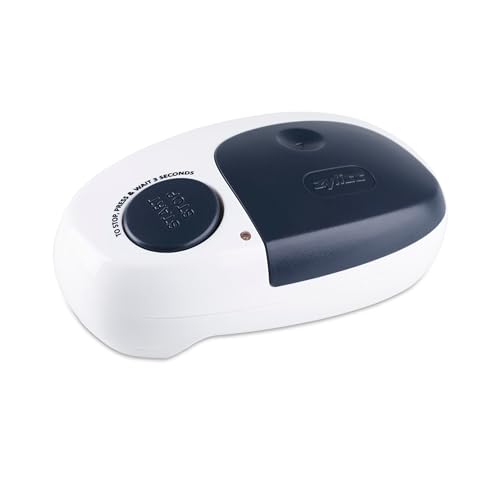
Zyliss EasiCan Electric — Best One-Touch Electric
The Zyliss EasiCan splits the difference between the countertop and automatic styles: a battery-powered electric that opens with one touch, works hands-free once started, and finishes with a small act of thoughtfulness — a magnet that grips the lid so it lifts away with the opener instead of dropping into the food or waiting to cut a finger.
Strengths
- One-touch start with hands-free operation
- Magnet holds the lid for clean, touch-free removal
- Stainless steel blades and a trusted kitchen brand behind it
Trade-offs
- Runs on AA batteries, which are not included — buy a pack with it
- Compact automatics are slower than countertop electrics
- Smooth-edge purists should confirm the edge style suits them
| Type | Electric, battery operated (AA, not included) |
| Operation | One-touch automatic, hands free |
| Blades | Stainless steel |
| Lid | Magnet for safe lid removal |
The magnet is a bigger deal than it sounds. The dangerous moment with any opener is the end — a loose, sharp lid balanced on food or sliding off the can. An opener that simply holds the lid and carries it to the bin removes that moment from the process entirely. Combined with one-touch starting, the EasiCan asks for the least end-to-end attention of any pick here: press, wait, lift the opener, and the lid comes with it.
Remember the batteries are not in the box — order a pack alongside, and keep spares in the drawer as with the Kitchen Mama models. The EasiCan’s pace suits one-to-three-can sessions, which describes most home cooking. For a gift buyer shopping for a parent, this is often the sweet spot: genuinely automatic, genuinely safe at the lid, from a brand the recipient may already trust in their drawer.
Best for: cooks who want one-touch opening and touch-free lid disposal / Not suited for: high-volume can opening sessions
Check the current price on Amazon
Comparison Table
| Pick | Badge | Key spec | Best for |
|---|---|---|---|
| Hamilton Beach Smooth Touch 76606AG | Best Overall | Electric, easy push-down lever, opens standard, tall and pop-top cans | older cooks who open cans daily and want near-zero hand effort |
| Kitchen Mama Auto Electric (Red) | Best Hands-Free | Battery operated, automatic, smooth edge, hands free | cooks wanting fully hands-free, one-button opening |
| Kitchen Mama Auto 2.0 (Navy Blue) | Best Cordless Refined | Cordless, refined blade, automatic hands free, smooth edge | buyers wanting the most polished hands-free opener |
| OXO Good Grips Smooth Edge Can Opener | Best Manual | Manual smooth edge, soft grip, no sharp edges | cooks who prefer manual tools but want comfort and safe edges |
| GoodCook Safe-Cut Can Opener | Best Budget Manual | Manual safe-cut, easy turn knob, ergonomic handle, no sharp edges | budget shoppers wanting safer edges and an easier knob |
| Zyliss EasiCan Electric | Best One-Touch Electric | Electric one-touch, hands-free design, magnet for lid removal | cooks who want one-touch opening and touch-free lid disposal |
Choose by how much effort you want to retire. The Hamilton Beach retires nearly all of it at the counter; the Kitchen Mama models retire it anywhere, at battery pace; the Zyliss adds touch-free lid handling; and the two manuals reduce effort and remove sharp edges while keeping the simplicity of a hand tool. There is no wrong philosophy here — only the wrong match to a particular pair of hands.
How to Choose a Can Opener for Seniors
Start by naming the hardest part of opening a can today. If it is the squeeze — closing a butterfly opener onto the rim — then lever-action electrics and place-on automatics are your category, because they remove squeezing entirely. If it is the turning, look for motors or for manual knobs that are large and easy to turn. If it is the lid — sharp, loose, falling into food — then smooth-edge cuts and magnetic lid holders are the features to insist on. The right diagnosis picks the right machine.
Consider where the opener will live. A countertop electric needs a permanent spot and an outlet, and repays it with speed and stability. Drawer-sized automatics need nothing but batteries and suit small kitchens and occasional use. Manuals need nothing at all and never fail to start — but they always ask for some hand effort. Match the tool to the kitchen’s space and the cook’s routine, not to a showroom demo.
Finally, think about the whole pantry, not the ideal can. Tall cans, small tomato-paste cans, pop-top lids that still need help, dented cans from the back of the shelf — a versatile opener handles the real distribution. The countertop pick here covers the widest range; the automatics cover standard cans best. If your pantry leans on one unusual format, check it against the pick before buying.
Comfort Details That Actually Matter
Handle thickness beats handle padding alone. A thick handle spreads pressure across the whole hand instead of concentrating it in the fingers, which is why the better manual openers feel easier even before any cushioning is considered. Knobs follow the same rule: a large knob turned by the whole hand is a different experience from a small wing key pinched between two fingertips.
Stability is an underrated comfort feature. A can that skids must be chased and held — extra grip work that never appears in product descriptions. Countertop electrics solve it with weight, automatics by riding the can itself, and manual users can solve it with a damp cloth under the can, which grips the counter surprisingly well. Small setup habits like this are free comfort; use them with any opener.
Sound and feedback matter too, in a quiet way. An opener that clearly engages, runs steadily and stops decisively lets the cook relax; one that hesitates or needs repositioning creates a small daily stress. When you first use any new opener, open two or three cans in a row to learn its engagement feel — after that, it becomes the kind of kitchen task you no longer think about, which is the entire goal.
Setting Up a Comfort-First Kitchen for Older Cooks
A good can opener works best inside a kitchen set up with the same philosophy: reduce grip, reduce reaching, reduce force. Start with placement. The opener should live where the cans are used — in the drawer nearest the stove or on the counter section where preparation happens — not in a high cupboard or a deep drawer that must be excavated. Countertop electrics earn their footprint by being already out, already plugged in, asking nothing before the moment of use. Drawer automatics should sit at the front of the drawer, on top of the clutter line, where a hand finds them without a search.
Lighting and contrast are the quiet helpers. Opening a can involves aligning a small mechanism on a small rim; a bright task light over the preparation counter makes that alignment easy instead of squinted. If the household buys canned goods in quantity, decanting the weekly cans to a low, reachable shelf beats the daily step-stool negotiation with a high pantry shelf. None of this is elaborate renovation — it is the same comfort logic as the opener itself, applied to the room: the best tool is the one that is present, visible and effortless at the moment it is needed.
Finally, think in terms of the whole task chain. A can opened is usually a can emptied: a lightweight bowl or pan waiting nearby, a fork for lid duty, a clear path to the bin for the lid itself. Households setting up a kitchen for an older parent often focus on the headline gadget and miss these thirty-second arrangements, yet it is the chain that decides whether cooking feels easy. The openers in this guide were chosen to be strong links; a few minutes spent arranging the rest of the chain makes them feel effortless.
When to Replace a Can Opener: Wear Signs Worth Watching
Manual openers rarely break dramatically; they fade. The cutting wheel dulls gradually, so the first symptom is effort creep — the opener that used to bite and glide begins to need a harder squeeze and a second pass. Gears develop play, so the wheel wanders off the rim mid-cut and leaves the lid attached by a stubborn tab. Handles loosen. Any of these is the tool announcing its retirement, and for a senior user the announcement should be heeded early: a fading opener demands exactly the force and fiddling that cause kitchen accidents, and replacement openers — as this guide’s budget picks prove — are inexpensive safety equipment.
Electric and automatic openers have their own tells. A countertop electric that slows, strains or leaves uncut sections is showing cutter wear or motor fatigue. Automatics that hesitate to engage, stop mid-rim or need repeated restarts may simply need fresh batteries — always rule that out first — but persistent hesitation on fresh batteries is wear, not luck. Magnets weaken with age too; a lid that used to be carried away cleanly and now drops is a small warning worth acting on before it drops into a pot of soup.
A simple household habit covers all of it: once a year, open a can with fresh attention and ask whether the tool still feels easy. If it does not, replace it without sentimentality. Kitchen tools for older cooks should be retired at the first sign of asking for more effort, not the last. The cost is trivial, the comfort is daily, and the safety margin — in a task involving cut metal edges — is very real.
Gift Buyer’s Guide: Choosing an Opener for a Parent
Many of the openers in this guide will be bought by adult children for parents, and gift buying has its own rules. The first is respect: choose a tool that solves a problem without announcing a decline. An automatic opener framed as clever new kitchen tech lands differently from one framed as help, and the same product can be either depending on the wrapping of the conversation. The second rule is demonstration: set the opener up, open two cans together, and leave it where it will live — a gift that requires the recipient to decode a manual alone on a Tuesday is a gift half-given.
Match the gift to the kitchen you actually know. If the counter has space and the cans are daily — soups, beans, the cat’s food — the countertop electric is the substantial, permanent answer. If the kitchen is small or the cooking occasional, a drawer automatic respects the space. If your parent has used a manual opener for sixty years and trusts nothing with a battery, honour that identity and give the best manual — the OXO in this guide — rather than winning an argument and losing the tool to a drawer.
Include the consumables and the follow-up. Batteries in the box for automatics, a note of where spares live, and a check-in a week later to ask how the third can went — that is the complete gift. The follow-up matters because the first solo use is where confidence is built or lost, and a two-minute phone call at that moment is worth more than any feature on the box.
Can Storage and Pantry Habits That Make Opening Easier
The easiest can to open is the one you can find, reach and read. Pantry organisation is therefore part of can-opening comfort: keep the week’s cans on the lowest, most reachable shelf, labels facing forward, heaviest cans lowest where they are lifted the least distance. Decanting a bulk shop into that working shelf — rather than living out of a high cupboard or a garage stockpile — removes the daily reach-and-lift negotiation that makes canned food feel like effort before the opener is even involved.
Rotation protects both food and morale. New cans go behind old ones, so the stock turns over and nothing fossilises at the back; a can that has waited two years often has a compromised rim and a discouraging look, and opening it is nobody’s favourite task. Check pull-top cans at purchase if they are a household staple — a broken ring-pull turns an easy can into a hard one, and a smooth-edge opener that grips the rim properly, several of which appear in this guide, is the rescue tool for exactly that accident.
Finally, keep the opener’s home as organised as the cans’. A countertop electric with a clear patch of counter, an automatic at the front of its drawer, a manual hanging on a hook by the preparation area — each placement is a small promise that the tool will be effortless to reach for. Comfort in the kitchen is rarely one product; it is a dozen small arrangements all pointing the same way, and the opener is simply the most important of them.
Understanding the Two Cut Styles: A Buyer’s Plain-Language Primer
Every opener in this guide uses one of two ways to separate a lid, and the difference is worth understanding before choosing. The traditional top cut slices through the lid just inside the rim. It is fast and familiar, and it leaves two sharp edges — one on the lid, one on the can — and a lid that often drops onto the food. Generations of cooks have used it safely, but it demands care at exactly the moment the task should be over, and it is the style most senior shoppers are trying to retire.
The smooth-edge side cut works from outside the rim, uncrimping the factory seal rather than slicing the metal. The lid lifts off whole, the can’s rim is left smooth enough to run a finger along, and nothing falls into the food. The trade-offs are subtle: the first use feels unfamiliar, the lid cannot be used to strain liquid against the can’s contents in the old way, and a badly dented rim can defeat the mechanism. For most senior households, the safety arithmetic is decisive — the style removes the sharpest object from the task entirely.
Whichever style you choose, the supporting habits in this guide’s how-to section close the remaining gaps: a fork or magnet for any lid, a bin positioned before you start, and a wipe of the cutter afterward. Tools and habits together are what make a kitchen task genuinely easy — neither half achieves it alone, and both halves are inexpensive.
A Short Word on Pop-Top Cans and Broken Ring Pulls
Many modern cans arrive with pop-top lids that promise to need no opener at all, and for many cooks they deliver — until a ring pull snaps, a lid bends halfway, or the pull itself demands more finger strength than the opener it replaced. Senior households meet all three failures regularly, which is why a good opener remains essential equipment even in the pop-top era. The countertop pick in this guide is explicitly rated for pop-top cans, finishing the job the ring started, and smooth-edge openers grip the rim in a way that rescues a half-opened lid without a wrestling match.
Technique helps the unbroken ones too: lift the ring with a spoon handle or the opener’s own edge rather than a fingertip, peel the lid back slowly rather than snapping it, and treat the removed pop-top lid with the same sharp-edge respect as any cut lid — it goes to the bin by fork or magnet, never carried pinched between fingers over a pot of food. Small habits, again; but it is the small habits, plus the right tool, that keep a daily task daily and safe.
How to Open Cans Comfortably and Safely: A Step-by-Step Routine
This routine works with any pick in the guide and focuses on setup — the unglamorous details that decide whether opening a can is easy or annoying.
- Set the can on a stable, dry surface at a comfortable height. For manual openers, place a damp cloth under the can so it cannot rotate while you turn.
- Remove any paper label overhanging the rim, and wipe the top of the can — a clean rim helps every opener engage properly and keeps paper out of the food.
- Engage the opener fully before starting: for electrics and automatics, seat the unit as its design intends and confirm it has caught the rim; for manuals, close the handles firmly until the cutter bites.
- Let the tool do the work at its own pace. Do not force an automatic or squeeze a manual harder mid-cut — steady progress is what produces a clean, complete cut.
- Finish the lid safely: lift smooth-edge lids by their rim, let magnetic models carry the lid away, and for traditional cuts, use a fork or the opener’s magnet to lift the lid without touching its edge.
- Drop the lid straight into the bin — never press rubbish down on top of it by hand — and wipe the opener’s cutter clean before putting it away.
If a can is dented on the rim, open it from the bottom if that rim is sound, or transfer the contents with extra care. No opener performs well on a crushed rim, and forcing one is how small kitchen accidents happen.
Common Buying Mistakes
Buying a stiff butterfly opener because it is cheap and familiar. Familiarity is not comfort. The classic design concentrates force exactly where older hands least want it; every pick in this guide exists because better options do.
Ignoring the lid. Most can-opening cuts come from the lid, not the opener. Smooth-edge cuts, magnetic holders and a fork for lifting lids remove the risk — choose at least one of those protections.
Forgetting the batteries. Automatic openers are wonderful until the drawer has no spare AAs. Buy batteries with the opener and store them together; it is the only maintenance these tools really ask for.
Holding the can in the air with a manual opener. A can held in one hand while the other turns is a can that slips. Set it down on a damp cloth and let the counter do the holding.
Pressing down rubbish on top of a discarded lid. A sharp lid in a bin cuts the hand that compresses the trash. Drop lids deep into the bin or wrap them in the can’s label before disposal.
Final Recommendation
For most senior kitchens, the Hamilton Beach Smooth Touch is the complete answer — a lever press instead of a squeeze, a stable countertop stance, and safe edges. The Kitchen Mama Auto and Auto 2.0 deliver the same freedom in drawer-sized, hands-free form, the Zyliss EasiCan adds touch-free lid disposal, and the OXO and GoodCook manuals serve cooks who prefer a hand tool with kinder handles and no sharp rims. For the wider field, compare Best Can Openers and the format-specific shortlists at Best Electric Can Openers and Best Manual Can Openers, plus more comfort-first kitchen ideas in Best Kitchen Gadgets For Seniors.
Ready to decide? Start with the top three picks and check price on Amazon for each before you buy: Hamilton Beach Smooth Touch 76606AG · Kitchen Mama Auto Electric (Red) · Kitchen Mama Auto 2.0 (Navy Blue).
Frequently Asked Questions
What type of can opener is easiest for seniors to use?
For the least hand effort, powered designs win: a countertop electric with a push-down lever, or a place-on automatic that walks around the can by itself. Both remove the squeeze-and-twist that makes traditional openers hard. Among manual openers, look for thick soft-grip handles, a large easy-turn knob and a smooth-edge cut.
Are smooth-edge can openers safer?
They remove the sharpest hazard: the lid and rim are left smooth enough to touch, and the lid lifts off whole instead of dropping into the food. That makes them a strong choice for households concerned about cuts. They cut from the side of the rim, so the first use feels slightly different — after two cans it is second nature.
Do automatic can openers need batteries?
The portable automatic models in this guide are battery operated — that is what makes them cordless and drawer-sized. Countertop electrics plug into an outlet instead. If you choose a battery model, keep a spare set in the same drawer and the tool will never let you down mid-recipe.
Can these openers handle large or tall cans?
The countertop Hamilton Beach in this guide is rated for standard, extra-tall and pop-top cans, the widest range here. Portable automatics handle standard cans best. If your pantry relies on very large food-service cans, a countertop model is the safer purchase.
My parent insists on a manual opener. Which is kindest?
Choose the OXO Good Grips Smooth Edge for the most considered manual comfort — thick cushioned handles, a smooth action and no sharp edges — or the GoodCook Safe-Cut as the budget option with an easy-turn knob. Pair either with the damp-cloth trick so the can stays still, and the task becomes far gentler than a classic butterfly opener.
How do I dispose of can lids safely?
Let the opener’s magnet carry the lid where fitted, or lift it with a fork — never with fingertips near a cut edge. Drop it straight into the bin rather than leaving it on the counter, and never press down bin contents by hand where a lid might be waiting.


