Disclosure: airfryerkitchensupply.com is reader-supported. When you buy through links on our site, we may earn an affiliate commission at no extra cost to you.
Where to buy
Every machine shortlisted for the best air fryers for french fries is listed on Amazon, every fryer below is listed on Amazon, where you can compare basket dimensions and included accessories. For fries, the basket’s floor area is the number that matters — check it against the portion your household eats, because fries crisp in a layer, not in a pile.
- Ninja AF161 Air Fryer Max XL 5.5 Qt (Best Overall for Fries) — check price on Amazon
- Cosori TurboBlaze Air Fryer 6 Qt (Best for Fresh-Cut Fries) — check price on Amazon
- Ninja AF150AMZ Air Fryer XL 5.5 Qt (Best Simple Family Fryer) — check price on Amazon
- Chefman 6 QT Compact Air Fryer (Best Value for Fries) — check price on Amazon
- Cosori Pro LE Air Fryer 5 Qt (Best With a Shake Reminder) — check price on Amazon
- Instant Pot Vortex XL 6 Qt 4-in-1 Air Fryer (Best Big-Batch Fryer) — check price on Amazon
The best air fryers for french fries are not the biggest or the most expensive — they are the ones that solve the fry’s three problems: a heap of fries steams itself, a weak fan leaves the middle layer pale, and a slow finish leaves the outside leathery instead of crisp. A french fry is a small, wet, starchy baton that must dry on every face while its interior turns fluffy, and it only does that with space around it, moving air on all sides, and a hot, decisive finish. This guide ranks six verified machines by how well their design serves exactly that process: basket floors that spread a real portion in one layer, fans with the strength to reach the middle of the layer, shake reminders that fire at the moment fries need redistributing, and maximum temperatures that set a crust instead of baking a jacket.
Two different foods share this search, and the guide treats them separately throughout. Frozen fries are an engineered product — blanched, oiled and cut by a factory — and they mainly need aggression: maximum heat, maximum airflow, one hard shake. Fresh-cut fries are a project: the variety of potato, the soak, the drying and the cut thickness all matter as much as the machine, and they reward control and evenness over raw violence. Each review below states which fry it suits best, because the machine that produces the finest frozen fries can be merely adequate for fresh-cut, and the reverse is also true.
Set one expectation honestly: an air fryer makes excellent fries, but they are their own thing — crisper-edged and lighter than deep-fried, without the same shattering shell. Households that accept that trade gain fries with a fraction of the oil, no pot of fat cooling on the hob, and a fifteen-minute route from freezer to plate. The six machines here are the ones that get closest to the deep-fried ideal, each by a different route.
In this guide
Quick Picks
Six verified fryers ranked for fries specifically — layer space, fan strength, shake timing and finishing heat — with each pick matched to frozen or fresh-cut cooking.
- Best Overall for Fries: Ninja AF161 Air Fryer Max XL 5.5 Qt — Max Crisp mode was practically designed for fries — the listing itself rates the basket at 3 lbs of them. Check the current price on Amazon.
- Best for Fresh-Cut Fries: Cosori TurboBlaze Air Fryer 6 Qt — Fan-speed control lets fresh fries cook through gently, then crisp hard — the two-stage cook in one machine. Check the current price on Amazon.
- Best Simple Family Fryer: Ninja AF150AMZ Air Fryer XL 5.5 Qt — A powerful 5.5-quart Ninja with no learning curve — load, shake once, serve. Check the current price on Amazon.
- Best Value for Fries: Chefman 6 QT Compact Air Fryer — Hi-Fry technology aims a harder finish at frozen food, in a 6-quart basket at a friendly tier. Check the current price on Amazon.
- Best With a Shake Reminder: Cosori Pro LE Air Fryer 5 Qt — A shake reminder that fires at the halfway point, plus a 450°F ceiling and a ceramic basket. Check the current price on Amazon.
- Best Big-Batch Fryer: Instant Pot Vortex XL 6 Qt 4-in-1 Air Fryer — A roomy 6-quart Instant with the even, predictable cooking that big fry loads need. Check the current price on Amazon.
How These Picks Were Chosen
All candidates were confirmed through Amazon’s catalogue data — exact model, capacity and functions verified against the listing, with unconfirmed machines excluded. We then applied fry-specific tests: does the basket floor spread a household portion in one layer? Does the machine reach a genuine high finish — around 450°F or a named max-crisp or extra-crisp mode? Is there a shake reminder or a window to manage the mid-cook redistribution? And does the fan have the strength to dry the middle of a layer, which is where fries go to die?
We also weighed the second batch. Fries are rarely cooked once; they are cooked for rounds of people, and a machine that reheats its own cavity quickly and crisps a second layer as well as the first is worth more than its paper specs suggest. Basket shape mattered — square floors use their corners for fries, which are short and happy to fill them — and dishwasher-safe baskets mattered because fry cooking leaves a starchy, oily film that punishes hand-washing households into cooking fries less often.
The 6 Best Air Fryers for French Fries

Ninja AF161 Air Fryer Max XL 5.5 Qt — Best Overall for Fries
The AF161 takes the top spot because its signature mode reads like a fry specification. Max Crisp combines the 450°F ceiling with the machine’s strongest airflow, which is exactly the environment a frozen fry needs: the surface ice flashes off, the factory coating sets and browns, and the interior steams itself fluffy — all before the fry can slump. The listing rates the basket at 3 lbs of fries, a genuinely family-size layer, and in practice the mode produces the closest thing to a deep-fried finish this guide offers.
Strengths
- Max Crisp mode is a purpose-built fry finish
- Basket rated at 3 lbs of fries per the listing
- Fast recovery keeps the post-shake cook at full power
Trade-offs
- Round basket loses a little layer area in the corners
- Max Crisp is the loudest setting here
- Coating needs gentle utensils and soaking, not scouring
| Capacity | 5.5 Qt |
| Max temperature | 450°F |
| Functions | 7-in-1: Max Crisp, air fry, roast, broil, bake, reheat, dehydrate |
| Basket load note | Fits 3 lbs of fries per Amazon listing |
Fresh-cut fries do nearly as well with a two-stage approach the machine handles gracefully: a first phase at a moderate-high heat in the standard mode to cook the interior, then a switch to Max Crisp for the final minutes to set the crust. The round basket is the one geometric compromise — fries are short enough that the lost corners matter less than they do for cutlets, and a proper shake redistributes the layer’s edges and centre so the roundness rarely shows in the results. Heat recovery after the shake is quick, which keeps the second half of the cook at full power.
The trade-offs are noise at full blast and a nonstick basket that wants non-metal tools and a soak rather than a scour. Owners who cook fries for a crowd weekly should also read the AF181 and Gourmia reviews in the family guides — but as a fry machine first and foremost, the AF161’s combination of a rated fry capacity and a purpose-built finishing mode is the one to beat.
Best for: frozen-fry households wanting the hardest finish and a family-size layer / Not suited for: cooks who need a square basket for other foods above all
Check on Amazon — check the current price on Amazon before you decide, since listings and included accessories change over time.

Cosori TurboBlaze Air Fryer 6 Qt — Best for Fresh-Cut Fries
Fresh-cut fries fail in ordinary fryers for a specific reason: a raw baton’s surface is wet starch, and a violent fan at full temperature cases the outside hard before the inside cooks, leaving a crisp shell around a raw core — or, with a timid machine, a limp, steamed stick. The TurboBlaze’s five fan speeds and wide temperature range let you run the correct two-stage cook without workarounds: moderate heat and airflow to cook the baton through and dry its surface, then full fan and 450°F to crisp it. The square 6-quart basket spreads a family layer of hand-cut fries with room to spare.
Strengths
- Five fan speeds enable a true two-stage fry cook
- Square ceramic basket spreads and releases fresh fries
- 450°F ceiling finishes as hard as the frozen specialists
Trade-offs
- Control panel is more than frozen-only cooks need
- Large footprint; premium tier for a single basket
- Fresh fries still demand soaking and drying — no machine skips prep
| Capacity | 6 Qt |
| Power | 1725W |
| Temperature range | 90–450°F |
| Fan speeds | 5 |
| Functions | 9-in-1 incl. air fry, roast, broil, frozen, bake, dry, proof |
| Basket coating | PFAS-free ceramic per Amazon listing |
The ceramic basket earns its mention on fresh fries specifically, because raw potato starch bakes onto surfaces like glue; the ceramic releases the inevitable stuck baton with a soak instead of a scrape, and it shrugs off the sugary browning that fresh fries leave behind. The frozen function covers the other fry family competently, so a household that does both is not compromising either way. Control is the theme of the whole machine, and fries — the food where the cook’s decisions matter most — are where it pays off.
The costs are the familiar TurboBlaze ones: a busier panel than a preset machine, a larger footprint, and a tier above the simple fry specialists. A frozen-only household is buying control it will never touch and should take the AF161 or the Chefman below. A household that cuts its own potatoes — especially one experimenting with thick steak fries, which need the longest gentle phase — will use every one of those fan speeds.
Best for: fresh-cut fry cooks who vary cut thickness and want staged control / Not suited for: frozen-only households wanting one-button simplicity
Check on Amazon — check the current price on Amazon before you decide, since listings and included accessories change over time.

Ninja AF150AMZ Air Fryer XL 5.5 Qt — Best Simple Family Fryer
Not every fry household wants modes and fan speeds; some want a strong machine that makes Friday’s fries the same way every Friday. The AF150 is that machine: 5.5 quarts, a full 1750W, five functions, and the straightforward temperament of a workhorse. The wattage is the fry-relevant detail — a family layer of cold fries is a heavy thermal load, and this element pushes through the steaming phase quickly and recovers after the shake, which is where underpowered machines quietly ruin the second half of the cook.
Strengths
- 1750W keeps family fry loads cooking, not steaming
- Honest 5.5 Qt layer for four people’s fries
- Simple controls the whole household can run
Trade-offs
- 400°F ceiling — a gentler finish than Max Crisp models
- No fan-speed control for fresh-cut finesse
- Round basket shape
| Capacity | 5.5 Qt |
| Power | 1750W |
| Max temperature | 400°F |
| Functions | 5-in-1 incl. air fry, roast, reheat, dehydrate |
| Basket load note | Fits 3 lbs of wings per Amazon listing |
The basket size is the family sweet spot: a proper single layer for four people’s fries, or a main-course load of wings — the listing rates it at 3 lbs of wings, which gives a sense of its honest capacity. Dishwasher-safe parts handle the starchy film fry cooking leaves, and the five functions cover the rest of the week without novelty modes nobody asked for. In a household where several people operate the fryer, including teenagers on snack duty, the simple controls are a safety feature as much as a convenience.
The ceiling is 400°F, so the final finish is a notch less violent than the Max Crisp machines — frozen fries still crisp properly, they simply take the scenic route, and fresh-cut fries benefit from the two-stage timing being done by the clock rather than by fan control. Buyers chasing the ultimate fry should step up to the AF161. Buyers wanting a powerful, unpretentious family fryer that happens to be excellent at fries should stop here.
Best for: families wanting strong, simple, repeatable fries every week / Not suited for: fry perfectionists chasing the hardest possible finish
Check on Amazon — check the current price on Amazon before you decide, since listings and included accessories change over time.

Chefman 6 QT Compact Air Fryer — Best Value for Fries
The Chefman 6 QT is the value answer to the fry question, and its Hi-Fry technology is the reason it makes this guide rather than the many cheap fryers that do not. Hi-Fry is designed to push an extra-crisp finish — the phase of the cook where frozen fries are won or lost — and at 6 quarts the basket spreads a family layer properly. For the household whose fry life is a freezer bag on a Friday, this machine delivers the essential experience at a tier that leaves money for the potatoes.
Strengths
- Hi-Fry finish targets exactly what frozen fries need
- 6 QT layer at a budget-friendly tier
- Touchscreen simplicity; dishwasher-safe basket
Trade-offs
- No fan control for fresh-cut technique
- No viewing window
- Finish a step below the Max Crisp flagship
| Capacity | 6 Qt |
| Technology | Hi-Fry technology for extra crisp |
| Controls | Touchscreen with 4 presets |
| Basket | Nonstick, dishwasher-safe |
The touchscreen and four presets keep operation to a couple of taps, and the nonstick basket goes in the dishwasher after the inevitable crumb-and-oil residue. Six quarts in a body Chefman still calls compact is a useful trick for smaller kitchens feeding a family. Fries emerge with the colour and crunch that matter; the machine’s simplicity means the cook supplies the technique — the single layer, the halfway shake — rather than the electronics enforcing it.
There is no fan control for fresh-cut subtleties, no window, and the finish, while strong for the tier, sits a step below Ninja’s Max Crisp at its fiercest. Fresh-cut devotees should take the TurboBlaze. But judged honestly — frozen fries, family portions, sensible spend — the Chefman is the pick that respects both the food and the budget.
Best for: frozen-fry families wanting real crisp at a value tier / Not suited for: fresh-cut cooks who need staged airflow control
Check on Amazon — check the current price on Amazon before you decide, since listings and included accessories change over time.

Cosori Pro LE Air Fryer 5 Qt — Best With a Shake Reminder
Ask fry cooks what ruins batches and the honest answer is rarely the machine — it is the forgotten shake. Fries that sit undisturbed crisp on top and steam beneath, and the cook who is also making burgers, answering the door and supervising homework forgets the redistribution. The Cosori Pro LE’s shake reminder exists for real kitchens: it prompts at the midpoint, you shake hard once, and the layer finishes evenly. Add a 450°F ceiling for the finish and a ceramic basket that releases the batons that caramelise onto the floor, and you have the most forgiving fry machine in this guide.
Strengths
- Shake reminder rescues batches from the forgotten-shake failure
- 450°F finish and ceramic release surface
- Wipe-clean glass panel suits messy fry prep
Trade-offs
- 1500W — slower recovery than the Ninja picks
- 5 Qt is a layer for three to four, not a crowd
- Keep-warm holding softens fries if overused
| Capacity | 5 Qt |
| Power | 1500W |
| Max temperature | 450°F |
| Functions | 9-in-1, 7 presets incl. reheat and keep warm |
| Extras | Shake reminder, ceramic coating |
Five quarts suits a family layer for three to four, and the nine functions with seven presets cover the rest of the week’s cooking, including a keep-warm that can hold a first batch briefly while a second runs — used for minutes, not tens of minutes, if the first batch is to stay crisp. The glass touch panel wipes clean of the flour and starch dust that fry prep spreads around, a small virtue that dial-controlled machines cannot claim.
At 1500W it is the least powerful machine here, and recovery after opening is steadier than the Ninjas’ — the reminder’s shake should be one decisive action, not a leisurely inspection. It also will not match the AF161’s Max Crisp violence on a frozen bag. What it offers instead is consistency for real, distracted, multitasking cooks — which is to say, most of the people who cook fries at home.
Best for: busy multitasking cooks whose fries suffer from forgotten shakes / Not suited for: power users cooking the largest frozen batches
Check on Amazon — check the current price on Amazon before you decide, since listings and included accessories change over time.
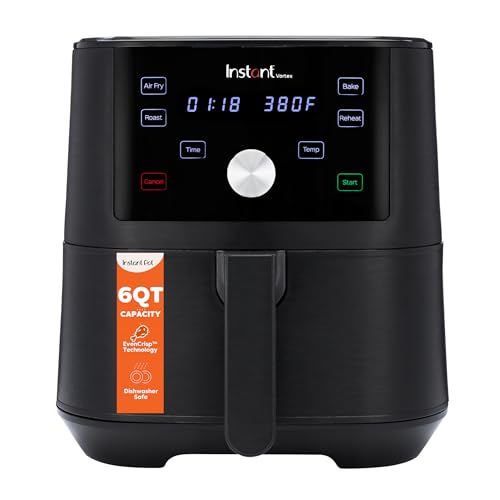
Instant Pot Vortex XL 6 Qt 4-in-1 Air Fryer — Best Big-Batch Fryer
The Vortex XL closes the guide as the big-batch diplomat: 6 quarts of basket, Instant’s even-cooking design language, and a temperament that produces the same fries on the tenth batch as on the first. For households where fries are a main event — a double portion for a table of teenagers, a film-night mountain — the extra quart over the 5-quart machines is the difference between one layer and a layer plus a resentful second batch, and the machine’s predictability means the second batch, when it happens, matches the first.
Strengths
- 6 Qt layer for generous portions and seconds
- Even, predictable results batch after batch
- Reheat function revives fries better than oven or microwave
Trade-offs
- No 450°F finishing mode
- Four functions is a short list
- Less fry-specific technology than the Ninja picks
| Capacity | 6 Qt |
| Functions | 4-in-1: crisp, roast, bake, reheat |
| Cleanup | Dishwasher-safe parts per Amazon listing |
Four functions keep the panel honest — crisp, roast, bake, reheat — and the reheat function is a genuine fry asset, reviving the portion that sat while the table was set better than any oven or microwave manages. Dishwasher-safe parts deal with the aftermath, and the brand’s app recipe library gives fry variations — seasoned, sweet potato, crinkle — for households whose fry night needs rotating ideas to survive the year.
There is no 450°F hero mode and no fan theatre; the Vortex wins on space and evenness rather than extremes, and sweet potato fries — the fry family’s sugar-rich, burn-prone member — actually benefit from that steadier temperament. Buyers who want the fiercest finish should take the AF161. Buyers who want the most fries, reliably, with the least fuss, should take this.
Best for: households cooking fries in main-event quantities / Not suited for: finish-obsessed cooks wanting a max-crisp mode
Check on Amazon — check the current price on Amazon before you decide, since listings and included accessories change over time.
Comparison Table
| Pick | Badge | Key spec | Best for |
|---|---|---|---|
| Ninja AF161 Air Fryer Max XL 5.5 Qt | Best Overall for Fries | 5.5 Qt, 450°F Max Crisp, fits 3 lbs of fries per listing | Frozen fries with the hardest, fastest finish |
| Cosori TurboBlaze Air Fryer 6 Qt | Best for Fresh-Cut Fries | 6 Qt square basket, 5 fan speeds, up to 450°F | Hand-cut fries that need a gentle start and a fierce finish |
| Ninja AF150AMZ Air Fryer XL 5.5 Qt | Best Simple Family Fryer | 5.5 Qt, 1750W, fits 3 lbs of wings per listing | Everyday family fries with strong, simple performance |
| Chefman 6 QT Compact Air Fryer | Best Value for Fries | 6 QT, Hi-Fry extra-crisp technology, touchscreen | Frozen fries at a budget-friendly tier |
| Cosori Pro LE Air Fryer 5 Qt | Best With a Shake Reminder | 5 Qt, 450°F max, shake reminder, ceramic coating | Fries cooked by distracted cooks — the machine keeps the schedule |
| Instant Pot Vortex XL 6 Qt 4-in-1 Air Fryer | Best Big-Batch Fryer | 6 Qt, 4-in-1, dishwasher-safe parts | Generous fry portions and second helpings |
Frozen fries and maximum crunch: the Ninja AF161 on Amazon. Fresh-cut and control: the Cosori TurboBlaze listing. Frozen fries on a budget: compare the Chefman 6 QT on Amazon before spending more.
How to Choose the Best Air Fryers for French Fries
Measure the floor, then check the finish. Fries crisp in a layer, so the basket’s usable floor area decides your true batch size — a square 6-quart basket spreads more fries in one layer than a deep, narrow 7-quart one. Count your household’s fry portion honestly and buy the floor that holds it once, because a machine that double-batches every Friday will be resented by Christmas. Then check the top end: a 450°F ceiling or a named max-crisp or Hi-Fry finish is the difference between fries that are cooked and fries that are crisp, especially from frozen, where the finish must outrun the melt water.
After those two, judge the supporting cast. A shake reminder or window manages the mid-cook moment fries depend on. Wattage decides how fast the machine recovers after that shake — the second half of the cook is where underpowered fryers quietly fail. And a dishwasher-safe basket decides whether fry night survives contact with your real life, because the starchy film fries leave behind is the enemy of hand-washing good intentions.
Frozen Fries Versus Fresh-Cut: Buying for Your Actual Fry
Frozen fries are the air fryer’s home fixture. They arrive blanched and oiled, cut to a uniform thickness, and ask only for heat, air and one shake. Almost any competent machine cooks them well, and the differences appear at the finish: the max-crisp and Hi-Fry machines produce a harder, darker crunch, while steadier machines produce a gentler one. If frozen is your fry, buy finish and floor area and ignore the rest of the feature list with a clear conscience.
Fresh-cut fries are a collaboration between you and the machine. The potato variety, a soak to remove surface starch, thorough drying and a consistent cut all matter before the basket is involved; the machine’s contribution is a two-stage cook — through first, crisp second — which fan control or a mode change provides. Households that cut their own should buy control. Households that do both should buy control too, because a controllable machine cooks frozen fries perfectly well, while a one-mode machine cannot be taught the fresh-cut two-stage.
Cut Thickness, Portions and the Layer Rule
Thickness changes everything about a fry’s cook. Shoestring fries crisp in minutes and burn while you blink; standard batons are the forgiving middle; steak fries need a long, gentle through-cook before any finish, and are the cut most often served raw in the middle by impatient settings. When you read a machine’s fry claims, translate them to your cut: a fryer that excels at frozen standard batons — most of this guide — will need its timing, not its temperature, adjusted for the extremes. Consistency of cut matters as much as the cut itself, because a mixed basket finishes its thin fries while its thick ones are still cooking through.
The layer rule admits no exceptions: fries in contact steam at the contact points. A portion spread in one layer in a right-sized basket beats a double portion heaped in a bigger one, every time, and two fast batches beat one slow heap. If your household’s portion genuinely exceeds every single layer in this guide, the honest solutions are a dual-basket machine running both sides — covered in the family guides — or serving in waves, which suits fries, a food eaten in rounds anyway.
Budget Tiers for a Fry Machine
Fries are the kindest category to a budget. The value tier — the Chefman here — buys a real extra-crisp finish and a family layer, which is the whole frozen-fry experience. The mid tier buys power and shape: stronger recovery, square ceramic baskets, reminders. The premium tier buys control and violence in equal measure — fan speeds for the fresh-cut cook, max-crisp modes for the frozen perfectionist. Spend according to which fry you cook and how often; a monthly fry household in a premium machine is money asleep on the counter.
Avoid the classic false economy: the very cheap, very small fryer that double-batches every portion. Fries are a high-frequency food, and a machine that makes each fry night slightly annoying will be replaced or abandoned within the year — the most expensive outcome of all.
Sweet Potato, Crinkle and the Other Fries
Not all fries behave like the standard baton. Sweet potato fries carry more sugar, brown faster and burn at finishes that white fries shrug off — they reward the steadier machines and a watchful last two minutes, and they are the strongest argument for a window or a shake reminder in a fry household that loves them. Crinkle-cut fries crisp on their ridges and need the shake even more than straight cuts, because their shapes nest together and trap steam. Curly fries and waffle fries are mostly surface, cook fast, and punish overloading hardest of all.
The practical conclusion is that a fry household with varied tastes should value evenness and mid-cook management over peak temperature. The fiercest machine in this guide is the right answer to one question — frozen standard fries, maximum crunch — and a slightly wrong answer to several others. Match the machine to the fry rotation you actually serve.
How to Use an Air Fryer to Make Great French Fries
This routine covers frozen fries directly and fresh-cut fries with one extra stage. The principles are constant: dry, spaced, shaken once, finished hard, served immediately.
- For fresh-cut fries, soak the cut batons in cold water for at least thirty minutes, then dry them completely. Soaking removes the surface starch that makes fries glue together and brown patchily; drying is non-negotiable, because a wet fry steams.
- Preheat the fryer. Fries should land on a hot crisper plate so their undersides start drying on contact instead of sitting in the moisture they release.
- Toss fries with a thin, even film of oil in a bowl — and season after cooking, not before, since salt draws out moisture during the cook. Frozen fries need no added oil.
- Load a single layer with small gaps. If the portion does not fit, commit to two batches from the start rather than heaping one and hoping.
- Cook the first phase at a strong temperature until the fries are cooked through and just beginning to colour — for fresh-cut fries, use a gentler fan or temperature here if your machine allows, so the interior finishes before the crust sets.
- Shake the basket hard once at the halfway point, redistributing edges to centre. This is the single most important action in fry cookery; set a timer for it if your machine has no reminder.
- Finish at the machine’s maximum — or its max-crisp or Hi-Fry mode — until the fries are deep gold and audibly crisp when shaken. Salt immediately, while the surface is hot and receptive, and serve within minutes.
Fries wait for no one: they are at their peak for about five minutes, soften steadily in a pile, and should be the last thing cooked in any meal. If the table is not ready, hold the cooked fries spread on a rack in a low oven rather than in the closed basket, where their own steam undoes them. And when a batch does go soft — guests are late, the main course misbehaves — a two-minute return to a hot, empty fryer restores most of the crust, because the structure underneath is still sound; only the surface needs re-drying. It is not a trick to plan around, but it rescues more dinners than any other sentence in this guide.
The Anatomy of a Perfect Air Fryer Fry
A perfect fry is a contrast: a dry, glassy crust a millimetre thick around a soft, steaming, fluffy interior. Everything in fry cookery serves that contrast. The soak removes the surface starch that would otherwise form a gummy layer between crust and interior. The drying ensures the first heat goes into the potato, not into boiling off water. The single layer guarantees that the steam escaping from each fry is carried away instead of condensing on its neighbour. The hot finish sets the crust at the moment the interior reaches fluffiness. Remove any one element and the contrast collapses in a predictable direction — which is why troubleshooting fries is really just identifying which element went missing.
Frozen fries arrive with the contrast pre-engineered: the factory has blanched the interior partway, set a thin oil film, and frozen the baton in its ideal starting state. That is why they are so reliable, and why the machine’s only real jobs are aggression and space. It is also why thawed frozen fries are such a disappointment — thawing destroys the engineered starting state, wetting the surface and softening the structure, and no machine can fully restore it. Cook from frozen, always.
The resting question deserves a direct answer, because fries are the food most often held while something else finishes: do not rest them, and do not hold them in the fryer. A fry’s crust is a moisture barrier under attack from its own steaming interior, and it loses within minutes. The professional solution is sequencing — fries last, everything else ready and waiting — and the domestic solution is the same, scaled down. Build the meal around the fries’ five perfect minutes, not the other way round.
Finally, the second-batch effect is real and worth planning for: a fryer cooking its second consecutive layer is fully heat-soaked, recovers instantly, and often produces the best fries of the evening. Cooks serving a crowd can exploit this deliberately — a small first batch as the cook’s tax, the main batches after — rather than fighting the machine’s warm-up with the portion that matters most.
Seasoning is the last frontier of fry quality and the one most often fumbled. Salt belongs on hot fries in the first thirty seconds out of the basket, when the surface film of oil is still liquid enough to catch it; salt applied to cooled fries bounces off and pools in the bowl. Flavoured salts, spice blends and grated hard cheese all follow the same rule, and all should be ready in a dish before the fries come out, because the window is short. Vinegar, for those who take their fries that way, goes on at the table — its water content softens a crust it touches early. None of this requires a better machine; it requires the seasoning to be staged before the basket opens, which is the fry cook’s version of the professional’s mise en place.
Common Buying Mistakes
Heaping the basket to cook the whole bag at once. The middle layer steams, the fries weld together, and the batch takes longer than two proper layers would have. The layer rule is the whole game.
Skipping the soak and dry for fresh-cut fries. Surface starch makes fresh fries gummy and patchy. Thirty minutes in water and a thorough dry is the difference between a project and a result.
Salting before cooking. Salt pulls moisture to the surface during the cook, fighting the crisp you are building. Salt hot fries the moment they come out instead.
Forgetting the halfway shake. Undisturbed fries crisp on one face and steam on the other. One hard shake at the midpoint is worth more than any preset on the panel.
Judging a fryer by its quart number for fries. Fries need floor area, not volume. A deep basket with a big number can hold fewer layered fries than a shallower, wider design — and the deep basket’s extra volume actively tempts the heaping that ruins the batch. When comparing two machines for fries, compare the baskets’ floor dimensions first and let the quart figure break ties, never the other way round.
Holding finished fries in the closed basket. Their own steam softens them within minutes — the crust you spent fifteen minutes building is a moisture barrier under attack from the fry’s own interior, and a sealed, steamy basket accelerates the surrender. Serve immediately, or hold them spread out in a low oven where the air is dry — never sealed in the fryer, and never piled under a cover or a tea towel, which traps the same steam against them.
Final Recommendation
The Ninja AF161 is the fry machine to beat: a purpose-built Max Crisp finish and a basket rated for family fry loads make it the frozen-fry champion, and it handles fresh-cut nearly as well. Fresh-cut devotees should choose the Cosori TurboBlaze for its staged fan control, value hunters the Chefman 6 QT, distracted multitaskers the shake-reminded Cosori Pro LE, and big-batch households the Instant Vortex XL. The AF150 remains the simple, powerful family answer for anyone who distrusts modes on principle.
Fries are one chapter of the crisping story — Best Air Fryers For Crisping covers the general principles, and Best Air Fryers For Crispy Onion Rings applies the same single-layer discipline to the other great fried side. For the main events fries accompany, see Best Air Fryers For Fried Chicken, and for sizing the machine to the household, Best Air Fryers For Family Of 4.
Frequently Asked Questions
Why are my air fryer fries soggy?
Three causes cover nearly every case: the basket was crowded so the fries steamed each other, the fries went in wet — especially fresh-cut fries that were not dried after soaking — or the finish was too gentle to set the crust. Spread a single layer, dry thoroughly, shake once halfway, and finish at the machine’s maximum or its crisp mode. One of those four fixes solves almost every soggy batch.
Do I need to flip fries in an air fryer?
A hard shake is better than a flip: it redistributes the whole layer at once, exposing every face over the cook. Individual flipping is for cutlets and fillets, not for fifty batons. Shake once at the halfway point — twice for very thick steak fries — and let the moving air do the rest.
What is the best temperature for frozen fries?
Frozen fries reward the top of the machine’s range, or its dedicated crisp finish mode, because the first job is driving off surface ice and setting the factory coating before it absorbs water. Cook them from frozen, never thawed, in a single layer, and judge by colour and sound — deep gold, and a dry rattle when the basket shakes — rather than by the clock alone.
How do I make fresh-cut fries crisp instead of limp?
Choose a floury potato, cut even batons, soak them to remove surface starch, and dry them completely — completely is the operative word. Cook in two stages: through at a moderate-high heat, then crisp at maximum. A machine with fan-speed control makes the staging easy, but a manual temperature change achieves the same result. Limp fresh fries are almost always wet fries or crowded fries, not underpowered fries.
Can I cook fries and chicken at the same time?
In a single basket, not honestly — they want different handling and the fries would steam under the chicken’s moisture. Cook the chicken first and rest it while the fries run; the timing dovetails. Or use a dual-basket machine, covered in our family guides, where each food gets its own basket and the finishes sync. Either way, the fries should always be the last thing cooked.
Why do my fries brown unevenly?
Uneven browning is a layer problem before it is a machine problem: fries at the edges of a heaped basket overcook while the centre steams. A single layer, a hard halfway shake that moves edges to centre, and a basket shape that suits the portion fix most cases. Persistent hot spots on a properly loaded layer point to the machine — which is why evenness was scored in this guide’s picks.