Disclosure: airfryerkitchensupply.com is reader-supported. When you buy through links on our site, we may earn an affiliate commission at no extra cost to you.
Where to buy
If you are comparing the best dry toilets worth your money, start with this verified shortlist. Every toilet below was confirmed against Amazon’s catalogue data before it earned a link, so the model you land on is the model reviewed — important in a category where one brand sells five systems that look alike. Dry toilets are bought as a unit and fed as consumables, so check each listing for what bags, medium or cartridges are included before comparing headline value.
- Nature’s Head Self Contained Composting Toilet (Close Quarters Spider Handle) — Check the current price on Amazon
- Separett Villa Urine-Separating Compost Toilet — Check the current price on Amazon
- Laveo Dry Flush Toilet — Check the current price on Amazon
- OGO Origin Compact Composting Toilet — Check the current price on Amazon
- TRELINO Composting Toilet Evo L (Gray) — Check the current price on Amazon
- Compo Closet Cuddy Composting Toilet — Check the current price on Amazon
This is the umbrella guide: it compares the three dry systems — urine-separating, composting and dry flush — across homes, cabins, vans and tiny houses. The dedicated guides linked at the end go deeper on camping, indoor and tiny-house picks; here, the job is choosing the right system and the right exemplar of it.
The best dry toilets share a single liberation: they need no water and no drain. Everything else — and there is a lot of everything else — is a choice between three technologies. Urine-separating toilets split liquids from solids at the seat so odour never forms, collecting solids in a bag or container for a running cost of pennies. Composting toilets add a chamber and a stir, converting solids over weeks into a material you empty a few times a season. Dry flush toilets seal each use into an airtight cartridge liner at the press of a button, trading a real refill bill for the most normal, guest-proof experience of the three. This guide ranks six verified exemplars across those systems, from the all-round separating benchmark to the compact composter that fits a 15-inch footprint.
Why go dry at all? Because plumbing is not always available, affordable or permitted: off-grid homes, cabins, boats, vans, tiny houses, annexes, workshops, emergency preparedness and water-scarce regions all land on dry toilets for practical rather than ideological reasons — though saving thousands of litres of flush water a year is a respectable side effect. The reviews below are organised so you can shop by system first and model second, and the buying guide gives you the running-cost and routine comparison the listings never print side by side.
A note on scope before the picks: this guide covers self-contained dry toilets for homes, cabins, vehicles and boats — the units a household buys, installs and lives with. It does not cover public or commercial composting installations, pit latrines, or incinerating toilets, which are a separate (electric or gas-fired) category with its own economics. Everything ranked below was chosen because an ordinary household can buy it, install it in a day and maintain it without specialist help.
In this guide
Quick Picks
Six dry toilets, three systems, every setting from homestead to van. Find your system in the badges, then your model.
- Nature’s Head Self Contained Composting Toilet (Close Quarters Spider Handle) — Best Overall: the composting benchmark — urine diversion plus an agitated chamber that runs for weeks between emptying, in the close-quarters handle version that fits tight installs. Check price on Amazon.
- Separett Villa Urine-Separating Compost Toilet — Best for Homes and Cabins: the separating benchmark — high-capacity, no additives or mixing, fan-vented, and the simplest permanent dry toilet a home can install. Check price on Amazon.
- Laveo Dry Flush Toilet — Best Dry Flush (No Vent, No Admin): the dry flush benchmark — seals every use into a cartridge, needs no vent or drain, and is the only dry toilet guests use with zero explanation. Check price on Amazon.
- OGO Origin Compact Composting Toilet — Best Compact Composting: true composting in a 15-inch footprint — urine diversion and an agitated chamber scaled for vans, RVs, boats and the smallest bathrooms. Check price on Amazon.
- TRELINO Composting Toilet Evo L (Gray) — Best Portable Separating: the portable separating option in the larger size — twin 2.6 gal containers in a 13 x 15.4 in body, for camping, cabins and rooms that need a toilet without an install. Check price on Amazon.
- Compo Closet Cuddy Composting Toilet — Best Budget-Friendly Compact: a self-contained compact composter with 3.9 gal capacity and a 12V fan — the small-space dry toilet for studios, vans and tiny homes on a tighter budget. Check price on Amazon.
How These Picks Were Chosen
Picks were chosen to represent each dry system at its best, because a single-system roundup would fail the keyword: a buyer asking for the best dry toilets needs the separating benchmark, the composting benchmark, the dry flush benchmark, and the compact and high-capacity variants that real spaces demand. Every model then had to be confirmed against Amazon’s catalogue data — brand and listing matched — before receiving a link; anything unconfirmable was excluded, and no pick in this guide is not linked, because each system has verified exemplars worth linking.
Within systems we weighted the ownership experience over the purchase moment: odour strategy, emptying interval at realistic household use, consumable cost per month, installation demands (vent, power, neither), and the quality of the seat-and-housing experience for something you may live with for a decade. We also kept one eye on track record — dry toilets are long-lived goods from specialist makers, and the picks here come from the names with the deepest installed bases in their classes.
A category honesty note: no dry toilet is maintenance-free, and any listing implying otherwise is selling. Each system has a routine; the reviews state each routine plainly so you can choose the one you will still be happy doing in year three.
We also applied a survivorship test that matters in a niche category: every maker represented here has sold its system for years, through multiple model generations, with consumables and spares continuously available. Dry toilets are decade-scale purchases from small specialist companies, and the risk that quietly dwarfs every specification is orphanage — a toilet whose bags, medium or parts vanish. Two newer entrants with interesting designs were held back from this list until their ecosystems have the same track record; the camping and indoor guides, refreshed more often, are where such models will appear first.
The 6 Best Dry Toilets
Each review leads with its system, then who it suits, three strengths, three trade-offs, the verified specification points and a verdict — so cross-system comparison stays honest.
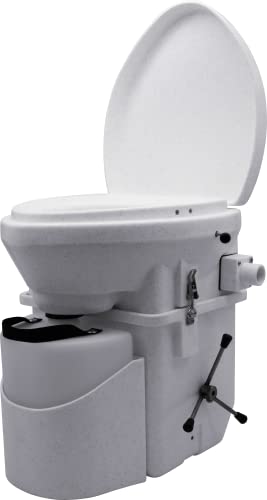
Nature’s Head Self Contained Composting Toilet (Close Quarters Spider Handle) — Best Overall
A composting dry toilet, and the category’s best-known name for good reason. Urine diverts to a bottle at the front; solids drop into a chamber of coir or peat medium that you stir with the spider handle after each use; a small fan vents the housing. The chamber’s capacity and the composting process together deliver the longest intervals and the lowest consumable cost of any system here, which is why this toilet anchors off-grid homes, boats, expedition vehicles and cabins alike.
Strengths
- Weeks-long solids intervals for a couple — the fewest emptying chores here
- Consumables are just medium — the cheapest dry toilet to run
- Close Quarters handle version fits tight bathrooms and vehicle installs
Trade-offs
- Needs a vent and 12V fan power to work as designed
- Owner manages medium moisture — a small, learnable routine
- Premium tier purchase price, repaid slowly through low running costs
| System | Composting with agitator; urine diverting |
| Handle | Close Quarters Spider Handle (per Amazon listing title) |
| Ventilation | Fan-assisted |
| Verified via | Amazon listing title, 2026-11-21 |
The Nature’s Head earns Best Overall by being the dry toilet that disappears from your life most completely: seconds of handle-turning per day, a urine bottle every couple of days, a chamber every few weeks or months depending on use, and contents that come out substantially composted. Installed and vented properly, it is also effectively odourless — the standard every other system is quietly compared against.
Its demands are front-loaded: buy-in price, a vent hole, a power feed, and a first month of learning the medium. Owners who clear those hurdles tend to become the category’s evangelists. If your situation forbids the vent or the budget forbids the price, the systems below exist precisely for you.
One underreported virtue of the composting pattern: resilience. The Nature’s Head has no cartridge supply chain, no proprietary bag and no battery between you and a working toilet — medium is a commodity available anywhere, and the mechanism is a handle. In remote homes and long voyages, that independence from consumable logistics is worth as much as the low running cost that usually headlines its case.
Best for: off-grid homes, boats, cabins and serious van builds wanting minimal upkeep / Not suited for: renters who cannot vent, or buyers wanting zero learning curve
Check on Amazon to see the current listing, options and delivery details.

Separett Villa Urine-Separating Compost Toilet — Best for Homes and Cabins
A urine-separating dry toilet: the Villa splits urine to a container or drain and collects solids in a bag inside a fan-vented housing — no churning, no additives, no medium to manage. Its high-capacity design is purposed for homesteads, schoolies and cottages, and its simplicity makes it the easiest permanent dry toilet to live with: the routine is a bag change and a urine pour, and the learning curve is one sentence long.
Strengths
- Simplest permanent system — nothing to stir, dose or balance
- High-capacity design suits full-time household use
- Running cost is bags alone — near the bottom of the category
Trade-offs
- Solids leave in bags rather than composting in place
- Needs a vent and a urine plan (container or drain)
- The sitting rule is absolute — diversion depends on it
| System | Urine-separating, fan-vented |
| Additives | None needed (per Amazon listing title) |
| Capacity | High-capacity design |
| Verified via | Amazon listing title, 2026-11-21 |
Choose the Villa over the Nature’s Head when you want the toilet to be an appliance rather than a process: it asks less, forgives more, and suits households where several people — including the compost-sceptical — share the bathroom. The fan keeps room air fresh, the housing looks like a fixture, and the weekly routine is measured in minutes.
What you give up is the composter’s elegance: solids are bagged waste, not a chamber quietly converting. For most homes that is a trade happily made, which is why the Villa is the default recommendation for permanent indoor installs across this programme’s dry-toilet guides.
The Villa’s strongest long-term argument is the size of its installed base across Scandinavian cabins and off-grid homes: a system that has been emptied, wintered, repaired and re-ordered by thousands of households has had its weaknesses found and engineered out in public. For a purchase meant to serve a decade in a wall of your home, that depth of field history is a specification in itself.
Best for: permanent homes, cabins and homesteads wanting the simplest dry system / Not suited for: owners who want solids composted in the unit itself
Check on Amazon to see the current listing, options and delivery details.

Laveo Dry Flush Toilet — Best Dry Flush (No Vent, No Admin)
A dry flush toilet: press the button and the Laveo twists a liner closed around the waste, sealing it airtight into the cartridge and presenting a clean bowl. It is waterless, self-contained and — per its listing — made for tiny homes, vans, boats, camping, RVs and off-grid life. No vent, no urine plan, no medium, no sitting rule: of the three systems, this is the one that behaves most like the plumbed toilet it replaces.
Strengths
- Sealed-per-flush odour control with zero installation
- Completely guest-proof — no instructions needed
- Portable between rooms, vehicles and properties
Trade-offs
- Cartridges are a real, permanent running cost per flush
- Battery power must be maintained for the sealing mechanism
- Capacity is counted in flushes, so busy households cycle refills fast
| System | Dry flush — cartridge sealing |
| Install needs | None — waterless, self-contained |
| Made for | Tiny homes, vans, boats, off-grid (per Amazon listing title) |
| Verified via | Amazon listing title, 2026-11-21 |
The Laveo is the answer wherever the other systems’ requirements fail: the rental where you cannot drill a vent, the room with nowhere for urine to go, the household with guests, children or carers who cannot be briefed on a special toilet. Its normality is a genuine technology — the seal — and it works every single flush.
Price that normality honestly before buying: estimate your daily flush count, price a month of cartridges at that rate from the listing, and decide with open eyes. Light-use households find it trivial; heavy full-time households often migrate to separating or composting — which is a systems decision, not a verdict on this excellent unit.
Dry flush also has an underappreciated hygiene argument in shared settings: because each use is sealed at the source, the toilet’s contact surfaces stay cleaner between users than any open-bowl system, and there is no shared container being carried through living space on emptying day. In care settings, guest houses and multi-household buildings, that sealed pathway is a genuine operational advantage, not merely a comfort.
Best for: rentals, guest spaces, tiny homes and anyone needing zero-install normality / Not suited for: high-flush-count full-time households watching running costs
Check on Amazon to see the current listing, options and delivery details.
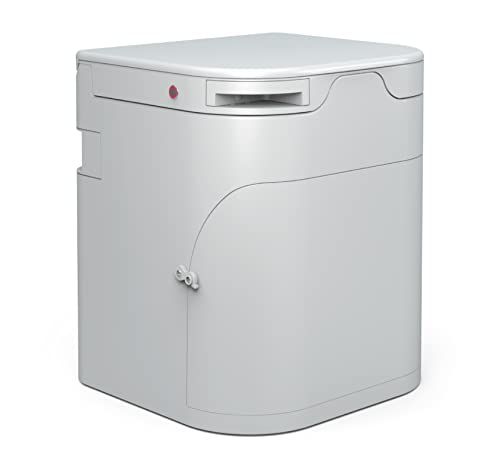
OGO Origin Compact Composting Toilet — Best Compact Composting
A compact composting toilet: the OGO Origin compresses the full composting pattern — diversion plus an agitated solids chamber — into a 15-inch footprint aimed at vans, RVs and boats. It exists for the spaces the Nature’s Head cannot enter: the van wet-room, the boat heads, the tiny-house bathroom measured in centimetres, where owners still want composting’s intervals and running costs rather than a bag routine.
Strengths
- Real composting in the smallest footprint here
- Urine diversion keeps odour down and chamber working
- Purpose-designed for vehicle and marine installs
Trade-offs
- Smaller chamber means shorter intervals than full-size composters
- Wants venting and fan power like any true composter
- Premium tier for its size
| System | Compact composting, urine diverting |
| Footprint | 15 in (per Amazon listing title) |
| Made for | Van, RV and boat (per Amazon listing title) |
| Verified via | Amazon listing title, 2026-11-21 |
Scaling composting down is not just shrinking the box — the chamber must still hold enough medium to process, and the Origin’s design keeps that balance at the cost of interval length. Expect a couple to empty solids roughly weekly-to-fortnightly rather than monthly; in exchange the consumable remains cheap medium and the toilet fits where nothing else composting will.
If your space fits a Nature’s Head, buy the Nature’s Head. If it fits 15 inches and a vent route, the Origin is the most complete dry toilet that will go in it.
Vehicle builders should note the Origin’s hidden requirement: its composting works best when the unit lives at room temperature and gets regular use, so it suits lived-in vans and boats better than vehicles stored cold and empty for months. Match the system to the vehicle’s life, not just its floor plan — a stored vehicle is happier with a simple separator, a lived-in one with a composter.
Best for: vans, boats and tiny bathrooms wanting true composting in minimal space / Not suited for: owners with room for a full-size composter and its longer intervals
Check on Amazon to see the current listing, options and delivery details.

TRELINO Composting Toilet Evo L (Gray) — Best Portable Separating
A portable urine-diverting dry toilet, in Trelino’s larger Evo L format: both containers are 2.6 gallons, the body measures about 13 by 15.4 inches per the listing, and the whole unit lifts, travels and sets down wherever a dry toilet is needed — a cabin without a bathroom build yet, a workshop, a camping pitch, a house during plumbing works. No vent, no power, no installation: separation alone does the odour work.
Strengths
- Twin 2.6 gal containers stretch intervals for a portable
- Completely installation-free and genuinely portable
- Separating system keeps odour minimal without power or chemicals
Trade-offs
- No fan — siting and airflow do the ventilation work
- Solids are bag-and-litter managed, not composted in place
- Portable seat height is lower than a fixed household toilet
| System | Urine-diverting, portable |
| Capacities | 2 x 2.6 gal (per Amazon listing title) |
| Body | Approx. 13 x 15.4 in footprint (per Amazon listing title) |
| Verified via | Amazon listing title, 2026-11-21 |
The Evo L is the dry toilet as furniture-grade equipment rather than fixture: it serves a season at a cabin, a summer of camping, a renovation month at home, then stores away. The larger containers fix the standard portable complaint — the urine side outlasting a weekend for a couple — and Trelino’s diverter geometry is among the most reliable in the class.
Permanent full-time homes should step up to the Villa or Nature’s Head for capacity and venting; everyone whose dry toilet needs to move, or whose room cannot be modified, gets in the Evo L the most capable portable separator here.
The Evo L’s grey finish earns a practical mention: portable toilets live outdoors, in boots and in garages, and a darker body hides the scuffs and dust of that life far better than white. It is a small thing — but portable equipment is judged by how it looks in year three, and this is the pick that ages most gracefully in a working environment.
Best for: cabins, camping, workshops and temporary or portable indoor use / Not suited for: permanent main bathrooms wanting a fixed, vented install
Check on Amazon to see the current listing, options and delivery details.

Compo Closet Cuddy Composting Toilet — Best Budget-Friendly Compact
A compact composting toilet: self-contained and waterless, 3.9-gallon capacity, a 12V fan for ventilation, and a design brief spanning RVs, vans, boats, tiny homes and off-grid use. The Cuddy brings the composting pattern — diversion plus a managed solids side — to the smallest spaces and the more moderate budgets in this guide, for single occupants and couples whose alternative is a full-size unit that will not fit.
Strengths
- Compact, self-contained composting with fan ventilation
- Suits the smallest spaces — studios, vans, tiny homes
- Moderate tier compared with the premium composters
Trade-offs
- 3.9 gal class capacity means the shortest intervals among the composters here
- Needs 12V power for the fan
- Best for one to two users; households will outgrow it
| System | Composting, self-contained |
| Capacity | 3.9 gal (per Amazon listing title) |
| Ventilation | 12V fan |
| Verified via | Amazon listing title, 2026-11-21 |
The Cuddy’s role in the dry-toilet landscape is access: it puts a fan-vented, self-contained composter into spaces and budgets the premium units cannot reach. A studio dweller, a van builder or a tiny-house owner gets genuine odour control and a manageable routine, accepting shorter intervals as the price of the footprint.
Size it honestly — one person full-time or a couple part-time is its happy load — and it is among the most likeable small dry toilets available. Ask it to serve a family and the same unit becomes a chore machine; the guide’s sizing advice exists to prevent exactly that mismatch.
The Cuddy’s fan deserves a final word, because at this size owners sometimes skip powering it to save effort — resist that. The fan is what converts a compact composter from ‘surprisingly fine’ to genuinely odourless in a small room, and its draw is small enough to run from the same 12V supply as a light. Wire it once, properly, and the toilet will repay the hour every day.
Best for: single occupants, couples and the smallest spaces on a moderate budget / Not suited for: families or high-traffic installs
Check on Amazon to see the current listing, options and delivery details.
Comparison Table
Read across by system: composting (Nature’s Head, OGO, Cuddy) minimises running cost; separating (Villa, Trelino) minimises routine; dry flush (Laveo) minimises explanation. Capacity descends roughly with footprint.
| Pick | Badge | Key spec | Best for |
|---|---|---|---|
| Nature’s Head Self Contained Composting Toilet (Close Quarters Spider Handle) | Best Overall | Agitated compost chamber, urine diverting | Most dry-toilet buyers |
| Separett Villa Urine-Separating Compost Toilet | Best for Homes and Cabins | Urine-separating, high capacity, no additives | Permanent homes |
| Laveo Dry Flush Toilet | Best Dry Flush (No Vent, No Admin) | Dry flush cartridge sealing, no vent | Zero-install use |
| OGO Origin Compact Composting Toilet | Best Compact Composting | Composting, 15-inch footprint | Tight installs |
| TRELINO Composting Toilet Evo L (Gray) | Best Portable Separating | Portable separating, 2 x 2.6 gal | Portable use |
| Compo Closet Cuddy Composting Toilet | Best Budget-Friendly Compact | Compact composting, 3.9 gal, 12V fan | Small spaces, small budgets |
How to Choose a Dry Toilet: The Three Systems, Compared Honestly
Separating toilets are the simple middle: urine diverted, solids bagged, a fan if fitted. They install easily, run on bags, forgive beginners, and suit permanent homes that want minimum process. Composting toilets are the low-cost marathoners: a chamber, medium and a stir convert solids over time, giving the longest intervals and cheapest running, at the price of a vent, fan power and an owner who will learn the medium. Dry flush toilets are the convenience champions: sealed per flush, no vent, no rules for guests — and a cartridge bill that scales with every use.
Match the system to the setting
Homes and cabins with an external wall: separating or composting, vented, with urine to a container or drain. Vehicles and boats: compact composting or portable separating, secured and vented where possible. Rentals and unmodifiable rooms: dry flush, because it asks the building for nothing. Emergency and occasional use: portable separating or a bag system (covered in the camping guide). High-traffic and guest-heavy: dry flush for normality, or high-capacity separating for economy — but not a compact anything.
The three numbers that matter
Interval (how many days of your household’s use between emptying jobs), consumable cost per month at that use, and installation requirements (vent? power? neither?). Get those three for any model you consider — the reviews above give them in comparable form — and the right dry toilet usually selects itself. Ignore headline capacity claims measured in ‘uses’ without a household size attached; a use is not a unit of time.
Dry Toilet Running Costs and Routines: What Ownership Actually Looks Like
Weekly life with a separating toilet: pour the urine container every couple of days, swap the solids bag when it reaches its line, wipe the seat. With a composter: turn the handle seconds a day, keep an eye on moisture, empty the chamber a few times a season. With dry flush: change the cartridge when its count runs out, keep the battery charged, and put the sealed bag out with household waste. None of these routines exceeds a few minutes a week; all of them fail socially when skipped, because a dry toilet’s odour control is a system of habits as much as hardware.
Money follows the same pattern in reverse order of effort. Dry flush costs the most per week — every flush spends liner — separating costs bags, composting costs medium and a fan’s trickle of electricity. Over a five-year full-time life, the purchase prices in this guide are almost irrelevant next to those streams: the dearest unit here (a premium composter) is typically the cheapest to own, and the mid-priced dry flush the dearest. Occasional use inverts the maths completely, which is why cabins and annexes rationally choose convenience.
Disposal is the last ownership fact: bagged solids and sealed dry-flush waste go with household waste where local rules allow and are carried out from wild sites; urine goes to a toilet, drain or suitable ground away from water; finished compost is handled per maker and local guidance. Dry toilets are low-impact when the disposal half is done properly — build it into the routine from day one.
How to Install and Use a Dry Toilet: Venting, Sitting and the First Month
Most dry toilets install in under an hour: position with knee room, secure in vehicles, fit the vent pipe through a wall or window route with a cowl where the system uses one, connect urine to its container or drain, supply fan power, load medium or the first bag or cartridge, and brief every user. The briefing is part of the installation: separators and composters require sitting for every use — the diversion geometry depends on it — and that single habit prevents most of the problems new owners report.
- Keep the toilet’s consumable stocked: a spare bag roll, medium or cartridge set in reserve at all times.
- Vent fans run continuously on composting and separating installs — that trickle of moving air is the odour system’s backbone.
- In vehicles and boats, secure the unit before moving and travel with containers capped; a dry toilet is spill-resistant, not spill-proof.
- Clean with mild, non-abrasive products only — harsh chemicals can kill a compost chamber’s process and damage seals.
- In the first month, check the solids side weekly whatever the manual’s interval says, until you know your household’s real rhythm.
The first month is calibration for every system: moisture in a composter, bag timing in a separator, cartridge pace in a dry flush. Owners who treat it as learning end up with a toilet they forget about; owners who expect plumbed-toilet invisibility from day one sometimes blame good equipment for a skipped lesson.
The Dry Toilet Decision in Five Questions
If the comparison sections have left you circling, these five questions, answered honestly, settle the category for almost every household. One: can the space take a small vent to outside? If not, your answer is dry flush, and the remaining questions are about model and refill budget. Two: how many people, full-time? One or two suits every system; three or more pushes you to high-capacity separating or composting, sized as the reviews direct. Three: what is your honest monthly consumable budget? Near-zero means composting; modest means separating; comfortable means dry flush is available to you. Four: who else uses this toilet? Guests, children, tenants and care recipients all argue for the system that needs no briefing — dry flush — or for the simplest separator. Five: how long will this toilet serve? A season argues portable; a decade argues the established, vented, high-capacity end of the market.
Notice what is not among the five: brand, colour, and the feature list on the box. Dry toilets are infrastructure disguised as appliances, and infrastructure is chosen on setting, load, budget, users and lifespan. The six picks in this guide map cleanly onto the answers — the benchmarks (Nature’s Head, Villa, Laveo) for the three systems, the compacts (OGO, Cuddy) where space rules, and the portable (Trelino) where the toilet must move.
And if your answers point two ways at once — vent possible but guests frequent, budget tight but occupancy high — that is a real configuration, not indecision: it is the case for the separating middle, or for the two-toilet strategy some households adopt (a high-capacity separator as the daily unit, a portable dry flush for guests and travel). The guides linked below explore each branch in the depth a purchase this permanent deserves.
Dry Toilets and Water Saving: the Quiet Environmental Case
The environmental argument for dry toilets is usually made loudly and vaguely; here it is, quietly and specifically. A conventional toilet is among the largest single users of drinking-quality water in a home, flushing litres of treated water per use to move waste a body produced with almost none. A dry toilet reduces that figure to zero — not by efficiency, but by design: there is no flush because there is nothing to flush with. In water-stressed regions, in homes on wells or rainwater tanks, and in any building where water arrives by effort, that is not a lifestyle statement; it is the arithmetic that makes the house viable.
The honest offsets belong in the same paragraph. Dry systems consume other things instead — bags, medium, cartridges, a fan’s trickle of power, and the transport embedded in all of them — and their waste still enters a disposal stream that must be managed properly. The balanced verdict is that a well-run separating or composting toilet has a genuinely light footprint, a dry flush a heavier but still water-free one, and all of them beat flushing where water is scarce or plumbing impossible. Choose the system your setting justifies, run it properly, and the environmental case takes care of itself.
A Brief History of the Modern Dry Toilet — and Where It Is Going
The modern dry toilet descends from two lineages that converged. The first is the Scandinavian cabin tradition, where Separett and its predecessors refined urine separation over decades of off-grid summers: the insight that separation, not chemistry, is the master key to odour. The second is the marine and RV world, where Nature’s Head and its rivals miniaturised true composting for spaces with no room and no patience, adding the agitator and the fan. Dry flush arrived third, from the care and portable-sanitation world, trading consumables for a sealed, appliance-like experience that needs no user education at all.
The direction of travel is visible in this guide’s own picks: sensors that warn before a container overflows, compact composters shrinking toward a one-foot footprint, and refill ecosystems becoming the real competition between brands. The next decade’s dry toilet will likely be judged less on its bowl than on its system — the availability of its consumables, the intelligence of its warnings, and the honesty of its capacity claims. Which is to say, it will be judged exactly as this guide has judged the current six, and buyers who learn to shop by system now will shop well then too.
Dry Toilets in Emergencies and Grid-Down Situations
One use case cuts across every setting in this guide and deserves explicit treatment: the dry toilet as emergency infrastructure. When water stops — a burst main, a frozen supply, a natural disaster, a plumbing failure in a finished house — a plumbed toilet becomes unusable within a day, while every system in this guide continues working indefinitely on its stored consumables. Households in earthquake, hurricane and deep-winter regions increasingly keep a portable separator or a storable dry flush for exactly this reason, alongside water storage and lighting, as unglamorous and essential preparation.
If emergency readiness is among your reasons for buying, let it shape the choice in two ways. Favour the systems with no dependencies — non-electric separators and battery-backed dry flush with spares — and store a month of the toilet’s consumable with it, rotated like any other household stock. A dry toilet bought for daily life that doubles as the household’s sanitation insurance is among the most rational purchases in this entire category, and it is the quiet reason many owners first arrive here before staying for the everyday benefits.
Common Buying Mistakes
Choosing a system by purchase price alone. Over any real ownership period the consumable stream dominates — run the monthly maths for your household before the unit price impresses or frightens you.
Skipping the vent on a system designed for one. Separating and composting toilets are engineered around moving air; unvented, they underperform and the category gets blamed for an installation error.
- Standing at a separating or composting toilet: it defeats diversion, mixes the streams and manufactures the smell the design exists to prevent.
- Sizing by best-case capacity claims — plan intervals at your household’s real usage, in warm weather, with guests included.
- Letting consumables run out: a dry toilet without its bag, medium or cartridge is furniture, and it always happens at the least convenient hour.
- Using chemical cleaners or scented additives the maker does not approve, which can stall composting and degrade seals.
And the meta-mistake: buying a dry toilet to make a statement rather than to solve the plumbing problem in front of you. The right system, sized honestly and routined properly, is invisible infrastructure — which is the highest praise a toilet can earn.
The last mistake is temporal: waiting for the perfect dry toilet while living with a bad interim arrangement. The category is mature — the benchmarks in this guide have served households for years — and the difference between the best system and the second-best is far smaller than the difference between a well-chosen dry toilet installed this month and another year of buckets, chemicals or a bathroom that does not exist. Decide by the five questions, buy the benchmark of your system, and start the first-month calibration that turns any of these units into invisible infrastructure.
Final Recommendation
Start with the system. For most permanent settings, the Nature’s Head (composting) and Separett Villa (separating) are the two benchmarks — the first for the lowest upkeep and running cost, the second for the simplest routine. Where nothing can be installed, the Laveo dry flush delivers normality at a per-flush price. In small spaces, the OGO Origin composts in 15 inches and the Compo Closet Cuddy does it on a tighter budget; where the toilet must travel, the Trelino Evo L is the portable separator to beat.
Then narrow by setting with the specialist guides below — camping portables, permanent indoor installs, and dry flush for tiny houses each get a dedicated roundup that goes deeper than this umbrella comparison.
That invisibility is the destination every pick here is aimed at: a toilet that needs no water, fears no winter, explains itself briefly and then disappears from your attention for years. Whichever system your answers selected, you are one installation afternoon away from it.
Shortlist recap: Nature’s Head Self Contained Composting Toilet (Close Quarters Spider Handle) (best overall), Separett Villa Urine-Separating Compost Toilet (best for homes and cabins), Laveo Dry Flush Toilet (best dry flush (no vent, no admin)) — the three to price-check first; the full reviews above explain exactly who each one suits.
Best Dry Indoor Toilets Best Dry Camping Toilets Best Dry Flush Toilets Tiny Houses Best Composting Toilets Best Portable Toilets
Frequently Asked Questions
What is a dry toilet and how does it work?
A dry toilet needs no water and no drain. Depending on the system, it separates urine from solids so odour never forms, composts solids in a chamber with a carbon medium, or seals each use into an airtight cartridge liner. All three avoid plumbing entirely, which is why they serve off-grid homes, cabins, boats, vans and rooms a plumber cannot reach.
Do dry toilets smell?
Properly installed and used, no. Odour in conventional portable toilets comes mainly from urine and solids mixing; dry systems prevent that by separation, by composting with ventilation, or by sealing each use. Smell complaints almost always trace to a missing vent, a skipped emptying routine, or standing at a separating toilet, which defeats its diverter.
Which dry toilet system is cheapest to run?
Composting, over time: its consumable is a bag of coir or peat medium per chamber cycle, plus a fan’s small power draw. Separating toilets cost a compostable bag per solids change. Dry flush costs the most per use because every flush consumes cartridge liner — the price of its zero-install convenience.
Can a dry toilet be a home’s only toilet?
Yes, in the right size class. High-capacity separating and composting models — the Separett Villa and Nature’s Head class — are designed and widely used for full-time service. Compact and portable models suit second bathrooms, annexes and travel better. Match capacity class to household size.
How do you empty a dry toilet?
By system: urine containers pour into a toilet, drain or suitable ground away from water; bagged solids and sealed dry-flush waste go with household waste where rules allow and are carried out from wild sites; compost chambers are emptied a few times a season, with finished material handled per the maker and local guidance. Gloves and two minutes are the standard equipment.
Do dry toilets need electricity?
Some do, a little: vent fans on composting and many separating models draw a few watts, often 12V, and dry flush models run their sealing mechanism from batteries or a rechargeable pack. Fully non-electric separating models also exist for off-grid and emergency use, relying on separation and room airflow alone.


