Disclosure: airfryerkitchensupply.com is reader-supported. When you buy through links on our site, we may earn an affiliate commission at no extra cost to you.
Where to buy
If you are comparing the best dry indoor toilets worth your money, start with this verified shortlist. Every toilet below was confirmed against Amazon’s catalogue data before it earned a link, with one stated exception: the Sun-Mar Excel appears as a pick without a link because our verification search returned only its compost accessories, not a toilet listing — it is reviewed on its established merits with no buying link, rather than linked to the wrong product. For the linked picks, check the listing for the configuration you need, since vent kits and containers vary.
- Separett Villa Urine-Separating Compost Toilet — Check the current price on Amazon
- Nature’s Head Self Contained Composting Toilet (Foot-Spider Handle) — Check the current price on Amazon
- Laveo Dry Flush Toilet — Check the current price on Amazon
- Separett Weekend Prime Urine-Separating Compost Toilet — Check the current price on Amazon
- Sun-Mar Excel Composting Toilet — sold direct by the maker and through specialty retailers; see the review below for how to buy it.
- Compo Closet Cuddy Composting Toilet — Check the current price on Amazon
Indoor dry toilets divide by what they do with urine and air: separating and composting models want a small vent to outside and somewhere for urine to go, while dry flush models want neither but eat cartridges. Read the system line in each review before the badge — indoors, the system is the decision.
The best dry indoor toilets exist for the rooms plumbing forgot: the basement flat without a soil pipe, the cabin bedroom, the workshop or studio conversion, the granny annexe, the off-grid home, the spare room that becomes a carer’s base. A dry indoor toilet needs no water supply and no drain — instead it separates, composts or seals waste on the spot — which means it can be installed in an afternoon in a room a plumber would need a week and a trench to serve. This guide ranks six options for indoor life specifically: quiet, odour-controlled, presentable enough to live with, and sized for real rooms rather than vehicle cupboards.
Indoor use raises the bar in two ways camping never does. Odour control must be absolute, because the toilet shares air with living space permanently, not for a weekend. And the emptying routine must be sustainable week after week, year after year — a system that is charming for a holiday becomes a burden if its consumables are dear or its chamber is fiddly. The picks below are therefore weighted for the long indoor haul: Separett’s high-capacity separator as the overall choice, two true composters, a dry flush for zero-admin rooms, a non-electric cabin model, and the compact Cuddy for the smallest indoor spaces. One pick is not linked for the honest reason stated above and in its review.
One boundary is worth drawing before the reviews: this guide assumes the toilet will be the room’s permanent or long-term fixture, used daily by a known household. That assumption drives every ranking — capacity classes are judged at full-time load, fans are judged as appliances that will run for years, and consumable costs are compared at household volumes. If your indoor need is actually temporary — a renovation month, a single convalescence — the portable end of the camping guide will serve you better and cheaper, and the final section links it.
In this guide
Quick Picks
Six indoor dry toilets across the three systems. Start with how permanent the room is and whether it can take a small vent — those two answers pick your system, and the badges pick your model.
- Separett Villa Urine-Separating Compost Toilet — Best Overall Indoor: a high-capacity urine-separating toilet with no additives or mixing — the proven indoor dry toilet for homes, homesteads and cottages, with bags and a vent doing the work. Check price on Amazon.
- Nature’s Head Self Contained Composting Toilet (Foot-Spider Handle) — Best Composting Indoor: the true composter — an agitated chamber that turns solids toward compost over weeks, with urine diverted and a fan vent, in the foot-spider handle version. Check price on Amazon.
- Laveo Dry Flush Toilet — Best Zero-Admin (No Vent Needed): the dry flush option — seals every use into its cartridge, needs no vent, no drain and no instructions, for indoor rooms where nothing can be drilled or plumbed. Check price on Amazon.
- Separett Weekend Prime Urine-Separating Compost Toilet — Best Non-Electric for Cabins: Separett’s non-electric separator — self-contained, made for off-grid living and emergency use, for indoor rooms with no power to spare. Check price on Amazon.
- Sun-Mar Excel Composting Toilet — Best High-Capacity Centre: the long-established high-capacity composter for full-time indoor homes — included unlinked because our verification found no Amazon listing for the toilet itself (see the review note).
- Compo Closet Cuddy Composting Toilet — Best for Small Indoor Spaces: a compact self-contained composter with a 3.9 gal capacity and 12V fan — the indoor dry toilet for the box room, studio corner and small annexe. Check price on Amazon.
How These Picks Were Chosen
Selection started with indoor suitability: a pick had to be designed or widely used for permanent indoor installation — proper seat, presentable housing, a credible odour strategy for shared living air. Vehicle-only portables were excluded. Every candidate was then checked against Amazon’s catalogue data with brand and model matched before receiving a link; the single exception is disclosed rather than hidden — the Sun-Mar Excel’s verification search returned only its compost accessories, so it appears unlinked with no link, on the strength of its long record as a high-capacity indoor composter.
We weighted odour strategy first: fan-vented composters and separators for permanent rooms, sealed dry flush where no vent is possible. Then the ownership routine — consumable cost per month of indoor living, chamber or container sizes relative to household count, and how much of the job is lifting, pouring or stirring. Noise mattered too: a vent fan that hums through a bedroom wall at night is a real specification indoors, and the reviews note where a system is silent by design.
Finally, we spread the list across the genuine indoor situations: the main bathroom of an off-grid home, the annexe or cabin room, the no-vent-possible interior room, and the very small space. If your room has a soil pipe nearby and a modest budget, a macerating or conventional toilet may beat everything here — dry toilets earn their premium specifically where plumbing cannot go.
Noise and air movement were checked as indoor-specific criteria that camping roundups ignore. A vent fan’s job indoors is continuous duty in a quiet house, so we favoured systems whose fans are small, low-speed and designed for permanent running, and we noted the one pick — the non-electric Separett — that removes the question entirely. We also considered what each unit does to a small room’s air in winter, when windows stay shut for months: vented systems exhaust a small, steady stream of air, which is the correct trade for freshness, while the dry flush’s sealed approach exhausts nothing at all.
The 6 Best Dry Indoor Toilets
Each review names its system first, then who it suits, strengths, trade-offs, verified specification points and a verdict. The unlinked pick is labelled in its heading note and carries no link.

Separett Villa Urine-Separating Compost Toilet — Best Overall Indoor
The Villa is the indoor dry toilet against which others are measured: urine separates at the seat to a container or drain, solids collect in a bag inside the housing, a small fan vents the unit to outside air, and that is the entire system — no additives, no churning, no chemicals. Its high-capacity design is rated by Separett for homestead, schoolie and cottage use, and decades of Scandinavian cabin life stand behind the pattern. For a permanent indoor install, it is the balanced default.
Strengths
- Simple, proven separating system with nothing to stir or dose
- High-capacity design suits full-time indoor living
- Fan venting keeps the room’s air genuinely fresh
Trade-offs
- Needs a vent route to outside and a plan for urine — container or drain
- Solids are bagged, so there is a bag routine, though a cheap one
- Guests need one sentence of instruction (sit, always)
| System | Urine-separating, fan-vented |
| Additives | None needed (per Amazon listing title) |
| Capacity | High-capacity design |
| Verified via | Amazon listing title, 2026-11-21 |
The Villa’s indoor virtues are quiet ones: the fan is a whisper rather than a drone, the housing looks like a bathroom fixture rather than equipment, and the weekly routine — check the urine side, change the solids bag on its cycle — takes minutes and costs bags, not cartridges. Because urine never meets solids, the room-scale odour problem that haunts lesser dry toilets simply does not develop.
It asks for the two installations dry toilets can ask for: a vent hole and a urine plan. In return it gives the lowest-admin permanent indoor service here short of dry flush, without dry flush’s refill bill. For the main bathroom of a waterless home, this is the pick to beat.
A permanent-install tip that owners repeat: fit the urine side to a drain if your building allows it, even if that means a slightly longer installation day. The container routine is perfectly workable, but the drained Villa is the closest a dry toilet comes to plumbed-toilet invisibility — the bag change becomes the only recurring job, and it is a monthly-scale job in many households rather than a weekly one.
Best for: permanent indoor installs in off-grid homes, annexes and cottages / Not suited for: rooms where no vent can be fitted, or zero-admin seekers
Check on Amazon to see the current listing, options and delivery details.

Nature’s Head Self Contained Composting Toilet (Foot-Spider Handle) — Best Composting Indoor
Where the Villa bags its solids, the Nature’s Head composts them: solids fall into a chamber of coir or peat medium, a turn of the handle after use mixes and aerates, urine diverts to its own bottle, and a small 12V fan vents the housing. Indoors, that means the longest solids interval of any pick here and a chamber whose contents, when finally emptied, are substantially broken down rather than fresh — the deepest version of the dry-toilet idea, for owners willing to run a process.
Strengths
- Agitated compost chamber gives weeks-long solids intervals
- Medium costs pennies per cycle compared with bags or cartridges at volume
- Foot-spider handle version suits its install footprint well
Trade-offs
- Needs 12V for the fan and a vent route to work as designed
- The owner manages moisture and medium — a light but real gardening mindset
- Urine bottle still wants emptying every couple of days for a couple
| System | Composting with agitator; urine diverting |
| Handle | Foot-Spider Handle (per Amazon listing title) |
| Ventilation | Fan-assisted, 12V |
| Verified via | Amazon listing title, 2026-11-21 |
Indoor composting succeeds or fails on moisture: too wet and the chamber sulks, too dry and it stalls. The Nature’s Head design — diversion keeping urine out, the handle keeping air in — stacks the odds correctly, and owners who learn the medium’s look and feel in the first month settle into a rhythm of seconds per day. The payoff is a main-bathroom dry toilet whose solids leave the house a few times a season, carried out as a chamber of earthy material rather than a parade of bags.
Choose it over the Villa if your household is large, your usage heavy, or your principles and budget both favour process over consumables. Choose the Villa if you want the toilet to ask almost nothing of you. Both are honourable indoor answers; they are answers for different owners.
Indoor composting has one seasonal rhythm worth knowing: the chamber’s process slows in a cold room and thrives in a warm one, so a toilet in an unheated annexe will want its medium a little drier and its intervals a little more generous in winter. It is a small calibration, learned in the first cold snap, and it is the kind of honest operational detail that separates owners who love these units from owners who were never told.
Best for: full-time indoor homes wanting true composting and long intervals / Not suited for: owners wanting a fit-and-forget toilet with no medium to manage
Check on Amazon to see the current listing, options and delivery details.

Laveo Dry Flush Toilet — Best Zero-Admin (No Vent Needed)
The Laveo is the indoor pick for the room that cannot be modified: a rental annexe, a listed building, a spare room pressed into service, anywhere a vent hole or urine drain is impossible or forbidden. It is waterless and self-contained; each flush seals the waste airtight into the cartridge, so the room needs nothing from the toilet and the toilet needs nothing from the room except floor space and battery power.
Strengths
- No vent, no drain, no plumbing — installs in any room in minutes
- Sealed-per-flush system is the most guest-proof indoor option
- Zero routine beyond cartridge changes and charging
Trade-offs
- Cartridge refills are a permanent, non-trivial running cost
- Not a fixed fixture — it sits in the room rather than being installed
- Flush-count capacity suits one room’s use, not a whole busy household’s
| System | Dry flush — seals each use in a cartridge liner |
| Install needs | None — waterless, self-contained, no vent |
| Made for | Tiny homes, off-grid and more (per Amazon listing title) |
| Verified via | Amazon listing title, 2026-11-21 |
Indoors, the Laveo’s party trick is social: it is the only dry toilet a visitor can use correctly with no briefing, and the only one whose bathroom never needs the ‘it’s a special toilet’ conversation. For a carer’s room, a guest annexe or a home worker’s garden-room office, that normality can be worth more than the refill bill costs.
Do the cartridge maths for your room’s traffic before buying — a lightly used annexe toilet is cheap to run, a busy household’s only toilet is not. The dry flush tiny-house guide linked below works through that estimation in detail.
Renters should read this pick with their deposit in mind: the Laveo leaves no trace in a room — no holes, no marks, no plumbing alterations — which makes it the only system here fully compatible with a strict tenancy. When the tenancy ends, the toilet leaves with you and the room is exactly as found. For a growing slice of indoor dry-toilet buyers, that reversibility is the deciding feature, ahead of every specification.
Best for: rooms that cannot take a vent or drain, and guest or care spaces / Not suited for: high-traffic main bathrooms where cartridge costs compound
Check on Amazon to see the current listing, options and delivery details.
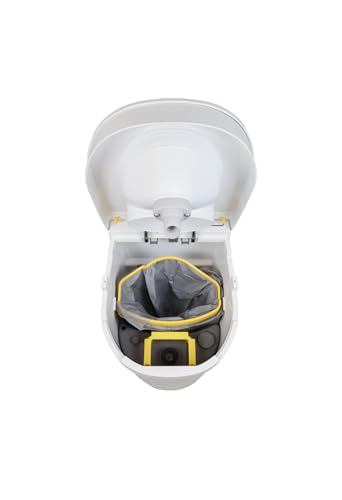
Separett Weekend Prime Urine-Separating Compost Toilet — Best Non-Electric for Cabins
The Weekend Prime strips the separating toilet to its essentials: no electricity at all, self-contained, urine separated from solids, designed — per its listing — for off-grid living, emergency use and even bunkers. Indoors, that makes it the pick for the cabin room, the unpowered annexe, the off-grid home rationing its battery bank, or the prepared household that wants a toilet which works in a blackout exactly as it works on a normal day.
Strengths
- Completely non-electric — nothing to charge, wire or fail
- Self-contained separating system with Separett’s proven geometry
- Suits off-grid and emergency indoor use by design
Trade-offs
- No fan means odour control leans entirely on separation and room airflow
- Capacities are weekend-class rather than full-household-class
- Bag-based solids, with the usual bag routine
| System | Urine-separating, non-electric |
| Format | Self-contained |
| Made for | Off-grid living, emergency use (per Amazon listing title) |
| Verified via | Amazon listing title, 2026-11-21 |
Non-electric is a genuine feature indoors where power is scarce or unreliable: the Weekend Prime asks the house for nothing, and in a cabin that is visited monthly it also asks nothing between visits — no battery to self-discharge, no fan to seize. Separation does the odour work, helped by a room with any natural airflow.
It is not the full-time main-bathroom answer — capacities and the fanless design see to that — but as the indoor toilet for cabins, outbuildings and emergency readiness, it is the most self-sufficient pick on this page.
The Weekend Prime’s bunker-and-emergency billing undersells a domestic virtue: it is the indoor toilet that cannot be broken by a power cut, a flat battery bank or a failed fan, because it has none of those parts. In regions with unreliable supply — or in homes that simply prize mechanical simplicity — that absence of failure modes is a design philosophy, and this is its purest expression in the guide.
Best for: unpowered cabins, annexes and off-grid rooms; emergency preparedness / Not suited for: busy full-time main bathrooms
Check on Amazon to see the current listing, options and delivery details.
Sun-Mar Excel Composting Toilet — Best High-Capacity Centre
The Sun-Mar Excel is one of the original self-contained composting toilets: a larger unit with a rotating drum chamber, designed for continuous full-time indoor use by a household, and sold for decades into off-grid homes and cottages. It is included here unlinked — our catalogue verification for this guide found listings for Sun-Mar’s compost accessories but not for the toilet itself, so rather than link you to the wrong product, this review carries no buying link; the Excel is bought direct from Sun-Mar or through sanitation retailers.
Strengths
- Drum composting chamber sized for continuous household use
- Long-established design with a deep base of off-grid homes using it
- Handles full-time traffic that overwhelms weekend-class units
Trade-offs
- Larger and heavier than the other picks — a committed install
- Electric versions draw power for fan and (on some) heater; non-electric variants exist in the range
- No verified Amazon listing found for this guide — buying is direct or via specialist retailers
The Excel represents the heavy end of indoor composting: where the Nature’s Head is a chamber you stir, the Sun-Mar is a drum you rotate, processing a household’s solids continuously and dropping finished material to a finishing drawer. For a full-time off-grid family home, that capacity is the argument — the toilet is sized like infrastructure because it is infrastructure.
Buy it with the diligence a direct purchase deserves: confirm the exact variant (electric or non-electric), its vent kit and its capacity rating for your household size with the seller, and price the compost bulking mix it uses. Owners who do that homework tend to run these units for many years; it remains the high-capacity benchmark this category is judged against, which is why it belongs in an honest indoor roundup even without a link.
Because this pick is bought direct, one more piece of homework is worth specifying: ask the seller for the capacity rating in people for full-time residential use (not weekend use), the vent kit contents, and the power draw of the exact variant you are ordering. Sun-Mar’s range spans electric and non-electric configurations with meaningfully different installs, and the right variant chosen at order time is the difference between infrastructure and an expensive lesson.
Best for: full-time off-grid family homes needing maximum composting capacity / Not suited for: small rooms, light use, or buyers who want one-click marketplace ordering
Buying note: this model is sold direct by the maker rather than through a marketplace listing we could verify, so there is no Amazon link for it — order from the manufacturer’s own store and confirm the configuration before you pay.

Compo Closet Cuddy Composting Toilet — Best for Small Indoor Spaces
The Cuddy is the compact end of indoor dry toilets: a self-contained composting unit, waterless, with a 3.9-gallon capacity and a 12V fan, designed for RVs, vans, boats, tiny homes and off-grid use. Indoors, that translates to the toilet for the smallest rooms — the under-stairs conversion, the studio’s bathroom corner, the narrowboat-style annexe — where a Villa or Nature’s Head simply will not fit the floor plan.
Strengths
- Compact footprint fits genuinely small indoor spaces
- 12V fan ventilation keeps a small room’s air fresh
- Self-contained and waterless — no plumbing or drain needed
Trade-offs
- 3.9 gal class capacity means shorter intervals than the big units
- Needs 12V power for the fan
- Small-room buyers should check seat height comfort for taller users
| System | Composting, self-contained |
| Capacity | 3.9 gal (per Amazon listing title) |
| Ventilation | 12V fan |
| Verified via | Amazon listing title, 2026-11-21 |
Small indoor spaces punish big toilets twice — once in floor area, once in visual bulk — and the Cuddy is proportioned to avoid both while keeping the essentials: diversion, a fan, and a sealed self-contained body. For a single occupant or a couple in a compact annexe, its intervals are workable and its consumables modest.
It is the specialist pick: households with room for the Villa should take the Villa’s capacity, while rooms measured in centimetres get, in the Cuddy, a proper composting toilet rather than a camping bucket in disguise.
The Cuddy also makes a thoughtful second toilet: a small en-suite corner, a loft conversion or a teenager’s annexe where a full install is overkill but a real, fan-vented dry toilet is genuinely needed. Second bathrooms are where dry toilets quietly win their largest indoor market, because the alternative — new soil pipe runs through a finished house — is so disproportionately expensive.
Best for: the smallest indoor rooms — studios, box-room conversions, tiny annexes / Not suited for: households of three or more in full-time use
Check on Amazon to see the current listing, options and delivery details.
Comparison Table
Systems divide the list: separating (Villa, Weekend Prime), composting (Nature’s Head, Sun-Mar, Cuddy) and dry flush (Laveo). The Sun-Mar is not linked — no verified listing was found for the toilet itself.
| Pick | Badge | Key spec | Best for |
|---|---|---|---|
| Separett Villa Urine-Separating Compost Toilet | Best Overall Indoor | Urine-separating, high capacity, fan vented | Most indoor homes |
| Nature’s Head Self Contained Composting Toilet (Foot-Spider Handle) | Best Composting Indoor | Agitated compost chamber, urine diverting | Heavy full-time use |
| Laveo Dry Flush Toilet | Best Zero-Admin (No Vent Needed) | Dry flush sealing, no vent needed | Unmodifiable rooms |
| Separett Weekend Prime Urine-Separating Compost Toilet | Best Non-Electric for Cabins | Non-electric urine-separating | No-power rooms |
| Sun-Mar Excel Composting Toilet | Best High-Capacity Centre | Drum composter, household capacity | Full-time family homes |
| Compo Closet Cuddy Composting Toilet | Best for Small Indoor Spaces | Compact composting, 3.9 gal, 12V fan | Smallest rooms |
How to Choose a Dry Indoor Toilet: Vent, Urine and Admin — the Three Indoor Questions
First question: can the room take a small vent to outside air? If yes, the separating and composting systems open up, with their low running costs and long intervals; a vent is typically a modest hole through a wall with a cowl, well within DIY or handyman scope. If no — rentals, listed buildings, internal rooms — dry flush is your system, because it is the only one that asks for nothing. Decide this before falling for any model, because it halves the list instantly.
Second question: where does the urine go?
Separating and composting toilets produce a stream of urine that must go somewhere: a removable container emptied every couple of days (simplest, no install), a drain into an existing grey-water line or soakaway where regulations allow (the set-and-forget option for permanent homes), or — on composters — a smaller diverted bottle because some moisture enters the chamber system differently. For a permanent indoor install, plumbing the urine to a drain is the single upgrade that most improves daily life; for a temporary room, the container is fine and keeps the install reversible.
Third question: how much admin will you actually do?
Be honest at the level of years, not weekends. Dry flush asks for cartridge changes and money. Separators ask for a bag change and a container pour each week or so. Composters ask for medium, moisture judgement and a chamber empty a few times a season. None is onerous; all are resented when they surprise. The right indoor toilet is the one whose routine you can picture yourself doing, without irritation, in year three.
Running Costs Indoors: Cartridges vs Bags vs Medium, Year After Year
Indoor dry toilets are bought once and fed forever, so compare feeding costs at your household’s usage. Dry flush is the dearest to feed by a wide margin — every flush consumes a share of a cartridge — and the most convenient. Separating toilets are the cheapest per week after a composter: a compostable bag per solids cycle and nothing else, with urine free to dispose of. Composters cost medium per chamber cycle plus a small fan’s electricity; at household volumes that is typically the lowest cash cost of all, paid for with the owner’s attention instead of money.
Capacity interacts with cost in a way listings obscure: a high-capacity unit (Villa, Nature’s Head, Sun-Mar class) stretches every interval, so its consumables are bought and changed less often, while compact units in full-time use cycle quickly. A compact toilet in a busy home is not a saving; it is a subscription. Size the unit to the household as the reviews indicate, and the running costs land where the guide says they will.
Finally, price the unglamorous extras before buying: vent kits, extra urine containers, a second compost chamber rotation if your system uses one, and the delivery cost of bulky medium or cartridges to an off-grid address. None is large; together they are the difference between the advertised cost of dry living and the real one.
How to Install and Live With a Dry Indoor Toilet: Venting, Routines and Keeping It Fresh
Installation day for a separating or composting toilet runs: position the unit with knee room and door clearance, fit the vent pipe through the wall with its cowl and insect screen, connect the urine container or drain, wire the fan to its 12V or mains supply as the model requires, load the medium or first bag, and brief the household. Dry flush skips everything except positioning and charging. Either way, keep the maker’s manual in the room for the first month — the routines below become habit faster with it to hand.
- Daily: nothing, beyond the sitting rule for separators and composters and a medium sprinkle or handle turn where the system asks for it.
- Every couple of days (couple’s use): empty the urine container into a toilet or drain, rinse it, and return it — two minutes, no ceremony.
- Weekly: check the solids side, change bags on separators when they reach the maker’s line, wipe the seat and housing with a mild cleaner.
- Seasonally (composters): empty the chamber or finishing drawer when the system indicates, wearing gloves, and dispose of or use the finished material only as local rules and the maker advise.
- Always: keep a spare bag roll, medium or cartridge set in the house, and never let the toilet’s consumable become an emergency purchase.
The freshness secret is boring consistency: vents left running, urine kept out of solids, containers emptied on schedule rather than at capacity. Indoor dry toilets that smell are almost always indoor dry toilets whose routine slipped — the technology, given its routine, keeps a room as fresh as a plumbed bathroom.
Dry Toilets and Building Reality: Vents, Drains and What ‘No Plumbing’ Really Means
‘No plumbing’ deserves a precise definition, because it is the phrase that sells dry toilets and the phrase most often misunderstood. It means no water supply and no soil pipe — the two systems that make conventional toilet installation expensive, disruptive or impossible. It does not always mean ‘no holes and no connections of any kind’: separating and composting toilets typically want a vent — a modest pipe through a wall or roof with a cowl — and offer the option of draining urine into an existing grey-water line or soakaway where regulations permit. Those are handyman-scale works, measured in an hour and a small hole, not a plumber’s week and a trench — but they are works, and a buyer whose room cannot accept even a vent hole should be reading the dry flush review, not this section.
The urine drain option deserves its own honest paragraph. Draining to an existing line removes the container routine entirely and is the single biggest quality-of-life upgrade available to a permanent install. It is also the point where local rules genuinely vary — some jurisdictions welcome grey-water-style drainage, others require the container route or a specific soakaway design. Check before you drill; the container fallback works everywhere and keeps the install fully reversible.
Vent placement has one rule that matters: exhaust above and away from windows and seating areas, with the pipe run as short and straight as the building allows. A fan-assisted vent is forgiving of imperfect runs, but physics still rewards the direct route. Get those two decisions — vent route, urine route — right on paper before installation day, and a dry indoor toilet becomes what it promises to be: a permanent bathroom that simply never needed a plumber.
Second Bathrooms, Annexes and the Economics of Not Plumbing
The indoor dry toilet’s largest real-world market is not the off-grid homestead of the imagination — it is the ordinary house that needs one more bathroom than its plumbing allows. A basement guest room, a loft conversion, a garden annexe, a carer’s base in a spare room: in each case the conventional route means a soil pipe run that can cost more than every toilet in this guide combined, involve floors and walls being opened, and end with building-control paperwork. The dry route means a unit, a vent hole in the worst case, and an afternoon.
That asymmetry explains the category’s growth and should frame your own decision honestly. Price the plumbed option properly — quote, disruption, redecoration — before assuming dry is the extravagant choice. In a great many real houses it is the economical one, with the added strategic benefit of reversibility: an annexe that stops needing a bathroom gets its room back in an hour, leaving no capped pipes in the walls. For landlords, carers and families whose needs change, that reversibility is worth money as surely as the install saving is.
Guests, Children and Carers: the Social Life of an Indoor Dry Toilet
An indoor dry toilet rarely serves one person alone, and its success with everyone else is a design consideration, not an afterthought. Guests need either a system that explains itself — dry flush — or one sentence of briefing delivered without embarrassment: ‘it’s a waterless toilet, just sit as normal and close the lid.’ Children, once told the sitting rule, are usually the most reliable users in the house, and a step that lets smaller users sit properly is a five-minute addition that pays for years. Carers and the people they support benefit most from the sealed and containerised systems, where no part of the routine involves carrying open waste through the home.
Landlords and hosts of paying guests should weight this section heaviest of all: the toilet that generates no questions is the toilet that generates no complaints, and in a rental annexe that arithmetic can outrank every running-cost table in this guide. Choose for your actual users, brief them once and kindly, and the dry toilet becomes what every bathroom should be — unremarkable, in the best possible way.
Common Buying Mistakes
Installing a fan-vented toilet without fitting the vent, ‘to try it first’. The vent is not an accessory; without it the system’s odour design is incomplete and the room will tell you so.
Choosing a compact unit for a full-time household to save money or space, then living with constant emptying. Capacity is an indoor feature, not a luxury.
- Ignoring the urine plan until installation day — container, drain or bottle is a decision that shapes the install and the daily routine.
- Letting guests guess: one sentence of briefing (and the sitting rule) prevents the misuse that causes most indoor dry-toilet smells.
- Using harsh chemical cleaners inside composting or separating units, which can kill the compost process and attack seals — mild cleaners only.
- Forgetting the fan’s power supply in the room plan, then running an ugly cable across the bathroom forever.
And the strategic error: buying dry to avoid a plumbing quote you never obtained. Where a soil pipe is genuinely within reach, a conventional or macerating toilet can be cheaper over five years — dry earns its place where plumbing cannot reasonably go.
Do not overlook the household conversation, either. An indoor dry toilet succeeds socially before it succeeds mechanically: everyone who will use it should understand its one or two rules before installation day, and anyone who will help maintain it should see the routine once, in daylight, rather than discovering it during a crisis. The households that report ‘we forget it is not a normal toilet’ are, without exception, the ones that had that conversation.
Final Recommendation
For most permanent indoor installs, the Separett Villa is the dry toilet to beat — simple, high-capacity, cheap to run, and proven over decades of cabin and homestead life. Heavy full-time households should compare the Nature’s Head’s true composting, and the Sun-Mar Excel’s drum capacity (unlinked here, bought direct). Rooms that cannot be vented belong to the Laveo dry flush; unpowered rooms to the Separett Weekend Prime; and the smallest rooms to the Compo Closet Cuddy.
If your dry toilet will live in a tiny house specifically, the dry flush tiny-house guide works the cartridge maths in detail, and the general dry toilets roundup compares all three systems across every setting.
An indoor dry toilet is a decade-scale decision disguised as an appliance purchase. Choose the system your room allows, the capacity your household needs and the routine your future self will keep, and the toilet will repay the care with years of unremarkable, odour-free service — which, for a bathroom, is the highest praise there is.
Shortlist recap: Separett Villa Urine-Separating Compost Toilet (best overall indoor), Nature’s Head Self Contained Composting Toilet (Foot-Spider Handle) (best composting indoor), Laveo Dry Flush Toilet (best zero-admin (no vent needed)) — the three to price-check first; the full reviews above explain exactly who each one suits.
Best Dry Toilets Best Dry Flush Toilets Tiny Houses Best Dry Camping Toilets Best Composting Toilets Best Toilets For Off Grid Homes
Frequently Asked Questions
Do dry indoor toilets smell?
A correctly installed and routinely kept dry toilet does not make a room smell. Separating and composting models rely on keeping urine out of solids plus a small vent fan; dry flush seals each use airtight. Smell almost always traces to a skipped vent, a missed emptying schedule, or guests standing instead of sitting on a separating model.
Can you install a dry toilet in a normal house?
Yes — that is their purpose. They need no water supply or soil pipe, so they suit basement flats, annexes, conversions and rooms far from existing plumbing. Separating and composting models want a small vent through an external wall and a plan for urine; dry flush models want neither.
What happens to the waste from an indoor dry toilet?
It depends on the system. Dry flush waste leaves sealed in its cartridge bag with household waste. Separating toilets produce a urine container to empty into a toilet or drain and a bag of solids for disposal per local rules. Composters gradually convert solids in the chamber; finished material is emptied a few times a season and handled as the maker and local rules advise.
How much electricity does an indoor dry toilet use?
Very little. Vent fans on composting and separating models are small — typically a 12V fan drawing a few watts — and dry flush models run their sealing mechanism from batteries or a rechargeable pack. The Separett Weekend Prime in this guide uses none at all.
Are dry indoor toilets suitable as a home’s only toilet?
The high-capacity models are: the Separett Villa, Nature’s Head and Sun-Mar class units are designed and widely used for full-time service. Compact and weekend-class models suit second bathrooms and annexes better. Match the unit’s capacity class to your household size, as the reviews set out.
Do you need planning permission or a plumber for a dry indoor toilet?
Generally no plumber is needed — installation is positioning, venting and (for some) a urine drain connection. Building rules vary by area, particularly around urine drainage and any new vent, so check local requirements for permanent installs; a dry flush in a temporary room typically needs nothing at all.


