Disclosure: airfryerkitchensupply.com is reader-supported. When you buy through links on our site, we may earn an affiliate commission at no extra cost to you.
Where to buy
If you are shopping for the best cooktop grills — the heavy pans that turn two burners of your stove into a grill — start with the verified shortlist below, organized by size and by the kitchens each pan suits best. Every pan was confirmed against a live Amazon listing before it earned its place in this guide.
All six picks are reversible cast iron grill/griddle pans verified: a ridged grill side for marks and drainage, and a flat griddle side for everything else a stove cooks. Confirm the pan’s dimensions against your own cooktop before ordering — fit is truly the whole game in this category — and check the current price on Amazon at the exact moment you buy.
- Lodge Reversible Cast Iron Grill/Griddle Pan 16.75 x 9.5 (LPGI3) (Best Overall) — Check the current price on Amazon
- Lodge Pro-Grid Reversible Grill/Griddle 20 x 10.5 (Best Large) — Check the current price on Amazon
- Lodge Blacklock Double Burner Griddle 10 x 20 (Lightweight) (Best Lightweight) — Check the current price on Amazon
- Victoria 20-by-14-Inch Rectangular Cast Iron Griddle (Reversible) (Best Extra-Wide) — Check the current price on Amazon
- NutriChef Cast Iron Reversible Griddle 18 x 10 (Best Budget) — Check the current price on Amazon
- Lodge Reversible Cast Iron Grill/Griddle Pan XL 16.75 x 11.5 (Best Oversized Standard) — Check the current price on Amazon
The best cooktop grills solve a specific problem beautifully: it is February, or raining, or you live in an apartment, and you want grilled food — real marks, real browning, fat draining away — from the stove you already own. A cooktop grill is a heavy cast iron pan, usually reversible, that spans one or two burners: ridges on the grill side lift food out of its fat and lay down sear marks, while the flat reverse side works as a griddle for pancakes, eggs, and smash burgers. No fuel, no assembly, no weather. Just iron, heat, and technique.
This category rewards honesty about physics. A cooktop grill will not taste like charcoal, because nothing in a kitchen produces charcoal smoke — and any pan claiming otherwise is selling you a coating, not a flavor. What a great cooktop grill does deliver is high, even, retained heat: the searing half of grilling, done indoors, in any season. The six picks below are all cast iron from makers who understand the material, and they differ in the ways that actually matter — size, weight, ridge design, and how their dimensions map onto real cooktops, including the glass-top and induction questions the buying guide answers directly.
Sizing is the category’s trap, so it is addressed up front: a double-burner pan must fit your stove’s burner spacing and your sink, or it will live in a cabinet as a monument to optimism. Every review below states the pan’s listed dimensions plainly, and the how-to section includes the measuring routine to run before ordering. Get the fit right and a cooktop grill becomes the most-used pan in a small kitchen; get it wrong and no amount of iron quality saves it.
In this guide
Quick Picks
- Lodge Reversible Cast Iron Grill/Griddle Pan 16.75 x 9.5 (LPGI3) — Best Overall: The category’s reference pan — a double-burner reversible iron with a ridged grill side and flat griddle side, PFAS-free, preseasoned, sized for the standard American stove. Check price on Amazon
- Lodge Pro-Grid Reversible Grill/Griddle 20 x 10.5 — Best Large: The big Lodge — 20 by 10.5 inches of reversible iron for cooks whose two burners and appetite both run large, with the even heat distribution the Pro-Grid name promises. Check price on Amazon
- Lodge Blacklock Double Burner Griddle 10 x 20 (Lightweight) — Best Lightweight: Lodge’s Blacklock line casts iron noticeably lighter and triple-seasons it — the double-burner format for cooks who love iron’s cooking and hate iron’s heft. Check price on Amazon
- Victoria 20-by-14-Inch Rectangular Cast Iron Griddle (Reversible) — Best Extra-Wide: The widest pan in the guide — Victoria’s 20 by 14-inch preseasoned reversible griddle covers burners and then some, for cooks whose limiting factor is elbow room. Check price on Amazon
- NutriChef Cast Iron Reversible Griddle 18 x 10 — Best Budget: The value entry — an 18 by 10-inch pre-seasoned reversible iron with flat and ridged sides, bringing genuine cast iron cooktop grilling to the friendliest tier in this guide. Check price on Amazon
- Lodge Reversible Cast Iron Grill/Griddle Pan XL 16.75 x 11.5 — Best Oversized Standard: The LPGI3’s wider XL sibling — same 16.75-inch length, a broader 11.5-inch width, for stoves whose burners spread wider and cooks who want more room per batch. Check price on Amazon
How These Picks Were Chosen
Every pan in this guide was verified against a live Amazon listing on the airfry site, with dimensions and construction taken from those listings. We required genuine cast iron — not aluminum with a grill pattern, not a coated novelty pan — because mass is the mechanism: iron stores the heat that a home burner delivers unevenly and returns it as a sear. We required reversible designs, since a single-purpose grill pan wastes the storage it occupies, and we screened out pans with nonstick coatings on the grill surface, which cannot survive true searing heat and fail exactly where the pan should be immortal.
The six survivors divide by size and weight philosophy: the balanced standard, the big professional footprint, the lightweight modern casting, the extra-wide family pan, the budget entry, and an oversized single-format variant. Lodge dominates the list because Lodge dominates the material — its foundry consistency and preseasoning are the category’s baseline — but the Victoria and NutriChef picks earn their places on dimensions and value respectively, not as token alternatives. Prices are never printed here; check the current price on Amazon when you buy, and treat tier language as guidance.
One selection note on handles and helpers: on a pan this heavy, the handle design is a safety feature, not a style choice. Every pick was checked for a grip you can hold with an oven mitt when the pan is loaded and hot, and the reviews call out weight honestly in pounds-adjacent language — ‘noticeably lighter’, ‘a two-hand lift’ — because a pan you dread lifting is a pan you will stop using, whatever its sear.
The 6 Best Cooktop Grills

Lodge Reversible Cast Iron Grill/Griddle Pan 16.75 x 9.5 (LPGI3) — Best Overall
The LPGI3 is the cooktop grill against which others are measured, because it gets the fundamentals exactly right: real cast iron mass across a 16.75 by 9.5-inch double-burner footprint, a grill side with ridges tall enough to drain fat and mark food, and a flat griddle reverse that handles breakfast without complaint. It is PFAS-free — bare seasoned iron, the original nonstick — and it arrives preseasoned so the first cook is a pleasure rather than a project.
Strengths
- Balanced size fits most double-burner spacings and most sinks — the usability sweet spot
- Ridge height and iron mass produce genuine marks and browning, not cosmetic stripes
- Lodge’s preseasoning and foundry consistency make it the reliable default
Trade-offs
- Heavy, as all honest iron is — a two-hand, mitt-on lift when loaded
- Too narrow for a full family batch of burgers at once; it is a two-burner pan, not a griddle station
- Glass-top owners should read the compatibility section below before ordering
| Specification | Detail |
|---|---|
| Dimensions | 16.75 x 9.5 in (per listing) |
| Material | Cast iron, PFAS-free |
| Design | Reversible: grill ridges / flat griddle |
| Burners | Double-burner span |
Cooking on the LPGI3 teaches the category’s core technique in one pan. Preheat it longer than feels reasonable — iron over two burners wants a full five to eight minutes at medium to even out — and it rewards you with a surface that sears a steak or a row of asparagus without the cold stripe between burners that plagues thin pans. The grill side’s ridges keep chicken thighs and burgers lifted from their drippings, and the fat channel actually collects rather than smokes. Flip it, and the griddle side does pancakes with the even, gentle browning only mass provides.
It is the pick for the standard case: a gas or coil cooktop, a household cooking for two to four, a cook who wants one pan that grills in winter and griddles on weekends. Its limits are the format’s limits — capacity and weight — not execution flaws. If your stove and sink accept its footprint, the decision is honestly this simple: buy the reference pan and spend your attention on technique.
Best for: Most households with a standard cooktop who want one reversible iron that does both jobs well / Not suited for: Large-batch cooks (size up), or anyone who cannot lift a heavy pan safely with mitts
Check on Amazon — check the current price on Amazon before ordering.

Lodge Pro-Grid Reversible Grill/Griddle 20 x 10.5 — Best Large
The Pro-Grid is the LPGI3’s larger sibling for cooks who found the standard pan’s capacity, not its quality, limiting. At 20 by 10.5 inches it covers more of the cooktop, fits a family batch of burgers or a serious row of chops, and carries the same reversible logic — ridged grill on one face, flat griddle on the other — in a casting built for even heat distribution across its wider span.
Strengths
- Largest mainstream Lodge footprint — batch cooking without a second round
- Even-heat casting design addresses the wide-pan cold-middle problem directly
- Same PFAS-free seasoned iron and Lodge support as the reference pick
Trade-offs
- The heaviest pan in this guide — a committed two-hand lift, full stop
- 20 inches challenges smaller sinks for washing and smaller cabinets for storage
- Needs a cooktop whose burner spacing suits its span; measure before ordering
| Specification | Detail |
|---|---|
| Dimensions | 20 x 10.5 in (per listing) |
| Material | Cast iron, PFAS-free |
| Design | Reversible grill / griddle |
| Burners | Double-burner span |
Size changes technique on a pan like this. The Pro-Grid’s span means its ends and middle live over different heat, and its casting is designed to smear that difference out — but the cook still preheats patiently and rotates food once, the way outdoor grillers work zones. In exchange, you get the indoor equivalent of a real grill station: six burgers with elbow room, a whole spatchcocked chicken’s worth of vegetables, a breakfast for four in one pass. For households that cook in quantity on the stove, that capacity is not a luxury; it is the difference between one pan and two shifts.
Be honest about the ownership side: this pan is a commitment in the hands and in the cupboard. It stores on the stovetop for many owners — which, seasoned and handsome, it tolerates beautifully — because cabinet Tetris with a 20-inch iron is nobody’s hobby. Choose it when your cooking volume justifies a resident pan, and it will earn its counter citizenship weekly.
Best for: Family-volume stove cooks who batch burgers, chops, and breakfasts for four or more / Not suited for: Small kitchens, small sinks, or anyone for whom pan weight is a hard constraint
Check on Amazon — check the current price on Amazon before ordering.

Lodge Blacklock Double Burner Griddle 10 x 20 (Lightweight) — Best Lightweight
Blacklock is Lodge’s answer to cast iron’s one true objection: weight. The line is cast thinner and lighter than traditional iron — noticeably easier to maneuver — and arrives triple-seasoned for a head start on release. This 10 by 20-inch double-burner griddle format (with the line’s smooth, easy-handling design) is the pick for cooks who have handled a traditional pan, loved the food, and quietly stopped using it because their wrists voted no.
Strengths
- Significantly lighter than traditional castings — the pan you will actually reach for
- Triple-seasoned from the foundry; release starts strong and improves
- Full 10 x 20 double-burner format despite the weight savings
Trade-offs
- Less thermal mass than the heavy pans — sears well, forgives less, preheat discipline matters more
- Premium line pricing; lightness is engineered, not free
- Thinner casting wants gentler thermal shocks — no cold-water-on-hot-pan moments
| Specification | Detail |
|---|---|
| Dimensions | 10 x 20 in (per listing) |
| Material | Lightweight cast iron, triple-seasoned |
| Design | Double burner griddle format |
| Line | Lodge Blacklock |
The Blacklock bargain is honest physics traded consciously: some stored heat in exchange for daily usability. In practice the pan sears beautifully when preheated with the patience its lighter mass requires — it reaches temperature faster, in fact — but it will not brute-force a cold, crowded load the way the Pro-Grid’s mass does. Cook in sensible batches, let the surface recover between them, and the results stand comparison with any pan here. The smooth, refined finish also cleans more easily than traditional rough castings, a daily virtue that compounds.
This is the pick we steer to most often in real kitchens, because the best pan is the one that gets used, and used pans are the ones that fit the cook’s hands. Older cooks, smaller cooks, cooks with a wrist or shoulder that complains — Blacklock keeps them in the cast iron church without the penance. If weight has ever been your reason for avoiding iron, this line exists precisely for you.
Best for: Cooks who want cast iron cooking without cast iron heft — smaller hands, sore wrists, daily use / Not suited for: Maximum-sear maximalists who load a pan cold and crowded and expect mass to save them
Check on Amazon — check the current price on Amazon before ordering.

Victoria 20-by-14-Inch Rectangular Cast Iron Griddle (Reversible) — Best Extra-Wide
Victoria’s big rectangle goes where Lodge’s line stops: 20 by 14 inches, a genuinely wide cooking field that swallows a family batch whole. It arrives preseasoned and reversible, with the grill/griddle duality the category expects, and its extra width changes what a cooktop can do — a full breakfast layout, a double row of burgers, tortillas warming at the edge while the filling sears in the middle.
Strengths
- Widest surface in this guide — batch capacity beyond the standard double-burner pans
- Preseasoned and reversible, with Victoria’s long foundry history behind the casting
- Width creates natural heat zones — sear in the center, warm at the edges
Trade-offs
- Its width overhangs many cooktops; it must be measured against your stove with real care
- Heaviest class of pan here alongside the Pro-Grid; a serious two-hand lift
- Too wide for many sinks — washing may mean the tub or a tilt-and-scrub technique
| Specification | Detail |
|---|---|
| Dimensions | 20 x 14 in (per listing) |
| Material | Cast iron, preseasoned |
| Design | Reversible griddle / grill |
Width is a cooking feature, not just a size. On the Victoria, the area beyond the burners runs cooler, and a thoughtful cook exploits that gradient the way outdoor grillers exploit zones: sear over the fire, hold at the margins, warm tortillas and buns at the far edge. Big-format foods that defeat standard pans — a pile of fajita vegetables with the steak, a dozen pancakes, a whole family’s grilled cheese production line — fit with room to work the spatula. It is the closest a cooktop comes to a restaurant flat-top’s sense of space.
The cautions are geometric, not qualitative. Measure your cooktop’s usable span, your oven door’s swing beneath it, and your sink, and picture the pan stored. If your kitchen passes those three tests, the Victoria rewards you with the most capable surface in this guide. If it fails any of them, the Pro-Grid or LPGI3 will serve you better — fit is the first feature, a refrain this category teaches everyone eventually.
Best for: Big-batch cooks with a wide cooktop and sink who want flat-top spaciousness indoors / Not suited for: Compact kitchens or anyone who has not measured — its width is unforgiving of optimism
Check on Amazon — check the current price on Amazon before ordering.

NutriChef Cast Iron Reversible Griddle 18 x 10 — Best Budget
NutriChef’s reversible griddle is the budget door into this category that still opens onto the real thing: actual cast iron, pre-seasoned, with a flat top side and a ridged grill side across an 18 by 10-inch double-burner footprint. It lacks the foundry pedigree of the Lodge picks and compensates with the two things budget buyers actually need — honest material and a sensible size.
Strengths
- Real cast iron at the guide’s friendliest tier — no aluminum imitation
- Pre-seasoned and reversible; the full category experience without the premium
- 18 x 10 footprint fits the standard double-burner span and most sinks
Trade-offs
- Casting finish and seasoning depth trail Lodge; expect a longer break-in
- Ridge definition is adequate rather than excellent — marks are good, not steakhouse
- Brand support and longevity expectations should be set a notch below the premium picks
| Specification | Detail |
|---|---|
| Dimensions | 18 x 10 in (per listing) |
| Material | Cast iron, pre-seasoned |
| Design | Reversible: flat top and ridged grill |
Judged as a first cast iron pan, the NutriChef does its job: it teaches the technique — patient preheat, dry food, flip once — on genuine iron, and its results improve as its seasoning builds over the first dozen cooks, which is the authentic cast iron experience at any price. Burgers brown, vegetables char at the edges, pancakes release. The differences from the premium picks show in refinement: a rougher surface that holds seasoning unevenly at first, ridges that mark a little less crisply, edges finished a little less kindly.
Buy it as an education and a workhorse for the years when budget rules, and it will not embarrass you. Many cooks start here, learn they love iron, and eventually hand this pan down when a Lodge joins the kitchen — a honorable lifecycle. What it is not is a fake: in a category full of coated aluminum pretending, honest iron at this tier deserves its place on the list.
Best for: First-time cast iron buyers and budget kitchens that still want the real material / Not suited for: Cooks who want foundry-grade finish and seasoning maturity out of the box
Check on Amazon — check the current price on Amazon before ordering.
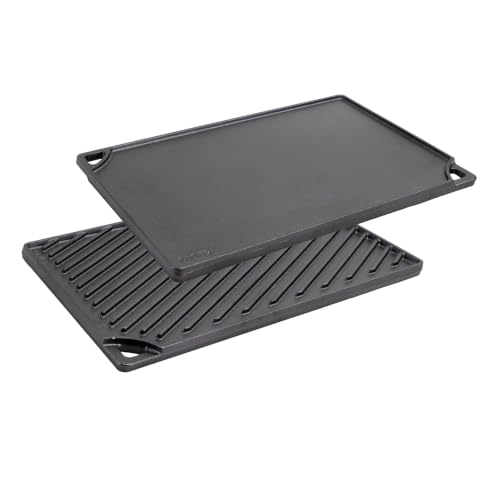
Lodge Reversible Cast Iron Grill/Griddle Pan XL 16.75 x 11.5 — Best Oversized Standard
The XL takes the reference pan’s proven 16.75-inch length and widens it to 11.5 inches, a meaningful gain in working room for the many cooktops whose front-to-back burner spacing runs generous. It keeps the family formula — reversible ridged grill and flat griddle, PFAS-free seasoned iron — and simply gives each cook more surface to arrange food on, which in practice means fewer compromises per batch.
Strengths
- Extra width over the standard pan suits wide-spaced burners and bigger batches
- Same Lodge iron, seasoning, and support as the Best Overall pick
- Length stays sink- and storage-friendly where the 20-inch pans struggle
Trade-offs
- Width must still be verified against your cooktop — wider is only better if it fits
- Heavier than the standard LPGI3, as the extra iron promises
- If your burners are closely spaced, the standard pan heats more evenly — width is not free
| Specification | Detail |
|---|---|
| Dimensions | 16.75 x 11.5 in (per listing) |
| Material | Cast iron, PFAS-free |
| Design | Reversible grill / griddle |
| Burners | Double-burner span |
Choosing between the XL and the standard LPGI3 is a tape-measure decision disguised as a product decision. On a stove with wide burner spacing, the standard pan leaves iron overhanging cold air at its edges while the XL covers the burners properly, heating its full width and giving the cook a genuinely larger working field. On a compact stove, the XL’s edges hang past the burners, run cool, and collect the food that was supposed to sear. The pans are equally good; your stove casts the deciding vote, and the how-to section’s measuring routine is how you hold the election.
In use it is everything the reference pick is, with breathing room: a row of pork chops that are not touching, asparagus that lies flat in one layer, a griddle side that takes six pancakes with flipping space. For the wide-stove household, it is arguably the true Best Overall — this guide keeps the LPGI3 on the throne only because more stoves fit it. Measure first, then choose between siblings with confidence either way.
Best for: Wide-spaced double-burner stoves and cooks who want more room without the 20-inch commitment / Not suited for: Compact cooktops, where its extra width would overhang and heat unevenly
Check on Amazon — check the current price on Amazon before ordering.
Comparison Table
| Pick | Badge | Key spec | Best for |
|---|---|---|---|
| Lodge Reversible Cast Iron Grill/Griddle Pan 16.75 x 9.5 (LPGI3) | Best Overall | 16.75 x 9.5 in reversible cast iron; double burner | Most households with a standard cooktop who want one reversible iron that does both jobs well |
| Lodge Pro-Grid Reversible Grill/Griddle 20 x 10.5 | Best Large | 20 x 10.5 in reversible cast iron; largest Lodge format | Family-volume stove cooks who batch burgers, chops, and breakfasts for four or more |
| Lodge Blacklock Double Burner Griddle 10 x 20 (Lightweight) | Best Lightweight | 10 x 20 in lightweight cast iron; triple-seasoned | Cooks who want cast iron cooking without cast iron heft — smaller hands, sore wrists, daily use |
| Victoria 20-by-14-Inch Rectangular Cast Iron Griddle (Reversible) | Best Extra-Wide | 20 x 14 in reversible cast iron; widest in guide | Big-batch cooks with a wide cooktop and sink who want flat-top spaciousness indoors |
| NutriChef Cast Iron Reversible Griddle 18 x 10 | Best Budget | 18 x 10 in reversible cast iron; pre-seasoned; budget tier | First-time cast iron buyers and budget kitchens that still want the real material |
| Lodge Reversible Cast Iron Grill/Griddle Pan XL 16.75 x 11.5 | Best Oversized Standard | 16.75 x 11.5 in reversible cast iron; XL width | Wide-spaced double-burner stoves and cooks who want more room without the 20-inch commitment |
How to Choose a Cooktop Grill
A cooktop grill is a pan, and pan shopping is refreshingly concrete: fit, material, and weight, in that order. The sections below run the decision the way experienced cooks actually make it.
Fit: measure the stove, the sink, and the cupboard
Measure your cooktop’s burner span — center to center of the two burners the pan will cover, plus the grate or surface the pan will rest on. The pan should sit stable and cover both burners without rocking or hanging so far past them that its edges stay cold. Then measure your sink: a pan you cannot wash is a pan you will stop using, and the 20-inch picks in this guide fail more sinks than stoves. Finally, picture storage — on the stovetop is a legitimate, common answer for resident pans. Three measurements, five minutes, and the category’s main regret is designed out.
Cooktop compatibility: gas, coil, glass, and induction
Gas and coil electric are the natural homes of cast iron cooktop grills — full contact, no drama. Glass and ceramic tops demand care: cast iron is heavy and rough-bottomed castings can scratch, so lift rather than slide, confirm your stove maker’s weight and cookware guidance, and consider that a loaded 20-inch pan plus food is a real load on glass. Induction requires magnetic cookware, which cast iron is — but a double-burner pan needs an induction bridge zone or two hobs that can sync, and the pan must sit flat across them; check your hob’s bridge capability before assuming. When in doubt, the pan makers’ and stove makers’ stated guidance governs, not optimism.
Weight and handles: the daily-use test
Every pan here is heavy; they differ in how heavy and how gracefully. Traditional castings run heaviest, Blacklock’s line is the deliberate exception, and width adds pounds fast. Handles matter as much as mass: you will move this pan hot, loaded, with mitts, over a stove. Prefer designs your mittened hands can grip securely, and be honest about your own strength — the Blacklock exists because Lodge itself acknowledged that the best pan is the one its owner can lift happily in year five.
What a Cooktop Grill Can and Cannot Do
Set the expectation correctly and this category delights. A cooktop grill gives you searing heat, browning, marks, fat drainage, and year-round indoor convenience — the mechanical half of grilling, done very well. It does not give you smoke flavor, because there is no combusting wood or charcoal, and ventilation matters: searing indoors makes smoke in the kitchen even though the food is not smoked, so run the hood, crack a window, and expect the apartment to smell like a steakhouse for an evening — most owners count that as a feature. It also asks for heat management a burner cannot automate: preheat patiently, use medium rather than maximum (iron holds heat so well that high burners overshoot and scorch), and let the pan’s mass do the work it was cast to do. Within those honest borders, a cooktop grill is one of the highest-value tools in a small or weather-bound kitchen.
What Cooks Best on a Cooktop Grill
The ridged side earns its keep with foods that render fat or carry a marinade: burgers that drain as they sear, chicken thighs whose skin crisps while fat runs off, sausages, chops, and steaks up to the thickness a pan can finish without an oven assist. Thick steaks deserve a hybrid method — sear hard on the ridges for marks and crust, then finish in a moderate oven to the exact internal temperature — which is how steakhouses have always done it, and the pan’s oven-safe iron construction makes the transfer seamless. Vegetables are the quiet stars: asparagus, zucchini planks, bell pepper strips, mushrooms, and corn blister and mark beautifully, and their sugars caramelize on iron in a way a sheet pan never achieves.
The flat side is a breakfast and short-order station: pancakes with lacy edges, eggs that release from a well-seasoned surface, bacon that stays flat, hash browns, grilled cheese with a shattering crust, tortillas, and smash burgers — the one burger style that honestly prefers flat iron to ridges, because the crust is the point and ridges interrupt it. Knowing which side a food wants is the whole culinary education this pan offers: ridges for drainage and marks, flat for contact and crust. Cooks who internalize that single rule will use both sides weekly, which is the design’s intent and the reason single-purpose grill pans, however handsome, eventually gather dust in real kitchens.
Seasoning and Care: The Cast Iron Contract
All six picks are seasoned iron, and their care is a contract with three clauses. First, dry heat is fine and water is a guest, not a resident: wash hot with a brush and minimal soap when needed, then dry the pan on a warm burner every time — rust is just iron left wet. Second, oil is maintenance, not cooking spray theater: after drying, the thinnest wiped film of oil, heated until it just smokes, maintains the seasoning that makes the surface release. Third, thermal manners: heat and cool the pan gradually, never plunge a hot pan into cold water, and never leave it soaking in the sink overnight. Keep those three clauses and a cast iron cooktop grill is effectively immortal — the pans in this guide will outlive the stoves they sit on, which is more than any coated pan in any category can promise. Break them, and the same iron will teach you about rust and sticking with equal reliability. The contract is short because the material is honest.
How to Use a Cooktop Grill for a Real Sear
Measure before you ever cook — the fit routine bears repeating as step zero. Confirm the pan sits flat and stable across its burners, that it fits your sink, and that you can lift it with mitts when it is loaded. Then, for the first cook, wash the pan in hot water, dry it on the burner, and wipe on the lightest film of oil to refresh the factory seasoning. Choose a forgiving first food — burgers, sausages, zucchini planks — while you and the pan learn each other.
Preheat like you mean it. Set the pan over medium heat — not high — for five to eight minutes, turning it once if your burners heat unevenly, until a flick of water dances and evaporates instantly across the whole surface. Iron’s mass means medium burners produce a fiercely hot pan; maximum heat mostly produces smoke and scorched exteriors over raw centers. While it preheats, pat the food dry and season it. Dry surfaces brown; wet surfaces steam, on the finest pan ever cast.
Cook in the pan’s zones. On a double-burner pan, the areas directly over the burners run hottest and the middle runs gentler — arrange food accordingly, searing over the burners and finishing in the middle, exactly like a two-zone outdoor fire. Oil the food, not the pan, lay it down, and leave it alone until it releases; iron lets go when the crust is ready, and tearing at food early is how good pans get blamed. Flip once, finish, and rest the food while the pan cools on the stove.
Clean while the pan is warm, not hot: scrape with a metal spatula or brush, rinse hot, and dry it back on the burner with that whisper of oil. That three-minute ritual, repeated, is the entire maintenance program — and it is why a cooktop grill seasoned by a hundred dinners cooks better than the day it arrived. Master the preheat and the patience, and your stove becomes a grill that works in January, in the rain, and in an apartment with no patio at all.
Set up the kitchen like you mean it, too: hood on before the pan heats, a splatter screen within reach for fatty foods, and a landing plate ready so cooked food is not balanced on the pan’s edge. Keep a window cracked in small apartments and accept the honest aroma as the price of January steak. None of this is hardship — it is the small stagecraft that turns a pan on a stove into a grill station, and cooks who stage it once will stage it automatically forever after.
Common Buying Mistakes
Buying by the photo, not the tape measure. Cooktop grills fail on fit more than on quality. Stove span, sink, and storage measurements come before brand preference — always.
Cranking the burner to maximum. Cast iron stores so much heat that high burners overshoot, scorching food and smoking out the kitchen. Medium heat and a patient preheat sear better than maximum ever will.
Expecting charcoal flavor from a pan. No cooktop grill produces wood smoke. Buy it for searing and convenience, season food boldly, and let outdoor grills keep their one honest advantage.
Soaking the pan or skipping the dry. Water left on iron is rust on a schedule. Wash quickly, dry on the burner, oil lightly — the three-minute contract that makes iron immortal.
Sliding a heavy pan across a glass top. Cast iron on glass or ceramic must be lifted, not dragged, and your stove maker’s cookware guidance governs. Treat the surface like it is expensive, because it is.
Crowding the ridges. A packed grill pan steams its own load. Cook in batches with space between pieces; the pan recovers fast, and every batch sears instead of stewing.
Final Recommendation
For most kitchens, the Lodge LPGI3 is the cooktop grill to buy first and keep longest: the reference size that fits the most stoves, the reference iron from the category’s reference foundry, and a lifetime of service — realistically, several stoves’ worth — for a pan-sized price. Size up to the Pro-Grid for family batches or the Victoria for true width, sideways to the XL if your burners spread wide, and to the Blacklock if weight has ever kept you from iron. The NutriChef opens the category honestly on a budget. Every one of them will outcook its price for years if it fits your stove and you keep the seasoning contract.
Measure your cooktop and sink, confirm the dimensions on the listing, check the current price on Amazon, and plan the first cook for a patient evening. Readers who want the outdoor originals these pans imitate should see Best Cooking Grills Barbecue and Best Cooking Propane Grills; those cooking for crowds on a counter, Best Counter Top Grills; stainless shoppers, Best Cost Effective Stainless Steel Grills; and anyone replacing an outdoor grill’s surface, Best Cooking Grids For Gas Grills.
- Lodge Reversible Cast Iron Grill/Griddle Pan 16.75 x 9.5 (LPGI3) — Check the current price on Amazon
- Lodge Pro-Grid Reversible Grill/Griddle 20 x 10.5 — Check the current price on Amazon
- Lodge Blacklock Double Burner Griddle 10 x 20 (Lightweight) — Check the current price on Amazon
Best Cooking Grills Barbecue Best Cooking Propane Grills Best Counter Top Grills Best Cost Effective Stainless Steel Grills Best Cooking Grids For Gas Grills
Frequently Asked Questions
Do cooktop grills work on glass-top stoves?
With care, generally yes — but the stove maker’s guidance governs. Cast iron is heavy and can scratch glass if slid, so lift the pan rather than dragging it, keep the bottom clean of grit, and respect the stove’s cookware weight guidance. Many glass-top owners use these pans happily for years with lift-don’t-slide discipline; if your stove maker advises against cast iron, believe them and choose a lighter category instead.
Can I use a cast iron grill pan on induction?
Cast iron is magnetic, so the material works on induction — the geometry is the question. A double-burner pan needs an induction bridge function or synchronized hobs, and it must sit flat across both. On a single induction hob, use a smaller single-burner pan rather than bridging. Check your hob’s bridge capability and the pan’s flatness before ordering.
Why does my grill pan smoke so much indoors?
Because searing is supposed to make some smoke — the pan is doing its job at temperatures where fats and juices vaporize. Reduce it by patting food dry, trimming excess fat, using medium rather than maximum heat, and running the range hood from the first minute. A pan smoking gently is normal; a kitchen filling with smoke means the burner is too high for the food’s fat content.
How is a cooktop grill different from a regular skillet?
The ridges. A grill pan’s raised ridges lift food out of its rendered fat, drain it away, and create the marked, drier surface that defines grilled food, while a flat skillet fries food in its own fat. The reversible picks in this guide give you both surfaces in one pan — grill on one side, griddle-skillet behavior on the other — which is why they are the category’s standard form.
Do I need to season a pan that arrives pre-seasoned?
Not from scratch — pre-seasoning is a working head start, not a finished surface. Cook fatty foods early in the pan’s life, keep the dry-and-oil ritual after washing, and the seasoning deepens into true easy release over the first dozen cooks. If food sticks in week one, the fix is almost always a longer preheat and patience before flipping, not more oil. Think of the factory seasoning as the primer coat: your cooking is the paint, and it builds with every meal the pan makes.
What size cooktop grill should I buy?
The largest that fits your stove’s burner span, your sink, and your strength — in that order. For most standard cooktops that is the 16.75-inch class; wide stoves and big families justify the 20-inch pans; compact stoves and small sinks argue for the standard size even if your appetite argues otherwise. Measure all three constraints before ordering and the pan will fit your life as well as your burners.


