Disclosure: airfryerkitchensupply.com is reader-supported. When you buy through links on our site, we may earn an affiliate commission at no extra cost to you.
Where to buy
The fastest way to shop for best coffee makers for a boat is on Amazon, where every pick below is sold with full specifications and configuration options on the product page. Start with our top recommendation, the CONQUECO Portable Coffee Machine, 12V Travel Espresso Maker — check price on Amazon — then compare it with the other picks below.
Every machine below was matched to a live Amazon listing before inclusion. Marine gear pricing moves with seasons, so check price on Amazon for the current figure on anything you shortlist.
- CONQUECO Portable Coffee Machine, 12V Travel Espresso Maker — check price on Amazon
- BougeRV 144Wh Portable Coffee Maker for K-Cup and Grounds — check price on Amazon
- AeroPress Go Portable Coffee Maker Kit — check price on Amazon
- Coleman Stainless Steel Coffee Percolator, 12-Cup — check price on Amazon
- HAWOK Portable Coffee Maker, 12V Travel Espresso Machine — check price on Amazon
- Tastyle Mini Single Serve Coffee Maker for K-Cups and Grounds — check price on Amazon
Finding the best coffee makers for a boat starts with a constraint no kitchen buyer faces: power. A boat runs on a battery bank, an inverter with real limits, shore power at the dock, and sometimes nothing but a galley stove. A standard 1,200-to-1,500-watt drip machine can be the single largest load on a small boat, draining batteries through an inverter at an alarming rate, which is why so many sailors either give up coffee underway or burn out an inverter trying.
The honest shape of this market is that there are four real solutions, and this guide covers all of them. Purpose-built 12-volt machines sip directly from the battery bank. Battery-powered portable espresso makers carry their own energy with them. Manual brewers like the AeroPress need only hot water, which a boat can always make on the stove. And a stovetop percolator turns the galley burner itself into the coffee maker, using no electricity at all. The right pick depends on your boat’s electrical system and how you actually cruise, not on which machine wins kitchen awards.
Two marine warnings apply to every pick. First, nothing glass belongs in a working galley in a seaway if you can avoid it, and every pick below is metal, plastic, or silicone for that reason. Second, anything electric on a boat should be treated as a guest in a damp, salty environment: stored dry, rinsed after salt exposure, and never left plugged in underway.
There is also a hierarchy of failure to think about before choosing. On land, a broken coffee maker is an errand. Aboard, mid-passage or in a remote anchorage, a broken coffee maker is simply no coffee, possibly for weeks. That asymmetry quietly shapes experienced cruisers’ choices toward systems with no single point of failure: a manual press that cannot break, a percolator with nothing to fail, or an electric machine backed up by one of those in a locker. This guide’s picks are presented as a ladder you can combine, not only as rivals, because offshore, redundancy is a feature.
In this guide
Quick Picks
Six ways to make coffee afloat, sorted by power source: 12-volt battery bank, self-powered battery, kettle-and-manual, and the galley stove itself.
CONQUECO Portable Coffee Machine, 12V Travel Espresso Maker — Best 12-Volt Electric. The direct answer to the inverter problem: a portable espresso-style coffee machine that runs on 12 volts, straight from the boat’s DC system. Plug it into a cockpit or cabin 12V socket and make real coffee underway without waking the inverter or the battery monitor’s alarm. Check on Amazon
BougeRV 144Wh Portable Coffee Maker for K-Cup and Grounds — Best Battery Powered. Coffee with no wiring at all. This portable maker carries a 144Wh battery, heats its own water, and brews either a K-Cup pod or your own grounds. Charge it at the dock or from solar, carry it to the cockpit, and brew where the view is. Check on Amazon
AeroPress Go Portable Coffee Maker Kit — Best Manual. The sailor’s classic, sized for travel. The AeroPress Go packs the press, stirrer, scoop, and filters inside its own drinking mug, needs only hot water from the kettle, and makes a smooth cup that embarrasses electric machines costing ten times more. Zero watts, zero worry. Check on Amazon
Coleman Stainless Steel Coffee Percolator, 12-Cup — Best for a Crowd on the Stove. The crew answer that uses the stove you already have. This stainless percolator brews a full 12-cup pot on a galley burner with no electricity, no glass, and no delicate parts, then pours for the whole cockpit. Old technology, perfectly matched to boats. Check on Amazon
HAWOK Portable Coffee Maker, 12V Travel Espresso Machine — Best 12V Value. A second 12-volt route, in a compact travel format aimed at vehicles and boats alike. Like the CONQUECO it skips the inverter and runs from the DC system, giving smaller boats and smaller budgets an electric option that respects the battery bank. Check on Amazon
Tastyle Mini Single Serve Coffee Maker for K-Cups and Grounds — Best at the Dock or on a Modest Inverter. For boats that live on shore power or run a decent inverter for short bursts: a mini single-serve machine that takes both K-Cups and grounds, sized for travel and RV use, with a carry handle and a footprint a small galley can absorb. Check on Amazon
How These Picks Were Chosen
Marine-marketplace listings are especially prone to fantasy specifications, so only machines whose listings clearly matched a real, identifiable product were included, and the few headline claims repeated below are the ones stated in those verified listings.
The functional filter was boat reality. Each pick had to run on power a boat actually has: 12-volt DC, a self-contained battery, hot water from a kettle, or a stove burner. Each had to survive a galley: no fragile glass carafes, compact storage, and parts that rinse in a small sink. And each had to make a cup worth drinking, because coffee at anchor is one of cruising’s genuine pleasures and a bad machine will simply stop being used.
Weight and storage volume were scored as seriously as power. Every litre of locker space aboard is contested, and a machine that earns a permanent counter spot on a small boat must justify it daily. That is why the self-storing AeroPress Go and the locker-friendly portable electrics rank so well here, and why no full-size drip machine appears at all: aboard, the best coffee maker is partly the one that disappears when the sailing starts.
The 6 Best Coffee Makers for a Boat

CONQUECO Portable Coffee Machine, 12V Travel Espresso Maker — Best 12-Volt Electric
Most boat coffee compromises exist because of one mismatch: kitchen machines want 120-volt AC at high wattage, and boats store energy as 12-volt DC. The CONQUECO removes the mismatch by working natively on 12 volts. Running from a cabin socket or a properly rated outlet, it heats and pumps for espresso-style coffee using pods or grounds depending on configuration, at a power draw a healthy battery bank can absorb for a morning routine.
The honest limits are speed and volume. Twelve-volt heating is patient, so this is a one-cup-at-a-time machine, and a big crew will queue. Wiring matters too: the circuit feeding it must be rated for the draw, and on older boats that means checking the socket and its fuse rather than assuming. Treated as a two-person cruising solution, though, it is the most straightforward electric coffee a small boat can have.
Strengths
- Runs natively on 12V DC, no inverter load
- Real espresso-style coffee from pods or grounds formats
- Compact portable body stores in a locker
Trade-offs
- Slow heating compared with 120V machines
- One cup at a time; not a crew machine
- Needs a properly rated 12V circuit and socket
| Power | 12V DC |
| Format | Portable espresso-style maker |
| Use case | Car, truck, boat cabin |
| Verified via | Amazon listing match |
Buy the CONQUECO if your boat has a sound 12-volt system and your coffee habit is one or two cups at a time. It is the pick that respects how boats actually store energy, and at anchor, with the engine off and the anchorage quiet, that respect is the difference between coffee and no coffee.
Installation discipline decides whether this machine delights or disappoints. Wire it to a circuit with honest capacity, keep the run short, and the 12V system will deliver its rated performance. Hang it on an elderly, undersized cabin socket with a long thin cable and voltage drop will make every brew slower and weaker. The machine is only ever as good as the boat’s wiring, which is true of everything electrical aboard and doubly worth checking here.
Best for: small cruising boats with healthy 12V systems and one or two coffee drinkers / Not suited for: large crews or charter boats needing pot after pot
Check on Amazon — check the current price on Amazon before you buy, because coffee maker pricing moves often.

BougeRV 144Wh Portable Coffee Maker for K-Cup and Grounds — Best Battery Powered
BougeRV comes from the portable-power and overlanding world, and this machine applies that thinking to coffee: the energy travels with the brewer. A 144Wh battery is enough for several heated brews per charge, and the machine accepts both pods and grounds, so a boat can stock whichever format suits the trip. Recharging can happen on shore power, from the boat’s system while motoring, or from a portable solar panel on a long anchor stay.
For boats, the freedom from fixed wiring is the point. There is no socket to rate, no inverter to run, and no permanent galley space surrendered; the machine lives in a locker and comes out for coffee in the cockpit. The limits are the obvious ones: when the battery is flat, coffee waits for a charge, and heated brews per charge are finite, so it suits couples and small crews rather than a full charter roster.
Strengths
- Fully self-powered: no socket, inverter, or wiring needed
- Brews both K-Cup pods and ground coffee
- Recharges from shore power, boat DC, or solar
Trade-offs
- Finite brews per charge; flat battery means no coffee
- Heating from battery is slower than mains machines
- Battery adds weight compared with manual brewers
| Power | 144Wh built-in battery |
| Format | Pods or grounds, single serve |
| Charging | AC, DC, or solar input per listing |
| Verified via | Amazon listing match |
This is the best pick for trailer sailors, small cruisers without a proper cabin socket near the galley, and anyone who wants cockpit coffee without an electrical project. It is also the easiest recommendation for a boat you do not own, such as a charter, because it simply travels with you.
Charge management is this machine’s seamanship. Treat its battery like the house bank in miniature: top it up whenever the engine runs or shore power connects, and it will never be flat at dawn. Boats with solar will find a sunny afternoon restores it fully. The skippers who love this format plan its charging the way they plan water; the ones who hate it treated a battery appliance as if it were a mains one.
Best for: small boats, charters, and cockpit coffee without wiring / Not suited for: heavy daily use by a large crew far from charging
Check on Amazon — check the current price on Amazon before you buy, because coffee maker pricing moves often.

AeroPress Go Portable Coffee Maker Kit — Best Manual
If a boat can boil water, it can make AeroPress coffee, and every boat can boil water. The Go version shrinks the original AeroPress into a self-contained kit: everything nests into the included mug with a lid, so the whole coffee system occupies one small cylinder in a locker and cannot rattle itself apart in a seaway. The brew itself is the familiar immersion-and-press method, producing a clean, sweet, low-bitterness cup in about two minutes.
Afloat, the virtues compound. There is nothing electric to corrode, nothing glass to break, and the grounds eject as a dry puck straight into the bin, which matters when the galley sink drains slowly and water is rationed. Rinsing takes a splash. The costs are effort and scale: you make one mug at a time, by hand, and a crew of six means six pressings or a different tool for crew days.
Strengths
- No electricity at all; works with any kettle or stove
- Packs into its own mug, unbreakable, locker-friendly
- Excellent flavour and near-zero cleanup and water use
Trade-offs
- One mug per press, made by hand
- Needs paper micro-filters stocked aboard
- Not a solution for serving a full crew quickly
| Power | None, manual |
| Format | Immersion press, travel kit with mug |
| Storage | All parts nest in the mug |
| Verified via | Amazon listing match |
For a cruising couple, this is arguably the most rational coffee system afloat, and the one least likely to fail mid-passage. Pair it with the kettle you already own and spend the savings on better beans. Crew days are what the percolator below is for.
The Go kit has one more marine virtue that rarely appears in reviews: it is silent and steam-light. Below decks at 5 a.m., with crew sleeping a metre away, a kettle and a press make coffee without the pump noise and gushing steam of an electric machine waking the boat. On overnight passages and early starts, that discretion is worth as much as the coffee itself.
Best for: cruising couples, minimalists, and as the indestructible backup aboard any boat / Not suited for: skippers who want to serve six people at once
Check on Amazon — check the current price on Amazon before you buy, because coffee maker pricing moves often.

Coleman Stainless Steel Coffee Percolator, 12-Cup — Best for a Crowd on the Stove
Percolators fell out of fashion in kitchens and quietly stayed perfect for boats and campsites. Coleman’s stainless version puts coffee and water in one rugged pot, the burner does the work, and a glass-free brew chamber cycles water through the grounds until the pot is done. Twelve cups covers a full crew’s first round, and the same pot serves at the cockpit table without a carafe to protect.
Honesty about flavour: percolated coffee runs hot and recirculates, so it tastes bolder and less delicate than drip or AeroPress coffee, and it can turn bitter if left perking too long. Managed with a timer and taken off the heat when done, it makes a hearty, satisfying pot that suits bacon-and-eggs mornings at anchor. It is also nearly indestructible, which on a boat is a flavour of its own.
Strengths
- Brews for a whole crew with zero electricity
- Stainless build survives galley life and rough storage
- One pot brews and serves; nothing else to wash or store
Trade-offs
- Bolder, less nuanced flavour; over-perking turns it bitter
- Needs a burner free at coffee time
- No automatic shut-off: it needs watching
| Power | Stovetop, none electric |
| Capacity | 12 cups |
| Material | Stainless steel |
| Verified via | Amazon listing match |
Choose the percolator if your boat hosts people and your stove is reliable. It is the traditional solution because it works: big capacity, no power draw, no breakage. Solo sailors will find it oversized, and that is what the AeroPress Go above is for.
Technique transforms the percolator from blunt instrument to good brewer. Use a coarse grind, watch for the first gentle perking rather than a rolling boil, time roughly seven to ten minutes of gentle perking, then take it off the heat and let it settle a minute before pouring. Managed that way, the pot is rich and clean-tasting. Boiled violently and left perking while breakfast cooks, it becomes the bitter brew that gave percolators their reputation.
Best for: crews, fishing boats, and family boats brewing for a group on the stove / Not suited for: solo sailors or flavour purists
Check on Amazon — check the current price on Amazon before you buy, because coffee maker pricing moves often.

HAWOK Portable Coffee Maker, 12V Travel Espresso Machine — Best 12V Value
The HAWOK occupies the same smart niche as the CONQUECO pick: espresso-style coffee generated from 12-volt power, in a body small enough to live in a locker or a vehicle’s storage. For boats, the appeal is identical and real. The DC system is where a boat’s energy actually lives, and a machine that drinks from it directly avoids the conversion losses and inverter strain of a household brewer.
As with all 12-volt heating, patience is part of the deal: heat-up and brewing are slower than a mains machine, and the format is one traveller’s cup at a time. Where this pick earns its place is value and simplicity for occasional use: weekend boats, fishing trips, and deliveries where coffee is a morale item rather than a daily ceremony. Check your socket’s rating before the first brew, as with any 12V appliance.
Strengths
- 12V operation avoids inverter load and conversion loss
- Compact travel format stores almost anywhere
- Accessible price for occasional boat use
Trade-offs
- Slow heat-up typical of 12V machines
- Single servings only
- Accessory and parts ecosystem smaller than big brands
| Power | 12V DC |
| Format | Portable travel espresso machine |
| Use case | Vehicle and boat travel |
| Verified via | Amazon listing match |
Pick the HAWOK when the CONQUECO’s format does not suit or the budget is tight, and your use is occasional. Daily liveaboard coffee is better served by the manual or battery picks; weekend and fishing coffee is exactly this machine’s brief.
The HAWOK’s natural habitat is the boat that motors as much as it sails: fishing boats, trawlers, and weekend cruisers whose alternators keep the bank full and whose coffee demand is a cup here and there rather than a dawn ceremony. In that pattern its slowness barely matters and its simplicity shines. Liveaboards brewing on a strict solar budget should weight the manual and battery picks more heavily.
Best for: weekend boats, fishing trips, and budget-conscious 12V setups / Not suited for: daily liveaboard routines or serving groups
Check on Amazon — check the current price on Amazon before you buy, because coffee maker pricing moves often.
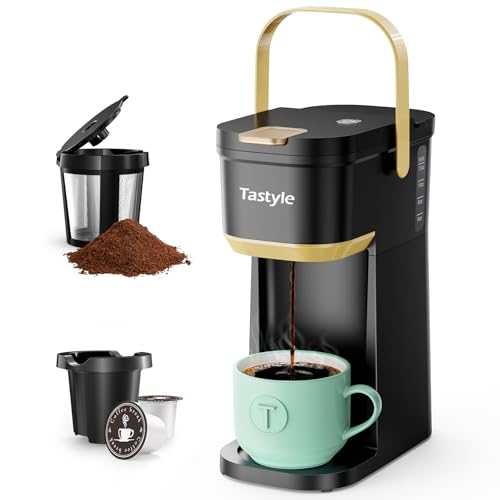
Tastyle Mini Single Serve Coffee Maker for K-Cups and Grounds — Best at the Dock or on a Modest Inverter
Not every boat is off-grid. Marina-based boats on shore power, and larger cruisers with generous inverter capacity, can run a small AC machine, and the Tastyle Mini is the right scale of one: single-serve, dual-format for pods or grounds, and compact with a handle for moving between galley and cockpit. It brews one mug at a time, which keeps both the power draw duration and the water use modest.
The discipline is in the usage, not the machine. On an inverter, run it as a short, deliberate load with the engine or charger supporting the bank when possible, and never leave it as a forgotten draw. At the dock, none of that applies and it behaves like the handy little brewer it is. For boats that split their lives between marina and anchor, it covers the marina half beautifully and the anchor half with care.
Strengths
- Pods or grounds in one compact machine
- Small single-serve loads suit shore power and short inverter runs
- Handle and travel sizing fit small galleys
Trade-offs
- Needs AC power: shore, generator, or inverter
- Not a native 12V machine
- One cup at a time, like all single-serve formats
| Power | AC (shore power or inverter) |
| Format | Mini single serve, pods or grounds |
| Design | Compact with handle, travel oriented |
| Verified via | Amazon listing match |
Buy the Tastyle if your boating is marina-centred with weekends at anchor and a healthy electrical system. If your boat is a small off-grid cruiser, the 12V, battery, and manual picks above respect your batteries better, and this machine will become a dock-only appliance.
A practical arrangement for mixed marina-and-anchor boats: keep the Tastyle as the dock machine, plugged into shore power where its AC appetite costs nothing, and keep an AeroPress in the locker for anchorages. The pair together cost less than most single premium machines, cover both halves of the boat’s life honestly, and give the crew a backup when, not if, one system is unavailable.
Best for: marina-based boats and larger cruisers with strong inverter capacity / Not suited for: small off-grid boats with limited battery banks
Check on Amazon — check the current price on Amazon before you buy, because coffee maker pricing moves often.
Comparison Table
| Pick | Badge | Key spec | Best for |
|---|---|---|---|
| CONQUECO Portable Coffee Machine, 12V Travel Espresso Maker | Best 12-Volt Electric | Runs on 12V DC, portable espresso-style machine for car and boat | small cruising boats with healthy 12V systems and one or two coffee drinkers |
| BougeRV 144Wh Portable Coffee Maker for K-Cup and Grounds | Best Battery Powered | 144Wh built-in battery, brews K-Cup pods or ground coffee | small boats, charters, and cockpit coffee without wiring |
| AeroPress Go Portable Coffee Maker Kit | Best Manual | Manual press, packs into its own mug, no electricity | cruising couples, minimalists, and as the indestructible backup aboard any boat |
| Coleman Stainless Steel Coffee Percolator, 12-Cup | Best for a Crowd on the Stove | Stovetop percolator, stainless steel, 12-cup capacity | crews, fishing boats, and family boats brewing for a group on the stove |
| HAWOK Portable Coffee Maker, 12V Travel Espresso Machine | Best 12V Value | 12V travel espresso machine, compact portable format | weekend boats, fishing trips, and budget-conscious 12V setups |
| Tastyle Mini Single Serve Coffee Maker for K-Cups and Grounds | Best at the Dock or on a Modest Inverter | Mini single serve for pods and grounds, handle, travel and RV oriented | marina-based boats and larger cruisers with strong inverter capacity |
Sort this table by power source, because on a boat that is the decision. Native 12V (CONQUECO, HAWOK) draws gently from the bank; the BougeRV carries its own energy; the AeroPress and Coleman need only the stove or kettle; the Tastyle assumes shore power or a serious inverter. Everything else is preference.
How to Choose the Best Coffee Makers for a Boat
Start with your electrical reality, written down. How large is the battery bank, what can the inverter actually sustain, and how do you recharge: alternator, solar, shore power? A household drip machine at 1,200-plus watts pulls roughly 100 amps from a 12-volt bank through an inverter, which empties small banks with shocking speed. That single calculation explains this entire category: boat coffee is a power decision first and a taste decision second.
Then match the machine to the crew pattern. A cruising couple can press AeroPress cups in rotation and call it a ritual. A fishing boat with six aboard at dawn needs the percolator’s pot or a queue nobody enjoys. Charter and guest-heavy boats should favour the simplest system guests can operate without a briefing, which usually means the battery machine or the dock-side single-serve.
- Off-grid couple: AeroPress Go, or the 12V CONQUECO for a button-press option
- Small boat, no wiring projects: BougeRV battery maker
- Crew and family mornings: Coleman percolator on the galley stove
- Marina-based with shore power: Tastyle Mini single serve
- Occasional weekend coffee: HAWOK 12V value pick
Finally, apply the marine filter to whatever you choose: no glass where a seaway can throw it, compact storage that secures for sea, corrosion-resistant materials, and a cleaning routine that fits a small sink and a water budget. A machine that fails any of these will end up left ashore, which is the most expensive outcome of all.
How Many Watts Can a Boat Coffee Maker Safely Use?
Work backwards from the bank. As a rough guide, a 100Ah lead-acid bank offers about 50Ah of comfortable daily use; a 1,200-watt brewer on an inverter draws around 110 amps with conversion losses, so ten minutes of brewing and warming can consume a serious slice of that budget before the day starts. Lithium banks tolerate far more, and engine-running brewing changes the maths completely, which is why many cruisers simply make coffee while motoring.
Native 12V machines and battery machines exist to soften exactly this problem, trading speed for gentleness. Manual and stovetop methods remove the problem entirely by moving the energy source to the stove, where boats already carry plenty of fuel. None of these is the “wrong” answer; the wrong answer is a big AC machine bought without doing the arithmetic.
What About Glass, Corrosion, and Storage at Sea?
Glass carafes are the standard casualty of galley life: a wake, a heel, a fumble with cold hands. Every pick in this guide avoids a glass carafe, and if you bring any glass aboard for coffee, it should be a small, replaceable piece stored padded and low. Stainless and quality plastics are the marine defaults for a reason.
Salt air corrodes heating elements, switches, and cheap plating, so rinse and dry electric machines after trips, store them in a dry locker rather than on the counter underway, and expect a shorter life than the same machine would have in a house. Manual brewers and the stainless percolator shrug off the environment entirely, which is why experienced cruisers so often end up with one of them as the permanent solution.
What Coffee Should You Provision for a Cruise?
Provisioning is where boat coffee succeeds or fails, because there is no shop at anchor. Whole beans keep best but demand a grinder; a small hand grinder is silent, power-free, and doubles as a galley ritual many cruisers enjoy. Ground coffee is simpler and stales within weeks once opened, so buy small bags and rotate them. Pods are the most forgiving of all: sealed, portioned, and stable for months, at the highest cost and with packaging waste that must be carried ashore.
Quantities deserve arithmetic rather than optimism. Count coffee drinkers, multiply by cups per day and days between shops, then add a genuine margin for weather days and guests, because running out is remembered out of all proportion. Store everything in airtight containers low in the boat where it is cool, and keep a written note of what is aboard; the middle of a passage is the wrong time to discover the last bag was the last bag.
Fresh Water, Kettles, and the Rest of the Boat Coffee System
The machine is only the middle of the system. Before it sits the water: boat tank water varies in taste, and a simple filter jug or a dedicated drinking-water container improves every cup more than any machine upgrade. Alongside it sits the heat source for manual methods: a kettle that pours with control, sized to the crew, and stable on the stove with a fiddle rail or in a sink for rough conditions.
After the machine sits the mug, which aboard should be insulated, lidded, and unbreakable, and the washing-up reality that favours systems with dry, ejectable grounds. Judge any boat coffee purchase against that whole chain, water, heat, brew, mug, waste, and the right answer for your boat usually becomes obvious: it is the chain with no weak link, not the machine with the longest feature list.
Coffee at Sea: Safety and Seamanship Around Hot Water
Hot water is the most dangerous ordinary substance in a galley, and coffee routines deserve the same respect as stove routines. Brew in conditions that suit the method: manual and percolator coffee in a calm anchorage or a settled sea, nothing with boiling water in a lurching cockpit. Use mugs with lids underway, fill them below the brim, and pass them rather than carrying them across a moving cabin sole. None of this is meant to frighten; it is the ordinary seamanship that lets coffee stay a pleasure instead of becoming a story.
Electrical safety has its own short list. Twelve-volt circuits should be fused for the appliance they feed, sockets inspected for the green corrosion that marine air grows, and any machine that has been soaked, in a knockdown or a galley flood, dried fully and checked before it is trusted again. Battery machines should be charged in the open cabin, not buried in bedding lockers, as with every lithium device aboard.
Finally, brief the crew. Guests and new crew should be shown the coffee system like any other boat system: where the water is, what not to pour down the sink, and which method to use if the skipper is asleep. A boat where anyone can make coffee safely is a happier boat at dawn, and dawn is when it matters.
How to Make Great Coffee Aboard, Step by Step
Whatever machine you choose, this routine keeps boat coffee tasting like a pleasure rather than a compromise, and keeps the electrical system respected.
- Do the power check first. Glance at the battery monitor before brewing anything electric; if the bank is low, switch to the manual or stovetop method for this round and brew electrically after the engine or solar has topped things up.
- Heat water once, efficiently. If you are making AeroPress coffee or tea as well, one full kettle on the stove beats repeated small heatings, and leftover hot water goes into a flask for later cups.
- Use a consistent ratio and write it on a bulkhead note: about two tablespoons of medium-ground coffee per 6 ounces of water for drip and percolator methods, adjusted once to your taste and then kept. Consistency is what separates a system from a series of accidents.
- Secure everything before the boat moves. Brew at anchor, at the dock, or in calm conditions underway with the machine gimballed, wedged, or held; hot water and a moving boat demand the same respect as the stove itself.
- Manage grounds like the waste they are: a dry puck or filter goes in the bin, never down a small galley drain, and grounds stay aboard until they can go ashore where local rules require it.
- Rinse with a minimum of fresh water, dry the machine, and store it in its locker before getting underway. Thirty seconds of care after each use is what makes electric machines survive seasons afloat instead of months.
Follow this and coffee becomes one of the reliable pleasures of the boat: up early, kettle on, first cup in hand while the anchorage wakes up around you.
Common Buying Mistakes
Bringing a household drip machine aboard without doing the power maths. It is the classic new-owner error: the machine works beautifully at the dock and flattens the bank at anchor. Calculate the inverter draw before the first trip, not during it.
Glass carafes in a working galley. Sooner or later a wake or a heel sends it across the cabin sole. Stainless, plastic, and silicone exist precisely because boats move.
Leaving electric machines plugged in and stored damp. Salt air plus moisture plus standby power is how marine appliances die young and, in the worst cases, become electrical faults. Unplug, dry, and locker-store them.
Grinding beans for a whole season in advance. Pre-ground coffee stales fast in warm, humid marine air. Carry beans and a small hand grinder, or buy ground coffee in small quantities and store it sealed and dry.
Pouring grounds down the galley sink. Small marine drains and seacocks clog and sour. Bin the grounds; the sink is for rinse water only.
Forgetting the backup. A single electric machine with no manual fallback means one failure ends coffee for the whole trip. An AeroPress in a locker weighs almost nothing and insures the ritual completely; experienced crews carry one even when their main system is excellent.
Storing the coffee kit in five different lockers. A boat coffee system should live together: machine, coffee, filters, and mug in one place that can be reached in the dark. Scattered kits fail at dawn, which is the only hour they are for.
Final Recommendation
Most cruising couples should start with the AeroPress Go: it cannot break, cannot drain a battery, and makes the best cup in this guide. If you want a button to press instead, the CONQUECO’s native 12-volt design is the electrically honest choice, and the BougeRV battery maker is the pick when wiring is not an option at all.
For crews, the Coleman percolator on the galley stove remains the undefeated solution, and marina-centred boats can happily run the Tastyle Mini on shore power. Match the machine to your boat’s power and your crew’s size, and coffee afloat stops being a compromise and becomes part of why you go.
A final word from the way experienced cruisers actually outfit a boat: start simple, then add. Put the AeroPress or the percolator aboard first, live with it for a season, and let the boat tell you whether an electric layer is worth its power and storage. Boats that reverse the order, buying the impressive machine first, often discover its appetite for watts or locker space a season too late. The sea rewards the setup that was chosen by evidence, and coffee, of all systems, generates evidence every single morning.
If you are ready to buy, the two shortest paths are the BougeRV 144Wh Portable Coffee Maker for K-Cup and Grounds (Best Battery Powered) and the AeroPress Go Portable Coffee Maker Kit (Best Manual) — check price on Amazon for each, then decide by the routine described in their reviews above.
Keep exploring the rest of this coffee maker cluster while you decide: Best Coffee Makers Best Coffee Makers For Campers Best Coffee Makers For Backpacking Best 12 Volt K Cup Coffee Makers For Boats Best Coffee Makers Aeropress
Frequently Asked Questions
Can I run a normal coffee maker on my boat’s inverter?
Sometimes, briefly, if the inverter and battery bank are sized for it. A typical drip machine draws around 1,200 watts, which is roughly 110 amps from a 12V bank through an inverter. Many cruisers brew only while the engine runs. Native 12V, battery, manual, and stovetop machines avoid the problem entirely.
What is the best coffee maker for a small sailboat with no inverter?
A manual brewer such as the AeroPress Go, or a stovetop percolator for groups. Both need only the stove or a kettle, draw nothing from the batteries, and store in almost no space.
Are 12V coffee makers any good?
They make real coffee and respect the battery bank, which is the point. Their trade-off is speed: 12-volt heating is slow, and the format is one cup at a time. For one or two drinkers, that trade is usually worth it.
How do I keep coffee gear from corroding on a boat?
Rinse and dry electric machines after trips, store them in a dry locker unplugged, and wipe contacts occasionally. Manual and stainless gear needs almost no protection, which is one reason experienced cruisers favour it.
What coffee should I store aboard?
Whole beans in small sealed quantities with a hand grinder stay freshest. If you use ground coffee or pods, store them in airtight containers low in the boat, away from heat, and rotate stock each season.
Is a percolator’s coffee actually good?
It is hearty and bold rather than delicate, and it punishes neglect: left perking too long it turns bitter. Timed carefully and taken off the heat when done, it makes a satisfying pot that suits cooked breakfasts and cold mornings on deck.
Can I use a coffee maker while sailing, or only at anchor?
Manual and stovetop methods can be used underway in calm conditions with everything secured and hot water handled with stove-level care. Electric machines are best used at anchor, at the dock, or while motoring, when power and attention are both available. In rough weather, the correct coffee maker is the one left in its locker.
What is the best coffee setup for a liveaboard couple?
A layered one: an AeroPress or percolator as the unbreakable base, plus one electric option matched to the boat’s power, such as the 12V CONQUECO or the BougeRV battery maker, for mornings when convenience wins. The pair covers every electrical situation a cruising life produces.
What do most long-term cruisers end up using?
A manual or stovetop method as the permanent base, very often an AeroPress for couples or a percolator for crews, sometimes with a small electric option for marina stays. The pattern repeats because it matches the boat’s power reality and cannot be broken by a flat battery or a failed inverter.


