Disclosure: airfryerkitchensupply.com is reader-supported. When you buy through links on our site, we may earn an affiliate commission at no extra cost to you.
Where to buy
The most reliable place to buy any pick in this guide to the best coffee makers dual brew is Amazon, where each verified model below is listed with full product details and delivery options. Use the Check on Amazon links beside each pick to see the current listing. We do not print static prices in our guides because listings change, so check price on Amazon before you decide. If a pick is described as unlinked, that means we could not verify a listing we were confident in, and we say so openly rather than guess at a link.
- Ninja DualBrew Pro Specialty Coffee System CFP301 — Check on Amazon (check price on Amazon)
- Keurig K-Duo Essentials Coffee Maker Gen 2 — Check on Amazon (check price on Amazon)
- Cuisinart Coffee Center 10-Cup SS-21NAS — Check on Amazon (check price on Amazon)
- Hamilton Beach FlexBrew Advanced 4-in-1 Single Serve Coffee Maker — Check on Amazon (check price on Amazon)
- Hamilton Beach 2-Way Programmable Coffee Maker 49980RG — Check on Amazon (check price on Amazon)
- De’Longhi All-in-One Espresso & Coffee Maker — Check on Amazon (check price on Amazon)
The best coffee makers dual brew shoppers find are not really one product category but one idea expressed six ways: a single machine that refuses to make you choose between a cup and a pot. Dual brew means two complete brewing lives in one housing — a full carafe for the household, the weekend and the guests, and a single serve for the early riser, the night owl and the one-cup decaf at nine in the evening. Done well, it ends the era of two machines colonising the counter and two maintenance regimes colonising your weekends. Done badly, it is two mediocre brewers sharing a power cord. This guide exists to sort the first kind from the second, using only machines verified against the retailer’s catalogue data, and it goes deeper on the engineering than our companion drip-and-single-cup guide: if that page is about which dual machine fits your household, this one is about what dual brew actually is, where its compromises hide, and which expression of the idea deserves your counter.
Three architectures compete under the dual brew name, and naming them now will make every review clearer. Pod-and-carafe machines pair a K-Cup-style single side with a ground-coffee carafe. Grounds-and-carafe machines brew both formats from loose coffee, differing only in batch size. And hybrid flagships add specialty drinks — richer brews, iced preparations, frothed milk — across both sides, arguing that dual should mean not just two sizes but two philosophies of coffee. Each architecture has a household it serves perfectly and a household it will quietly frustrate, and the badges in this guide name those households rather than pretending a single winner exists. No static prices appear anywhere; tiers are qualitative, and you should check price on Amazon as you buy, because this category’s listings are among the most promotion-sensitive in the kitchen.
In this guide
Quick Picks
Six dual machines, three architectures. Hybrids first for the maximalists, pod-and-carafe for the Keurig world, grounds-only for the purists — find your architecture, then your badge.
- Ninja DualBrew Pro Specialty Coffee System CFP301 — Best Overall Dual Brew. The hybrid flagship: pods and grounds singles, a specialty carafe, four brew styles, thirteen sizes, a frother. Dual brew at its most complete. Check on Amazon
- Keurig K-Duo Essentials Coffee Maker Gen 2 — Best Streamlined Keurig Dual. The K-Duo idea distilled: K-Cup singles and a ground-coffee carafe, Gen 2 platform, without the flagship extras. Verified fresh for this guide. Check on Amazon
- Cuisinart Coffee Center 10-Cup SS-21NAS — Best Carafe-First Dual Brew. Dual brew weighted toward the pot: a 10-cup thermal carafe that keeps coffee kind for hours, with a capable single-serve side and over-ice function alongside. Check on Amazon
- Hamilton Beach FlexBrew Advanced 4-in-1 Single Serve Coffee Maker — Best Single-Side Flexibility. A single-serve specialist with a 45-ounce reservoir, hot and iced brewing, and pods or grounds — the dual idea expressed as batch flexibility within the single cup itself. Check on Amazon
- Hamilton Beach 2-Way Programmable Coffee Maker 49980RG — Best Pod-Free Dual Brew. Grounds on both sides: a programmable 12-cup carafe and a scoop-filter single side. The dual machine for households that will never buy a pod. Verified fresh for this guide. Check on Amazon
- De’Longhi All-in-One Espresso & Coffee Maker — Best Espresso-and-Drip Dual. The other meaning of dual: a pump espresso side with milk frothing beside a full drip coffee side. For households divided between espresso drinkers and pot drinkers. Check on Amazon
How These Picks Were Chosen
We built this list by stress-testing the dual claim itself. A candidate had to brew a carafe a drip loyalist would accept — even extraction, proper temperature, a pot that holds kindly — and a single cup a pod loyalist would accept, at a standard that makes the second machine genuinely redundant. Machines whose second side read as a marketing garnish were cut. We then weighted the sharing design: how water, heat and controls are divided between the sides is where dual machines either feel like one thoughtful appliance or two rivals in a trench coat, so shared-reservoir logic, independent operation and descale paths were all examined. Format freedom — pods, grounds or both on the single side — was scored as a first-class feature, because a dual machine locks a household’s habits for years.
Every linked machine passed the site’s verification discipline: searched in the retailer’s catalogue through the site’s product data connection by brand and model, title matched to the exact product, link taken from that record. This guide’s verifications include fresh catalogue checks performed for this batch on the Keurig K-Duo Gen 2, the K-Duo Essentials and the Hamilton Beach 2-Way, alongside cache-verified Ninja, Cuisinart and FlexBrew models. Tiers are qualitative throughout. And a note on scope: this guide deliberately overlaps its companion drip-and-single-cup guide by a few flagship models, because the categories genuinely share flagships — but the analysis here is written from the dual-architecture angle, and a reader of both will find different reasoning, different emphasis and different verdicts, as two honest lenses on the same machines should produce.
What are the 6 best coffee makers with dual brew?
Each review names its machine’s architecture first, then judges both brew paths, the sharing design and the ownership reality, before the verdict assigns it to its household.

Ninja DualBrew Pro Specialty Coffee System CFP301 — Best Overall Dual Brew
Judged purely as dual brew engineering, the CFP301 is the most ambitious machine in this guide, because it treats dual as a matrix rather than a pair: two formats (pods, grounds) crossed with thirteen sizes (cup to full pot) crossed with four brew styles, plus a frother standing by for the milk drinks. The carafe path is a specialty drip brewer with genuine style control — classic, rich, over-ice and specialty concentrations — and the single path inherits the same thinking rather than shrinking it, so a single rich brew and a full rich carafe taste like relatives. That coherence is what lesser duals lack: one design language, one flavour philosophy, two batch sizes.
The sharing design is equally considered: a single control logic governs both paths, the frother folds away when the machine is in pot mode, and the whole unit, while substantial, is manifestly smaller than the pod brewer plus specialty brewer plus frother it replaces. Ownership costs are the flagship’s usual: premium positioning, a descale routine that must cover both paths, and a control dial with enough range that new users should brew the defaults for a week before exploring. Households whose coffee life is genuinely plural — and in 2026 that is most households with more than one adult — will use its range weekly. It is the dual brew benchmark, and the rest of this list is best understood as ways to need less than it, more cheaply or more narrowly, rather than as rivals that beat it.
Strengths
- Widest dual matrix: formats, sizes and styles in one system
- One flavour philosophy across cup and carafe paths
- Frother completes genuine three-machine replacement
Trade-offs
- Premium positioning within the category
- Substantial footprint — measure carefully
- Range exceeds what simple households will ever use
| Detail | What to know |
|---|---|
| Type | Dual drip and single-serve specialty system |
| Single side | Pods and grounds, K-Cup compatible (per catalogue title) |
| Brew styles | 4 styles, 13 cup-to-pot sizes (per catalogue title) |
| Extras | Built-in fold-away frother |
This is dual brew with nothing held back. Buy it when the household’s habits justify it and it will quietly become the most-used appliance in the kitchen; buy a narrower machine below when they do not, with equal confidence.
Best for: plural households wanting one flagship for every coffee format / Not suited for: single-habit drinkers or minimal counters
Check on Amazon — check price on Amazon for the current listing.

Keurig K-Duo Essentials Coffee Maker Gen 2 — Best Streamlined Keurig Dual
The Essentials is the dual brew argument reduced to its essence, and there is a real elegance in that. Keurig’s Gen 2 platform provides the modern pod side — even, reliable, utterly familiar to the millions who already live in the ecosystem — and the carafe side provides the thing the ecosystem always lacked: a proper ground-coffee pot for weekends, guests and households. What the Essentials trims, relative to its Hot and Iced sibling, is the garnish: fewer modes, a simpler brief, a machine that does the two core jobs and declines to audition for a third. Verified fresh for this guide, it is the K-Duo to recommend to buyers who find flagship feature lists more tiring than tempting.
In daily life the split personality is the pleasure: weekday pods in under a minute of attention, Sunday carafes with the smell of real drip brewing, one reservoir routine and one footprint. The carafe is glass on a warming plate, with the usual counsel against stewing; the single side is pods only, with the usual counsel about per-cup costs and packaging, both stated here because a dual machine is a years-long commitment to its formats. Positioned below its sibling in the Keurig line, the Essentials is the dual purchase for the household that knows exactly which two things it wants and would like to stop reading comparison charts. We sympathise, and the machine rewards the decisiveness.
Strengths
- The dual essentials with nothing superfluous
- Gen 2 pod platform plus a real ground-coffee carafe
- Simple controls — the anti-feature-list dual machine
Trade-offs
- Pods only on the single side
- Fewer modes than the Hot and Iced Gen 2
- Glass carafe on a warming plate
| Detail | What to know |
|---|---|
| Type | Single-serve and carafe coffee maker |
| Generation | Gen 2 (per catalogue title) |
| Single side | K-Cup pod brewing |
| Carafe side | Ground-coffee carafe brewing |
Choose the Essentials over its sibling when iced modes and extraction extras do not match your habits. It is the same peace treaty between cup and pot, signed in simpler language.
Best for: Keurig households wanting dual brew without flagship complexity / Not suited for: iced-coffee drinkers or grounds-on-single-side households
Check on Amazon — check price on Amazon for the current listing.

Cuisinart Coffee Center 10-Cup SS-21NAS — Best Carafe-First Dual Brew
Every dual machine has a senior partner, and in the Coffee Center it is unmistakably the carafe. The 10-cup thermal pot is the best carafe-side proposition in this guide: insulation instead of a hot plate, so the second and third hours of a morning pot taste like the first instead of like a warning. For pot-first households — the grazers, the home workers, the weekend hosts — that is not a detail; it is the difference between dual brew as a compromise and dual brew as an upgrade on the drip machine it replaces. Cuisinart then adds a single-serve side that is properly capable rather than decorative, with an over-ice function that covers the household’s cold-coffee member without a third appliance joining the counter.
The balance of the machine tells you its philosophy: build and finish a tier above the value duals, controls that feel deliberate, and a single side that leans pod-format, accepting that a carafe-first household’s occasional single cups are convenience cups. The costs follow the philosophy — mid-to-premium positioning, a thermal carafe that conceals its level, and grounds flexibility on the single side that yields to the Ninja and FlexBrew. None of that troubles the household this machine is for. If your dual life is eighty percent pot and twenty percent cup, weighting the machine eighty-twenty is not a compromise at all. It is correct engineering.
Strengths
- Thermal carafe — the best pot-side flavour over hours
- Capable single side with over-ice built in
- Build and finish above the value tier
Trade-offs
- Single side leans pods over grounds
- Thermal carafe hides how much remains
- Mid-to-premium positioning
| Detail | What to know |
|---|---|
| Type | Drip coffee maker and single-serve brewer |
| Carafe | 10-cup thermal (per catalogue title) |
| Single side | Single-serve with over-ice function (per catalogue title) |
| Model | SS-21NAS |
The Coffee Center is the dual machine for drip loyalists who need singles occasionally, rather than pod loyalists who need pots occasionally — a distinction this category blurs and this machine clarifies beautifully.
Best for: pot-first households that graze a morning carafe / Not suited for: pod-first households or grounds-flexible single-cup drinkers
Check on Amazon — check price on Amazon for the current listing.

Hamilton Beach FlexBrew Advanced 4-in-1 Single Serve Coffee Maker — Best Single-Side Flexibility
A word of honest framing first, because this guide respects its readers: the FlexBrew Advanced is a single-serve machine, included in a dual brew guide because it embodies the other half of the dual idea — the household whose duality is not cup-versus-pot but format-versus-format and temperature-versus-temperature within single cups. Its 4-in-1 brief covers pods and grounds, hot and iced, from a removable 45-ounce reservoir that means back-to-back cups for a couple or a small team without refilling theatre. For the many households whose carafe era has quietly ended — everyone drinks singles now, but nobody agrees on pods, grounds or ice — this is not a lesser dual. It is the dual they actually live.
The fast-brewing design and the reservoir size make it the best back-to-back single machine in this guide, and its footprint undercuts every true carafe dual here, which matters in the small kitchens where single-serve households disproportionately live. The trade-off is stated in its name: there is no carafe, and a household that still hosts Sunday pots should buy a true dual from the picks above or below. But judged on the lives actually led in studios, offices, couples’ flats and dorm-adjacent kitchens, the Advanced represents the dual brew principle — one machine, every version of your cup — in its most counter-honest form, and we include it proudly, labelled precisely as what it is.
Strengths
- Pods and grounds, hot and iced — four formats, one cup at a time
- 45 oz removable reservoir for back-to-back brewing
- Smallest footprint in this guide
Trade-offs
- No carafe — not a true pot-and-cup dual
- Singles only, however flexible
- Plastic-forward build at its tier
| Detail | What to know |
|---|---|
| Type | Single-serve coffee maker, 4-in-1 (per catalogue title) |
| Reservoir | Removable 45 oz (per catalogue title) |
| Formats | Pod packs and grounds (per catalogue title) |
| Modes | Hot and iced, fast brewing (per catalogue title) |
Include this in your thinking if your household’s pot has already retired. It is the dual brew idea after the carafe leaves — and for a growing number of kitchens, that is the honest version of the idea.
Best for: all-single households divided by format and temperature / Not suited for: anyone who still brews pots for guests or weekends
Check on Amazon — check price on Amazon for the current listing.

Hamilton Beach 2-Way Programmable Coffee Maker 49980RG — Best Pod-Free Dual Brew
The 2-Way is the dual machine as a manifesto: both brew paths, one ingredient, zero pods. The carafe side is a programmable 12-cup drip brewer in black with stainless accents — set it the night before and the household pot simply exists at wake-up. The single side brews a cup or travel mug through a scoop filter of loose grounds, Hamilton Beach’s long-standing answer to the single cup for people who buy coffee by the bag. Separate reservoirs keep the paths independent, so the evening decaf single never touches the morning pot’s water. Verified fresh for this guide, it remains the reference design for pod-free duality, years into its service life.
Ownership economics are its deepest strength: with grounds on both sides, its running cost per cup is the lowest in this guide by a wide qualitative margin, and its waste stream is filters and grounds, both compostable in most routines. The costs are involvement and ceiling: the single side asks for a scoop and a rinse where a pod asks for nothing, and neither path offers the style controls or iced modes of the hybrid flagship. Glass carafe, warming plate, familiar counsel. For the household whose dual question was never which pod but simply how much coffee, this machine answers in the only currency it deals in — batch size — and it has been answering reliably for a very long time.
Strengths
- Lowest running cost in the guide — grounds on both paths
- Programmable carafe plus travel-mug single side
- No pod waste anywhere in the system
Trade-offs
- Single side needs scoop-and-rinse involvement
- No pods, no iced mode, no style controls
- Glass carafe on a warming plate
| Detail | What to know |
|---|---|
| Type | 2-way programmable coffee maker |
| Carafe | 12-cup glass (per catalogue title) |
| Single side | Grounds single serve, scoop filter format |
| Finish | Black with stainless steel accents |
The 2-Way is dual brew for purists and pragmatists, and its longevity on the market is its review written by other means. If your household’s coffee comes from a bag and always will, this is your machine and the flagship’s fireworks are somebody else’s.
Best for: grounds-only households spanning mugs and pots / Not suited for: pod devotees or iced-coffee households
Check on Amazon — check price on Amazon for the current listing.
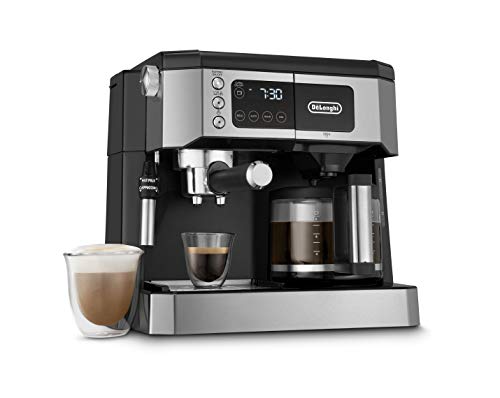
De’Longhi All-in-One Espresso & Coffee Maker — Best Espresso-and-Drip Dual
There is a second dual divide in coffee households, wider than cup-versus-pot: espresso people versus drip people, coexisting, each convinced the other’s machine is the clutter. De’Longhi’s All-in-One is the treaty for that household — a genuine pump espresso side, with milk frothing for lattes and cappuccinos, sharing a housing with a full drip coffee side that brews the pot the rest of the family runs on. It is the only machine in this guide whose two sides brew by different physics — pressure and percolation — and for the mixed household that is precisely its value: nobody converts, nobody compromises, one footprint hosts both faiths.
Combination machines demand honest expectations. Neither side is a dedicated flagship: the espresso side will not match a standalone De’Longhi built only for espresso, and the drip side is a capable household brewer rather than a specialty instrument. What it offers instead is peace and counter space, at a combined footprint and tier below the two separate machines it replaces. Ownership involves both sides’ rituals — espresso puck prep and drip filters, two cleaning personalities — so it suits a household of genuine enthusiasts rather than convenience seekers. Verified through the site’s catalogue cache for this category, it closes this guide as the reminder that dual brew, at its best, means respecting both of the household’s coffee religions at once.
Strengths
- True espresso and true drip in one footprint
- Milk frothing covers the latte and cappuccino drinkers
- Ends the two-machine standoff in mixed households
Trade-offs
- Neither side matches a dedicated flagship
- Two brewing rituals to learn and clean
- Substantial machine for a single-format household
| Detail | What to know |
|---|---|
| Type | All-in-one espresso and coffee maker (per catalogue title) |
| Espresso side | Pump espresso with milk frothing capability |
| Coffee side | Full drip coffee brewing |
Buy the All-in-One when the household divide is espresso versus drip rather than cup versus pot. It is the dual machine as diplomacy, and in the right kitchen it is worth more than either flagship it replaces.
Best for: mixed households of espresso drinkers and drip drinkers / Not suited for: single-format households or pure convenience seekers
Check on Amazon — check price on Amazon for the current listing.
Comparison Table
| Pick | Badge | Key spec | Best for |
|---|---|---|---|
| Ninja DualBrew Pro Specialty Coffee System CFP301 | Best Overall Dual Brew | Hybrid dual — pods and grounds, 4 styles, 13 sizes, frother | plural households wanting one flagship for every coffee format |
| Keurig K-Duo Essentials Coffee Maker Gen 2 | Best Streamlined Keurig Dual | Pod-and-carafe dual, Gen 2, streamlined feature set | Keurig households wanting dual brew without flagship complexity |
| Cuisinart Coffee Center 10-Cup SS-21NAS | Best Carafe-First Dual Brew | Dual — 10-cup thermal carafe, single-serve side, over-ice | pot-first households that graze a morning carafe |
| Hamilton Beach FlexBrew Advanced 4-in-1 Single Serve Coffee Maker | Best Single-Side Flexibility | Single-serve 4-in-1 — pods and grounds, hot and iced, 45 oz reservoir | all-single households divided by format and temperature |
| Hamilton Beach 2-Way Programmable Coffee Maker 49980RG | Best Pod-Free Dual Brew | Grounds-only dual — 12-cup glass carafe, scoop single side, programmable | grounds-only households spanning mugs and pots |
| De’Longhi All-in-One Espresso & Coffee Maker | Best Espresso-and-Drip Dual | Combination machine — pump espresso side plus drip coffee side | mixed households of espresso drinkers and drip drinkers |
Read this table by architecture. Hybrid: Ninja. Pod-and-carafe: the two Keurigs — Essentials for simplicity, and its Hot and Iced sibling in our companion guide for the full mode set. Carafe-first: Cuisinart. Singles-flexible: FlexBrew Advanced. Grounds-only: Hamilton Beach 2-Way. Espresso-and-drip: De’Longhi. The architecture is the decision; the model is merely its best current expression.
What does dual brew actually mean, and what does it not mean?
Dual brew means two independent batch formats — single serve and carafe — engineered into one appliance with shared housing and, usually, shared water and power systems. It does not mean a single-serve machine with a large-cup setting, however the marketing stretches; a 14-ounce travel mug brew is a big single, not a carafe, and a household that hosts will discover the difference at the first Sunday lunch. It does not mean two machines bundled in one box at checkout. And in this guide’s usage it does not automatically mean espresso: the espresso-and-drip combination is a cousin architecture, included here once, labelled clearly, because its household problem — two coffee faiths, one counter — is the dual problem in its other form.
What dual brew should guarantee, and what we required of every pick, is parity of dignity: the carafe side must brew like a drip machine you would buy alone, and the single side must extract like a single machine you would buy alone. The moment one side exists to justify a bullet point, the machine is a single brewer with a hobby, and it will be used as one — the neglected side scaling, staling and silently resenting its way across your counter. Judge display models and listings by that standard and the category becomes suddenly small and suddenly clear, which is exactly what a good standard is for.
Shared or separate reservoirs — and other sharing questions that matter
The reservoir is where dual design philosophy becomes daily experience. A shared tank, as on the Keurig Gen 2 platform, means one fill serves both sides, one level to watch, one descale path to remember — the simplest life, with the single constraint that a drained tank stops both formats at once. Separate reservoirs, as on the Hamilton Beach machines, mean the sides live independently — fresh water for the evening single while the morning pot’s supply stands ready — at the cost of two fills, two levels and two limescale personalities to manage. Neither is superior in the abstract; shared suits households that brew both sides daily, separate suits households whose sides keep different hours. Decide by your rhythm, not by the specification’s elegance.
Heat and control sharing matter almost as much. Machines that run one side at a time — nearly all of them — sequence a household’s peak minutes, which is painless unless two people need two formats in the same three minutes every morning, in which case no dual machine will save you and two machines were never clutter but infrastructure. Controls deserve a trial read on any listing: the best duals keep a single, obvious logic across both sides, so a guest can operate the half they need without a briefing. A dual machine a visitor cannot use is a dual machine that fails at the exact moment — guests — it was bought for.
How much should dual brew cost you over its life?
Think in three ledgers, all qualitative because this site prints no prices. The purchase ledger favours dual almost always: one mid-to-premium machine against two decent machines is rarely the dearer path, and the counter space returned has its own value in a small kitchen. The consumables ledger is format arithmetic: pods on a single side will outspend grounds severalfold across a year of daily cups, which is why both-formats and grounds-only duals exist and why the honest guide keeps recommending them to the pod-ambivalent. Filters, descaler and the occasional carafe are minor and roughly equal across architectures. The risk ledger is the one shoppers forget: a dual machine is a single point of failure for two habits, so platform maturity, parts availability and brand service depth are worth real weight in the decision — every machine in this guide was chosen partly on that ledger, and the long-serving Hamilton Beach and Keurig platforms score on it precisely because they have been failing, and being repaired, in public for years.
Set against those ledgers, the most expensive dual machine is the wrong-architecture one: the pod dual in a grounds household, bought back out of within a year; the carafe-first dual in a singles household, its pot side a monument. The cheapest dual machine is the right architecture at any tier, used daily for years. Spend your deliberation on the architecture and the deliberation will pay you back every morning; spend it on the feature list and it will not.
How do the best coffee makers dual brew designs handle two different households in one kitchen?
The scenario dual brew quietly serves best is the kitchen with two coffee households inside it — and modern life manufactures these constantly. The merged household of two adults who kept their habits through a wedding; the multi-generational kitchen where grandparents run on a morning pot and adult children run on pods; the house-share where the carafe is communal property and the single cup is private ritual; the home office where work coffee and family coffee observe different rules in the same room. Each of these is really two coffee systems sharing a postcode, and each was historically served by two machines, two stockpiles and a low-grade territorial negotiation over counter frontage. A well-chosen dual machine is the constitutional settlement: one footprint, formally divided into two jurisdictions, each with its own format, its own supplies and its own legitimacy.
The settlement holds only if the constitution is respected in the small print. Supplies must be jointly stocked — the week the pods run out and the carafe faction says we told you so, the treaty frays — so the station box and the shared shopping list are governance, not tidiness. Cleaning must be jointly owned for the same reason; a dual machine cleaned by one faction for both sides breeds exactly the resentment it was bought to end, and a simple rota or a whoever-brewwed-it rule keeps the peace. And the machine’s architecture must genuinely give each faction its first choice — both-formats for the split household, carafe-weighting where the pot faction dominates — because a settlement that reads as one side’s victory merely relocates the argument from the counter to the machine itself.
Judged by that standard, the best coffee makers dual brew can offer are not really appliances at all but agreements, and the households that thrive with them are the ones that negotiate the agreement consciously at purchase: whose formats, whose supplies, whose cleaning, whose Sunday carafe. Ten minutes of that conversation, held once, is worth more than any feature on any listing in this guide — because the machines are all, in the end, good enough. It is the households that differ, and the ones that talk first are the ones still sharing one machine, contentedly, years later.
How to get the best from both sides of a dual brew machine
Dual machines reward owners who treat the two sides as one system with two expressions. The routine below keeps both paths fresh, both formats honest, and the machine’s one real vulnerability — the neglected side — permanently defended.
- Alternate deliberately: brew at least one carafe and several singles every week, even in seasons when one format dominates, so neither path sits stale.
- Dose each side on its own terms: the carafe side wants a full, measured basket for the pot you are actually brewing; the single side wants its pod fresh or its scoop level — never carry habits across sides unexamined.
- Use the single side for experiments — a new roast, a stronger style, an iced variation — because a single cup is the cheapest laboratory in coffee, and let proven results graduate to the carafe.
- Decant plate-warmed carafes into a thermal jug after the first hour; thermal-carafe owners, maintain your entirely justified composure.
- Rinse what each side leaves behind the same day: drip baskets and scoop filters daily, pod chambers wiped weekly, drip trays before they announce themselves.
- Descale on the machine’s schedule for both paths, not the busy path — limescale does not respect which side you love more.
- Keep both sides’ supplies in one station box beside the machine: pods, grounds, filters, descaler. A side whose supplies live elsewhere is a side in the process of retiring.
Followed for a month, this stops feeling like a routine and starts feeling like what it is: one coffee station, fully alive on both sides, doing the work of the two machines whose counter it took. That is the dual brew promise kept — and it is kept by the owner, not the appliance.
Common Buying Mistakes
The signature dual brew mistake is architecture mismatch: falling for a machine’s flagship shine while its format split quietly contradicts your household — pods where you needed grounds, a garnish carafe where you needed a pot, a pot where you needed pace. Architecture first, model second, features last; every disappointed dual owner we have ever heard from inverted that order. The second mistake is the neglected side: buying dual, living single, and letting the unused path stale and scale until the day it is needed, when it performs like the afterthought its owner made it. Brew both sides weekly or admit you needed a single machine and buy a better one.
The third mistake is measurement theatre — checking width, guessing height, ignoring tank access — repeated so faithfully across this category that we suspect the tape measure industry of conspiracy. The fourth is duplicate retention: the old machines staying, the counter saving evaporating, the whole point quietly unhappening in a cupboard. The fifth is expecting simultaneity: dual machines sequence, they do not parallel-process, and the household that needs two formats in the same three minutes daily should keep two machines and call it infrastructure rather than clutter. Dual brew is a superb answer to a specific, common question. Ask your household the question honestly first.
Final Recommendation
The dual brew verdicts, by architecture. Hybrid maximalists: the Ninja DualBrew Pro, the most complete expression of the idea we could verify. Keurig households: the K-Duo Essentials Gen 2 for the streamlined treaty, with its Hot and Iced sibling awaiting in our companion guide if iced modes matter. Pot-first households: the Cuisinart Coffee Center and its thermal carafe. Singles-only households: the FlexBrew Advanced, honestly labelled. Grounds purists: the Hamilton Beach 2-Way, pod-free on both paths. Espresso-versus-drip households: the De’Longhi All-in-One, diplomacy in stainless form.
Choose the architecture in that list that describes your kitchen at breakfast, verify its footprint against your counter, and commit the replaced machines to new homes the week it arrives. Dual brew, chosen that way, is not a compromise between a cup and a pot. It is the end of compromising.
Keep exploring the same shelf of guides on this site: Best Coffee Makers Drip And Single Cup Best Coffee Makers Best Coffee Makers Christmas Present Best Single Cup Coffee Makers Best Drip Coffee Makers
Frequently Asked Questions
What is the difference between dual brew and drip and single cup?
Nothing in substance — they are two names for the same architecture of a carafe brewer and a single-serve brewer in one machine, which is why this site maintains a guide under each phrase. The difference is emphasis: the drip-and-single-cup guide shops by household fit, while this dual brew guide shops by architecture and engineering. A few flagship models legitimately appear in both, analysed from the two different angles, and a reader comparing both will find the reasoning complementary rather than repeated.
Can a dual brew machine make espresso?
Standard dual brew machines cannot: their single sides brew pods or drip singles at low pressure, which is coffee, not espresso, whatever the cup size suggests. The exception is the combination architecture, represented here by the De’Longhi All-in-One, which houses a true pump espresso side beside its drip side. If espresso is a requirement rather than a curiosity, that architecture — or a dedicated espresso machine — is the honest route, and guides that blur the distinction are selling, not advising.
Do both sides of a dual machine share the same water?
It depends on the platform, and the difference matters. Keurig’s Gen 2 duals share one large reservoir across both sides — one fill, one level, one descale path. Hamilton Beach’s duals give each side its own reservoir — independent operation and water freshness per side, at the cost of two fills to manage. Ninja’s flagship runs its formats through one system with its own logic. Neither arrangement is a flaw; match shared to households that brew both sides daily, and separate to households whose sides keep different hours.
Is dual brew worth it for a single person?
Usually not in its carafe form — a single person who brews one pot a month is carrying a carafe side as ballast. The exceptions are the single person who entertains seriously, whose weekends genuinely differ from their weekdays, and the singles-flexible architecture of the FlexBrew Advanced, which is dual in format and temperature rather than in batch size and suits solo life precisely. Everyone else solo should buy the best single-format machine their habit describes and spend the difference on better coffee.
How long do dual brew machines last?
As long as the platforms they are built on — which is why this guide weights proven platforms heavily. A dual machine has two brew paths’ worth of seals, pumps and scale exposure, so its lifespan is set less by its calendar age than by its water and its descaling discipline. Soft or filtered water and on-schedule descaling of both paths are the whole secret; households that keep that discipline report years of dual service, and households that descale neither path meet the category’s failure stories early, on both sides at once.
Should I choose pods or grounds for the single side?
Choose by the household’s real week, counted honestly. Pods win on speed, consistency and per-person variety, and lose on per-cup cost and packaging, every single week, for years. Grounds win on cost, freshness and roaster freedom, and ask for a scoop and a rinse in return. If the household is split — and most are — the both-formats machines exist precisely for you: the Ninja and the FlexBrew designs in our guides let the format follow the morning rather than the machine. That flexibility, used weekly, is worth more than any single brew-style feature.


