Disclosure: airfryerkitchensupply.com is reader-supported. When you buy through links on our site, we may earn an affiliate commission at no extra cost to you.
Where to buy
The most reliable place to buy any pick in this guide to the best can openers for elderly is Amazon, where each verified model below is listed with full product details and delivery options. Use the Check on Amazon links beside each pick to see the current listing. We do not print static prices in our guides because listings change, so check price on Amazon before you decide. If a pick is described as unlinked, that means we could not verify a listing we were confident in, and we say so openly rather than guess at a link.
- Hamilton Beach Smooth Touch 76608 — Check on Amazon (check price on Amazon)
- Kitchen Mama Auto 2.0 Electric Can Opener — Check on Amazon (check price on Amazon)
- Cuisinart CCO-50BKN Deluxe Electric Can Opener — Check on Amazon (check price on Amazon)
- Zyliss EasiCan Electric Can Opener — Check on Amazon (check price on Amazon)
- OXO Good Grips Manual Can Opener — Check on Amazon (check price on Amazon)
- Canslab Ultrablade PRO Electric Can Opener — Check on Amazon (check price on Amazon)
If you are choosing the best can openers for elderly cooks, the honest starting point is that opening a can should never be the hardest part of making lunch. Yet for many older hands it quietly becomes exactly that: a thin metal lid, a small turning knob, a clamp that demands a hard pinch, and a wrist twist that used to be automatic and now is not. The good news is that this is one of the most solvable problems in the kitchen. Modern electric openers remove the grip, the pinch and the twist almost entirely, and the best manual designs replace them with big soft handles, long cranks and side-cut wheels that leave no sharp edge to wrestle with. This guide is written for elderly users themselves and for adult children and carers shopping on their behalf, and it judges every pick on one test above all others: can this opener be used safely, calmly and without help on an ordinary day, including a stiff, tired day?
A quick word on how to use this page. Start with the Quick Picks if you want the short answer, because each pick carries a badge that tells you the job it does best. Then read the detailed reviews, where every opener gets an honest strengths and trade-offs list, because the right choice depends on details no headline can capture: whether the user can lift a full can up to a countertop unit, whether they can press a lever down with an open palm rather than fingertips, whether batteries will actually get changed, and whether counter space even allows a tall electric model. After the reviews you will find a comparison table, a full buying guide covering grip, cut style and power source, a practical how-to section on safe technique, the mistakes we see families make most often, and a short FAQ. Every linked pick below was verified against the retailer’s own catalogue data before it earned its link, and we never print static prices, so use the links to check price on Amazon at the moment you buy.
In this guide
Quick Picks
Six openers, six different answers to the same problem. If you only read one line, read this: for most elderly users a countertop or handheld electric wins, and the choice between them is about counter space and lifting, not about cutting power.
- Hamilton Beach Smooth Touch 76608 — Best Overall. A countertop electric that cuts along the side of the lid, so the lid lifts off whole with no sharp edge and no fishing in the food. Push the lever down with an open palm and the machine does the rest. Check on Amazon
- Kitchen Mama Auto 2.0 Electric Can Opener — Best Handheld Electric. A small cordless unit that sits on top of the can, walks itself around the rim at the press of one big button, and stops on its own. Nothing to lift, nothing to squeeze, nothing to turn. Check on Amazon
- Cuisinart CCO-50BKN Deluxe Electric Can Opener — Best Simple Countertop Electric. A classic single-touch countertop electric with a magnetic lid holder and a removable lever for washing. The catalogue listing itself describes it as suited for seniors, and the one-touch routine is why. Check on Amazon
- Zyliss EasiCan Electric Can Opener — Best Compact Electric. A one-touch, hands-free battery opener with a magnet for safe lid removal. Compact enough for small kitchens and easy to store, with stainless steel blades doing the cutting. Check on Amazon
- OXO Good Grips Manual Can Opener — Best Manual for Weak Grip. The manual opener to buy when a manual opener is what the user wants: big soft handles, a smooth turning action, and a catalogue description that names weak hands and seniors directly. Check on Amazon
- Canslab Ultrablade PRO Electric Can Opener — Best Rechargeable Upgrade. A USB-rechargeable, hands-free side-cut opener with smart auto stop, marketed for seniors and wall-mountable for a fixed, findable home. No disposable batteries to manage. Check on Amazon
How These Picks Were Chosen
We chose these picks by starting from the failure points elderly users actually report, not from marketing categories. The first failure point is grip: any opener that needs a sustained hard squeeze to stay clamped will eventually be abandoned in a drawer, so manual picks here needed oversized, soft, non-slip handles and a clamp that locks rather than one that must be held shut. The second is torque: turning a small wing knob against a steel lid demands wrist rotation and finger strength together, so we favoured long cranks, large knobs and, above all, motors. The third is the lid itself: a traditionally cut lid is a sharp disc that must be fished out of food, which is a cut risk for thinner skin and slower reactions, so smooth-edge and side-cut designs scored heavily. The fourth is the ending of the task: an opener that leaves the user holding a full, heavy can in mid-air while hunting for a bin has failed at the last step, so lid magnets, auto-stop and one-touch release all mattered.
Every product named with a link was verified the same way: we searched the retailer’s catalogue through the site’s own product data connection using the brand and model name, matched the returned title to the exact model we intended to recommend, and only then took the identifier used in the link. Where a model could not be matched with confidence, we either left it out or described it without a link and said why. We also screened out anything with a known safety recall and anything whose design depends on smartphone apps, accounts or firmware, because an opener for an elderly cook should work the day it arrives and every day after with nothing to update, pair or charge-manage beyond simple batteries or a plug. Finally, we deliberately mixed price tiers in qualitative terms only — budget, mid-range and premium positioning — because what an elderly user needs is the right mechanism, and the right mechanism exists at more than one tier.
What are the 6 best can openers for elderly cooks?
Each review follows the same pattern: who the opener suits, its strengths and trade-offs in plain bullets, the verified details that matter, a deeper look at living with it, and a bold verdict. Badges match the Quick Picks exactly, so you can move between the two sections without losing your place.

Hamilton Beach Smooth Touch 76608 — Best Overall
The Smooth Touch earns Best Overall because it removes every difficult motion at once. There is no clamp to squeeze, no knob to turn and no wrist twist: you set the can under the cutting head, press the large lever down — an open palm or the heel of the hand works fine — and the motor walks the cutter around the lid. Because it cuts along the side seam rather than through the top, the lid comes away as one smooth-edged disc that stays held until you release it, instead of dropping into the soup. For elderly users, that single difference eliminates the two most common can-opening injuries: the cut from a jagged lid and the scald or spill from fishing around in hot food.
In daily life the tall body is the main thing to plan around. It opens standard, extra-tall and pop-top cans, which covers everything from a small tin of tuna to a family-size can of tomatoes, and the corded design means it is always ready — no batteries to discover dead at the worst moment. The included bottle-opening accessory and knife sharpener are minor extras, but for a household simplifying its drawers they are genuinely handy. The lever needs a firm downward press to start, which most users manage with body weight rather than finger strength, and the cutting assembly should be wiped after use because side-cut wheels collect residue over time.
Strengths
- No grip, pinch or wrist torque required — the motor does the work
- Smooth-edge side cut removes the sharp-lid problem entirely
- Corded, so it is always ready with no batteries to manage
Trade-offs
- Takes permanent counter space and needs an outlet nearby
- The can must be lifted up to the machine, which suits most but not all users
- Cutting head needs regular wiping to stay hygienic
| Detail | What to know |
|---|---|
| Type | Countertop electric can opener |
| Cut style | Side cut — lid lifts off with a smooth edge |
| Operation | Easy push-down lever, automatic shutoff |
| Extras | Bottle opening accessory, built-in knife sharpener (per catalogue title) |
What makes this the default recommendation is the combination of effortlessness and forgiveness. If the can is slightly misaligned, you simply lift the lever and start again; nothing is half-cut or jammed. The automatic shutoff means there is no timing to judge. For an elderly person living alone, that predictability matters as much as raw ease, because confidence is what keeps someone cooking for themselves. Households where the user cannot comfortably lift a full large can to counter height should look at the handheld Kitchen Mama below instead, which travels to the can rather than the other way round.
Best for: elderly cooks who want the easiest all-round routine and have counter space near an outlet / Not suited for: tiny kitchens with no spare counter space, or users who cannot lift full cans to counter height
Check on Amazon — check price on Amazon for the current listing.

Kitchen Mama Auto 2.0 Electric Can Opener — Best Handheld Electric
The Kitchen Mama Auto 2.0 solves the lifting problem that countertop electrics create. Instead of bringing the can to the machine, you bring this palm-sized machine to the can: rest it on the lid, press the single large button, and let go. It grips the rim, walks itself around the can completely hands-free, and stops automatically when the circuit is complete, leaving a smooth edge you can lift away without a sharp rim on either the can or the lid. For an elderly user with limited shoulder or arm strength, opening a can that stays sitting on the counter the whole time is a genuinely different and easier task.
The refined blade on the 2.0 version is the detail that matters most in practice, because first-generation handheld electrics sometimes struggled with dented rims or very thick seams. This one handles standard cans calmly, and the whole routine — place, press, wait, lift — asks for no sustained grip at all. The honest costs are batteries and patience: it runs on replaceable batteries that someone must keep spares of, and a hands-free walk around a large can takes a little longer than a countertop motor. It also lives in a drawer, which means it must have a fixed home or it will be hunted for. Households that open cans daily may prefer the corded Hamilton Beach; households that open a few cans a week will find this the least intimidating tool on the list.
Strengths
- Truly hands-free — one button press, then let go entirely
- The can stays on the counter, so no lifting a full can
- Smooth edge on both lid and can, with nothing sharp to handle
Trade-offs
- Runs on batteries that need spares kept in the house
- Slower on very large cans than a countertop electric
- Small size means it can be misplaced if it has no fixed drawer
| Detail | What to know |
|---|---|
| Type | Handheld cordless electric can opener |
| Cut style | Smooth edge, food-safe blade (per catalogue title) |
| Operation | One-button start, automatic hands-free walk, auto stop |
| Power | Battery operated, cordless |
This is the pick we recommend most often for a parent living alone, because the psychological barrier is as low as the physical one: there is no technique to learn and no strength to summon. It is also the easiest opener to give as a gift that will actually be used, since it needs no installation, no counter space and no instruction beyond showing the button once. Pair it with a spare set of batteries taped inside the same drawer and the routine is complete.
Best for: elderly users with weak arms or shoulders, and anyone who cannot lift cans to a countertop unit / Not suited for: very high-volume can opening, or households that never keep spare batteries
Check on Amazon — check price on Amazon for the current listing.

Cuisinart CCO-50BKN Deluxe Electric Can Opener — Best Simple Countertop Electric
Some elderly users do not want the smooth-edge side cut of the Hamilton Beach; they want the familiar top cut they have used for decades, done by a motor instead of by hand. The Cuisinart CCO-50BKN is exactly that: a single-touch countertop electric where you position the can, press the activation lever once, and the machine cuts and holds the lid on its magnet when the job is done. That magnet is a small feature with outsized value, because it means the cut lid never falls into the food and never has to be picked off a blade with fingertips — it is simply lifted away from the magnet over the bin.
The removable activation lever is the other senior-friendly detail, since it pops off for washing, which keeps the cutting area hygienic without scrubbing around a fixed mechanism. The trade-off of the traditional top cut is the edge itself: the lid retains a sharper rim than a side-cut design, so it should go straight into the bin rather than being handled or used to press liquid from a can, a habit worth retiring. The unit is compact for a countertop model and the routine is about as learnable as an appliance gets — one press, one beep-free stop, one magnet-held lid. For a user who finds unfamiliar mechanisms stressful, this familiarity is a feature, not a lack of ambition.
Strengths
- Single-touch operation with almost nothing to learn
- Magnetic lid holder keeps the cut lid out of the food
- Removable lever makes proper washing easy
Trade-offs
- Traditional top cut leaves a sharper lid edge than side-cut models
- Corded countertop footprint, like all countertop electrics
- Not the choice for users who specifically want a smooth-edge finish
| Detail | What to know |
|---|---|
| Type | Countertop electric can opener |
| Operation | Single-touch automatic operation (per catalogue title) |
| Lid handling | Magnetic lid holder |
| Cleaning | Removable activation lever |
Choose this when the user values a routine they already understand. Many older cooks have decades of muscle memory around a top-cut electric, and swapping the hand effort for a motor while keeping everything else familiar is often the smoothest transition. Just pair it with the habit of dropping the lid straight in the bin, and the one real trade-off is managed.
Best for: elderly users who want a familiar top-cut routine with the effort removed / Not suited for: users who need a completely smooth, touch-safe lid edge
Check on Amazon — check price on Amazon for the current listing.
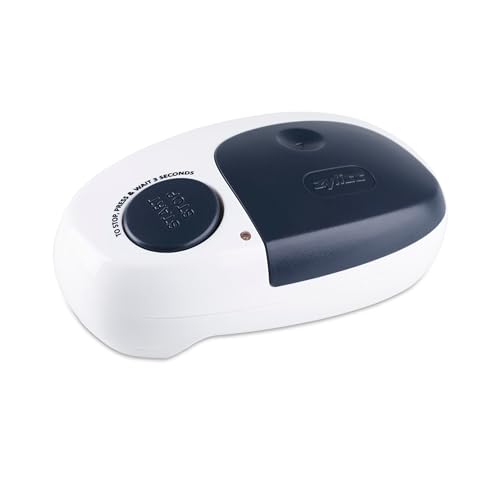
Zyliss EasiCan Electric Can Opener — Best Compact Electric
The Zyliss EasiCan is the other strong answer to the lifting problem, with a slightly different personality from the Kitchen Mama: it is a one-touch automatic opener that clamps on, cuts hands-free, and then lets its magnet do the delicate part — lifting the lid clear so fingers never approach the cut edge. For elderly users, that magnet finish is the difference between a task completed independently and a task that still ends with a fiddly, risky moment. The stainless steel blades are a durability plus, and the white, compact body stores in a standard drawer without dominating it.
Because it runs on AA batteries that are not included, the first job after buying is unglamorous but essential: fit fresh AAs and put a spare set in the same drawer, because a battery opener that has gone flat mid-week is worse than a manual one. AA power is at least the most standard battery format there is, so spares are easy for family to supply. In use, the routine is calm and undemanding — position, press, wait, lift the lid from the magnet — and the hands-free cut means the user’s hands are free to steady themselves on the counter rather than grip anything. It handles everyday can sizes well and suits kitchens where a countertop unit simply will not fit.
Strengths
- One-touch hands-free cutting with no grip or turning
- Magnet lifts the lid clear, keeping fingers away from the edge
- Compact drawer-friendly size for small kitchens
Trade-offs
- Batteries are not included and spares must be kept
- Battery power is less tireless than a corded motor on big cans
- White body shows splashes and needs a wipe to stay looking clean
| Detail | What to know |
|---|---|
| Type | Handheld battery electric can opener |
| Operation | One-touch automatic, hands-free design (per catalogue title) |
| Lid handling | Magnet for safe lid removal |
| Power | AA battery operated (batteries not included, per catalogue title) |
Between this and the Kitchen Mama, the deciding factors are small: this one’s magnet-led lid removal and Zyliss blade heritage against the Mama’s refined blade and colour choices. Either removes the strength requirement completely. For a small kitchen or a holiday home kitchen where cans are occasional, the EasiCan’s compact, no-install format is exactly right.
Best for: small kitchens and elderly users who want hands-free cutting plus magnet lid removal / Not suited for: households that dislike battery-powered tools on principle
Check on Amazon — check price on Amazon for the current listing.

OXO Good Grips Manual Can Opener — Best Manual for Weak Grip
Not every elderly cook wants a motor, and autonomy sometimes means keeping a simple tool that needs no power, no batteries and no bench space. Among manual openers, the OXO Good Grips is the one designed around the problem rather than despite it: the handles are fat, soft and non-slip, so the clamping squeeze is spread across the whole palm instead of concentrated in the fingertips, and the turning knob is sized and shaped to be turned with a fuller grip. The catalogue description explicitly frames it for arthritis and weak hands, and in practice the smooth gearing means the turn stays even instead of lurching, which is what makes manual opening exhausting with cheap openers.
Honesty matters here: this is still a manual opener. It still asks for a squeeze to clamp and a sustained turn to cut, so on a genuinely bad day it will be harder than any electric on this list, and we would not make it the only opener in the house of someone whose grip is fading fast. Its role is different — it is the best version of the familiar tool, ideal for users whose hands are still capable but tire quickly, as a backup when the power is out, and for the many older cooks who simply trust a tool they can see working. It also includes a bottle opener, and it washes and stores like any utensil. Bought with open eyes, it serves for years.
Strengths
- Soft oversized handles spread the clamping force across the palm
- Smooth, even turning action with no lurching
- No power or batteries — always ready, anywhere
Trade-offs
- Still requires squeeze and turning effort a motor would remove
- Traditional cut leaves a lid edge to handle with care
- Not sufficient as the only opener if grip is severely reduced
| Detail | What to know |
|---|---|
| Type | Manual can opener with bottle opener |
| Handles | Soft, easy-grip ergonomic handles (per catalogue title) |
| Operation | Hand-turned knob, smooth operation (per catalogue title) |
Think of this as the dignity pick and the backup pick in one. Many elderly users keep cooking confidently with a good manual opener long after a bad one would have defeated them, and the gap between this and a bargain-bin opener is the gap between finishing the job and abandoning it. Pair it with an electric for bad days and the kitchen is covered for every day.
Best for: elderly users with mild grip loss who prefer a manual tool, and as a reliable backup opener / Not suited for: severe grip weakness or days when hands are at their worst
Check on Amazon — check price on Amazon for the current listing.

Canslab Ultrablade PRO Electric Can Opener — Best Rechargeable Upgrade
The Canslab Ultrablade PRO answers the one objection that dogs the other handheld electrics: batteries. It is USB rechargeable, so there is no drawer of AAs to keep stocked and no mid-task fade from a half-dead disposable cell — you charge it like a phone, and the routine in between charges is fully hands-free. It cuts from the side, leaving a smooth edge, stops automatically when the cut is complete, and is explicitly positioned for seniors. For an elderly user who is comfortable charging a phone, this is arguably the most modern and lowest-maintenance routine on the list.
The wall-mountable design deserves attention, because the quiet failure mode of small openers is not mechanical at all — it is being put in the wrong drawer and effectively lost. A fixed wall or cupboard-door home means the opener is always in the same place, which matters more with every year. The honest trade-offs are charging discipline and brand familiarity: someone must remember to recharge it occasionally, and Canslab is a newer name than Hamilton Beach or Cuisinart, so long-term parts and support horizons are less proven. In exchange you get a cordless, smooth-edge, auto-stop routine with no consumables at all. For the right household — especially one where family visits weekly and can fold a quick charge into the routine if needed — it is a genuinely thoughtful upgrade pick.
Strengths
- USB rechargeable — no disposable batteries to buy or stock
- Hands-free side cut with smooth edge and smart auto stop
- Wall-mountable, so it always lives in the same findable place
Trade-offs
- Needs occasional recharging, which must become a habit
- Newer brand with a shorter track record than the legacy names
- Premium positioning within this category
| Detail | What to know |
|---|---|
| Type | Cordless electric can opener |
| Cut style | Side cut with smooth edge (per catalogue title) |
| Operation | Automatic, hands-free, smart auto stop |
| Power | USB rechargeable; wall mountable (per catalogue title) |
Choose the PRO when battery management is the known weak point in the household and charging a device is not. It is also the tidiest solution for a small kitchen, living on the wall rather than in a drawer or on the counter. If the user never charges anything willingly, pick a corded countertop model instead and remove the question entirely.
Best for: elderly users who happily charge devices and hate managing spare batteries / Not suited for: anyone who will not remember to recharge a kitchen tool
Check on Amazon — check price on Amazon for the current listing.
Comparison Table
| Pick | Badge | Key spec | Best for |
|---|---|---|---|
| Hamilton Beach Smooth Touch 76608 | Best Overall | Countertop electric, side-cut smooth edge, push-down lever | elderly cooks who want the easiest all-round routine and have counter space near an outlet |
| Kitchen Mama Auto 2.0 Electric Can Opener | Best Handheld Electric | Handheld battery electric, hands-free, smooth edge, auto stop | elderly users with weak arms or shoulders, and anyone who cannot lift cans to a countertop unit |
| Cuisinart CCO-50BKN Deluxe Electric Can Opener | Best Simple Countertop Electric | Countertop electric, single-touch, magnetic lid holder, removable lever | elderly users who want a familiar top-cut routine with the effort removed |
| Zyliss EasiCan Electric Can Opener | Best Compact Electric | Compact battery electric, one-touch, hands-free, lid magnet | small kitchens and elderly users who want hands-free cutting plus magnet lid removal |
| OXO Good Grips Manual Can Opener | Best Manual for Weak Grip | Manual butterfly opener, soft easy-grip handles, built-in bottle opener | elderly users with mild grip loss who prefer a manual tool, and as a reliable backup opener |
| Canslab Ultrablade PRO Electric Can Opener | Best Rechargeable Upgrade | Cordless rechargeable electric, side cut, smart auto stop, wall mountable | elderly users who happily charge devices and hate managing spare batteries |
Read the table by power source first. Corded countertop models (Hamilton Beach, Cuisinart) are always ready and strongest on big cans, but need space, an outlet and a lifted can. Battery handhelds (Kitchen Mama, Zyliss) remove lifting entirely and store in a drawer, in exchange for battery discipline. The rechargeable Canslab splits the difference. The lone manual pick, the OXO, asks the most of the hands and asks nothing of the power supply — which is exactly why it belongs in the drawer as the backup even when an electric is the daily driver.
How to choose the best can openers for elderly hands?
Start with the hands, not with the product listings. Watch the person who will use the opener actually open a can, and note which of the four motions fails first. If the clamp squeeze is the problem, the answer is any opener that locks or motors its clamp — in practice, an electric. If the turning motion is the problem but grip is fair, a long crank or large knob can still work, though a motor solves it more completely. If the wrist twist hurts, eliminate every design that needs the can or the opener rotated by hand. And if the dangerous moment is the end — lifting a sharp lid out of food — prioritise side-cut and magnet designs regardless of power source. Matching the mechanism to the failing motion is the whole game; a premium opener that still demands the one motion the user has lost is a bad buy at any tier.
Next, decide the power source as a household, not as an individual. Corded countertop electrics suit a stable kitchen with spare counter space and a user who opens cans most days; they never need charging or batteries and they shrug off the biggest cans. Battery handhelds suit small kitchens, lighter use, and users who cannot lift — but they introduce a supply task, so nominate who keeps the spare batteries and where they live before the opener arrives. Rechargeables suit users who already charge a phone without thinking about it. There is no universally right answer, only the answer that matches the routine the household will actually maintain in month six, not just week one.
Finally, think about the lid as a safety object. Traditional top-cut openers — manual or electric — separate the lid inside the rim and leave a thin, sharp disc that must be handled. Side-cut and smooth-edge openers separate the lid at the seam so both the lid edge and the can rim are blunt enough to touch, and the lid can often be lifted with the opener itself or a magnet. For elderly skin, which tears more easily and heals more slowly, and for anyone on blood-thinning medication, that difference is not a luxury feature. If you remember one line from this guide, make it this: for elderly users, smooth edge first, everything else second.
Should elderly cooks choose a side cut or a top cut?
A top cut is the cut most of us grew up with: the wheel slices through the top of the lid just inside the rim, the lid drops slightly into the can, and you fish it out or let the opener’s magnet catch it. Its advantages are familiarity and a clean pour — you can use the lid to strain liquid, a habit many cooks have. Its disadvantage is the edge: the separated lid is genuinely sharp, and so is the rim it leaves behind. A side cut works differently: the wheel runs around the outside of the seam, the whole top of the can lifts away as a unit, and both surfaces are left smooth because the metal is separated at its folded joint rather than sheared. The lid can even be set back on the can as a loose cover for short storage.
For elderly users we recommend the side cut in almost every case, and the reasoning is practical rather than fashionable. The sharpest object in the entire task disappears. The lid is bigger, stiffer and easier to grip than a floppy top-cut disc. Nothing falls into the food. The only real adjustments are that you cannot strain through the lid, and the first time feels unfamiliar because the can looks unopened until the top lifts. One demonstration removes that doubt permanently. If the user strains tuna or beans daily and insists on the lid trick, a magnet top-cut electric like the Cuisinart is the compromise — but retire the habit of pressing the lid down with fingers, and use a fork instead.
What about counter space, outlets and storage?
The best opener is the one that is out, charged or plugged in, and reachable — so plan its home before it arrives. A countertop electric needs roughly a coffee-mug footprint of permanent space within cord reach of an outlet, ideally on the side of the kitchen where cans are actually opened, not across the room. Measure the gap under your wall cabinets too: tall models plus a tall can need vertical clearance, and discovering the collision after purchase is the most common avoidable disappointment with countertop units. If space fails that test, the decision makes itself — go handheld and give the opener a fixed drawer, ideally the top drawer nearest the food preparation area, with its spare batteries or charging cable in the same place.
Storage discipline sounds like a small thing until you picture the alternative: a person with sore hands rummaging through three drawers while a pot waits on the stove. One home, always the same home, is an accessibility feature. The wall-mountable rechargeable pick exists precisely for households where drawers are deep and chaotic. Whichever style you choose, do a final reach test with the actual user: can they get the opener, use it, and put it back without stretching, stooping or lifting anything heavy? If any step fails, rearrange the kitchen, not the person.
How to open a can safely with weak hands, step by step
Technique matters even with the easiest opener, because most cuts and spills happen in the seconds before and after the cut itself. Set up once, properly, and every can after that follows the same calm pattern. Work at a clear stretch of counter at comfortable height, with the bin within one step and a clean tea towel to hand. Never open a can balanced on a knee, held in one hand, or over a sink full of dishes — the can needs a flat, dry surface and so do you.
- Put the can on a dry, flat counter and wipe the top of the lid with a clean cloth, so dust and store grime stay out of the food.
- Steady the can with a tea towel under it if it slides; a non-slip mat under the can is even better and worth keeping in the drawer.
- Fit the opener according to its type: for a countertop electric, set the can under the head and lower the lever with an open palm; for a handheld electric, rest it squarely on the lid; for a manual, clamp fully before you start turning.
- Start the cut and then let go if your opener is hands-free. Keep hands clear of the rim while any motor is running.
- When the cut completes, lift the lid away with the opener, its magnet, or a fork — never with fingertips pressed on the cut edge.
- Tip the lid straight into the bin. If you must handle it, pick it up by its flat centre, not its edge.
- Run a fingertip lightly — and only if your opener is a smooth-edge model — around the rim to confirm it is blunt. With a top-cut can, do not do this; simply look instead.
- Wipe the opener’s wheel or blade area after use, and return the opener to its fixed home while the food cooks.
Two habits prevent most of the remaining accidents. First, open all the cans a recipe needs before anything goes on the heat, so no can is ever opened in a hurry beside a hot pan. Second, if a can is dented on its seam, swollen, or hisses and spurts on opening, discard it unopened or untouched — no opener technique fixes a can that should not be eaten from, and elderly cooks should be especially firm about this rule. When in doubt, throw it out is not wastefulness; it is the cheapest food safety there is.
Common Buying Mistakes
The most common mistake families make is buying the opener they would want rather than the opener the user’s hands need — typically a sleek manual model that photographs well and demands exactly the grip strength that is disappearing. The second mistake is the opposite excess: buying a large countertop machine for a kitchen with no spare counter and no nearby outlet, so the machine migrates to a high cupboard and is never used at all. An opener that is not out and reachable does not exist, whatever its motor can do.
The third mistake is ignoring the consumables. Battery openers arrive, delight everyone for a month, go flat, and are quietly replaced in frustration by the old painful manual because nobody owned the job of keeping spares. Decide the battery or charging plan at purchase, and write it on a card in the drawer if that helps. The fourth mistake is keeping a dangerous lid habit: pressing a sharp top-cut lid into a can with bare fingers to strain liquid. Swap in a fork or a small strainer and the risk vanishes. Finally, do not wait for a cut or a dropped can to make the change. Grip loss is gradual, pride is real, and the kindest time to introduce an easier opener is while the old one still just about works — framed as an upgrade, not a surrender.
Final Recommendation
Here is the short version. For most elderly cooks, buy the Hamilton Beach Smooth Touch 76608: it removes grip, turning and sharp lids in one countertop machine that is always ready. If lifting a full can to the machine is the barrier, buy the Kitchen Mama Auto 2.0 instead and let the can stay on the counter. If the user wants the familiar top-cut routine with the effort removed, the Cuisinart CCO-50BKN is the gentle transition, and if the kitchen is small, the Zyliss EasiCan gives hands-free cutting from a drawer. Choose the Canslab Ultrablade PRO when battery-keeping is the household’s weak point and charging is a habit, and add the OXO Good Grips manual to the drawer in almost every case, as the power-cut backup and the dignity-preserving familiar tool.
Whichever you choose, set it up with the user the first time, agree its permanent home together, and sort the batteries or charging plan on day one. That ten-minute setup is what turns a good purchase into years of independent lunches — which is the real product being bought here.
Keep exploring the same shelf of guides on this site: Best Can Openers For Arthritis Best Can Openers For People With Arthritis Best Can Openers For Lefties Best Can Openers Best Electric Can Openers
Frequently Asked Questions
What is the easiest type of can opener for elderly hands?
An electric one, because it removes the three motions that fail first: the clamping squeeze, the knob turn and the wrist twist. Between the styles, a countertop electric is the most tireless and always ready, while a handheld electric is easiest for anyone who cannot lift a full can up to a machine, because the can stays on the counter. A smooth-edge side cut is the safest finish on either style.
Are smooth-edge can openers safer for seniors?
Yes, in the specific way that matters most. A side-cut smooth-edge opener separates the lid at the seam, so neither the lid nor the can rim is left sharp, and the lid lifts away whole instead of dropping into the food. That removes the most common can-related cuts, which matters more for thinner elderly skin and for anyone whose medication slows clotting. The small trade-off is that you cannot strain liquid through the lid; use a fork or strainer instead.
Can someone with very weak grip use a manual can opener at all?
Sometimes, with the right model and honest expectations. A manual opener with oversized soft handles and smooth gearing, like the OXO Good Grips pick in this guide, spreads the squeeze across the palm and can work well while grip loss is mild. But it will still be the hardest tool on a bad day, so we recommend pairing any manual opener with an electric for the days when hands are at their worst, rather than relying on willpower.
Do battery can openers run out at the worst moment?
They can, which is a planning problem rather than a product flaw. The fixes are simple: keep a spare set of batteries in the same drawer as the opener, or choose a USB-rechargeable model and fold charging into a weekly routine, or choose a corded countertop model and remove the question entirely. What does not work is hoping someone will notice the opener slowing down — by then it is already the worst moment.
How do you clean an electric can opener?
Wipe the cutting wheel and the area around it after each use with a damp cloth, because tomato and fish residue collect there quickly. Models with a removable lever or head, like the Cuisinart pick, can have that part washed properly at the sink, which is a real hygiene advantage. Never immerse a countertop or handheld electric body in water; the motor and batteries must stay dry. A clean wheel also cuts more smoothly, so cleaning is maintenance, not just tidiness.
When should a family step in and replace a parent’s can opener?
Earlier than feels necessary. The warning signs are cans left unopened and meals quietly changed to avoid them, a lid fished out of food by hand, small cuts explained away, or the opener migrating to the back of a drawer because using it hurts. Introduce the easier opener as an upgrade while the old routine still works, set it up together, and let the parent choose its home in the kitchen. Independence lasts longest when the tools change before the struggle does.


