Disclosure: airfryerkitchensupply.com is reader-supported. When you buy through links on our site, we may earn an affiliate commission at no extra cost to you.
Where to buy
Every pick shortlisted for best air fryers for chicken wings is sold through Amazon, and listings in this category change variants, finishes and bundles often, so use the links below to confirm the exact model code in the listing title before you order. The verified picks in this guide are: Ninja DCT401 Double Oven 12-in-1 FlexDoor; Ninja DZ401 Foodi DualZone XL 10 Qt; Ninja AF161 Air Fryer Max XL 5.5 Qt; Ninja AF181 Air Fryer XL with MaxCrisp 6.5 Qt; Cosori TurboBlaze Air Fryer 6 Qt; Chefman 8 Qt TurboFry Air Fryer. When you are ready to buy, check the current price on Amazon from any of these links rather than trusting a price quoted anywhere else, because air fryer listings are repriced constantly and the live listing is the only number that matters.
Wing capacity is quoted in pounds by the honest listings and in vague ‘XL’ language by the rest, so every pick below was confirmed through Amazon’s catalogue data for this site, and where a listing states a wing capacity — 3 lbs, 6 lbs — the review says so plainly. Confirm the model code in the listing title when you order, as several of these models have smaller siblings with the same name.
The best air fryers for chicken wings are the machines that understand the wing’s one demand: a single, uncrowded layer under violent hot air. Wings are mostly skin and surface, which makes them the air fryer’s perfect food — and also its most betrayed one, because a stacked, steaming pile of wings is a rubbery disappointment that has convinced too many people that air-fried wings ‘aren’t as good’. They are better than oven wings and rival deep-fried ones, in the right machine, loaded the right way. This guide is about the machines that make that easy at every scale, from a solo pound to a party’s worth.
Scale is the organising idea. A game-day household needs pounds of wings finished together, hot, which points to dual zones, double ovens and big baskets with stated capacities. A weeknight household needs one perfect pound, fast, with minimal washing-up. And every scale needs the same fundamentals: a high temperature ceiling for rendering, a basket shape that spreads wings out rather than piling them, and a shake or flip that is easy mid-cook. The picks below are matched to those jobs, with their listings’ own capacity claims quoted where they exist.
One technique truth before the machines: wings should go in dry and naked. Sauce is a finishing coat, applied in the last minutes or tossed on afterwards — sauced wings steam their own skin soft and scorch their sugars. Dry-brined or simply well-patted wings, cooked hard and sauced at the end, are the whole secret. The machines below differ in scale and format; none of them repeal that rule, and the best one for you is the one whose capacity matches your crowd.
Key Takeaways
- Wings demand one uncrowded layer under the hottest air you have
- Cook naked, sauce last — sauced wings steam their own skin soft
- Stated capacities plan parties: 3 lb class for families, 6 lbs for the double oven
- One halfway shake is half the cooking method
- Hold finished wings uncovered in a low oven, never sealed
In this guide
Quick Picks
If you only read one section, read this one. These six best air fryers for chicken wings contenders earned their places for different reasons, and the badge on each pick tells you exactly which job it does best. The same badges are used again at the top of each full review further down, so you can jump straight to the model that matches your kitchen.
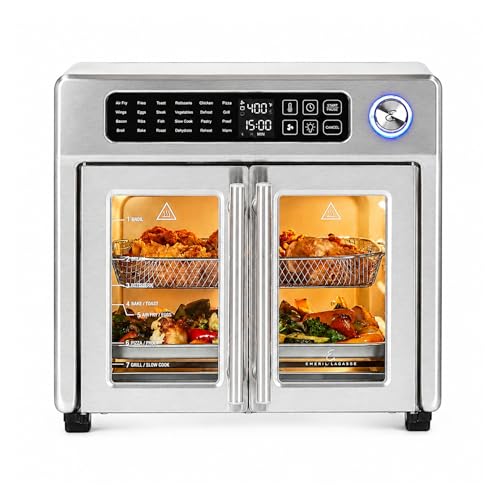
- Best for Parties — Ninja DCT401 Double Oven 12-in-1 FlexDoor: A two-level oven whose listing states the party number outright — fits 6 lbs of wings — with independent top and bottom cooking zones.
- Best Dual-Basket for Wings — Ninja DZ401 Foodi DualZone XL 10 Qt: Two 5-quart baskets that can run two wing flavours at once — or one giant matched batch — and finish them at the same moment.
- Best Crisping Power — Ninja AF161 Air Fryer Max XL 5.5 Qt: Max Crisp at 450°F in a 5.5-quart basket — the hardest-rendering single basket here, for wings with genuinely shattering skin.
- Best Big Single Basket — Ninja AF181 Air Fryer XL with MaxCrisp 6.5 Qt: The largest MaxCrisp basket in the line — 6.5 quarts at 450°F for the biggest single-layer wing batch a drawer can hold.
- Best for Frozen Wings — Cosori TurboBlaze Air Fryer 6 Qt: A dedicated Frozen function and five fan speeds — the machine tuned for wings that start rock-hard, which is most weeknight wings.
- Best Budget for Wings — Chefman 8 Qt TurboFry Air Fryer: Eight quarts of basket and a 450°F Hi-Fry finish at a budget-tier position — party-adjacent volume without party-machine spend.
How These Picks Were Chosen
Candidates were verified against Amazon’s catalogue data for this site, then screened for wing-specific merit: stated wing capacity where the listing offers it, 450°F-class ceilings for rendering, basket floors wide enough for a true single layer, and — for party scale — dual zones or stacked formats that multiply the layer rather than the pile. Machines that could only cook wings in stacked batches were excluded; wings are the food where stacking fails hardest.
The six survivors divide by crowd size: a double oven and a dual-zone machine for parties, two powerful single baskets for family batches, a tunable all-rounder, and a compact precision option for small households. Every pick was also checked for the unglamorous essentials — a basket that shakes easily, parts that go in the dishwasher after a greasy cook, and controls that make a mid-cook temperature bump simple, because wings often finish with one.
The 6 Best Air Fryers for Chicken Wings, Reviewed

1. Ninja DCT401 Double Oven 12-in-1 FlexDoor — Best for Parties
This is the game-day machine. Six pounds of wings is a party, and the double oven cooks them across two levels with a FlexDoor that opens either the top section alone or the full cavity. Smart Finish synchronises the zones, so the top and bottom loads land together instead of in shifts. If wings are an event food in your house, this is the event machine.
Strengths
- Stated capacity of 6 lbs of wings — the clearest party claim in this guide
- Two independent zones with synchronised finishing for big loads
- FlexDoor lets you check the top load without dumping the whole oven’s heat
Trade-offs
- A full countertop oven footprint — this is a commitment appliance
- Two levels of wings benefit from a mid-cook tray swap for perfect evenness
- Overkill for a household whose wing night is one pound for two people
| Format | Double oven, 12-in-1 |
| Fits | 6 lbs wings |
| Door | FlexDoor — top-only or full access |
| Features | FlavorSeal, Smart Finish |
Party wings fail on logistics, not cooking: the first batch cools and softens while later batches cook, and the host eats last and worst. The DCT401 attacks the logistics with volume and synchronisation — a stated 6 lb wing capacity across two zones, finished together. Wings go out in one wave, hot and crisp, and the host sits down with everyone else. That is the entire case, and for party households it is decisive.
The oven format adds range the baskets cannot: pizzas alongside, trays of fries below, a full second-oven repertoire for the rest of the year. The mid-cook honesty: two stacked loads brown best with one tray swap, a ten-second job the FlexDoor makes easy. If your wing cooking is measured in pounds and people, start here.
Best for: parties and game days cooking wings by the multi-pound batch / Not suited for: small households or counters that cannot host a full oven format
Check the current price on Amazon for the Ninja DCT401 Double Oven 12-in-1 FlexDoor.

2. Ninja DZ401 Foodi DualZone XL 10 Qt — Best Dual-Basket for Wings
Choose the DZ401 if your wing nights involve variety or volume in drawer form: buffalo in one basket, dry-rubbed in the other, both done together; or Match Cook both baskets for one big plain batch to sauce in bowls. Each 5-quart basket is a full fryer, so neither flavour is a compromise batch. For families, this is the wing machine with the fewest arguments built in.
Strengths
- Two flavours or rubs cooked simultaneously, finished together
- Match Cook doubles up for one large single-flavour batch
- Drawers shake more easily than oven trays — a real wing advantage
Trade-offs
- Each basket’s layer is 5-quart class — party scale means a second run
- Wide footprint, permanently on the counter
- Two baskets of greasy wings means two baskets in the wash
| Capacity | 10 Qt — two 5 Qt baskets |
| Functions | 6-in-1 |
| Zone features | Match Cook, IQ Boost |
| Zones | 2 independent |
Wings are a shaking food, and drawers are the shaking format: pull, shake, push, done. The DZ401 gives you two of them, which transforms wing night from a sequence into a production. Two rubs for two tastes, a hot batch and a mild batch for mixed company, or a doubled plain batch — the machine absorbs the variation that makes wing cooking social.
Its limit is absolute scale: the DCT401 above states 6 lbs at once, and the dual drawers will need a second run to match a true party load. For family-scale wing nights — which is most wing nights — the drawers’ speed, shakeability and synchronised finish make this the most enjoyable wing machine in the guide to actually cook with.
Best for: families cooking two wing styles at once or family-size batches / Not suited for: single-load party volumes beyond its two baskets
Check the current price on Amazon for the Ninja DZ401 Foodi DualZone XL 10 Qt.

3. Ninja AF161 Air Fryer Max XL 5.5 Qt — Best Crisping Power
If your wing standard is skin — blistered, rendered, crisp enough to hear — this is your machine. Max Crisp runs at 450°F with aggressive airflow, and the 5.5-quart basket takes a family layer of wings without crowding. It is the single-basket wing specialist for households of three to five who cook wings weekly and judge them harshly.
Strengths
- 450°F Max Crisp renders wing skin harder than standard modes
- 5.5-quart basket holds a family batch in one true layer
- Broil mode rescues and re-crisps sauced wings in the final minutes
Trade-offs
- Single basket — one flavour, one batch at a time
- At Max Crisp the margin between crisp and scorched rubs is a few minutes
- No dual-zone tricks for sides; wings are the whole show
| Capacity | 5.5 Qt |
| Max temperature | 450°F (Max Crisp) |
| Functions | 7-in-1 including broil |
| Fits | 3 lbs fries |
Wing skin is a rendering problem: the fat under the skin must melt and escape while the skin itself dries and crisps. Max Crisp’s combination of ceiling heat and fan aggression is built for exactly that, and the results on naked, well-dried wings are the closest a basket comes to a fryer. The broil finish adds the party trick — toss wings in sauce, give them a short broil, and the sauce sets into a glaze instead of softening the skin.
Technique still rules: dry wings, single layer, one shake, sauce late. Given those, this machine produces the wings that convert oven-wing sceptics. Households choosing between it and the DZ401 should ask whether they value peak crispness in one batch or two simultaneous batches more; there is no wrong answer, only a preference.
Best for: crispness-first wing cooking for three to five people / Not suited for: two-flavour simultaneity or party-scale single loads
Check the current price on Amazon for the Ninja AF161 Air Fryer Max XL 5.5 Qt.

4. Ninja AF181 Air Fryer XL with MaxCrisp 6.5 Qt — Best Big Single Basket
Pick the AF181 if you want Max Crisp violence at maximum drawer scale. The 6.5-quart basket spreads a big family load of wings in one layer — the layer is the point — and 1750W holds temperature when that load goes in cold. It is the single-basket answer for households that found 5.5 quarts just too small.
Strengths
- 6.5-quart basket gives wings the widest single layer in a drawer here
- MaxCrisp at 450°F with 1750W behind it
- Six functions cover the rest of the week without menu clutter
Trade-offs
- A big drawer — check counter depth and storage honestly
- One basket still means flavours and sides run in sequence
- Full loads at maximum heat need the halfway shake without exception
| Capacity | 6.5 Qt |
| Max temperature | 450°F (MaxCrisp) |
| Power | 1750W |
| Functions | 6-in-1 |
Capacity in a wing machine should be measured in layer area, and the AF181’s basket floor is the largest single layer in this guide’s drawer machines. More layer means more wings per batch at true crisping quality — not more wings steamed in a pile. Combined with MaxCrisp heat, it is the batch wing machine for families who cook one big flavour and cook it hard.
The ownership notes are simple: it is a large appliance that earns its space only if wing-scale batches are a weekly event, and its full loads demand the halfway shake like any basket. Households between sizes should size by their real wing night — if a 5.5-quart layer feeds your crowd, the AF161 is the sharper buy; if it never quite does, this is the fix.
Best for: large single-flavour wing batches for five or more / Not suited for: small kitchens or two-flavour wing nights
Check the current price on Amazon for the Ninja AF181 Air Fryer XL with MaxCrisp 6.5 Qt.

5. Cosori TurboBlaze Air Fryer 6 Qt — Best for Frozen Wings
Most wings are cooked from frozen, whatever the recipe blogs pretend. The TurboBlaze is the pick that admits it: a Frozen function designed for the thaw-and-crisp sequence, fan speeds that let you manage the moisture frozen wings shed, and a 450°F ceiling for the finish. For freezer-to-table wing nights, it is the most honestly matched machine here.
Strengths
- Frozen function handles the thaw-then-crisp sequence automatically
- Five fan speeds manage the moisture phase frozen wings go through
- 450°F ceiling and broil give the finish frozen wings need
Trade-offs
- Fan-speed control is a variable to learn, not a pure convenience
- Frozen wings still need a mid-cook separation once they release
- Ceramic basket prefers gentle handling after greasy cooks
| Capacity | 6 Qt |
| Temperature range | 90–450°F |
| Fan speeds | 5 |
| Functions | 9-in-1 including Frozen and Broil |
| Power | 1725W |
Frozen wings have a three-act structure: thaw and shed water, cook through, then crisp. Machines without a frozen program force the cook to improvise the transitions, usually by over-heating the first act and scorching the rub. The TurboBlaze’s Frozen function stages it properly, and its fan control lets experienced owners push airflow during the wet phase and ease it for the finish — a level of wing management no other basket here offers.
Fresh wings, of course, cook beautifully in it too, with the full 450°F range available. Treat it as the thinking cook’s wing machine: the one that rewards the household that cooks wings both ways, from the freezer on Tuesdays and fresh on Saturdays, and wants one appliance fluent in both.
Best for: frozen wings and cooks who like control over airflow / Not suited for: one-button households that never cook from frozen
Check the current price on Amazon for the Cosori TurboBlaze Air Fryer 6 Qt.
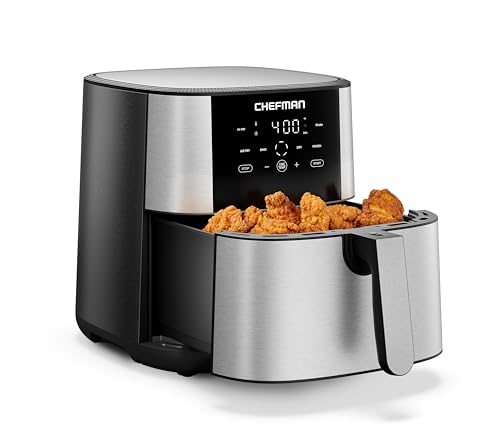
6. Chefman 8 Qt TurboFry Air Fryer — Best Budget for Wings
This is the budget wing answer, and it is a good one: a genuinely large 8-quart basket for spreading a family load in one layer, a Frozen function among its four modes for freezer wings, and the Hi-Fry 450°F finish to set the skin at the end. If wings are a weekly family event and the budget is real, start here without apology.
Strengths
- 8-quart basket spreads a family wing load in a true single layer
- Hi-Fry 450°F option delivers the finishing heat wings demand
- Frozen function covers the most common weeknight wing scenario
Trade-offs
- Four functions only — a workhorse, not a Swiss army knife
- Budget-tier build and control feel
- One basket, one flavour: variety means sequential batches
| Capacity | 8 Qt |
| Functions | TurboFry 4-in-1 including Frozen |
| Special feature | 450°F Hi-Fry option |
| Basket | XL nonstick, dishwasher-safe |
Wings forgive budget machines more than most foods, because the wing method — dry, hot, shaken, sauced late — does most of the work. What a budget machine must provide is space and finishing heat, and this Chefman provides both: the layer fits, and the Hi-Fry blast at the end crisps skin that standard budget modes leave a shade soft. Blind-taste a well-run batch from this machine against a premium basket and the gap is smaller than the tier gap suggests.
The compromises are breadth and polish: four functions, a functional finish, no dual-zone or smart features. For a household whose air fryer life is wings, fries and frozen staples, that is not a compromise at all — it is the correct specification at the correct tier, with the savings available for the wings themselves.
Best for: budget wing nights and large simple batches / Not suited for: multi-flavour simultaneity or feature collectors
Check the current price on Amazon for the Chefman 8 Qt TurboFry Air Fryer.
Comparison Table
The table below puts the six picks side by side on the one specification that matters most for this search, so you can shortlist in seconds and then read the full review of the two or three models that survive.
| Pick | Badge | Key spec | Best for |
|---|---|---|---|
| Ninja DCT401 Double Oven 12-in-1 FlexDoor | Best for Parties | Double oven, fits 6 lbs wings, Smart Finish | parties and game days cooking wings by the multi-pound batch |
| Ninja DZ401 Foodi DualZone XL 10 Qt | Best Dual-Basket for Wings | Dual 5 Qt baskets, Match Cook, two flavours at once | families cooking two wing styles at once or family-size batches |
| Ninja AF161 Air Fryer Max XL 5.5 Qt | Best Crisping Power | 5.5 Qt, Max Crisp 450°F, broil finish | crispness-first wing cooking for three to five people |
| Ninja AF181 Air Fryer XL with MaxCrisp 6.5 Qt | Best Big Single Basket | 6.5 Qt, MaxCrisp 450°F, 1750W | large single-flavour wing batches for five or more |
| Cosori TurboBlaze Air Fryer 6 Qt | Best for Frozen Wings | 6 Qt, Frozen function, 5 fan speeds, 450°F | frozen wings and cooks who like control over airflow |
| Chefman 8 Qt TurboFry Air Fryer | Best Budget for Wings | 8 Qt, Hi-Fry 450°F finish, Frozen function | budget wing nights and large simple batches |
How many wings fit in an air fryer, really?
Work in layers, then in pounds. A wing layer in a 5-to-6-quart basket is roughly a pound to a pound and a half of wings spread with small gaps; the 6.5-to-8-quart baskets stretch that meaningfully; and the stated capacities in this guide — 3 lbs of wings class machines at family scale, the double oven’s stated 6 lbs — describe full loads cooked the way wings must be cooked, in the machine’s full layer area across its zones or levels. Any claim beyond a machine’s layer area assumes stacking, and stacking is where wings go to steam.
For planning: a pound of wings is a generous main for one wing-lover or a starter for two or three. A family wing night for five usually means three pounds across the evening; a party means the double-oven class or a planned two-wave service from a dual machine, with the first wave held uncovered in a low oven. There is no shame in waves — restaurants cook wings in waves — but plan them, rather than discovering them with hungry people watching.
- Solo / couple: one layer in a 4–5.5 Qt basket
- Family of 4–5: 6.5–8 Qt single layer, or dual 5 Qt baskets
- Party: stated multi-pound formats — double oven or dual zones, run as planned waves if needed
- Never count stacked wings as capacity; count layers
Fresh or frozen wings: which cook better in an air fryer?
Fresh wings, properly dried, hold a small edge: their skin starts dry, so rendering begins immediately and the finish is marginally crisper. Frozen wings, cooked with a staged approach — moderate heat to thaw and separate, then full heat to crisp, ideally with a frozen function managing the sequence — finish close enough that most households cannot justify thawing planning around them. The deciding factor is not fresh versus frozen; it is dry versus wet at the moment the high-heat phase starts. Shake off frost, separate pieces as soon as they release, and let the machine’s hot phase meet dry skin.
Sourcing note for both: wings sold as ‘party wings’, split into drumettes and flats, cook more evenly than whole wings folded over themselves, and they layer better. Whole wings work, but tuck and arrange them deliberately, and expect the fold to need the flip. Either way, pat fresh wings dry and consider salting them ahead — even thirty minutes of dry-brining firms the skin’s start in a way no machine setting can substitute for.
What temperature and method give the crispest wings?
High heat, dry skin, one layer, one shake, sauce last — the five-part method every pick in this guide is built to serve. The temperature question resolves to your machine’s ceiling: run wings at or near the top of it for the crisping phase, because wing skin renders best under aggressive heat, and use any finish mode — Max Crisp, Hi-Fry, broil — for the final minutes if the colour lags. Rubs with sugar need watching at these temperatures in the last phase; plain salted wings are nearly indestructible.
The shake deserves its reputation: wings nestle into each other as they cook and shrink, sealing contact patches that steam. One firm shake at halfway — or a tong-turn for arranged party trays — re-exposes every surface. After cooking, sauce in a warm bowl and toss fast, or broil sauced wings very briefly to set a glaze. Serve immediately: wings are the food that punishes waiting most, which is why the synchronised machines in this guide matter.
Buffalo, dry rub or glazed: how should wings be finished?
The three great wing finishes are three different final acts, and the air fryer serves each one distinctly. Buffalo style — tossed in a warm butter-and-hot-sauce mixture — must happen off the heat, in a bowl, seconds before serving, because the sauce is a coat, not a cook. The wings should be at their crispest when they meet it, and the bowl should be warm so the sauce flows instead of clumping. Serve immediately; buffalo wings wait for nobody, and their crispness is measured in minutes.
Dry-rub wings take their seasoning in two acts: a salt-forward base before cooking, so it can work on the skin, and a second dusting after, when the hot rendered surface grabs it. Glazed wings — sweet, sticky, Asian-inspired or barbecue — reverse the buffalo rule: the glaze goes on in the final minutes and is set by a brief return to high heat or broil, which is where the finish modes on the AF161 and TurboBlaze earn their keep. Watch glazed wings constantly in that phase; the distance from lacquered to scorched is the shortest in this guide.
How do you run wing night for a crowd without living in the kitchen?
Crowd wing service is a production problem with a known solution: waves, a holding bay and a sauce station. Cook in waves sized to your machine’s true layer — the stated capacities in this guide are your planning numbers — and hold each finished wave uncovered in a low oven, which keeps wings hot and crisp for the span of a party. Never seal them, never pile them deep in a slow cooker; both are steam chambers wearing a disguise.
Set the sauces out as a station rather than saucing centrally: naked crisp wings hold their quality far longer than sauced ones, and guests tossing their own portions in warm bowls get the fresh-tossed experience at any hour of the event. The host’s job shrinks to running waves and refilling the station — which is to say, the host attends their own party. The double-oven and dual-zone picks exist to make the waves bigger and fewer; the system matters more than the machine, and the machine should be bought to serve the system.
- Cook waves at true layer capacity; hold uncovered in a low oven
- Sauce at a station, by the portion, at the moment of eating
- Naked wings hold; sauced wings fade — plan accordingly
Drumettes, flats or whole wings: does the cut change the cook?
It changes the layer, the timing balance and the eating — and partisans of each cut are right about their own. Drumettes are the meatiest and most forgiving: they tolerate heat, hold sauce and eat like small drumsticks. Flats cook fastest and crispest per gram, with the two-bone structure that fans insist eats best; they are also the first to overcook in a mixed batch. Whole wings, folded, cook least evenly of the three and need deliberate arranging and a certain flip.
Mixed party packs are the reality in most shops, and the management is simple: arrange by type where you can — flats toward the basket’s hotter zones only if your machine has known hot spots, drumettes given the longer exposure — and pull flats a shade early if the batch is mixed. Or buy split wings of one type for the cooks that matter. The machine cannot repeal the geometry; it can only be loaded with it in mind.
How do you make wings for people who disagree about heat?
Every wing crowd contains a heat spectrum, and the air fryer handles it more gracefully than a fryer full of oil because batches are cheap to vary. The base cook is identical for everyone: naked, dried, crisped wings. Heat is applied at the finish, where it can be portioned — a mild batch tossed in a gentle glaze, a hot batch in the full buffalo treatment, a suicidal ramekin on the side for the one guest who insists. Seasoning after cooking, which this guide already preaches for crispness, turns out to be the diplomacy protocol as well.
Dry rubs portion the same way: a base rub for all, a chilli-heavy second dusting for the brave. The dual-basket pick in this guide industrialises the approach — two rubs, two zones, one finish time — but a single basket running two waves achieves it with a holding oven. What not to do is average the heat into a single compromise batch that thrills nobody: wings are a plural food, and the machine’s batch structure is built for pluralism.
What do wings cost a household that cooks them weekly — and is it worth it?
Wings are among the most economical party and family foods per person, and the air fryer improves the arithmetic in two directions. The obvious one is oil: a batch uses a teaspoon or none, against the litres a deep fryer consumes and then discards — a recurring saving that compounds weekly, alongside the absence of oil storage, straining and disposal from a home kitchen. The quieter saving is energy and time: a countertop machine heating a small volume for a short cook, against an oven heating a cavern for the same wings.
Against that, set the honest costs: wings themselves fluctuate in price by season and demand, and a household that cooks them weekly will feel those swings more than the machine’s running costs. The verdict of weekly wing households is consistent, though — the total cost of a wing night at home lands far below the same night ordered in, at quality most prefer, and the machine that enables it pays its tier back in a season of Fridays. That is the whole economic case, and it does not need exaggeration.
How do you scale wings down: the perfect single portion
Most wing writing assumes a crowd, but the wing’s secret second life is as the perfect solo food: a pound of wings is a complete, satisfying meal for one, cooked in a small basket in a single layer with no waste and no leftovers worth the name. The method shrinks gracefully — the same dry, hot, shaken cook, in the AF101-class compact end of this category or a single zone of a dual machine — and the economics shrink with it: one portion, bought exactly, cooked in minutes, eaten hot at the counter.
Solo wing cooks should optimise for the small end of this guide’s logic: a basket whose layer fits a pound with gaps, a finish mode for the final crisp, and a sauce habit measured in tablespoons. The party machines remain wonderful, but a household of one running a double oven for six wings is spending counter and energy on theatre it does not need. Match the machine to the portion you actually cook — the principle this entire cluster is built on — and wings become a weeknight staple instead of an event.
A final word on wing night
Wing night endures because it is the rare meal that is simultaneously cheap, festive and genuinely delicious — and the air fryer is the appliance that finally made it effortless at home. No oil to heat, strain and store; no oven heating the kitchen for an hour; just dry wings, violent hot air, one shake and a warm bowl of sauce. The machines in this guide differ in scale and cleverness, but they all serve that same small ceremony, and any of them will run it weekly for years. Pick the one whose layer matches your crowd, write your house timing on a card, and protect the two rules that matter — one layer, sauce last. Do that, and wing night stops being a recipe you follow and becomes a thing your household simply does, which is the highest state any dinner can reach.
How to cook perfect air fryer wings, step by step
This is the house method for every machine in the guide. It assumes naked wings and a sauce or rub finish, because that sequence — crisp first, flavour coat last — is what makes air-fried wings rival any other method.
- Dry the wings thoroughly. Pat fresh wings with paper towels; shake frost from frozen wings. If you have thirty minutes, salt them and rest uncovered in the fridge — the skin will thank you.
- Season the naked wings: salt, pepper, and any dry rub without much sugar. Sugar goes on late or in the sauce, not under maximum heat for the whole cook.
- Preheat the basket or oven. Wings hitting hot metal start rendering immediately instead of steaming in their own first juices.
- Load one layer with gaps. Arrange, do not dump — thirty seconds of arranging buys the airflow that crisps.
- Cook at your machine’s high setting. Shake the basket firmly once at halfway, or turn arranged wings with tongs.
- Finish with intent: if the colour is a shade light, use Max Crisp, Hi-Fry or broil for the final short burst rather than extending the whole cook.
- Sauce in a warm bowl, toss to coat, and serve at once. For a set glaze, return sauced wings for a very brief finish — watch them constantly.
Write down your machine’s wing line — weight, setting, time, shake point — after the first good batch. Wings are a repeat food; a recorded house method turns every wing night into a performance you have already rehearsed.
Common Buying Mistakes
Wing failures are consistent and fixable. If your wings disappoint, the cause is on this list with near-certainty.
- Saucing before cooking. Wet, sugary coatings steam the skin and scorch. Crisp naked; sauce at the end.
- Stacking to fit more. Piled wings steam each other. Cook a proper layer, then a second wave if the crowd demands it.
- Skipping the shake. Wings settle into sealed contact patches. One halfway shake is half the method.
- Starting with wet wings. Washed, marinated or frost-heavy wings spend their cook drying instead of crisping. Dry first, always.
- Serving in waves without a holding plan. Hold finished wings uncovered in a low oven, never sealed — trapped steam undoes the crisp in minutes.
Final Recommendation
Choose by crowd: the Ninja DCT401 double oven for stated 6 lb party loads, the DZ401 for two-flavour family nights, the AF161 for peak single-basket crispness, the AF181 for the biggest single layer, the TurboBlaze for frozen-wing fluency, and the Chefman 8 Qt for budget volume. Every one of them, loaded in a single layer with dry wings, produces wings worth serving to people you like.
Wings sit inside the wider chicken cluster — the general chicken guide and the browning guide are the natural next reads, linked below with the base guide.
Check the current price on Amazon for the Ninja DCT401 Double Oven 12-in-1 FlexDoor (Best for Parties). Check the current price on Amazon for the Ninja DZ401 Foodi DualZone XL 10 Qt (Best Dual-Basket for Wings). Check the current price on Amazon for the Ninja AF161 Air Fryer Max XL 5.5 Qt (Best Crisping Power).
Best Air Fryers Best Air Fryers For Chicken Best Air Fryers For Browning Best Air Fryers For Big Families Best Air Fryers For Chips
Frequently Asked Questions
How long do wings take in an air fryer?
It depends on size, starting temperature and machine, so treat any single number with suspicion: fresh wings at high heat are a fast cook, frozen wings take meaningfully longer, and party trays longer still. Use your machine’s guidance as the first estimate, shake at halfway, and judge by skin — rendered, deep-coloured and crisp to a tap — then record your machine’s timing for your usual wing size.
Do wings need to be thawed before air frying?
No. Frozen wings cook well with a staged method: moderate heat first so they thaw and separate, then full heat to crisp, which is exactly what frozen functions automate. Fresh wings hold a small crispness edge because their skin starts dry, but the difference is minor next to the convenience of cooking from frozen.
Why are my air fryer wings soggy?
One of three causes: they were stacked, they were wet, or they were sauced too early. Wings must cook in a single layer with gaps, go in dry, and meet sauce only at the end. Holding them in a sealed container after cooking is the fourth cause — serve them or hold them uncovered in a low oven.
How do you keep wings crispy after saucing?
Sauce them hot, in a warm bowl, and serve immediately. For a more durable finish, return the sauced wings to the machine for a very brief high-heat set — a broil or max-crisp burst — which turns the sauce into a glaze. Watch constantly; the line between glazed and scorched is short.
What size air fryer do I need for a family wing night?
For four to five people eating wings as the main event, plan on roughly three pounds cooked in layers: a 6.5-to-8-quart single basket, dual 5-quart baskets, or a double oven all cover it. Smaller baskets cook excellent wings in waves — just hold the first wave uncovered in a low oven and tell the family the system is intentional.
Are air-fried wings healthier than deep-fried wings?
They are cooked with far less oil — typically a teaspoon tossed over a batch, or none — because the crisping comes from the wing’s own rendered fat and hot air rather than a bath of frying oil. The wings themselves are unchanged, skin and all, so the honest claim is ‘much less added fat for a very similar result’, which is why the method has become the default in so many homes.