Disclosure: airfryerkitchensupply.com is reader-supported. When you buy through links on our site, we may earn an affiliate commission at no extra cost to you.
Where to buy
Every pick shortlisted for best air fryers for browning is sold through Amazon, and listings in this category change variants, finishes and bundles often, so use the links below to confirm the exact model code in the listing title before you order. The verified picks in this guide are: Ninja AF161 Air Fryer Max XL 5.5 Qt; Typhur Dome 2 Large AI Smart Air Fryer; Breville BOV900BSS Smart Oven Air Fryer Pro; Cosori TurboBlaze Air Fryer 6 Qt; Chefman 6 QT Compact Air Fryer with Hi-Fry; Ninja Crispi FN101GY Glass Air Fryer 4 Qt. When you are ready to buy, check the current price on Amazon from any of these links rather than trusting a price quoted anywhere else, because air fryer listings are repriced constantly and the live listing is the only number that matters.
Browning claims are the easiest in this category to exaggerate, so every pick below was confirmed through Amazon’s catalogue data for this site — maximum temperature, heating layout and special crisping modes checked from the listing data itself. Confirm the model code in the title when you order; several of these machines have near-identical siblings with lower temperature ceilings.
The best air fryers for browning are separated from ordinary air fryers by physics, not by marketing. Browning — the deep colour and flavour of the Maillard reaction — needs surface temperatures well above the boiling point of water, fast moisture removal, and food surfaces that stay exposed to moving hot air. A machine can be excellent at cooking and mediocre at browning: gentle airflow, a 400°F ceiling and a crowded basket will produce food that is cooked through and pale. This guide is for the cooks who notice that difference and are tired of it.
Three design choices decide browning performance. The first is ceiling temperature: 450°F machines brown decisively faster than 400°F machines, especially on frozen breaded food. The second is heat geometry — a second heating element below the food, as in the Typhur Dome, browns the underside that single-element baskets leave pale. The third is airflow speed and basket design: fast fans strip surface moisture, and wide, flat baskets let a whole batch sit in the browning zone at once. Every pick below leads on at least one of these axes, and the reviews say which.
One expectation to set honestly: technique still matters as much as machinery. Wet food does not brown in any machine at any price. Patting chicken skin dry, preheating for thick items, and leaving space between pieces will improve your results more than the difference between the first and sixth pick here. Buy the machine for its ceiling and its geometry — then give it dry surfaces and room to work.
Key Takeaways
- Browning needs a dry surface, high heat and moving air — in that order
- 450°F machines and finish modes brown decisively harder than 400°F models
- Dual heat browns the underside without flipping; broilers finish the top
- Fan speed is moisture removal, and moisture is browning’s enemy
- Technique beats hardware: dry, single layer, one flip, sauce last
In this guide
Quick Picks
If you only read one section, read this one. These six best air fryers for browning contenders earned their places for different reasons, and the badge on each pick tells you exactly which job it does best. The same badges are used again at the top of each full review further down, so you can jump straight to the model that matches your kitchen.
- Best Overall for Browning — Ninja AF161 Air Fryer Max XL 5.5 Qt: Max Crisp mode at 450°F plus a dedicated broil — the basket fryer built around surface colour, with room for 3 lbs of fries at once.
- Best Dual-Heat Browning — Typhur Dome 2 Large AI Smart Air Fryer: Heating elements above and below the food brown both sides at once — the flip-free route to even colour on steaks, chops and pizza.
- Best Broiler Oven — Breville BOV900BSS Smart Oven Air Fryer Pro: Thirteen functions with precise element control in an oven format — the browning choice for gratins, roasts and anything finished under a grill.
- Best Fan-Driven Crisping — Cosori TurboBlaze Air Fryer 6 Qt: Five fan speeds up to a 450°F ceiling: airflow you can tune is airflow that strips moisture and builds colour faster.
- Best Budget Browning — Chefman 6 QT Compact Air Fryer with Hi-Fry: Hi-Fry finishing technology in a budget-tier 6-quart basket — proof that a browning mode matters more than a premium badge.
- Best Visible Browning — Ninja Crispi FN101GY Glass Air Fryer 4 Qt: Max Crisp at 450°F in glass you can watch — browning you can see happening, in a PFAS-free glass vessel.
How These Picks Were Chosen
Candidates were verified against Amazon’s catalogue data for this site, then screened specifically for browning hardware: a maximum temperature at or near 450°F, a dedicated crisp or broil mode, dual heating elements, or an oven format with a true top broiler. Machines capped at 400°F with no crisping mode were excluded unless a specialised finish mode compensated — this is a performance shortlist, not a general one.
Within that screen, picks were diversified by method: maximum-heat baskets, dual-element designs, a broiler oven, a high-fan-speed design and a glass design that lets you watch browning happen. That spread matters because browning jobs differ — skin, cheese, frozen breading and steak crusts each reward a different machine strength — and the verdicts below match each pick to the browning work it does best.
The 6 Best Air Fryers for Browning, Reviewed

1. Ninja AF161 Air Fryer Max XL 5.5 Qt — Best Overall for Browning
This is the default browning pick: a powerful basket machine whose Max Crisp function runs hotter than standard air fry mode, with a broil setting for finishing. It suits cooks whose browning jobs are the classics — chicken skin, fries, frozen breaded items, roasted vegetables — in family-size batches. If you want one machine that browns harder than the standard fryer without changing format, this is it.
Strengths
- Max Crisp at 450°F delivers the hardest sear in a conventional basket
- Broil function finishes cheese, gratins and skin under direct top heat
- 5.5-quart basket browns family batches in one layer — 3 lbs of fries
Trade-offs
- Single top element — undersides still benefit from a halfway flip
- Seven functions, but the browning modes are the reason to buy; generalists may not need them
- At full power it is not the quietest machine in the guide
| Capacity | 5.5 Qt |
| Max temperature | 450°F (Max Crisp) |
| Functions | 7-in-1 including broil |
| Fits | 3 lbs fries |
Max Crisp is not a relabelled air fry mode: it pairs the 450°F ceiling with aggressive airflow aimed at frozen and breaded foods, the category where lesser machines produce the dreaded pale-and-soggy result. Frozen wings, breaded cutlets and fries come out with the deep, even colour that normally takes a broiler finish. For fresh food, the standard modes plus a preheat deliver the same philosophy — get the surface hot and dry, fast.
The broil function is the second half of the browning story. Browning is not only about the main cook; it is about finishes — cheese bubbling on a bake, skin re-crisped after resting, a gratin’s top taken from blonde to bronze. Having broil in the same machine removes the transfer-to-oven step that cools food down. For most households, this is the most complete browning tool that still behaves like an ordinary, friendly air fryer.
Best for: households wanting maximum basket browning for skin, fries and frozen breaded food / Not suited for: cooks who want underside browning without flipping — that is the Typhur’s job, next
Check the current price on Amazon for the Ninja AF161 Air Fryer Max XL 5.5 Qt.

2. Typhur Dome 2 Large AI Smart Air Fryer — Best Dual-Heat Browning
Choose the Dome 2 if your browning frustration is specifically one-sided: tops bronzed, undersides pale and soft. Its dual heating elements attack both surfaces simultaneously, in a wide, shallow basket that fits a 12-inch pizza or steaks in a single layer. It is a premium-tier, design-led machine for cooks who plate food and look at it critically.
Strengths
- Top and bottom heating browns both faces without flipping
- Wide shallow basket is the ideal geometry for steaks, chops and pizza
- Self-cleaning function and dishwasher-safe parts offset the premium format
Trade-offs
- Premium tier — the most considered purchase in this guide
- Shallow basket suits flat foods; bulky roasts are not its game
- Smart features reward owners who use them; technophobes pay for capability they will ignore
| Heating | Dual — top and bottom elements |
| Functions | 15-in-1 |
| Basket | PFAS-free ceramic, fits 12-inch pizza or steaks |
| Extras | Self-cleaning, whisper-quiet operation |
Every other basket fryer in this guide heats from above and hopes the crisper plate and a flip will handle the underside. The Dome 2 removes the hope. A bottom element browns the contact side directly, which transforms exactly the foods that embarrass single-element machines: steaks and chops get two real crusts, pizza gets a crisp base instead of a floppy one, and skin-on chicken browns on the side you cannot see until serving.
The wide, shallow format reinforces the point — browning is a surface game, and this basket maximises surface per portion. Add the self-cleaning cycle, rare in this category, and the machine makes a coherent case at its tier: it is the browning specialist’s specialist. If your cooking is mostly deep-basket family batches, the Ninja above is the better tool; if it is flat, plated and judged by its crust, this is.
Best for: steaks, chops, pizza and skin-on portions where both sides must brown / Not suited for: budget buyers or bulky family batch cooking
Check the current price on Amazon for the Typhur Dome 2 Large AI Smart Air Fryer.
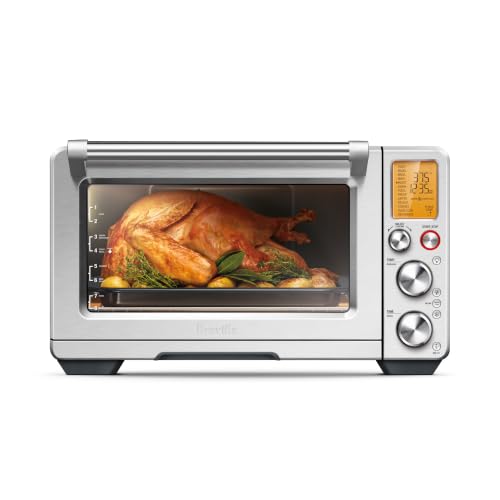
3. Breville BOV900BSS Smart Oven Air Fryer Pro — Best Broiler Oven
The Breville is for cooks whose browning happens in an oven context: the cheese on a bake, the top of a shepherd’s pie, a tray of vegetables roasted hard, a roast finished at high heat. Its element control lets you direct heat from above with a precision no basket machine attempts, and its convection system keeps big tray loads even. It is the premium, cook’s-machine pick.
Strengths
- Precise top-element control delivers true broiler-style finishing
- Thirteen functions cover roast, bake and dehydrate alongside air fry
- Large tray format browns a whole meal’s worth in one layer
Trade-offs
- Premium tier, and a full countertop-oven footprint
- Tray air frying is marginally less intense than a small basket for tiny portions
- More settings to learn than any basket fryer here
| Format | Countertop smart oven |
| Functions | 13, including roast, bake, dehydrate |
| Convection | Reduces cook time by up to 30% |
| Finish | Brushed stainless steel |
Browning in an oven format is about control rather than brute force. The Breville’s system manages its elements in combinations, so a roast can cook through gently and then finish under concentrated top heat without moving dishes or preheating a second appliance. Gratins, crumbles, cheese-topped anything and tray vegetables all live in this workflow, and it is the workflow basket machines imitate least well.
It is also the pick that grows with a serious cook: thirteen functions that are genuinely distinct, an interior that takes real cookware, and build quality aimed at a decade of service. If your browning ambitions are weeknight fries, it is more machine than you need. If they are dinner-party finishes, it is the only pick in the guide designed for exactly that.
Best for: oven-style browning — gratins, roasts, tray vegetables and broiler finishes / Not suited for: small kitchens or shoppers wanting a simple sub-premium basket fryer
Check the current price on Amazon for the Breville BOV900BSS Smart Oven Air Fryer Pro.

4. Cosori TurboBlaze Air Fryer 6 Qt — Best Fan-Driven Crisping
Pick the TurboBlaze if your browning targets vary — delicate items that need colour without violence, and frozen items that need maximum attack. Fan speed is its lever: full blast for frozen breading, moderated for items that brown unevenly under a hurricane. With a broil mode and a 450°F ceiling, it covers the browning bases in a mainstream family basket.
Strengths
- Five fan speeds make browning adjustable rather than binary
- 450°F ceiling plus a broil function covers sear and finish
- Frozen function is tuned for the pale-food problem beginners hate most
Trade-offs
- Fan control is one more variable to learn — the first week has a curve
- Single top element, so flipping still matters for two-sided colour
- Ceramic coating prefers gentle utensils to stay pristine
| Capacity | 6 Qt |
| Temperature range | 90–450°F |
| Fan speeds | 5 |
| Functions | 9-in-1 including broil and frozen |
| Power | 1725W |
Moisture is browning’s enemy, and fan speed is moisture removal. That is the TurboBlaze thesis: at maximum fan, surface water is stripped so fast that breading sets and colours instead of steaming; at lower speeds, items like salmon or reheated pastry gain colour without drying or blowing apart. Owners who learn the fan dial produce visibly more even results than owners of fixed-fan machines, because they can match the airflow to the food instead of accepting one compromise.
In every other respect it is a complete modern fryer — 6 quarts, broil, a proper frozen mode, dishwasher-safe ceramic basket. It earns its place here not as a generalist that also browns, but as the machine that treats browning as a controllable process. For the cook who experiments and adjusts, it is the most instructive pick in the guide.
Best for: varied browning work where tuning airflow to the food matters / Not suited for: set-and-forget cooks who want one button and no variables
Check the current price on Amazon for the Cosori TurboBlaze Air Fryer 6 Qt.

5. Chefman 6 QT Compact Air Fryer with Hi-Fry — Best Budget Browning
This is the value answer to the browning question. Its Hi-Fry technology exists for one purpose: a final high-heat blast that takes food from cooked to coloured. Wrapped in a 6-quart family basket with four simple presets, it delivers the browning feature that matters most at the lowest tier in this guide. Budget shoppers who cook frozen and breaded food often should start here.
Strengths
- Dedicated Hi-Fry finish mode targets browning directly
- 6-quart capacity browns family portions in one layer
- Four presets keep the machine approachable for the whole household
Trade-offs
- Finishing blast is a mode, not a 450°F-everything design
- Budget-tier build and controls feel
- Four presets means manual settings for anything beyond the staples
| Capacity | 6 QT |
| Special feature | Hi-Fry technology for extra crisp |
| Controls | Touchscreen, 4 presets |
| Basket | Nonstick, dishwasher safe |
The Hi-Fry concept is smarter than it looks. Most pale-food failures happen at the end of the cook: the food is done inside but under-coloured outside, and extending the full cook dries it out. A short, hotter finish solves the sequencing — cook through at normal settings, then blast for colour. It is the same trick chefs use with a broiler, packaged as one button on a budget machine.
Set expectations at the tier: this is a family workhorse with a browning trick, not a precision instrument. Frozen staples, fries, nuggets and weeknight chicken pieces — the foods families actually brown weekly — come out with the colour that sells the category. If your browning ambitions run to steaks and gratins, the Typhur and Breville are your picks; if they run to Tuesday, this one suffices.
Best for: budget buyers whose browning is mostly frozen and breaded family staples / Not suited for: precision cooks wanting full manual control and premium build
Check the current price on Amazon for the Chefman 6 QT Compact Air Fryer with Hi-Fry.

6. Ninja Crispi FN101GY Glass Air Fryer 4 Qt — Best Visible Browning
The Crispi is the browning pick for visual cooks and coating-sceptics. Its glass cooking vessel lets you watch colour develop and pull food at the exact moment it peaks — no guessing, no basket-opening heat loss — and the glassware is PFAS-free, which settles the coating question entirely for households that have it. The 450°F Max Crisp mode gives it genuine browning muscle, not just a window.
Strengths
- Glass vessel makes browning progress visible in real time
- Max Crisp reaches 450°F for hard searing of small batches
- PFAS-free glassware doubles as serving and storage vessels
Trade-offs
- 4-quart class capacity — a browning tool for one to three people
- Glass needs a moment’s care that metal baskets do not
- Modular pod design is a different ownership experience from a classic drawer fryer
| Capacity | 4 Qt and 6 Cup glassware included |
| Max temperature | 450°F (Max Crisp) |
| Functions | 4-in-1: max crisp, bake, air fry, recrisp |
| Material | PFAS-free glass |
Watching browning is a genuine technique upgrade. Colour is the best doneness signal for most air-fried food, and glass turns every cook into calibration: you learn exactly what your fries look like at perfect, what chicken skin does in its final minute, and how your machine’s hot spots behave. Owners of windowless machines learn this by opening and losing heat; Crispi owners learn it by looking.
The format has a second, quieter virtue: the glassware goes from cooking to table to fridge, so browned leftovers re-crisp in their own vessel with the Recrisp mode. As a household’s only fryer it suits singles and couples; as a second machine for a coating-conscious or visually minded cook, it is unmatched in this guide.
Best for: visual cooks, small households and anyone avoiding coated baskets / Not suited for: families needing 6-quart batch capacity
Check the current price on Amazon for the Ninja Crispi FN101GY Glass Air Fryer 4 Qt.
Comparison Table
The table below puts the six picks side by side on the one specification that matters most for this search, so you can shortlist in seconds and then read the full review of the two or three models that survive.
| Pick | Badge | Key spec | Best for |
|---|---|---|---|
| Ninja AF161 Air Fryer Max XL 5.5 Qt | Best Overall for Browning | 5.5 Qt, Max Crisp 450°F, broil mode | households wanting maximum basket browning for skin, fries and frozen breaded food |
| Typhur Dome 2 Large AI Smart Air Fryer | Best Dual-Heat Browning | Dual top + bottom heating, fits 12-inch pizza | steaks, chops, pizza and skin-on portions where both sides must brown |
| Breville BOV900BSS Smart Oven Air Fryer Pro | Best Broiler Oven | 13 functions, precision element control, oven format | oven-style browning — gratins, roasts, tray vegetables and broiler finishes |
| Cosori TurboBlaze Air Fryer 6 Qt | Best Fan-Driven Crisping | 6 Qt, 450°F, 5 fan speeds, broil | varied browning work where tuning airflow to the food matters |
| Chefman 6 QT Compact Air Fryer with Hi-Fry | Best Budget Browning | 6 QT, Hi-Fry finish mode, 4 presets | budget buyers whose browning is mostly frozen and breaded family staples |
| Ninja Crispi FN101GY Glass Air Fryer 4 Qt | Best Visible Browning | 4 Qt glass, Max Crisp 450°F, PFAS-free | visual cooks, small households and anyone avoiding coated baskets |
What actually makes food brown in an air fryer?
Browning is chemistry with requirements. The Maillard reaction between proteins and sugars accelerates above roughly 285°F at the food’s surface and produces the colour and flavour cooks chase — but a wet surface cannot pass the boiling point of water until the water is gone. So browning is really two races: heating the surface, and drying it. Air fryers win the drying race with fast moving air, which is why fan speed, basket crowding and surface moisture decide results as much as the temperature dial.
This is also why frozen breaded food is the hardest browning test: it releases moisture for the first half of the cook, and a weak machine never catches up — the coating steams, then pales. High ceilings (450°F), strong fans and dedicated frozen modes exist to win that specific race. Fresh food rewards the opposite discipline: a dry surface from the start — patted, salted a little ahead, oiled thinly — browns in any competent machine. Buy hardware for the frozen race; use technique for the fresh one.
- Dry the surface: pat protein dry, and never sauce before cooking — sauce after
- Preheat for thick or frozen items so the first contact is with hot air and a hot plate
- Single layer, with gaps: touching pieces brown only where air reaches
- Flip or shake once, halfway: the underside needs its turn in the airflow
Is 450°F really better than 400°F for browning?
Yes, measurably, for the jobs where browning is hardest. The extra fifty degrees is not about cooking faster in general; it is about the final phase, when the surface is dry and colour develops. At 450°F that phase is shorter and deeper — frozen breading sets before it can slump, chicken skin renders and crisps instead of tightening, and fries take colour at the edges. At 400°F the same foods cook perfectly well but often finish a shade paler, which is why finish modes (Hi-Fry, broil, Max Crisp) exist: they borrow the high-heat phase even on machines whose standard modes are gentler.
The trade-off is forgiveness. At 450°F the distance between bronzed and burnt is a couple of minutes, and sugary marinades scorch quickly. Cooks who set timers and check once do beautifully at high heat; cooks who wander off should use 400°F modes and finish modes, and accept slightly gentler colour as the price of a wider safety margin. Neither choice is wrong — but know which cook you are.
Basket, dual-heat or oven: which browning format should you buy?
Choose by the food you brown most. Basket machines with Max Crisp-style modes are the best all-round browners for pieces — fries, wings, thighs, frozen items — because small volumes of fast air are inherently aggressive. Dual-heat designs win for flat foods: steaks, chops, fish fillets and pizza, where the underside is half the eating experience. Oven formats win for finishes and trays: cheese-topped bakes, gratins, sheet vegetables and anything whose browning is a top-heat event across a wide area.
Most households brown pieces most often, which is why a high-ceiling basket leads this guide. But be honest about your signature dishes. If Sunday is steak night, the Typhur’s second element is worth more than any basket. If your cooking is casserole-led, the Breville’s broiler control is the tool. The wrong format at a premium price browns worse than the right format at a mid-range one.
How does browning differ by food: skin, cheese, breading and sugar?
Each browning target fails differently, and matching the fix to the food is the expert move. Skin — chicken, salmon, pork — browns by rendering: its own fat must melt and escape while the surface dries, which rewards high heat, dry starting surfaces and patience through the pale phase. Cheese browns by direct top heat and speed; it wants a broil finish measured in moments, and it goes from bronze to burnt while you find a plate. Breading browns by setting: the coating must dry and firm before its moisture escapes, which is why frozen breaded food is the hardest test and why fan aggression matters.
Sugar is the traitor in the system: glazes, sweet rubs and marinades brown beautifully and then scorch, because sugars caramelise and burn at temperatures proteins tolerate. The technique is sequencing — cook the food plain or lightly seasoned, apply the sweet element in the final phase, and watch it. Machines with finish modes make this easy to execute; the cook’s job is remembering that the last three minutes are a separate cook with its own rules.
Does preheating really matter for browning?
Yes, for some foods, and the distinction is worth understanding rather than obeying blindly. Preheating matters when the food’s underside and first minutes decide the result: frozen items that would otherwise sit in their own meltwater on a cold plate, thick items whose surfaces need an immediate set, and anything on a crisper plate you want to sizzle on contact. A few minutes of empty running brings the basket and plate to temperature, and the food’s first contact is with hot metal instead of a warming-up appliance.
It matters least for gentle, longer cooks — reheating, dehydrating, delicate bakes — where the ramp is harmless or even kind. The practical rule: preheat for browning jobs, skip it for warming jobs. Owners who treat preheating as a browning tool rather than a universal ritual get both the results and the convenience right, and their machines’ guidance usually agrees — most manufacturers recommend exactly this split, quietly, in the manual nobody reads.
Why did it burn on top and stay pale underneath? A browning diagnostic
This is the most common browning complaint, and it has three usual causes. The first is geometry: a single top element cooks the face it sees, and food sitting in a deep pile presents only its top layer. The fixes are the layer rule and the halfway flip — or a dual-heat machine, which exists precisely to delete this diagnosis. The second cause is a wet underside: food placed on a cold or greasy plate steams from below. Preheat the plate, and pat the food’s underside as dry as its top.
The third cause is seasoning placement: rubs and crumbs on top scorch under direct heat while the bare underside pales. Put the delicate seasoning underneath or apply it after the flip, so each side’s exposure matches its coating. Work through the three causes in order — geometry, moisture, seasoning — and nearly every two-tone result in an air fryer explains itself. The machine is rarely the problem; the arrangement is.
- Top burnt, bottom pale, cause one: no flip — or buy dual heat
- Cause two: cold plate, wet underside — preheat and dry both faces
- Cause three: scorch-prone seasoning facing the element for the whole cook
How do you brown delicate foods without destroying them?
Delicate foods — fish fillets, asparagus, reheated pastry, anything crumbed by hand — brown under different rules, because the airflow that crisps a fry can desiccate a fillet and blow a light crumb off its base. The technique is moderation with intent: a step down in fan speed where the machine allows it, which is the TurboBlaze’s home ground; a slightly lower temperature for slightly longer, so colour arrives as the interior finishes; and a stable base — a tray, a piece of perforated liner, the glass of the Crispi — so fragile items are never shaken, only turned once, gently, or not at all.
Fish is the test case worth mastering: patted very dry, oiled, cooked on a tray or liner without a shake, and judged by the surface’s colour and the flesh’s first flake. Owners who learn delicate browning stop thinking of the air fryer as a blunt instrument — it is a controllable one, and the control is mostly the willingness to use less of its power. The machines in this guide all permit that restraint; the cook has to choose it.
Browning for a crowd: how do you keep batch two as good as batch one?
Crowd browning fails in the holding, not the cooking. The first batch emerges perfect and then waits — sealed, stacked or sauced — while the second cooks, and arrives at the table as a rumour of itself. The system that prevents it is the one from our wings guide, generalised: hold finished food uncovered in a low oven, where gentle heat and open air preserve the crust; cook the second batch in a machine that is now fully hot, which means it browns faster and often better than the first; and serve the two batches together or in deliberate waves, never merged into a pile.
Dual-zone and double-oven machines shrink the problem by shrinking the gap — two loads finishing together need no holding at all — which is why they dominate the party end of this cluster’s guides. But the holding discipline matters even with them, because guests graze at their own pace. Brown in waves, hold in the open, sauce at the plate: the crowd eats bronzed food all evening, and the cook’s reputation survives dessert.
How do altitude, humidity and your kitchen itself change browning?
Browning results drift with environment in ways that baffle owners who follow recipes exactly. Humid kitchens and rainy days load the air itself with moisture, and food surfaces dry a fraction slower — the fix is a slightly longer preheat and patience through the pale phase, not more temperature. High-altitude kitchens dry food faster but cook interiors slower, which argues for the moderated finish: brown a shade lighter than lowland photographs suggest, because the interior needs the extra minutes the surface would rather skip.
Even the machine’s placement plays a part: a fryer venting into a wall or under a cabinet recirculates its own moist exhaust and subtly steams its next batch. Give it open air, let the basket rest open for a moment between batches so residual steam escapes, and batch two will brown like batch one. These are small effects individually, but browning is a game of small effects compounding — which is why the same machine produces legendary results in one kitchen and ordinary ones in another, and why your own notes, introduced earlier in this guide, outrank any published timing.
A final word on chasing colour
Browning is the most satisfying skill in air frying precisely because it is a skill — a small system of dry surfaces, hot metal, moving air and patience that any cook can learn and no appliance can learn for them. The machines in this guide raise the ceiling of what that system can achieve: higher heat, second elements, tunable fans, honest broilers. But the floor is set by the cook’s habits, and the encouraging truth is that the habits are few, cheap and quick to build. Dry the food. Give it room. Flip it once. Finish it deliberately. Four sentences, practised for a fortnight, will do more for your cooking than any upgrade — and with the right machine underneath them, they will produce the deep, even, appetising colour that made you search for this guide in the first place.
How to get deep browning on chicken, fries and vegetables, step by step
This sequence works in every machine in this guide. It assumes one goal: maximum colour without drying the interior. The steps are ordered because each one protects the next — skip the drying step and no temperature will save you.
- Dry the food. Pat protein with paper towels; leave fries and vegetables spread on a tray for a few minutes if they are wet from washing. Surface water is browning’s enemy number one.
- Oil thinly and evenly — a teaspoon tossed in a bowl beats a spray’s patchy coat. Oil conducts heat into the surface and is part of the browning system, not an optional extra.
- Preheat the empty basket or tray for thick or frozen items, so the food’s first contact is hot metal and hot air, not a cold start.
- Load a single layer with visible gaps. If the batch does not fit, cook two batches — the second batch cooks faster in a hot machine, and both will brown, which one crowded batch will not.
- Cook at your machine’s high setting; flip or shake once at halfway, decisively, then leave it alone. Every extra opening costs heat and time.
- Finish deliberately: use broil, Max Crisp or Hi-Fry for the final short burst if the colour is a shade light, rather than extending the whole cook and drying the interior.
- Rest meat for a few minutes before serving. The crust stays crisp; cutting immediately floods it with juice and softens your work.
Keep notes for your three most-cooked foods: temperature, time, flip point, result. Browning is repeatable once your machine’s personality is mapped, and three lines of notes per food is the whole mapping process.
Common Buying Mistakes
Pale results are almost never the machine’s fault alone. These five errors account for nearly every disappointing batch, including in premium fryers.
- Cooking wet food. Marinade, washing water and freezer frost all have to boil off before browning starts. Dry first, always.
- Crowding for convenience. Touching pieces steam each other. The layer rule is absolute: if air cannot reach it, it will not brown.
- Saucing before cooking. Sugary sauces scorch at browning temperatures and wet the surface. Cook, brown, then sauce and toss.
- Never preheating. A cold crisper plate is a steaming plate for the first minutes. Thick and frozen foods need the hot start.
- Judging by time instead of colour. Timings are estimates; colour is fact. Look, and pull the food when it is the colour you want.
Final Recommendation
If browning is your priority and your cooking is the classic basket repertoire, buy the Ninja AF161 Max XL — its Max Crisp and broil pairing is the most complete basket browning kit. For flat foods and two-sided crusts, the Typhur Dome 2 is the specialist’s answer; for oven-style finishes, the Breville Smart Oven Air Fryer Pro. The Cosori TurboBlaze is the tunable all-rounder, and the Chefman Hi-Fry proves the budget tier can play this game too.
For the wider category view — sizes, family formats and beginner picks — the rest of this cluster is linked below.
Check the current price on Amazon for the Ninja AF161 Air Fryer Max XL 5.5 Qt (Best Overall for Browning). Check the current price on Amazon for the Typhur Dome 2 Large AI Smart Air Fryer (Best Dual-Heat Browning). Check the current price on Amazon for the Breville BOV900BSS Smart Oven Air Fryer Pro (Best Broiler Oven).
Best Air Fryers Best Air Fryers For Chicken Best Air Fryers For Chicken Wings Best Air Fryers For Chips Best Air Fryers For Beginners
Frequently Asked Questions
Why does my air fryer food come out pale instead of brown?
Almost always moisture or crowding. A wet surface cannot exceed the boiling point of water until it dries, and stacked food traps steam. Pat food dry, cook a single layer with gaps, preheat for frozen items, and use the highest setting or a finish mode for the final minutes. If all four are right and results are still pale, your machine’s ceiling or fan is the limit — which is what this guide’s picks address.
Does a higher wattage mean better browning?
Not directly. Browning tracks temperature ceiling, airflow and basket geometry more than raw watts, though adequate power matters for holding temperature when a cold, full basket goes in. A well-designed 450°F machine will out-brown a poorly designed higher-wattage 400°F machine every time.
Should I flip food in an air fryer for even browning?
In a single-element basket, yes — once, halfway. The underside sits against the crisper plate and browns more slowly. Dual-heat machines like the Typhur Dome are the exception, since the bottom element browns the underside in place. Shaking serves the same purpose for small items like fries.
Can I brown a steak properly in an air fryer?
Yes, with the right expectations and machine. You need a preheated, high-ceiling machine, a dry, room-temperature steak, and a rest afterwards; dual-heat designs give the most even two-sided crust. The result is a genuinely well-browned steak, though purists will note the crust differs in character from a ripping-hot cast iron pan. For weeknight steaks, it is more than good enough.
Do glass air fryers brown as well as metal baskets?
The Ninja Crispi in this guide reaches the same 450°F Max Crisp ceiling as metal rivals, and glass adds a real advantage: you can watch colour develop and stop at the peak. Glass vessels suit smaller batches, so judge them as precision tools for one to three people rather than family batch machines.
Will parchment liners stop food browning?
They reduce underside browning, because they interrupt airflow and contact with the hot crisper plate. Use them for messy, saucy foods where cleanup matters more, and skip them when maximum crust is the goal — or use perforated liners, which compromise least.