Disclosure: airfryerkitchensupply.com is reader-supported. When you buy through links on our site, we may earn an affiliate commission at no extra cost to you.
Where to buy
Every pick shortlisted for best air fryers for beginners is sold through Amazon, and listings in this category change variants, finishes and bundles often, so use the links below to confirm the exact model code in the listing title before you order. The verified picks in this guide are: Cosori TurboBlaze Air Fryer 6 Qt; Chefman 4 QT Compact Air Fryer; DASH Tasti-Crisp Small Air Fryer 2.6 Quart; Ninja AF101 Air Fryer 4 Qt; Instant Pot Vortex Plus ClearCook 6 Qt Air Fryer; Ninja AF141 Air Fryer Pro 5 Qt. When you are ready to buy, check the current price on Amazon from any of these links rather than trusting a price quoted anywhere else, because air fryer listings are repriced constantly and the live listing is the only number that matters.
A first air fryer is a forgiving purchase if you buy the right shape of machine: a single basket, clear controls and a size matched to your household. Every model below was confirmed through Amazon’s own catalogue data for this site, and every model is a current, in-production design rather than a discontinued unit being cleared out — an important check for beginners, because discontinued models are where confusing listings and missing spare baskets hide.
The best air fryers for beginners share one trait that matters more than any preset count: they make your first ten cooks easy to repeat. A beginner does not need seventeen functions, an app, or a dual drawer. A beginner needs a basket that fits a real portion, controls that explain themselves, a shake reminder that teaches timing, and cleanup that takes two minutes — because the habit only sticks if the machine is easier than the oven it replaces.
That is why this guide is organised differently from a general best list. Raw power and maximum capacity are deliberately de-prioritised. Instead, each pick below was judged on learning curve: how fast a first-time owner can cook frozen fries, chicken thighs and leftovers successfully on the first attempt, how clearly the machine tells you what it is doing, and how hard it is to ruin a meal with a wrong setting. A model that forgives mistakes beats a model that rewards expertise you do not have yet.
One honest warning before the picks: beginners are the exact shoppers most often upsold into oversized dual-basket machines. Two drawers are genuinely useful for families cooking two foods at once, but for a first machine they double the controls, double the washing-up and double the counter footprint before you know whether you even like air frying. Start with one good basket. If you outgrow it, you will know exactly why — and that knowledge is what this first purchase is really for.
Key Takeaways
- Start with one basket, not two — learn the fundamentals first
- Size by people: 2.6–4 Qt for one or two, 5–6 Qt for three or four
- A shake reminder, clear controls and dishwasher-safe parts teach fastest
- The Cosori TurboBlaze is the learn-and-keep pick; the Chefman 4 QT is the low-risk start
- Your first three cooks should be frozen fries, chicken thighs and a reheat
In this guide
Quick Picks
If you only read one section, read this one. These six best air fryers for beginners contenders earned their places for different reasons, and the badge on each pick tells you exactly which job it does best. The same badges are used again at the top of each full review further down, so you can jump straight to the model that matches your kitchen.
- Best Overall — Cosori TurboBlaze Air Fryer 6 Qt: A guided, forgiving 6-quart machine whose fan-speed control teaches you how air frying actually works while cooking family-size portions from day one.
- Best Budget — Chefman 4 QT Compact Air Fryer: Four honest presets, a touchscreen a first-timer can read at a glance, and a 4-quart basket sized for one or two people — the low-risk first purchase.
- Best Simple Dial Controls — DASH Tasti-Crisp Small Air Fryer 2.6 Quart: Two dials, no menu, no touchscreen: the least intimidating first air fryer you can buy, sized for one or two people.
- Best Compact All-Rounder — Ninja AF101 Air Fryer 4 Qt: The long-running 4-in-1 Ninja that crisps, roasts, reheats and dehydrates — a proven first machine with the widest base of recipes and advice behind it.
- Best for Watching Food Cook — Instant Pot Vortex Plus ClearCook 6 Qt Air Fryer: A clear viewing window and interior light solve the beginner’s biggest anxiety — not being able to see whether dinner is burning.
- Best Step-Up Pick — Ninja AF141 Air Fryer Pro 5 Qt: More power and a bigger basket than the classic AF101, in the same simple four-function layout — the beginner machine with headroom.
How These Picks Were Chosen
Each candidate was checked against Amazon’s catalogue data for this site to confirm the exact model code, capacity and function list before it was considered — no pick below relies on a reseller’s description. Models were then filtered for beginner suitability: a first-time owner should be able to run the machine confidently within one cook, so anything requiring an app for basic operation, anything with a known steep learning curve, and anything without dishwasher-safe parts was pushed down the list.
The surviving criteria were portion realism (does the basket cook for the household it claims to serve, in one layer?), control clarity (physical dial or labelled presets versus anonymous touch icons), feedback (shake reminders, viewing windows, audible cues) and forgiveness (how wide is the window between underdone and burnt?). Price was treated as a tier question only — budget, mid-range and premium — because what a first machine should cost depends on household size, not on chasing the cheapest listing of the week.
The 6 Best Air Fryers for Beginners, Reviewed

1. Cosori TurboBlaze Air Fryer 6 Qt — Best Overall
This is the pick for a beginner who is cooking for a household, not just themselves, and wants one machine they will not outgrow in six months. The 6-quart basket handles four chicken thighs or a family portion of fries in a single layer, and the control panel labels everything in plain language. If your kitchen confidence is low but your household is not small, start here.
Strengths
- Five fan speeds make results adjustable in a way beginners can feel — gentler air for reheating, maximum air for crisping
- Wide 90–450°F range covers everything from proofing dough to hard-searing frozen food
- Ceramic-coated, dishwasher-safe basket removes the cleanup friction that kills new habits
Trade-offs
- Larger footprint than a starter mini — measure your counter before ordering
- More settings than a dial machine, so the first cook asks for five minutes with the manual
- 6-quart capacity is wasted on a solo cook who mostly reheats single portions
| Capacity | 6 Qt |
| Temperature range | 90–450°F |
| Functions | 9-in-1: air fry, roast, broil, frozen, bake, dry, proof and more |
| Fan speeds | 5 |
| Power | 1725W |
The TurboBlaze earns the top spot for a teaching reason: fan speed is the variable most beginners never learn, because most machines hide it. Here it is a front-panel choice, and within a week of cooking you develop an instinct — delicate foods on a low fan, dense frozen foods on full blast — that transfers to every air fryer you will ever own. The Frozen function deserves special mention for new owners: it adjusts the cook for food straight from the freezer, which is how most first-month meals actually start.
Day to day, the machine is undramatic in the best way. The basket slides smoothly, the shake reminder is audible without being irritating, and the ceramic coating releases stuck cheese and marinade sugars with a soak rather than a scrub. It is a mid-range tier machine, and it feels like one: nothing about it asks you to be careful with it, which is exactly the confidence a beginner needs.
Best for: beginners cooking for two to five people who want one machine to learn on and keep / Not suited for: solo cooks in very small kitchens, who should start with the Dash or Ninja AF101 below
Check the current price on Amazon for the Cosori TurboBlaze Air Fryer 6 Qt.

2. Chefman 4 QT Compact Air Fryer — Best Budget
Buy this if your main fear is spending serious money on an appliance you might not use. It sits in the budget tier, covers the four jobs beginners actually do — air fry, and reheating-style cooks among its presets — and its Hi-Fry finish adds a final blast of heat for crisping. For a single person or a couple, the 4-quart basket is the right size, not a compromise.
Strengths
- Only four presets, so there is almost nothing to learn before the first cook
- Hi-Fry technology adds a finishing burst for browning without a separate broil step
- Compact body fits counters that cannot take a 6-quart machine
Trade-offs
- Four presets means manual time-and-temperature cooking sooner for anything unusual
- 4 quarts feeds two, not a family — batch cooking becomes normal at three people
- Budget-tier finish and plastics feel a step below the Cosori and Ninja picks
| Capacity | 4 QT |
| Controls | Touchscreen with 4 presets |
| Special feature | Hi-Fry technology for extra crisp |
| Basket | Nonstick, dishwasher safe |
The beginner case for this Chefman is about decision removal. A first-time owner standing in front of seventeen presets does not feel empowered; they feel tested. Four presets plus a clear touchscreen means your first cook is: food in, preset pressed, shake when it beeps, eat. That early success matters more than any specification, because the second and third cooks only happen if the first one felt easy.
Performance is honest budget-tier air frying: fries and nuggets crisp well, chicken cooks evenly in a single layer, and the Hi-Fry finish genuinely helps with foods that come out pale, like breaded items from frozen. It will not match the TurboBlaze on thick cuts or delicate bakes, but it was never supposed to. As a first machine — or as the machine you buy to find out whether you like air frying at all — it is the lowest-risk route in this guide.
Best for: first-time buyers on a budget cooking for one or two / Not suited for: families of four or more, who will spend every meal cooking in batches
Check the current price on Amazon for the Chefman 4 QT Compact Air Fryer.

3. DASH Tasti-Crisp Small Air Fryer 2.6 Quart — Best Simple Dial Controls
This is the pick for the beginner who looks at digital panels and wants to walk away. Temperature is one dial, time is another, and that is the entire interface. It suits a solo cook, a couple making sides, a teen’s first appliance or an older relative who will actually use a machine they can understand in ten seconds. What it teaches — time, temperature, shaking — is the whole skill of air frying, with nothing else in the way.
Strengths
- Dial controls are instantly understood by anyone, at any age
- Auto shut-off removes the main safety worry for nervous first-time owners
- Small footprint and light body make it easy to store in a cupboard between uses
Trade-offs
- 2.6 quarts is genuinely small — a main course for one, a side for two
- No presets means you learn timings from a chart or the included guidance, not a button
- Dial timers are less precise than digital countdowns for delicate bakes
| Capacity | 2.6 Quart |
| Controls | Simple dial controls |
| Serves | 1–2 people |
| Safety | Auto shut-off |
| Basket | Dishwasher safe basket and tray |
There is a real argument that a dial machine is the best teacher of all. Presets hide the relationship between temperature, time and result; dials expose it. After a month with the Tasti-Crisp, its owner knows that fries want high heat and a shake halfway, that reheated pizza wants moderate heat and a short clock, and that chicken wants patience. Those instincts are portable to every kitchen appliance, not just this one.
The compromises are size and precision, and both are visible before you buy. This is a personal fryer: a portion of fries, two chicken thighs at most, a single serving of anything. If that matches your household, the simplicity is worth more than capacity you will never fill. If you regularly cook for three, skip straight to the Chefman or Cosori — batch-cooking in a 2.6-quart basket is the fastest way to fall out of love with a new appliance.
Best for: technology-averse beginners and solo cooks who value simplicity over capacity / Not suited for: anyone cooking mains for three or more people
Check the current price on Amazon for the DASH Tasti-Crisp Small Air Fryer 2.6 Quart.

4. Ninja AF101 Air Fryer 4 Qt — Best Compact All-Rounder
Choose the AF101 if you want the safest possible first purchase: a design that has been in production for years, with an enormous library of recipes, timing charts and community advice written specifically for it. Its four functions cover the beginner curriculum — crisping, roasting, reheating and a dehydrate mode for experimenting — and the basket fits 2 lbs of fries, which is a real portion for two to three people.
Strengths
- Years in production means timings and recipes for this exact model are everywhere
- Dehydrate function gives beginners a fun, low-stakes way to experiment
- Strong, even crisping from a 1550W element in a compact body
Trade-offs
- Four functions is fewer than newer rivals at the same tier
- High-gloss finish shows fingerprints and splashes readily
- No viewing window — you open the basket to check, like most basket fryers
| Capacity | 4 Qt |
| Functions | 4-in-1: crisp, roast, reheat, dehydrate |
| Power | 1550W |
| Fits | 2 lbs fries |
| Parts | Dishwasher-safe |
Beginners underestimate how much they will lean on other people’s timings. With the AF101, almost every recipe blog, video and cookbook page that says ‘air fryer’ was tested on a machine of this shape and power, so the gap between the recipe’s promise and your result is unusually small. That reliability is a feature: early cooks that match the recipe build the confidence to improvise later.
In use it is a sturdy, no-drama appliance. The basket is a sensible shape for single-layer cooking, the controls are a simple digital panel with the four functions labelled, and cleanup is a dishwasher cycle. Newer machines beat it on paper — more presets, wider temperature ranges — but for a first fryer, proven beats novel. It is the pick we would hand to a friend who asked for ‘the normal one, please’ and meant it as a compliment.
Best for: beginners who want the most-documented, lowest-surprise first fryer / Not suited for: shoppers who want the newest features or a window to watch food cook
Check the current price on Amazon for the Ninja AF101 Air Fryer 4 Qt.
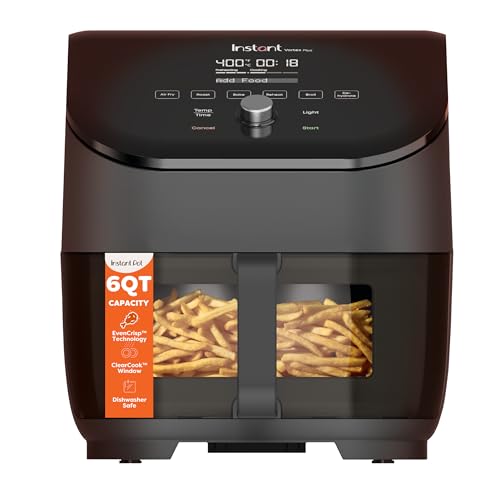
5. Instant Pot Vortex Plus ClearCook 6 Qt Air Fryer — Best for Watching Food Cook
The ClearCook is built for the beginner who opens the basket every two minutes to check. Its window lets you watch browning happen without dumping the heat, which quietly teaches you what ‘done’ looks like at each stage. At 6 quarts with six functions, it is also a full family-size machine, so this is not a training-wheels compromise — it is a long-term fryer that happens to be unusually reassuring to learn on.
Strengths
- Viewing window removes the open-and-check habit that ruins cooking times
- Six functions including broil give a beginner room to grow into
- Customisable programs let you save the settings your household repeats
Trade-offs
- Window needs a wipe after greasy cooks to stay genuinely useful
- Full-size footprint, like the TurboBlaze — not a small-kitchen pick
- Watching food cook is so satisfying that the window becomes the reason you hover in the kitchen
| Capacity | 6 Qt |
| Functions | 6-in-1: crisp, broil, roast, dehydrate, bake, reheat |
| Special feature | ClearCook viewing window |
| Programs | Customisable program |
Every beginner’s first month follows the same arc: distrust, constant checking, gradual confidence. The checking is the problem — each basket opening dumps hot air and adds minutes you then fail to add back. The ClearCook breaks that cycle. You watch fries colour, cheese bubble and chicken skin tighten through the window, and within a few cooks you can read doneness visually. That is a permanent skill, learned without a single ruined dinner.
As a machine it holds its own against the TurboBlaze: six honest functions, even cooking, and a broil mode that finishes gratins and garlic bread properly. Choose between them on interface preference — the Cosori teaches through fan control, the Instant teaches through your eyes. Households that cook with kids, in particular, tend to love this one: the window turns dinner into a spectator sport and gets children interested in what is cooking.
Best for: anxious beginners and families who want to see food as it cooks / Not suited for: buyers with limited counter depth or who prefer the smallest possible machine
Check the current price on Amazon for the Instant Pot Vortex Plus ClearCook 6 Qt Air Fryer.

6. Ninja AF141 Air Fryer Pro 5 Qt — Best Step-Up Pick
Pick the AF141 if you like the AF101’s simplicity but cook for three or four. The 5-quart basket fits 4 lbs of fries — double the classic model — and the 1750W element brings it to temperature fast and holds it there when the basket is full. It is the step-up for beginners who already know the household will use the machine hard from week one.
Strengths
- 1750W of power keeps cooking even when the basket is properly loaded
- Fits 4 lbs of fries — genuine family portions in one batch
- Same four-function simplicity as the AF101, nothing new to learn
Trade-offs
- 400°F maximum is lower than the 450°F ceiling of the TurboBlaze and ClearCook class
- Bigger and heavier than the AF101 — check cabinet height if you plan to store it
- Four functions only; no broil or bake specialisation
| Capacity | 5 Qt |
| Functions | 4-in-1: air fry, roast, reheat, dehydrate |
| Power | 1750W |
| Max temperature | 400°F |
| Fits | 4 lbs fries |
Power is the specification beginners feel without knowing its name. An underpowered fryer steams a full basket before it crisps it, and the owner concludes air frying is overrated. The AF141’s 1750W element is the fix: loaded with a family portion, it still crisps. If your household is three or four people and every meal will be a full basket, this headroom matters more than extra presets or a wider temperature range.
The honest limit is the 400°F ceiling. Most cooking lives below it, but the hardest browning jobs — frozen breaded items, skin-on chicken from cold — benefit from the extra heat the 450°F machines offer. Treat the choice as a trade: the Ninja gives you power and capacity with total simplicity; the Cosori gives you range and adjustability. Neither is wrong; they suit different learners.
Best for: beginners cooking for three or four who want power without complexity / Not suited for: perfectionists chasing maximum browning at 450°F
Check the current price on Amazon for the Ninja AF141 Air Fryer Pro 5 Qt.
Comparison Table
The table below puts the six picks side by side on the one specification that matters most for this search, so you can shortlist in seconds and then read the full review of the two or three models that survive.
| Pick | Badge | Key spec | Best for |
|---|---|---|---|
| Cosori TurboBlaze Air Fryer 6 Qt | Best Overall | 6 Qt, 90–450°F, 5 fan speeds | beginners cooking for two to five people who want one machine to learn on and keep |
| Chefman 4 QT Compact Air Fryer | Best Budget | 4 QT, 4 presets, Hi-Fry finish | first-time buyers on a budget cooking for one or two |
| DASH Tasti-Crisp Small Air Fryer 2.6 Quart | Best Simple Dial Controls | 2.6 Qt, dial controls, auto shut-off | technology-averse beginners and solo cooks who value simplicity over capacity |
| Ninja AF101 Air Fryer 4 Qt | Best Compact All-Rounder | 4 Qt, 4-in-1, fits 2 lbs fries | beginners who want the most-documented, lowest-surprise first fryer |
| Instant Pot Vortex Plus ClearCook 6 Qt Air Fryer | Best for Watching Food Cook | 6 Qt, 6-in-1, ClearCook window | anxious beginners and families who want to see food as it cooks |
| Ninja AF141 Air Fryer Pro 5 Qt | Best Step-Up Pick | 5 Qt, 1750W, fits 4 lbs fries | beginners cooking for three or four who want power without complexity |
What size air fryer does a beginner actually need?
Capacity is the decision beginners get wrong most often, in both directions. Too small, and every meal becomes two batches, with the first batch going cold while the second cooks. Too large, and the machine dominates the counter, heats slowly for small portions and gets pushed into a cupboard — the death of any new appliance habit. The honest sizing rule is based on people, not quarts on a box: one to two people cook happily in 2.6 to 4 quarts, three to four people want 5 to 6 quarts, and households of five or more should look at the dual-basket and XL machines in our family guide rather than stretching a single basket.
Ignore the headline capacity slightly and think in layers instead. Air fryers cook by moving hot air over exposed surfaces, so the working capacity of any basket is one uncrowded layer. A 6-quart basket does not cook twice the food of a 3-quart basket if the food is stacked — it cooks roughly twice the food only because its floor is wider. When you compare models, basket width matters as much as the quart figure, and square baskets use their footprint better than round ones.
- 1–2 people: 2.6–4 Qt is the comfortable range
- 3–4 people: 5–6 Qt avoids batch cooking at dinner
- 5+ people: go dual-basket or oven-style rather than oversizing a single basket
- Measure the counter and the cupboard before choosing — a stored-away fryer is a wasted fryer
Which features actually help a beginner, and which are marketing?
Three features genuinely shorten the learning curve. A shake reminder — a beep halfway through the cook — teaches the single most important air frying habit and rescues countless trays of fries. A viewing window, like the ClearCook’s, lets you learn what doneness looks like without dumping heat. And labelled presets for the foods you actually cook (fries, chicken, frozen items) beat a long list of exotic functions, because a good preset is a tested time-and-temperature combination you can trust on day one.
Everything else should be weighed sceptically. App control is pleasant but must never be required for basic cooking. Double-digit function counts usually pad the list with variations of the same hot-air cook. Rotisserie, dehydrate and proof modes are real but belong to month three of ownership, not week one — buy them if they come along, never pay a tier more just to get them. The features that matter daily are unglamorous: a basket that slides smoothly, parts that go in the dishwasher, and a cord long enough to reach your socket without dragging the machine to the counter’s edge.
How much should a beginner spend?
Think in tiers rather than prices, because listings move constantly. The budget tier — where the Chefman 4 QT sits — buys a competent single-basket machine with a few presets and dishwasher-safe parts; it is the right spend if you are testing whether air frying suits your life. The mid-range tier, home of the TurboBlaze, AF141 and ClearCook, buys more power, better coatings, wider temperature ranges and controls that stay pleasant for years. The premium tier buys size, dual zones or oven formats — capabilities a beginner rarely needs on day one.
The expensive mistake is not overspending; it is buying the wrong size cheaply. A too-small budget machine that gets replaced in four months costs more than the right mid-range machine bought once. If the budget forces a choice, prioritise capacity for your household first, then power, then features — in that order — and check the current price on Amazon for the exact model code before comparing across retailers.
What should a beginner cook in the first week?
Plan the first week as a rotation, not a series of experiments. Days one and two belong to frozen food: fries, nuggets, anything engineered to forgive. These cooks teach you the machine’s timing against the packet’s oven instructions — expect to finish several minutes early — and they cannot really fail, which matters more than food writers admit. Confidence is the ingredient every later cook uses.
Days three and four are fresh protein: chicken thighs first, because they forgive overcooking, then something leaner like a chicken breast or salmon fillet, which teaches you to check early and rest properly. Day five is vegetables — broccoli, carrots or green beans with oil and salt — the cook that surprises beginners most, because air-fried vegetables caramelise in a way boiled and steamed versions never do. The weekend is for the reheat test and one ambitious cook of your choosing: wings, a small roast, a baked item. By day seven you will have a personal timing card for your machine and a realistic sense of what it replaces in your kitchen — which, for most households, turns out to be the oven on four nights out of five.
Basket or oven style: which should a first-time buyer choose?
Beginners are usually steered to baskets, and mostly rightly: a basket machine is one vessel, one control set and one washing-up job, and its small volume of fast air is the most forgiving cooking environment for the classic starter foods. If your first-year menu is fries, chicken pieces, roasted vegetables and reheating, a basket is not the simple option — it is the correct one, and the picks in this guide are baskets for that reason.
Oven-style machines enter the conversation when the household’s cooking is already tray-shaped: pizzas, sheet-pan dinners, toast for a family, gratins. They are superb appliances and several appear elsewhere in this cluster, but they ask a beginner to manage racks, trays and door heat from day one. The honest sequence for most households is basket first, oven later if the cooking outgrows it — and many households find it never does. Buy the format your current menu needs, not the one an imagined future menu might.
Which accessories does a beginner actually need?
Almost none, and the short list is cheap. A pair of silicone-tipped tongs protects nonstick and ceramic baskets while turning food. A pump oil sprayer — not an aerosol with propellants — gives the thin, even oil coat that crisping loves. Perforated parchment liners earn their place for sticky, marinated or cheesy cooks, and should be skipped for maximum-crisp jobs where airflow matters most. A simple probe thermometer transforms chicken cooking from guessing to knowing, and it is the one accessory we would call close to essential.
Everything else can wait until a specific recipe demands it: racks, skewers, cake barrels, pizza pans and divider inserts are all legitimate, and all useless if your cooking never calls for them. The beginner mistake is buying the accessory bundle with the machine, then discovering that ninety percent of air frying is food, basket, heat and a shake. Spend the difference on better ingredients for the first month — you will learn more per cook, and the machine will get the use that justifies accessories later.
- Silicone-tipped tongs — protect the basket coating
- Pump oil sprayer — thin, even oil without aerosol additives
- Probe thermometer — chicken doneness without guessing
- Perforated liners — for sticky cooks only, not for crisping records
How loud, hot and heavy is a first air fryer? The ownership details nobody lists
Specifications omit the three things owners mention most after a month: noise, exterior heat and weight. Fan noise in this class is comparable to a microwave or a modest extractor — present, conversational-level, and irrelevant in most kitchens, but worth knowing if your kitchen is also your living room or a studio. The sensible test is not silence; it is whether you can hold a conversation beside it, and every pick in this guide passes that test comfortably.
Exterior heat matters where beginners place machines badly: against a wall, under a low cabinet, on a crowded counter. Every fryer vents hot air, usually from the back, and needs a hand’s width of clearance around it and open space above the basket’s pull-out path. Weight decides storage: the minis move one-handed to a cupboard; the 6-quart machines are counter residents. None of this is a reason to choose one pick over another — it is a reason to measure your kitchen before the box arrives, because a machine that fits its space gets used, and use is the whole point of a first fryer.
When should a beginner upgrade — and what should the second machine be?
Upgrade when a specific, repeated frustration has a name. If the frustration is batches — the same dinner cooked twice because the basket is small — the upgrade is capacity, in the shape your cooking takes: a bigger basket, dual zones or an oven, and the family guide in this cluster maps those choices. If the frustration is simultaneity — mains and sides queuing — the upgrade is a second zone, not a bigger first one. If there is no named frustration, there is no upgrade; a contented beginner with a 4-quart machine is not an unfinished shopper.
The second machine, when it comes, usually complements rather than replaces: the first fryer becomes the side-dish and reheat unit, the new one takes the mains. This is why we counsel against overbuying the first machine — a modest, well-chosen starter remains useful for a decade in the supporting role, while an oversized first machine becomes the thing the household cooks around. Buy the beginner machine for the beginner year without embarrassment; it is a foundation, not a draft.
How to use an air fryer for the first time: your first three cooks
Do not start with the meal you care about. The smart first week with any new fryer is a curriculum: one cook that cannot fail, one that teaches shaking, and one real dinner. Run the empty basket for a few minutes first if the manual suggests a burn-off — new machines can carry a faint manufacturing smell that disappears after the first heat cycle and should never flavour food.
- Cook 1 — frozen fries: single layer, the fries preset or 400°F-class heat, shake at the reminder. This teaches loading, shaking and how your machine’s timing compares to the packet’s oven instructions (start checking several minutes early).
- Cook 2 — chicken thighs, skin-on: pat the skin dry, season, cook skin-side down first then flip. Dry skin is the whole secret; moisture is the enemy of crisping.
- Cook 3 — reheating leftovers: pizza, roast potatoes or yesterday’s roast chicken at moderate heat for a short time. This is the function you will use weekly for years, and it is where air fryers most embarrass microwaves.
- After each cook, wash the basket while it is still warm, or put it straight in the dishwasher — dried-on residue is ten times harder than fresh residue.
- Write down what worked: food, temperature, time, result. Three lines per cook for the first fortnight builds a personal timing chart no blog can give you, because it matches your machine and your portions.
By the end of these three cooks you will know your machine’s personality — whether it runs hot, whether its basket browns evenly, how loud its fan is in your kitchen. Every air fryer has one. Learning it on forgiving food, rather than on a birthday dinner, is the entire beginner strategy in one sentence.
Common Buying Mistakes
Most beginner disappointment is not caused by the machine. It is caused by five repeatable errors, every one of them fixable in a single cook.
- Overcrowding the basket. Stacked food steams instead of crisping. Cook a single layer, or accept a second batch — a smaller crisp batch beats a larger soggy one every time.
- Skipping the shake or flip. Hot air needs exposed surfaces. The halfway shake is not a suggestion; it is half the cooking method.
- Using oven times unchanged. Air fryers cook faster than the fan oven the packet instructions assume. Start several minutes early and check.
- Adding oil spray with propellants to nonstick baskets. Aerosol additives can damage coatings over time; use a pump sprayer or toss food in a teaspoon of oil in a bowl instead.
- Buying capacity for the biggest meal of the year. Size the machine for Tuesday dinner, not for the one holiday gathering — the oven still exists for exceptional days.
Final Recommendation
If you buy one machine from this guide, make it the Cosori TurboBlaze for households of two or more: it teaches the most, cooks family portions and will not need replacing as your skill grows. Solo cooks and the technology-shy should take the DASH Tasti-Crisp or the Ninja AF101, and the genuinely uncertain should risk the least with the budget-tier Chefman 4 QT — every one of these is a legitimate first fryer, matched to a different kind of beginner.
Keep exploring the cluster once your first machine is on the counter: the base guide and the size and use-case lenses below cover the same product group from other angles, including family capacity, specific foods and small-space living.
Check the current price on Amazon for the Cosori TurboBlaze Air Fryer 6 Qt (Best Overall). Check the current price on Amazon for the Chefman 4 QT Compact Air Fryer (Best Budget). Check the current price on Amazon for the DASH Tasti-Crisp Small Air Fryer 2.6 Quart (Best Simple Dial Controls).
Best Air Fryers Best Air Fryers For Big Families Best Air Fryers For Chicken Wings Best Air Fryers For College Students Best Air Fryers For Chips
Frequently Asked Questions
Is an air fryer worth it for a complete beginner?
Yes, if you cook any frozen food, roast any vegetables, or reheat leftovers at least twice a week — those three jobs alone justify the counter space. It is not worth it if your cooking is mostly soups, sauces and large traybakes, which belong in pots and ovens. Beginners benefit most because the machine’s speed and forgiveness make weeknight cooking feel achievable rather than like a project.
How long does it take to learn to use an air fryer?
Three cooks, if you choose them well: one frozen food, one fresh protein and one reheat, as laid out in the how-to section above. The core skills are only loading in a single layer, shaking halfway, and checking earlier than the packet suggests. Everything after that is refinement, not learning.
What is the easiest food to cook first in an air fryer?
Frozen fries or frozen breaded items, because they are engineered to be forgiving and the result is easy to judge. Follow with chicken thighs — the most tolerant fresh protein — and leave delicate fish and homemade batters until you know your machine’s hot spots.
Do beginners need a dual-basket air fryer?
Almost never. A dual basket solves the problem of cooking two foods to finish together, which is a weeknight-logistics problem most beginners do not have yet. A single basket teaches the fundamentals with half the washing-up. Upgrade later if two-zone cooking becomes your bottleneck; you will know, because you will be standing at the counter timing batches.
Are air fryers hard to clean?
No — this is their underrated advantage. Baskets and crisper plates on every pick in this guide are dishwasher-safe, and a warm soapy soak handles anything the dishwasher would. The discipline that matters is washing promptly: residue cleaned the same evening takes two minutes, and residue left for a week takes twenty.
Can a beginner put foil or parchment in an air fryer?
Yes, with rules: it must be weighed down by food, never placed in an empty preheating basket where the fan can lift it into the element, and it should not cover the whole basket floor or airflow stops and cooking suffers. Perforated liners made for air fryers are the beginner-friendly option.