Disclosure: airfryerkitchensupply.com is reader-supported. When you buy through links on our site, we may earn an affiliate commission at no extra cost to you.
Where to buy
Every pick in this guide to the best durable kitchen sinks was confirmed through the Amazon Creators catalogue for this site before it earned a link, so the model names and configurations below match what you will actually find on the product page. Start with the shortlist here, then read the full reviews before you decide: SANYCASA 30 11-Gauge · Kraus KHU100-30 · Kraus KA1US33B · Karran Granite Black · Blanco Diamond Truffle · Kraus Bellucci 32. On each product page, use the “check price on Amazon” habit rather than trusting any number quoted elsewhere, because sink, grinder and footwear pricing moves with size, finish and season.
The best durable kitchen sinks are not the prettiest sinks in the showroom — they are the ones that still look honest after a decade of cast iron, sheet pans, frozen turkeys thawing and teenagers doing the washing up. Durability in a sink is measurable: steel gauge, material density, scratch-masking finish, heat and stain resistance, and whether the surface’s good looks are a coating that can wear through or the material itself all the way through. This guide ranks six verified sinks on exactly those terms.
Every material family makes a durability claim, so here is the honest map before the reviews. Thick stainless steel — 16 gauge, and especially the 11-gauge outlier in this list — resists denting and holds its shape, but shows fine scratches that a brushed finish must be chosen to disguise. Granite composite cannot rust, shrugs off heat and carries its colour through its whole body, so wear does not read as damage. Fireclay is immensely hard but can chip if a heavy pan strikes its rim. The picks below weight those truths by household reality, and each was confirmed through this site’the Amazon catalogue.
One warning that will save you money: durability cannot be retrofitted. A bottom grid helps any sink, and good habits help more, but a thin sink in a heavy household will dent, drum and disappoint on a schedule. If your kitchen is genuinely hard on equipment, buy the thickness or the composite now — it is cheaper than buying twice.
In this guide
Quick Picks
If you only have two minutes, this is the whole guide to the best durable kitchen sinks in one screen. Each pick carries the same badge it keeps in its full review further down, so you can jump straight to the detailed section for the one that fits your kitchen, your budget tier and the way you actually cook, clean or unwind at home.
- SANYCASA 30-Inch Undermount Sink, 11 Gauge Stainless Steel — Best Overall Durability. Eleven-gauge, 3 mm stainless — two gauge classes thicker than premium norm — in a workstation body that will not flex, belly or dent under real loads. Check price on Amazon
- KRAUS KHU100-30 Standart Pro 30-Inch Undermount Sink — Best Proven Steel Pick. The long-running 16-gauge benchmark: TRU16 steel, rounded corners that never trap grit, and a design with years of service history behind it. Check price on Amazon
- KRAUS KA1US33B 33-Inch Undermount Sink with Radiant Pearl Finish — Best Scratch-Disguising Finish. A 33-inch 16-gauge body wearing Kraus’s radiant pearl finish, engineered to mask the scratches steel inevitably collects. Check price on Amazon
- Karran Granite Composite Single Bowl Undermount Sink, Black — Best Composite Value. Quartz composite with a 9-inch bowl: no rust, no coating to wear through, colour that is the material itself. Check price on Amazon
- BLANCO Diamond SILGRANIT Super Single Undermount Sink, Truffle — Best Premium Composite. Blanco’s SILGRANIT in the big 33.5-inch Diamond body — the reference standard for composite durability, in a warm truffle tone. Check price on Amazon
- KRAUS Bellucci 32-Inch Granite Workstation Sink, Metallic Gray — Best Durable Workstation. Granite composite toughness with a workstation ledge and accessories — durability for cooks who also want the prep system. Check price on Amazon
How These Picks Were Chosen
Verification came first, as on every guide here: each model was matched by brand and model connection, and the returned title had to confirm the material and configuration we intended to recommend. Durability claims are the easiest in the industry to inflate, so we only credited specifications the catalogue listing itself stated — gauge, material family and finish technology.
Judging then ran on five axes: resistance to denting and impact, resistance to scratching — or, more honestly, to showing scratches — heat and stain behaviour, corrosion resistance in a permanently wet environment, and the durability of the finish system itself. A sink whose beauty is a surface coating starts dying the day the coating is breached; a sink whose material is the finish, like brushed steel or colour-through composite, ages instead of failing.
The six finalists deliberately span the three credible durability strategies: maximum steel thickness, scratch-disguising steel finish technology, and granite composite in two executions. There is no fireclay pick in the final six — not because fireclay is weak, but because its chip risk on rim strikes makes it a poorer bet than composite for the heavy-handed households this guide serves.
The 6 Best durable kitchen sinks
The six reviews below are ordered by how we would recommend the best durable kitchen sinks to most households, not by price. The first pick is the one to buy if you do not want to think about the category again for years; the later picks win on a specific strength — a tighter budget tier, a particular layout, a material or a use case — that matters more to some homes than all-round polish.
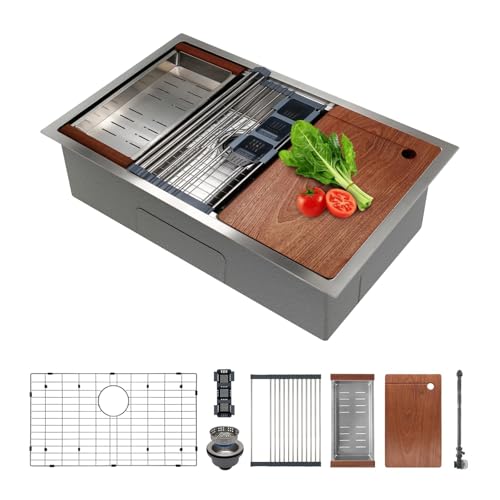
1. SANYCASA 30-Inch Undermount Sink, 11 Gauge Stainless Steel — Best Overall Durability
Gauge numbers run backwards — lower is thicker — and the gap between this sink’s 11 gauge and the premium field’s 16 gauge is not incremental. At 3 mm, the SANYCASA’s steel is closer to a commercial fabrication than a domestic pressing. A cast-iron skillet set down hard, a stockpot dropped the last inch, a frozen bird landing badly: the impacts that write dents into ordinary sinks meet a floor that simply does not move. For a household that is genuinely rough on equipment, this is the durability argument settled in one specification.
Thickness protects more than appearance. A rigid floor keeps its engineered drainage slope true for life, because it cannot develop the flex-induced belly that pools water in thinner sinks, and the workstation ledge — machined into the same massive body — carries loaded boards and racks without the slightest sense of strain. The sink feels less like an appliance and more like part of the building.
Respect the logistics: this is a heavy object that needs a sound cabinet, a planned lift and preferably two people for the undermount set. The tier is premium, though spread over the fifteen-plus years this sink should serve, it undercuts replacing a thinner sink once. If durability is the brief and the budget can follow, the search ends here.
Strengths
- 3 mm steel is in a different dent-resistance class from 16-gauge
- Rigid floor holds its drainage slope permanently under load
- Workstation ledge machined into a body built to carry weight
Trade-offs
- Heaviest sink here — needs solid cabinet support and two installers
- Premium tier
- Thick steel makes clip work and handling more physical
| Mount | Undermount |
|---|---|
| Material | Stainless steel, 11 gauge (3 mm) |
| Ledge | Integrated workstation ledge |
| Drain | Superior-drain floor design |
A year of ownership recalibrates what owners worry about: not the sink. Pans land, loads stack, the ledge carries weight, and the bowl simply continues. The one habit thick steel teaches is respect at installation time — after that, it asks nothing. Households that process food at scale, from canning days to holiday production, describe the same relief: the sink is never the weak point in a heavy day, and that reliability compounds across a decade of heavy days.
Best for: The heaviest-use households: cast iron, canning, big-batch cooking / Not suited for: Lightweight cabinets or anyone who cannot manage a two-person install

2. KRAUS KHU100-30 Standart Pro 30-Inch Undermount Sink — Best Proven Steel Pick
There is a durability that comes from specification and a durability that comes from evidence, and the KHU100-30 has both. Its 16-gauge TRU16 stainless body is the thickness class that separates sinks that dent from sinks that shrug, and the design has been installed in large numbers for years — the failure modes are known, and they are few. When a guide like this one reaches for a safe recommendation, this is the profile it reaches for.
The rounded corners are a quiet durability feature in their own right. Corners are where grit, moisture and neglect combine to stain and pit a sink’s finish; a generous radius lets water flow through and a sponge wipe clean in one motion, so the corrosive little deposits never get their foothold. Combined with channel grooves that keep the floor rinsed, the sink defends itself chemically as well as mechanically.
Steel honesty applies: brushed stainless shows fine scratches, and this sink will develop the soft patina of use lines over years. Owners who find that distressing should use the included bottom grid — thoughtfully supplied in the box — on the wash side. Owners who see it as a working kitchen’s natural finish will find this the most proven durable buy in the guide.
Strengths
- 16-gauge TRU16 steel — the proven domestic durability standard
- Rounded corners eliminate the grit traps that corrode and stain
- Design has years of installed history rather than launch promises
Trade-offs
- Will show fine scratches like all brushed steel — a grid helps
- No workstation ledge
- Deep bowl needs disposal clearance checked
| Mount | Undermount |
|---|---|
| Size | 30 x 18 in; bowl 28 x 16 x 10 in |
| Material | T-304 stainless steel, 16 gauge |
| Kit | Grid, drain assembly, hardware, template included |
The KHU100-30’s durability story is written in its installed base: this design has been in kitchens long enough for its wear pattern to be known, and the pattern is a soft patina, not a failure. Owners who fit the included grid from day one report bowls that look close to new at five years; owners who did not describe honest, even wear that a scouring routine mostly civilises. Either way the structure — the part that costs money — simply does not degrade.
Best for: Buyers who value a proven design with a long track record / Not suited for: Anyone wanting a workstation ledge

3. KRAUS KA1US33B 33-Inch Undermount Sink with Radiant Pearl Finish — Best Scratch-Disguising Finish
Every stainless sink scratches; the only question is whether you can see it. The KA1US33B attacks the visibility half of that equation with Kraus’s radiant pearl finish, a textured surface treatment whose light play breaks up the fine lines that a smooth brushed finish advertises. Underneath sits the same 16-gauge TRU16 body as the Standart Pro, so the dent resistance is fully present — this sink simply refuses to narrate its own wear.
At 33 inches it is also the generous steel option here, with a bowl that takes the biggest pans and a foil-layer NoiseDefend system that keeps a large, loaded bowl from ringing. Rounded corners keep the cleaning and corrosion story as good as the smaller Kraus. For a busy family kitchen that cooks hard and entertains in the same space, the combination of size, toughness and discretion is compelling.
The finish is a taste commitment: its soft sheen differs from classic brushed steel, and some buyers will prefer the traditional look and accept visible patina. That is a legitimate preference, not a wrong one. But if your durability worry is specifically ‘my sink will look scratched within a year,’ this is the steel sink engineered to answer it.
Strengths
- Finish is designed to visually mask fine scratches as they occur
- Full 16-gauge TRU16 body underneath the finish technology
- Foil-layer soundproofing keeps the big bowl quiet
Trade-offs
- Finish look is distinctive — see it in person if possible
- 33-inch size needs a 36-inch class cabinet
- Premium tier over the standard Standart Pro
| Mount | Undermount |
|---|---|
| Material | T-304 stainless steel, 16 gauge |
| Finish | Radiant pearl, scratch-masking |
| Sound | NoiseDefend foil-layer soundproofing |
The radiant pearl finish’s trick reveals itself slowly: scratches still happen, but they stop announcing themselves, so the sink’s appearance ages in dog years rather than human ones. Owners who entertain in the kitchen rate this highest — the bowl under party lighting looks composed rather than battle-worn. Underneath, the ownership is standard Kraus 16-gauge: quiet, solid, and uneventful in the way durable things should be.
Best for: Owners who want steel’s toughness without watching it scratch / Not suited for: Anyone who prefers a traditional brushed look

4. Karran Granite Composite Single Bowl Undermount Sink, Black — Best Composite Value
Granite composite changes the durability equation by removing whole failure categories. There is no metal to rust, no plating or coating whose breach starts a decline, and the colour you see is the material all the way through — a decade of utensil contact polishes it rather than wounding it. Karran’s quartz composite in black, with a deep 9-inch bowl, is the value-priced way into that ownership profile.
Daily behaviour suits hard kitchens: the dense body lands dishes with a muted thud, tolerates hot pans set down in a hurry, and does not water-spot with anything like steel’s enthusiasm. The one honest maintenance note runs the other way for black specifically — in hard-water districts, mineral film shows pale on a dark surface if the bowl is left to air-dry constantly, so a quick towel pass or a periodic vinegar wipe keeps it looking its best.
It is a heavy sink that wants proper support and a careful set, and it is a single bowl. Within those bounds, this is the pick for buyers whose durability frustration is specifically about upkeep — the sink that asks the least of you while taking the most from your kitchen.
Strengths
- Composite cannot rust and has no coating to breach
- Colour runs through the material — wear does not show as damage
- Dense body is quiet and heat-tolerant in daily use
Trade-offs
- Heavy — support and careful handling during install
- Black shows limescale film in hard-water areas if not dried
- Single bowl only
| Mount | Undermount |
|---|---|
| Material | Granite / quartz composite |
| Depth | 9 in bowl |
| Colour | Black |
Composite ownership in hard-water country teaches one habit — the quick dry — and rewards it with a bowl that looks perpetually composed. Owners also note the sound difference daily: the dense body turns the clatter of washing up into something the household barely registers, which in an open-plan home is a durability of nerves as much as of material. The black finish’s mineral film is the only recurring chore, and it is a wipe, not a project.
Best for: Hard-water homes and anyone tired of steel’s upkeep / Not suited for: Buyers who want a light-coloured sink or a double bowl

5. BLANCO Diamond SILGRANIT Super Single Undermount Sink, Truffle — Best Premium Composite
If composite is the durability strategy you choose, SILGRANIT is its reference formulation, and the Diamond super single is its full-size expression: 33.5 inches of dense granite composite that absorbs impact, resists staining and heat, and presents a surface that utensils slide over rather than score. Blanco has refined this material over decades, and it shows in the evenness of the finish and the confidence of the warranty culture around it.
The truffle colourway is a durability choice in disguise. Mid-tone warm neutrals are the most forgiving colours a sink can wear — they neither advertise water spots like black nor pigment spills like white, so the sink looks composed between cleanings. In a busy kitchen, that visual durability matters almost as much as the structural kind.
Expect a premium tier and a sink heavy enough that professional installation is the sensible default. What the money buys is the lowest-maintenance decade of sink ownership in this guide, at a size that never asks a pan to compromise. For a forever-kitchen remodel, that is a rational summit to aim at.
Strengths
- SILGRANIT is the benchmark composite for impact and stain resistance
- Super-single bowl takes the largest cookware whole
- Warm colour hides daily evidence better than black or white
Trade-offs
- Premium tier — the most expensive strategy here
- Very heavy; professional installation is sensible
- Single bowl only
| Mount | Undermount |
|---|---|
| Size | 33.5 x 18.5 in |
| Material | SILGRANIT granite composite |
| Colour | Truffle |
The Diamond’s owners tend to be remodel-once households, and their reports match the intention: years in, the sink is the element of the kitchen that has needed nothing — no refinishing, no apology, no plan. The truffle tone proves as forgiving in year five as the brochure promised, and the super-single bowl’s size means the sink never became the bottleneck as the household’s cooking grew. It is the definition of a fixture that exits your attention, permanently.
Best for: Premium remodels wanting composite toughness at full size / Not suited for: Budget tiers or double-bowl households
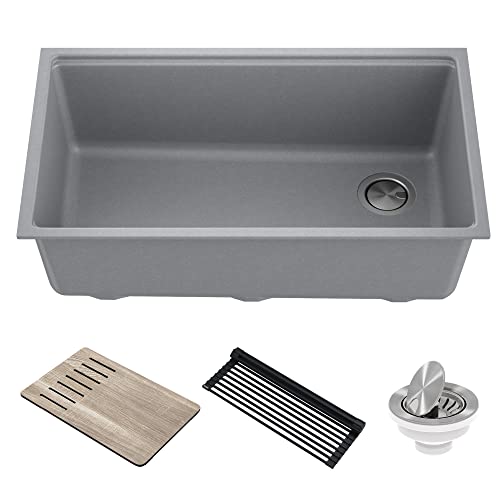
6. KRAUS Bellucci 32-Inch Granite Workstation Sink, Metallic Gray — Best Durable Workstation
The Bellucci answers the buyer who read the composite case, believed it, and then asked why they must give up the workstation ledge to get it. They do not: Kraus moulds its granite composite into a 32-inch undermount workstation with an integrated ledge and an accessory set, so the prep-over-the-bowl, dry-over-the-bowl workflow runs on the toughest mainstream sink material available.
Composite suits workstation life particularly well. Boards and racks slide on the ledge constantly, pans land hard during prep, and knives live inches from the surface — a duty cycle that marks steel up quickly and that dense composite absorbs with far less evidence. The metallic gray finish is chosen with the same realism: modern, mid-toned and exceptionally good at looking clean between cleans.
The installation deserves respect — a heavy composite workstation must be supported evenly and its ledge set true — and the tier is premium. For the cook who wants one purchase to settle both the durability question and the workflow question for a decade, the Bellucci is the most complete answer in this guide.
Strengths
- Composite body shrugs off impact, heat and staining
- Workstation ledge adds the prep-and-dry system to a tough sink
- Metallic gray is a highly forgiving, modern colour
Trade-offs
- Composite weight plus ledge precision makes install a pro job for most
- Premium tier
- Ledge accessories need storage discipline
| Mount | Undermount |
|---|---|
| Material | Granite composite |
| Size | 32 in class |
| Ledge | Workstation ledge with accessories |
The Bellucci’s ledge sees the hardest service of any feature in this guide — boards, racks and pans sliding daily — and composite is the right material for that abrasion, wearing by polish rather than by scratch. Owners who cook at volume describe the workstation and the toughness as a single benefit: a prep surface that cannot be hurt by prepping. The metallic gray finish keeps the evidence of that busy life to itself.
Best for: Prep-heavy cooks who want composite durability plus a ledge / Not suited for: Steel loyalists or compact cabinets
Comparison Table
Use this table to compare the six best durable kitchen sinks side by side on the one specification that decides most purchases in this category, then read the full review of your top two before ordering.
| Pick | Badge | Key spec | Best for |
|---|---|---|---|
| SANYCASA 30-Inch Undermount Sink, 11 Gauge Stainless Steel | Best Overall Durability | 30 in, 11-gauge (3 mm) T-steel, workstation ledge | The heaviest-use households: cast iron, canning, big-batch cooking |
| KRAUS KHU100-30 Standart Pro 30-Inch Undermount Sink | Best Proven Steel Pick | 30 x 18 in, 16-gauge TRU16, rounded corners, NoiseDefend | Buyers who value a proven design with a long track record |
| KRAUS KA1US33B 33-Inch Undermount Sink with Radiant Pearl Finish | Best Scratch-Disguising Finish | 33 in, 16-gauge TRU16, radiant pearl finish, foil-layer soundproofing | Owners who want steel’s toughness without watching it scratch |
| Karran Granite Composite Single Bowl Undermount Sink, Black | Best Composite Value | Quartz composite, 9 in deep bowl, undermount, black | Hard-water homes and anyone tired of steel’s upkeep |
| BLANCO Diamond SILGRANIT Super Single Undermount Sink, Truffle | Best Premium Composite | 33.5 x 18.5 in, SILGRANIT composite, super single bowl | Premium remodels wanting composite toughness at full size |
| KRAUS Bellucci 32-Inch Granite Workstation Sink, Metallic Gray | Best Durable Workstation | 32 in granite composite, workstation ledge, accessories included | Prep-heavy cooks who want composite durability plus a ledge |
Steel Gauge Explained: What Actually Makes a Sink Dent-Proof?
Gauge measures steel thickness on an inverse scale: 18-gauge is roughly 1.2 mm, 16-gauge roughly 1.5 mm, and the 11-gauge outlier in this guide a full 3 mm. Dent resistance rises faster than the numbers suggest, because stiffness grows with the cube of thickness — doubling thickness makes a panel about eight times stiffer. That is why the step from 18 to 16 gauge is worth paying for, and why 11 gauge feels like a different material altogether.
Grade matters alongside gauge. T-304 stainless, with its chromium and nickel content, is the grade that resists rust in a permanently wet, chemically varied environment. Cheaper 201-grade steel appears in budget sinks and can tea-stain or pit in hard use. Every steel pick in this guide is T-304; treat any listing that will not state its grade as a listing that has answered the question.
Sound padding is the third leg. Thick steel with full-coverage pads and undercoating sounds as solid as it is; thin steel, however well padded, still flexes under impact. Judge durability by gauge first, grade second and padding third — in that order — and you will not be misled by marketing that leads with the padding.
Granite Composite vs Stainless Steel: Which Lasts Longer?
In corrosion terms, composite wins outright: it cannot rust, and its colour is structural rather than applied. In impact terms, quality composite and 16-gauge steel are closer than either camp admits — composite resists the sharp dents that mark steel, while steel tolerates certain point impacts that could chip a composite rim. In heat, both handle kitchen reality; composite shrugs off hot pans set down carelessly, while steel never worries at all.
The lived difference is evidence. Steel narrates its life in fine scratches — harmless, but visible unless the finish is designed to mask them, as the radiant pearl pick in this guide is. Composite keeps its counsel: wear polishes rather than scars, so a five-year-old composite sink usually looks closer to new than a five-year-old steel one. Households that entertain in the kitchen weight that heavily.
Cost and weight break the tie for many buyers. Composite sinks are heavier and usually pricier at the same size, and they want confident installation. Steel offers the better value per year of service at mid tiers. Neither choice is wrong; choose steel for value and familiarity, composite for quiet, colour and the lowest-evidence ageing.
How Do You Keep a Durable Sink Looking Durable?
The habits are few and cheap. Use a bottom grid on the wash side if you own heavy cast iron — it converts point impacts into distributed contact for any material. Rinse and wipe the bowl after acidic or pigmented loads rather than letting them sit overnight; even the best finishes prefer not to marinate. In hard-water areas, a weekly wipe with a vinegar solution prevents the mineral film that makes dark sinks look tired.
Avoid the two classic acts of sink self-harm: using the bowl as a ladder substitute or tool rest during kitchen DIY, and attacking stains with steel wool or powdered abrasives that roughen the very surface smoothness that makes a sink easy to keep clean. A roughened finish holds dirt faster forever after — the damage compounds.
Finally, maintain the sealant and mounting. A durable sink in a cabinet ruined by a slow leak is a pyrrhic victory. Check under the sink monthly, keep the rim seal sound, and the fixture you bought for a decade will get its decade, in a kitchen that survives with it.
What Damages Sinks Most? A Honest Ranking of Kitchen Threats
Impact ranks first, and it is not close: the dropped cast-iron skillet, the mixer bowl fumbled at height, the frozen turkey’s landing. Impact is what gauge and composite density defend against, and why the bottom grid — which converts a point impact into distributed contact — is the highest-value accessory in this entire guide. Second is abrasion: utensils, gritty scouring and the daily slide of pan bases, which finishes must either resist or disguise. Third is chemistry: pigments, acids and harsh cleaners sitting in the bowl, which punish coatings and light colours. Fourth, and most underestimated, is water itself — not on the bowl, but under it, where a slow leak destroys the cabinet that holds the sink long before the sink itself fails.
Notice what is not on the list: ordinary daily use. Washing dishes in a sink does not meaningfully wear a sink that was specified for the household doing the washing. Durability failures are almost always specification failures — a light sink in a heavy kitchen — or installation failures, which is why this guide spends its words on gauge, grade, material and support rather than on babying techniques.
The practical programme follows directly: buy thickness or composite for the impacts, a disguising finish for the abrasion, prompt rinsing for the chemistry, a grid for insurance, and a monthly glance under the cabinet for the water. Five habits and one honest purchase, and durability stops being a hope.
Is a Durable Sink Worth It in a Rental or a Starter Home?
The arithmetic differs by who benefits. In a rental, a durable sink is the landlord’s quiet profit: a 16-gauge or composite sink survives tenant turnover that destroys a budget bowl, and its replacement cost — plumber, disruption, vacancy days — dwarfs the price difference at purchase. Tenants benefit too, in the daily currency of a sink that does not drum, dent or stain at a glance, though they rarely get to choose it.
In a starter home, the question is time horizon. If the kitchen will be remodelled within five years, the budget pick’s honest service is the rational buy, and the Elkay-class doubles in our other guides exist for exactly that bridge. If the kitchen is the kitchen for a decade — the common reality, whatever the plan said — the durable pick pays for itself the first time it does not need replacing, and pays again every year in how the room feels to work in.
The middle path many households take is durability where it is cheap: a mid-tier 16-gauge sink, a grid from day one, and the maintenance habits from the guide above. That combination captures most of the flagship benefit at a fraction of the flagship tier, and it is the allocation this guide would defend in almost any budget meeting.
How Does Installation Quality Decide Whether a Durable Sink Stays Durable?
The toughest sink in this guide can be undermined in an afternoon by an installation that ignores its weight and its sealing. Composite and 11-gauge steel sinks are heavy in a way that punishes casual support: an undermount that bears unevenly will flex its seal, creak under load and eventually weep into the cabinet — converting the most durable bowl in the market into the agent of its own cabinet’s destruction. Even support, the manufacturer’s clip pattern followed exactly, and sealant applied as directed are not formalities; they are the second half of the durability you purchased.
Plumbing strain is the quieter saboteur. A disposal hung carelessly torques one side of the bowl with every grind; drain lines forced into alignment hold that force permanently. A careful installer leaves every joint unstressed, which is why this guide keeps recommending professional installation for the heavy picks — not because the task is mysterious, but because the cost of a strained joint is paid years later, in a cabinet, at the worst exchange rate in home maintenance.
Judge your installation the morning after: a dry paper towel under every joint, a bowl filled and drained without a creak, a disposal run under load without a shudder travelling through the counter. Pass those three tests and the durable sink you bought is genuinely installed to be durable. Fail one and fix it now, while the fix is a wrench and not a renovation.
What Warranty and Support Signals Predict a Sink That Lasts?
A warranty is a manufacturer’s durability opinion expressed in years, and it is worth reading as data. Makers who offer long or lifetime limited warranties on residential sinks are pricing their confidence in the material and the fabrication; makers whose warranty is short or hedged are telling you something quieter. Read what the warranty actually covers — structural integrity and finish defects are the meaningful clauses — and whether the maker sells replacement grids, strainers and parts openly, since a sink you cannot re-grid in year six is a sink whose protection expires early.
Support history matters alongside the paper. Brands with long-running models — the Standart Pro pattern in this guide — accumulate a public record: installers know them, parts fit them, and their failure modes are documented rather than discovered by you. A newly launched sink may be excellent, but its durability is a promise; an established model’s durability is a statistic. This guide weights that difference openly, which is why proven designs anchor its recommendations.
None of this replaces specification — gauge, grade and material remain the primary evidence. Warranty and track record are the corroborating witnesses. When specification and witnesses agree, as they do for the picks here, durability stops being a gamble and becomes the most predictable purchase in the kitchen.
How to Protect a New Sink During Its First Year
The first year sets a sink’s ageing trajectory, mostly through three installations done right at the start. Fit the bottom grid before the first cast-iron wash, not after the first dent. Set the faucet firmly so its base never rocks and grinds its seal against the deck. And run the disposal, if fitted, with a healthy flow of cold water so its chamber never becomes the grit trap that vibrates against the bowl it serves.
Build the cleaning kit the material asks for and nothing harsher: a non-scratch sponge, a soft brush for corners, a mild detergent and, for composite or dark finishes, a vinegar solution for mineral film. Keep steel wool and gritty powders in a different room of your mind — they solve today’s mark by creating tomorrow’s dirt-holding texture.
Adopt the two-minute close-down after heavy sessions: rinse the bowl walls, sweep the floor to the drain, lift and rinse under the grid weekly, and dry dark composite if your water is hard. These are small rituals, but they are the entire difference between a durable sink that still looks durable at year five and one that merely survives.
Common Buying Mistakes
Durability is usually lost at the buying stage, not the using stage. These are the specification mistakes that put a short-lived sink into a long-term kitchen.
- Buying 18-gauge or thinner for a heavy household. The savings are small and the dents are forever. Match the gauge to the roughest cookware you own.
- Choosing a coated finish for toughness. Coatings breach; materials endure. Brushed steel and colour-through composite age — coatings fail.
- Ignoring the grade behind the gauge. Unstated steel grade usually means a lesser alloy. T-304 is the specification to insist on.
- Skipping the bottom grid. One dropped Dutch oven writes a permanent record. A grid is the cheapest durability upgrade that exists.
- Assuming heavy means indestructible. Composite and fireclay can chip on a rim strike. Heavy buys resistance, not immunity — handle the install and the big pans with respect.
Read the specification like an engineer — gauge, grade, material, finish system — and a durable sink is a straightforward purchase. Read only the photographs, and durability becomes a lottery you did not need to enter.
Final Recommendation
If maximum toughness is the whole brief, the SANYCASA’s 11-gauge body stands alone in this guide, with the Kraus KHU100-30 as the proven 16-gauge alternative and the KA1US33B for owners who want steel that hides its scratches. Composite buyers should choose between the Karran’s value, the Blanco Diamond’s premium reference build and the Bellucci’s workstation versatility. Every one of the six will outlast a budget sink by years in a hard-working kitchen.
Decide your material strategy first — thickest steel, disguised steel or composite — then confirm cabinet size and support, and check price on Amazon for the exact model. Durability bought correctly is bought once.
Ready to order? Start with the top three: SANYCASA 30 11-Gauge · Kraus KHU100-30 · Kraus KA1US33B — and check price on Amazon for the exact configuration you measured or sized for.
Best Kitchen Sinks Best Double Kitchen Sinks Best Dropin Kitchen Sinks
Frequently Asked Questions
What is the most durable kitchen sink material?
For dent resistance, very thick stainless steel — 16 gauge and especially 11 gauge — leads. For corrosion and evidence-free ageing, granite composite leads. The most durable choice depends on whether your kitchen’s main threat is impact or appearance wear.
Is 16-gauge really better than 18-gauge?
Yes, meaningfully. The thicker steel is substantially stiffer, so it dents less, feels solider and holds its drainage slope. In a hard-working kitchen the upgrade is one of the best-value specifications in the whole purchase.
Do granite composite sinks chip?
They can chip if a heavy object strikes an exposed rim edge, though the bowl surfaces are highly impact-resistant in normal use. Care during installation and ordinary respect with the heaviest pans keep the risk low.
Will a stainless sink rust?
T-304 stainless resists rust in normal kitchen conditions. Lesser grades can tea-stain, and any steel can show surface marks if iron-rich items are left soaking against it for days — another reason to confirm the grade before buying.
How long should a durable sink last?
A 16-gauge T-304 or quality composite sink, correctly installed, should serve fifteen years and commonly much longer — typically outlasting the faucet, the disposal and often the countertop around it.
Does a bottom grid really protect the sink?
Yes. It spreads the contact of heavy cookware, prevents utensil scratching on the bowl floor and keeps items slightly raised so the floor rinses clean. It is the highest-value accessory for any sink in this guide.
Can a dented stainless sink be repaired?
Small dents can sometimes be improved by a specialist, but a creased or work-hardened dent rarely disappears completely. Prevention — gauge and a grid — is far cheaper than cure, which is why this guide weights thickness so heavily.
Does hard water damage durable sinks?
Hard water leaves mineral film, especially visible on dark composite and black finishes, but it is a cosmetic deposit rather than structural damage. A periodic vinegar wipe removes it; the sink beneath is unharmed.
Is fireclay a durable choice after all?
Fireclay is genuinely hard, heat-proof and beautifully finished, and in farmhouse single bowls it serves for decades. Its one weakness is chipping when a heavy pan strikes an exposed rim or apron edge. Households that handle cookware gently get superb service from it; heavy-handed, cast-iron-daily kitchens are safer with thick steel or composite, which is how this guide weighted it.
What is the single best habit for sink longevity?
Rinse and wipe the bowl after heavy use, and glance under the sink monthly. The first habit keeps finishes smooth and chemistry kind; the second catches the slow leak that destroys more sink installations than any dropped pan ever has. Together they cost perhaps ten minutes a month, and they are the entire maintenance programme a well-bought sink requires.
Best Draining Kitchen Sinks Best Undermount Kitchen Sinks


