Disclosure: airfryerkitchensupply.com is reader-supported. When you buy through links on our site, we may earn an affiliate commission at no extra cost to you.
Where to buy
Every pick in this guide to the best draining kitchen sinks was confirmed through the Amazon Creators catalogue for this site before it earned a link, so the model names and configurations below match what you will actually find on the product page. Start with the shortlist here, then read the full reviews before you decide: Kraus KWU110-30 · Kraus KHU100-30 · SANYCASA 30 Workstation · Kraus KWF410-30 · Elkay Crosstown Workstation · Ruvati RVH8300. On each product page, use the “check price on Amazon” habit rather than trusting any number quoted elsewhere, because sink, grinder and footwear pricing moves with size, finish and season.
The best draining kitchen sinks share one trait you will never see in a lifestyle photo: water leaves them completely. No grey puddle in the corner, no grit ring where the bowl floor flattens out, no standing water under the drying rack. Drainage is engineering — sloped bowl floors, channel grooves that guide water to the drain, rear-set drains and, on workstation models, ledges and racks that let dishes drip into the bowl instead of onto the counter. This guide ranks sinks by how well that whole system works together.
If your current sink drains badly, you already know the symptoms: you chase the last half-cup of water with the sprayer, food particles settle in the corners, and the bowl needs a wipe after every use just to look clean. Cheap sinks cause this with flat floors and centre drains. The six picks below were chosen because their manufacturers actually design for drainage — grooved floors, X-shaped channel patterns, fast-draining workstation accessories — and every model was confirmed through this site’the Amazon catalogue before earning its link.
A note on honesty: no sink drains well if it is installed dead level with a poorly run drain line, and no sink drains badly enough to matter if the alternative is a layout you hate. Drainage should break ties between sinks you already like on size and material. Use the reviews below that way — pick your layout first, then let drainage quality make the final call.
In this guide
Quick Picks
If you only have two minutes, this is the whole guide to the best draining kitchen sinks in one screen. Each pick carries the same badge it keeps in its full review further down, so you can jump straight to the detailed section for the one that fits your kitchen, your budget tier and the way you actually cook, clean or unwind at home.
- KRAUS KWU110-30 Standart Pro Workstation Undermount Sink — Best Overall for Drainage. Channel-grooved floors, a rear drain and a roll-up rack on an integrated ledge — the most complete drain-and-dry system in a 30-inch sink. Check price on Amazon
- KRAUS KHU100-30 Standart Pro 30-Inch Undermount Sink — Best Classic Draining Design. The long-running Standart Pro design: grooved draining floor, rounded corners and a full accessory kit, without the workstation ledge. Check price on Amazon
- SANYCASA 30-Inch Undermount Workstation Sink, 11 Gauge — Best Heavy-Gauge Quiet Drain. An unusually thick 11-gauge body with a superior-drain floor and a full workstation ledge — drainage engineering with maximum metal behind it. Check price on Amazon
- Kraus KWF410-30 Kore Farmhouse Workstation Sink — Best Farmhouse with Drying Rack. An apron-front workstation that ships with an in-sink dish drying rack — farmhouse looks with drainage thought through end to end. Check price on Amazon
- Elkay Crosstown Workstation 31-1/2 Inch Undermount Sink Kit — Best Workstation Kit. Elkay’s workstation kit pairs a ledged bowl with the accessories to use it, in a slightly larger 31-1/2-inch footprint. Check price on Amazon
- Ruvati RVH8300 32-Inch Undermount Workstation Sink — Best Large Workstation. A 32-inch 16-gauge chef’s workstation with a ledge, board and accessories — maximum in-sink working and drying room. Check price on Amazon
How These Picks Were Chosen
Drainage claims are easy to print and hard to verify from a listing, so our method focused on design features that physically move water: channel grooves pressed or machined into the bowl floor, sloped floors that fall to the drain from every point, drain position, and corner radius. Sinks whose listings and specifications showed those features — and whose model identities were confirmed — formed the candidate pool.
We then weighted the drying half of the equation. A sink drains dishes as well as water, so workstation models with roll-up racks, drying ledges and colanders scored for giving washed items an in-sink place to drip dry. That is why this list leans toward workstation designs: they are, by construction, the best draining kitchen sinks a household can buy, because the water has somewhere designed to go at every stage.
The final six spread across undermount workstations, a farmhouse workstation with an in-sink drying rack, and quiet-drain designs for buyers who want drainage engineering without the full accessory ecosystem. Every pick lists its drainage-relevant specification openly, so you can compare the engineering rather than the adjectives.
The 6 Best draining kitchen sinks
The six reviews below are ordered by how we would recommend the best draining kitchen sinks to most households, not by price. The first pick is the one to buy if you do not want to think about the category again for years; the later picks win on a specific strength — a tighter budget tier, a particular layout, a material or a use case — that matters more to some homes than all-round polish.

1. KRAUS KWU110-30 Standart Pro Workstation Undermount Sink — Best Overall for Drainage
The KWU110-30 tops this list because drainage was clearly a design brief, not an afterthought. The bowl floor carries channel grooves that break the surface tension letting water sheet and stall on flat steel, guiding rinse water and food particles toward the drain instead of leaving them to settle in a film. Stand at this sink after washing up and the bowl is genuinely dry minutes later — the everyday test that flat-floored sinks fail.
The drying side is just as considered. The integrated ledge holds the included roll-up rack at rim height, so glasses, boards and pans drip directly into the bowl and drain away, instead of pooling on a counter mat that needs its own washing. The cutting board shares the ledge, which means prep runoff also lands in the sink. Taken together, the sink manages water from the moment the faucet opens to the moment the last glass dries.
None of this comes at the cost of build. The body is 16-gauge TRU16 stainless with NoiseDefend soundproofing, the corners are rounded enough to wipe clean in one pass, and the 30-inch size fits the common 33-inch cabinet. If your current sink’s puddles are the daily irritation you most want gone, this is the most complete answer we verified.
Strengths
- Grooved bowl floor actively channels water and particles to the drain
- Roll-up rack gives dishes an in-sink drying station that drains itself
- 16-gauge steel with NoiseDefend padding keeps drainage quiet
Trade-offs
- Single bowl only — no second zone for soaking
- Workstation ledge wants a 33-inch class cabinet
- Accessories need a storage plan when not in use
| Mount | Undermount |
|---|---|
| Material | T-304 stainless steel, 16 gauge |
| Floor | Channel grooves to drain |
| Ledge | Integrated, with cutting board and roll-up rack |
A year of ownership usually converts the roll-up rack into the most-used accessory in the kitchen — trivet, colander rest, glass dryer and extra counter in one rolled tube of steel. Owners who keep it living across the bowl use it daily; that habit, more than any single feature, is what keeps their counters dry. The grooved floor also proves itself in a subtle way: the bowl needs a full scrub less often, because sediment never gets the standing water it needs to set.
Best for: Households that air-dry in the sink and hate counter puddles / Not suited for: Anyone wanting a double bowl or a drop-in mount

2. KRAUS KHU100-30 Standart Pro 30-Inch Undermount Sink — Best Classic Draining Design
The KHU100-30 has been in Kraus’s line for years, and its drainage design is exactly why. The bowl floor combines a genuine slope with channel grooves, so rinse water gathers momentum instead of spreading into a stagnant sheet, and the rounded corners mean the flow has no dead corners to abandon sediment in. It is the textbook answer to the question this article asks, executed in 16-gauge steel.
The included kit deserves mention because drainage is a system: the bottom grid keeps dishes and pan bases slightly raised, so water flows beneath them to the drain rather than damming behind a flat pot base, and the supplied drain assembly is sized to the sink’s outlet. Small details, but they are the difference between a sink that drains on paper and one that drains after a family dinner.
Choose this over the workstation model above if you prefer a plain, deep single bowl and dry dishes in a separate rack or dishwasher. You give up the ledge and its accessories; you keep the grooved floor, the quiet 16-gauge body and a lower tier price for the same core engineering. For traditional remodels, it remains one of the safest buys in the category.
Strengths
- Channel grooves and sloped floor drain the bowl completely
- Rounded corners leave nowhere for grit to lodge
- Included grid and drain assembly complete the system out of the box
Trade-offs
- No workstation ledge for in-sink drying accessories
- Deep 10-inch bowl lowers the drain — check disposal clearance
- Single bowl layout only
| Mount | Undermount |
|---|---|
| Size | 30 x 18 in external; bowl 28 x 16 x 10 in |
| Material | T-304 stainless steel, 16 gauge |
| Kit | Bottom grid, drain assembly, mounting hardware, template |
Long service is this model’s reputation, and drainage plays a quiet role in it: a bowl that rinses itself clean after every use simply spends less of its life sitting in dirty water, and its finish shows it. Owners consistently describe the same small pleasure — the last rinse actually being the last rinse, with no sprayer archaeology required in the corners. It is the pick for people who find daily micro-annoyances more corrosive than big ones.
Best for: Buyers who want proven drainage engineering in a plain single bowl / Not suited for: Anyone who wants an integrated accessory ledge
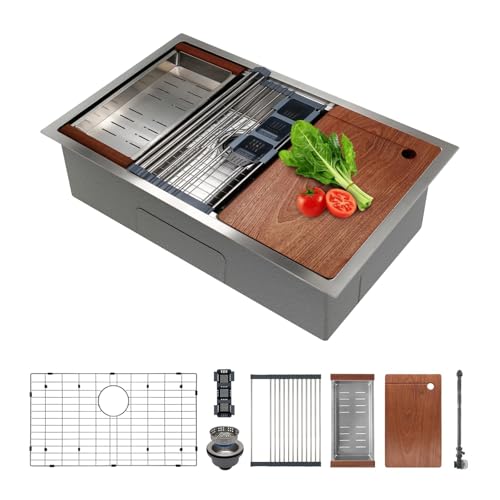
3. SANYCASA 30-Inch Undermount Workstation Sink, 11 Gauge — Best Heavy-Gauge Quiet Drain
Most sinks compete at 16 or 18 gauge; the SANYCASA competes at 11 gauge, a full 3 mm of stainless steel. That mass matters for drainage in an indirect way: a floor this rigid does not oil-can or flex under a loaded stockpot, so the engineered slope to the drain stays true instead of developing the shallow belly that pools water in thinner sinks. The manufacturer’s superior-drain floor shaping does the rest, moving water decisively to the outlet.
The workstation ledge turns the sink into a drying system as well. Accessories ride the integrated ledge over the bowl, so everything washed can drip where the water is already going. Combined with sound treatment under the bowl, the experience is of a sink that feels carved rather than pressed — quiet, solid and quick to clear itself after use.
The cautions are weight and tier. An 11-gauge sink with accessories is a heavy lift into an undermount position, and your cabinet and counter must be up to supporting it; this is a two-person, plan-ahead installation. The price tier sits above the 16-gauge field. If you cook with genuinely heavy pots and want drainage that will still be true in fifteen years, the extra metal is a rational place to spend.
Strengths
- 11-gauge steel is far thicker than the 16-gauge norm — exceptionally solid
- Drain-focused floor design clears water and particles quickly
- Workstation ledge supports a full accessory set for in-sink drying
Trade-offs
- Heavier sink — confirm cabinet support before installing
- Premium tier for the gauge and accessory bundle
- Thick steel makes clip installation firmer work
| Mount | Undermount |
|---|---|
| Material | Stainless steel, 11 gauge (3 mm) |
| Floor | Superior-drain design |
| Ledge | Integrated workstation ledge with set |
Living with 11-gauge steel changes your sense of what a sink is. Heavy pans are set down without calculation, the ledge carries loaded boards without a tremor, and the floor’s slope stays true because nothing you own can flex it. The ownership cost is paid once, at installation, in effort and assistance; after that the sink is the least worrying object in the kitchen. Households that cook with cast iron daily tend to become quietly evangelical about thick steel.
Best for: Heavy cookware households that want the thickest steel and fast drainage / Not suited for: Anyone on a tight budget tier or with a lightweight cabinet setup

4. Kraus KWF410-30 Kore Farmhouse Workstation Sink — Best Farmhouse with Drying Rack
Farmhouse sinks are usually sold on looks, and their drainage is whatever the bowl shape happens to give. The KWF410-30 is a workstation first: an integrated ledge, a sloped bowl and — the detail that earns its place here — an in-sink dish drying rack included in the box. Washed dishes sit over the bowl on the rack and drain where they stand, which is the single most effective anti-puddle habit a kitchen can adopt.
The apron front helps the human side of drainage too. With no countertop strip between you and the bowl, you stand closer, splash less over the front edge, and rinse at a more natural angle that sends water into the bowl rather than across the counter. Households that hand-wash most loads will feel that ergonomic difference every single day.
Installation is the gate: an apron-front sink needs a cabinet designed or adapted for it, with support for the bowl’s weight carried from below. That makes this a remodel pick rather than a swap pick. If your project already includes new or modified cabinetry and your style runs farmhouse, this is the draining pick with the most character — and the drying rack means its party trick works from day one.
Strengths
- Included in-sink drying rack drains straight into the bowl
- Apron front shortens the reach to the bowl — easier on backs
- Workstation ledge supports boards and colanders over the sink
Trade-offs
- Apron-front install needs a suitable cabinet or modification
- Farmhouse styling will not suit every kitchen
- Single bowl — no separate soak zone
| Mount | Farmhouse / apron front |
|---|---|
| Material | Stainless steel |
| Ledge | Workstation ledge |
| Accessory | In-sink dish drying rack included |
Farmhouse ownership adds one ritual steel undermount owners skip: the apron front itself gets wiped and, being stainless, occasionally polished, since it is furniture as much as fixture. In exchange, the shorter reach to the bowl is a daily ergonomic dividend that taller and shorter cooks both report. The included drying rack tends to become permanent furniture too — a defined wet zone that keeps the farmhouse look from being undermined by counter clutter.
Best for: Farmhouse kitchens that hand-wash and air-dry daily / Not suited for: Standard cabinets not built or modified for an apron front

5. Elkay Crosstown Workstation 31-1/2 Inch Undermount Sink Kit — Best Workstation Kit
Elkay’s Crosstown workstation takes the same drain-and-dry philosophy as the Kraus models and packages it as a kit: a ledged undermount bowl with the accessories that make the ledge useful from the first wash. The ledge workflow is the drainage story — prep over the bowl, wash in the bowl, dry over the bowl — with every drip landing somewhere designed to carry it away.
The trade against the Kraus picks is steel gauge: this is an 18-gauge body, lighter and livelier-sounding than 16-gauge, though Elkay’s sound treatment keeps it civilised. In return you get a slightly larger 31-1/2-inch footprint that fills a 36-inch cabinet run elegantly, plus the backing of one of the most established names in sinks, which matters for replacement parts and grids years later.
Buy this if the kit completeness and the brand’s support network matter more to you than maximum metal thickness, and if your cabinet is the larger size. The drainage engineering — sloped floor, ledge system, raised drying — is fully present; it simply arrives in a lighter-gauge suit.
Strengths
- Workstation ledge with kit accessories for in-sink drying and prep
- Slightly larger footprint suits 36-inch cabinets well
- Elkay’s dealer and support network is extensive
Trade-offs
- 18-gauge steel is lighter than the 16-gauge picks
- Kit format means a higher tier than a bare sink
- Undermount only
| Mount | Undermount |
|---|---|
| Size | 31-1/2 x 18-1/2 x 9 in |
| Material | Stainless steel, 18 gauge |
| Format | Workstation sink kit |
Kit ownership has a practical afterlife: because the accessories are a designed system, replacements and additions stay findable, and the ledge never becomes a groove in search of a purpose. Owners rate the slightly larger footprint as the sleeper benefit — the extra inch and a half over a 30-inch sink is exactly the difference between a roasting pan sitting flat and sitting defiantly. The 18-gauge body asks for a fraction more care with dropped cast iron than the 16-gauge picks.
Best for: Buyers who want a complete workstation kit from an established maker / Not suited for: Anyone who prioritises the thickest steel over the kit

6. Ruvati RVH8300 32-Inch Undermount Workstation Sink — Best Large Workstation
The RVH8300 is the workstation idea at full size: 32 inches of 16-gauge stainless with an integrated ledge, a cutting board and the accessories to run prep, washing and drying along a single span of sink. For drainage, size itself is an advantage — a bigger bowl gives water a longer, better-sloped run to the drain and gives drying items room to sit over the bowl instead of migrating to the counter.
Ruvati builds this as a chef’s sink, and the details back the claim: soundproofing under the bowl, a brushed finish that hides the evidence of heavy use, and a ledge machined to carry its accessories without wobble. Cook a multi-pan meal here and the workflow is visibly calmer — scraps sweep into the bowl from the board, pans soak in the deep end, and finished items dry on the rack while the floor clears itself beneath them.
The requirements are a 36-inch class cabinet and a household that will actually use the system; if everything you own goes in the dishwasher and prep happens on a separate island, the ledge is jewellery. For the cook it was designed for, though, this is the most complete draining workstation in the guide, and the one least likely to be outgrown.
Strengths
- Largest workstation footprint here — prep, wash and dry in one span
- 16-gauge body with soundproofing for heavy daily use
- Accessory set included, ledge useful immediately
Trade-offs
- Needs a 36-inch class cabinet
- Accessory ecosystem is wasted if you dishwasher everything
- Premium tier among the workstation picks
| Mount | Undermount |
|---|---|
| Material | Stainless steel, 16 gauge |
| Size | 32 in class |
| Accessories | Cutting board and workstation accessories |
The RVH8300 rewards the cook who treats the sink as a workstation in the literal sense — a place where work happens, not just washing. Owners who prep at the ledge daily describe prep and cleanup merging into one continuous motion over the bowl, with the floor clearing itself beneath. The accessory set’s storage is the one discipline it asks: give the board and racks a home position on the ledge or in one drawer, and the system stays effortless.
Best for: Serious home cooks with a 36-inch cabinet and big prep sessions / Not suited for: Compact kitchens or minimalist buyers who dislike accessories
Comparison Table
Use this table to compare the six best draining kitchen sinks side by side on the one specification that decides most purchases in this category, then read the full review of your top two before ordering.
| Pick | Badge | Key spec | Best for |
|---|---|---|---|
| KRAUS KWU110-30 Standart Pro Workstation Undermount Sink | Best Overall for Drainage | 30 in, 16-gauge, grooved floor, workstation ledge with roll-up rack | Households that air-dry in the sink and hate counter puddles |
| KRAUS KHU100-30 Standart Pro 30-Inch Undermount Sink | Best Classic Draining Design | 30 x 18 in, 16-gauge, channel grooves, rounded corners | Buyers who want proven drainage engineering in a plain single bowl |
| SANYCASA 30-Inch Undermount Workstation Sink, 11 Gauge | Best Heavy-Gauge Quiet Drain | 30 in, 11-gauge (3 mm) steel, superior-drain floor, ledge set | Heavy cookware households that want the thickest steel and fast drainage |
| Kraus KWF410-30 Kore Farmhouse Workstation Sink | Best Farmhouse with Drying Rack | 30 in farmhouse, workstation ledge, in-sink drying rack included | Farmhouse kitchens that hand-wash and air-dry daily |
| Elkay Crosstown Workstation 31-1/2 Inch Undermount Sink Kit | Best Workstation Kit | 31-1/2 x 18-1/2 in, 18-gauge, workstation kit, 9 in deep | Buyers who want a complete workstation kit from an established maker |
| Ruvati RVH8300 32-Inch Undermount Workstation Sink | Best Large Workstation | 32 in, 16-gauge, workstation ledge, accessory set included | Serious home cooks with a 36-inch cabinet and big prep sessions |
What Makes a Kitchen Sink Drain Well?
Four design features decide drainage, and you can check all four on a specification sheet. First, floor slope: the bowl floor should fall continuously toward the drain from every point, with no flat plateau around the outlet. Second, channel grooves: pressed or machined channels break surface tension and give water a guided path, which is why the Kraus Standart Pro design has used them for years. Third, drain position: a rear-set drain keeps the centre of the floor free for stacking and usually pairs with a better slope. Fourth, corner radius: tight corners hold a meniscus of dirty water; rounded or gently radiused corners let the flow — and your sponge — sweep through.
Gauge plays a supporting role. A thin floor can flex under a heavy, water-filled pot, and a flexed floor is a floor with a new low spot that pools. Sixteen-gauge steel holds its engineered slope; eleven-gauge, like the SANYCASA in this guide, holds it absolutely. This is why drainage quality correlates with build quality more than with price alone.
Finally, installation can defeat design. A sink set dead level is correct — the slope is built into the bowl — but a drain line with insufficient fall, a sagging trap arm or a partially blocked vent will slow any sink. If a new, well-designed sink still drains slowly, the problem is downstream in the plumbing, and a plumber will fix in an hour what no sink upgrade could.
How Do Workstation Sinks Improve Drying and Drainage?
A workstation sink adds a ledge inside the bowl rim that carries accessories at counter height: cutting boards, colanders and, most importantly for this topic, roll-up or fitted drying racks. The drainage benefit is behavioural as much as mechanical. When washed items dry over the bowl, every drip lands in the sink and leaves by the drain. When they dry on a counter mat, the water pools, the mat stays damp, and the counter edge eventually shows it.
The roll-up rack is the most versatile of these accessories: it unrolls across the bowl for drying, doubles as a trivet for hot pans and a landing pad for a colander while pasta drains, then rolls away into a drawer. Fitted racks give a more stable platform for heavy items. Either way, the household habit changes — the sink becomes the wet zone for the whole wash-up process, and counters stay dry.
If you are choosing between a plain sink and a workstation at the same size, the workstation is the better draining purchase for any household that hand-washes even part of its load. Pure dishwasher households gain less, and for them the grooved-floor classic picks in this guide are the more honest spend.
How Should You Maintain a Fast-Draining Sink?
Weekly habits keep drainage at its designed speed. Wipe the bowl floor toward the drain after heavy use so fine grit never builds into a dam; run the disposal, if fitted, with cold water for a few seconds after grinding to flush the line; and lift the bottom grid, if you use one, often enough to rinse beneath it — a grid protects the floor but traps a layer of sediment if ignored for a month.
Monthly, treat the drain itself: remove and scrub the strainer basket, check the trap for grease build-up if drainage has slowed, and flush with hot water. Avoid the instinct to pour harsh chemicals at the first slowdown; most kitchen slowness is a physical film of grease and food fines that hot water, a brush and, where needed, a trap clean-out will clear safely.
Protect the floor’s slope over the long term by avoiding the two habits that damage it: dropping heavy cookware from height, which can dent a low spot into the floor, and using the bowl as a chemical soaking tub for aggressive cleaners that attack the finish and roughen the surface water should glide over. A smooth, true floor is a fast floor.
Rear Drain vs Centre Drain: Does Position Really Change Drainage?
Position changes two things at once. In the bowl, a rear-set drain keeps the centre of the floor free, so a stack of plates or a flat pan base never dams the outlet — the single most common cause of the ‘my sink drains slowly’ complaint that is actually the sink’s fault. The water’s path also tends to be a cleaner slope, since the floor can fall continuously toward the back rather than gathering around a central point from all sides.
Below the bowl, a rear drain moves the trap toward the back of the cabinet, which returns the centre of the cabinet to storage — the difference between a pull-out bin fitting or not fitting under many sinks. On double bowls and disposal installations the geometry compounds: rear drains give the plumber room to route both bowls and the disposal without the trap sagging into a water-holding belly.
None of this makes centre drains wrong — generations of sinks drain acceptably through them, especially with grooved floors. But when two otherwise equal sinks differ only in drain position, the rear-drain model is the better draining purchase, and it is why drainage-focused designs keep choosing it.
Why Does My New Sink Drain Slower Than My Old One?
It is a common and confusing experience, and it usually has one of three causes — none of them the sink’s bowl. First, modern strainers and disposal flanges sometimes have smaller effective openings than the old fittings they replaced, throttling flow at the outlet. Second, a new installation can introduce a sagging trap arm or an extra elbow that the old plumbing did not have, and water notices every one. Third, the vent path may have been marginal for years, revealed only when a deeper bowl changed the drain height relationship.
Diagnose by filling the bowl and timing the drain, then removing the strainer basket and timing again: a big improvement points at the fitting, not the line. No improvement points downstream — trap, arm or vent — and that is plumber territory, usually resolved in a single visit. The encouraging truth is that a well-designed bowl like the picks in this guide almost never needs replacing for drainage; it needs its line set up to let it work.
While the plumber is there, have the whole run checked for the grease film that narrows older kitchen lines. A fast bowl draining into a half-closed line is a sports car in a traffic jam — the fix is the road, not the car.
What Does Good Drainage Save You Over a Year?
It is worth totalling what a puddle actually costs, because the sum is larger than it looks. A sink that holds water needs a wipe after nearly every use — call it thirty seconds, several times a day, plus the sprayer’s extra work chasing sediment, plus the periodic deep scrub when the film sets in the corners. Across a year that is hours of small labour and a measurable amount of water, spent compensating for a floor shape. A grooved, sloped bowl deletes most of that tax permanently, which is why drainage-focused buyers describe the upgrade in terms of time rather than plumbing.
There is also a hygiene dividend that rarely gets priced. Standing water in a bowl is where kitchen biofilm establishes itself — the pink and grey films that appear in corners and around drains are colonies, not stains, and they establish fastest exactly where water lingers. A bowl that dries itself between uses is a bowl that gives those colonies no harbour. Families with young children, raw-meat-heavy cooking or immunocompromised members should weight that benefit as a first-order reason, not a footnote.
None of this requires the flagship pick. The drainage features that matter — slope, grooves, rounded corners, a rack that keeps drying in the bowl — appear across the tiers in this guide, including the long-running Standart Pro design. What it requires is refusing to buy a sink whose floor design the manufacturer will not describe. Drainage is specified or it is absent; choose accordingly and the savings compound daily.
How Does Sink Shape Affect Splashing as Well as Draining?
Drainage and splashing are the same physics viewed from opposite ends: water entering the bowl with energy must lose that energy somewhere, and a well-shaped bowl takes it in the floor’s slope rather than returning it as spray. Depth is the obvious splash defence — a nine- or ten-inch bowl keeps a high-arc faucet’s stream contained — but floor shape matters more than most buyers realise. A floor that falls decisively to the drain gives falling water a direction; a flat floor gives it a mirror, and mirrors bounce.
Faucet pairing completes the picture. A pull-down sprayer used at bowl level rinses with almost no splash in any sink, while a tall fixed faucet at full pressure will mist the counter of even a deep bowl. If splashing is your daily grievance, audit the faucet’s height and flow against the bowl’s depth before blaming the sink — and when you replace the sink, choose the depth that matches the faucet you actually own. The picks in this guide, with their sloped floors and mostly generous depths, are the forgiving half of that partnership.
Corner radius plays a supporting role here too: tight corners reflect a sprayer’s stream back at the user, while rounded corners absorb and redirect it downward. It is one more reason the drainage-focused designs in this guide converge on the same geometry — sloped floors, generous radii, rearward drains. Water, given a considered shape, behaves.
How to Improve Drainage in Your Existing Sink
Before replacing anything, diagnose what you have. Fill the bowl with a few inches of water, pull the stopper and watch the last phase of draining: if a shallow puddle remains in a consistent spot, your floor has a flat area or a dent; if the water spirals slowly from the start, the restriction is in the drain line or trap. The first problem is the sink; the second is plumbing, and it is far cheaper to fix.
For a floor that puddles, small interventions help more than expected. A fitted bottom grid raises dishes so water can pass beneath them, which cures the dam effect of a flat pot base even if the floor itself is imperfect. Directing the faucet’s sprayer in a quick clockwise sweep after washing gathers the settled film into the drain — a five-second habit that keeps a mediocre floor looking drained. And keeping the strainer basket clean matters: a half-blocked basket slows the whole bowl.
For a line that drains slowly, work downstream: empty and clean the trap, check the trap arm’s fall into the wall, and clear the vent path if gurgling accompanies draining. If those steps restore speed, your sink was never the problem. If the floor itself is the problem and the puddle genuinely bothers you daily, that is the honest case for replacement — and the grooved-floor and workstation models in this guide are designed precisely so the puddle never forms.
Common Buying Mistakes
Drainage disappointment usually comes from buying on looks and discovering the engineering later. Watch for these traps when you compare sinks.
- Judging drainage by bowl depth. Depth holds water; slope moves it. A shallow, well-sloped bowl drains faster than a deep, flat one every time.
- Ignoring the floor design entirely. If the listing never mentions grooves, slope or drain position, assume a flat floor and a permanent puddle.
- Blocking the drain with a full-size mat. Thick sink mats dam the flow they sit in. Use a fitted grid that water can pass under, or nothing.
- Blaming the sink for a plumbing problem. Slow spiralling from a full bowl points at the trap or vent. Fix the line before you replace a good sink.
- Letting grit build up. A film of food fines roughens the floor and slows sheeting water. A weekly wipe to the drain keeps the design working.
The pattern across all five mistakes is the same: drainage is a system of floor, drain and line, and it fails at whichever part is ignored. Buy the floor design, install the line correctly, and keep both clean, and any pick in this guide will stay fast for years.
Final Recommendation
For most remodels, the Kraus KWU110-30 is the draining sink to buy: grooved floor, rearward drainage and a roll-up rack that turns drying into part of the system. If you want the same floor engineering without the ledge, the KHU100-30 is the proven classic, and if maximum metal appeals, the SANYCASA’s 11-gauge body holds its slope like nothing else here. Farmhouse projects should take the KWF410-30 and its in-sink rack; large kitchens, the Ruvati RVH8300; kit-and-brand shoppers, the Elkay Crosstown workstation.
Whichever you choose, check the floor design on the specification before you check the finish, confirm your cabinet size, and check price on Amazon for the exact configuration — then install it with a properly falling drain line so the engineering you paid for can actually perform.
Ready to order? Start with the top three: Kraus KWU110-30 · Kraus KHU100-30 · SANYCASA 30 Workstation — and check price on Amazon for the exact configuration you measured or sized for.
Best Kitchen Sinks Best Undermount Kitchen Sinks Best Double Kitchen Sinks
Frequently Asked Questions
Why does water pool in my kitchen sink?
Pooling means the bowl floor has a flat spot or a dent where water cannot reach the drain, often worsened by a flat-based pot damming the flow. Grooved, sloped floors and a raised bottom grid are the design answers; a persistent single puddle spot points at floor shape, while slow draining overall points at the plumbing.
Do channel grooves in a sink floor really help?
Yes. Grooves break the surface tension that lets water sheet and stall on flat steel, and they give rinse water a guided path to the drain. It is a small feature with an outsized effect on how dry the bowl is minutes after washing up.
Are workstation sinks better for drying dishes?
They are, because the ledge holds a rack over the bowl, so dishes drip into the sink and drain away instead of pooling on the counter. For households that hand-wash regularly, that single habit change keeps counters noticeably drier.
Does a garbage disposal affect drainage?
A disposal adds a chamber the water must pass through, and a worn or grease-lined disposal can slow things. Run cold water during and briefly after grinding to flush the line, and treat persistent slowness as a line-cleaning job rather than a sink fault.
What drain position is best?
A rear-set drain keeps the bowl floor’s centre free for stacking dishes and usually pairs with a cleaner slope and more usable cabinet space below, since the trap sits further back. It is the position most drainage-focused designs choose.
Can installation make a good sink drain badly?
Yes. A sagging trap arm, insufficient fall in the drain line or a blocked vent will slow any sink. If a well-designed new sink drains slowly, have the line checked before blaming the bowl.
Do bottom grids slow drainage down?
No — a fitted grid raises items so water flows beneath them, which usually improves real-world drainage during washing. The grid itself needs a periodic lift and rinse, since it can trap a layer of sediment against the floor if ignored for weeks.
Are deeper sinks slower to drain?
Not by design. Depth adds water volume, not resistance; a deep bowl with a sloped, grooved floor drains as decisively as a shallow one. What depth changes is the plumbing geometry below, which is why disposal clearance should be checked on deep models.


