Disclosure: airfryerkitchensupply.com is reader-supported. When you buy through links on our site, we may earn an affiliate commission at no extra cost to you.
Where to buy
Every pick in this guide to the best double kitchen sinks was confirmed through the Amazon Creators catalogue for this site before it earned a link, so the model names and configurations below match what you will actually find on the product page. Start with the shortlist here, then read the full reviews before you decide: Kraus KWU112-30 · Kraus KWT302-30 · Ruvati RVM4350 · Ruvati RVH7411 · Elkay Dayton Double · Blanco Precis 60/40. On each product page, use the “check price on Amazon” habit rather than trusting any number quoted elsewhere, because sink, grinder and footwear pricing moves with size, finish and season.
The best double kitchen sinks solve a workflow problem, not a looks problem: one bowl soaking a roasting pan while the other stays free for rinsing produce, draining pasta or washing hands mid-recipe. If that split workflow is how your kitchen actually runs, a double bowl is not a compromise — it is the correct tool. If you mostly wash sheet pans and stockpots one at a time, be honest about it before you order, because a single large bowl will serve you better and several of the guides linked at the end of this article cover that layout instead.
The double-bowl market splits into three real families. Equal 50/50 bowls suit households that soak and rinse in similar volumes. Unequal 60/40 layouts give you one genuinely large bowl plus a smaller prep bowl, which fits most family cooking better. Low-divide models split the difference: the divider sits lower, so a long pan can rest across both bowls while you still keep two zones for most tasks. All six picks below were confirmed through the Amazon Creators catalogue for this site, and each one is a true two-bowl sink — not a single bowl photographed with a divider accessory.
Size is the first filter. Most double sinks are built for 33-inch or 36-inch base cabinets, and the cabinet minimum printed by the manufacturer is not a suggestion: an undermount double bowl needs clearance for clips, the divider wall and both drain assemblies. Measure your cabinet interior, check the bowl depth against your garbage disposal height, and only then fall in love with a finish. The reviews below flag the cabinet and depth numbers that matter for each pick.
In this guide
Quick Picks
If you only have two minutes, this is the whole guide to the best double kitchen sinks in one screen. Each pick carries the same badge it keeps in its full review further down, so you can jump straight to the detailed section for the one that fits your kitchen, your budget tier and the way you actually cook, clean or unwind at home.
- KRAUS KWU112-30 Kore Workstation 30-Inch Double Bowl Undermount Sink — Best Overall. A 16-gauge undermount workstation with a true 50/50 split, a low divider you can pass pans across, and an integrated ledge that turns the sink into a prep counter. Check price on Amazon
- KRAUS KWT302-30 Kore 30-Inch Drop-In Workstation Double Bowl Sink — Best Drop-In Workstation. The workstation idea in a drop-in body: 16-gauge steel, a 50/50 split and a ledge with accessories, installed from above in an afternoon. Check price on Amazon
- Ruvati RVM4350 32-Inch 50/50 Undermount Double Bowl Sink — Best Classic Undermount. A no-gimmick 32-inch undermount in 16-gauge T-304 with a brushed finish that hides scratches — the traditional double bowl done properly. Check price on Amazon
- Ruvati RVH7411 32-Inch 50/50 Low-Divide Undermount Sink — Best Low-Divide for Pans. A low divider in a 16-gauge 32-inch body, so long pans bridge both bowls while everyday washing still gets two zones. Check price on Amazon
- Elkay Dayton Equal Double Bowl Drop-In Sink, 33 x 19 — Best Budget. An honest, shallow-bowled American-made drop-in double at a budget tier — ideal for rentals, laundry conversions and first kitchens. Check price on Amazon
- BLANCO Precis 60/40 Double Bowl Undermount Sink, Soft White — Best 60/40 Composite. SILGRANIT composite in a 60/40 layout with a low divide — quiet, colour-through material with one large bowl and a true prep bowl. Check price on Amazon
How These Picks Were Chosen
Every candidate started with a catalogue verification step: the model was searched by brand and model name connection, the returned title was matched against the configuration we intended to describe, and only then did the sink earn a product link. That process matters in this category because the same model family often ships in single-bowl, double-bowl, undermount and drop-in variants under near-identical names, and linking the wrong variant is the most common error in sink roundups.
From the verified shortlist we judged drainage geometry, divider height, corner radius, steel gauge or composite makeup, sound treatment and the accessory bundle. A double sink lives or dies on details you cannot see in a hero photo: whether the divider is low enough to pass a pan handle over, whether the bowl floors actually slope to the drains, and whether the corners are rounded enough to wipe clean with a sponge instead of a toothbrush.
Finally, we spread the six picks across mount types and budget tiers on purpose. There is an undermount workstation for remodels, a drop-in double for a weekend swap, a low-divide for pan households, a granite composite for buyers who want colour and quiet, and an honest budget drop-in for rentals and first kitchens. No pick is here because of its brand; each is here because it does one double-bowl job measurably well.
The 6 Best double kitchen sinks
The six reviews below are ordered by how we would recommend the best double kitchen sinks to most households, not by price. The first pick is the one to buy if you do not want to think about the category again for years; the later picks win on a specific strength — a tighter budget tier, a particular layout, a material or a use case — that matters more to some homes than all-round polish.

1. KRAUS KWU112-30 Kore Workstation 30-Inch Double Bowl Undermount Sink — Best Overall
The KWU112-30 earns the top spot because it understands why people buy a double sink in the first place. The 50/50 split gives you two equal work zones, but the divider between them is deliberately low, so the classic double-bowl frustration — a roasting pan that fits in neither bowl — mostly disappears. Rest the pan across the divide, fill one side, and keep scrubbing. For households that cook in batches and wash as they go, that single design decision is worth more than any finish option.
The workstation ledge is the second half of the appeal. A track machined into the bowl rim carries the included cutting board and roll-up drying rack at counter height, which effectively extends your prep surface over the sink itself. Chop over one bowl and sweep scraps straight in; park washed glasses on the rack over the other. In a 30-inch footprint that normally forces compromises, the ledge hands you back working room that a plain double bowl never could.
Construction is properly serious: 16-gauge T-304 steel, commercial-grade brushed finish and NoiseDefend padding that keeps the bowls from drumming when the faucet runs at full tilt or a disposal grinds below. The rounded corners wipe clean without the grit trap that tight-radius handmade sinks can become. If you are remodelling with solid-surface or stone counters and want the double-bowl layout to feel like an upgrade rather than a throwback, this is the sink to build around.
Strengths
- Low divider lets sheet pans and long handles rest across both bowls
- Integrated ledge holds the included cutting board and roll-up rack over the bowls
- 16-gauge TRU16 steel resists denting from dropped cookware
Trade-offs
- Needs a 33-inch minimum cabinet, so it will not fit compact kitchens
- Undermount install means a fabricator or confident DIY templating
- Workstation accessories reward daily use but clutter a drawer if ignored
| Mount | Undermount |
|---|---|
| Material | T-304 stainless steel, 16 gauge |
| Split | 50/50 with low divider |
| Ledge | Integrated workstation ledge |
| Sound | NoiseDefend padding |
Ownership, a year in, tends to centre on the ledge discipline: households that keep the board and rack living on the sink use them daily, while households that store them in a cupboard rediscover them monthly. Decide which household you are before you weight the workstation premium — the sink is excellent either way, but its best trick only pays rent when the accessories stay in play. The low divider also changes cleaning habits for the better: a single sweep across both bowls, rather than two separate scrubs, becomes the natural motion.
Best for: Remodels that want one sink to handle soaking, rinsing and prep at once / Not suited for: Cabinets under 33 inches or anyone set on a single uninterrupted bowl

2. KRAUS KWT302-30 Kore 30-Inch Drop-In Workstation Double Bowl Sink — Best Drop-In Workstation
Most drop-in double sinks are built to a price, and it shows in thin steel and shallow bowls. The KWT302-30 is the exception that proves a top-mount sink can still be a serious tool: 16-gauge construction, a proper 50/50 split and the Kore workstation ledge, all in a body that drops into an existing cutout from above. If your countertop is laminate or tile that cannot take an undermount, this is how you get a modern double-bowl workstation without replacing the counter.
Installation is the headline. A drop-in swap is a realistic half-day project: shut off the water, lift the old sink, clean the deck, set the new sink on sealant, connect the drains and faucet. Because the rim covers the cutout edge, minor chips or an out-of-square opening from the old sink disappear under the deck flange. Renters cannot use that advantage, but homeowners refreshing a dated kitchen absolutely can.
In daily use the ledge accessories do the same work as on the undermount model — board over one bowl, rack over the other — while the equal bowls keep the soak-and-rinse rhythm that double-sink households love. The honest cost is the rim itself: crumbs stop at the lip instead of sweeping into the bowl, and the look is more traditional. If you can accept that, this is the easiest meaningful sink upgrade in this entire guide.
Strengths
- Drop-in rim forgives an existing cutout that is not perfectly true
- Same workstation ledge system as the undermount Kore line
- 16-gauge steel is a real step up from builder-grade drop-ins
Trade-offs
- Raised rim catches crumbs that an undermount would let you sweep in
- 30-inch size still needs a reasonably wide base cabinet
- Accessory ledge narrows the effective rim-to-bowl reach slightly
| Mount | Drop-in / top mount |
|---|---|
| Material | Stainless steel, 16 gauge |
| Split | 50/50 double bowl |
| Ledge | Integrated workstation ledge |
Long-term owners of drop-in workstations report one consistent surprise: the rim, expected to be the compromise, becomes a convenience — a place to rest a hot spoon, park a sponge and catch the drips that an undermount would send down the cabinet face. The steel’s brushed finish hides the small evidence of that busy rim well. Keep the sealant bead inspected yearly, as with any drop-in, and the installation side of ownership is otherwise silent — exactly what a replacement sink should be.
Best for: Replacing an old drop-in without touching the countertop / Not suited for: Anyone who wants the seamless wipe-in edge of an undermount
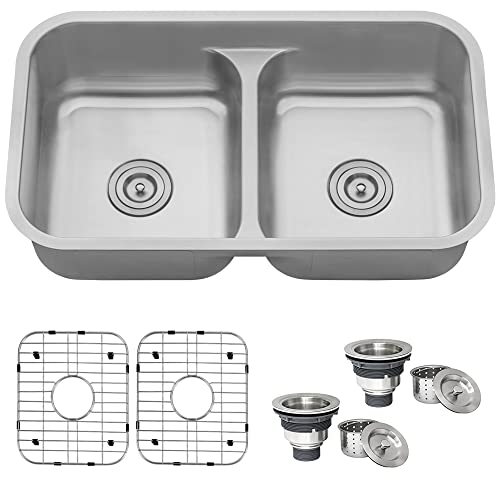
3. Ruvati RVM4350 32-Inch 50/50 Undermount Double Bowl Sink — Best Classic Undermount
The RVM4350 is the pick for buyers who looked at workstation ledges and decided they would rather have two deep, honest bowls. At 32 inches wide in 16-gauge T-304 stainless, each side of the 50/50 split swallows a dinner-party load without the shallow splashiness of budget doubles. Ruvati’s brushed finish is chosen well: it hides the fine scratch pattern that polished sinks advertise within a month, so the sink ages gracefully instead of looking tired.
The full-height divider is both the point and the limitation. It keeps soak water genuinely separate — greasy pan water never sloshes into the rinse side — and gives the sink a classic, symmetrical feel that suits traditional and transitional kitchens. The trade is pan handling: a long-handled skillet must sit diagonally in one bowl rather than resting across the divide. If your cooking leans on sheet pans daily, the low-divide Kraus above or the Ruvati RVH7411 below will frustrate you less.
Underneath, sound pads and undercoating keep the bowls civilised, and the sloped floors drain completely instead of leaving the grey puddle that flat-bottomed sinks hold hostage. Pair it with bottom grids if you wash heavy cast iron often; the steel is thick, but a grid is cheap insurance against the one dropped Dutch oven that tests it. For a remodel that values proven proportions over novelty, this is the safe, satisfying buy.
Strengths
- 32-inch width gives each bowl genuinely useful volume
- Brushed finish disguises the fine scratches of daily use
- 16-gauge build with sound pads keeps wash-up quiet
Trade-offs
- Full-height divider, so long pans must angle into one bowl
- No workstation ledge or included prep accessories
- Needs a 36-inch cabinet class for comfortable installation
| Mount | Undermount |
|---|---|
| Material | T-304 stainless steel, 16 gauge |
| Split | 50/50 double bowl |
| Finish | Brushed, scratch-masking |
The RVM4350’s ownership story is quiet competence. There is no system to learn and no accessory to store; there are two deep bowls that rinse clean, a finish that hides its history and a size that never asks a pan to wait its turn. Owners upgrading from builder doubles notice the sound difference first — the padded 16-gauge body turns wash-up from a percussion session into background noise — and then the drainage, which simply completes instead of lingering.
Best for: Traditional kitchens that want depth and quiet over accessories / Not suited for: Buyers who want a workstation ledge or a low divider

4. Ruvati RVH7411 32-Inch 50/50 Low-Divide Undermount Sink — Best Low-Divide for Pans
The RVH7411 exists for one specific cook: the one who loves a double sink’s two-zone workflow but owns pans that refuse to fit in either half. Its divider is cut low on purpose, so a roasting pan, a long griddle or a skillet with a helper handle can bridge across the middle and soak flat instead of teetering at an angle. The rest of the day, you still have two defined bowls for the soak-and-rinse rhythm.
That flexibility has a price you should accept with open eyes. Fill one bowl deep for a serious soak and water will find the low divider and equalise into the second bowl, so the strict separation a full-height divider guarantees is gone. Tight-radius corners give the sink its crisp, handmade look, but they collect grime in a way rounded corners do not; budget a small brush and a weekly corner scrub into your routine.
Build quality is the expected Ruvati standard: 16-gauge steel, sound treatment underneath and a brushed finish that wears in rather than wearing out. At 32 inches it wants a full-size base cabinet, and as an undermount it belongs in a remodel with stone, quartz or solid-surface counters. If your household’s sink frustration is specifically about pans, this is the double sink engineered around that frustration.
Strengths
- Low divider passes long handles and sheet pans across the sink
- 16-gauge steel with a fitted, handmade look
- Two true bowls for soaking and rinsing the rest of the time
Trade-offs
- Low divider lets deep soak water spill into the second bowl
- Tight-radius corners need a brush, not just a sponge wipe
- Undermount only — no drop-in fallback for laminate counters
| Mount | Undermount |
|---|---|
| Material | Stainless steel, 16 gauge |
| Split | 50/50 with low divider |
| Corners | Tight radius |
Living with a low divider teaches a small choreography: shallow work in both bowls all day, deep soaking in one bowl with the other kept as the rinse-and-stack side, and the big-pan bridge whenever the roaster appears. Owners who cook in sheet-pan batches describe the divider as the feature they would not trade back. The tight corners do ask for their weekly brush, and households that accept that trade in advance stay happy; those who expected zero maintenance in exchange for the look are the ones who grumble.
Best for: Pan-heavy cooks who still want a two-zone wash-up / Not suited for: Anyone who needs a fully watertight separation between bowls

5. Elkay Dayton Equal Double Bowl Drop-In Sink, 33 x 19 — Best Budget
Not every double sink needs to be a remodel centrepiece. The Elkay Dayton is the sink you buy when the old one is cracked, stained or leaking and the budget for the whole project is modest: a straightforward equal-double drop-in from one of the oldest names in American sinks, at a tier that leaves money for the faucet and the plumber. For rental properties, a first home or a laundry-room conversion, that restraint is a feature.
Be clear about what the tier buys. The bowls are shallow at roughly six and a half inches, which is fine for plates, glasses and everyday pans but will splash during energetic rinsing and cannot soak a big roaster submerged. The steel is lighter than the 16-gauge picks in this guide, so the bowls sound tinnier and dent more easily if a heavy pot lands badly. None of that makes it a bad sink; it makes it a correctly priced one.
Installation is as friendly as sinks get: the drop-in rim covers the existing cutout, the deck takes a standard faucet, and both drains connect with ordinary hardware. If your priority is a clean, functional double bowl this weekend rather than a decade-long statement piece, the Dayton does the job without drama. Upgrade later when the kitchen remodel is real; this sink will not embarrass you in the meantime.
Strengths
- Budget-tier pricing from a long-established sink maker
- Simple drop-in install suits a fast weekend replacement
- Equal bowls keep the classic soak-and-rinse layout
Trade-offs
- Shallow bowls splash and limit soaking large items
- Thinner steel than the 16-gauge picks — expect more noise
- Plain styling with no workstation or accessory system
| Mount | Drop-in |
|---|---|
| Size | 33 x 19 in |
| Bowl depth | 6-7/16 in |
| Split | Equal double bowl |
The Dayton’s long ownership arc is mostly told in rentals and first homes, where its virtues are availability and indifference: it installs fast, cleans adequately and asks nothing. In a household that later remodels, it is often the sink that gets donated onward still working — thin steel and shallow bowls limit its ceiling, not its lifespan. If your plan is a full kitchen in three years, this is the sink that bridges those years without eating the budget the remodel needs.
Best for: Budget replacements, rentals and utility-minded kitchens / Not suited for: Deep soaking or anyone washing large stockpots daily

6. BLANCO Precis 60/40 Double Bowl Undermount Sink, Soft White — Best 60/40 Composite
The Precis makes the case that 50/50 is not the only sensible split. Its 60/40 layout gives you one bowl big enough for a half-sheet pan and a second, smaller bowl that earns its keep as a prep and rinse station — thawing, draining colanders, washing vegetables while the main bowl soaks. Add the low divide, which lets long items bridge the middle, and you have the most workflow-literate layout in this guide for cooks who prep seriously.
SILGRANIT composite changes the ownership experience as much as the layout. It is dense and quiet — dishes land with a thud instead of a clang — and the colour is integral to the material, so the fine wear of daily use does not read as scratching the way it can on coated steel. The Soft White finish suits bright, modern kitchens that stainless can make feel clinical, and the surface resists heat and staining under normal kitchen discipline.
Discipline is the operative word: light composite rewards owners who rinse turmeric, beet and red-wine spills promptly rather than leaving them overnight, and the tier is premium next to stainless. Installation is undermount-only into a full-size cabinet. If your kitchen design calls for colour and your cooking calls for an asymmetric split, the Precis is not a compromise pick — it is the one the other five are measured against in this layout.
Strengths
- 60/40 split matches real cooking: one large bowl, one prep bowl
- Composite is noticeably quieter than steel under running water
- Colour runs through the material, so wear does not show as scratches
Trade-offs
- Premium tier compared with stainless doubles
- Light colours need prompt attention to turmeric and wine spills
- Undermount installation only, with a 36-inch class cabinet
| Mount | Undermount |
|---|---|
| Material | SILGRANIT granite composite |
| Split | 60/40 with low divide |
| Colour | Soft White |
Composite ownership differs from steel in one psychological way: the sink stops being a surface you protect and becomes a material you use. Owners report setting hot pans down without the flinch steel teaches, and the low divide’s water-equalising habit becomes second nature within a month. The Soft White finish rewards a prompt rinse after strong pigments and otherwise asks little. In bright kitchens it also changes the room’s feel — warmer and quieter than steel — which owners consistently mention as the unplanned benefit.
Best for: Cooks who want one big bowl plus a prep bowl, in a coloured finish / Not suited for: Buyers who want stainless steel or a drop-in mount
Comparison Table
Use this table to compare the six best double kitchen sinks side by side on the one specification that decides most purchases in this category, then read the full review of your top two before ordering.
| Pick | Badge | Key spec | Best for |
|---|---|---|---|
| KRAUS KWU112-30 Kore Workstation 30-Inch Double Bowl Undermount Sink | Best Overall | 30 in, 16-gauge T-304, 50/50 low divider, workstation ledge | Remodels that want one sink to handle soaking, rinsing and prep at once |
| KRAUS KWT302-30 Kore 30-Inch Drop-In Workstation Double Bowl Sink | Best Drop-In Workstation | 30 in drop-in, 16-gauge, 50/50 double bowl, ledge accessories | Replacing an old drop-in without touching the countertop |
| Ruvati RVM4350 32-Inch 50/50 Undermount Double Bowl Sink | Best Classic Undermount | 32 in, 16-gauge T-304, 50/50 split, brushed finish | Traditional kitchens that want depth and quiet over accessories |
| Ruvati RVH7411 32-Inch 50/50 Low-Divide Undermount Sink | Best Low-Divide for Pans | 32 in, 16-gauge, 50/50 low-divide, tight radius corners | Pan-heavy cooks who still want a two-zone wash-up |
| Elkay Dayton Equal Double Bowl Drop-In Sink, 33 x 19 | Best Budget | 33 x 19 in drop-in, equal double bowl, 6-7/16 in depth | Budget replacements, rentals and utility-minded kitchens |
| BLANCO Precis 60/40 Double Bowl Undermount Sink, Soft White | Best 60/40 Composite | 33 x 18 in, SILGRANIT composite, 60/40 low divide | Cooks who want one big bowl plus a prep bowl, in a coloured finish |
What Is the Best Layout for Double Kitchen Sinks: 50/50, 60/40 or Low-Divide?
Layout decides your daily experience more than brand or finish, so choose it from your cooking, not from a showroom photo. A 50/50 split suits households whose wash-up genuinely divides into two equal jobs: a soaking bowl and a rinsing bowl, or a washing bowl and a drying-rack bowl. It is the classic double for a reason, and cooks who batch-wash after family dinners tend to stay loyal to it.
A 60/40 split admits that one job is bigger than the other. The large bowl takes sheet pans, stockpots and roasting dishes that defeat an equal split, while the small bowl handles produce, thawing and hand-washing. If you own even one pan that currently has to be washed in the bathtub or at an angle, the asymmetric layout will feel like a revelation. Low-divide versions of either split lower the centre wall so long items can rest across both bowls, trading strict separation for pan flexibility.
Divider height deserves its own decision. A full-height divider keeps soak water honest and gives each bowl an independent water level — essential if one side holds a disposal and a stack of soaking dishes for hours. A low divider turns the sink into a part-time single bowl. Neither is better in the abstract; match the divider to whether your bigger pain is cross-contamination of soak water or pans that do not fit.
How Do You Size a Double Sink for Your Cabinet and Counters?
Start under the counter, not on top of it. The manufacturer’s minimum cabinet size accounts for the bowl walls, mounting clips and the plumbing of two drains plus, usually, a garbage disposal on one side. A 30-inch double typically needs a 33-inch cabinet; a 32- or 33-inch double typically needs 36 inches. Measure the interior width between the cabinet sides, not the door opening, and check for drawer boxes or pull-outs that steal depth below the counter.
Bowl depth is the second measurement people get wrong. Deeper bowls — nine to ten inches — hide a day of dishes and soak tall pots, but they lower the drain outlet, which can collide with a disposal or a low drain stub in the wall. Shallower bowls around six to seven inches suit shorter users and older plumbing. If anyone in the house washes up seated or has limited reach, remember that a deep bowl plus a thick countertop puts the bowl floor a long way down.
Finally, confirm the mount against your countertop material before ordering. Undermount doubles need a finished, water-resistant cutout edge — stone, quartz and solid surface qualify; ordinary laminate does not, because its cut edge swells with water. Laminate and tile kitchens should shop the drop-in picks in this guide, whose rims seal and cover the cutout completely.
Which Material Lasts Longest in a Double Bowl Sink?
For stainless steel, gauge is the durability shorthand: the lower the number, the thicker the metal. Sixteen-gauge bowls resist denting from dropped cookware and feel solid under a loaded pan; eighteen-gauge saves money and weight but drums more and dents sooner. Grade matters too — T-304 stainless carries the chromium and nickel balance that resists rust in a permanently wet environment, which is why every steel pick in this guide specifies it.
Granite composite sinks such as the SILGRANIT and quartz-composite models trade steel’s cold ring for density and quiet. They shrug off heat, resist chipping under normal use and carry colour through the whole body of the material. Their vulnerabilities are different rather than greater: light colours can pick up pigment from strong dyes if spills sit, and the material is heavy, so cabinet support and a careful install matter.
Fireclay and cast iron bring mass and a traditional look, mostly in farmhouse and single-bowl designs, while copper is a living finish that patinas. For a double bowl specifically, the realistic shortlist is 16-gauge stainless for resilience and value, or quality granite composite for quiet and colour. Either, installed correctly with a bottom grid on the wash side, should outlast the kitchen around it.
Should You Put a Garbage Disposal in a Double Sink — and in Which Bowl?
A disposal in a double sink serves one bowl, and the choice shapes your workflow more than most buyers expect. The common arrangement puts the disposal in the bowl you scrape into: on a 50/50 split that is usually the bowl nearest the dishwasher or the cook’s dominant side; on a 60/40 it is usually the smaller bowl, reserving the large bowl as the clean soak-and-prep space. Think about where plates are actually scraped in your kitchen — at the sink’s left or right, standing in which spot — and put the disposal under that hand.
Plumbing reality adds two checks. A disposal lowers the drain outlet on its bowl, so confirm the trap and wall stub geometry still works with your bowl depth, especially on deep nine- and ten-inch bowls. And a disposal adds weight and vibration to one side of the sink, which is one more reason the 16-gauge picks in this guide age better in disposal households: thinner bowls drum and flex under a grinding load in a way thick steel simply does not.
Households that compost aggressively or cook mostly fresh produce sometimes skip the disposal entirely and gain a simpler, quieter, cheaper installation with two free-draining bowls. Neither answer is wrong. What is wrong is deciding by default — the disposal question deserves the same ten honest minutes as the split and the divider.
How Do Double Sinks Handle a Dishwasher Household vs a Hand-Washing Household?
It is tempting to assume a dishwasher makes the sink layout irrelevant. In practice the dishwasher changes the double sink’s job rather than deleting it: one bowl becomes the staging area where dishes wait, soaking the baked-on exceptions, while the other stays clear for produce, hand-washing the knives and pans that never enter the machine, and general cooking water work. Households that run this system describe the clear bowl as the luxury — a sink that is never fully occupied is a sink that is always available.
Hand-washing households use the split literally: wash in one, rinse and stack in the other, with the divider as the border between dirty and clean. For them, bowl depth and drainage matter more, because both bowls work at full capacity nightly, and a low divider’s spill-over during a deep soak is a genuine workflow cost rather than a footnote. That is why this guide pairs its low-divide recommendations with pan-heavy cooking rather than with hand-washing volume.
Mixed households — most real households — should choose by their worst evening, not their average one: the dinner-party night when the dishwasher runs twice and the sink still has to absorb overflow, soaking and prep simultaneously. Every pick in this guide was chosen to survive that evening gracefully; the differences are in which part of it each pick makes easiest.
How to Measure for and Install a Double Bowl Sink
Begin with the cabinet, a tape measure and a torch. Record the interior width and depth of the base cabinet, the height from the cabinet floor to the underside of the counter, and the position of the water supplies and drain stub. Compare those numbers with the sink’s minimum cabinet size and bowl depth before anything is ordered. This ten-minute check prevents the most expensive mistake in sink buying: a beautiful sink that physically cannot be plumbed in the space available.
For an undermount, dry-fit with the template the manufacturer supplies. The cutout must match the template exactly, the sink’s ledge or rim must bear evenly on the counter underside, and clips should be placed as the instructions direct — not improvised. Set the sink on a bead of the recommended sealant, lift it into place with help (a loaded double bowl is heavy and awkward), and snug the clips in a cross pattern rather than running down one side. For a drop-in, the ritual is simpler: sealant under the rim, lower the sink squarely into the cutout, and tighten the retaining clips from below.
Plumb both bowls before you celebrate. Each bowl gets its own strainer or disposal flange; a disposal normally serves one bowl only, with the second bowl draining into the same trap through a continuous waste tee. Run both faucets, fill both bowls, and check every joint with a dry paper towel while the bowls drain — a slow weep found now is a five-minute fix, while the same weep found in a month is a swollen cabinet floor. Finish by running the disposal side under load and confirming the low divider or full divider behaves as you expected with a full soak.
Common Buying Mistakes
Most double-sink regret is not about the sink — it is about a mismatch between the sink and the kitchen it landed in. These are the errors we see repeated, and every one of them is avoidable at the measuring stage.
- Ordering by countertop cutout alone. The cutout fitting means nothing if the cabinet below cannot take the bowls, clips and twin drains. Always check the minimum cabinet size first.
- Choosing 50/50 by default. If your biggest pan fits in neither half, the equal split will annoy you daily. Consider 60/40 or a low divider before you buy.
- Ignoring drain position. Rear-set drains free cabinet space below and let dishes stack on the bowl floor. Centre drains on both bowls waste the storage you were counting on.
- Skipping the bottom grid. One dropped cast-iron skillet can dent even thick steel. A fitted grid on the wash side is the cheapest insurance in the whole purchase.
- Forgetting the disposal side. Decide which bowl hosts the disposal before plumbing — it changes how you soak, scrape and rinse, and swapping later is real work.
None of these mistakes requires expertise to avoid — only a tape measure, ten honest minutes thinking about your biggest pan and your wash-up habits, and the discipline to check the cabinet before the finish. Get those right and any of the six picks above will feel like the correct sink for years.
Final Recommendation
If you are remodelling and want the single best answer, buy the Kraus KWU112-30: the low divider, workstation ledge and 16-gauge build make it the most capable double sink here. If the countertop stays, the Kraus KWT302-30 delivers the same workstation thinking as a drop-in. Pan-heavy cooks on a classic layout should look at the Ruvati RVH7411’s low divide, traditionalists at the RVM4350, and design-led kitchens at the Blanco Precis 60/40. The Elkay Dayton remains the honest budget answer when the goal is a clean, working double bowl without a remodel budget.
Whichever you choose, measure the cabinet first, decide the split from your largest pan, and check price on Amazon on the exact size and configuration you measured for — sink pricing shifts with finish and bundle, and the right sink at the wrong size is simply the wrong sink.
Ready to order? Start with the top three: Kraus KWU112-30 · Kraus KWT302-30 · Ruvati RVM4350 — and check price on Amazon for the exact configuration you measured or sized for.
Best Single Kitchen Sinks Best Undermount Kitchen Sinks Best Kitchen Sinks
Frequently Asked Questions
Is a double kitchen sink better than a single bowl?
Neither is universally better. A double sink wins when your wash-up naturally splits into two jobs — soaking and rinsing, washing and prep — because both can happen at once. A single large bowl wins for oversized pans and simpler plumbing. Choose from your biggest pan and your habits, not from fashion.
What size cabinet do I need for a double sink?
Most 30-inch doubles need a 33-inch base cabinet, and most 32- to 33-inch doubles need a 36-inch cabinet. Always follow the manufacturer’s stated minimum for the exact model, and measure the cabinet interior rather than the door opening.
Does a low divider defeat the purpose of a double sink?
No — it changes the purpose. A low divider still gives you two zones for everyday washing, but lets long pans rest across both bowls. The trade is that deep soak water will equalise across the divider, so strict separation is lost.
Which bowl should the garbage disposal go in?
Most households put the disposal in the bowl they scrape plates into — usually the smaller bowl on a 60/40 split, or the right-hand bowl on a 50/50. Put it where your scraping hand naturally goes, and keep the other bowl free for soaking.
Are granite composite double sinks durable?
Yes. Quality granite composite is dense, heat-resistant and quiet, with colour running through the material. Its main care rule is prompt rinsing of strong pigments such as turmeric and red wine, especially on light colours.
Can I install a drop-in double sink myself?
A drop-in replacement is a realistic DIY project for a confident homeowner: the rim covers the existing cutout and connections are standard. Undermount installations are less forgiving and are usually best left to the countertop fabricator or a plumber.
Can a double sink work in a small kitchen?
Yes, at the 30-inch size with a 33-inch cabinet, as the two Kraus picks in this guide show. What a small kitchen cannot afford is a badly chosen split — measure your largest pan and let it arbitrate between 50/50 and a low divider before you order.
Do double sinks cost more to plumb than single bowls?
Slightly. A double needs two strainers or a disposal plus a second strainer, and a waste tee joining both to one trap. The parts are standard and the labour difference is modest — budget for the extra drain kit rather than discovering it mid-install.


