Disclosure: airfryerkitchensupply.com is reader-supported. When you buy through links on our site, we may earn an affiliate commission at no extra cost to you.
Where to buy
For the best cutoff valves for toilets, the listing is where the fitment facts live, and fitment is everything in this category: every pick below was verified in Amazon’s catalog, with the returned title checked for inlet type, outlet size and action before a link was attached. A valve with the wrong inlet is not a bargain at any price, so read the specification lines in these reviews against the stub behind your own toilet, check price on Amazon on the listing, and order once.
- SharkBite Max Angle Stop Valve — 1/2 x 3/8 Compression — Best Overall: Check the current price on Amazon
- BrassCraft G2CR19L1X Quarter-Turn Angle Stop — 4-Pack — Best Traditional Compression: Check the current price on Amazon
- Eastman Quarter Turn Angle Stop Valve — Best Budget Single: Check the current price on Amazon
- WiseWater Threaded Angle Stop Valve — 1/2 FNPT — Best for Threaded Iron Pipe: Check the current price on Amazon
- EFIELD PEX Angle Stop Valve — 10-Pack — Best for PEX Systems: Check the current price on Amazon
- PROCURU PushFit Angle Stop Valve — 2-Pack — Best Push-Fit Value: Check the current price on Amazon
The best cutoff valves for toilets — the angle stop valves that live on the wall behind the bowl — are the least glamorous and most consequential plumbing parts in the house. A toilet’s cutoff valve does nothing for years, and then, on the one day the fill valve fails or the supply line lets go, it is the difference between a quarter-turn and a flooded bathroom. The uncomfortable truth this guide is built on: most installed toilet stops cannot do that job. The multi-turn valves fitted for decades seize, weep and round off exactly when they are needed. Replacing them with modern quarter-turn stops, matched correctly to your pipe, is one of the cheapest insurance policies in home ownership.
Six verified angle stops follow, organized by the only decision that really matters — what your supply stub is made of and how it connects. Push-fit for the easiest install, compression for copper, threaded for old iron pipe, PEX-native for PEX houses, in singles and packs matched to real project sizes. Every specification quoted comes from a Amazon listing data-verified listing. Read your stub first, with a flashlight, before you read the picks: the stub chooses the valve, and the valve merely agrees. Everything after that first identification — the brand, the pack size, the connection’s finer points — is a preference exercised inside a decision the pipe has already made for you, and honoring that order is what separates the twenty-minute job from the weekend saga in this whole category of small, vital, easily ignored and utterly unforgiving plumbing parts.
In this guide
Quick Picks
SharkBite Max Angle Stop Valve — 1/2 x 3/8 Compression — Best Overall. A quarter-turn angle stop with a push-to-connect inlet that installs on PEX, copper, CPVC and PE-RT with no soldering, no compression ring and no special tools — the fastest reliable way to give a toilet a shutoff that actually works. Check the current price on Amazon
BrassCraft G2CR19L1X Quarter-Turn Angle Stop — 4-Pack — Best Traditional Compression. The plumber’s-standard compression angle stop in quarter-turn form: 1/2-inch nominal compression inlet, 3/8-inch outlet, chrome-plated brass, from the brand whose valves sit behind more American toilets than any other. Check the current price on Amazon
Eastman Quarter Turn Angle Stop Valve — Best Budget Single. A single quarter-turn compression angle stop in chrome-plated brass from a long-standing plumbing fittings maker — the inexpensive, correct-spec valve for one toilet, bought one at a time. Check the current price on Amazon
WiseWater Threaded Angle Stop Valve — 1/2 FNPT — Best for Threaded Iron Pipe. A heavy-duty quarter-turn angle stop with a 1/2-inch female threaded inlet for iron-pipe stubs — the older-house specification the compression and push-fit picks cannot serve — and a 3/8-inch compression outlet for the toilet supply line. Check the current price on Amazon
EFIELD PEX Angle Stop Valve — 10-Pack — Best for PEX Systems. PEX-inlet angle stops in a ten-pack: 1/2-inch PEX inlet, 3/8-inch compression outlet, quarter-turn, chrome-plated brass — the outfitting choice for a PEX-plumbed house replacing stops throughout. Check the current price on Amazon
PROCURU PushFit Angle Stop Valve — 2-Pack — Best Push-Fit Value. Push-to-connect quarter-turn angle stops in a two-pack, rated for copper, PEX, CPVC, PE-RT and HDPE — the push-fit convenience of the Best Overall pick, packaged for a two-bathroom weekend. Check the current price on Amazon
How These Picks Were Chosen
Every valve in this guide had to pass three filters. First, quarter-turn action — the modern ball-valve mechanism that seals positively and reports its state honestly — because the entire point of the purchase is a shutoff that works on demand. Second, lead-free-era chrome-plated brass construction suitable for potable water, as the verified listings describe. Third, Amazon listing data verification: brand and model searched, the returned title checked line by line for inlet connection, outlet size and pack count, and a link attached only on a match. In a category where a half-inch of wrongness is total, that discipline is the review.
The six survivors were chosen to cover the stub types American toilets actually sit in front of — push-fit universal, compression copper, threaded iron, PEX — at the project sizes owners actually buy: one valve, two, four, ten. We print no prices and no star ratings, because both change too often to be honest in a static guide; check price on Amazon on the listing, where the pack count and inlet are stated, before ordering.
The 6 Best Cutoff Valves for Toilets

SharkBite Max Angle Stop Valve — 1/2 x 3/8 Compression — Best Overall
The best cutoff valve for most toilets is the one a homeowner will actually install correctly, and push-to-connect wins that argument in a single push. The SharkBite Max angle stop slides onto a cut, deburred 1/2-inch stub — copper, PEX, CPVC or PE-RT — and locks; the quarter-turn handle then gives the toilet a shutoff that opens and closes with a flick instead of a corroded multi-turn stem’s prayer. No torch, no solder, no compression nut torque to judge, and if the stub is ever reworked, the fitting releases with a disconnect clip. For the classic job — the old valve behind the toilet that has not moved in fifteen years and will not move today — this is the replacement that turns a plumber call into a twenty-minute task.
Quarter-turn is the other half of the recommendation, and it applies to every pick in this guide. A ball-valve quarter-turn stop either seals or it does not, visibly, with the handle’s position telling the truth. The multi-turn compression-seal stems it replaces fail slowly and dishonestly — a drip that becomes a stain that becomes a floor. Modernizing the mechanism matters as much as modernizing the connection.
Check the current price on Amazon
Strengths
- Push-to-connect installation on four pipe materials with hand tools only — the lowest-skill, highest-success route to a working shutoff.
- Quarter-turn ball mechanism: positive shutoff, honest handle position, no stem packing to weep in five years.
- Removable with a release clip, so the valve is not a life sentence if the stub is ever replumbed.
Trade-offs
- Push-fit fittings cost more per valve than compression equivalents — the premium buys the installation, and on one valve it is worth it; on twenty, do the arithmetic.
- The fitting needs its insertion depth and a clean, square, deburred cut; push-fit forgives much, but not a jagged stub.
- Some plumbers distrust push-fit on principle for concealed locations; behind a toilet it is accessible and inspectable, which is where the technology belongs.
| Spec | Detail |
|---|---|
| Inlet | 1/2in push-to-connect (PEX, copper, CPVC, PE-RT) |
| Outlet | 3/8in compression |
| Action | Quarter-turn ball valve |
| Body | Brass, chrome finish (per Amazon listing) |
Buy the SharkBite when the stub is sound and your goal is a working shutoff today. It is also the pick for the toilet that shares a wall with finished space, where a torch for a sweat fitting is a risk with no upside. Keep the release clip in the vanity drawer, note the valve’s date on a tag behind the toilet if you are the organized kind, and test it twice a year with the exercise routine this guide’s how-to section describes — a quarter-turn valve that is turned stays a valve that turns.
Best for: Most homeowners replacing a toilet cutoff valve themselves / Not suited for: Purists who want a soldered or compression joint they can disassemble

BrassCraft G2CR19L1X Quarter-Turn Angle Stop — 4-Pack — Best Traditional Compression
Behind most toilets in America sits a BrassCraft stop, and the G2CR19L1X is the current quarter-turn form of that institution: a 1/2-inch nominal compression inlet that clamps onto a copper stub with a ferrule and nut, a 3/8-inch compression outlet for the supply line, chrome-plated brass throughout, sold here as a four-pack. Compression is the traditional homeowner-serviceable joint — no torch, fully disassemblable, and honest about its tightness: snug the nut until the ferrule bites, then a measured fraction more, and the joint is made for decades.
The four-pack format is the quiet value: toilets rarely live alone, and the house that replaces one failed stop usually has three more of the same age waiting their turn. Doing all of them in one weekend, with matched valves and one learning curve, is the professional’s approach at a homeowner’s scale.
Check the current price on Amazon
Strengths
- The trade-standard brand: any plumber, anywhere, knows this valve and its parts story.
- Compression joint is fully mechanical and reversible — the fitting can be removed and remade without cutting the stub.
- Quarter-turn mechanism modernizes the classic stop; the four-pack prices the whole-house job sensibly.
Trade-offs
- Compression needs a sound copper stub of the right diameter; a stub cut too short by a previous installer leaves nothing for the ferrule to bite.
- Torque judgment is real: under-tightened ferrules weep, over-tightened ones deform the pipe. The feel is learnable, but it is a feel.
- Not for PEX stubs — the EFIELD pick below serves those, and forcing a compression stop onto PEX without its insert is a leak in waiting.
| Spec | Detail |
|---|---|
| Inlet | 1/2in nominal compression |
| Outlet | 3/8in OD compression |
| Action | Quarter-turn |
| Pack | 4 valves (per Amazon listing) |
| Body | Chrome-plated brass |
Choose BrassCraft when your stubs are copper, your instincts are traditional, or your house has several toilets of the same vintage — which is to say, in most houses doing this job properly. It is also the pick a resale-minded owner should note: a row of matched, modern quarter-turn stops behind the toilets is the kind of detail a home inspector’s flashlight finds and approves of, in a sale where small competence signals compound.
Best for: Copper supply stubs and owners who want the trade-standard valve / Not suited for: PEX stubs, which need a PEX-rated inlet instead
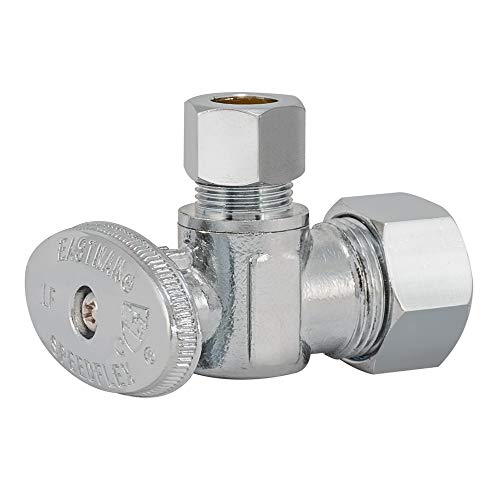
Eastman Quarter Turn Angle Stop Valve — Best Budget Single
Sometimes the job is one toilet, one valve, one Saturday. The Eastman quarter-turn angle stop is that purchase: a single compression valve, 3/8-inch OD outlet on a 5/8-inch OD (1/2-inch nominal) inlet, chrome-plated brass, from Eastman — a fittings maker whose name has been on American plumbing parts for generations. There is no pack economics to weigh and no exotic connection to learn; it is the correct specification for the standard copper stub, in the modern quarter-turn action, at the friendly end of the category’s pricing.
Its place in this guide is deliberate. Multi-packs are value only if the extra valves get used, and push-fit premiums are value only if the installation saving matters to you. For a single, accessible, copper-stub toilet with a confident installer, the Eastman is the rational minimum — everything the job requires, nothing it does not.
Check the current price on Amazon
Strengths
- Correct standard specification from an established fittings brand — the safe single-valve purchase.
- Quarter-turn action replaces the failure-prone multi-turn stem without changing the connection your stub expects.
- Single-pack format suits the one-toilet job without surplus valves gathering dust.
Trade-offs
- Compression connection, with the same torque judgment and sound-stub requirements as the BrassCraft.
- No pack value: a house with four aging stops should buy the four-pack instead of four singles.
- Copper and compression only — threaded and PEX stubs have their own picks in this guide.
| Spec | Detail |
|---|---|
| Inlet | 5/8in OD (1/2in nominal) compression |
| Outlet | 3/8in OD compression |
| Action | Quarter-turn |
| Body | Brass, chrome finish (per Amazon listing) |
The Eastman is also the right answer for the toilet whose valve is being replaced preemptively during another job — a toilet swap, a floor replacement — where the old stop works but its age argues for renewal while the water is already off and the toilet already out. In that moment, a correct, inexpensive, quarter-turn valve is pure insurance, and the discipline of replacing stops opportunistically is what separates houses whose plumbing ages gracefully from houses whose plumbing ambushes them.
Best for: One toilet, one valve, no multi-pack commitment / Not suited for: Whole-house replacements, where a multi-pack serves better

WiseWater Threaded Angle Stop Valve — 1/2 FNPT — Best for Threaded Iron Pipe
Older houses speak a different plumbing dialect: the supply stub behind the toilet is threaded iron pipe, and neither compression nor push-fit fittings have anything to say to it. The WiseWater angle stop is the translation — a heavy-duty quarter-turn valve with a 1/2-inch female pipe thread inlet that screws directly onto the threaded stub, and a standard 3/8-inch compression outlet for the toilet’s supply line. The listing frames it for toilets and bathrooms, in chrome-plated brass, and its heft is the point: threaded joints in old houses appreciate a valve body that does not flex under the wrench.
Threaded work has its own liturgy, and the review should say it plainly: clean the stub’s threads to bright metal, wrap them correctly with PTFE tape or apply pipe dope as the fitting’s instructions direct, and tighten to firm — iron pipe threads seal by wedging, and the feel is different from compression’s bite. Done right, the joint will outlive the valve, which is as it should be in a house that has already outlived several.
Check the current price on Amazon
Strengths
- The only inlet in this guide that serves threaded iron stubs — for the houses that need it, nothing else on the page substitutes.
- Heavy-duty body suits the torque a threaded joint honestly requires.
- Quarter-turn action brings the old house’s shutoff into the modern, positive-sealing era.
Trade-offs
- Threaded installation is the least forgiving here: cross-threading or lazy tape work weeps, and old stubs can crumble if their threads are rotted — inspect before you commit.
- Iron-pipe houses often hide galvanized corrosion upstream; a new valve on a choked stub still delivers a choked supply.
- One-trick fitment: if the house is ever repiped in copper or PEX, this valve retires with its stub.
| Spec | Detail |
|---|---|
| Inlet | 1/2in FNPT threaded |
| Outlet | 3/8in OD compression |
| Action | Quarter-turn |
| Body | Chrome-plated brass, heavy duty (per Amazon listing) |
Buy the WiseWater when the flashlight behind your toilet shows threads, not smooth pipe. It is also the pick for the careful renovator keeping an old house’s plumbing in its original dialect rather than adapting stub by stub. And a word of respect for the situation itself: a threaded stub that has sealed for fifty years deserves a measured hand — support the pipe while you wrench, because the joint you must not break is the one inside the wall.
Best for: Older homes with threaded galvanized or iron supply stubs / Not suited for: Copper or PEX stubs, which want the compression or push-fit picks

EFIELD PEX Angle Stop Valve — 10-Pack — Best for PEX Systems
A PEX-plumbed house replaces its stops in PEX dialect too, and the EFIELD ten-pack is the fleet purchase: angle stops with a 1/2-inch PEX inlet — crimp, clamp or expansion per the fitting’s specification, which the buyer must confirm against their PEX system — a 3/8-inch compression outlet, quarter-turn action and chrome-plated brass bodies. Ten valves is a whole-house number, and that is the intent: PEX houses are usually newer, their stops are usually the same age, and replacing them as a set converts a decade of future drips into one organized weekend.
The PEX inlet deserves its sentence of caution, because PEX is a family, not a fitting: the connection method your house uses — crimp rings, stainless clamps, or expansion sleeves — decides the tool and the exact fitting variant. The listing describes a PEX angle stop; match its connection style to your system and your tool before the pack is ordered, and the job becomes the fastest in this guide, PEX being the most forgiving pipe a homeowner works with.
Check the current price on Amazon
Strengths
- PEX-native inlets for the houses plumbed in PEX — no adapters, no dialect translation at every toilet.
- Ten-pack economics suit the whole-house replacement that same-age stops eventually demand.
- Quarter-turn chrome brass bodies keep the specification modern and uniform across every bathroom.
Trade-offs
- Connection method must match your PEX system and tooling; the pack is only value if the variant is right.
- Ten valves is surplus for a one-toilet job — the Eastman exists for that Saturday.
- PEX work needs its specific tool (crimper, clamp tool or expander); budget it if the house has not already provided one.
| Spec | Detail |
|---|---|
| Inlet | 1/2in PEX |
| Outlet | 3/8in OD compression |
| Action | Quarter-turn |
| Pack | 10 valves (per Amazon listing) |
| Body | Chrome-plated brass |
Choose EFIELD when the house is PEX and the stops are a generation. There is also a systems argument for uniformity worth making once: a house whose every toilet wears the same valve is a house whose owner stocks one spare, knows one mechanism, and can shut any toilet in the dark by feel. Standardization is a maintenance strategy, and a ten-pack is its cheapest form.
Best for: PEX homes doing several bathrooms or a whole-house stop replacement / Not suited for: A single copper-stub toilet, where the pack is surplus

PROCURU PushFit Angle Stop Valve — 2-Pack — Best Push-Fit Value
The PROCURU two-pack splits the difference between the SharkBite single and the fleet packs: push-to-connect quarter-turn stops, rated across copper, PEX, CPVC, PE-RT and HDPE, in a pair sized for the two-bathroom refresh that is most houses’ actual project. The push-fit virtues are the Best Overall pick’s — no torch, no torque judgment, a fitting that releases if the plan changes — and the two-pack simply prices them for the common case, from a fittings brand that competes on exactly this value ground.
The honest comparison with the SharkBite belongs in the open: SharkBite is the category’s defining name, with the deepest retail presence and the longest push-fit record; PROCURU competes as the value alternative with the same connection logic. Behind a toilet — accessible, visible, inspectable — is precisely where a value push-fit earns its place, because the owner can see the joint every time they clean and confirm it is dry with a fingertip.
Check the current price on Amazon
Strengths
- Push-fit speed and forgiveness in a two-pack matched to the most common project size.
- Broad pipe compatibility covers mixed houses — copper in one bathroom, PEX in the addition — with one valve.
- Quarter-turn action and chrome brass body keep the core specification identical to the premium pick.
Trade-offs
- Value-brand support is thinner than SharkBite’s; keep the listing documentation for the fitting’s specifications.
- Push-fit needs its insertion depth and a clean square cut, as with any fitting of the type.
- Two is a project size, not a house size — bigger fleets belong to the EFIELD or BrassCraft packs.
| Spec | Detail |
|---|---|
| Inlet | 1/2in nominal push-to-connect |
| Outlet | 3/8in OD compression |
| Action | Quarter-turn |
| Pack | 2 valves (per Amazon listing) |
Buy the PROCURU pair when the project is exactly what it describes — two bathrooms, one weekend, no torch — and the budget would rather spend its premium elsewhere in the renovation. It is the pragmatic pick, and pragmatism behind a toilet is a virtue: the valve’s job is to disappear and to work the one day in five years it is asked to. Both push-fit picks in this guide understand that job; this one prices it for the pair.
Best for: Two-bathroom refresh projects that want push-fit speed / Not suited for: Buyers who want the SharkBite name and its retail support behind the fitting
Comparison Table
| Pick | Badge | Key spec | Best for |
|---|---|---|---|
| SharkBite Max Angle Stop Valve — 1/2 x 3/8 Compression | Best Overall | Push-to-connect inlet, quarter-turn, 1/2 in x 3/8 in compression outlet (per Amazon listing) | Most homeowners replacing a toilet cutoff valve themselves |
| BrassCraft G2CR19L1X Quarter-Turn Angle Stop — 4-Pack | Best Traditional Compression | Compression inlet 1/2in nom x 3/8in OD outlet, quarter-turn, chrome brass (per Amazon listing) | Copper supply stubs and owners who want the trade-standard valve |
| Eastman Quarter Turn Angle Stop Valve | Best Budget Single | 3/8in OD x 5/8in OD (1/2in nom) compression, quarter-turn, brass, chrome (per Amazon listing) | One toilet, one valve, no multi-pack commitment |
| WiseWater Threaded Angle Stop Valve — 1/2 FNPT | Best for Threaded Iron Pipe | 1/2in FNPT threaded inlet x 3/8in OD compression outlet, quarter-turn (per Amazon listing) | Older homes with threaded galvanized or iron supply stubs |
| EFIELD PEX Angle Stop Valve — 10-Pack | Best for PEX Systems | 1/2in PEX inlet x 3/8in OD compression outlet, quarter-turn, 10-pack (per Amazon listing) | PEX homes doing several bathrooms or a whole-house stop replacement |
| PROCURU PushFit Angle Stop Valve — 2-Pack | Best Push-Fit Value | Push-to-connect 1/2in nom x 3/8in OD compression, quarter-turn, 2-pack (per Amazon listing) | Two-bathroom refresh projects that want push-fit speed |
How to Choose a Cutoff Valve for a Toilet
Identify the stub before anything else. Kneel behind the toilet with a flashlight and classify what emerges from the wall or floor: smooth copper pipe (compression or push-fit), copper with threads cut on it or iron pipe (threaded), flexible colored plastic pipe (PEX — push-fit or PEX-native), or grey/white rigid plastic (CPVC — push-fit). Then measure its diameter: the near-universal residential size is 1/2-inch nominal, which is 5/8-inch outside diameter on copper — the dual naming on several listings in this guide (‘1/2in nominal, 5/8in OD’) describes that same pipe, and confusing the two names is the category’s most common ordering error.
Quarter-turn is not a preference, it is the point
A cutoff valve exists for one moment: the emergency. Quarter-turn ball valves serve that moment because they seal with a ball, not a washer stack; they cannot be left ‘almost closed’; their handle position tells the truth at a glance; and they resist the seizure that disables multi-turn stems left untouched for a decade. Every pick in this guide is quarter-turn for that reason, and any valve you meet that is not — however handsome, however discounted — is the previous generation asking to fail you later. Replace like with better, never like with like.
Match the outlet to the supply line
The toilet side of the valve is the easy half: a 3/8-inch OD compression outlet is the residential standard, matching the flexible supply line that runs to the fill valve. All six picks speak it. If you are replacing the valve, replace the supply line in the same job — the braided stainless lines are inexpensive, their washers age alongside the valve’s, and a new valve feeding a fifteen-year-old line is a job half done. Confirm the line’s toilet-end fitting against your fill valve’s inlet while you are there; it is the third size in the system and the one nobody measures.
Buy the pack your house actually needs
Stops age as a cohort: the house’s toilets were plumbed in the same era, with the same valves, and they will fail in the same decade. Count the toilets before you order. One failing valve in a one-bathroom house is a single; the same failure in a four-bathroom house is a reconnaissance report, and the four- and ten-packs in this guide exist to act on it in one weekend, at one learning curve, with matched valves throughout. The cheapest valve in plumbing is the one bought before the flood, in the pack size the house asked for.
When Should a Toilet Cutoff Valve Be Replaced?
Replace it when it fails any of four tests, and test yours this week. The exercise test: a stop that will not turn, or turns with grinding resistance, is already failed — its emergency has merely not been scheduled. The weep test: moisture, green crust or a mineral trail at the stem or joints means the seal is going. The honesty test: a multi-turn valve that must be closed ‘just so’ to stop the flow is lying about being a shutoff. The opportunity test: any time the toilet is off for another job — a swap, a floor, a fill valve — the stop’s replacement costs minutes inside a job already paid for, and skipping it is the most expensive thrift in plumbing.
Age alone is a fair fifth test. A multi-turn stop of unknown vintage, in a house you intend to keep, is a scheduled replacement on the evidence of the category’s history. The parts in this guide cost little, the work is an hour a toilet at the outside, and the alternative — discovering the valve’s condition at midnight with water rising — costs what floods cost. Few purchases in the house offer that ratio, which is why plumbers replace these valves reflexively and why this guide exists to help owners do the same.
What Do Certifications and ‘Lead-Free’ Actually Mean on a Valve?
A cutoff valve touches drinking water, so its materials are regulated, and the listings in this category carry the vocabulary of that regulation. ‘Lead-free’ in current American plumbing law means the wetted surfaces average no more than a quarter of one percent lead content — the standard every valve sold for potable use must meet, and the reason modern brass valves are a different alloy from their ancestors. When a listing states lead-free compliance plainly, it is confirming the valve belongs in a drinking-water system at all; when it is silent, the buyer should ask, because a valve is a strange place to save the cost of the correct alloy.
Certification marks extend the same logic. Listings in this category variously cite UPC certification and standards such as NSF/ANSI 61 for drinking-water system components — third-party verification that the valve was tested, not merely described. This guide does not treat a certification as a performance ranking: a certified valve and an uncertified one may shut water identically on day one. The difference is accountability over time — materials verified, construction sampled, a standard to be held to. In a part whose whole purpose is to be trustworthy in year ten, that accountability is worth preferring when the choice costs little, and it is one more reason this guide’s picks come from listings that state their specifications instead of implying them.
How to Replace a Toilet Cutoff Valve
A one-valve job with hand tools and a bucket. Work in order, and keep a towel in the bucket’s place of honor — the stub holds a pipe’s worth of water even with the house supply off.
- Shut off the house water main and open a low faucet to drain pressure. Flush the toilet and hold the handle to empty the tank; sponge out what remains.
- Exercise nothing yet — first, photograph the existing valve and stub. The photo is your inlet identification and your before picture in one.
- Disconnect the supply line at the valve outlet with a wrench, bucket beneath: expect the stub’s residual water here.
- Remove the old valve by its connection type: unthread it (supporting the stub pipe against your wrench’s torque), un-nut a compression fitting (hold the valve body with a second wrench), or release a push-fit with its disconnect clip.
- Prepare the stub: clean to bright metal, cut square and deburr if push-fit is going on, verify enough straight stub exists for the new fitting’s grip — compression and push-fit both need their length.
- Fit the new valve per its type: ferrule and nut snugged for compression, threads taped and firm for threaded, pushed to its depth mark for push-fit. Aim the outlet up toward the toilet’s fill valve.
- Connect a new braided supply line, hand-tight plus a measured wrench fraction at both ends — these washers seal by compression, not by force.
- Restore house water slowly, watching the new joints with a dry fingertip and a flashlight. Open the valve, let the tank fill, flush twice, and check again. Then exercise the new valve closed and open once, so its first emergency is not its first movement.
Label the valve with its install date on a tag if your household keeps such records — the next owner, or the future you, will plan better for knowing. Then put the date on the calendar to exercise every toilet stop in the house twice a year: a quarter-turn each way, ten seconds a valve, and the whole system stays honest.
Common Buying Mistakes
Ordering before identifying the stub. Inlet type is the purchase. A compression valve for a threaded stub is not a near miss — it is a return, discovered with the water off and the toilet dry.
Confusing nominal and OD sizes. Half-inch nominal copper measures 5/8-inch across. Listings use both names for the same pipe; buyers who treat them as different sizes order wrong with total confidence.
Reusing the old supply line. The line’s washers aged with the valve. A new valve on a geriatric line is a leak postponed, not prevented — replace both in the same dry hour.
Over-torquing everything. Compression ferrules bite at snug-plus-a-fraction; supply-line washers seal at hand-plus-a-little. Force is how stubs crack and threads strip in finished bathrooms.
Never exercising the new valve. Even quarter-turn valves appreciate movement. Twice a year, every stop, ten seconds each — the cheapest maintenance ritual in the house.
Final Recommendation
For most homeowners the SharkBite Max is the answer: push it on, quarter-turn it, and the toilet has a shutoff worthy of the name. Copper-stub traditionalists should take the BrassCraft — singly in spirit, in the four-pack in practice — and the one-toilet purist the Eastman. Threaded old houses need the WiseWater, PEX houses the EFIELD pack, and the two-bathroom weekend the PROCURU pair. Every one replaces a valve that was going to fail you with one that will not.
Do the flashlight test behind every toilet in the house this week. The stubs will tell you which picks to order, and the calendar — not the flood — will choose the day. That is the entire philosophy of this unglamorous category in one sentence: plumbing rewards the owner who schedules its small jobs, and punishes, with water, the owner who waits for the plumbing to schedule them instead. A quarter-turn valve behind every toilet, exercised twice a year and paired with a fresh braided supply line, is what the scheduled version of your house looks like — quiet, dry, and genuinely ready for the one bad day every toilet in every house eventually has, sooner or later, without exception.
The verified shortlist, with live listings:
- SharkBite Max Angle Stop Valve — 1/2 x 3/8 Compression — Best Overall: Check the current price on Amazon
- BrassCraft G2CR19L1X Quarter-Turn Angle Stop — 4-Pack — Best Traditional Compression: Check the current price on Amazon
- Eastman Quarter Turn Angle Stop Valve — Best Budget Single: Check the current price on Amazon
- WiseWater Threaded Angle Stop Valve — 1/2 FNPT — Best for Threaded Iron Pipe: Check the current price on Amazon
- EFIELD PEX Angle Stop Valve — 10-Pack — Best for PEX Systems: Check the current price on Amazon
- PROCURU PushFit Angle Stop Valve — 2-Pack — Best Push-Fit Value: Check the current price on Amazon
Keep researching the rest of this toilet cluster here: Best Corner Toilets Best Concealed Or Skirted Trapway Toilets Best Compact Toilets Best Designed Toilets Best Concealed Trapway Toilets Best Compact Toilets For Small Bathrooms
Frequently Asked Questions
What size cutoff valve does a toilet need?
In almost every residence: a 1/2-inch inlet on the wall side and a 3/8-inch OD compression outlet on the toilet side. The inlet’s connection type — compression, push-fit, threaded or PEX — depends on your stub, and the inlet’s size is stated two ways that confuse buyers: 1/2-inch nominal and 5/8-inch OD describe the same copper pipe. Every pick in this guide is built to that standard toilet specification; measure your stub’s outside diameter if you are unsure, and match the listing’s language to it.
What is the difference between an angle stop and a straight stop?
Geometry. An angle stop turns the flow 90 degrees, for stubs that emerge from the wall behind the toilet — the overwhelmingly common toilet arrangement, and the subject of this guide. A straight stop runs inline, for stubs that emerge from the floor. Check which way your stub points before ordering: the valves are not interchangeable, and the flashlight test behind the toilet settles it in seconds.
Are quarter-turn valves really better than multi-turn?
For a shutoff’s purpose, yes, decisively. A quarter-turn ball valve seals positively, shows its state by its handle, and resists the seizure and washer decay that disable multi-turn stems left untouched for years. Multi-turn valves earned their place when they were the only option; that era has ended. This guide lists only quarter-turn valves, and recommends replacing multi-turn stops on condition or on opportunity, whichever arrives first — and it will not be the flood, if you act on the advice.
Can I replace a toilet cutoff valve myself?
Most homeowners can, and this guide’s how-to section is the whole job: house water off, tank drained, old valve off by its connection type, new valve on by its own, new supply line, slow refill, dry-fingertip leak check. The skills are wrench control and patience. The legitimate exceptions: a stub too short or damaged for the new fitting, a threaded stub whose threads crumble, or any joint inside the wall that your wrench would stress. Those are plumber calls, and recognizing them is part of doing the job well.
Why is my toilet’s cutoff valve leaking at the handle?
On a multi-turn valve, that is the stem packing dying — the seal around the moving stem, compressed for years, now letting water track out when the valve is operated. Snugging the packing nut sometimes buys time. On any valve, a stem weep is the valve announcing its retirement: it will not heal, and its next stage is leaking unoperated. Treat the weep as the replacement signal it is, and choose the replacement’s inlet from the stub you are about to reveal — the picks in this guide cover every stub you will find.
Should I replace all the toilet valves in my house at once?
If they are the same age and type — and in most houses they are — yes, and the pack picks in this guide exist for exactly that decision. Stops fail as a cohort; the first weeping valve is the cohort’s messenger. One weekend, one learning curve, matched quarter-turn valves behind every toilet, and the exercise ritual twice a year thereafter: that is the whole maintenance philosophy of this category, and it costs less than one emergency call. Houses with a single bathroom can ignore the packs and buy the single — the philosophy scales down as honestly as it scales up.


