Disclosure: airfryerkitchensupply.com is reader-supported. When you buy through links on our site, we may earn an affiliate commission at no extra cost to you.
Where to buy
The fastest way to buy any pick in this guide is through Amazon, where stock, finishes and configurations change often, so check price on Amazon on the product page rather than trusting any number printed elsewhere. These are the six picks in this guide to the best crockpots and slow cookers:
- Crock-Pot 6 Quart Cook & Carry Programmable Slow Cooker — Check on Amazon
- Hamilton Beach Set & Forget 8 Quart Programmable Slow Cooker — Check on Amazon
- Crock-Pot Oval Manual Slow Cooker, 7-Quart Stainless Steel — Check on Amazon
- Ninja PossibleCooker PRO 8.5-qt Multi-Cooker (MC1001) — Check on Amazon
- GreenLife 6 Quart Programmable Slow Cooker (Turquoise) — Check on Amazon
- Crock-Pot Manual Slow Cooker, 3-Quart — Check on Amazon
Every pick in this guide was verified against Amazon catalog data for this site before its link was added, so the model name above is the model you will land on. Slow cooker listings often bundle liners, ladles or little-dipper warmers — check what is in the box on the listing if extras matter to you.
The search for the best crockpots and slow cookers starts with a naming tangle worth clearing up in the first breath: Crock-Pot is a brand, slow cooker is the appliance, and the two words now get used interchangeably for the same stoneware-pot-in-a-heating-base machine. This guide embraces that reality. It compares genuine Crock-Pot models against the strongest rival slow cookers in the same sizes, because what you actually need is the right pot for your household, whichever badge is on the front.
What separates a great slow cooker from a mediocre one is rarely the feature list. It is temperature honesty — a low setting that truly simmers gently instead of boiling, a warm setting that holds food safely without cooking it into mush — plus a pot shape that fits your food, a lid that seals well enough to keep moisture in, and cleanup you will not dread on a weeknight. The six picks below were chosen and ranked on exactly those practical grounds.
Sizes run from a 3-quart small-household pot to an 8.5-quart multi-cooker that can sear on the stove-heat principle inside its own base, so there is a considered option here for singles, families and batch cooks alike. Every pick carries a verified Amazon link in this guide, and each review states plainly who should skip it — because the wrong size is the most common slow cooker regret, ahead of every feature debate.
In this guide
Quick Picks
Six slow cookers spanning the sizes and styles that matter, led by the programmable Crock-Pot most families should buy and stretching to a searing multi-cooker for cooks who want one pot to do everything.
- Crock-Pot 6 Quart Cook & Carry Programmable Slow Cooker — Best Overall. The default recommendation for most families: programmable timing, a locking carry lid, and the 6-quart size that fits real life. Check on Amazon
- Hamilton Beach Set & Forget 8 Quart Programmable Slow Cooker — Best for Large Families. Eight quarts of programmable capacity with flexible time and heat combinations for crowds, holidays and serious batch cooking. Check on Amazon
- Crock-Pot Oval Manual Slow Cooker, 7-Quart Stainless Steel — Best Simple Large Cooker. A dial, an oval stoneware pot and 7 quarts of capacity — the traditional Crock-Pot formula at family size, with nothing digital to fail. Check on Amazon
- Ninja PossibleCooker PRO 8.5-qt Multi-Cooker (MC1001) — Best Multi-Function Slow Cooker. Slow cooks, sears, roasts and steams, with a pot that goes into the oven and then to the table — the one-pot maximalist’s pick. Check on Amazon
- GreenLife 6 Quart Programmable Slow Cooker (Turquoise) — Best Easy-Clean Programmable. A programmable 6-quart with a PFAS-free ceramic nonstick crock that is lighter than stoneware and far easier to wash. Check on Amazon
- Crock-Pot Manual Slow Cooker, 3-Quart — Best for Small Households. The right-sized Crock-Pot for one to three people: soups, small roasts and sides without a cavernous pot cooking them badly. Check on Amazon
If you cook for two, jump straight to the 3-quart pick; if you cook for a crowd or freeze meals, the two 8-quart-class picks are where your shortlist should start.
How These Picks Were Chosen
Picks were limited to dedicated slow cookers and slow-cook-led multi-cookers with removable pots, in the sizes households actually buy: 3, 6, 7 and 8-plus quarts. Pressure cookers appear only in the wider buying discussion, not the pick list, because this search is about slow cooking first.
Each model was verified individually: searched by brand and model through the site’s Amazon catalog connection, matched by its returned listing title, and only then given a purchase link. All six picks in this guide passed that check, so every link here is a confirmed match rather than a hopeful one.
Ranking weighed gentle-heat behavior, timer and keep-warm design, pot material and cleanup, lid fit, shape for real food — roasts, whole chickens, layered casseroles — and footprint. Brand loyalty was treated as a tiebreaker, not a criterion: two of the six picks are Crock-Pot models because they earned it, and four rivals earned their places the same way.
The 6 Best Crockpots and Slow Cookers Reviewed
Each review covers who the cooker suits, three strengths, three trade-offs, its verified key specifications, and a bold verdict. Sizes are stated in every heading’s review so you can compare like with like.
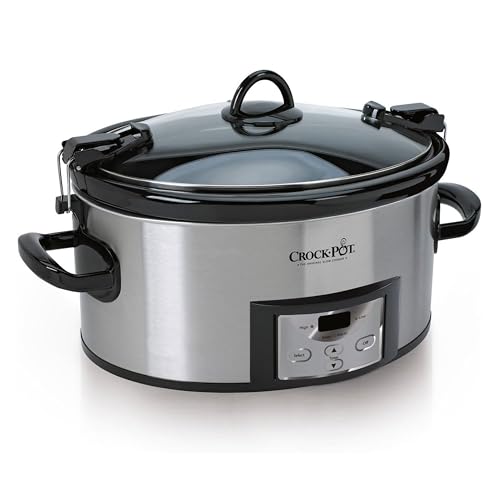
Crock-Pot 6 Quart Cook & Carry Programmable Slow Cooker — Best Overall
If a friend asked which slow cooker to buy and gave no other details, this is the answer. The 6-quart Cook & Carry Programmable covers the center of slow cooking life: big enough for a family stew, a whole chicken or a potluck contribution, small enough to live on a counter, and programmable so dinner can start before you leave and hold warm until you are home.
The locking lid is the feature owners praise most, and it is not a gimmick. It seals for transport — chili to a potluck without a trunk incident — and it also keeps moisture in during long cooks, which is when unlatched lids quietly dry food out. The digital timer counts down and shifts to warm automatically, the behavior that makes slow cooking genuinely hands-off rather than merely slow.
Strengths
- Programmable timer with automatic keep-warm — true set-and-forget cooking
- Locking Cook & Carry lid seals in moisture and travels safely
- 6-quart size fits whole chickens and family stews
Trade-offs
- Stoneware is heavy, especially full and hot
- Stainless exterior shows fingerprints
- No searing function — browning happens in a separate pan
| Spec | Detail |
|---|---|
| Capacity | 6 quarts |
| Controls | Programmable with digital timer |
| Lid | Cook & Carry locking lid |
| Finish | Stainless steel |
This model has anchored the Crock-Pot range for years because it gets the fundamentals right and adds exactly the two features — programming and a locking lid — that change daily use. Rivals beat it on individual tricks, but as a single recommendation for the widest range of kitchens, it remains the one to beat.
Best for: most families who want set-and-forget weekday cooking / Not suited for: households of one or two who rarely cook big
Check on Amazon — check the current price on Amazon before ordering, and confirm the size and finish on the listing match what this review describes.
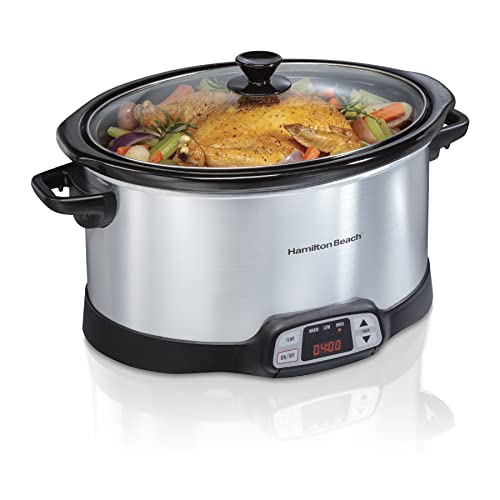
Hamilton Beach Set & Forget 8 Quart Programmable Slow Cooker — Best for Large Families
Some households simply outgrow 6 quarts, and the Set & Forget 8 Quart is built for them. A holiday ham, a double batch of pulled pork for a party, soup for a week of lunches — this is the pot that says yes. Hamilton Beach’s programming is the flexible kind: combine heat and time settings to match the recipe rather than forcing the recipe into fixed programs.
Despite the size, daily manners are good. The stoneware and lid go in the dishwasher, the controls are readable at a glance, and the cooker holds its gentle pace through long cooks instead of creeping hotter the way some big manual models do. For a big-family anchor appliance, it is refreshingly free of drama.
Strengths
- True 8-quart capacity for crowds and batch cooking
- Flexible programming adapts to recipes instead of the reverse
- Dishwasher-safe crock and lid keep cleanup proportionate
Trade-offs
- Large footprint in storage and on the counter
- A lot of pot for small cooks — food spreads thin
- Glass lid does not lock for transport like the Crock-Pot above
| Spec | Detail |
|---|---|
| Capacity | 8 quarts |
| Controls | Programmable; 3 heat and adjustable time settings |
| Pot and lid | Dishwasher-safe stoneware and glass lid |
Choose it when headcount, not features, is your deciding factor. Families of six or more, regular hosts and freezer-stockers will use the capacity weekly; smaller households should take the hint from the trade-offs and size down, because an oversized slow cooker cooks small meals worse, not just less efficiently.
Best for: large families, holiday hosts and batch cooks / Not suited for: small kitchens with limited storage
Check on Amazon — check the current price on Amazon before ordering, and confirm the size and finish on the listing match what this review describes.

Crock-Pot Oval Manual Slow Cooker, 7-Quart Stainless Steel — Best Simple Large Cooker
There is a durable argument for the manual dial: it cannot crash, forget or confuse, and on this 7-quart oval Crock-Pot it drives one of the most useful shapes in slow cooking. The oval pot takes a roast lying flat, a whole chicken without the squeeze, and ribs that would need cutting to fit a round pot. For cooks whose slow cooking centers on big proteins, shape beats programming.
High, low and warm are the whole interface, and the cooker rewards that simplicity with predictable behavior. It is the model to hand to a parent or grandparent who wants slow cooking without a manual-reading session, and the one least likely to be replaced because a control board gave up.
Strengths
- Oval stoneware fits roasts, ribs and whole birds naturally
- Manual dial is foolproof and ages gracefully
- 7 quarts serves eight or more
Trade-offs
- No timer — food waits on warm only if you switch it
- No locking lid for transport
- Basic feature set is the point, but planners should look above
| Spec | Detail |
|---|---|
| Capacity | 7 quarts, oval |
| Controls | Manual dial: high, low, warm |
| Pot | Removable oval stoneware |
Buy it for shape and simplicity. If your cooking is home-based — started in the morning, tended occasionally, served in the evening — the missing timer rarely matters, and the oval pot will please you every single time a roast goes in whole.
Best for: traditionalists who want simple controls and roast-friendly shape / Not suited for: cooks who need a timer while away all day
Check on Amazon — check the current price on Amazon before ordering, and confirm the size and finish on the listing match what this review describes.

Ninja PossibleCooker PRO 8.5-qt Multi-Cooker (MC1001) — Best Multi-Function Slow Cooker
The PossibleCooker PRO attacks slow cooking’s oldest annoyance: the separate browning pan. Its base heats the pot from the bottom and sides, so you sear meat in the cooking pot itself, then slow cook in the fond you just made. The flavor logic is sound and the washing-up logic is even better — one pot, start to finish, and that pot is oven-safe for a crisped finish and handsome enough to serve from.
At 8.5 quarts it is also the biggest cooker in this guide, with an 8-in-1 function set that reaches into roasting and steaming. It is a lot of appliance, and priced and sized accordingly, but for the cook who genuinely uses breadth, it replaces a shelf of single-purpose gear.
Strengths
- Sears in the cooking pot — better flavor, less washing up
- Huge 8.5-quart capacity with an oven-safe, table-ready pot
- Broad function set beyond slow cooking
Trade-offs
- Largest and heaviest pick here; storage is a real question
- Nonstick pot needs gentler utensils than stoneware
- Over-featured for cooks who only ever slow cook
| Spec | Detail |
|---|---|
| Capacity | 8.5 quarts |
| Functions | 8-in-1 including slow cook, sauté, roast, steam |
| Pot | Nonstick, oven-safe to 500°F |
This is the pick for the one-pot enthusiast who browns everything and hates washing pans. Traditionalists should save their money and take the Crock-Pot above; converts rarely go back, because searing in the pot changes both the food and the cleanup math.
Best for: cooks who want to sear, slow cook and serve from one pot / Not suited for: purists who prefer stoneware and simple dials
Check on Amazon — check the current price on Amazon before ordering, and confirm the size and finish on the listing match what this review describes.

GreenLife 6 Quart Programmable Slow Cooker (Turquoise) — Best Easy-Clean Programmable
GreenLife’s proposition is about the pot. Its ceramic nonstick crock is PFAS-free, noticeably lighter than stoneware, and releases the baked-on edges of cheesy, sugary and starchy cooks that make stoneware a soak-and-scrub job. For anyone who has stopped using a slow cooker because of the washing up, that is not a minor feature — it is the whole decision.
Around the pot sits a competent programmable cooker: five modes, delay start for morning prep, keep warm for late dinners, and a family-size 6-quart capacity. The turquoise finish also makes it the pick most likely to be left out on the counter willingly, which sounds trivial until you remember that appliances in cupboards do not cook dinner.
Strengths
- Ceramic nonstick crock cleans with a fraction of stoneware effort
- Lighter pot is kinder to wrists and smaller cooks
- Delay start plus keep warm covers real schedules
Trade-offs
- Nonstick surfaces age faster than stoneware with heavy use
- Lighter pot retains less carryover heat
- Color-led design will not match every kitchen
| Spec | Detail |
|---|---|
| Capacity | 6 quarts |
| Crock | PFAS-free nonstick ceramic, removable |
| Modes | 5 modes with delay start and keep warm |
Choose it when cleanup has been your barrier to slow cooking more often. It matches the Best Overall pick on programming while trading stoneware’s heft for a pot you can wash in a minute — a trade many households will happily make every week.
Best for: cleanup-haters and cooks who lift the pot often / Not suited for: traditionalists who want heavy stoneware heat retention
Check on Amazon — check the current price on Amazon before ordering, and confirm the size and finish on the listing match what this review describes.
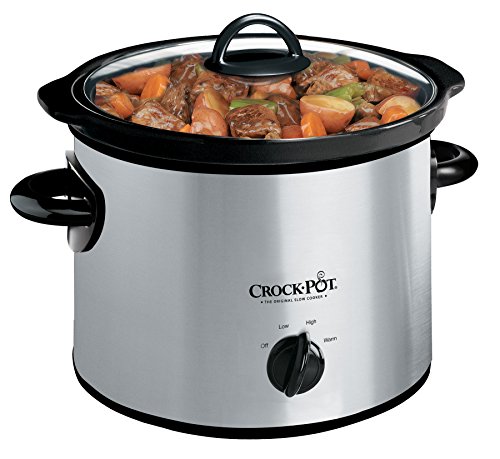
Crock-Pot Manual Slow Cooker, 3-Quart — Best for Small Households
Small households are slow cooking’s underserved market, and this 3-quart Crock-Pot serves them properly. A big cooker half-empty cooks unevenly and dries food at the edges; a 3-quart filled to its working range simmers stews, soups and small roasts the way the recipes intend. It is also the right size for hot dips, sides and oatmeal that would be lost in a family pot.
The formula is classic Crock-Pot: manual dial, removable oven-safe stoneware, warm setting for holding. Nothing to program, nothing to learn, and a footprint small enough for apartments, dorms and RV kitchens where the big picks in this guide simply cannot live.
Strengths
- Correct capacity for one to three servings — better results, not just smaller
- Compact footprint suits small kitchens
- Oven-safe stoneware adds serving flexibility
Trade-offs
- Too small for whole chickens or party batches
- Manual controls only
- Couples who batch cook will outgrow it
| Spec | Detail |
|---|---|
| Capacity | 3 quarts |
| Controls | Manual: high, low, warm |
| Pot | Removable stoneware, oven safe |
If you cook for one or two, this is not the compromise pick — it is the correct pick, and the big models are the compromise. Add it alongside a family cooker for sides and dips, or make it your only cooker and enjoy food that actually fits the pot.
Best for: singles, couples and small side dishes / Not suited for: families or anyone cooking whole chickens
Check on Amazon — check the current price on Amazon before ordering, and confirm the size and finish on the listing match what this review describes.
Comparison Table
Match capacity to headcount first, then choose your control style and pot material. The table compresses the six picks to those deciding factors.
| Pick | Badge | Key spec | Best for |
|---|---|---|---|
| Crock-Pot 6 Quart Cook & Carry Programmable Slow Cooker | Best Overall | 6-quart programmable; digital timer; locking lid | most families who want set-and-forget weekday cooking |
| Hamilton Beach Set & Forget 8 Quart Programmable Slow Cooker | Best for Large Families | 8-quart programmable; flexible time and heat settings | large families, holiday hosts and batch cooks |
| Crock-Pot Oval Manual Slow Cooker, 7-Quart Stainless Steel | Best Simple Large Cooker | 7-quart oval manual; high, low and warm settings | traditionalists who want simple controls and roast-friendly shape |
| Ninja PossibleCooker PRO 8.5-qt Multi-Cooker (MC1001) | Best Multi-Function Slow Cooker | 8.5-quart 8-in-1; oven-safe pot; sear and sauté in-pot | cooks who want to sear, slow cook and serve from one pot |
| GreenLife 6 Quart Programmable Slow Cooker (Turquoise) | Best Easy-Clean Programmable | 6-quart programmable; PFAS-free ceramic nonstick crock; delay start | cleanup-haters and cooks who lift the pot often |
| Crock-Pot Manual Slow Cooker, 3-Quart | Best for Small Households | 3-quart manual; removable oven-safe stoneware | singles, couples and small side dishes |
How to Choose Between Crockpots and Slow Cookers of Different Sizes
Size by the food, not the marketing. Slow cookers work best between half and two-thirds full, so pick the capacity whose working range matches your typical batch: 3 quarts for one to three servings, 6 quarts for families and whole chickens, 7 to 8.5 quarts for crowds, double batches and big roasts. A cooker that is usually a quarter full will dry food and cook unevenly no matter how good it is.
Shape is the second decision. Oval pots fit roasts, ribs and whole birds; round pots suit soups, stews and grains and usually store more compactly. If your signature dishes are proteins, go oval. If they are liquids, go round and save the counter width.
Controls come third. Manual dials are simple, durable and cheap, and they suit cooks who are home to switch to warm. Programmable models with automatic keep-warm are the right choice for anyone whose workday is longer than the recipe — which is most people, and why the programmable picks lead this guide.
Stoneware, Ceramic Nonstick or Metal: Which Slow Cooker Pot Is Best?
Stoneware is the traditional crock: heavy, heat-retentive, oven-safe in most models, and tolerant of decades of use. Its costs are weight and cleanup — baked-on food needs soaking, and a full 7-quart stoneware pot is a genuine lift. Most Crock-Pot and Hamilton Beach picks here use it because it is proven.
Ceramic nonstick, as in the GreenLife pick, trades some longevity and heat retention for dramatically easier washing and a lighter lift, and PFAS-free coatings answer the obvious material question. Metal multi-cooker pots like the Ninja’s add searing and oven finishing that neither ceramic style can match. There is no universal winner — there is the pot that matches the chore you hate most: lifting, scrubbing, or browning in a second pan.
How Long Can Food Safely Stay in a Slow Cooker on Warm?
Keep-warm settings are designed to hold cooked food at a safe serving temperature, and in practice a few hours is the comfortable window for quality as much as safety: textures soften, sauces keep reducing slowly, and delicate foods dry at the edges. Programmable cookers that switch to warm automatically are built for the workday pattern — cook while you are out, hold briefly until you are home.
What warm is not is storage. Refrigerate leftovers within a couple of hours of serving, cool them in shallow containers, and reheat thoroughly rather than re-warming in the cooker from cold, which passes too slowly through the temperature range where bacteria thrive. Treat the slow cooker as a cooking and short-holding tool and it will serve you safely for years.
Manual vs Programmable Slow Cookers: Which Control Style Fits Your Life?
The control question looks like a features question and is actually a schedule question. A manual dial does exactly three things — low, high, warm — and does them for decades without a circuit board to fail. If someone is home to switch the cooker to warm, or your cooks are weekend projects, a manual model like the oval Crock-Pot in this guide loses nothing that matters and gains a kind of permanence digital models cannot promise.
Programmable control earns its place the moment your absence exceeds your recipe. The automatic switch to warm is the whole argument: it converts a cooker that must be rescued at hour six into one that greets you with dinner at hour nine. Digital timers also repeat exactly, which suits cooks who calibrate recipes and expect the same result next month.
The honest middle ground most households land on: programmable for the main family cooker, manual for the second pot — the holiday helper, the dip warmer, the cabin cooker. This guide’s picks are arranged so either philosophy can be followed without leaving the verified list.
What Slow Cooker Recipes Reveal About Pot Shape and Size
Recipes quietly assume a pot, and mismatches explain many disappointments. Soups, stews, chilis and bean dishes are shape-neutral and forgive almost anything within the fill rules. Layered dishes — lasagna, enchilada stacks, casseroles — want width and shallowness, which is why oval and casserole shapes exist. Whole proteins want length: a chicken or roast that lies naturally cooks evenly, while one wedged into a round pot cooks in folds and pockets.
Size writes its own recipes. A pot of chili for two in an 8-quart cooker spreads thin, reduces oddly and overcooks at the edges; the same chili in a 3 or 4-quart sits deep and simmers as intended. This is why this guide insists on the half-to-two-thirds working range and why owning two sizes — a family cooker and a small one — is common among people who slow cook weekly.
Before buying, list your five most-cooked slow dishes and look at them as shapes and volumes. The cooker that fits those five is your cooker, whatever the marketing says, and the comparison table above is organized to make exactly that match.
How to Clean and Maintain Stoneware, Lids and Bases
Slow cookers ask little, but they ask it consistently. Stoneware and ceramic pots want a short soak after starchy or sugary cooks rather than heroic scrubbing; most in this guide are dishwasher-safe, though hand washing keeps glazes and nonstick surfaces younger. Never plunge a hot crock into cold water or set a cold crock into a hot base — thermal shock is the one reliable way to crack stoneware, and it is entirely avoidable with a minute of patience.
Lids deserve the same respect as pots: wash the rim channel where sauce hides, check glass lids for chips at the edge, and on locking models, keep the gasket and clips clean so the seal stays honest. The heating base itself should never be immersed — a damp cloth is the whole routine — and its cord and feet repay a glance each season.
Maintained this way, a slow cooker is one of the longest-lived appliances in a kitchen; the manual models especially can serve for decades. The cost of that longevity is five unglamorous minutes after dinner, which is the best maintenance bargain in cooking.
How Slow Cookers Handle Beans, Grains and Tough Cuts Differently
Three ingredient families explain most slow cooker loyalty. Tough cuts lead: shoulders, shanks and briskets convert their collagen over long, gentle hours into the texture no fast method imitates, and the slow cooker does it unattended. Beans follow — dried beans in a slow cooker emerge creamy and intact, with the cook’s only job being seasoning and patience, though red kidney beans should be boiled vigorously first to neutralize their natural lectins before the gentle cook.
Grains are the quiet third family: steel-cut oats overnight, rice-based casseroles, and barley in soups all thrive on the format’s patience. The pattern across all three is time as an ingredient — the slow cooker trades the one currency modern kitchens lack for results that cannot be hurried, which is why the appliance survives every fashion cycle in kitchen technology.
Slow Cooker Safety: Temperatures, Timers and Common Sense
A slow cooker’s safety story is mostly about temperature discipline. On low and high alike, a properly filled cooker brings food through the lukewarm zone and holds it at a cooking temperature that keeps it safe through the cook; warm then holds it at serving temperature for a reasonable window. The failures come from breaking the assumptions: starting frozen meat, cooking in a nearly empty pot, or holding food warm for most of a day.
Electrical common sense completes the picture: keep the base dry and unimmersed, inspect cords, give the cooker clearance from walls and papers while it runs, and retire any unit with a cracked crock or damaged lid seal. Follow those lines and a slow cooker is among the safest appliances ever sold — millions of unattended dinners are the evidence.
What Size Slow Cooker for Two People Who Entertain?
The straddle household — two people daily, eight at holidays — is the hardest sizing case in this guide, and it has a clean answer: buy for the daily pattern and solve the holiday separately. A 3 or 4-quart cooker will cook fifty weeks of dinners correctly; the family-size cooker bought for Thanksgiving will cook those same dinners badly all year, spread thin and dried at the edges.
For the big days, the solutions are a second batch, a borrowed cooker, or the strategy many experienced hosts use: a small daily cooker plus an inexpensive large manual model kept for events. That two-cooker fleet costs less counter pain than one oversized daily cooker, and each pot works in its proper range whenever it is used.
How to Adapt Stovetop and Oven Recipes for a Slow Cooker
Most braises and stews convert with three adjustments. Liquid goes down: a slow cooker traps evaporation, so reduce added liquid modestly from the oven version and expect the ingredients to contribute the rest. Timing stretches by the familiar exchange — a two-hour oven braise becomes roughly four hours on high or seven to eight on low — with tenderness, not the clock, as the final judge.
Staging is the third adjustment. Dairy, fresh herbs, pasta and quick vegetables enter in the final stretch, as they would burn, dull or dissolve across a full cook. Browning, where the original recipe asks for it, still happens first in a pan — or in the pot itself if you chose the searing Ninja pick. Convert your five favorite braises once, note the results, and you own a personal conversion table no book can give you.
The Slow Cooker Pantry: Ingredients That Reward Patience
Some ingredients exist for this appliance. Dried beans and lentils, split peas, barley and steel-cut oats all convert time into texture money cannot buy quickly. Cheap, collagen-rich cuts — shoulder, shank, chuck, oxtail — are the famous case, but the pantry case is broader: whole spices bloom gently over hours, tomato sauces mellow, and broths extract completely from bones a stockpot would need watching to match.
Stocking for slow cooking is therefore a strategy, not a shopping list: keep the patient ingredients on hand and the appliance turns them into dinner with ten minutes of morning work. That pantry logic is why slow cookers survive every kitchen fashion — they are the only appliance whose best ingredients are also the cheapest.
A Short History of the Slow Cooker — and Why It Refuses to Die
The slow cooker’s shape was set in the 1970s, when the Crock-Pot name attached itself to an older bean-cooker idea and American working households adopted it in a single decade. Its promise then is its promise now: inexpensive ingredients, loaded in the morning, transformed by unattended hours into dinner. Every kitchen fashion since — microwaves, pressure multi-cookers, air fryers — was supposed to replace it, and each instead found its own lane beside it.
The reason is thermodynamic as much as cultural. Gentle, surrounded heat over long hours does specific things to collagen, beans and sauces that faster, hotter methods approximate but never quite copy, and it does them with the least attention of any cooking method ever sold. Digital timers and nonstick pots modernize the edges of that idea in this guide’s picks; the center of it has not needed changing in fifty years, which is the strongest thing that can be said about any appliance design.
One Last Sizing Habit: The Hand Test
Here is the field test experienced cooks use in a store, worth more than any chart: imagine your most-cooked dish inside the pot, at its real volume, and check it would land between the pot’s halfway and two-thirds marks. If your stew would barely coat the bottom, the cooker is too big however good the deal looks; if it would brim, size up without apology.
That ten-second visualization, applied to the six verified picks above, chooses correctly more reliably than capacity charts, serving counts or sale prices — because it starts from your food, which is where every good appliance decision in this program begins.
How to Use a Slow Cooker for Tender Results Every Time
Slow cooking forgives a lot, but a few habits separate melting stews from watery disappointments. These steps apply to every pick in this guide.
- Fill the pot between half and two-thirds full. Underfilled food dries and overcooks at the edges; overfilled food cooks slowly and can bubble over.
- Layer by density: hard root vegetables go at the bottom near the heat, meat above them, and delicate vegetables and dairy toward the end of cooking.
- Keep the lid closed. Every lift releases accumulated heat and steam and can add fifteen to thirty minutes to the cook. Use the lid’s condensation as your window.
- Resist adding extra liquid. Slow cookers trap moisture, so most recipes need less liquid than their stovetop versions; you can always reduce at the end on the stove or with a sauté function.
- Season in two passes: sturdy herbs and spices at the start, fresh herbs, citrus and final salt at the end, when they stay bright instead of cooking dull.
- Rest and hold wisely: switch to warm when the food is done, serve within a comfortable window, and refrigerate leftovers promptly in shallow containers.
Brown meat before it goes in when you have time — the slow cooker will not do it for you (except in searing models like the Ninja pick), and the fond is where stews get their depth. Ten minutes at the start buys flavor that eight hours of simmering cannot invent.
Common Buying Mistakes
These are the errors behind most slow cooker disappointment, in rough order of how often they happen.
- Buying by headline capacity alone. A cooker used quarter-full cooks badly. Match the working range — half to two-thirds of the stated size — to your real batches, not your biggest-ever party.
- Cooking everything on high to save time. High is not simply faster low; tough cuts need the long, gentle conversion that low provides. Rushing brisket or shoulder on high gives you tight, dry meat on schedule.
- Lifting the lid to check. Each peek costs real heat and time. Trust the timer and the recipe; the lid is not a progress bar.
- Adding dairy and fresh herbs at the start. Cream curdles and herbs dull over eight hours. Both belong in the final stretch of cooking.
- Using warm as overnight storage. Warm holds cooked food for a serving window; it is not refrigeration. Cool and chill leftovers properly.
- Skipping the liner-versus-scrub decision. If cleanup is why your cooker sits unused, solve it directly: a nonstick crock, a dishwasher-safe stoneware pot, or liners for the messiest cooks.
Final Recommendation
Most families should buy the Crock-Pot 6 Quart Cook & Carry Programmable: it is the balanced center of this guide on size, programming and transport. Large households step up to the Hamilton Beach Set & Forget 8 Quart, traditionalists and roast cooks take the oval manual 7-quart Crock-Pot, and small households should proudly buy the 3-quart — it will cook their food better than any big pot could.
The two specialists earn their places honestly: the Ninja PossibleCooker PRO for cooks who sear and want one pot from stove-style browning to the table, and the GreenLife programmable for anyone whose slow cooker has been benched by scrubbing. Whichever you choose, every link in this guide was verified to land on the model reviewed.
Shop the verified picks again:
- Crock-Pot 6 Quart Cook & Carry Programmable Slow Cooker (Best Overall) — Check on Amazon
- Hamilton Beach Set & Forget 8 Quart Programmable Slow Cooker (Best for Large Families) — Check on Amazon
- Crock-Pot Oval Manual Slow Cooker, 7-Quart Stainless Steel (Best Simple Large Cooker) — Check on Amazon
- Ninja PossibleCooker PRO 8.5-qt Multi-Cooker (MC1001) (Best Multi-Function Slow Cooker) — Check on Amazon
- GreenLife 6 Quart Programmable Slow Cooker (Turquoise) (Best Easy-Clean Programmable) — Check on Amazon
- Crock-Pot Manual Slow Cooker, 3-Quart (Best for Small Households) — Check on Amazon
Keep exploring the cooker shelf: Best Crockpot Pressure Cookers Best Cuisinart Slow Cookers Best Digital Slow Cookers Best Digital Cookers Best Crockpot Pressure Cookers
Frequently Asked Questions
Are crockpots and slow cookers the same thing?
Functionally, yes. Crock-Pot is a brand name that became the generic word for the appliance; a slow cooker from any brand cooks the same way, with a removable pot in a heated base. This guide compares Crock-Pot models and rival slow cookers side by side on merit.
What size slow cooker is best for a family of four?
Six quarts is the sweet spot: it fits a whole chicken, a family stew or a batch of soup with the pot in its ideal half-to-two-thirds working range. Go to 7 or 8 quarts only if you regularly cook for guests or freeze double batches.
Is a programmable slow cooker worth it over a manual one?
If your day away from home is longer than your recipe’s cooking time, yes — automatic switch to warm prevents overcooking and is the feature that makes slow cooking work for working households. If you are home to tend the pot, a manual dial does the same job for less.
Can I put the stoneware pot in the oven or dishwasher?
Most stoneware crocks in this guide are dishwasher-safe, and several are oven-safe — check the individual model’s listing and manual for its temperature limit, and never put the electric base or lid with non-oven parts in the oven.
Why does my slow cooker food come out watery?
Slow cookers trap nearly all moisture, so recipes need less liquid than stovetop versions. Fill correctly, keep the lid closed, and reduce the sauce at the end if needed. Food cooked in a too-large pot also weeps more as it overcooks at the edges.
How long can I leave food on the warm setting?
Warm is for a serving window of a few hours at most. For safety and quality, refrigerate leftovers within a couple of hours of the meal rather than holding them in the cooker, and reheat them thoroughly in a pot or microwave rather than from cold in the slow cooker.
Can I cook frozen meat in a slow cooker?
Food safety guidance advises against starting frozen meat in a slow cooker, because it can linger too long in the temperature range where bacteria multiply before the cooker catches up. Thaw in the refrigerator first, or use a pressure cooker’s speed for from-frozen cooking instead.
Why is my slow cooker stew watery when the recipe was thick?
Slow cookers trap almost all evaporation, so ingredients release liquid that has nowhere to go. Use a little less added liquid than the stovetop version, keep the lid closed, and thicken at the end — a short simmer with the lid off, or a slurry stirred in for the final half hour.


