Disclosure: airfryerkitchensupply.com is reader-supported. When you buy through links on our site, we may earn an affiliate commission at no extra cost to you.
Where to buy
Every pick in this guide to the best combo grills with smoker was verified against the Amazon catalog before it earned a link. Start here: Char-Griller Texas Trio 3-Burner Gas & Charcoal Grill and Smoker · Oklahoma Joe’s Canyon Combo Dual Fuel Gas and Charcoal Smoker and Grill · Royal Gourmet ZH3006Y 2-Burner Gas and Charcoal Grill Combo with Offset Smoker · Sophia & William 3-Burner Gas and Charcoal Grill Combo with Offset Smoker · Char-Griller Flex Fuel Plus 3-in-1 Gas and Charcoal Grill, Griddle and Smoker Combo · Char-Griller Dual-Function 2-Burner Gas and Charcoal Combination Grill. Prices move with seasons and promotions, so check price on Amazon for each model rather than trusting any number printed elsewhere.
The best combo grills with smoker solve barbecue’s scheduling problem: ribs need five hours of smoke while guests want burgers in fifteen minutes. A combo with a real smoker function, a firebox or a charcoal chamber that holds low temperatures honestly, plus a gas side for everything else, runs both timelines from one station. These six verified picks all smoke genuinely, not as a marketing footnote.
Judge smoker claims skeptically. A lidded charcoal chamber can smoke; a dedicated side firebox smokes better, with the fire separated from the food and room to tend coals without disturbing the cook. The badges below separate those classes clearly, and every pick was confirmed before earning its link. If smoking is your headline and grilling your support act, start at the top of this list and work down.
In this guide
Quick Picks
- Best Overall with Smoker: Char-Griller Texas Trio 3-Burner Gas & Charcoal Grill and Smoker (Model 3070) — hosts who smoke and grill simultaneously. Check price on Amazon.
- Best Pure Smoking: Oklahoma Joe’s Canyon Combo Dual Fuel Gas and Charcoal Smoker and Grill — barbecue craftspeople and brisket devotees. Check price on Amazon.
- Best Value with Smoker: Royal Gourmet ZH3006Y 2-Burner Gas and Charcoal Grill Combo with Offset Smoker — learners and value buyers entering offset smoking. Check price on Amazon.
- Best Mid-Size with Smoker: Sophia & William 3-Burner Gas and Charcoal Grill Combo with Offset Smoker — mid-size patios wanting smoker capability. Check price on Amazon.
- Best for Occasional Smoking: Char-Griller Flex Fuel Plus 3-in-1 Gas and Charcoal Grill, Griddle and Smoker Combo — rotation cooks who smoke occasionally. Check price on Amazon.
- Best Without a Firebox: Char-Griller Dual-Function 2-Burner Gas and Charcoal Combination Grill (Model E5030) — beginners smoking smaller loads. Check price on Amazon.
How These Picks Were Chosen
Verification used Amazon listing data brand-and-model search with title matching. The smoker audit then asked three questions of every candidate: where does the fire live relative to the food, how is temperature held and adjusted over hours, and how much food fits in the smoke path at once? Models whose smoking was purely notional were excluded. Gas-side competence, total capacity and cleaning design broke the remaining ties, because a smoker combo still has to grill dinner on Tuesday.
The 6 Best Combo Grills With Smoker

Char-Griller Texas Trio 3-Burner Gas & Charcoal Grill and Smoker (Model 3070) — Best Overall with Smoker
The Texas Trio’s side firebox makes it the complete package: smoke in the charcoal chamber, grill over gas or charcoal, and a side burner for the beans.
Strengths
- Three cookers in one footprint: gas grill, charcoal grill and offset-style smoker
- Largest total cooking area in this roundup for crowd cooking
- Side burner handles sauces and sides while the main chambers work
Trade-offs
- Very large and heavy footprint that needs a big, level patio
- More chambers means more cleaning and more gaskets to maintain
- Assembly is a long, two-person job
Key specs
- Total cooking area: 1,390 sq. in. (per Amazon listing title)
- Format: 3-burner gas grill + charcoal grill + side firebox smoker (per Amazon listing title)
- Ignition: push-button (per Amazon listing title)
- Extras: side burner and dual temperature gauges (per Amazon listing title)
Its smoking geometry is the classic one: fire in the box, heat and smoke drawn across the food, out the stack. That separation is what lets you tend fuel without opening the cooking chamber and dumping your temperature. With 1,390 total square inches, the chamber swallows party quantities while the gas side handles the fast menu in parallel.
It is the largest and heaviest route into combo smoking, with assembly and upkeep to match. For households that host and smoke in the same afternoon, it remains the single most capable verified answer.
Long-cook logistics favor the Trio: the firebox accepts wood chunks and splits that flavor deeply, the chamber’s capacity lets you smoke for the freezer in batches, and the warming space holds finished cuts while the last items catch up. Its gauges help a single cook supervise smoke and grill simultaneously without phone-timer chaos. For households whose barbecue ambitions are social, feeding people is the point, this is the smoker combo that scales to the ambition.
Best for: hosts who smoke and grill simultaneously / Not suited for: small patios and solo small-batch cooks
Check the current price on Amazon
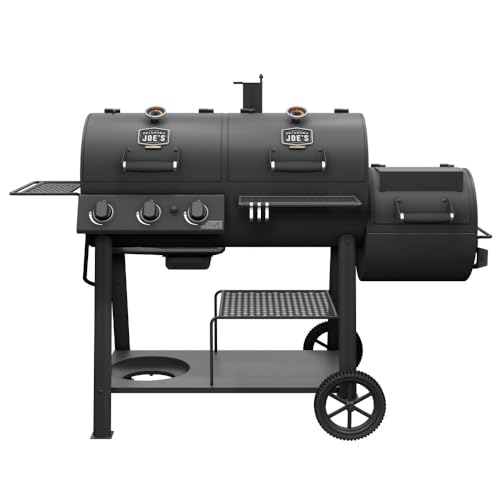
Oklahoma Joe’s Canyon Combo Dual Fuel Gas and Charcoal Smoker and Grill — Best Pure Smoking
Oklahoma Joe’s smoking heritage makes the Canyon the connoisseur’s combo: its charcoal side behaves like the dedicated smokers the brand is known for.
Strengths
- Charcoal side is a genuine smoker, not just a grill with a lid
- Gas side has three burners for better zone control
- Heavy-feeling build in the Oklahoma Joe’s offset tradition
Trade-offs
- Large, heavy unit that is effectively a permanent patio fixture
- Smoker side needs sealing attention and fire management skill
- Takes meaningful time to bring the charcoal side up to temperature
Key specs
- Total cooking area: 1,031 sq. in. (per Amazon listing title)
- Format: 3-burner propane gas side plus charcoal smoker and grill side (per Amazon listing title)
- Brand line: Oklahoma Joe’s combo series (per Amazon listing title)
Everything about the Canyon’s charcoal chamber, its proportions, its venting, its heavy feel, teaches correct fire management. Briskets, pork shoulders and ribs cook the way barbecue literature promises, while the three-burner gas side covers the rest of the menu without compromise.
Offset-style cooking is a craft: small fuel additions, patience, and attention to door sealing. Buyers who want smoke flavor without the craft should look at the side-by-side picks; buyers who want the craft itself have found their grill.
Fuel craft notes: the Canyon’s chamber prefers lump or quality briquettes in modest loads, rewards patience between vent adjustments, and produces its best work in the low-and-slow band where barbecue lives. A water pan steadies its temperatures on long cooks, and a probe at grate level tells the truth its lid gauge approximates. Owners describe a two-cook learning curve followed by repeatability, which is exactly the profile of a real smoker rather than a smoking accessory.
Best for: barbecue craftspeople and brisket devotees / Not suited for: hands-off, set-and-forget cooks
Check the current price on Amazon

Royal Gourmet ZH3006Y 2-Burner Gas and Charcoal Grill Combo with Offset Smoker — Best Value with Smoker
The ZH3006Y puts a real offset firebox on a value-tier dual fuel frame, with a side burner included: the cheapest honest classroom for smoking in this cluster.
Strengths
- Offset smoker adds true low-and-slow capacity to a dual-fuel frame
- Side burner and bottom shelf round out a complete cook station
- Royal Gourmet parts and support are easy to find in this class
Trade-offs
- Offset firebox is compact, so long smokes need frequent small fuel adds
- Total footprint is wide once the firebox is counted
- Charcoal chamber and firebox share ash management chores
Key specs
- Total cooking area: 1,020 sq. in. (per Amazon listing title)
- Total output: 34,000 BTU dual fuel including side burner (per Amazon listing title)
- Format: gas and charcoal chambers plus offset smoker (per Amazon listing title)
Its firebox is compact, which defines its style: shorter fuel cycles, more frequent small additions, excellent learning feedback. Ribs, chickens and pork shoulders fit its rhythm beautifully; overnight briskets demand dedication. The gas side and side burner keep the rest of the meal effortless meanwhile.
For the price of admission to true offset smoking, with Royal Gourmet’s support behind it, nothing else verified here competes. Measure the full width before ordering; the firebox counts.
Budget smoking has a hidden curriculum, and the ZH3006Y teaches it cheaply: fire sizing, vent discipline, and the spritz-and-wrap rhythm of ribs. Its compact firebox forgives beginners by making small errors small, and its gas side guarantees dinner even while the lesson is in progress. Add Royal Gourmet’s parts availability and the package becomes the rational first offset for anyone unwilling to buy a dedicated smoker before knowing they love the craft.
Best for: learners and value buyers entering offset smoking / Not suited for: overnight, unattended brisket cooks
Check the current price on Amazon
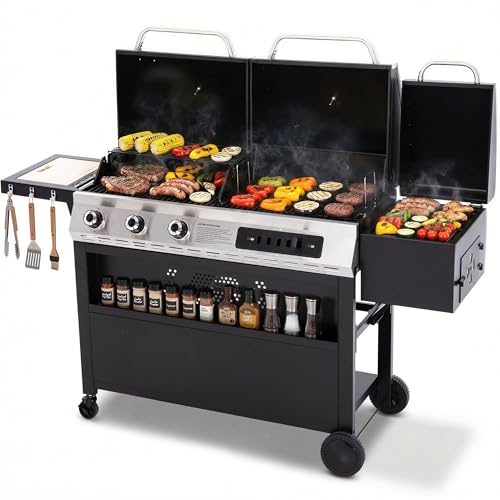
Sophia & William 3-Burner Gas and Charcoal Grill Combo with Offset Smoker — Best Mid-Size with Smoker
Three gas burners, a charcoal side and an offset smoker in 840 square inches: the Sophia & William combo is the capability-dense mid-size option.
Strengths
- Three gas burners give the best gas-side zone control in this group
- Offset smoker included without jumping to the largest footprints
- Sized for events without overwhelming a mid-size patio
Trade-offs
- Newer brand name with a shorter track record than legacy grill makers
- 840 sq. in. is total area, split across chambers
- Smoker firebox is modest for very long brisket cooks
Key specs
- Total cooking area: 840 sq. in. (per Amazon listing title)
- Format: 3-burner gas side plus charcoal side with offset smoker (per Amazon listing title)
- Build positioning: heavy duty (per Amazon listing title)
Its appeal is compression: most of the Texas Trio’s technique list in a noticeably smaller footprint. The gas side zones properly with three burners, and the smoker handles weekend projects without demanding a second appliance or a bigger patio.
The brand is newer, so keep documentation and expect a shorter track record than the legacy names. On hardware and layout, it earns its badge in a crowded field.
The Sophia & William’s smoker sits in the size class most families actually smoke in: a rack or two of ribs, a shoulder, a chicken, without heating a cavern. Its three-burner gas side is the strongest in this guide’s mid-size class, so the grill never feels like the smoker’s apology. For households graduating from indirect smoking on a kettle, it is the natural next step that also upgrades every weeknight.
Best for: mid-size patios wanting smoker capability / Not suited for: buyers prioritizing long brand history
Check the current price on Amazon
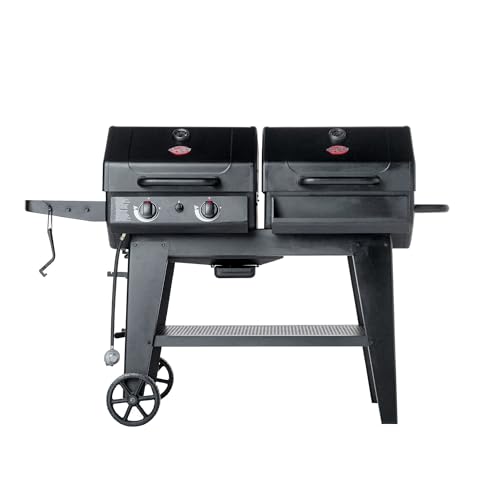
Char-Griller Flex Fuel Plus 3-in-1 Gas and Charcoal Grill, Griddle and Smoker Combo — Best for Occasional Smoking
The Flex Fuel Plus smokes as one of four modes, grill, griddle, charcoal and smoke, making it the pick for cooks who smoke monthly rather than weekly.
Strengths
- Griddle insert adds smash burgers, breakfast and teppanyaki-style cooking
- Three cooking modes in one station: grill, griddle and smoke
- Char-Griller ecosystem of covers and parts is widely available
Trade-offs
- Griddle insert stores separately when the grill grates are in use
- Jack-of-all-trades layout means no single mode is class-leading
- Switching modes mid-cook takes planning and heat management
Key specs
- Total output: 30,000 BTUs (per Amazon listing title)
- Format: gas and charcoal grill with flat top griddle insert and smoker function (per Amazon listing title)
- Model: CG30281224 (per Amazon listing title)
Occasional smokers need a different bargain: smoking that works well when called on, without a firebox dominating the design the rest of the year. The Flex’s smoker function, layered on its charcoal side, delivers ribs and chicken convincingly, while the griddle insert wins the other weekends.
Dedicated weekly smokers will outgrow its smoking depth; the Canyon and Trio exist for them. For the rotation cook, this is the efficient allocation of one footprint.
Occasional smoking has its own technique here: use the charcoal side with a two-zone fire, wood chunks on the coals, food indirect, and the lid’s vents cracked to draw smoke across. Results on ribs and chicken genuinely impress guests who assume a dedicated smoker was involved. The rest of the month, the griddle insert and gas side carry the menu, which is the correct workload distribution for a monthly smoker and the reason this pick exists.
Best for: rotation cooks who smoke occasionally / Not suited for: weekly, high-volume smokers
Check the current price on Amazon

Char-Griller Dual-Function 2-Burner Gas and Charcoal Combination Grill (Model E5030) — Best Without a Firebox
No firebox, no problem: the E5030’s charcoal chamber smokes smaller loads the indirect way, and it is the simplest route in this guide.
Strengths
- True side-by-side layout: gas on one side, charcoal on the other
- Mid-size footprint suits ordinary patios better than the biggest combos
- Charcoal side doubles as a small smoker with the lid down and vents managed
Trade-offs
- Each chamber is modest, so very large cooks must be split
- Two fuel systems mean two sets of upkeep
- Charcoal tray height adjustment is basic compared with premium charcoal grills
Key specs
- Total cooking area: 870 sq. in. (per Amazon listing title)
- Gas output: 24,000 BTU across 2 burners (per Amazon listing title)
- Format: side-by-side propane gas and charcoal chambers (per Amazon listing title)
Indirect smoking here means coals banked to one side, food on the other, lid down, vents steering temperature. Ribs, whole chickens and sausages emerge properly smoked, and the technique teaches the fundamentals every smoker owner should know. The gas side meanwhile stays completely free.
Capacity and long-cook stability are the limits: this is hours-long smoking of modest loads, not brisket marathons. As the entry point that also happens to be a superb everyday dual fuel grill, it is hard to beat.
Indirect smoking technique, perfected on the E5030, transfers to every grill you will ever own: banked coals, a drip pan doubling as a water pan, food over the cool side, and temperature steered by the intake vent. Its chamber size keeps cooks honest and small, which for learning is a feature. Many owners smoke happily at this level for years; those who catch the brisket bug graduate to the firebox picks with skills already installed.
Best for: beginners smoking smaller loads / Not suited for: large brisket and whole-packer cooks
Check the current price on Amazon
Comparison Table
| Pick | Badge | Key spec | Best for |
|---|---|---|---|
| Char-Griller Texas Trio 3-Burner Gas & Charcoal Grill and Smoker (Model 3070) | Best Overall with Smoker | 1,390 sq. in. (per Amazon listing title) | hosts who smoke and grill simultaneously |
| Oklahoma Joe’s Canyon Combo Dual Fuel Gas and Charcoal Smoker and Grill | Best Pure Smoking | 1,031 sq. in. (per Amazon listing title) | barbecue craftspeople and brisket devotees |
| Royal Gourmet ZH3006Y 2-Burner Gas and Charcoal Grill Combo with Offset Smoker | Best Value with Smoker | 1,020 sq. in. (per Amazon listing title) | learners and value buyers entering offset smoking |
| Sophia & William 3-Burner Gas and Charcoal Grill Combo with Offset Smoker | Best Mid-Size with Smoker | 840 sq. in. (per Amazon listing title) | mid-size patios wanting smoker capability |
| Char-Griller Flex Fuel Plus 3-in-1 Gas and Charcoal Grill, Griddle and Smoker Combo | Best for Occasional Smoking | 30,000 BTUs (per Amazon listing title) | rotation cooks who smoke occasionally |
| Char-Griller Dual-Function 2-Burner Gas and Charcoal Combination Grill (Model E5030) | Best Without a Firebox | 870 sq. in. (per Amazon listing title) | beginners smoking smaller loads |
How to Choose the Best Combo Grills With Smoker: Firebox or Indirect?
A side firebox separates fire from food, letting you tend fuel without opening the chamber, and suits long, large cooks. Indirect smoking in a charcoal chamber suits smaller loads and shorter sessions, with simpler hardware and easier cleaning. Choose by your real smoker menu: monthly ribs and chicken point to indirect-capable dual fuels; regular briskets and shoulders point to a firebox. Then check chamber sealing, vent quality and grate space in the smoke path, the three details that decide whether the badge on the box survives contact with a five-hour cook.
What Can You Actually Smoke in a Combo Grill?
Ribs, pork shoulder, whole chickens, sausages, salmon and vegetables all thrive in these chambers. Whole packer briskets fit the larger firebox models; smaller chambers prefer flats or points cooked separately. Cheese and nuts cold-smoke with the right setup on the charcoal side. The honest boundary is volume and duration: combo smokers excel at family-scale barbecue, and caterers should look at dedicated smokers for capacity.
How Do You Hold Low Temperatures on a Combo Smoker?
Small fires, added little and often, beat big fires choked down. Start with less charcoal than instinct suggests, steer with the intake vent in small movements, and wait ten minutes between adjustments, because chamber temperatures lag. Keep a water pan in the chamber to buffer swings, and track temperature at grate level rather than trusting any single lid gauge. These habits, more than hardware tier, separate tender results from dry ones.
How to Smoke Ribs on a Combo Grill, Step by Step
1. Set the fire: light a small charcoal fire in the firebox, or bank coals to one side of the charcoal chamber for indirect models. 2. Stabilize at a low, steady cooking temperature and wait until the smoke runs thin and pale rather than thick and white. 3. Season ribs, place them bone-side down in the smoke path, and close the lid. 4. Tend in small cycles: check hourly, add small fuel amounts, spritz if the surface dries. 5. Wrap when the bark is set and the color is deep mahogany, then finish until a probe slides in tenderly. 6. Rest wrapped before slicing. Meanwhile the gas side grills corn, burgers for the impatient, and anything else the party demands, which is the entire point of owning this format.
Common Buying Mistakes
Believing every smoker label: check where the fire actually lives. Buying a firebox model for a patio it cannot fit, firebox included in the width. Expecting set-and-forget behavior from an offset design. Judging a smoker by its first cook, when sealing and vent behavior improve as you learn the unit. Forgetting a probe thermometer, the one accessory that makes low-and-slow repeatable. And smoking only twice a year on a smoker-first grill when an indirect-capable dual fuel would have served better.
How Does Combo Smoking Compare with a Dedicated Smoker?
Dedicated offsets and cabinet smokers win on capacity, fuel efficiency over very long cooks and temperature stability. Combo smokers win on everything else in a household’s life: one footprint, gas convenience for daily cooking, and no second appliance to store and maintain. For the overwhelming majority of home barbecue, family ribs, shoulders and chickens, a good combo’s smoker is not a compromise at all. It only becomes one at competition volume, which is a fine problem to graduate to later.
Wood Selection for Combo Smokers: A Practical Guide
Match wood to meat and to your chamber’s temperament. Oak is the reliable all-rounder, steady heat and medium smoke for beef and pork. Hickory is stronger, classic on ribs and shoulders, easy to overdo in small chambers, so use one chunk fewer than instinct says. Fruitwoods, apple and cherry, are gentler and sweeter, ideal for poultry, ribs and salmon, and forgiving for beginners. Mesquite burns hot and assertive, best reserved for short, high-flavor cooks. In fireboxes, splits and large chunks sustain coals; in chambers, chunks on charcoal are the controllable unit. Whatever you choose, burn clean: thin, pale smoke flavors food, while thick white smoke from a smothered fire coats it in bitterness.
How to Plan a Smoke Day Around a Combo Grill
Work backwards from serving time. Shoulders and briskets start early or the night before on firebox models; ribs need an afternoon; chickens and sausages fit a morning. Build the rest of the menu onto the gas side’s timeline: sides that grill in the final hour, breads in the final minutes, and a holding plan, the warming rack or a low chamber, for finished items. Assign one person to the fire and let everyone else enjoy the party; the combo format’s gas side exists precisely so the pitmaster is not also the short-order cook. Finish with the closing ritual: burn off, brush, and ash out when cold, so the next smoke day starts clean.
Troubleshooting Combo Smoker Problems
Problem: temperature will not rise. Check fuel quantity and ash blockage first, then open the intake vent and wait ten full minutes before adjusting again. Problem: temperature runs away. Close the intake in small steps, confirm the fire is not oversized, and add a water pan. Problem: bitter food. Your fire is smothered; burn smaller and cleaner, with better airflow and fully lit fuel. Problem: smoke leaks everywhere except the stack. Check door fit and gasket condition, and accept that some leakage is normal on value models while sealing improves with use and seasoning. Nearly every smoker complaint is a fire-management complaint in disguise, which is good news: the fix is skill, and skill is free.
How Do You Manage a Long Smoke Without Living Beside the Grill?
Preparation is the whole secret. Start with a stable fire and a full hour of temperature steadiness before food goes on; a chamber that has held its number for an hour will hold it for three. Use a reliable probe thermometer with a grate-level sensor so checks happen from the kitchen, not the patio. Batch your interventions: fuel, spritz and inspection in one lid opening, not three. Keep the gas side ready to finish or hold food if the fire misbehaves late. And choose your battles: ribs and chickens forgive a social afternoon; a brisket asks for a quieter one. Combo owners who plan this way host parties and smoke simultaneously, which is the lifestyle the format advertises.
What Is the Difference Between Smoking, Barbecuing and Grilling on a Combo?
Grilling is fast cooking over direct high heat: steaks, burgers, chops. Barbecuing is the broad church of outdoor cooking, but in its strict sense means low-and-slow cooking with smoke: ribs, shoulders, briskets. Smoking is the technique at barbecue’s heart, exposing food to wood smoke at controlled low temperatures over time. A combo grill with smoker capability performs all three without moving appliances, which is why its owners’ menus widen so quickly. Knowing the words matters practically: recipes, times and temperatures assume them, and a cook who confuses grilling times with smoking times ruins good meat with a clear conscience.
How Much Wood Smoke Is Too Much?
When the food tastes like an ashtray instead of a campfire’s memory, the fire was dirty or the dose was heavy-handed. Clean smoke, thin and pale blue, comes from a small, hot, well-oxygenated fire; it flavors in hours without bitterness. White, billowing smoke comes from smothered, freshly added fuel and should be allowed to settle before food meets it. In small combo chambers, one or two chunks at a time is the disciplined dose, refreshed as they exhaust. Restraint is the master skill of smoking, and combo chambers, being compact, teach it faster than cavernous offsets that forgive excess.
Can You Cold Smoke on a Combo Grill?
Yes, with care, and it is the format’s party trick: cheese, nuts, salmon and even butter, smoked with a pellet tube or a small maze as the only heat source, the chamber acting purely as a smoke box on a cool day. Keep ambient temperatures low, keep the food on the chamber’s far side from the smoke source, and ice trays beneath delicate items in borderline weather. Food safety rules tighten as temperatures drop into the danger zone’s neighborhood, so follow established cold-smoking guidance for times and temperatures, especially with fish. Done properly, a winter afternoon of smoked cheese justifies the smoker badge all by itself.
How Do You Choose Between Ribs, Shoulder and Brisket for Your Chamber Size?
Match the cut to the chamber’s honest capacity in the smoke path, not its total area. Ribs are the universal fit: flat, forgiving and portionable, they smoke beautifully in every pick here. Pork shoulder is the value champion, tolerant of temperature wander and generous in yield, ideal for learning a new firebox. Brisket is the examination: long, space-hungry and unforgiving of a fire that needs constant correction, best attempted on the firebox models once your vent discipline is proven on shoulders.
Cooking in that order, ribs, shoulder, brisket, is the curriculum combo smokers teach best, and each success funds the confidence for the next. Skipping to brisket on day one is how smokers acquire their unfair reputation for difficulty.
What Does Smoke Do to Different Meats, Hour by Hour?
In the first hours, smoke adheres and the surface dries into the pellicle that becomes bark; this is when clean smoke matters most. In the middle hours, fat renders, connective tissue softens, and the meat passes through the stall, that long plateau where patience is the only technique. In the final hours, tenderness arrives gradually and then completely, and the probe, not the clock, gives the verdict.
Combo chambers compress none of this chemistry; they only ask the cook to tend a smaller fire more attentively. Understanding the hours makes the tending feel like participation rather than labor, which is the difference between smokers who quit and smokers who host.
How Should You Rest and Hold Smoked Meat on a Combo Station?
Resting is cooking’s final act: large cuts want thirty minutes to two hours wrapped and held warm, during which juices redistribute and tenderness completes. The combo station is built for this: the gas side, off or at its lowest, becomes a holding oven; the warming rack keeps ribs while sides grill; a cooler lined with towels serves as the classic faux cambro for shoulders.
Plan the hold into the schedule rather than discovering it at serving time, and smoke days stop ending in a scramble. Guests taste the difference as calm: food that arrives sliced, rested and ready, from a cook who was present at their own party.
What Are the Best Side Dishes to Cook Alongside the Smoker?
Assign them by timeline. Long companions, beans and cabbage-based dishes, can share the smoke’s early hours in pans at the chamber’s edge on firebox models. Medium companions, corn, peppers and onions, grill over the charcoal side’s direct zone or the gas side while the meat rests. Fast companions, breads and glazes, take the final ten minutes of gas heat. The side burner, where fitted, owns sauces and keeps the whole choreography on one station.
This division of labor is the combo-with-smoker’s deepest advantage: not that it smokes, but that dinner assembles around the smoking without a kitchen full of competing pans.
How Do You Know Your Combo Smoker Is Improving With Age?
Seasoning is visible: interior surfaces darken, doors seat more snugly, temperature responses grow familiar and then predictable. A well-used combo smoker holds its band with fewer corrections in month six than in week one, partly the equipment settling, mostly the cook learning its dialect. Keep a simple log, fuel load, vent positions, weather, results, and the improvement becomes measurable rather than mythical.
When the log shows repeatability, you have graduated from owning a smoker to operating one, and the firebox picks in this guide will carry that skill as far as your appetite for barbecue extends.
How Do You Smoke in Wind, Rain and Cold?
Wind is the chief thief: it feeds the fire unevenly and strips chamber heat, so position the smoker’s intake away from the gusts, shield the unit with a windbreak that respects clearances, and expect higher fuel use. Rain cools lids and tests resolve; a pop-up canopy over, never touching, the station keeps the cook dry and the fire honest. Cold weather lengthens everything and rewards smaller, denser fuel loads and lids that stay shut.
The combo’s gas side is the bad-weather insurance policy: when a smoke day collapses meteorologically, the meat can finish over controlled gas heat with its smoke already aboard, and dinner survives the forecast. Purists may object; hosts with guests arriving at six will not.
What Is the Stall, and How Should a Combo Cook Handle It?
Large cuts plateau for hours as evaporative cooling balances the fire’s input, a phenomenon called the stall, and it has ended more barbecue schedules than any equipment failure. The responses are patience, or the wrap: enclosing the cut in foil or butcher paper with a splash of liquid pushes through the plateau while trading a little bark texture for hours of time. Combo chambers, being modest, stall-manage well because their fires are responsive and their cooks are usually close at hand.
Plan serving times around the stall rather than despite it: start earlier than feels necessary, hold finished meat warm in the combo’s quiet side, and let the schedule absorb what physics insists on. Barbecue is done when it is done; the combo simply gives you somewhere graceful to wait.
How Should You Slice, Sauce and Serve Smoked Meat?
Slice against the grain, always, and only as much as the moment needs, because cut surfaces dry while whole muscles wait patiently. Sauce is a finish, not a cooking medium: glaze in the final minutes over heat, serve the rest warm at the table, and let the meat’s bark and smoke argue their own case first. Resting, covered and unhurried, is the difference between juices on the board and juices in the bite.
Serving from the combo station keeps the theater intact: the board beside the grill, the gas side still warm for bread, the smoker’s last wisps perfuming the patio. It is the ending the format was built to deliver, and it never gets old for the cook performing it.
What Does a Second Season of Combo Smoking Add?
Ambition, mostly: the first brisket attempted without fear, the first cold-smoked cheese, the first holiday bird smoked while the kitchen oven handles everything else. Technique consolidates too: vent movements become smaller, fires cleaner, logs shorter because the results speak. Many owners add exactly one accessory in season two, a quality probe system, and exactly one habit, cooking an extra shoulder for the freezer whenever the fire is lit anyway.
By the third season the combo smoker is simply how the household barbecues, its firebox as familiar as the kitchen range. That normalization, expertise disguised as routine, is the destination every pick in this guide was chosen to reach.
How Do You Smoke for a Crowd Without a Second Smoker?
Choose cuts that portion from one cook: a shoulder pulled for sandwiches feeds more people per chamber than any arrangement of individual cuts, and ribs can be cooked in two waves, the first held warm on the gas side while the second finishes. Stagger the menu so the smoker’s output lands in courses rather than all at once, and let the gas side carry the continuous items, corn, sausages, burgers for the impatient, that keep a crowd fed while the headline meat rests.
Hosts who plan this way discover the combo’s party arithmetic: one smoker chamber, properly sequenced, feeds a gathering that would defeat a larger single-purpose smoker with no second act.
What Is the Best First Smoke on a New Combo?
Pork shoulder, and it is not close. It tolerates temperature wander, forgives imperfect fire management, announces its doneness clearly, and yields a mountain of forgiving, delicious food that can be held, reheated and sauced to order. Ribs are the second cook, teaching timing and the wrap; chicken is the third, teaching restraint with smoke. Brisket graduates last, when the fire obeys you.
That sequence is the difference between a smoker that becomes a household institution and one that becomes a cautionary garage ornament. The picks in this guide were chosen to teach it kindly.
The Smoker Combo Verdict, Restated Plainly
Buy the firebox if smoking is your headline, the indirect chamber if it is your hobby, and the multi-mode model if it is your occasional pleasure, and let the gas side carry your ordinary dinners in every case. Verify the configuration in plain words, season the chamber before the first real cook, and tend small, clean fires with patience.
Do that, and the combo with smoker delivers the thing its buyers actually dream about: barbecue that tastes like a specialist made it, from a station that also made Tuesday’s dinner.
How Do You Smoke Fish and Delicate Foods on a Combo?
Gently, briefly and with the mildest wood you own. Fish takes smoke quickly and punishes excess, so run the chamber at its lowest stable temperature, use a single fruitwood chunk, and keep sessions short, checking texture rather than worshipping times. A water pan buffers both heat and dryness, and a clean grate or a cedar plank keeps delicate fillets intact through the cook.
The gas side plays its part at the finish: a thirty-second sear for skin or a glaze, after the smoke has done its quiet work. Delicate smoking is where the combo’s two-system control stops being a convenience and becomes a technique in itself.
What Should a Smoker Log Contain, and Why Bother?
Date, cut, fuel load, vent positions, weather, the stall’s timing, wrap decision and the result in one honest sentence. Six lines per cook. The log converts anecdotes into adjustments: you stop re-learning that your firebox runs hot in wind, because page three already knows it. It also protects good results, which are otherwise impossible to repeat exactly, from becoming folklore.
Every respected pitmaster keeps some version of this record; combo owners who adopt it in their first season compress years of folklore into months of data. It is the cheapest expertise in this entire guide.
One Last Word Before You Order
Measure the patio with the firebox counted, choose the smoker class your menu honestly needs, and put the first shoulder on the calendar before the grill arrives, because a dated first cook turns a delivery into a beginning. Season the chamber, log the cook, and expect the second attempt to be visibly better than the first; that slope is the hobby’s engine.
The six verified picks here span every honest route into combo smoking, from an indirect chamber that teaches the fundamentals to fireboxes that satisfy a brisket habit. Whichever you choose, you are buying weekends of a particular quality: unhurried, smoky and shared. Few purchases return that as reliably.
Final Recommendation
Pick the Texas Trio for parallel party cooking, the Canyon for pure smoking craft, the ZH3006Y for value with a firebox, the Sophia & William for mid-size density, the Flex Fuel Plus for occasional smoking, and the E5030 for simple indirect smoking. Browse the rest of the cluster: Best Combo Grills · Best Combo Barbeque Grills · Best Combo Fuel Grills · Best Combo Gas Grills · Best Combo Grills Under $500
Frequently Asked Questions
What makes a combo grill good for smoking?
A fire path that separates the fire from the food, vents that adjust in fine increments, a chamber that seals reasonably, and enough grate space in the smoke stream for your typical load.
Firebox or indirect: which should a beginner choose?
Indirect in a dual fuel chamber is simpler and cheaper to learn on. A firebox is the better long-term tool for frequent, large smokes. Many owners start indirect and upgrade when briskets become a habit.
Can I smoke and grill at the same time?
Yes, and it is the format’s party trick: the smoker runs low and slow on one side while the gas side grills fast items, so long and short menus finish together.
How long does smoking take on a combo grill?
Similar times to a dedicated smoker for the same food: ribs take hours, shoulders most of a day. Combo chambers may need slightly more frequent fuel attention on long cooks.
What wood should I use in a combo smoker?
Chunks rather than chips for charcoal chambers and fireboxes: oak and hickory for pork and beef, apple and cherry for poultry and ribs when you want a gentler smoke.
Do I need to season a new smoker chamber?
A seasoning burn, coating interior surfaces lightly with oil and running a medium fire empty, protects the steel and burns off manufacturing residues. Do it before the first real cook.


