Disclosure: airfryerkitchensupply.com is reader-supported. When you buy through links on our site, we may earn an affiliate commission at no extra cost to you.
Where to buy
Every pick in this guide to the best combo grills was verified against the Amazon catalog before it earned a link. Start here: Char-Griller Texas Trio 3-Burner Gas & Charcoal Grill and Smoker · Oklahoma Joe’s Canyon Combo Dual Fuel Gas and Charcoal Smoker and Grill · Char-Griller Dual-Function 2-Burner Gas and Charcoal Combination Grill · SPIRE 30-Inch Built-In 5-Burner Dual Fuel Grill · Char-Griller Flex Fuel Plus 3-in-1 Gas and Charcoal Grill, Griddle and Smoker Combo · Royal Gourmet ZH3006Y 2-Burner Gas and Charcoal Grill Combo with Offset Smoker. Prices move with seasons and promotions, so check price on Amazon for each model rather than trusting any number printed elsewhere.
This is the flagship guide to the best combo grills: the six strongest verified models across every combo format, dual fuel side-by-sides, triple cookers with smoker boxes, grill-and-griddle stations and a premium built-in. If you read one combo guide, read this one; the sibling guides in this cluster then go deeper on fuel type, smokers and budget.
A combo grill is a bet on flexibility: that your cooking will range wider than any single-fuel grill can follow. The bet pays when both systems are genuine, and fails when one side is a token. Every pick below passed the same test verification and a weak-side audit: each system in each unit can carry a real meal on its own. Ranked by overall ownership satisfaction, here is the class of 2026’s combo field as it stands on Amazon today.
In this guide
Quick Picks
- Best Overall: Char-Griller Texas Trio 3-Burner Gas & Charcoal Grill and Smoker (Model 3070) — one-grill households that cook everything outside. Check price on Amazon.
- Best for Smokers: Oklahoma Joe’s Canyon Combo Dual Fuel Gas and Charcoal Smoker and Grill — barbecue-focused cooks who also need gas. Check price on Amazon.
- Best Mid-Size: Char-Griller Dual-Function 2-Burner Gas and Charcoal Combination Grill (Model E5030) — typical families on typical patios. Check price on Amazon.
- Best Built-In: SPIRE 30-Inch Built-In 5-Burner Dual Fuel Grill — outdoor kitchen builders and coastal homes. Check price on Amazon.
- Best Grill and Griddle Combo: Char-Griller Flex Fuel Plus 3-in-1 Gas and Charcoal Grill, Griddle and Smoker Combo — menu-rotating households and flat-top fans. Check price on Amazon.
- Best Value with Smoker: Royal Gourmet ZH3006Y 2-Burner Gas and Charcoal Grill Combo with Offset Smoker — budget buyers who want to learn smoking. Check price on Amazon.
How These Picks Were Chosen
Verification came first: brand-and-model searches, title matching, and links only for confirmed ASINs. Then the audit: per-chamber cooking area rather than headline totals, gas zoning, charcoal airflow and ash handling, smoker authenticity where claimed, griddle quality where fitted, grate materials, and cleaning design. Format diversity was intentional: the best combo for a smoker, a tailgater and an outdoor-kitchen builder are different machines, and the badges say so.
The 6 Best Combo Grills

Char-Griller Texas Trio 3-Burner Gas & Charcoal Grill and Smoker (Model 3070) — Best Overall
Across all formats, the Texas Trio remains the combo to beat: gas, charcoal and a firebox smoker in one 1,390 square inch station with a side burner besides.
Strengths
- Three cookers in one footprint: gas grill, charcoal grill and offset-style smoker
- Largest total cooking area in this roundup for crowd cooking
- Side burner handles sauces and sides while the main chambers work
Trade-offs
- Very large and heavy footprint that needs a big, level patio
- More chambers means more cleaning and more gaskets to maintain
- Assembly is a long, two-person job
Key specs
- Total cooking area: 1,390 sq. in. (per Amazon listing title)
- Format: 3-burner gas grill + charcoal grill + side firebox smoker (per Amazon listing title)
- Ignition: push-button (per Amazon listing title)
- Extras: side burner and dual temperature gauges (per Amazon listing title)
Overall winners should disappear into your cooking life, handling Tuesday and the Fourth of July with the same competence. The Trio does: quick gas dinners, charcoal-flavored weekends, genuine smoking, and parallel cooking for crowds. Its dual gauges and generous chambers mean one cook can run a full barbecue service without a second appliance or a helper.
Size and upkeep are the standing costs, and assembly is a project. But measured over seasons of varied cooking, no other verified combo covers as much ground. This is the benchmark the rest of the cluster is judged against.
Benchmark status brings benchmark scrutiny, so note the Trio’s finer points: dual temperature gauges positioned for their respective chambers, a firebox that accepts splits and chunks comfortably, and warming space that keeps finished food in the game during long services. Its charcoal side doubles as a second grill for overflow, a trick party cooks use constantly. No rival in the verified field matches its parallel capacity, which is why dethroning it requires more than a longer feature list.
Best for: one-grill households that cook everything outside / Not suited for: small patios and frequent movers
Check the current price on Amazon
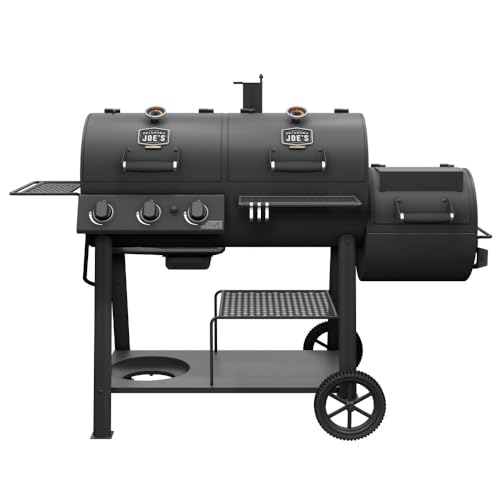
Oklahoma Joe’s Canyon Combo Dual Fuel Gas and Charcoal Smoker and Grill — Best for Smokers
Oklahoma Joe’s Canyon Combo is the pick when smoking is a first-class requirement rather than a party trick.
Strengths
- Charcoal side is a genuine smoker, not just a grill with a lid
- Gas side has three burners for better zone control
- Heavy-feeling build in the Oklahoma Joe’s offset tradition
Trade-offs
- Large, heavy unit that is effectively a permanent patio fixture
- Smoker side needs sealing attention and fire management skill
- Takes meaningful time to bring the charcoal side up to temperature
Key specs
- Total cooking area: 1,031 sq. in. (per Amazon listing title)
- Format: 3-burner propane gas side plus charcoal smoker and grill side (per Amazon listing title)
- Brand line: Oklahoma Joe’s combo series (per Amazon listing title)
Its charcoal side descends from dedicated offset smokers, so heat and smoke behave the way barbecue books describe. The three-burner gas side is no garnish either, with zoning that suits daily cooking. Together they form the most barbecue-serious combo in the field.
Fire management is a skill this grill expects you to build, and its weight makes it a fixture. For the buyer whose weekend identity involves brisket, that expectation is the appeal, not the warning.
The Canyon rewards a specific owner: the cook who reads fire the way others read recipes. Its charcoal chamber responds predictably to vent changes, holds low temperatures with the steadiness barbecue requires, and produces bark and smoke rings that make guests ask questions. The gas side’s three burners are its weeknight insurance policy. If your identity as a cook is trending toward barbecue, this is the combo that grows with you longest before you start eyeing a dedicated offset.
Best for: barbecue-focused cooks who also need gas / Not suited for: set-and-forget beginners
Check the current price on Amazon

Char-Griller Dual-Function 2-Burner Gas and Charcoal Combination Grill (Model E5030) — Best Mid-Size
The E5030 is the combo most households should actually buy: two real cookers, side by side, in a patio-friendly footprint at 870 square inches.
Strengths
- True side-by-side layout: gas on one side, charcoal on the other
- Mid-size footprint suits ordinary patios better than the biggest combos
- Charcoal side doubles as a small smoker with the lid down and vents managed
Trade-offs
- Each chamber is modest, so very large cooks must be split
- Two fuel systems mean two sets of upkeep
- Charcoal tray height adjustment is basic compared with premium charcoal grills
Key specs
- Total cooking area: 870 sq. in. (per Amazon listing title)
- Gas output: 24,000 BTU across 2 burners (per Amazon listing title)
- Format: side-by-side propane gas and charcoal chambers (per Amazon listing title)
Mid-size is where combo design is hardest, because every inch is contested, and the E5030 spends its inches wisely: adult chambers, independent lids, workable grates. It lacks a firebox and a side burner, and in exchange it stays simple, proportionate and easy to live with daily.
If your cooking is family dinners plus weekend projects for up to eight people, this is the sweet spot of the entire category, and the sibling guides in this cluster keep returning to it for that reason.
Why the mid-size badge matters: most combo disappointment comes from buying a giant that dominates the patio and intimidates weeknight use, or a toy that cannot feed guests. The E5030 threads that needle with adult chambers in a footprint that leaves the patio livable. Its parts ecosystem, grates, covers, igniters, is the deepest in this guide relative to price, which quietly guarantees a long, repairable life. It is the recommendation given to friends, and it anchors this flagship list accordingly.
Best for: typical families on typical patios / Not suited for: hosts of very large events
Check the current price on Amazon

SPIRE 30-Inch Built-In 5-Burner Dual Fuel Grill — Best Built-In
The SPIRE 30-inch is the premium outlier: 304 stainless, five burners, 63,000 BTU, a ceramic rear burner and interior lighting, built for outdoor kitchen islands.
Strengths
- 304 stainless construction is a genuine step up in corrosion resistance
- Ceramic rear burner suits rotisserie cooking in an outdoor kitchen
- Interior lighting and electronic ignition are premium, practical touches
Trade-offs
- Built-in format requires an island cutout and professional planning
- Premium tier positioning, well above cart-style combos
- Dual fuel refers to gas-type flexibility, not a charcoal chamber
Key specs
- Total output: 63,000 BTU across 5 burners (per Amazon listing title)
- Cooking space: 904 sq. in. (per Amazon listing title)
- Build: all 304 stainless steel body, ceramic rear burner, interior lighting (per Amazon listing title)
Built-in combos play a different game: permanence, finish and integration. The SPIRE’s all-304 stainless body resists coastal and poolside corrosion that destroys painted steel, its rear ceramic burner enables rotisserie cooking, and its lighting extends the cooking day. Its dual fuel claim is gas-type flexibility, propane or natural gas planning, which suits fixed installations perfectly.
It needs an island cutout, utility planning and a premium budget. For buyers building a permanent outdoor kitchen, it is the only pick here speaking that language fluently.
Built-in ownership differs in kind: the SPIRE becomes architecture. Its 304 stainless shrugs off coastal salt and pool chemistry, its ceramic rear burner turns rotisserie chicken into a weekly routine, and its interior lighting makes winter evening cooking civilized. Installation planning, cutout dimensions, gas type, ventilation and clearances, is the real work of buying it, and should be done with the island builder before the order. Done right, it is a fifteen-year appliance, not a seasonal grill.
Best for: outdoor kitchen builders and coastal homes / Not suited for: cart-grill buyers and renters
Check the current price on Amazon
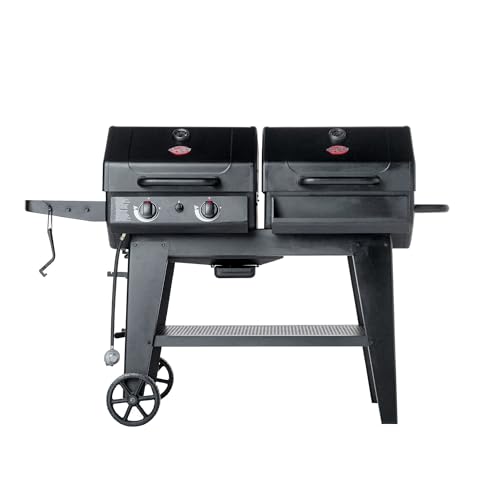
Char-Griller Flex Fuel Plus 3-in-1 Gas and Charcoal Grill, Griddle and Smoker Combo — Best Grill and Griddle Combo
Char-Griller’s Flex Fuel Plus rotates grill, griddle and smoker modes through one dual fuel station, the broadest menu coverage per footprint here.
Strengths
- Griddle insert adds smash burgers, breakfast and teppanyaki-style cooking
- Three cooking modes in one station: grill, griddle and smoke
- Char-Griller ecosystem of covers and parts is widely available
Trade-offs
- Griddle insert stores separately when the grill grates are in use
- Jack-of-all-trades layout means no single mode is class-leading
- Switching modes mid-cook takes planning and heat management
Key specs
- Total output: 30,000 BTUs (per Amazon listing title)
- Format: gas and charcoal grill with flat top griddle insert and smoker function (per Amazon listing title)
- Model: CG30281224 (per Amazon listing title)
Its griddle insert is the headline: it converts the station into a flat top for the foods grates do worst, eggs, smash burgers, fried rice, delicate fish. Remove it and you are back to gas and charcoal grilling, with a smoker function for ribs. Few single purchases cover breakfast through brisket this completely.
Mode-switching takes forethought and storage for the insert. Households that truly rotate menus weekly will forgive that instantly; single-mode specialists should buy their specialist tool instead.
The Flex Fuel Plus earns its place through menu mathematics: households tracking their actual cooking find griddle sessions rivaling grill sessions once a flat top exists, because breakfast, burgers and stir-fries migrate outside. The insert’s storage is the only friction, solved by a deck box or garage hook. Char-Griller’s accessory tail, covers cut for the model, replacement grates, protects the investment. For the rotation cook, it converts one patio corner into a four-instrument kitchen.
Best for: menu-rotating households and flat-top fans / Not suited for: single-technique specialists
Check the current price on Amazon

Royal Gourmet ZH3006Y 2-Burner Gas and Charcoal Grill Combo with Offset Smoker — Best Value with Smoker
The ZH3006Y delivers the triple format, gas, charcoal and offset smoker, plus a side burner, at a value tier: 1,020 square inches and 34,000 BTU.
Strengths
- Offset smoker adds true low-and-slow capacity to a dual-fuel frame
- Side burner and bottom shelf round out a complete cook station
- Royal Gourmet parts and support are easy to find in this class
Trade-offs
- Offset firebox is compact, so long smokes need frequent small fuel adds
- Total footprint is wide once the firebox is counted
- Charcoal chamber and firebox share ash management chores
Key specs
- Total cooking area: 1,020 sq. in. (per Amazon listing title)
- Total output: 34,000 BTU dual fuel including side burner (per Amazon listing title)
- Format: gas and charcoal chambers plus offset smoker (per Amazon listing title)
Value triples usually cut the firebox or the side burner; keeping both makes this the most complete budget route into offset smoking. Royal Gourmet’s support footprint in this class adds ownership confidence that no-name triples cannot match.
The compact firebox demands attentive fueling on long cooks, and the full width needs measuring. As a learning platform for barbecue with gas convenience included, it is the strongest value in the flagship field.
Value triples live or die on whether the firebox is real, and the ZH3006Y’s is: sized for genuine offset flow, with the charcoal chamber receiving smoke across its full width. Expect to feed it small loads frequently and to learn its vents over two or three cooks, after which ribs become routine. The side burner and bottom shelf complete a station that, tier for tier, has no business offering this much. It is the flagship list’s value conscience.
Best for: budget buyers who want to learn smoking / Not suited for: hands-off cooks on long smokes
Check the current price on Amazon
Comparison Table
| Pick | Badge | Key spec | Best for |
|---|---|---|---|
| Char-Griller Texas Trio 3-Burner Gas & Charcoal Grill and Smoker (Model 3070) | Best Overall | 1,390 sq. in. (per Amazon listing title) | one-grill households that cook everything outside |
| Oklahoma Joe’s Canyon Combo Dual Fuel Gas and Charcoal Smoker and Grill | Best for Smokers | 1,031 sq. in. (per Amazon listing title) | barbecue-focused cooks who also need gas |
| Char-Griller Dual-Function 2-Burner Gas and Charcoal Combination Grill (Model E5030) | Best Mid-Size | 870 sq. in. (per Amazon listing title) | typical families on typical patios |
| SPIRE 30-Inch Built-In 5-Burner Dual Fuel Grill | Best Built-In | 63,000 BTU across 5 burners (per Amazon listing title) | outdoor kitchen builders and coastal homes |
| Char-Griller Flex Fuel Plus 3-in-1 Gas and Charcoal Grill, Griddle and Smoker Combo | Best Grill and Griddle Combo | 30,000 BTUs (per Amazon listing title) | menu-rotating households and flat-top fans |
| Royal Gourmet ZH3006Y 2-Burner Gas and Charcoal Grill Combo with Offset Smoker | Best Value with Smoker | 1,020 sq. in. (per Amazon listing title) | budget buyers who want to learn smoking |
How to Choose the Best Combo Grills: The Complete Framework
Work through five questions in order. One: which systems do you need, gas, charcoal, smoker, griddle, and in what priority? Two: what is your largest single-chamber cook, since that, not total area, sizes the grill? Three: what are your patio’s true dimensions including lid swing and firebox width? Four: what is your maintenance temperament, honestly, because combos reward five-minute habits and punish neglect? Five: what does the five-year cost look like including cover, fuel and eventual grates? A grill that survives all five questions is your grill, regardless of badges, including ours.
Are Combo Grills Worth It Compared with Separate Grills?
Run the honest comparison. Two dedicated cookers win on per-system capacity and specialization, and lose on space, duplicate accessories and total cost. One combo wins on footprint, convenience and price, and concedes some capacity in each chamber. Households with big patios and big crowds lean separate; the majority, with real patios and mixed menus, get more cooking done per dollar and per square foot from a good combo. The six above are the combos that make that case convincingly.
What Size Combo Grill Do You Need?
Size by your largest regular cook, not your largest imaginable one. Two to four people live happily in the 690 to 870 square inch class. Families and regular hosts of eight to twelve belong in the 1,000-plus class. Beyond that, the Texas Trio’s parallel chambers matter more than raw area, because party cooking is a scheduling problem as much as a space problem. Renting or borrowing for the one annual giant event is cheaper than owning a giant you feed propane to all year.
How to Set Up a Combo Grill Station That Actually Works
Place the grill on a level, non-combustible surface with safe clearance from walls, railings and overhangs, and room behind for lid swing. Keep fuels staged separately and safely: propane connected and leak-checked, charcoal in a dry sealed bin, never stored under a hot firebox. Set a work triangle: grill, a landing surface for raw and cooked food on separate trays, and tools within one step. Add lighting for evening cooks and a lidded metal bin for ash. Finally, run a full burn-off and a thermometer check across the grates before the first real meal, mapping hot spots while nothing is at stake. A well-set station makes the combo’s flexibility feel effortless; a cramped one makes every cook a negotiation.
Common Buying Mistakes
Shopping the headline area instead of chamber sizes. Assuming smoker on the box means offset capability. Forgetting delivery dimensions and gate widths. Buying the griddle combo for charcoal flavor, or the charcoal combo for breakfast menus: match the second system to your menu, not your fantasy. Skipping the cover and the ash bin, the two cheapest longevity items in the category. And judging by first-cook performance: combos have learning curves, and week six is the honest review date.
Combo Grills and resale, parts and longevity
Mainstream brands hold a practical advantage that rarely appears in feature lists: grates, burners, igniters and covers remain available for years, and a used combo from a known maker resells because the next owner can still maintain it. When comparing a feature-rich newcomer against a slightly plainer legacy model at the same tier, that parts tail is a real, monetizable difference. It is one reason this flagship list leans on established lines for its top badges while still badging genuine value where newcomers earned it on hardware.
The History of the Combo Grill, Briefly and Usefully
Combo grills emerged because American outdoor cooking split into two religions: gas convenience and charcoal flavor, and most households quietly practiced both. Early combos were crude, a gas grill with a charcoal box bolted on, and earned the format a mediocre reputation. The current generation, represented by every pick in this guide, fixed the formula with independent chambers, real fireboxes, griddle integration and honest zoning. Understanding that arc explains the market’s price spread: you are paying for how completely the second system was engineered, not for the word combo on the box.
How Combo Grills Perform in Each Season
Spring is combo season’s opening argument: fast gas dinners return to the patio while weekends rediscover charcoal. Summer belongs to parallel cooking, smokers running while gas handles the crowd. Autumn favors the charcoal and smoker sides, low sun and low-and-slow cooking made for each other, while the gas side roasts the sides. Winter separates owners: the gas side’s push-button reliability keeps outdoor cooking alive in cold climates, especially under a cover-kept, well-maintained station, while charcoal becomes the deliberate weekend ritual. A format that gives every season its own reason is a format that earns its footprint all year.
What to Cook on Each System: A Combo Menu Map
Gas owns speed and precision: weeknight chicken, burgers for a crowd, vegetables, fish and anything sauced late. Charcoal owns flavor and crust: steaks, chops, chicken skin, corn and anything that benefits from a live fire’s kiss. The smoker owns time: ribs, shoulders, briskets, whole birds and salmon. The griddle owns the flat foods: smash burgers, breakfast, cheesesteaks, fried rice and delicate items that grates swallow. Keep this map on the refrigerator door for the first season and the combo’s logic becomes instinct; after that, you will break the rules creatively, which is the other point of owning one.
How Do Combo Grills Compare with Pellet Grills and Kamados?
Pellet grills trade fuel flexibility for automation: set a temperature and walk away, with wood flavor as the medium rather than the event. Kamados are charcoal instruments of remarkable efficiency and heat range, but single-fuel and heavy. Combos answer a different question: not the best smoke or the easiest smoke, but the widest menu from one footprint. Households that entertain variably, grilling, smoking, griddling across a month, usually land on combos; households devoted to one discipline land on its specialist. There is no universal winner, only the match between a household’s actual calendar and a format’s honest strengths, which is the standard this flagship guide applied throughout.
What Does a Combo Grill Do to a Patio’s Social Life?
It centralizes it. One station becomes the hearth around which the evening organizes: the cook is present rather than exiled to a distant grill, guests drift toward the fire, and the menu’s variety gives everyone a dish to claim as theirs. Hosts consistently underestimate this effect when comparing specification tables, and consistently cite it afterward as the purchase’s real return. Size your patio layout for it: room for two or three people to stand with the cook, a surface for drinks that is not the grill’s shelf, and lighting that flatters both food and faces after dark.
How Should You Budget the Total Combo Grill Purchase?
Price the project, not the box. The grill itself, a fitted cover, a chimney starter and ash bin for charcoal models, basic tools per system, an instant-read thermometer, the first season’s fuel for both systems, and delivery or assembly time if you value yours. That honest total usually lands modestly above the grill’s ticket, and planning it prevents the two classic disappointments: a great grill weathering uncovered for want of a small accessory budget, and a first party under-equipped. It also frames the format’s value correctly, because the comparison is against two complete single-fuel setups, not one.
What Trends Are Shaping the Next Generation of Combo Grills?
Three are visible in today’s listings. Griddle integration keeps expanding, as flat-top cooking pulls combo design toward breakfast-and-burger versatility. Fit and finish are climbing at the value tier, enamel, stainless lids and pull-out cleaning systems migrating down from premium models, as several picks in this guide show. And modularity is rising: inserts, interchangeable surfaces and accessory ecosystems that let one frame change jobs across seasons. Buyers today benefit from all three trends at once, which is why the current verified field, judged strictly, is the strongest the format has ever fielded at these tiers.
How Does the Flagship Field Divide by Household Type?
Small households and small patios belong to the E5030 and its mid-size kin: full format, modest shadow. Growing families and social households belong to the Texas Trio’s class, where parallel chambers turn parties from logistics into cooking. Barbecue devotees belong to the Canyon, where the smoker is the point and the gas is the support. Builders of permanent outdoor kitchens belong to the SPIRE, and menu maximalists to the Flex Fuel Plus.
Notice what the flagship field does not contain: a bad grill. At this level of the market, the verified differences are fit, not quality, which is why this guide spends its words on matching rather than ranking by decimal points. Your household type is the specification that matters most.
What Is the Combo Grill’s Answer to the Weeknight Problem?
The weeknight problem is time pretending to be a cooking problem: thirty usable minutes, hungry people, no desire for a project. The combo’s answer is a gas side that lights instantly and a layout the cook knows by muscle memory, with the second system simply absent that evening, costing nothing, demanding nothing. Flexibility that charges rent on busy nights would be a bad bargain; the combo’s second system waits silently until the weekend, which is exactly right.
This is also why mid-size combos outsell giants in satisfaction: the giant’s ceremony taxes weeknights, while the mid-size disappears into routine and expands only when asked. Judge every flagship pick against your Tuesdays before your Fourths of July.
How Do You Compare Combo Grills Across Brands Fairly?
Normalize three numbers first: per-chamber area, not totals; burner count on the gas side, not bundled BTU; and total width as installed, not as boxed. Then compare the intangibles that listings hide: grate material, cleaning access, cover existence, and parts listings for the exact model. Finally, weight the second system’s authenticity by your menu’s actual demand for it.
Run any two finalists through that normalization and the apparent chaos of the category resolves into a short, honest list, which is the exercise this entire cluster of guides performed on the current Amazon field to arrive at these six.
What Separates a Good Combo Review From a Marketing Page?
Three tells. It names the weak side of every pick, because every combo has one and honesty about it is the review’s whole value. It distinguishes configurations in words, gas-charcoal versus gas-griddle versus built-in, rather than letting the word combo blur them. And it verifies the products exist as described, through a catalog source, before linking them, which this program does for every ASIN in the guide.
Hold every buying guide you read, including this one, to those tells. The category’s marketing is loud; the cooking, done well, is quiet, specific and repeatable, and your guide should sound like the cooking.
Where Should a Buyer Start Reading in This Cluster?
Start here, with the flagship six and the badges that match your household. Then read the one specialist guide that matches your strongest interest: fuel mechanics, gas-first cooking, smokers, or the budget tier, because those guides rotate the same verified field through a single lens and will sharpen, not replace, this overview’s verdict. Readers who do that arrive at a decision in two sittings with no residual doubt about what the second system in their grill actually is.
That is the cluster’s design: one flagship map, four specialist lenses, zero invented products. However you enter it, you exit knowing your grill.
How Does the Flagship Verdict Change for Coastal, Desert and Cold Climates?
Coastal buyers should weight corrosion resistance above every other flagship quality: enamel finishes, stainless hardware and, at the premium end, the SPIRE’s 304 body move from luxuries to necessities within sight of salt air. Desert buyers should weight dust discipline and cover quality, because grit in dampers and burners is the local failure mode, and should favor enclosed storage for charcoal. Cold-climate buyers should weight the gas side’s authority and the lid’s insulation behavior, and expect the charcoal side to become a fair-weather pleasure rather than a January tool.
The flagship six were chosen to contain a climate answer for each of those regions, which is part of what flagship means here: not the six most expensive, but the six whose strengths cover the map of real ownership conditions.
What Is the Combo Grill’s Place in a Household That Already Owns a Smoker?
A complementary one, if the smoker is a specialist you love: the combo becomes the daily and party grill, its own smoker function demoted to overflow and small jobs, which it performs without firing the big unit. If the smoker is an unloved appliance gathering dust, the combo is its replacement and its upgrade, consolidating three footprints into one and returning patio space to the humans.
The honest question is frequency. A smoker used monthly earns its floor space beside a combo; a smoker used twice a year is a storage problem that a firebox-equipped combo, the Trio or the ZH3006Y, quietly solves by absorbing its job.
How Should You Read Owner Reviews of Combo Grills?
Filter for time and specificity. Reviews written after a season outweigh launch-week enthusiasm; reviews describing a specific cook, a failure and a fix outweigh adjectives. Weight complaints about assembly separately from complaints about cooking, because they describe different products: the Saturday you build it and the years you use it. And discount any review, rapturous or furious, that never mentions which system the owner actually cooks on, because in this category the configuration is the experience.
This guide’s own method mirrors that filter: verified existence through the API, configuration stated plainly, weak sides named, and badges tied to use rather than to superlatives. It is the standard to hold every source to, this one included.
What Would Make You Regret a Combo Grill Purchase?
Almost never the cooking. Regret arrives as logistics: a unit too wide for its patio corner, a firebox that crowds the door swing, a giant whose ceremony taxes weeknights until it stands unused, a budget model whose ash system makes cleaning a grievance. Every one of those regrets is a measurement or honesty failure at purchase time, which is why this flagship guide returns relentlessly to dimensions, menus and maintenance temperament.
Run the five questions in the buying framework one final time before ordering, with a tape measure physically in hand, and the flagship field contains no regrets, only fits.
How Does the Flagship List Serve a Reader in a Hurry?
By badge, honestly. Overall: the Texas Trio. Smoking: the Canyon. Everyday balance: the E5030. Permanence: the SPIRE. Menu breadth: the Flex Fuel Plus. Value with a smoker: the ZH3006Y. A hurried reader who matches one badge to one household fact, patio size, menu or ambition, will buy well from this list without reading another paragraph, and the depth below the badges exists for the readers who want to verify the match themselves.
That is the flagship guide’s contract: the shortcut and the evidence, in the same document, either sufficient alone.
What Single Habit Separates Happy Combo Owners From the Rest?
They clean as they go, in the small currencies the format accepts: ash out when cold, grates brushed while hot, grease tray checked monthly, cover on when the cook ends. Five minutes distributed across a cook replaces the grim Saturday overhaul that teaches owners to dread their own grill, and dread is the true beginning of disuse.
Every other success factor in this guide, fuel craft, sequencing, menu planning, compounds on top of that one habit. The flagship picks were chosen partly for how little friction their designs put between the owner and it.
The Flagship Verdict, Restated Plainly
The combo grill is the correct default purchase for a household that cooks outside in more than one way, and the current verified field is the strongest the format has offered: real second systems, honest cleaning design and support tails that promise years rather than seasons. Choose by household and menu from the six above, verify the live details on the listing, and maintain the five-minute habits.
Do that, and the grill disappears into your cooking life in the best possible way: not as equipment you manage, but as the place dinner comes from, most nights, in every season, for years.
How Should You Introduce a Combo Grill to a Household That Grills Rarely?
Lower the activation energy until cooking outside is easier than ordering in: keep the gas side fueled and covered by the door, a small kit of tools living at the station, and two or three house recipes so rehearsed they need no thought. Use the second system monthly at first, a charcoal Sunday, a griddle breakfast, so it becomes a rhythm rather than an event requiring planning.
Frequency follows friction, and friction is a design problem the owner controls. The flagship picks minimize it structurally, honest ignition, reachable cleaning, sane footprints, but the household’s habits finish the job. Rarely-grilling households do not need a smaller grill; they need a closer one.
What Is the Combo Grill’s Resale and Upgrade Story in Practice?
Mainstream combos in maintained condition sell quickly in local marketplaces, because the next owner inherits a parts-supported, two-system instrument at a used price, an easy yes. The upgrade path inside the format is equally gentle: households move from mid-size to triple as their entertaining grows, or from cart to built-in as a patio becomes a project, and the old unit funds the new one partially rather than decorating a garage.
Both stories depend on the same two choices made at purchase: a brand with a support tail, and care that keeps the unit presentable. The flagship list is, in that sense, also a resale list, which value-minded readers should weigh alongside the badges.
One Last Word Before You Order
The flagship field in this guide was assembled slowly: every model verified through the catalog, every configuration stated in plain words, every weak side named in its own review. If the process seems almost stubborn, that is because combo grills are where marketing language does its most confident blurring, and the only antidote is specificity. You now hold the specific version: six machines, their real systems, their real trade-offs.
Choose the one whose strong side matches your frequent cooking and whose weak side you can forgive without thinking about it. That forgiveness test, more than any ranking, predicts the grill still in weekly use five seasons from now, and it is the note this flagship guide most wants to leave with you.
One practical footnote for the undecided: if two flagship picks still tie after the framework, choose the one whose cleaning routine you dislike less. Over five seasons you will perform that routine hundreds of times, while the specification that tied the decision will be forgotten by June. Ownership is a relationship with maintenance as much as with cooking, and the tiebreak belongs to the chore.
Final Recommendation
Start with the Texas Trio for maximum coverage, the Canyon for smoking, the E5030 for the mid-size sweet spot, the SPIRE for built-in permanence, the Flex Fuel Plus for griddle versatility, and the ZH3006Y for value with a smoker. Then narrow with the specialist guides: Best Combo Barbeque Grills · Best Combo Fuel Grills · Best Combo Gas Grills · Best Combo Grills With Smoker · Best Combo Grills Under $500
Frequently Asked Questions
What is the best combo grill overall?
In this verified field, the Char-Griller Texas Trio, for covering gas, charcoal and smoking at real capacity in one station. The best for you may differ by patio size and menu, which is what the badges are for.
Do combo grills cook as well as dedicated grills?
The good ones cook each system at roughly nine-tenths of a dedicated unit’s level, which in practice means excellent food with slightly smaller chambers. Bad combos exist at the cheapest tier; this guide excluded them.
How long do combo grills last?
With covered storage, regular ash removal and seasonal gas checks, expect many seasons of weekly use from the mid-range picks here. Neglect, especially stored ash and weather exposure, shortens any combo’s life sharply.
Can one person assemble a combo grill?
Most are technically one-person jobs and practically two-person jobs, especially the large triple units. Budget an afternoon and a second pair of hands for lids and chambers.
Is a combo grill a good first grill?
A mid-size side-by-side like the E5030 is an excellent first grill because it teaches both fuels. Giant triples overwhelm beginners; built-ins are for committed outdoor kitchens.
What accessories does a combo grill need first?
A fitted cover, a metal ash bin, long tongs and a spatula per fuel, an instant-read thermometer, and a chimney starter for the charcoal side. Those five purchases transform ownership more than any gadget.


