Disclosure: airfryerkitchensupply.com is reader-supported. When you buy through links on our site, we may earn an affiliate commission at no extra cost to you.
Where to buy
Every pick in this guide to the best combo gas grills was verified against the Amazon catalog before it earned a link. Start here: Char-Griller Dual-Function 2-Burner Gas and Charcoal Combination Grill · Royal Gourmet ZH3002N 2-Burner Propane Gas and Charcoal Grill Combo · Grills House ZH3005Y 2-Burner Gas and Charcoal Combo Grill with Side Burner · Sophia & William 3-Burner Gas and Charcoal Grill Combo with Offset Smoker · Captiva Designs Charcoal and Gas Grill Combo · Nexgrill Dual Fuel 4-Burner Gas Grill with Side Burner and Griddle Insert. Prices move with seasons and promotions, so check price on Amazon for each model rather than trusting any number printed elsewhere.
Shoppers searching for the best combo gas grills usually want gas speed with something extra: a charcoal chamber for flavor, a griddle for flat-top cooking, or a smoker for weekends. These six listing-verified picks all start from a proper gas grill and add a second talent, and this guide is explicit about which extra each model actually delivers.
That honesty matters, because combo gas is the most loosely used label in the category. Some models are true gas-and-charcoal side-by-sides; others pair gas grates with a gas griddle, which is a different and equally valid versatility. We badge each pick for its real configuration, size its gas side by burners and zoning rather than marketing totals, and flag the trade-offs plainly, so the grill that arrives matches the cooking you imagined.
In this guide
Quick Picks
- Best Overall Combo Gas Grill: Char-Griller Dual-Function 2-Burner Gas and Charcoal Combination Grill (Model E5030) — most households wanting gas plus real charcoal. Check price on Amazon.
- Best Budget Combo Gas Grill: Royal Gourmet ZH3002N 2-Burner Propane Gas and Charcoal Grill Combo — first-time buyers and mild-climate households. Check price on Amazon.
- Best Value with Side Burner: Grills House ZH3005Y 2-Burner Gas and Charcoal Combo Grill with Side Burner — value hunters who cook full meals outside. Check price on Amazon.
- Best Three-Burner Combo Gas Grill: Sophia & William 3-Burner Gas and Charcoal Grill Combo with Offset Smoker — mid-size patios wanting maximum capability. Check price on Amazon.
- Best Compact with Easy Cleaning: Captiva Designs Charcoal and Gas Grill Combo (690 sq. in.) — smaller households that value easy upkeep. Check price on Amazon.
- Best Gas Griddle Combo: Nexgrill Dual Fuel 4-Burner Gas Grill with Side Burner and Griddle Insert — gas-first cooks who want griddle versatility. Check price on Amazon.
How These Picks Were Chosen
Each model was verified by brand-and-model search with title matching before receiving a link. We then scored the gas foundation first: burner count, zone control, grate material and ignition, because a combo gas grill lives or dies by its everyday gas cooking. The second system, charcoal chamber, griddle or smoker, was scored second, and no model with a token second system made the list. Size classes span compact patios to event-capable stations.
The 6 Best Combo Gas Grills

Char-Griller Dual-Function 2-Burner Gas and Charcoal Combination Grill (Model E5030) — Best Overall Combo Gas Grill
The E5030 pairs a two-burner propane side with a full charcoal chamber in the classic side-by-side layout, the reference design for this entire category.
Strengths
- True side-by-side layout: gas on one side, charcoal on the other
- Mid-size footprint suits ordinary patios better than the biggest combos
- Charcoal side doubles as a small smoker with the lid down and vents managed
Trade-offs
- Each chamber is modest, so very large cooks must be split
- Two fuel systems mean two sets of upkeep
- Charcoal tray height adjustment is basic compared with premium charcoal grills
Key specs
- Total cooking area: 870 sq. in. (per Amazon listing title)
- Gas output: 24,000 BTU across 2 burners (per Amazon listing title)
- Format: side-by-side propane gas and charcoal chambers (per Amazon listing title)
Its virtue is balance. The gas side is honestly sized for family cooking with push-button convenience, and the charcoal side is a real cooker with its own lid and airflow, not a warming tray with ambitions. Together they cover the full week: gas on school nights, charcoal when flavor is the point, both together when friends arrive.
At 870 total square inches it will not cater a wedding, and each chamber individually is mid-size. That is the correct trade for most patios, and it is why this model, rather than a giant, takes the overall badge for combo gas shoppers.
Gas-side specifics deserve emphasis: two burners across the propane chamber give a genuine hot side and warm side, the ignition is push-button simple, and the chamber preheats at a pace that suits weeknight patience. The charcoal side’s grate height and venting make indirect setups easy to arrange, which is how owners end up smoking ribs on a grill they bought for burgers. It is the completeness of these small behaviors, not any single specification, that earns the overall badge.
Best for: most households wanting gas plus real charcoal / Not suited for: very large event cooking
Check the current price on Amazon

Royal Gourmet ZH3002N 2-Burner Propane Gas and Charcoal Grill Combo — Best Budget Combo Gas Grill
The ZH3002N is the entry point that does not feel like a compromise demo: two gas burners, a charcoal chamber and two working shelves in 759 square inches.
Strengths
- Compact dual-fuel layout that fits smaller patios and decks
- Two side shelves give real prep space without add-on tables
- Straightforward assembly and controls for first-time combo owners
Trade-offs
- 20,000 BTU gas side is gentle for thick steaks in cold weather
- No dedicated smoker box, so smoking is an indirect-heat workaround
- Shelf space is fixed rather than fold-down on both sides
Key specs
- Total cooking area: 759 sq. in. (per Amazon listing title)
- Gas output: 20,000 BTUs across 2 burners (per Amazon listing title)
- Extras: two side shelves and stainless steel lid (per Amazon listing title)
Budget combo gas grills usually delete the shelves, thin the lids and shrink the charcoal side into uselessness. This one keeps the working layout intact, and the stainless steel lid improves both weather resistance and perceived quality every time you lift it. For a first combo, the experience teaches you your own fuel habits cheaply.
The 20,000 BTU gas side sets the ceiling: plan a little more preheat time, and sear in smaller batches in cold weather. Buyers in mild climates cooking for two to five people will rarely feel that limit.
For gas shoppers on a budget, note what the ZH3002N’s gas side does right: even, controllable heat for the foods that dominate real menus, burgers, chicken pieces, sausages, vegetables, without the hot-spot drama of the cheapest burners. Its charcoal chamber then functions as the flavor upgrade you grow into. Buying a combo whose gas side you love daily and whose second side you explore monthly is the correct order of priorities, and this model respects it at the tier’s friendliest position.
Best for: first-time buyers and mild-climate households / Not suited for: cold-weather, thick-steak searing at volume
Check the current price on Amazon

Grills House ZH3005Y 2-Burner Gas and Charcoal Combo Grill with Side Burner — Best Value with Side Burner
With 34,000 BTU total, a side burner and 1,020 square inches, the ZH3005Y is the combo gas grill that reads like a class above its tier.
Strengths
- Strong 34,000 BTU total output for a 2-burner combo layout
- Side burner included, which many value combos leave out
- Porcelain-enameled finish resists rust better than plain painted steel
Trade-offs
- Lesser-known brand, so long-term parts support is less certain
- Two main burners still limit fine zone control on the gas side
- Assembly instructions reward patience and a second pair of hands
Key specs
- Total cooking area: 1,020 sq. in. (per Amazon listing title)
- Total output: 34,000 BTU including side burner (per Amazon listing title)
- Finish: porcelain-enameled (per Amazon listing title)
The side burner is the feature owners mention most after a season, because it absorbs the pan work, sauces, boiled corn, sautéed onions, that otherwise steals grate space at the worst moment. Combined with the porcelain-enameled finish and a full dual fuel layout, the package is unusually complete.
The reservation is brand depth rather than the grill itself: support networks for newer brands are thinner. Keep documentation, and the hardware story here is strong enough to justify the badge.
The ZH3005Y’s gas story includes its total-output honesty check: 34,000 BTU across the whole station including the side burner is strong for the class, and the main chamber’s two burners zone adequately for family cooking. The side burner itself is properly sized for a saucepan or a small skillet, not a token ring. Combined with the enamel finish’s easy wipe-down after gas-side grease cooks, it presents as the value pick engineered by someone who has actually cleaned a grill.
Best for: value hunters who cook full meals outside / Not suited for: buyers who want decades-established brand support
Check the current price on Amazon
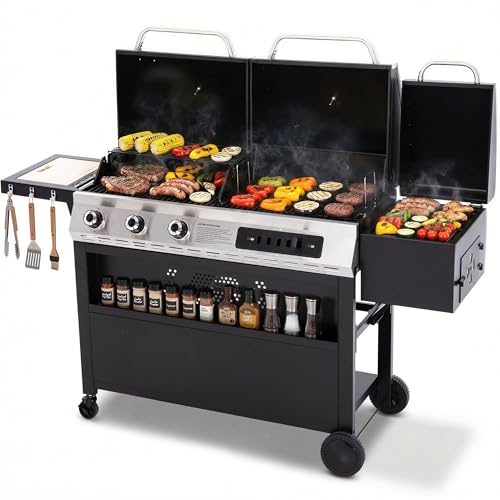
Sophia & William 3-Burner Gas and Charcoal Grill Combo with Offset Smoker — Best Three-Burner Combo Gas Grill
Three gas burners plus a charcoal side with an offset smoker: the Sophia & William combo is the most feature-complete mid-size gas combo in this guide at 840 square inches.
Strengths
- Three gas burners give the best gas-side zone control in this group
- Offset smoker included without jumping to the largest footprints
- Sized for events without overwhelming a mid-size patio
Trade-offs
- Newer brand name with a shorter track record than legacy grill makers
- 840 sq. in. is total area, split across chambers
- Smoker firebox is modest for very long brisket cooks
Key specs
- Total cooking area: 840 sq. in. (per Amazon listing title)
- Format: 3-burner gas side plus charcoal side with offset smoker (per Amazon listing title)
- Build positioning: heavy duty (per Amazon listing title)
Burner count is the quiet spec that decides gas cooking quality, and three burners transform zoning: sear left, roast center, hold right. Layer the offset smoker on the charcoal side and this single station covers techniques that normally need two or three appliances.
It asks for width, assembly patience and a cook willing to learn fire management on the smoker side. As a one-purchase outdoor kitchen for a mid-size patio, though, nothing else here packs this much capability per square inch.
Three burners change gas cooking qualitatively: you can hold a true medium zone, which is where chicken skin renders and vegetables caramelize instead of scorching. The Sophia & William’s gas side therefore suits ambitious weeknight cooking, while its smoker answers weekends. Assembly is the longest in this guide’s mid-size class, a fair trade for the capability density, and the finished station feels notably planted and rattle-free for its tier.
Best for: mid-size patios wanting maximum capability / Not suited for: minimalists who want one simple cooker
Check the current price on Amazon

Captiva Designs Charcoal and Gas Grill Combo (690 sq. in.) — Best Compact with Easy Cleaning
Captiva’s 690 square inch combo distinguishes itself where owners actually live: porcelain-enameled cast iron grates and pull-out trays that make cleanup fast.
Strengths
- Porcelain-enameled cast iron grates hold sear heat well
- Pull-out trays make ash and grease cleanup genuinely easier
- Most compact full combo here, kind to smaller patios
Trade-offs
- 690 sq. in. total is the smallest here, split between two fuels
- Side burner shares the total heat budget of the unit
- Cast iron grates need seasoning care to stay rust-free
Key specs
- Total cooking area: 690 sq. in. (per Amazon listing title)
- Grates: porcelain-enameled cast iron (per Amazon listing title)
- Extras: side burner and pull-out cleaning trays (per Amazon listing title)
Combo grills die of neglect more than of defects, so a model engineered for easy cleaning is a longevity feature disguised as convenience. The pull-out trays catch ash and grease where you can reach them, and the enameled cast iron grates sear like cast iron while resisting rust like a coated grate should.
The size is the boundary: 690 square inches split two ways suits households of two to five, not reunion crowds. Within that household size, it may be the most pleasant combo here to own week after week.
Captiva’s gas side benefits from its grates: porcelain-enameled cast iron stores heat through the moment cold food lands, recovering sear faster than thin wire grates on comparable burners. The pull-out tray system catches the gas side’s drippings where you can actually reach them, which quietly prevents the grease fires that plague neglected combos. Small households that cook often and clean briefly will find this the most sustainable gas combo here to own.
Best for: smaller households that value easy upkeep / Not suited for: large gatherings and big-batch cooking
Check the current price on Amazon

Nexgrill Dual Fuel 4-Burner Gas Grill with Side Burner and Griddle Insert — Best Gas Griddle Combo
For cooks whose second system should be a griddle rather than charcoal, Nexgrill’s 59,000 BTU station with a griddle insert and side burner is the answer.
Strengths
- 59,000 BTU is serious gas power with a side burner and griddle insert
- Porcelain-coated cast iron grates balance sear and maintenance
- Built-in thermometer and stainless burners suit frequent cooks
Trade-offs
- Dual fuel here leans gas-forward; charcoal capacity is secondary
- 626 sq. in. is mid-size once split across functions
- Griddle insert is an accessory surface, not a full flat top
Key specs
- Total output: 59,000 BTU (per Amazon listing title)
- Cooking space: 626 sq. in. (per Amazon listing title)
- Grates: porcelain-coated cast iron; stainless steel burners (per Amazon listing title)
Judge this as a gas grill first: four burners, porcelain-coated cast iron grates, stainless burners and a built-in thermometer make a strong daily driver. The griddle insert then adds the flat-top repertoire, smash burgers, cheesesteaks, breakfast, without a separate appliance purchase.
Charcoal purists should look at the side-by-side picks instead; this model’s versatility is gas-native. For the large group of cooks who grill over gas almost always and want options, it is the most powerful package in the guide.
As a gas grill in its own right, the Nexgrill is the strongest daily driver in this guide: four burners, stainless burner construction, a thermometer where you can read it, and grates with real thermal mass. The griddle insert swaps in without tools for the flat-top sessions. If your household’s honest ratio is ninety percent gas cooking, buying the best gas side and treating the insert as the combo element is not a compromise at all; it is correct prioritization with a bonus.
Best for: gas-first cooks who want griddle versatility / Not suited for: charcoal flavor seekers
Check the current price on Amazon
Comparison Table
| Pick | Badge | Key spec | Best for |
|---|---|---|---|
| Char-Griller Dual-Function 2-Burner Gas and Charcoal Combination Grill (Model E5030) | Best Overall Combo Gas Grill | 870 sq. in. (per Amazon listing title) | most households wanting gas plus real charcoal |
| Royal Gourmet ZH3002N 2-Burner Propane Gas and Charcoal Grill Combo | Best Budget Combo Gas Grill | 759 sq. in. (per Amazon listing title) | first-time buyers and mild-climate households |
| Grills House ZH3005Y 2-Burner Gas and Charcoal Combo Grill with Side Burner | Best Value with Side Burner | 1,020 sq. in. (per Amazon listing title) | value hunters who cook full meals outside |
| Sophia & William 3-Burner Gas and Charcoal Grill Combo with Offset Smoker | Best Three-Burner Combo Gas Grill | 840 sq. in. (per Amazon listing title) | mid-size patios wanting maximum capability |
| Captiva Designs Charcoal and Gas Grill Combo (690 sq. in.) | Best Compact with Easy Cleaning | 690 sq. in. (per Amazon listing title) | smaller households that value easy upkeep |
| Nexgrill Dual Fuel 4-Burner Gas Grill with Side Burner and Griddle Insert | Best Gas Griddle Combo | 59,000 BTU (per Amazon listing title) | gas-first cooks who want griddle versatility |
How to Choose the Best Combo Gas Grills: Gas First, Extra Second
Interrogate the gas grill as if the extra did not exist: burners, zoning, grates, ignition, lid build. Then price the extra honestly: a charcoal chamber you will use monthly is worth real money; a griddle you will use weekly is worth more. Finally check the marriage details: total width with shelves, cover fit, and cleaning access. This order prevents the classic mistake of buying a mediocre gas grill because its bonus feature photographed well.
Gas and Charcoal, or Gas and Griddle: Which Combo Is Better?
Choose charcoal if flavor is your gap: smoke, char and high-heat crust that gas cannot imitate. Choose a griddle if menu breadth is your gap: breakfast, smash burgers, fried rice, cheesesteaks and delicate vegetables that fall through grates. Many households honestly need the griddle more and the charcoal romance less; the sales charts for flat tops suggest exactly that. Both combos are legitimate; only your menu can rank them.
How Many Burners Does a Combo Gas Grill Need?
Two burners suffice for chambers up to family size, three unlock true zoning, and four suit wide grates and frequent entertaining. More important than the count is independent control per burner and a grate that holds heat: cast iron or porcelain-coated cast iron preferably. Every pick here meets its size class on both counts, which is why the smallest model still cooks like a grown-up grill.
How to Cook a Full Meal on a Combo Gas Grill Without Bottlenecks
Sequence by cooking time, not by food group. Start the charcoal side or smoker first if using it, since it stabilizes slowest. Preheat the gas side while you prep, then cook in waves: long items first, proteins that hold well next, quick vegetables and breads last. Use the second system as your holding and finishing station: burgers seared over gas can rest over indirect charcoal warmth; onions and peppers can live on the griddle or side burner without stealing grate space. Keep one zone deliberately empty as a flare-up refuge and a landing strip. Cooks who plan the sequence finish everything hot and together; cooks who improvise serve in apologetic installments.
Common Buying Mistakes
Believing combo gas automatically means charcoal is included; several leading combos pair gas with a griddle instead. Comparing BTU totals that bundle the side burner. Under-measuring width once shelves and fireboxes are counted. Buying four burners for a household of two and resenting the gas bill and cleaning forever. And neglecting the second system’s upkeep: charcoal ash and griddle seasoning are small habits that decide whether the extra gets used or abandoned.
What Should You Cook First on a New Combo Gas Grill?
Run a deliberate shakedown menu that tests every system in one session: burgers over gas for sear and timing, corn and peppers on the second system, and something saucy on the side burner if fitted. You will learn your grill’s hot spots, its preheat pace and its flare-up behavior in a single low-stakes cook, and every later meal benefits. Keep notes the first few cooks; combo grills have more personalities than single-fuel models, and the owners who learn theirs fastest are the ones still using both systems a year later.
What Is the Difference Between a Combo Gas Grill and a Dual Fuel Grill?
The terms overlap in marketing and diverge in this guide’s usage deliberately. Dual fuel names the fuel pairing: gas plus charcoal. Combo gas names the architecture: a gas grill combined with something, which may be charcoal, a griddle, or a smoker. Every dual fuel grill is a combo gas grill; not every combo gas grill is dual fuel, as the griddle models here prove. When shopping beyond this guide, translate every listing into its actual configuration sentence, this gas grill plus that second system, and comparisons suddenly become honest.
How to Get Charcoal Flavor from a Gas-Forward Combo
Three techniques, in ascending order of authenticity. A smoker tube or box filled with wood pellets or chips, placed over a lit burner, perfumes food with real wood smoke during a cook. A cast iron plancha or the charcoal side of a dual fuel model, where fitted, adds crust and char. And finishing over the charcoal chamber, for models that have one, remains the genuine article. Gas-forward owners who master the smoker tube are often surprised how far it closes the flavor gap for ribs and chicken, even if brisket purists will always choose the firebox route.
Gas Grill Care: The Fifteen-Minute Monthly Routine
Combo gas grills stay young on a short monthly rhythm. Brush grates hot after every cook. Monthly: empty and wipe the grease tray, inspect burner flames for even blue rows and clear any blocked ports with a soft brush, check the hose for cracks and the connections for leaks with soapy water, and wipe the exterior down. Seasonally: deep-clean the cook box, check the igniter spark, and confirm the cover still sheds water. Fifteen minutes a month is the entire price of a gas side that ignites first-click and sears evenly in year five.
How Do You Convert a Combo Gas Grill Between Propane and Natural Gas?
Some models are built convertible, with orifice changes and a kit; others are fuel-fixed at purchase, and assuming convertibility is an expensive mistake. Check the exact model’s documentation before ordering, and treat any conversion as a job for a qualified fitter, because gas work punishes improvisation. Where conversion is supported, it is genuinely valuable: a patio that gains a natural gas line later should not orphan a good grill. Where it is not, choose your fuel at purchase with your home’s next five years in mind, not just this summer’s convenience.
What Are the Signs a Combo Gas Grill Was Built to Last?
Read the wear points. Burners in stainless steel rather than thin aluminized steel. Grates with thermal mass, cast iron or heavy rod, rather than wire. A cook box that feels rigid when you rock the lid, hinges that close without lateral play, and a grease path you can trace with one finger from grate to tray. Then read the support tail: a model-specific cover exists, replacement grates and igniters are listed, and the manual is a real document. These signals, all visible before purchase, predict lifespan more reliably than any warranty number printed beside them.
How Does Altitude and Climate Affect Combo Gas Cooking?
At altitude, gas burners deliver less heat per setting and everything takes longer; generous preheats and lid discipline compensate, and charcoal burns faster in thin air, wanting smaller vent openings. In humid coastal climates, corrosion is the tax: enamel finishes, stainless hardware and religious cover use are the payment plan. In cold climates, the gas side is the winter hero, but propane pressure drops in deep cold, so keep tanks fuller and cooks zoned tightly. The combo format’s quiet advantage is tactical choice: every climate has a fuel that copes best, and you own both.
What Should a First-Time Combo Gas Owner Cook in the First Month?
Week one: burgers and sausages on gas, learning preheat and hot spots. Week two: chicken pieces using two zones, the skill that unlocks most of outdoor cooking. Week three: the second system’s debut, charcoal steaks or a griddle breakfast, cooked slowly with no guests to impress. Week four: a combined session, ribs started on the charcoal side, finished and glazed while the gas side grills the sides for friends. That deliberate month teaches the whole instrument, and owners who invest it report the highest long-term use of both systems, which is the entire point of the purchase.
How Do You Troubleshoot Uneven Heat on a Combo Gas Grill?
Start with the burners: flames should burn blue and even along each tube; lazy yellow sections mean blocked ports or a tired burner, both fixable with a soft brush, a port cleaner and, eventually, a replacement that mainstream brands stock cheaply. Next, the heat distribution layer, tents or plates above the burners, which warp and rust into hot spots over seasons and are consumables, not failures.
Then check the cook’s variables before the hardware’s: wind direction, lid discipline, and whether cold food is landing in one dense block. Most uneven-heat complaints resolve into one of those five causes, and the diagnosis order above finds it in minutes rather than parts orders.
What Is the Best Way to Use a Side Burner, If Your Combo Has One?
Treat it as the kitchen’s fifth element, not a spare. Sauces and glazes live there at a controlled simmer while the grates sear. Corn boils there, freeing grate space at the exact moment space is scarcest. A cast iron skillet there blackens fish, fries onions or sears scallops that would fall through or flare on the grates. Coffee and mulled drinks appear there in the cold months, to general applause.
Owners who assign the side burner a job at every cook quickly rank it with the main burners in importance, which is why this guide badges its presence so deliberately. Owners who never light it are the same ones who call it a gimmick; the difference is purely choreography.
How Does a Griddle Insert Change a Gas Grill’s Personality?
It converts radiant, open-flame cooking into contact cooking: even, crust-forming, and capable of holding small or liquid-adjacent foods, eggs, chopped onions, fried rice, that grates cannot. The insert absorbs the burners’ heat into a plate, so preheats lengthen slightly and recovery depends on the plate’s mass. In exchange, the grill gains a second repertoire without gaining a second footprint.
The practical rhythm owners settle into is weekly rotation rather than mid-cook swapping: griddle weekends for breakfast and smash burgers, grate weekdays for everything else, the insert stored oiled in its spot. That rhythm, not any single dish, is the insert’s real contribution to a gas-forward combo.
What Should You Check on a Combo Gas Grill Every Spring?
Ignition first: every burner lighting from its own control, first or second click. Gas integrity second: hose supple and uncracked, connections leak-tested with soapy water, regulator behaving. Cooking surfaces third: grates cleaned and oiled, charcoal chamber swept and inspected for thin spots, griddle insert re-seasoned if winter was unkind. Structure last: wheels, hinges, shelf bolts and the cover’s honest condition.
An hour of this each spring is the entire difference between a grill that starts the season as an asset and one that starts it as a project. Put it on the calendar with the first warm weekend and it never feels like maintenance at all.
How Do Combo Gas Grills Fit Modern Outdoor Kitchens?
As the flexible center of them. Built-in islands give permanence to the gas side’s daily role, while a combo’s second system, charcoal, griddle or smoker, keeps the outdoor kitchen from needing a second appliance bay. Even in cart form, the picks here anchor a zone: grill, landing counter, refrigeration within steps, and lighting above.
The planning advice is simple: design around the cook’s movement, not the appliances’ silhouettes, and leave the combo’s lids and firebox their full swing and clearance. Outdoor kitchens fail on choreography more often than on equipment, and a combo, with its two workflows, rewards a well-planned zone more than any single-fuel grill can.
How Do You Plan a Week of Dinners Around a Combo Gas Grill?
Anchor the week on proteins that share preparation. Monday’s gas-grilled chicken yields Tuesday’s chicken for salads and sandwiches without a second cook. Wednesday is the griddle or charcoal side’s feature night, smash burgers or charcoal chops, because midweek deserves one small event. Friday is seafood or vegetables on gas, fast and clean before the weekend. The weekend belongs to the second system at full stretch, a smoked or charcoal centerpiece with the gas side running the supporting cast.
Planned this way, the combo is not an appliance used occasionally but the kitchen’s second range, and its purchase price amortizes across hundreds of dinners rather than dozens of barbecues. Households that menu-plan around the grill report the highest ownership satisfaction in the entire category, a statistic hiding in plain sight in every owner forum.
What Is the Difference Between a Combo Gas Grill and a Kitchen Range Outdoors?
Less each year, by design. Side burners boil and sauté, griddles fry and toast, rotisserie-capable built-ins roast, and the gas grill itself does everything an oven’s broiler wishes it could. The combo gas grill is best understood as an outdoor range with a flavor option attached, which is why its owners migrate so much cooking outside across the warm months.
The remaining differences are weather and smoke, one a constraint and one a glory. Plan the station with light, shelter at the edges and a door close by, and the outdoor range becomes the preferred one for everything except baking, from April through October in most climates.
How Should Renters and Balcony Cooks Read This Guide?
Start with your lease and your building’s rules, because charcoal and open flame are restricted in many multi-unit properties, and no grill is worth a lease violation. Where gas is permitted, the compact picks here, sized honestly and badged for small footprints, are the renter’s field: they move when you move, fit real balconies, and store under standard covers. Where no flame is permitted at all, this guide’s honest advice is to wait for a different home rather than improvise around the rules.
Renters who can grill should also weight portability and assembly reversibility: a grill that comes apart for the next move is worth more than a marginally larger one that does not. The GD401C’s folding design, in the sibling guides, exists for exactly this life.
What Gas Grill Myths Should Combo Buyers Stop Believing?
That more BTU always means better searing; zoning and grate mass matter more, as this guide’s smaller picks prove weekly. That stainless exteriors guarantee stainless internals; read the burner and grate materials, not the lid’s shine. That a thermometer in the lid tells the food’s temperature; it tells the air near the lid, which is a different and less useful fact. And that gas food cannot taste grilled; a hot grate, a smoker tube and good technique embarrass that myth at any table.
Combo buyers are unusually exposed to mythology because two formats’ marketing compounds it. The antidote is the audit method used throughout this guide: configuration in plain words, materials by name, and performance judged at the grate.
How Do You Get the Most From a Combo Gas Grill in a Small Kitchen Garden or Terrace?
Treat the terrace as a room with one appliance and design around its workflow: grill against the safest wall, a narrow prep surface within a step, herbs in pots at the cook’s elbow, and lighting that makes evening cooking pleasant rather than theatrical. The compact picks in this guide were badged for exactly this footprint, and their second systems, a charcoal chamber or a griddle’s worth of menu, multiply a small space’s culinary range without multiplying its clutter.
Small-space combo cooking succeeds on mise en place: everything prepped before the first burner lights, because there is no counter to improvise on. Terrace cooks who adopt that discipline produce restaurant-calm meals from six square feet.
What Is the Combo Gas Grill’s Role in Healthy Weeknight Cooking?
A direct one: grilled proteins and vegetables with minimal added fat, cooked fast enough that the healthy option is also the easy option on a tired Tuesday. The griddle-equipped models extend it to stir-fry style cooking with total control of oil; the charcoal side makes vegetables interesting enough to anchor a meal. Outdoor cooking also moves the mess and the smell out of a small kitchen, a quality-of-life detail home cooks cite constantly.
No appliance makes a diet, but the combo gas grill removes the friction from the dinners most households are trying to eat more of, which is how kitchens actually change habits.
Final Buying Checklist for Combo Gas Grills
Gas side judged alone first: burners, zoning, grates, ignition. Second system named honestly, charcoal, griddle or smoker, and matched to your menu’s real gap. BTU claims decomposed, side burner separated from main burners. Width with shelves measured. Conversion between gas types confirmed or consciously declined. Cleaning path traced.
Six checks and the field narrows to the model this guide’s badges already point to for your pattern. Buy it, run the first-month curriculum, and the second system will be a habit by summer’s end.
How Do You Host a Tasting Menu Night on a Combo Gas Grill?
Small courses, sequenced by the grill’s zones, turn the combo into a tasting kitchen: scallops or shrimp from the hottest gas zone, a charcoal-kissed vegetable course from the second system, a sliced steak rested and re-seared in slices for the table, and grilled fruit to close. The side burner, where fitted, keeps a sauce at the exact simmer a tasting menu’s pacing demands.
The format shines here because each course uses a different strength, and the cook stays at the table’s edge rather than in the kitchen. Guests experience it as a restaurant with one chef and no walls, which, functionally, is what a well-run combo station is.
What Does a Combo Gas Grill Do for Holiday Overflow Cooking?
It becomes the second kitchen every holiday cook prays for: the turkey resting while sides grill, the ham glazing on the charcoal side, appetizers appearing from the gas grates while the indoor oven is occupied by three casseroles competing for one thermostat. Even in cold weather, the gas side’s reliability makes it a genuine auxiliary range steps from the kitchen door.
Households that discover this in November tend to restructure their entire holiday around the station by the following year. It is the combo’s least advertised and most retold benefit, the one that converts skeptical relatives at the table.
One Last Word Before You Order
Every grill in this guide was verified to exist as described, through the Amazon catalog itself, before it was allowed a link, and every badge was assigned against a named household pattern rather than a superlative. That method cannot choose for you, but it can guarantee the choice you make is between real products with honest configurations. Match the gas side to your Tuesdays, the second system to your weekends, and the size to your patio as it is, not as you wish it were.
Then cook the first-month curriculum without skipping the quiet weeks, because combo gas grills reward familiarity faster than almost any appliance in the home. By the second month, the station will feel less like equipment and more like where dinner happens, which is the entire promise of the format, kept.
Final Recommendation
The E5030 is the balanced default, the ZH3002N the budget door-opener, the ZH3005Y the side-burner value, the Sophia & William the capability pick, the Captiva the easy-clean compact, and the Nexgrill the gas-and-griddle powerhouse. Compare across the cluster: Best Combo Grills · Best Combo Barbeque Grills · Best Combo Fuel Grills · Best Combo Grills With Smoker · Best Combo Grills Under $500
Frequently Asked Questions
What is a combo gas grill?
A grill whose primary system is gas, combined with a second system in the same unit: a charcoal chamber, a griddle, or a smoker. The exact pairing varies by model, so check what the second system actually is.
Are combo gas grills as good as dedicated gas grills?
The best ones, including the picks here, use full-quality gas sides with proper burners and grates. Very cheap combos cut the gas side; that is the tier this guide avoided.
Can I smoke on a combo gas grill?
On models with a charcoal chamber or firebox, yes, using indirect heat. On gas-only combos, a smoker tube adds light smoke flavor but does not replicate charcoal smoking.
Which is better for burgers: charcoal side or griddle?
The griddle wins for smash burgers and volume; the charcoal side wins for flame-kissed, open-grate flavor. Many owners use both across a single party.
Do combo gas grills use more propane?
Only in proportion to burners lit. Zoning discipline, lighting only the burners you need, keeps consumption in line with a comparable dedicated gas grill.
How do I stop flare-ups on the gas side?
Keep the grates and grease tray clean, trim excess fat, keep one zone unlit as a refuge, and avoid sugary sauces until the final minutes of cooking.


