Disclosure: airfryerkitchensupply.com is reader-supported. When you buy through links on our site, we may earn an affiliate commission at no extra cost to you.
Where to buy
Every pick in this guide to the best combo fuel grills was verified against the Amazon catalog before it earned a link. Start here: Oklahoma Joe’s Canyon Combo Dual Fuel Gas and Charcoal Smoker and Grill · Grills House ZH3005Y 2-Burner Gas and Charcoal Combo Grill with Side Burner · Char-Griller Texas Trio 3-Burner Gas & Charcoal Grill and Smoker · Royal Gourmet ZH3002N 2-Burner Propane Gas and Charcoal Grill Combo · Nexgrill Dual Fuel 4-Burner Gas Grill with Side Burner and Griddle Insert · Char-Griller Flex Fuel Plus 3-in-1 Gas and Charcoal Grill, Griddle and Smoker Combo. Prices move with seasons and promotions, so check price on Amazon for each model rather than trusting any number printed elsewhere.
The best combo fuel grills, usually called dual fuel grills, put propane and charcoal in one frame so the fuel follows the food instead of the other way round. This guide compares six listing-verified dual fuel models, from a 1,390 square inch triple cooker to a stainless built-in, and judges them on the thing that matters: how well each fuel side does its own job.
Dual fuel sounds simple, but executions differ sharply. Some models are gas grills with a charcoal tray as an apology; others are genuine equals, two real cookers sharing a cart. A third group adds a smoker box or a griddle and changes the bargain again. Read the per-fuel verdicts below before the feature lists, because a dual fuel grill is only as good as its weaker side, and every pick here was chosen because both of its sides earn their space.
In this guide
Quick Picks
- Best Overall Dual Fuel: Oklahoma Joe’s Canyon Combo Dual Fuel Gas and Charcoal Smoker and Grill — households that refuse to compromise on either fuel. Check price on Amazon.
- Best Value Dual Fuel: Grills House ZH3005Y 2-Burner Gas and Charcoal Combo Grill with Side Burner — budget-focused buyers who still want a side burner. Check price on Amazon.
- Best for Capacity: Char-Griller Texas Trio 3-Burner Gas & Charcoal Grill and Smoker (Model 3070) — large families and frequent hosts. Check price on Amazon.
- Best Compact Dual Fuel: Royal Gourmet ZH3002N 2-Burner Propane Gas and Charcoal Grill Combo — small patios, couples and small families. Check price on Amazon.
- Best Gas-Forward Dual Fuel: Nexgrill Dual Fuel 4-Burner Gas Grill with Side Burner and Griddle Insert — frequent gas grillers who want a griddle option. Check price on Amazon.
- Most Versatile Dual Fuel: Char-Griller Flex Fuel Plus 3-in-1 Gas and Charcoal Grill, Griddle and Smoker Combo — households that grill, griddle and smoke in rotation. Check price on Amazon.
How These Picks Were Chosen
We verified each model, searching brand plus model and matching the returned title before assigning any link. Selection then focused on dual fuel integrity: a real charcoal chamber with airflow control, not just a tray; gas output sufficient for searing; and honest supporting details like grate material, side burners and cleaning access. Built-in and griddle-hybrid models were included deliberately, labeled for what they are, because dual fuel shoppers also cross-shop those formats.
The 6 Best Combo Fuel Grills
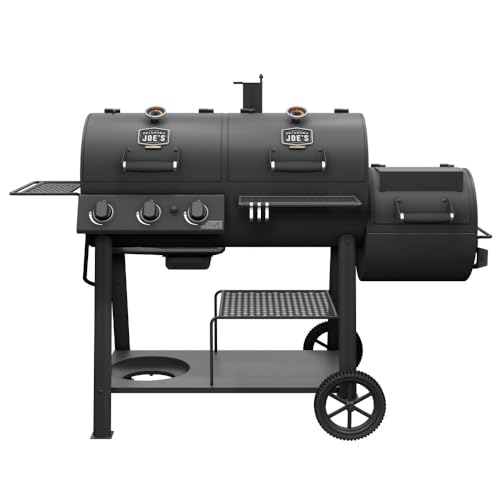
Oklahoma Joe’s Canyon Combo Dual Fuel Gas and Charcoal Smoker and Grill — Best Overall Dual Fuel
The Canyon Combo earns the top badge here because both of its fuels are the real thing: a three-burner propane side and a charcoal side from a brand whose reputation was built on charcoal and smoke.
Strengths
- Charcoal side is a genuine smoker, not just a grill with a lid
- Gas side has three burners for better zone control
- Heavy-feeling build in the Oklahoma Joe’s offset tradition
Trade-offs
- Large, heavy unit that is effectively a permanent patio fixture
- Smoker side needs sealing attention and fire management skill
- Takes meaningful time to bring the charcoal side up to temperature
Key specs
- Total cooking area: 1,031 sq. in. (per Amazon listing title)
- Format: 3-burner propane gas side plus charcoal smoker and grill side (per Amazon listing title)
- Brand line: Oklahoma Joe’s combo series (per Amazon listing title)
Dual fuel grills often hide a weak side. Here the charcoal chamber grills and smokes with genuine authority, while the gas side offers three burners, which matters more than raw BTU bragging: three burners let you build hot, medium and warm zones across the grate. That zoning is what weeknight cooking actually uses, a sear zone for steaks, a gentle zone for chicken skin and vegetables.
The costs are size, weight and the smoker learning curve. Treat it as a permanent installation, learn its vents over a few cooks, and it will cover everything from Tuesday burgers to a Saturday brisket without a second cooker ever entering the conversation.
Fuel economics favor the Canyon’s balance: propane handles the high-frequency, low-drama cooks cheaply per session, while charcoal is spent only when its flavor is the point. The charcoal chamber’s appetite is moderate for its class, and its vent control means less fuel wasted on overshoot-and-choke temperature management. Over a season of mixed cooking, owners typically report the dual fuel arrangement costing less than running charcoal for everything or replacing a cheap gas grill early.
Best for: households that refuse to compromise on either fuel / Not suited for: apartment balconies and small decks
Check the current price on Amazon

Grills House ZH3005Y 2-Burner Gas and Charcoal Combo Grill with Side Burner — Best Value Dual Fuel
The ZH3005Y pairs a 34,000 BTU total output and a side burner with 1,020 square inches of dual fuel space, a specification set that undercuts better-known badges.
Strengths
- Strong 34,000 BTU total output for a 2-burner combo layout
- Side burner included, which many value combos leave out
- Porcelain-enameled finish resists rust better than plain painted steel
Trade-offs
- Lesser-known brand, so long-term parts support is less certain
- Two main burners still limit fine zone control on the gas side
- Assembly instructions reward patience and a second pair of hands
Key specs
- Total cooking area: 1,020 sq. in. (per Amazon listing title)
- Total output: 34,000 BTU including side burner (per Amazon listing title)
- Finish: porcelain-enameled (per Amazon listing title)
Value dual fuel models usually cut the side burner first; this one keeps it, and that changes daily usefulness more than any other single feature, because sauces, beans and skillet sides no longer compete for grate space. The porcelain-enameled finish is the other grown-up touch, resisting the rust that ends cheap grills early.
The brand is the gamble: Grills House lacks the decades-long parts network of the legacy makers, so keep the manual and register the product. The grill itself, judged on layout, output and finish, is the strongest value equation in this particular roundup.
Look closer at the ZH3005Y’s working layout: the side shelves and burner placement keep pans off the main grates, the enamel finish wipes down without drama after greasy cooks, and the charcoal side is proportioned for family loads rather than token handfuls. Its total output figure includes the side burner, as most brands calculate it, so judge the main burners by their zoning behavior in the review above rather than the headline. As a package of decisions, it is unusually coherent for its tier.
Best for: budget-focused buyers who still want a side burner / Not suited for: buyers who prioritize long-established brand support
Check the current price on Amazon

Char-Griller Texas Trio 3-Burner Gas & Charcoal Grill and Smoker (Model 3070) — Best for Capacity
When the guest list grows, the Texas Trio’s 1,390 total square inches and three cooking systems make it the dual fuel pick that never says no.
Strengths
- Three cookers in one footprint: gas grill, charcoal grill and offset-style smoker
- Largest total cooking area in this roundup for crowd cooking
- Side burner handles sauces and sides while the main chambers work
Trade-offs
- Very large and heavy footprint that needs a big, level patio
- More chambers means more cleaning and more gaskets to maintain
- Assembly is a long, two-person job
Key specs
- Total cooking area: 1,390 sq. in. (per Amazon listing title)
- Format: 3-burner gas grill + charcoal grill + side firebox smoker (per Amazon listing title)
- Ignition: push-button (per Amazon listing title)
- Extras: side burner and dual temperature gauges (per Amazon listing title)
Capacity on a dual fuel grill is really parallelism: how many different things can cook at once at different temperatures. The Trio runs three fires, gas, charcoal and the firebox-fed smoker, so a full barbecue menu progresses simultaneously instead of in anxious relays. Its side burner extends that further for pans and pots.
You pay in patio width, assembly time and three cleaning routines. If your gatherings are regularly twelve people or more, that trade is obviously right. If they are four, the smaller picks here will make you happier every ordinary week.
On fuel flexibility the Trio is really a triple: gas for speed, charcoal for flavor, and wood in the firebox for smoke, three fuel stories in one frame. That breadth matters for households whose cooking ranges from frozen burgers to competition-practice brisket. The trade is management overhead: three fuel inventories to store dry and safely, three ash and grease streams to clean. Households that cook outside weekly absorb that overhead happily; monthly cooks should honestly consider the simpler dual fuel picks.
Best for: large families and frequent hosts / Not suited for: small households cooking for two or three
Check the current price on Amazon

Royal Gourmet ZH3002N 2-Burner Propane Gas and Charcoal Grill Combo — Best Compact Dual Fuel
At 759 square inches with two side shelves, the ZH3002N is the dual fuel grill for patios that cannot host the giants but still want both fires.
Strengths
- Compact dual-fuel layout that fits smaller patios and decks
- Two side shelves give real prep space without add-on tables
- Straightforward assembly and controls for first-time combo owners
Trade-offs
- 20,000 BTU gas side is gentle for thick steaks in cold weather
- No dedicated smoker box, so smoking is an indirect-heat workaround
- Shelf space is fixed rather than fold-down on both sides
Key specs
- Total cooking area: 759 sq. in. (per Amazon listing title)
- Gas output: 20,000 BTUs across 2 burners (per Amazon listing title)
- Extras: two side shelves and stainless steel lid (per Amazon listing title)
Compact dual fuel is a balancing act: shrink too far and each chamber becomes a toy. The ZH3002N keeps adult proportions, a two-burner gas side for real dinners and a charcoal side deep enough for indirect cooking, while the twin shelves preserve the working space that small grills usually sacrifice.
Its 20,000 BTU gas output is the ceiling to know about: fine for burgers, chicken and vegetables, slower for thick steaks in cold weather. Within those honest limits, it is the most livable small dual fuel package here.
The ZH3002N’s fuel story is efficiency: a modest gas side sipping propane for two-to-five-person dinners, and a charcoal chamber sized so a single chimney is a full cooking load rather than a starter. Nothing is oversized, so nothing is wasteful. Its shelves keep both fuels’ tools separated and ready. For apartments-adjacent patios, duplexes and first homes, that right-sized dual fuel equation is precisely the product the market needed and rarely builds this cleanly.
Best for: small patios, couples and small families / Not suited for: high-heat steak specialists
Check the current price on Amazon

Nexgrill Dual Fuel 4-Burner Gas Grill with Side Burner and Griddle Insert — Best Gas-Forward Dual Fuel
Nexgrill’s entry leans into gas: 59,000 BTU, four burners, a side burner and a griddle insert, with dual fuel flexibility in a 626 square inch frame.
Strengths
- 59,000 BTU is serious gas power with a side burner and griddle insert
- Porcelain-coated cast iron grates balance sear and maintenance
- Built-in thermometer and stainless burners suit frequent cooks
Trade-offs
- Dual fuel here leans gas-forward; charcoal capacity is secondary
- 626 sq. in. is mid-size once split across functions
- Griddle insert is an accessory surface, not a full flat top
Key specs
- Total output: 59,000 BTU (per Amazon listing title)
- Cooking space: 626 sq. in. (per Amazon listing title)
- Grates: porcelain-coated cast iron; stainless steel burners (per Amazon listing title)
Call this the dual fuel grill for the gas cook who wants options. The porcelain-coated cast iron grates sear properly, stainless burners promise longevity, and the griddle insert opens the flat-top repertoire without buying a second appliance. The built-in thermometer and tidy layout suit people who cook outside three or four nights a week.
Be clear that charcoal plays a supporting role here compared with the true side-by-side models. If charcoal is your headline act, choose the Canyon or the E5030 class of layout instead. If gas is the headline and versatility the encore, this is your pick.
Nexgrill’s fuel flexibility is gas-native: propane convenience plus a griddle surface that changes what the gas can cook. Think of it as dual format rather than dual fuel in the charcoal sense, a distinction this guide maintains deliberately. Stainless burners are the longevity headline, since burners are the gas side’s wear item, and porcelain-coated grates balance sear performance with forgiving maintenance. High-frequency cooks, the four-nights-a-week households, will extract the most value from this configuration.
Best for: frequent gas grillers who want a griddle option / Not suited for: charcoal-first cooks
Check the current price on Amazon
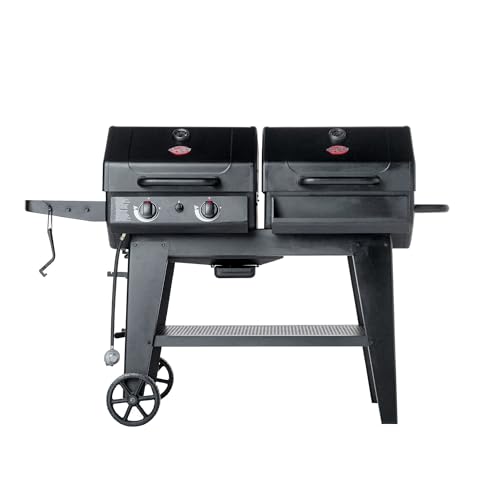
Char-Griller Flex Fuel Plus 3-in-1 Gas and Charcoal Grill, Griddle and Smoker Combo — Most Versatile Dual Fuel
The Flex Fuel Plus adds a flat top griddle insert to the gas-and-charcoal formula and keeps a smoker function, making it the most modes-per-footprint pick here at 30,000 BTUs.
Strengths
- Griddle insert adds smash burgers, breakfast and teppanyaki-style cooking
- Three cooking modes in one station: grill, griddle and smoke
- Char-Griller ecosystem of covers and parts is widely available
Trade-offs
- Griddle insert stores separately when the grill grates are in use
- Jack-of-all-trades layout means no single mode is class-leading
- Switching modes mid-cook takes planning and heat management
Key specs
- Total output: 30,000 BTUs (per Amazon listing title)
- Format: gas and charcoal grill with flat top griddle insert and smoker function (per Amazon listing title)
- Model: CG30281224 (per Amazon listing title)
Mode count matters when one station must serve many menus: grates for steaks, charcoal for flavor, griddle for smash burgers and breakfast, smoke for ribs. The Flex Fuel Plus rotates through all of them, and Char-Griller’s accessory ecosystem means covers and parts are easy to source.
Versatility taxes depth: no single mode here outclasses a dedicated cooker, and swapping the griddle insert in and out wants a storage plan. For the household that genuinely cooks in all four modes, it is the most efficient single purchase in the guide.
The Flex Fuel Plus manages its fuels with a party trick: the griddle insert lets the gas side mimic a flat top while the charcoal side works independently, so a single session can run smash burgers and charcoal-grilled vegetables in parallel. Char-Griller’s model support means the insert, grates and covers remain orderable, which matters for a format-shifting product whose accessories are part of the value. Keep the insert oiled and stored dry, and the four-mode promise stays true for years.
Best for: households that grill, griddle and smoke in rotation / Not suited for: specialists who want one mode done perfectly
Check the current price on Amazon
Comparison Table
| Pick | Badge | Key spec | Best for |
|---|---|---|---|
| Oklahoma Joe’s Canyon Combo Dual Fuel Gas and Charcoal Smoker and Grill | Best Overall Dual Fuel | 1,031 sq. in. (per Amazon listing title) | households that refuse to compromise on either fuel |
| Grills House ZH3005Y 2-Burner Gas and Charcoal Combo Grill with Side Burner | Best Value Dual Fuel | 1,020 sq. in. (per Amazon listing title) | budget-focused buyers who still want a side burner |
| Char-Griller Texas Trio 3-Burner Gas & Charcoal Grill and Smoker (Model 3070) | Best for Capacity | 1,390 sq. in. (per Amazon listing title) | large families and frequent hosts |
| Royal Gourmet ZH3002N 2-Burner Propane Gas and Charcoal Grill Combo | Best Compact Dual Fuel | 759 sq. in. (per Amazon listing title) | small patios, couples and small families |
| Nexgrill Dual Fuel 4-Burner Gas Grill with Side Burner and Griddle Insert | Best Gas-Forward Dual Fuel | 59,000 BTU (per Amazon listing title) | frequent gas grillers who want a griddle option |
| Char-Griller Flex Fuel Plus 3-in-1 Gas and Charcoal Grill, Griddle and Smoker Combo | Most Versatile Dual Fuel | 30,000 BTUs (per Amazon listing title) | households that grill, griddle and smoke in rotation |
How to Choose the Best Combo Fuel Grills Without Regretting the Weak Side
Audit each fuel separately. On the gas side: burner count and layout for zoning, grate material, ignition reliability and whether a side burner matters to your menus. On the charcoal side: chamber depth for indirect cooking, vent control, ash access and grate height adjustment. Then audit the marriage: total width, lid clearance, cover availability and whether you can clean both sides without moving the unit. A dual fuel grill that passes all three audits is rare and worth its price.
Does Dual Fuel Mean Gas and Charcoal, or Something Else?
Usually gas plus charcoal, but read listings carefully. Some brands use dual fuel for grills that run on either propane or natural gas, a completely different claim, and built-in models like the SPIRE in our wider research use it that way. Others mean a grill plus a griddle. The picks in this guide are labeled by their actual configuration, so match the definition to the listing before comparing prices across models.
How Much Gas Power Does a Dual Fuel Grill Need?
Judge by burners and zoning more than headline BTU, which often includes the side burner. Two burners suit small chambers; three or four give real zone control on larger gas sides. What you feel in practice is preheat speed and sear recovery when cold food lands: adequate output restores grate temperature quickly, weak output steams instead of searing. Every gas side here was selected to clear that bar for its chamber size.
How to Season and Maintain Both Sides of a Dual Fuel Grill
On the gas side: preheat, brush the grates hot, and oil them lightly before cooking; after cooking, burn off residue for ten minutes and brush again. On the charcoal side: empty ash once fully cold, because stored ash draws moisture and corrodes the chamber; oil cast iron grates while warm. Monthly, check gas hoses for cracks, test connections with soapy water, clear burner ports, and wipe down enamel or stainless with a non-abrasive cleaner. Twice a year, deep-clean drip pans and the smoker chamber if fitted. Dual fuel maintenance is two simple routines, not one big one, and five minutes after each cook prevents the weekend-scrub punishment.
Common Buying Mistakes
Comparing headline BTU totals that quietly include side burners. Buying a charcoal tray add-on and expecting a charcoal grill. Forgetting natural gas versus propane configuration at order time on convertible models. Measuring the patio but not the delivery path and gate. Assuming dual fuel halves your maintenance when it actually doubles the systems, just in one frame. And skipping the cover: two lids and more seams mean more weather exposure, not less.
What Does Dual Fuel Ownership Cost Over Time?
Beyond the purchase, budget for both fuel economies: propane refills or a natural gas line, charcoal by the bag, replacement grates eventually, a quality cover immediately, and small parts like igniters over the years. None of this is extravagant, but buyers who price only the grill itself get surprised. The offsetting truth is that one dual fuel station replaces two appliances and their duplicate covers, tools and patio space, which is why, totalled honestly over five seasons, the format usually wins the household economics as well as the cooking.
Propane, Natural Gas and Charcoal: Running Costs Compared Honestly
Propane is the convenience fuel: predictable, portable, and priced by the refill, with a tank exchange available almost everywhere. Natural gas, where a line exists, removes refills entirely at the cost of a fixed installation and a convertible grill. Charcoal is the flavor fuel: briquettes for steady, economical heat, lump for hotter, cleaner-burning sears, both priced by the bag and both demanding storage and ash handling. A dual fuel household spends across two of these economies, typically propane for volume and charcoal for occasions, which is why the format’s total running cost usually lands between an all-gas and an all-charcoal household’s, while its menu range exceeds both.
How Does Weather Change Dual Fuel Cooking?
Wind is the gas side’s enemy and the charcoal side’s complication: it steals heat from burners and accelerates charcoal burn unpredictably. Cold ambient temperatures lengthen every preheat and reward lids-down discipline. The dual fuel answer is tactical: on bitter days, lean on the charcoal chamber’s mass and the lid; on windy days, position the unit’s back to the wind and favor the fuel whose fire is most sheltered in your layout. Combos with enamel finishes and fitted covers also simply survive weather better between cooks, which is an ownership feature disguised as a cosmetic one.
Can a Dual Fuel Grill Replace a Smoker and a Griddle Too?
Partially, and the honest fractions matter. A dual fuel grill with a firebox replaces a household smoker for family-scale barbecue almost completely. A dual fuel grill without one still smokes indirectly at a level that satisfies most ribs-and-chicken ambitions. The griddle is the harder substitution: inserts and plancha plates add flat-top capability, but a dedicated griddle’s full-surface, multi-zone flat top remains its own instrument. The Flex Fuel Plus and Nexgrill in this guide come closest to the four-in-one ideal; dedicated specialists still win their individual disciplines, as specialists always do.
How Do You Light and Control Charcoal in a Dual Fuel Grill?
Use a chimney starter and newspaper or a fire starter cube; lighter fluid has no place in a good cook’s kit or in the flavor of the food. Pour the coals when they are ashed over, then arrange them for the cook: a full even bed for direct grilling, a banked bed for two-zone work, a ring or snake for low indirect sessions. Control temperature primarily with the intake vent, in small movements with patience between them, and use the exhaust to fine-tune. The charcoal side of a dual fuel grill rewards exactly the skills a kettle teaches, which is why owners who learn here can cook on anything with a lid for the rest of their lives.
What Gas Grill Skills Transfer to Dual Fuel Ownership?
Almost all of them: preheat discipline, zone cooking, the ten-minute burn-off habit, and reading food instead of timers. What dual fuel adds is fire literacy on the charcoal side and sequencing across two systems. The transfer runs both ways: charcoal cooks bring patience and smoke sense to the gas side, and gas cooks bring zoning discipline to charcoal. Households often find the format quietly makes them better cooks overall, because every session offers a comparison the single-fuel cook never gets: the same chicken, two fires, one dinner, and a standing lesson in what each fuel does best.
How Should You Position a Dual Fuel Grill for Wind, Shade and Safety?
Give the unit a level, non-combustible home with safe clearance on all sides and above, out of the main traffic path but inside the cook’s working triangle with the kitchen door and a landing table. Face the firebox and charcoal vents away from prevailing wind where you can, because wind drives charcoal burn rates and steals gas heat. Keep it out from under low eaves and never in a garage or enclosed porch, running or stored hot. Shade is a comfort for the cook, not the grill; a covered, ventilated spot is ideal. Placement decided once, correctly, pays out at every single cook.
Dual Fuel Grills and Home Insurance, Codes and Common Sense
Most local rules treat grills simply: outdoors only, away from combustible structures, never on wooden decks without protection in some jurisdictions, and never under balconies in many multi-unit buildings. Apartment and condo readers must check their specific rules before choosing a charcoal-capable unit, since some properties allow gas only, a fact that can flip a purchase decision to a gas-and-griddle model overnight. Homeowners should keep the manual’s clearance figures, follow them visibly, and store propane by the book. None of this is exotic; it is the ordinary diligence that keeps a beloved hobby welcome in any neighborhood.
How Do You Store Charcoal and Propane Safely Side by Side?
Charcoal wants dry, sealed and cool: a lidded metal or heavy plastic bin, off the ground, away from the grill’s heat, because damp charcoal lights badly and self-heating in bulk storage is a real, if rare, hazard that dry small-quantity storage avoids. Propane wants upright, outdoors and ventilated, connected or capped, never in a sealed indoor space and never beneath a hot firebox.
The dual fuel patio therefore has two small stations, not one fuel pile: the tank on the grill, a spare secured upright in open air, and the charcoal bin within a step of the chamber it feeds. Organized this way, either fuel is a thirty-second decision at dinnertime, which is precisely the convenience the format promises.
What Is the Best Way to Learn Temperature Control on Both Fuels?
Run the same cook on both sides in the same week: chicken pieces, say, over gas on Tuesday and over charcoal on Saturday, noting preheat time, vent or dial settings, and results. The comparison teaches what no manual can, how each fire responds, overshoots and recovers. Repeat with one new variable at a time, a water pan, a different coal arrangement, a colder day.
Within a season this produces the dual fuel cook’s signature skill: choosing the fire to fit the food and the evening, rather than forcing every dinner through whichever appliance happens to be clean. It also produces a notebook habit that competition cooks share and casual cooks underestimate.
How Do Dual Fuel Grills Serve Different Generations at One Table?
Grandparents want the brisket that tastes like memory, which is charcoal and smoke. Kids want burgers now, which is gas at full tilt. Parents want vegetables that were not an afterthought, which is whichever zone is free. A dual fuel station is the rare appliance that respects all three timelines simultaneously, and family cooks feel that as peace: nobody’s dinner is the compromise dish.
This is also why dual fuel grills so often become the house’s gathering point rather than its utility corner. The format does not just cook two ways; it hosts two generations’ ideas of what cooking outside means, at the same hour, on the same patio.
What Maintenance Records Should a Dual Fuel Owner Keep?
A single page in the manual’s cover suffices: purchase date, gas configuration, hose and igniter changes, grate replacements, and the dates of deep cleans. It takes seconds per entry and pays out twice, once in warranty conversations that suddenly become easy, and once at resale, where a documented grill commands trust a mystery grill cannot.
The record habit also reveals your own patterns: how fast you actually consume charcoal, which season eats igniters, when the cover truly died. Owners who keep it buy parts before failures and fuel before parties, which is to say they stop having grill emergencies entirely.
Are Dual Fuel Grills a Good Choice for Smaller Households?
Yes, at the right size, and the reasoning surprises people: small households cook small amounts frequently, which is exactly where fuel choice per meal matters most. Two chicken breasts over a full charcoal bed is waste; the same dinner over one gas burner is nothing. Conversely, a weekend rack of ribs for two is a charcoal occasion a gas-only household simply skips.
The compact picks in this guide exist for that household: right-sized chambers, both fuels, no wasted scale. The mistake is not buying dual fuel for two people; it is buying a 1,390 square inch station for two people and resenting its shadow on the patio.
How Does Dual Fuel Cooking Change Across a Household’s Lifetime?
Young households lean gas: speed wins when evenings are short and cooking is a weeknight utility. Family years lean parallel: both fuels at once, because children’s timelines and adults’ tastes diverge at the same table. Later years lean charcoal and smoke: time returns, and with it the appetite for cooking as an event rather than a task. A dual fuel grill is one of the few appliances that follows that entire arc without being replaced.
That longevity reframes the purchase entirely. You are not buying for this summer’s menu; you are buying the instrument your cooking grows up on. Choose the one whose both sides you can imagine using in ten years, and the flagship names in this guide start to look less like brands and more like what they are: long-term kitchen infrastructure that happens to live outside.
What Are the Environmental Considerations of Each Fuel?
Propane burns cleanly and efficiently at the point of use, with its footprint concentrated in production and distribution. Natural gas removes the tank logistics and burns similarly at the grate. Charcoal carries the heaviest footprint per cook, in production emissions and particulates, though quality briquettes and lump from managed sources narrow the gap, and cooking only what you will eat narrows it further than any fuel choice.
The dual fuel household’s honest lever is allocation: gas for the frequent small cooks where charcoal’s overhead is proportionally worst, charcoal for the occasions where its flavor is the entire point. That is, not coincidentally, the pattern this guide has recommended on purely culinary grounds all along.
How Do You Teach a Teenager or New Cook on a Dual Fuel Grill?
Start them on gas, where the fire obeys a dial and mistakes are recoverable, with one job done completely: burgers, timed and flipped once, or vegetables in a basket they own end to end. Graduate to charcoal with a chimney lighting ceremony and a simple direct cook, sausages or corn, where the fire’s behavior is visible and forgiving. Let the smoker be a shared project rather than a lesson, ribs on a Saturday with the student as fire-keeper.
Dual fuel grills are quietly excellent teaching instruments because they make the fundamental comparison tangible: same food, two fires, different results. A young cook who has run both sides owns an intuition that recipe followers never develop.
What Should You Do When One Side of a Dual Fuel Grill Needs Repair?
Keep cooking on the other side, which is the format’s unadvertised insurance policy, and order the part with the model plate’s information in hand. Mainstream picks in this guide stock burners, igniters, grates and dampers through multiple channels, so most repairs are a week and a screwdriver, not a season and a replacement. Photograph the assembly before disassembly, keep the fasteners, and test the repair with an empty burn before food is at stake.
Owners of single-fuel grills facing the same failure own a sculpture until the part arrives. Dual fuel owners own a grill with a temporary specialty. Over a decade of ownership, that resilience is worth real money and several saved parties.
How Do You Decide Which Fuel Gets the Holiday Cook?
By ceremony and by schedule, in that order. The holiday bird or roast that anchors a family tradition usually belongs to charcoal and smoke, because flavor is the tradition’s content. The sides, the reheats and the emergency second batch belong to gas, because the schedule is the host’s problem. Assigning each fuel its role before the day prevents the mid-cook negotiation that frazzles hosts.
Years of this division produce the dual fuel household’s signature calm: the important food gets the important fire, and everything else simply gets done. Guests experience it as effortlessness, which is hospitality’s highest form.
What Is the Dual Fuel Owner’s Relationship With Firewood and Charcoal Quality?
It matures quickly. Cheap charcoal that sparks, ashes excessively and burns unevenly teaches its lesson in one cook; quality fuel, consistent sizing, clean burn, predictable heat, becomes a non-negotiable staple bought in quantity when it is priced well. Wood chunks follow the same curve: a small, dry, known selection beats a garage of anonymous logs.
This discernment is part of the format’s hidden curriculum. The gas side forgives everything; the charcoal side grades your supplies honestly, and owners rise to its standard within a season.
Final Buying Checklist for Combo Fuel Grills
Both sides audited as real cookers, with the charcoal chamber’s depth and venting inspected by name. Gas zoning matched to your chamber size, burners counted rather than BTU admired. Fuel definition confirmed, gas-plus-charcoal versus gas-type flexibility, in the listing’s own words. Width, cover and cleaning access verified. Support tail located for the exact model.
With those five checks passed, the dual fuel field in this guide resolves to the pick whose strong side matches your frequent cooking. That match, not the badge order, is your answer.
How Do You Break In a New Dual Fuel Grill in One Weekend?
Saturday morning belongs to assembly, inspection and the seasoning burn: both chambers empty at medium heat, interior surfaces lightly oiled, manufacturing residues burned away while you learn how each vent and dial moves its thermometer. Saturday evening is the first real cook, deliberately simple: sausages and vegetables on gas, corn on charcoal, nothing that can be ruined while the instrument is still a stranger.
Sunday is the combined rehearsal: something slow on the charcoal side started early, something fast on gas at serving time, and the first honest notes in the log. By Monday the grill has a history, however short, and every later cook builds on data rather than hope. Skipping the rehearsal weekend is how owners end up learning their grill during a birthday party.
What Should Dual Fuel Owners Agree on as House Rules?
Three rules keep a shared grill healthy. Whoever cooks charcoal owns the ash, out when cold, every time, no exceptions for tiredness. Whoever finishes the propane notes it on the tank or the family board, because the spare-tank system fails silently otherwise. And the cover goes on the same evening, by whoever is last outside, as automatically as locking the door.
Households that state these rules once, kindly, never renegotiate them per cook. The grill’s condition a year later is simply the sum of whether the rules survived contact with real evenings, which is why they are written for tired people, not ideal ones.
Final Recommendation
Choose the Canyon Combo for uncompromised dual fuel cooking, the ZH3005Y for value, the Texas Trio for crowds, the ZH3002N for compact patios, the Nexgrill for gas-forward versatility, and the Flex Fuel Plus for maximum modes. Keep exploring the cluster: Best Combo Grills · Best Combo Barbeque Grills · Best Combo Gas Grills · Best Combo Grills With Smoker · Best Combo Grills Under $500
Frequently Asked Questions
What does dual fuel mean on a grill?
On most combo grills it means the unit cooks with both propane gas and charcoal in separate chambers. Occasionally brands use it for propane-or-natural-gas flexibility, so always confirm which definition a listing uses.
Can I use both fuels at the same time?
Yes. Side-by-side designs run both chambers simultaneously at independent temperatures, which is ideal for parties: gas for volume items, charcoal for flavor items, finishing and holding across both.
Which side of a dual fuel grill wears out first?
Usually the charcoal chamber’s ash zone and the gas side’s igniter and burners. Regular ash removal, covered storage and seasonal hose checks are the habits that extend both.
Is dual fuel worth it versus a gas grill and a kettle?
If patio space is limited, yes: one footprint, one cover, one station. If you have space and already own a good kettle, a dedicated gas grill plus your kettle can beat a combo on capacity.
Do dual fuel grills need a special cover?
They need a cover shaped for their extra width and, on smoker models, the firebox. Measure the full unit including shelves and firebox before ordering any cover.
Can a dual fuel grill run on natural gas?
Some gas sides are convertible with a kit, and some built-ins are gas-type flexible by design. Confirm the exact configuration and kit requirements for the model you choose before ordering.


