Disclosure: airfryerkitchensupply.com is reader-supported. When you buy through links on our site, we may earn an affiliate commission at no extra cost to you.
Where to buy
If you are shopping for the best counter top ice makers, start here: every linked model below was cross-checked against Amazon’s catalog data for this site before this guide was written, and only confirmed models carry a buying link. Countertop ice makers are sold under many near-identical listings, so confirm the exact model code and the daily output figure on the product page before ordering — the same brand often sells a bullet-ice and a nugget-ice machine in very similar bodies.
- GE Profile Opal 2.0 Ultra Nugget Ice Maker (Best Overall) — check price on Amazon
- EUHOMY Countertop Ice Maker Machine with Handle, 26 lbs/24H (Best Budget) — check price on Amazon
- Frigidaire Countertop Crunchy Chewable Nugget Ice Maker, 33 lbs per Day (Best Nugget Value) — check price on Amazon
- EUHOMY Nugget Ice Maker Countertop, 44 lbs/24H (Best for Entertaining) — check price on Amazon
- GE Profile Opal Mini Nugget Ice Maker (Best Compact) — check price on Amazon
- Silonn Ice Maker Countertop with Carry Handle (Best for Flexible Placement) — check price on Amazon
The best counter top ice makers solve a specific, recurring annoyance: the freezer ice tray or automatic ice maker that never quite keeps up. A countertop unit makes ice in small, fast batches — the first cubes land in minutes — stores a modest basketful, and quietly re-melts and re-makes what you do not use. It is not a freezer and it does not store ice frozen; understanding that single fact prevents most disappointment in this category.
Your real choice is ice style and output. Bullet ice is the classic countertop product: fast, hollow-centred cubes that suit most drinks and come from the most affordable machines. Nugget ice — the soft, chewable pebble style — needs a different mechanism and sits in a higher tier, but it has devoted fans who will accept no substitute. Daily output figures, quoted in pounds per 24 hours in the verified listings below, tell you whether a machine can cover a dinner party or just a household’s daily glasses.
One more expectation is worth setting before the picks. A countertop ice maker is a convenience appliance with a running cost in attention: it wants water, an occasional clean, and a sensible spot with airflow. In exchange it removes a whole category of small frustrations — the empty ice bin before guests arrive, the tray spill on the way to the freezer, the warm drink at a garden lunch. Households that use ice daily feel that exchange as a bargain within the first week; households that use ice monthly should keep their trays and spend the money and counter space elsewhere.
The six picks below span that honest range: a premium nugget machine with a side tank, a budget bullet-ice workhorse, a mid-priced nugget option, a high-output nugget model for entertainers, a mini nugget machine for tight counters, and a compact bullet-ice unit with a carry handle for flexible placement. Every pick was verified individually before it earned a link.
In this guide
Quick Picks
Here is the shortlist at a glance. Badges match the detailed reviews below, so you can jump straight to the machine that fits your drinks, your counter, and your household size.
- GE Profile Opal 2.0 Ultra Nugget Ice Maker — Best Overall. The benchmark nugget-ice machine: soft pebble ice, a 0.75-gallon side tank, first batch in about 10 minutes, and WiFi app control. — Check on Amazon
- EUHOMY Countertop Ice Maker Machine with Handle, 26 lbs/24H — Best Budget. The value benchmark for bullet ice: 26 pounds per day, nine cubes ready in about six minutes, auto-cleaning, and a carry handle. — Check on Amazon
- Frigidaire Countertop Crunchy Chewable Nugget Ice Maker, 33 lbs per Day — Best Nugget Value. Nugget ice at a mid-tier position: 33 pounds per day of crunchy, chewable pebble ice in a compact countertop body with a metallic finish. — Check on Amazon
- EUHOMY Nugget Ice Maker Countertop, 44 lbs/24H — Best for Entertaining. The output leader among the nugget picks: 44 pounds per day, ready in seven to ten minutes, with self-cleaning and scoop and basket included. — Check on Amazon
- GE Profile Opal Mini Nugget Ice Maker — Best Compact. Nugget ice in the smallest Opal footprint: chewable ice in about five minutes, 36 pounds per day, top-fill reservoir, and WiFi app control. — Check on Amazon
- Silonn Ice Maker Countertop with Carry Handle — Best for Flexible Placement. A portable bullet-ice maker with a carry handle, self-cleaning, basket and scoop included, and nine cubes in about six minutes. — Check on Amazon
How These Picks Were Chosen
We selected these machines by the criteria that decide satisfaction after the first week. Ice style came first, because bullet and nugget ice are different products and no machine does both. Output per day came second, checked against the figure stated in each verified listing rather than marketing summaries. Third came the ownership details: whether the machine self-cleans, how the water reservoir fills, whether a scoop and basket are included, and how the unit behaves when the basket sits full — because a countertop maker is a make-and-melt cycle, not a freezer.
Each product was verified the same way: brand and model searched in Amazon’s catalog data for this site, the returned title matched to the intended machine, and only a confirmed match received a link. Specifications in the mini spec boxes come only from that verified listing data — daily output, batch timing, and tank size are quoted exactly as the listings state them. Machines we could not confirm were left out entirely rather than written up from memory, which is why this list favours established models with stable listings.
The 6 Best Counter Top Ice Makers
Each review covers who the machine suits, its strengths, its trade-offs, and its verified headline specifications. Follow the badge from Quick Picks to find the same machine here.

GE Profile Opal 2.0 Ultra Nugget Ice Maker — Best Overall
If nugget ice is the reason you are shopping, the Opal 2.0 Ultra is the machine the rest of the category is measured against. It produces the soft, chewable pebble ice that bullet machines cannot imitate, starts its first batch in about ten minutes per the verified listing, and pairs a 0.75-gallon side tank with WiFi and app control so you can schedule ice before a gathering instead of remembering the morning of.
Strengths
- Genuine nugget (pebble) ice, soft and chewable
- Side tank reduces refill trips during heavy use
- WiFi and app control for scheduling, per the verified listing
Trade-offs
- Premium tier — the most considered purchase on this list
- Nugget machines are louder than bullet machines while producing
- Needs counter depth for the machine plus side tank
| Ice type | Nugget / pebble, soft chewable (per verified listing) |
| Output | 38 lbs/day (per verified listing) |
| Tank | 0.75 gallon side tank (per verified listing) |
| First batch | About 10 minutes (per verified listing) |
The Opal’s real advantage is not any single figure but the absence of friction. The side tank means the machine keeps producing through a party without someone playing water-carrier, and the app scheduling means the basket is full when guests arrive rather than when someone remembers. Nugget ice itself is the other half of the appeal: it chills drinks fast, absorbs a little of the drink’s flavour, and is genuinely pleasant to chew, which is why its fans describe every other ice as a compromise.
Ownership is straightforward but not invisible. Like all countertop makers, the Opal stores ice in an insulated — not refrigerated — basket, so unused ice melts back into the reservoir and is remade; that cycle is normal, not a fault. Nugget machines also benefit from regular descaling in hard-water areas, and the self-cleaning routine should be run on schedule rather than when taste changes remind you. Budget the counter space deliberately: machine plus side tank is a permanent installation, and kitchens that treat it as one are the happiest with it.
Best for: Nugget-ice devotees and regular entertainers / Not suited for: Shoppers who are happy with bullet ice and want the entry tier
Check the current price on Amazon
EUHOMY Countertop Ice Maker Machine with Handle, 26 lbs/24H — Best Budget
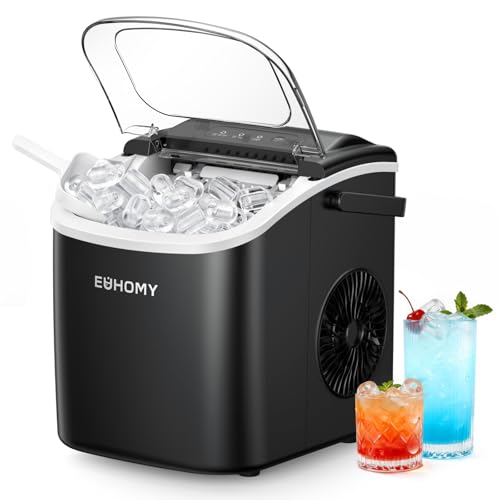
This EUHOMY is the machine that defines the sensible end of the category. It makes classic bullet ice at a verified 26 pounds per 24 hours, turns out nine cubes in about six minutes, includes an auto-cleaning function, and adds a carry handle so the unit can move between kitchen, office, and patio without a wrestling match. For most households’ daily drinks, this is all the ice maker they need.
Strengths
- Fast first batch — nine cubes in about six minutes, per the listing
- Auto-cleaning function simplifies the least-loved chore
- Carry handle and portable format suit flexible placement
Trade-offs
- Bullet ice only; nugget fans must look elsewhere on this list
- 26 lbs/day covers households, not large parties, without freezer backup
- Basket is insulated, not frozen — unused ice melts and remakes
| Ice type | Bullet ice (per verified listing) |
| Output | 26 lbs per 24 hours (per verified listing) |
| Batch | 9 cubes in about 6 minutes (per verified listing) |
| Extras | Auto-cleaning, carry handle (per verified listing) |
Bullet ice has an undeserved reputation as the boring option. Its hollow centre means it chills quickly and is gentle in blenders and soft drinks, and the two-size selection on machines of this style covers both tall glasses and water bottles. The EUHOMY’s six-minute first batch is the figure that matters at 6 p.m. when friends arrive early: you are never more than a few minutes from the first round of drinks, and production continues quietly in the background from there.
The honest limits are output and storage. Twenty-six pounds a day is generous for a family’s drinks but a barbecue with a cooler to fill will outrun it, so party hosts should make ice ahead and bag it in the freezer — a normal, sensible routine with any countertop unit. The auto-cleaning cycle is worth using on schedule, especially with hard water, because scale is the main long-term enemy of small ice machines. Treat this model as the household workhorse it is, and it is the easiest recommendation in the category.
Best for: Households wanting fast bullet ice without overspending / Not suited for: Nugget-ice fans or hosts filling coolers for big events
Check the current price on Amazon

Frigidaire Countertop Crunchy Chewable Nugget Ice Maker, 33 lbs per Day — Best Nugget Value
Not everyone who wants nugget ice wants the premium flagship. This Frigidaire splits the difference: genuine crunchy, chewable nugget ice at a verified 33 pounds per day, in a compact body that asks less of the counter than the side-tank designs. It is the pick for the nugget fan whose kitchen or budget rules out the top of the category.
Strengths
- Real nugget ice without the flagship tier
- 33 lbs/day output covers family plus guests
- Compact body suits smaller counters
Trade-offs
- No side tank, so refills are more frequent at full output
- Fewer connected features than the premium nugget machines
- Metallic finish shows splashes and needs wiping
| Ice type | Nugget, crunchy chewable (per verified listing) |
| Output | 33 lbs per day (per verified listing) |
| Format | Compact countertop (per verified listing) |
| Finish | Metallic (per verified listing) |
The value case here is about where the money goes. In this Frigidaire it goes into the nugget mechanism itself rather than tanks and connectivity, which is the right priority for a buyer who simply wants the ice style at home. Thirty-three pounds a day is a well-judged figure: comfortably beyond a household’s drinking needs, with headroom for a small gathering, especially if you bank a bag in the freezer the day before.
Set expectations on workflow. Without a side tank, heavy production days involve topping up the reservoir, and the sensible routine is to empty the basket into the freezer whenever it fills during a party rather than letting ice sit and melt back. The compact footprint is a genuine benefit in galley kitchens and apartments, where the flagship nugget machines can feel like installing furniture. For the buyer who has tasted nugget ice at a café and wants that exact thing at home without the flagship commitment, this is the balanced route in.
Best for: Nugget-ice fans with smaller counters or mid-range budgets / Not suited for: Hosts who need hands-off, high-volume production
Check the current price on Amazon

EUHOMY Nugget Ice Maker Countertop, 44 lbs/24H — Best for Entertaining
When the brief is volume — a house that entertains constantly, a home bar that never rests, an office kitchen with a crowd — this EUHOMY nugget model is the pick. Its verified 44 pounds per 24 hours is the highest nugget output on this list, the first ice arrives in seven to ten minutes, and self-cleaning plus the included scoop and basket keep the ownership side simple.
Strengths
- Highest nugget output here at 44 lbs/day, per the listing
- Self-cleaning function for easier upkeep at high use
- Scoop and basket included, per the verified listing
Trade-offs
- Built for volume; more machine than a quiet household needs
- High output means more frequent water refills on party days
- Nugget production is audible while running
| Ice type | Nugget / pebble (per verified listing) |
| Output | 44 lbs per 24 hours (per verified listing) |
| First ice | Ready in 7–10 minutes (per verified listing) |
| Extras | Self-cleaning, scoop and basket (per verified listing) |
Output figures need translating into real life. Forty-four pounds a day is roughly a full large bag of ice every day, produced continuously rather than in one load — which means the winning routine is to let the machine run ahead of demand and bank ice in freezer bags. Hosts who adopt that rhythm find the machine effectively unlimited for home purposes; hosts who switch it on when guests arrive will still be happy, because seven-to-ten-minute first ice is fast, but they will not see the machine at its best.
High-use machines reward high-use maintenance. Run the self-cleaning cycle on the maker’s schedule, descale more often if your water is hard, and keep the vents clear — a machine producing at this rate moves real heat. The black finish suits home bars and modern kitchens and hides the minor splashes of a busy drinks station better than pale finishes do. If your household’s ice demand is genuinely closer to a small café’s than a family’s, this is the countertop answer before stepping up to undercounter installations.
Best for: Frequent hosts, home bars, and busy shared kitchens / Not suited for: Quiet households making a few glasses of ice a day
Check the current price on Amazon

GE Profile Opal Mini Nugget Ice Maker — Best Compact
The Opal Mini answers the most common objection to nugget machines — their size. It keeps the essentials: soft chewable ice starting in about five minutes per the verified listing, a strong 36 pounds per day, a top-fill reservoir that is easy to pour into in place, and WiFi app control. What it gives up is the side tank, in exchange for a footprint small kitchens can actually accept.
Strengths
- Compact footprint for a genuine nugget machine
- Top-fill reservoir is easy to refill without moving the unit
- WiFi and app control, per the verified listing
Trade-offs
- No side tank, so heavy days mean more refills
- Still a premium-tier purchase despite the smaller size
- Output slightly below the full-size Opal
| Ice type | Nugget, chewable (per verified listing) |
| Output | 36 lbs/day (per verified listing) |
| First ice | In about 5 minutes (per verified listing) |
| Reservoir | Top-fill (per verified listing) |
The top-fill reservoir is a small design decision with daily consequences. Machines that must be pulled out from under cabinets to refill get refilled late and cleaned later; a top-fill unit under no such friction stays topped up and stays clean. Combined with app control, the Mini fits the pattern of apartment and small-kitchen life: schedule production for when you get home, keep the basket cycling, and never think about ice trays again.
Choose the Mini over the full Opal when counter depth is the binding constraint, and choose the full Opal when a side tank’s refill-free runtime matters more than footprint. Either way, the nugget texture is the same family of ice — soft, chewable, quick-chilling. For renters and small households who assumed nugget ice required a big kitchen, this model is the one that removes the excuse, provided the premium tier fits the budget honestly.
Best for: Apartments and small kitchens that want real nugget ice / Not suited for: Party hosts who need tank-fed, hands-off volume
Check the current price on Amazon

Silonn Ice Maker Countertop with Carry Handle — Best for Flexible Placement
Some kitchens do not have a permanent ice-maker spot — the machine needs to appear for the weekend and vanish on Monday. The Silonn is built for that life: a portable bullet-ice maker with a proper carry handle, self-cleaning, and the basket and scoop included, producing nine cubes in about six minutes when it is called into service.
Strengths
- Carry handle makes it genuinely portable between rooms and homes
- Self-cleaning keeps a sometimes-used machine hygienic
- Basket and scoop included, per the verified listing
Trade-offs
- Bullet ice only
- Portable format means modest basket storage
- Needs draining and drying before longer storage periods
| Ice type | Bullet ice (per verified listing) |
| Batch | 9 cubes in about 6 minutes (per verified listing) |
| Format | Portable with carry handle (per verified listing) |
| Extras | Self-cleaning, basket and scoop (per verified listing) |
Portability changes how an ice maker gets used. This is the machine that serves the garden party, the garage workshop, the holiday rental, and the dorm room across a single summer, because moving it is a one-hand decision rather than a project. The self-cleaning function matters more on a portable than on a fixed machine: a unit that sits stored between uses must be cleaned before storage and rinsed on revival, and a built-in cycle makes both habits realistic.
The routine that keeps a portable happy is simple: drain it after use, run the cleaning cycle on schedule, dry it with the lid open before storing, and give it a rinse cycle when it comes back out. Follow that and the machine avoids the stale taste that gives stored appliances a bad name. For a household whose ice demand is occasional but real — weekends, guests, hot spells — this format is honestly better matched than a permanent flagship, and the budget agrees.
Best for: Occasional hosts, renters, and multi-room use / Not suited for: Households wanting a permanent, always-on ice station
Check the current price on Amazon
Comparison Table
| Pick | Badge | Key spec | Best for |
|---|---|---|---|
| GE Profile Opal 2.0 Ultra Nugget Ice Maker | Best Overall | Nugget ice, 38 lbs/day, side tank | Nugget-ice devotees and regular entertainers |
| EUHOMY Countertop Ice Maker Machine with Handle, 26 lbs/24H | Best Budget | Bullet ice, 26 lbs/day, 6-min batch | Households wanting fast bullet ice without overspending |
| Frigidaire Countertop Crunchy Chewable Nugget Ice Maker, 33 lbs per Day | Best Nugget Value | Nugget ice, 33 lbs/day, compact | Nugget-ice fans with smaller counters or mid-range budgets |
| EUHOMY Nugget Ice Maker Countertop, 44 lbs/24H | Best for Entertaining | Nugget ice, 44 lbs/day | Frequent hosts, home bars, and busy shared kitchens |
| GE Profile Opal Mini Nugget Ice Maker | Best Compact | Nugget ice, 36 lbs/day, top-fill | Apartments and small kitchens that want real nugget ice |
| Silonn Ice Maker Countertop with Carry Handle | Best for Flexible Placement | Bullet ice, portable, self-cleaning | Occasional hosts, renters, and multi-room use |
Bullet ice vs nugget ice: which should you actually buy?
This is the category’s fork in the road, and it is about texture, not quality. Bullet ice is a hollow-centred, smooth cube produced by freezing water over chilled fingers. It is fast to make, gentle on drinks, works in every glass and bottle, and comes from the most affordable machines. For the majority of households it is the right answer, and its fans rarely think about ice again.
Nugget ice is made by compressing flaked ice into soft pebbles. It chills drinks extremely fast, is chewable rather than crunchy-hard, and absorbs a little flavour from the drink, which is why it has a cult following from café and fast-food culture. The machines cost more, run louder, and ask more maintenance. The honest test is personal: if you have ever chosen a drink shop because of its ice, buy nugget and do not look back. If ice has always been invisible to you, bullet machines will serve you perfectly for less.
How much daily output do you need?
Output figures in this category are quoted as pounds per 24 hours, and they describe continuous production, not storage. A household’s drinking ice typically runs to a few pounds a day; a machine rated around 26 pounds per day therefore has generous headroom for daily life. Gatherings change the maths: a drinks party for a dozen people, plus a cooler, can consume twenty pounds in an evening, which is why higher-output models exist and why banking ice in the freezer ahead of time is the professional routine at any output level.
Match the rating to your pattern rather than your biggest imaginable day. Daily overproduction is not free — the machine cycles, uses counter space, and needs cleaning in proportion to use. But underbuying is the more common regret, because ice demand clusters: the same households host repeatedly. If you entertain monthly or more, step up a class. If ice is for two people’s evening drinks, the sensible tier will delight you and leave budget for the drinks themselves.
Where will it live? Placement, water, and noise realities
Countertop ice makers need three things: a level surface, clearance for their vents, and a plan for water. None of these machines plumbs in; all are filled by hand, so the distance to the sink shapes your routine more than any specification. Top-fill reservoirs and side tanks exist precisely to soften that routine — judge them by your kitchen layout, not as abstract features.
Noise is the other lived reality. Production involves a compressor or fan, a water pump, and the percussion of ice dropping into a basket. Bullet machines are generally the quieter family; nugget machines work harder and sound like it. In an open-plan space, locate the machine away from the seating side of the counter and let it bank ice before guests arrive. Finally, remember the basket is insulated, not refrigerated: place the machine somewhere its melt-and-remake cycle will not surprise you, and never treat the basket as long-term frozen storage.
How to Set Up and Run a Countertop Ice Maker
Step 1 — Rest it upright. After transport, stand the machine upright on its final surface for a while before first use, so internal fluids settle — the same courtesy you give a refrigerator after moving it.
Step 2 — Rinse before the first batch. Wipe the basket, run a cleaning or plain-water cycle as the manual directs, and discard the first batch of ice. New machines can carry factory and packaging flavours that one sacrificial batch removes.
Step 3 — Fill to the line, with cold water. Fill the reservoir to its maximum line with fresh cold water. Overfilling risks spills during the freeze cycle; underfilling just means an earlier refill.
Step 4 — Choose your cube size if offered. Bullet machines often offer two sizes. Small cubes chill fast and suit bottles and children’s cups; large cubes last longer in a drink. Set it once for your household’s glasses.
Step 5 — Bank ice ahead of demand. For gatherings, start the machine hours early and move finished baskets into freezer bags. The freezer stores; the countertop produces. Combining the two is how small machines serve big evenings.
Step 6 — Keep vents clear and the lid routine clean. Leave breathing room around the unit, keep the scoop in its holder, and close the lid between servings so dust and kitchen odours stay out of the basket.
Step 7 — Drain before storage. If the machine will sit unused, drain it fully, run the cleaning cycle, and dry it with the lid open. A dry machine stores sweetly; a wet one does not.
How do you keep countertop ice tasting clean?
Ice tastes of whatever the machine has been breathing and holding, so cleanliness is flavour. Start with water: fresh, cold tap water in most homes, or filtered water where the tap supply is heavily chlorinated or very hard — you will taste the difference in a plain glass of water with ice, which is the purest test. Empty and rinse the reservoir whenever the machine will sit unused for more than a couple of days, because standing water is where stale flavours begin.
Then keep the calendar. Run the self-cleaning cycle if your machine offers one, on the maker’s schedule rather than your memory’s. Descale on the schedule your water hardness demands — hard-water homes may need it monthly — using the maker’s recommended solution, and always run plain-water rinse cycles afterwards until the ice tastes of nothing. Wash the basket and scoop in warm soapy water regularly; the scoop lives in the ice, so treat it like cutlery, and store it in its holder rather than buried in the basket where hands rummage.
Finally, manage the melt cycle. Ice that has melted and remade several times concentrates minerals and off-flavours, so on quiet weeks, empty the basket into drinks or the sink and let the machine start fresh. These are five-minute habits, and they are the entire difference between countertop ice that guests compliment and ice that quietly lets a good drink down.
Side tank, top-fill, or standard reservoir: which filling style suits you?
The filling routine is the interaction you will have with the machine every single day, so it deserves more weight than it usually gets in buying decisions. A standard reservoir, filled by lifting a basket or opening a lid and pouring carefully, is perfectly workable when the machine sits near the sink with open counter above it. It becomes a daily irritation when the machine lives under low cabinets, because every refill starts with pulling the unit forward.
A top-fill reservoir removes that friction: you pour from above, in place, often without opening anything beyond a small flap. In tight kitchens this is the difference between a machine that stays topped up and one that runs dry and gets cursed. A side tank takes the opposite approach — capacity instead of convenience of access. It suits a fixed installation where the machine is a drinks station: fill the tank, and production continues through a long evening untouched. The cost is footprint, permanently.
Choose by picturing your actual counter. If the machine will live under cabinets, prioritise top-fill or a tank. If it will live on an open island or bar counter, any style works and ice type should decide instead. And if the machine will travel — to a patio, a workshop, a rental — a compact standard reservoir in a handled body beats both, because tanks and travel do not mix.
What does owning one actually cost in effort? A realistic weekly routine
Daily effort is close to zero: glance at the basket, top up water when the level drops, and empty surplus ice into the freezer if the basket is full and the day is quiet. The machine otherwise runs its make-and-melt cycle unattended, and modern units signal when water is low or the basket is full rather than failing silently.
Weekly effort is a few minutes: wash the scoop and basket, wipe the exterior and the lid seal, and check the water in the reservoir is fresh — if the machine has been idle, replace it rather than topping up old water. Monthly effort, adjusted for your water hardness, is the cleaning and descaling cycle: run the maker’s cleaning programme or solution, rinse thoroughly with plain water cycles, and discard the first batch afterwards. In hard-water districts this monthly habit is what separates a five-year machine from a two-year one.
Seasonally, if the machine hibernates — a portable stored for winter, a holiday-home unit — drain it completely, clean it, and dry it open before storage, then rinse-cycle it on revival. Total honest effort across a year is a couple of hours, which is less than defrosting a freezer used to demand. Buyers who accept that routine get the category’s full benefit; buyers who want literally zero maintenance should stay with freezer ice and a good set of trays.
Countertop maker, freezer ice maker, or trays: an honest comparison
The built-in ice maker in a modern freezer is the invisible competitor here. It stores ice truly frozen, needs no counter space, and asks nothing but an occasional clean. Its weaknesses are pace and monopoly: it produces slowly, its bin is finite, and when it fails — usually at a party — the repair is a technician’s visit rather than a replacement appliance. Households whose freezer maker keeps up genuinely do not need this category.
Trays are the other honest baseline. They cost almost nothing, store truly frozen, and scale by buying more trays. Their costs are freezer space, planning, and the small daily labour of filling, carrying, and twisting. For a household that uses a handful of cubes a day, trays remain a perfectly rational answer, and this guide will not pretend otherwise.
A countertop machine wins when demand is spiky, social, or style-specific: the party that empties the freezer bin by the second round, the household that wants nugget ice no freezer makes, the renter whose freezer is too small for trays, the home bar that treats ice as an ingredient. It also wins as insurance — a portable unit that covers the freezer maker’s failure on the one weekend it matters. Judge the purchase against your spikes, not your averages, and the right answer usually becomes obvious.
How to read ice-maker specifications without being misled
Three numbers dominate these listings, and each needs translating. Pounds per 24 hours is a continuous-production figure measured in favourable conditions; your real yield will be a little lower in a hot kitchen, and — more importantly — it says nothing about storage, which is capped by the basket. Read it as pace, not capacity. Cubes per cycle and minutes per cycle describe the first-batch experience: nine cubes in six minutes means drinks for the first arrivals quickly, not a full basket in six minutes.
Basket capacity, where stated, is the number that governs a quiet evening: it is how much ice can sit ready. A machine with modest daily output but a basket you empty into drinks all evening will feel identical to a faster machine for household use. Conversely, a high-output machine with a small basket needs an owner who banks ice in the freezer, or its pace is wasted.
Finally, treat words like fast, quiet, and compact as unmeasured claims unless the listing ties them to a figure. The verified listings behind this guide state output, batch size, and timing explicitly, which is why those are the figures quoted in the spec boxes above. When you compare a model not listed here, demand the same three figures — output per day, cubes per cycle, minutes per cycle — and be wary of any listing that will not state them plainly.
Common Buying Mistakes
Expecting the basket to work like a freezer. It is insulated storage on a melt-and-remake cycle. Ice left for days shrinks and concentrates flavours. Move surplus to the freezer and treat the basket as a serving buffer.
Buying on output alone. A 44-pound rating does not help a two-person household, and a 26-pound rating does not fail a party if you bank ice ahead. Buy for your pattern, including ice style — style regret is far more common than output regret.
Ignoring the water routine. Every machine here is hand-filled. If the only possible spot is far from a sink, refills become a chore that breeds neglect. Choose placement and tank style around the refill you will actually perform.
Skipping descaling until the taste changes. By the time ice tastes wrong, scale is established. Follow the cleaning schedule for your water hardness from the first month, not the first symptom.
Running the machine tight against a wall. Vents pushed into a corner make any ice maker hotter, louder, and slower. A few centimetres of breathing room is a performance feature you control for free.
Storing the scoop in the ice. Hands follow scoops. Keep the scoop in its holder or on a clean hook, and wash it like the food-contact item it is.
Final Recommendation
Most nugget-ice households should start with the GE Profile Opal 2.0 Ultra — Best Overall, stepping down to the Frigidaire Nugget — Best Nugget Value for a mid-tier route or the GE Profile Opal Mini — Best Compact when the counter is small. Bullet-ice households get the category’s best value from the EUHOMY 26 lbs/24H — Best Budget, while serious hosts should look at the EUHOMY Nugget 44 lbs/24H — Best for Entertaining, and flexible households at the Silonn — Best for Flexible Placement.
Related guides worth your time: Best Counter Top Portable Ice Makers, Best Compressor Type Ice Cream Makers, and Best Ice Makers, plus Best Coffee Pots For Making Hot And Iced Coffee and Best Commercial Kitchen Faucets for the rest of the drinks station.
Frequently Asked Questions
Do countertop ice makers keep ice frozen?
No. The basket is insulated but not refrigerated, so ice slowly melts, the meltwater returns to the reservoir, and the machine remakes it into fresh ice. For storage beyond a few hours, move ice into bags in your freezer — the countertop machine is a producer, not a store.
How fast is the first batch of ice?
Bullet machines on this list produce their first nine cubes in about six minutes, and the nugget models start in roughly five to ten minutes, per their verified listings. Production then continues in cycles until the basket is full or the water runs out.
What is the difference between nugget and bullet ice?
Bullet ice is a smooth, hollow-centred cube that suits most drinks and comes from the most affordable machines. Nugget ice is compressed flaked ice formed into soft, chewable pebbles that chill drinks very fast and absorb a little flavour. Nugget machines cost more and need a little more maintenance.
How much ice does a household actually need per day?
Daily drinking ice for a household is usually only a few pounds, so a machine rated around 26 pounds per 24 hours has ample headroom. Parties are the exception: bank ice in the freezer ahead of gatherings, or choose a higher-output model if you entertain often.
Do these machines need a water line?
No. Every pick here is hand-filled from a reservoir or side tank, which is what makes them countertop appliances. The trade-off is refilling; side tanks and top-fill reservoirs exist to make that routine easier.
How often should I clean a countertop ice maker?
Run the self-cleaning cycle, if fitted, on the maker’s schedule, descale according to your water hardness — monthly is common in hard-water homes — and wash the basket and scoop regularly in warm soapy water. Clean machines make clean-tasting ice and last longer.
Can I use a countertop ice maker in an RV, office, or dorm?
Yes — that portability is one of the category’s strengths, and our companion guide to portable models covers it in depth. The requirements are a level surface, a standard outlet, and ventilation clearance. In an RV, run the machine while stationary and level, drain it before driving, and remember that production slows in a hot cabin, so banking ice in the freezer section ahead of a hot afternoon is the routine that works.