Disclosure: airfryerkitchensupply.com is reader-supported. When you buy through links on our site, we may earn an affiliate commission at no extra cost to you.
Where to buy
Every pick in this guide to the best coffee brewing vacuum coffee makers was cross-checked against Amazon’s own catalog data before it earned a place here. Use the links below to check price on Amazon for the current listing, confirm the exact model variant, and read the manufacturer’s own description before you order:
- Yama Glass 8-Cup Stovetop Siphon Coffee Maker — Best Overall: check price on Amazon
- Bodum ePebo Electric Vacuum Coffee Maker, 34 oz — Best Electric: check price on Amazon
- Hario Technica Coffee Syphon, 600 ml — Best for Enthusiasts: check price on Amazon
- Bodum Pebo Vacuum Coffee Maker, 34 oz — Best Stovetop Classic: check price on Amazon
- Nispira Belgium Royal Family Balance Syphon Coffee Maker, Copper 500 ml — Best Showpiece: check price on Amazon
- YUCHENGTECH Siphon Coffee Maker Tabletop, 5 Cup (600 ml) — Best Budget: check price on Amazon
The best coffee brewing vacuum coffee makers practice the most theatrical — and arguably the most delicious — brewing method ever put in a home kitchen. A vacuum brewer, or siphon, heats water in a lower chamber until vapor pressure drives it up into an upper chamber full of grounds; the coffee steeps there, fully immersed, at temperatures most drip machines never reach; then, as the heat comes off, the cooling vapor contracts and draws the finished coffee back down through a filter, leaving the grounds behind. The cup that results is famously clean, aromatic, and hot.
This is not the method for a programmable Tuesday, and this guide will not pretend otherwise. It is the method for people who find brewing pleasurable, who host, who collect beautiful functional objects, or who have tasted siphon coffee in a good café and want that clarity at home. Every pick below was verified against Amazon’s catalog data, and the six span the method’s whole range: the classic stovetop standard, an electric version for weekdays, a precision Japanese instrument, a family-size classic, a Belgian balance-siphon showpiece, and a budget door into the craft.
One safety note belongs at the top rather than buried: siphons combine glass, boiling water, and often an open flame. They are safe when handled with the ordinary respect those three things deserve — stable surfaces, dry hands, burners managed and never left unattended — and the how-to section in this guide walks the full routine step by step.
In this guide
Quick Picks
If you only read one section, make it this one. These are the six best coffee brewing vacuum coffee makers we would point a friend to, each chosen for a different kind of buyer:
- Best Overall: Yama Glass 8-Cup Stovetop Siphon Coffee Maker — 24 oz (8-cup) borosilicate glass siphon for stovetop use — the classic, proven vacuum brewer. Check the current price on Amazon.
- Best Electric: Bodum ePebo Electric Vacuum Coffee Maker, 34 oz — electric vacuum brewing with temperature control, 34 oz Tritan jug and borosilicate funnel. Check the current price on Amazon.
- Best for Enthusiasts: Hario Technica Coffee Syphon, 600 ml — 600 ml Japanese siphon from the glassware specialists — the enthusiast’s precision instrument. Check the current price on Amazon.
- Best Stovetop Classic: Bodum Pebo Vacuum Coffee Maker, 34 oz — 34 oz all-glass stovetop vacuum brewer, precisely calibrated, from the method’s best-known maker. Check the current price on Amazon.
- Best Showpiece: Nispira Belgium Royal Family Balance Syphon Coffee Maker, Copper 500 ml — 500 ml Belgian balance siphon — vintage gravity brewing system in copper finish, equal parts brewer and sculpture. Check the current price on Amazon.
- Best Budget: YUCHENGTECH Siphon Coffee Maker Tabletop, 5 Cup (600 ml) — 600 ml tabletop glass siphon in the Technica style at a starter price. Check the current price on Amazon.
How These Picks Were Chosen
Candidates had to be true vacuum brewers — two-chamber siphon systems in which vapor pressure moves the water and vacuum draws the brew back through a filter. Stovetop pots, percolators, and moka devices were excluded; they are fine methods, but they are not this one. Each qualifying model was verified in Amazon’s catalog and matched to its maker’s specification for capacity and materials.
The final six were chosen to span the method’s formats and budgets rather than to repeat one design six times: stovetop glass, electric, enthusiast tabletop, family-size glass, balance siphon, and budget glass. Prices are not printed — check price on Amazon on each listing — because glassware in this niche is promoted irregularly, and the gap between the budget pick and the showpiece is wide enough that your intended use, not a ranking, should decide.
The 6 Best Coffee Brewing Vacuum Coffee Makers, Reviewed
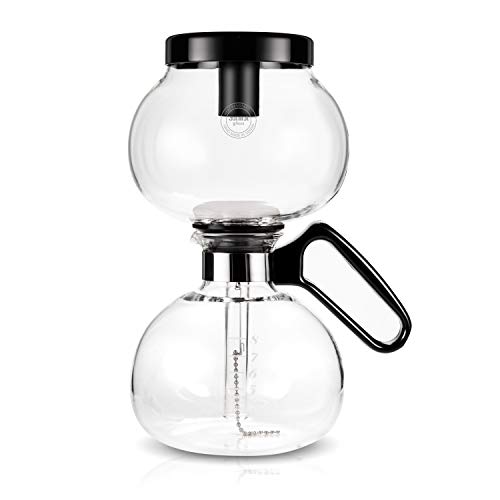
Yama Glass 8-Cup Stovetop Siphon Coffee Maker — Best Overall
The Yama 8-Cup is the siphon most people mean when they picture a vacuum coffee maker: two borosilicate glass chambers, a cloth filter between them, and a brew that happens in full view — water rising into the upper chamber, coffee steeping in a rolling, aromatic bath, then drawing back down through the filter as the vapor pressure relaxes. It is the best overall pick because it is the reference implementation of the method: proven, widely owned, and supported by a supply of replacement glass and filters that budget no-name siphons cannot match.
Strengths
- The classic vacuum brew: clean, hot, full-flavored cups
- Borosilicate glass with real replacement-part support
- 24 oz size suits two to four drinkers
Trade-offs
- Fully manual — ten attentive minutes per brew
- Glass chambers demand careful handling and washing
- Burner or stovetop management is part of the craft
| Capacity | 24 oz (8 cups) |
| Material | Heat-resistant borosilicate glass |
| Heat source | Stovetop (burner not included) |
The cup a siphon makes is distinctive: exceptionally clean, because the cloth filter holds back sediment that paper lets through, yet full-flavored, because the coffee steeps by immersion at a temperature that stays near boiling throughout — hotter and steadier than most drip machines ever manage. Drinkers who find drip coffee muddy and French press heavy tend to land on vacuum brewing as the method that finally tastes like the beans promised.
The ritual is the price of admission. A stovetop siphon wants your attention for its ten minutes: heat management as the water rises, a gentle stir, the draw-down watched rather than timed blindly. Owners describe this as the pleasure of the thing — it is brewing as a small performance, especially with guests — but nobody should buy one expecting a programmable machine’s indifference.
Yama’s advantage over the anonymous glass siphons is boring and decisive: replacement bowls, filters, and parts exist, the glass is genuinely borosilicate and heat-resistant, and the design has been refined across years of production. In a category made of fragile glass, the maker’s supply chain is a feature.
Best for: coffee lovers who want the definitive siphon experience and enjoy the ritual / Not suited for: anyone wanting push-button weekday coffee
Check the current price on Amazon for the Yama Glass 8-Cup Stovetop Siphon Coffee Maker.

Bodum ePebo Electric Vacuum Coffee Maker, 34 oz — Best Electric
The ePebo answers the obvious objection to siphon coffee — that it demands a stovetop, a burner, and a babysitter — by electrifying the whole process. Bodum’s electric base heats the water, the vacuum cycle runs as it should through the borosilicate funnel, temperature control keeps the brew in the ideal band, and the coffee lands in a Tritan jug that shrugs off the knocks that end glass carafes. It is vacuum brewing for people who love the cup and want it on a weekday.
Strengths
- Vacuum brewing without stovetop vigilance
- Temperature control for a repeatable cycle
- Durable Tritan jug survives daily handling
Trade-offs
- Less theatre than an all-glass siphon
- Premium price over stovetop models
- Counter appliance footprint
| Capacity | 34 oz |
| Format | Electric vacuum coffee maker |
| Jug | BPA-free Tritan plastic |
| Funnel | High-heat borosilicate glass |
| Control | Temperature control |
Automation changes the siphon’s character in one important way: consistency. A stovetop brew varies with your burner management; the ePebo’s controlled cycle repeats itself, so the second pot tastes like the first and Tuesday’s tastes like Saturday’s. For households that fell for vacuum coffee’s clarity but not its vigilance, that repeatability is the entire value proposition.
The Tritan lower jug is a considered trade: it loses the all-glass theatre of a classic siphon, and gains a chamber you can hand to a teenager, knock against a tap, and put through daily life without flinching. The glass funnel up top preserves the visual half of the ritual — you still watch the coffee rise, steep, and fall.
It costs more than a stovetop siphon and occupies counter like an appliance rather than living in a cupboard. Judge it as what it is: the only pick in this guide that makes vacuum coffee a routine rather than an occasion, from the brand that has championed the method for decades.
Best for: vacuum coffee lovers who want the cup quality on an electric, weekday-friendly machine / Not suited for: purists who want the full glass-and-flame ritual
Check the current price on Amazon for the Bodum ePebo Electric Vacuum Coffee Maker, 34 oz.
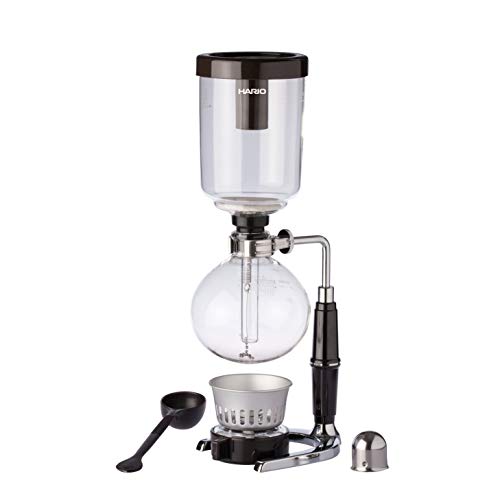
Hario Technica Coffee Syphon, 600 ml — Best for Enthusiasts
Hario is the name specialty coffee reaches for when glassware quality is the argument, and the Technica is its classic tabletop syphon: 600 ml of beautifully made Japanese glass, tolerances that seal exactly as they should, and a design refined for the way enthusiasts actually brew — with a small burner beneath, a bamboo paddle, and variables adjusted one at a time. If the siphon is a hobby rather than an appliance, this is the instrument the hobby is played on.
Strengths
- Superb Japanese glassware quality and fit
- Repeatable seals and draw-down for experimental brewing
- The enthusiast community’s reference siphon
Trade-offs
- 600 ml is a small batch for households
- Burner and accessories are part of the setup
- Glass demands hobbyist-grade care
| Capacity | 600 ml |
| Origin | Japanese glassware maker Hario |
| Format | Tabletop siphon (burner used beneath lower bowl) |
What precision buys in a siphon is control over the two moments that decide the cup: the steep, where grind and agitation set extraction, and the draw-down, where a clean, even pull through the filter separates a sweet cup from a stalled, over-extracted one. The Technica’s fit and finish — the seal between chambers, the filter assembly, the balance of the handle — make both moments repeatable, which is why it anchors so many enthusiasts’ benches.
The 600 ml size is a two-to-three-cup brewer, scaled for deliberate brewing rather than family volume. It pairs with a small alcohol or butane burner (managed carefully, as the safety notes in this guide insist), and its glass rewards the gentle handling that hobbyists give their equipment anyway.
Beginners can absolutely start here — the fundamentals are the same as the Yama’s — but the Technica makes most sense for the drinker who expects to experiment: different grinds, steep times, and agitation patterns, logged and compared. It is a precision tool bought for a pursuit, and judged by that standard it has few peers.
Best for: enthusiasts who brew siphon coffee as a craft and experiment with variables / Not suited for: families needing volume or beginners wanting the simplest start
Check the current price on Amazon for the Hario Technica Coffee Syphon, 600 ml.

Bodum Pebo Vacuum Coffee Maker, 34 oz — Best Stovetop Classic
The Pebo is Bodum’s classic all-glass stovetop vacuum brewer, and its calling card is calibration: Bodum has made vacuum brewers longer than almost anyone, and the Pebo’s chamber proportions and filter are tuned so the rise, steep, and draw-down happen in the sequence the method intends, without the fiddling cheaper glass siphons demand. At 34 ounces it is also one of the larger classic siphons — a family-sized pot from a single brew.
Strengths
- Family-size 34 oz capacity — rare among classic siphons
- Calibrated design from the category’s best-known maker
- Wide availability of filters and replacement parts
Trade-offs
- All-glass fragility, as with all classic siphons
- Manual stovetop process only
- Takes counter or cupboard space for its size
| Capacity | 34 oz |
| Material | High-heat borosilicate glass |
| Format | Stovetop vacuum coffee maker |
Size is a genuine differentiator in this category. Most tabletop siphons brew two or three cups; the Pebo’s 34-ounce capacity serves a table, which makes it the stovetop pick for households and hosts rather than solo hobbyists. The all-glass construction preserves the full visual ritual — there is no more theatrical legal way to make coffee in front of guests.
Bodum’s distribution is the practical advantage: filters, replacement parts, and the maker itself are stocked widely, and the design’s long production run means advice, recipes, and troubleshooting for it are easy to find. In a fragile-glass category, that ecosystem is worth real money.
It shares the format’s universal terms: manual heat management, careful washing, no timer, no mercy for the distracted. Within those terms, it is the stovetop classic against which the budget copies are measured — and the one to buy if the ritual will be performed for an audience of more than two.
Best for: households and hosts who brew vacuum coffee for a table / Not suited for: solo drinkers or the accident-prone
Check the current price on Amazon for the Bodum Pebo Vacuum Coffee Maker, 34 oz.
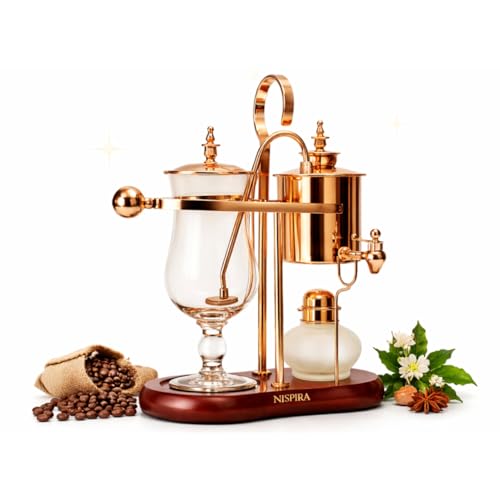
Nispira Belgium Royal Family Balance Syphon Coffee Maker, Copper 500 ml — Best Showpiece
The Belgian balance siphon is what happens when nineteenth-century engineering refuses to be improved: water heats in a sealed boiling chamber, vapor pressure pushes it through a tube into the brewing chamber, and when the boiling side empties, its rising counterweight snuffs the flame — letting cooling vapor draw the coffee back, filtered, into the serving chamber. The Nispira Royal, in copper at 500 ml, is the most theatrical coffee maker in this entire program of guides, and it also makes a genuinely lovely cup.
Strengths
- Unmatched theatre — a working piece of brewing history
- Counterweight mechanism automates the flame timing
- Makes a true, clean vacuum-brewed cup
Trade-offs
- 500 ml serves about two cups
- Most parts and seals to clean in this guide
- A display piece’s fragility and price
| Capacity | 500 ml |
| Format | Balance (Belgian royal) siphon |
| Finish | Copper, vintage style |
| System | Gravity vacuum brewing with counterweight mechanism |
Judge it first as an experience. A balance siphon brewing on a sideboard is a small mechanical ballet — flame, vapor, counterweight, draw-down — that guests remember long after they forget what was served with it. Hosts who love objects with stories will find it earns its space on presence alone, and the vintage copper finish is designed to live on display rather than in a cupboard.
The coffee itself is true vacuum brewing: full immersion, high temperature, a filtered draw-down, and the clean, bright cup the method is loved for. The mechanism’s automation — the counterweight extinguishing the flame at the right moment — is genuinely clever and removes one variable the stovetop siphons leave to you.
The terms are equally clear: 500 ml is a two-cup performance, the apparatus has more parts to wash and more seals to respect than any pick here, and it asks for the careful handling due to a display piece. Buy it as the centerpiece it is, and it will delight you; buy it as a weekday appliance and it will not survive your mornings.
Best for: hosts, collectors, and anyone who wants coffee making to be an event / Not suited for: daily family brewing or small, cluttered kitchens
Check the current price on Amazon for the Nispira Belgium Royal Family Balance Syphon Coffee Maker, Copper 500 ml.

YUCHENGTECH Siphon Coffee Maker Tabletop, 5 Cup (600 ml) — Best Budget
Every brewing method needs a low-priced door in, and for vacuum coffee this YUCHENGTECH tabletop siphon is it: a 600 ml, two-chamber glass siphon in the classic Technica layout, at a price that lets a curious drinker learn the method before committing to Yama or Hario money. The fundamentals are all present — upper and lower chambers, cloth filter, the rise and the draw-down — because the method itself is a century and a half old and belongs to no brand.
Strengths
- The real vacuum method at a starter price
- 600 ml — a practical two-to-three cup size
- Technique learned here transfers to any premium siphon
Trade-offs
- Glass and fittings a step below Hario and Yama
- Replacement glass not widely stocked
- Budget hardware demands gentler handling
| Capacity | 5 cups (600 ml) |
| Format | Tabletop glass siphon |
| Style | Technica-style two-chamber design |
What the budget buys and what it does not is worth stating precisely. It buys the real process and a real vacuum-brewed cup: immersion at high temperature, filtered on the draw-down, with the clarity the method promises. First-time siphon drinkers will taste exactly why people love these brewers, and the technique learned on this glass transfers unchanged to any premium siphon later.
It does not buy refinement: glass tolerances, handle fit, and filter hardware on budget siphons are a step below Hario’s, replacement chambers are not stocked the way Yama’s are, and a clumsy knock is more likely to end the brewer’s life. Treat it as tuition — a semester of siphon brewing at a fair price — and it is excellent value; treat it as a lifetime purchase and the premium picks above exist precisely for you.
Pair it with a suitable small burner, handle it like the glass instrument it is, and follow the safety routine in this guide. As a first siphon, it is the sensible place to start.
Best for: curious drinkers who want to learn siphon brewing before investing / Not suited for: buyers expecting a decades-long, heirloom instrument
Check the current price on Amazon for the YUCHENGTECH Siphon Coffee Maker Tabletop, 5 Cup (600 ml).
Comparison Table
| Pick | Badge | Key spec | Best for |
|---|---|---|---|
| Yama Glass 8-Cup Stovetop Siphon Coffee Maker | Best Overall | 24 oz (8-cup) borosilicate glass siphon for stovetop use — the classic, proven vacuum brewer | coffee lovers who want the definitive siphon experience and enjoy the ritual |
| Bodum ePebo Electric Vacuum Coffee Maker, 34 oz | Best Electric | electric vacuum brewing with temperature control, 34 oz Tritan jug and borosilicate funnel | vacuum coffee lovers who want the cup quality on an electric, weekday-friendly machine |
| Hario Technica Coffee Syphon, 600 ml | Best for Enthusiasts | 600 ml Japanese siphon from the glassware specialists — the enthusiast’s precision instrument | enthusiasts who brew siphon coffee as a craft and experiment with variables |
| Bodum Pebo Vacuum Coffee Maker, 34 oz | Best Stovetop Classic | 34 oz all-glass stovetop vacuum brewer, precisely calibrated, from the method’s best-known maker | households and hosts who brew vacuum coffee for a table |
| Nispira Belgium Royal Family Balance Syphon Coffee Maker, Copper 500 ml | Best Showpiece | 500 ml Belgian balance siphon — vintage gravity brewing system in copper finish, equal parts brewer and sculpture | hosts, collectors, and anyone who wants coffee making to be an event |
| YUCHENGTECH Siphon Coffee Maker Tabletop, 5 Cup (600 ml) | Best Budget | 600 ml tabletop glass siphon in the Technica style at a starter price | curious drinkers who want to learn siphon brewing before investing |
How does vacuum brewing actually work — and why does it taste different?
The cycle has four acts. Water in the sealed lower chamber heats; expanding vapor presses on the water’s surface and forces it up a tube into the upper chamber, where the grounds wait. There the coffee steeps by full immersion — every ground surrounded by water at a temperature that stays near the top of coffee’s ideal band, because the system is sealed and actively heated. When the heat is removed, the vapor in the lower chamber cools and contracts, and the resulting vacuum pulls the brewed coffee down through the filter. The grounds stay up top; the cup below is finished.
Two of those acts explain the flavor. Immersion at high, steady temperature extracts evenly and completely — there are no dry pockets and no channeling, the twin flaws of drip brewing. And the draw-down through a cloth filter produces a cup with the body of an immersion brew and a clarity closer to paper-filtered coffee, because cloth holds back the fine sediment that clouds a French press.
The method’s demands follow from the same physics: the brewer is glass because you need to see the cycle, the heat must be managed because you are the thermostat, and the whole performance takes about ten minutes. Drinkers who love the cup accept those terms gladly; this guide’s electric pick exists for those who love the cup and not the terms.
Stovetop, tabletop burner, electric, or balance: which siphon format suits you?
Stovetop siphons like the Yama and the Bodum Pebo use the burner you already own, store in a cupboard, and brew the largest volumes — the natural choice for households and for anyone whose kitchen already runs on gas or a good electric hob. Their skill requirement is heat judgment: too fierce a boil makes a turbulent, over-extracted steep; too gentle and the water will not rise completely.
Tabletop siphons like the Hario and the budget YUCHENGTECH pair with a small separate burner and live as a dedicated brewing station — the enthusiast’s format, offering the finest heat control and the most deliberate ritual. Electric siphons like the Bodum ePebo trade the flame for a controlled heating base and repeatability, at appliance prices and with counter permanence. Balance siphons like the Nispira are a format apart: part brewer, part kinetic sculpture, bought for the ceremony as much as the cup.
Choose by where the brewer will live and who will watch it brew. A siphon stored in a dark cupboard gets used monthly; a siphon living on a counter or sideboard gets used weekly. In this category more than any other in our coffee coverage, display is a feature — buy the one you will enjoy looking at.
What grind and ratio work best in a vacuum brewer?
Start with a medium grind — finer than French press, coarser than drip — because the draw-down is the constraint: too fine a grind stalls the vacuum’s pull and over-extracts into bitterness while it struggles; too coarse and the steep under-extracts before the coffee falls. Most siphon drinkers settle a notch finer than their drip setting and adjust from the draw-down’s behavior, which is the brewer’s own feedback mechanism: a healthy draw completes smoothly in well under a minute once the heat is off.
For ratio, begin around one part coffee to fifteen parts water by weight — roughly four level tablespoons for the 600 ml brewers in this guide — and adjust to taste over several brews. Siphon coffee’s clarity can make a familiar ratio taste lighter than it does in a press, and many drinkers settle slightly stronger than their drip habit.
Water and beans carry their usual weight, amplified: a method this clean shows stale beans and off-flavored water without mercy. Fresh beans, ground moments before brewing, and water you would happily drink on its own are not refinements in siphon brewing — they are the price of the clarity you bought the brewer for.
Is siphon coffee safe? Glass, flame, and boiling water, handled properly
A vacuum brewer concentrates three ordinary kitchen hazards — thin glass, boiling water, and frequently an open flame — into one appliance, and it deserves a clear-eyed paragraph rather than either fear or dismissal. The glass on every pick in this guide is borosilicate, formulated for thermal shock, and it fails almost exclusively from mechanical knocks or from being heated dry — both preventable by inspection and attention. Check chambers for chips or cracks before each brew, and retire any piece that has taken a hard knock, however intact it looks.
Flame discipline is the second half. Use the burner size the brewer expects, keep the flame under the lower chamber rather than licking up its sides (which overheats the handle and the seal), never leave a lit siphon unattended, and let everything cool before washing — glass that feels merely warm can still crack under cold tap water. Electric and stovetop users trade flame risk for the ordinary cautions of any boiling appliance.
Handled this way — the way cafés that brew siphons all day handle them — vacuum brewing is a safe, well-understood method with a century and a half of domestic history. The drinkers who get hurt by kitchen equipment are the distracted and the hurried, and a siphon honestly announces, by its nature, that it is not equipment for either.
Cloth, paper, or metal: which siphon filter should you use?
Most siphons ship with a cloth filter, and cloth is the traditional choice for a reason: it produces the method’s signature cup — clean, yet with enough of the coffee’s oils passing to keep the body generous. Cloth asks for care in return: rinse it after every brew, store it damp in water in the refrigerator as longtime siphon users do, and replace it when it darkens or holds odors, because an old cloth filter will flavor a pot more surely than any other part of the brewer.
Paper filters, where a brewer accepts them, give the cleanest and lightest cup and the easiest cleanup — the choice for drinkers whose ideal is clarity above all. Metal mesh filters are the zero-maintenance option and let the most sediment through, pushing the cup toward French press character; some drinkers prefer exactly that weight.
There is no correct answer, only a cup you are aiming at. New owners should brew the first month on the supplied cloth, learn the method’s baseline flavor, and then experiment — the filter is the cheapest variable in the entire setup and the one most drinkers never think to change.
A brief history of the vacuum pot — from 1830s salons to your counter
Vacuum brewing is nearly two centuries old: the first patents date to the 1830s, and by the late nineteenth century the balance siphon — the Nispira’s ancestor — was performing its counterweight ballet in European salons, as much entertainment as appliance. The method crossed to America, where makers like Cory and Silex put glass vacuum brewers in ordinary kitchens, and to Japan, where cafés refined the tabletop siphon into the precise ritual the Hario Technica still serves.
Drip machines displaced the siphon in the postwar decades on convenience alone — nobody disputes that a programmable pot is easier at 6 a.m. What the specialty coffee revival rediscovered is that the siphon never lost on flavor: immersion at high temperature with a filtered draw-down is, by the physics, one of the most even extractions available in a home. The method’s modern return is a connoisseur’s correction, not nostalgia.
Knowing the history improves the buying decision. These are mature, settled designs — the Yama and Pebo are not prototypes, and the balance siphon’s mechanism predates the light bulb. Buy the format whose century-old trade-offs match your mornings, and you are joining a long line of drinkers who made the same calculation.
What should you serve siphon coffee in — and with what?
A brewing method this aromatic deserves thirty seconds of thought about the cup. Siphon coffee is served immediately at high temperature and its clarity is its glory, so choose vessels that do not fight it: a warmed, medium-weight ceramic cup that holds heat without masking aroma, in a size that lets a 600 ml brew pour as two generous cups rather than four apologetic ones. Pre-warming matters more here than with drip, because the coffee arrives with no carafe to keep it and loses its edge quickly in a cold cup.
Food pairing follows the cup’s character: clean, bright coffee flatters rather than bulldozes, so it sits beautifully beside pastries, fruit, and the lighter end of a brunch table where a heavy press pot would dominate. Hosts who brew the balance siphon for guests usually discover the coffee becomes the course — served after the meal, performed at the table, remembered longer than dessert.
Finally, serve the whole pot. Siphon coffee does not hold: the same clarity that makes it extraordinary fresh makes it fade faster than drip in a thermal carafe. Brew the size the table will drink — one of the quiet virtues of this guide’s range of capacities — and let the method’s ephemerality be part of its ceremony.
How to Brew Coffee in a Vacuum Siphon, Step by Step
This is the classic stovetop and tabletop routine; the electric ePebo automates the heating steps, and the balance siphon automates the flame timing, but the coffee handling is identical:
- Prepare the filter and water. Fit the cloth filter in the upper chamber and draw its chain or hook through the tube so it seats snugly. Fill the lower chamber with fresh hot or cold water to the brewer’s measure — starting with hot water from a kettle shortens the stovetop phase and steadies the cycle.
- Assemble and add coffee. Set the lower chamber over its heat source, add medium-ground coffee to the upper chamber, and seat the upper chamber on the lower with its seal firm — but do not push it fully down if your brewer’s design calls for a loose seat until the water rises; follow your model’s design, as Yama, Hario, and Bodum differ slightly here.
- Heat and watch the rise. Bring the water up steadily. As vapor pressure builds, water climbs the tube and fills the upper chamber; when nearly all of it has risen, reduce the heat to the lowest setting that keeps the water up — you want a gentle, rolling steep, not a violent boil.
- Steep and stir. Let the coffee steep for about a minute to ninety seconds in the upper chamber, stirring once, gently, to wet any dry crust of grounds. This immersion is where the siphon’s even extraction happens.
- Remove the heat and watch the draw-down. Take the brewer off the flame or switch the burner off. As the lower chamber cools, the vacuum draws the coffee down through the filter; a healthy draw-down flows smoothly and finishes with the grounds settled in a gentle dome in the upper chamber. If it stalls, your grind is likely too fine — note it for next time.
- Serve at once, then handle glass with respect. Remove the upper chamber (a stand or heat-proof surface receives it), pour immediately into warmed cups, and let all glass cool fully before washing in warm water. Never move a hot siphon by its upper chamber, and never set hot glass on a cold or wet surface.
Your first three brews are calibration, not judgment: adjust one variable at a time — grind first, then steep time, then ratio — and the method will come into focus quickly. Siphon drinkers keep a small notebook for a reason; a month of notes turns a performance into a repeatable, personal recipe.
Common Buying Mistakes
Grinding too fine and stalling the draw-down. The classic beginner error. A stalled draw over-extracts and can stress the glass with pressure differences. Start medium, adjust gradually.
Heating an empty or near-empty lower chamber. Dry heat is how borosilicate dies. Water in first, always, and never walk away from a lit siphon.
Boiling the steep violently. A rolling, turbulent steep over-extracts and can push grounds past the filter. Once the water is up, the heat goes to its gentlest setting.
Washing hot glass under cold water. Thermal shock cracks even borosilicate. Let the brewer cool until it is comfortable to hold before washing.
Neglecting the cloth filter. A sour, stained cloth will flavor every pot. Rinse after each brew, store damp and cold, replace when it darkens.
Buying the showpiece as a daily appliance. The balance siphon is a ceremony for two, not a family workhorse. Match the format to the use or the magic curdles into resentment.
Final Recommendation
For most buyers, the Yama 8-Cup is the right first — and possibly only — siphon: the classic design, real parts support, and a size that serves a small table. The Bodum ePebo is the pick when the cup matters more than the ceremony and weekdays matter most; the Hario Technica when the brewing itself is the hobby; the Bodum Pebo when the table is larger. The Nispira balance siphon is the gift, the centerpiece, and the conversation — buy it for exactly those reasons — and the YUCHENGTECH is the honest, inexpensive way to find out whether this method is for you at all.
Every pick was verified against Amazon’s catalog data before inclusion. Check price on Amazon for the current figure, keep the safety routine in this guide taped inside a cupboard door for the first month, and give the method three brews before you judge it — the fourth pot of siphon coffee is the one that converts people.
Keep exploring the rest of our coffee coverage: Best Coffee Brewing Vacuum Coffee Makers Best Ceramic Pour Over Coffee Makers Best Coffee Brew Makers Best Coffee And Tea Makers Best Carafeless Coffee Makers
Frequently Asked Questions
Is vacuum coffee better than drip coffee?
Different, and by many drinkers’ judgment better in specific ways: fuller extraction from immersion at high temperature, and greater clarity from the filtered draw-down. Drip wins on convenience, volume, and programmability — which is why many households own both and use each for what it does best.
How long does siphon brewing take?
About ten minutes from cold water, less if you start with kettle-hot water — and it wants your attention for most of that time. The electric ePebo in this guide removes the supervision while keeping the method.
Is a vacuum coffee maker fragile?
It is glass, and it asks for the handling glass deserves: no knocks, no dry heat, no cold water on hot chambers. Treated that way, borosilicate siphons serve for years — the designs in this guide have decades of household history behind them.
What coffee should I buy for a siphon?
Fresh whole beans, ground medium just before brewing. The method’s clarity flatters fresh, well-roasted coffee and exposes stale beans mercilessly, so buy in quantities you finish within a few weeks.
Can I use a siphon on an induction or electric stovetop?
Glass siphons suit gas and most electric hobs; induction requires a compatible diffuser plate, and many owners use a small tabletop burner instead for finer control. The electric ePebo sidesteps the question entirely with its own heating base.
Why did my draw-down stall?
Almost always a grind that is too fine, or a filter seated unevenly. Coarsen the grind slightly, seat the filter carefully, and keep the steep gentle — a healthy draw-down completes smoothly once the heat comes off.
How do I clean a vacuum coffee maker?
Let it cool fully, remove the upper chamber, knock the grounds out, and wash both chambers in warm soapy water. Rinse the cloth filter thoroughly after every brew and store it damp in the refrigerator, replacing it when it darkens or holds odors.
How many cups does a vacuum coffee maker make?
In this guide, from about two cups for the 500 ml balance siphon to a family pot from the 34 oz Bodum Pebo. Note that siphon ‘cups’ are small — roughly four to five ounces — so a ‘5-cup’ tabletop model pours as two generous mugs. Buy by ounces, not by the cup number on the box.
Is siphon coffee a good gift?
For a coffee lover, one of the best: it is beautiful, storied, and makes a genuinely distinctive cup. Pair the Yama or Hario with fresh beans and a small burner if the recipient lacks one, and choose the balance siphon when the gift is meant to be an occasion in itself.


