Disclosure: airfryerkitchensupply.com is reader-supported. When you buy through links on our site, we may earn an affiliate commission at no extra cost to you.
Where to buy
Shopping for the best ceramic smoker grills? Start with the verified shortlist below. A ceramic smoker grill is a long-term purchase delivered as heavy freight, so buy where the returns process protects you against transit cracks — Amazon, for most readers. Every linked pick below was confirmed against Amazon’s catalog, and you should check price on Amazon rather than trust any static figure, because this category’s pricing swings with the seasons and we do not print prices. If a pick’s deflector or smoking accessories are sold separately, we say so in its review, because the honest cost of a smoker setup includes them.
- GRILLA Grills Kong Ceramic Kamado Grill — check price on Amazon
- Kamado Joe Classic Joe Series II, 18 Inch — check price on Amazon
- Kamado Joe Classic Joe I, 18 Inch — check price on Amazon
- London Sunshine 15-Inch Ceramic Kamado — check price on Amazon
- AUPLEX Yakitori Ceramic Charcoal Grill, 16 Inch — check price on Amazon
- Char-Griller AKORN Kamado, 20 Inch — check price on Amazon
The best ceramic smoker grills solve the oldest problem in barbecue: holding a low, even temperature for twelve hours without a human being chained to the fire. A thick ceramic body is a thermal flywheel — once it is soaked at smoking temperature it shrugs off wind, cold and charcoal variation that would send a thin metal smoker swinging — and it does it on a fraction of the fuel. This guide ranks ceramic grills specifically as smokers: temperature stability, capacity for briskets and rib racks, deflector and drip management, and the ash and gasket details that decide whether an overnight cook is restful or miserable. Every linked pick is verified through Amazon’s catalog data; anything we could not verify is labelled unlinked.
In this guide
Quick Picks
GRILLA Grills Kong Ceramic Kamado Grill — Best Overall Smoker
Capacity plus flywheel mass: around 600 square inches and a big ceramic body that holds smoking temperature like a bank vault. For briskets, multiple butts and rib racks without gymnastics, this is the smoker to beat.
Kamado Joe Classic Joe Series II, 18 Inch — Best for Serious Home Smoking
The precision instrument: best-in-class gasket and vent control, a two-tier system that doubles rib capacity, and an ash drawer that keeps long-season maintenance trivial. The smoker for cooks who value control over raw size.
Kamado Joe Classic Joe I, 18 Inch — Best Value Smoker
The same ceramic body and two-tier smoking system as the flagship, at a friendlier tier. If your budget is split between grill and the meat that goes in it, this is the thinking smoker’s buy.
London Sunshine 15-Inch Ceramic Kamado — Best Compact Smoker
Small-format smoking done properly: thick ceramic, a tall wheeled stand, and the fuel economy of a little egg. For couples smoking a butt or a rack or two, it is all the smoker they need.
AUPLEX Yakitori Ceramic Charcoal Grill, 16 Inch — Best for Hot-and-Fast Smoke-Kissed Cooking
Included with clear eyes: this is not a low-and-slow smoker. It is a thick-walled ceramic tabletop grill whose wood-and-charcoal kiss on skewers, wings and small cuts delivers smoke flavour in minutes — the pick for smoke flavour without the twelve-hour commitment.
Char-Griller AKORN Kamado, 20 Inch — Best Budget Smoker Alternative (Insulated Steel)
Not ceramic — labelled plainly. The AKORN’s insulated steel body holds smoking temperatures respectably for a budget tier, fits family-size cuts on a 20-inch grate, and costs what ceramic accessories do. The starter smoker we recommend without embarrassment.
How These Picks Were Chosen
We judged these grills as smokers first and grills second. The criteria, in order: low-temperature stability over long cooks, which is a function of ceramic mass, gasket sealing and vent precision; usable smoking capacity with a deflector fitted, since the deflector eats vertical space; fuel efficiency across an overnight cook; and cleanout design, because ash management mid-season decides whether you smoke often or rarely.
Each candidate had to be confirmable — Amazon title matched to model — before it could carry a link. That verification discipline is why the list leans on Kamado Joe, GRILLA and London Sunshine ceramics whose listings we could confirm, plus one honestly-labelled insulated-steel alternative for budget buyers. Heritage names without confirmable listings are discussed qualitatively in the guide sections rather than given invented links.
We also weighted real smoking workflow: can you add a water or drip pan, fit a rib rack, run a temperature probe through the gasket without crushing the cable, and refuel or add wood without dismantling the cook? On paper many grills smoke; in the backyard at 2 a.m., these details are the whole game.
The 6 Best Ceramic Smoker Grills for Low and Slow

GRILLA Grills Kong Ceramic Kamado Grill — Best Overall Smoker
The Kong is the pick for the smoker who cooks volume: two pork butts and a brisket in one session, four racks of ribs laid flat, a holiday turkey with room for the drippings pan. Space is a smoking feature, not a luxury — meat needs airflow around it, and crowded smokers produce steamed, uneven barbecue. The Kong’s mass also means the steadiest long-cook temperatures in this guide once it settles.
Strengths
- Around 600 sq in fits briskets and multiple butts properly
- Huge ceramic mass equals outstanding temperature stability
- Adjustable vent gives fine low-end control
Trade-offs
- Long heat-soak: overshoots take time to correct
- Big footprint and heavy — a permanent patio resident
- Burns more charcoal per cook than a small kamado
| Cook space | 600 sq in (per Amazon title) |
| Max temperature | 700°F (per Amazon title) |
| Construction | Ceramic kamado with adjustable vent |
| Mobility | EZ Glide wheel system |
Overnight brisket is where the Kong justifies itself. Load the firebox fully, light one spot, park the vents, and the big ceramic body rides through the night with the kind of stability that lets you sleep — the cook that defines whether a household smokes monthly or twice a year. The roomy interior also fits a full drip pan under the grate without crowding the deflector setup, which keeps the inside cleaner and the drippings usable.
The discipline it demands is patience at startup: bring it up slowly, because correcting an overshoot in this much ceramic is a long negotiation. Start your fire earlier than a kettle cook would and let the mass work for you. Check price on Amazon — as a direct-brand grill, its bundles and seasonal offers change the value equation often.
Best for: Briskets, batch smoking and overnight cooks for a crowd / Not suited for: Small patios or impatient startup routines
Check on Amazon — check price on Amazon before you buy, because grill-season pricing moves around.

Kamado Joe Classic Joe Series II, 18 Inch — Best for Serious Home Smoking
Choose the Classic II if your smoking is about craft on family scale: one brisket or butt cooked perfectly, ribs on two tiers, a chicken spatchcocked above its own dripping vegetables. The upgraded gasket is the smoking feature — low-temperature stability lives and dies on air leaks, and this grill seals like it means it. The counterbalanced hinge matters at hour ten when you are lifting the lid one-handed with a probe in the other.
Strengths
- Excellent gasket seal for steady low temperatures
- Two-tier system doubles rib and wing capacity
- Ash drawer keeps a heavy smoking season low-effort
Trade-offs
- 250 sq in still limits true batch cooking
- Deflector and accessories add to the total (check price on Amazon)
- Premium tier pricing
| Cooking area | 250 sq in (per Amazon title) |
| Format | 18-inch ceramic grill and smoker |
| Grates | Stainless steel, 2-tier system |
| Model | KJ-23RHC with cart and side shelves |
Smoking exposes vent quality mercilessly, and the Series II’s top vent — which holds its setting when the lid opens — plus its tight gasket produce the flattest temperature graph of the 18-inch class. That flatness is flavour: no spikes to toughen bark, no dips to stall a butt for extra hours. The two-tier Divide & Conquer setup lets you run ribs up high in the dome’s gentle heat while a butt rides low, a flexibility single-grate eggs cannot match.
The ecosystem completes the case for the serious home smoker: deflectors, expansion racks and a rotisserie all exist and fit properly. Budget the full smoking kit — deflector, drip pans, a leave-in probe thermometer — alongside the grill. Owners who do tend to describe this grill the way musicians describe a good instrument: it disappears, and only the cooking remains.
Best for: Craft-focused home smokers cooking for family and friends / Not suited for: Batch cooks for very large groups
Check on Amazon — check price on Amazon before you buy, because grill-season pricing moves around.

Kamado Joe Classic Joe I, 18 Inch — Best Value Smoker
The Classic I is for the smoker who would rather spend the savings on briskets. Its ceramic body holds low temperatures with the same composure as the Series II — that stability comes from the shell, not the trim — and the two-tier system gives identical cooking geometry. You manage ash with the included tool instead of a drawer, lift a lid without counterbalance assistance, and maintain a gasket of an older generation. The barbecue does not know the difference.
Strengths
- Full ceramic smoking stability at a lower tier
- Two-tier system included for rib capacity
- Cart, shelves, gripper and ash tool in the box
Trade-offs
- Gasket needs seasonal attention to keep low temps honest
- Manual ash removal before long cooks is non-negotiable
- Heavier-feeling lid during long sessions
| Cooking area | 250 sq in (per Amazon title) |
| Format | 18-inch ceramic grill and smoker |
| System | 2-tier cooking system |
| Model | KJ23RH with cart and side shelves |
Every dollar of the Classic I’s discount lives in convenience hardware, which makes it the easiest value call in this guide for a patient owner. The smoking ritual it asks — clean the ash, check the gasket twice a year, set vents a touch earlier — is the ritual traditional kamado owners have always kept, and the results on the plate are the flagship’s results. Pair it with a good dual-probe thermometer and you have closed most of the practical gap to the Series II for long cooks.
One honest caution: gasket condition is destiny on this model. A fresh, well-seated gasket holds a low fire beautifully; a frayed one leaks air and makes temperatures wander, which owners sometimes misdiagnose as a grill problem. Replacement gaskets are inexpensive and the job takes twenty minutes — treat it as scheduled maintenance and this grill smokes superbly for years.
Best for: Value-minded smokers who keep up basic maintenance / Not suited for: Set-and-forget owners who skip gasket and ash care
Check on Amazon — check price on Amazon before you buy, because grill-season pricing moves around.
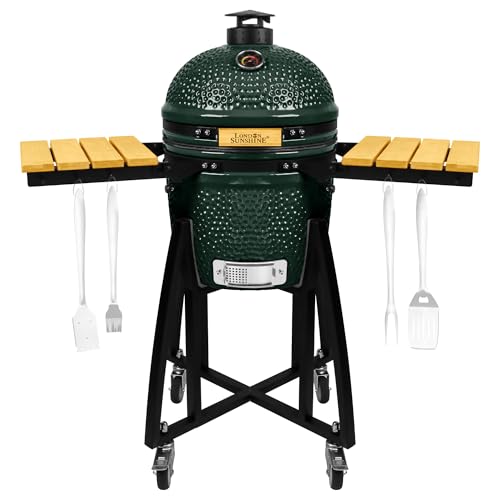
London Sunshine 15-Inch Ceramic Kamado — Best Compact Smoker
The London Sunshine suits the small household that smokes seriously but in small formats: a 4-pound pork shoulder, ribs in a rack, a whole chicken, salmon fillets. Its ceramic walls give big-grill stability, and the small air volume means a tiny charcoal load runs for hours — the cheapest long cooks in this guide. The tall stand and locking casters make it a civilised patio resident rather than a floor-level crouch.
Strengths
- Genuine ceramic stability in a 15-inch footprint
- Outstanding fuel economy on small cooks
- Tall stand with locking casters and folding shelves
Trade-offs
- No full briskets; ribs need a rack or halving
- Newer brand — verify gasket and parts support
- Small firebox means long cooks need a full, careful load
| Format | 15-inch ceramic kamado smoker-grill |
| Stand | Tall stand with locking casters |
| Shelves | Foldable side shelves |
| Grates | Stainless steel |
Small kamados are the efficiency champions of smoking. With less air to heat and thick walls to hold it, the London Sunshine settles quickly and sips lump charcoal — an overnight small cook can run on what a big grill uses to preheat. For a two-person household that smokes twice a month, the running-cost and storage advantages over an 18-inch grill are real, and the barbecue quality on small cuts is indistinguishable.
Technique adapts to the format: choose a rib rack, trim butts to fit with airflow around them, and load the firebox thoughtfully since there is less margin for a mid-cook refuel (which, in fairness, ceramics rarely need). Buy a cover, confirm the gasket supply when you order, and this little egg will quietly out-smoke metal smokers three times its price.
Best for: Couples and small households smoking small cuts / Not suited for: Whole briskets or party volumes
Check on Amazon — check price on Amazon before you buy, because grill-season pricing moves around.

AUPLEX Yakitori Ceramic Charcoal Grill, 16 Inch — Best for Hot-and-Fast Smoke-Kissed Cooking
Choose the AUPLEX if your idea of smoked food is yakitori-style: skewers, chicken wings, mushrooms and small seafood kissed by real charcoal smoke and eaten as they come off the grill. The 3.5cm ceramic walls radiate stored heat so small pieces cook evenly and pick up smoke quickly, and the fast stated heat-up makes it a weeknight tool. It earns its place in a smoker guide as the honest alternative for people who want the flavour, not the hobby.
Strengths
- Real charcoal smoke flavour in minutes, not hours
- Thick ceramic walls cook small pieces evenly
- Tabletop format with heat shield for social cooking
Trade-offs
- Cannot hold low-and-slow temperatures for brisket or butt
- Small capacity — graze-format cooking only
- Open format means smoke exposure depends on the charcoal and wood you choose
| Size | 16-inch square tabletop (per Amazon title) |
| Ceramic thickness | 3.5cm (per Amazon title) |
| Heat-up | 350°C / 662°F in 15 min (per Amazon title) |
| Capacity | Fits 2–5 people (per Amazon title) |
Smoke flavour is chemistry, not duration: the compounds that make barbecue taste smoked deposit fastest on cool, moist surfaces in the first part of a cook. A hot ceramic grill with a chunk of smouldering wood among the coals lays genuine smoke flavour onto skewers and wings in a ten-minute cook — different from a brisket’s deep smoke ring, but absolutely real, and for many weeknight cooks it is the right trade.
We include it with its limitation printed in bold because honesty is the point of this guide: if you want pulled pork, keep scrolling up. If you want the flavour of live fire on a Tuesday with friends standing around the table, this little ceramic is a delight — and its thick walls make it far more even and controllable than the thin metal tabletop grills it competes with.
Best for: Skewers, wings and quick smoke-kissed cooking / Not suited for: Low-and-slow barbecue of any kind
Check on Amazon — check price on Amazon before you buy, because grill-season pricing moves around.

Char-Griller AKORN Kamado, 20 Inch — Best Budget Smoker Alternative (Insulated Steel)
The AKORN is for the aspiring smoker whose budget is real. It holds low temperatures far better than an uninsulated kettle thanks to its triple-wall body, takes a deflector-style setup for indirect cooking, and its 20-inch size fits the cuts a family actually smokes. It will drift more than ceramic in wind and cold, and its body will not see a second decade — but it produces genuinely good barbecue now, at a price that leaves money for meat and thermometers.
Strengths
- Budget tier entry into kamado-style smoking (check price on Amazon)
- Insulated steel beats kettles for temperature holding
- Generous 20-inch size with cast iron grates
Trade-offs
- Steel, not ceramic — more drift in bad weather, shorter lifespan
- Gaskets and seals need attention to hold low temps
- Rust vigilance required where the finish chips
| Construction | Triple-wall insulated steel (per Amazon title) |
| Size | 20-inch kamado-style grill and smoker |
| Grates | Cast iron |
The AKORN’s smoking reputation is better than its price suggests, because insulation — not material romance — does most of the work in holding a temperature. Where ceramic pulls ahead is at the extremes: deep winter, high wind, and the second decade of ownership. For a first smoker, those extremes matter less than learning fire management, and the AKORN teaches it faithfully — vent discipline, charcoal loading, patience — with skills that transfer one-for-one to a ceramic upgrade later.
Ownership tips from the community are consistent: keep it covered, add a quality gasket if yours compresses, and touch up paint chips before they rust. Do those things and the AKORN is a five-plus-year smoker that has launched a great many barbecue obsessions. Skip them and it becomes the rusty cautionary tale its critics describe. The difference is an hour of care per season.
Best for: First-time smokers on a real budget / Not suited for: Overnight cooks in harsh winter weather
Check on Amazon — check price on Amazon before you buy, because grill-season pricing moves around.
Comparison Table
| Pick | Badge | Key spec | Best for |
|---|---|---|---|
| GRILLA Grills Kong Ceramic Kamado Grill | Best Overall Smoker | 600 sq in ceramic smoker-grill | Briskets, batch smoking and overnight cooks for a crowd |
| Kamado Joe Classic Joe Series II, 18 Inch | Best for Serious Home Smoking | 18 in, 250 sq in, precision vents | Craft-focused home smokers cooking for family and friends |
| Kamado Joe Classic Joe I, 18 Inch | Best Value Smoker | 18 in, 250 sq in, 2-tier smoking | Value-minded smokers who keep up basic maintenance |
| London Sunshine 15-Inch Ceramic Kamado | Best Compact Smoker | 15 in ceramic compact smoker | Couples and small households smoking small cuts |
| AUPLEX Yakitori Ceramic Charcoal Grill, 16 Inch | Best for Hot-and-Fast Smoke-Kissed Cooking | 16 in tabletop ceramic, hot and fast | Skewers, wings and quick smoke-kissed cooking |
| Char-Griller AKORN Kamado, 20 Inch | Best Budget Smoker Alternative (Insulated Steel) | 20 in insulated steel kamado-style | First-time smokers on a real budget |
Read the table through a smoker’s eyes: the only columns that matter at 2 a.m. are stability and capacity. The Kong wins both for volume cooks; the Kamado Joe pair win on control per square inch; the London Sunshine wins on efficiency for small households; the AKORN wins on access. The AUPLEX sits in the table as a deliberate contrast — it is the answer to a different question (smoke flavour, fast) and we would rather show it labelled than pretend every ceramic grill is a brisket machine.
One accessory note applies to the whole table: a deflector setup and a drip pan are what turn a ceramic grill into a smoker. Some packages include them, many do not. Before comparing prices, add the smoking kit each grill needs — the ranking of complete setups is the only ranking that survives contact with your first brisket.
A note on thermometers, because it decides more cooks than any pick in the table: the dome gauge on any ceramic reads the air where it sits, not the grate where the meat lives, and the two can differ meaningfully. A dual-probe digital thermometer — one probe at grate level, one in the meat — is the single highest-value accessory in ceramic smoking, ahead of every rack and gadget. Budget it with the grill, learn your dome gauge’s offset against it once, and your temperature control problems shrink to the vent discipline covered in this guide.
Whichever pick you land on, schedule the first smoke for a day with no audience. A new ceramic, a new cut and a dinner party is a triangle of pressure nobody needs; the forgiving pork butt on a quiet Saturday is where this category’s confidence is built.
How to Choose a Ceramic Smoker Grill
Judge stability first, because it is the product. Stability comes from three things multiplied together: ceramic mass (heat storage), sealing (gasket quality and lid fit), and vent precision (small, repeatable adjustments that stay where you set them). A heavy grill with a leaky gasket drifts; a light grill with a perfect seal does surprisingly well. When you read reviews — ours included — look for long-cook behaviour, not how fast a grill reaches searing heat; smoking is a marathon judged at hour eight.
Capacity must be measured with the deflector fitted. Indirect setups consume vertical room, and a grill that fits a brisket on paper may fit it only with the meat touching the dome. Think in your real menu: ribs need width or a rack, butts need height clearance, briskets need length. Two-tier systems are the great equaliser for 18-inch grills, effectively adding a second smoking shelf. If you cook for more than six regularly, step up in size rather than in accessories.
Finally, price the ownership, not the grill. A ceramic smoker’s running costs are low — lump charcoal is sipped, not gulped — but the kit matters: deflector, drip pans, a reliable dual-probe thermometer, a cover, and replacement gaskets over the years. Makers with deep parts support turn a fifteen-year grill into a reality; makers without it turn it into a gamble. That support question, more than any single feature, is why this guide’s verified picks lean on established names.
Ceramic Smoker vs Pellet Grill vs Offset: Which Holds Temperature Best?
On pure temperature-holding, the ranking is honest: a pellet grill’s electronic controller holds a set point most precisely, a ceramic kamado holds it most efficiently and through any weather, and an offset holds it only as well as its firekeeper. But ‘holds temperature’ is not the whole of smoking. The kamado wins on flavour depth per dollar and on silence — no auger, no fan, no electricity — and it sears and bakes after the smoke, which neither rival does well. The pellet grill wins on convenience and repeatability for busy households. The offset wins on capacity and on the craft itself.
The deciding factor is usually lifestyle. If smoking is your Saturday ritual and you cook other things too, the ceramic is the backyard’s centre of gravity. If barbecue must fit around a job and children with zero babysitting, pellets earn their place. If you dream in brisket volume and firewood, the offset is calling. This guide exists for the first group — and the picks above are the ceramics we would smoke on ourselves.
Wood Selection for Ceramic Smokers: A Practical Guide
In a sealed ceramic, smoke is concentrated, so wood choices land louder than in an offset. The working rule is to match wood strength to cook length and meat delicacy. Strong woods — hickory and mesquite — suit beef and long cooks, but mesquite in a kamado can overwhelm in a way it never does in a leaky offset; use it as an accent chunk among oak, not as the whole programme. Medium woods — oak, pecan — are the all-rounders for pork and brisket. Fruitwoods — apple, cherry, peach — are the poultry and fish woods, and cherry has the bonus of deepening the colour of everything it touches.
Form matters as much as species. Chunks the size of a fist, buried through the charcoal pile, smoulder for hours and meter smoke across the cook; chips burn out in the first hour and are the main cause of ‘my kamado barbecue tastes like an ashtray at the start and nothing later’. Use three to five chunks for a long cook, fewer for short ones, and remember that the meat takes smoke most readily while it is cold and moist — which is why the wood placement and the clean-fire wait at the start of the cook decide the flavour of the whole result.
Troubleshooting Ceramic Smoker Problems
Nearly every ceramic smoking problem reduces to air. Problem: temperature will not rise. The cause is almost always ash restricting the firebox vents or a charcoal pile of small, packed pieces with no air channels — clean the ash, rebuild the pile with larger lump at the bottom, and the grill recovers. Problem: temperature will not fall or keeps creeping. Air is entering somewhere it should not: a worn gasket, a top vent that migrates when the lid opens, or a fire lit in too many places at the start. Replace the gasket, mark your vent positions with a pencil line so migration is visible, and light one spot only for low cooks.
Problem: bitter, acrid barbecue. The smoke was dirty when the meat went on — thick white clouds from a young fire or too much wood. Wait for thin, pale smoke and halve the wood next cook. Problem: the cook finishes hours late. Usually the temperature was lower than the dome thermometer claimed; verify with a grate-level probe, because dome gauges read the air at the top, not the environment the meat lives in. A dual-probe thermometer is the diagnostic tool that pays for itself in a single saved brisket.
Bark, Stall and Rest: The Three Phases Every Ceramic Smoker Owner Meets
Bark is the crust that forms as the rub, smoke and rendered surface dry into a mahogany shell — in a ceramic’s moist environment bark sets a little slower than in an offset, which tempts beginners to add wood; resist, because the bark arrives on schedule if the fire is clean, and over-wooding is the one flavour error a kamado cannot forgive. Judge bark by colour and set — it should not wipe off with a fingertip — before any wrap decision.
The stall is the plateau where evaporative cooling balances the fire’s input and the internal temperature parks for hours. A ceramic’s stability makes the stall feel endless because nothing around the meat changes; the correct responses are patience or the wrap (foil or butcher paper, each with its texture trade), chosen by your bark, not by your anxiety. The rest is the phase beginners skip and pitmasters protect: large cuts rested, wrapped, in a dry cooler for an hour or more redistribute juices and finish tenderising. In a ceramic household the routine becomes simple — the grill’s stability handles phase one and two; your discipline handles phase three.
Pellet Owners Considering Ceramic: What Transfers and What Doesn’t
A growing share of ceramic smoker buyers arrive from pellet grills, and their skills transfer unevenly. What transfers completely: meat knowledge. Brisket trimming, rub building, wrap timing, rest discipline — the protein half of barbecue is identical, and an experienced pellet cook’s first ceramic brisket is usually excellent. Temperature intuition transfers partially: you already think in targets and stability, but the ceramic replaces the controller’s instant corrections with slow, anticipatory vent work — set earlier, move smaller, wait longer.
What does not transfer is the relationship with the fire. A pellet grill’s fire is a utility; a ceramic’s fire is a collaborator with moods set by charcoal load, ash and weather. The pellet owners who thrive make peace with a notebook and a learning month. The ones who struggle keep reaching for a dial that is not there. If you are making this move, keep the pellet grill through your first ceramic season — the pair covers every cook while you learn, and by season’s end you will know which one your household actually reaches for, which is information worth more than any review, including this one.
How to Set Up a Ceramic Grill for an Overnight Smoke
An overnight cook is a system, not an event: fuel, airflow, meat placement and monitoring all decided before you go to bed. This is the routine that makes ceramic smokers famous for restful nights.
- Clean the ash completely and inspect the gasket — an overnight cook magnifies small air leaks into temperature drift.
- Fill the firebox to the top with fresh lump charcoal; an overnight cook is the one time you never under-load, and leftover lump is reusable anyway.
- Bury three or four wood chunks through the pile at different depths so fresh smoke arrives across the whole cook.
- Light a single small spot, assemble the deflector and drip pan, and bring the grill up slowly — throttle from 50 degrees below target and let it stabilise for a full thirty minutes before the meat goes on.
- Place the meat cold from the fridge; cold meat collects smoke better in the early phase.
- Route probe cables carefully over the gasket at a hinge-side point, and set high/low alarms on the pit probe — the alarm is your night watchman.
- Check once before bed: vents as recorded, temperature flat for an hour, charcoal visibly healthy through the top vent. Then leave it alone.
- In the morning, judge by internal temperature and probe tenderness, not the clock; wrap or rest as your method dictates.
- After the cook, close both vents to smother and save the remaining lump; clean the ash once cool.
The first overnight cook on any new ceramic should be a pork butt — the most forgiving cut in barbecue — while you learn your grill’s vent settings. Write them down. By the second or third cook you will know exactly where your vents live for a steady smoke, and brisket night becomes a pleasure instead of a vigil.
Common Buying Mistakes
Under-loading charcoal for a long cook. Ceramics sip fuel, but a twelve-hour cook still needs a full firebox. Leftover lump is saved, not wasted — a short firebox is the only real risk.
Judging doneness by time. Every brisket finishes when it finishes. Internal temperature plus probe tenderness is the standard; the clock is a rough planning tool only.
Skipping the drip pan. Fat rendering onto the deflector for ten hours makes bitter smoke and a filthy grill. A pan costs nothing and catches both problems.
Chasing small temperature swings. A ceramic that wanders a few degrees either side of target is cooking perfectly. Constant vent fiddling creates the swings you are trying to prevent.
Adding meat to thick white smoke. Wait for the fire to clean up — thin, pale smoke is the sign. Meat that goes on during the dirty phase tastes like it.
Opening the lid to admire the bark every hour. Every opening dumps the dome’s stored heat and adds recovery time to the cook. Admire through the thermometer’s graph; open at decision points only.
Final Recommendation
If you smoke for a crowd or dream in whole briskets, buy the Kong and enjoy the calmest overnight cooks in this guide. If your smoking is family-scale and craft-focused, the Classic Joe Series II is the precision pick, and the Classic Joe I delivers the same ceramic stability for less money and a little more ritual. Small households should not overlook the London Sunshine — efficiency is a feature — and the AKORN remains the budget door into real kamado smoking.
Whichever you choose, spend the small money alongside it: deflector, drip pans, a dual-probe thermometer and a cover. Those four items, not the badge on the lid, are what separate households that smoke every month from households that smoked twice. For the broader ceramic picture, continue to Best Ceramic Bbq Grills, and for the egg-format comparison, Best Ceramic Egg Grills.
Best Ceramic Bbq Grills Best Ceramic Egg Grills Best Kamado Grills
Frequently Asked Questions
What temperature should a ceramic smoker grill hold for brisket?
Most brisket cooks run in the classic low-and-slow band, roughly 225–275°F, with the exact point mattering far less than stability. A ceramic’s strength is holding whichever point you choose for the whole cook. Pick a temperature your grill settles at naturally, keep it flat, and judge the meat by internal temperature and tenderness rather than the clock.
How much charcoal does an overnight smoke use in a kamado?
Remarkably little — the insulation means most of a full firebox can remain after a long cook, and the leftovers are reusable once you shake off the ash. Exact use varies with weather and target temperature, but ceramic smokers are consistently the most fuel-efficient charcoal cookers, which is a genuine running-cost advantage over offsets and kettles.
Do I need a water pan in a ceramic smoker?
Usually not for moisture — the sealed ceramic environment retains meat juices far better than thin metal smokers, which is why kamado barbecue rarely tastes dry. A drip pan, however, is still recommended: it keeps fat off the deflector, prevents bitter dripping smoke, and makes cleanup dramatically easier. Fill it with water only if you want the extra temperature ballast on a new grill you are still learning.
Can a ceramic grill really smoke and sear on the same day?
Yes — that is the format’s party trick. Smoke low with the deflector in, remove it, open the vents, and the same charcoal fire climbs to searing temperatures in minutes. Reverse-seared steaks and smoked-then-seared chicken are signature kamado cooks. Just plan the sequence: low first, then hot, because bringing a heat-soaked ceramic back down is the slow direction.
Why does my kamado temperature keep creeping up during a smoke?
Air is getting in somewhere: a worn gasket, a top vent that shifts when the lid opens, ash restricting and then clearing, or vents set slightly too open for the fire’s size. Check the gasket first — it causes most creep — then confirm the vents hold their settings, and make smaller adjustments with longer waits. A ceramic rewards patience because every correction arrives late.
What wood should I use in a ceramic smoker?
Chunks, not chips — three or four fist-sized chunks of a wood that matches the meat: oak and hickory for beef and pork, apple or cherry for poultry and fish. Bury them through the charcoal pile so they smoulder across the cook. Avoid softwoods and anything treated, and resist over-wooding: in a sealed ceramic, smoke concentrates, and too much wood is the fastest route to bitter barbecue.
How do I add more smoke flavour in a ceramic smoker?
Use chunks rather than chips, place them where the fire will reach them across the cook, and put the meat on cold so it collects smoke during the early phase. If flavour still seems light, check your fire first — meat added to a clean, thin-smoke fire takes flavour better than meat blasted with thick smoke, which deposits bitterness rather than depth. More smoke is usually about timing and cleanliness, not volume of wood.
Can I cold-smoke in a ceramic grill?
With care, yes — cheese and fish are cold-smoked in kamados using a separate smoke generator or a tiny, barely-lit fire with the food kept far from the heat, in cool weather. The ceramic’s insulation helps hold the low ambient temperature. It is an advanced technique: monitor food temperatures rigorously, follow safe curing guidance for fish, and treat your first attempts as experiments with inexpensive ingredients.
Should I wrap brisket and ribs in a ceramic smoker?
Wrapping is a texture and schedule tool, not a rule. Foil speeds the cook through the stall and softens bark toward tenderness; butcher paper breathes more, preserving bark while still helping the stall; no wrap maximises bark and accepts the longest timeline. In a ceramic’s moist environment, many cooks find paper the balanced default for brisket and a shorter foil finish for ribs they intend to glaze. Decide by the bark you have built — wrap when the colour and set are where you want them, not by the clock.
How do I keep a ceramic smoker’s temperature steady in wind?
Wind attacks through the vents, so start by positioning the grill so its intake is sheltered, and consider a windbreak for exposed patios. Then trust the ceramic: its mass absorbs gusts that would swing a metal smoker, and small vent settings limit how much the wind can feed the fire. If temperatures still wander, the gasket is the next suspect — a worn seal lets wind-driven air in regardless of vent settings.
Best Ceramic Smoker Grills Best Smokers Best Charcoal Grills


