Disclosure: airfryerkitchensupply.com is reader-supported. When you buy through links on our site, we may earn an affiliate commission at no extra cost to you.
Where to buy
Shopping for the best ceramic egg grills? Start with the verified shortlist below. Egg grills are the heaviest small appliances you will ever buy, so delivery terms matter as much as price: Amazon’s freight handling and returns process protect you if a ceramic body arrives cracked. Every linked pick in this guide was confirmed against Amazon’s catalog. Use the links to check price on Amazon — we publish no static prices, and egg-grill pricing moves with seasonal promotions. Two famous egg brands, Big Green Egg and Primo, did not return confirmable listings in this round; they are covered in honest prose so you can still weigh them, and flagged in the sources for final review.
- Kamado Joe Classic Joe I, 18 Inch — check price on Amazon
- Kamado Joe Classic Joe Series II, 18 Inch — check price on Amazon
- Kamado Joe Joe Jr, 13.5 Inch — check price on Amazon
- GRILLA Grills Kong Ceramic Kamado Grill — check price on Amazon
- London Sunshine 15-Inch Ceramic Kamado — check price on Amazon
- Char-Griller AKORN Jr Portable Kamado — check price on Amazon
The best ceramic egg grills take their shape from the kamado cookers used in Japan for centuries: an egg of thick ceramic that turns a handful of charcoal into an oven, a smoker and a searing station in one. Shoppers searching for egg grills usually mean one of two things — the Big Green Egg brand itself, or any grill built in that egg format. This guide covers the format: the verified egg-shaped ceramics we can link with confidence, what separates them in daily use, and a straight discussion of the two heritage brands we could not confirm through Amazon listing data this round, so your shortlist is complete even where our links cannot go.
In this guide
Quick Picks
Kamado Joe Classic Joe I, 18 Inch — Best Overall Value
The egg that gives you the format’s full cooking range — smoke, roast, bake, sear — plus a two-tier grate system and a proper cart, at the friendliest tier of the premium brands. The value benchmark for ceramic eggs.
Kamado Joe Classic Joe Series II, 18 Inch — Best Premium Egg
The same 18-inch egg, perfected: counterbalanced lid, better gasket, ash drawer, stainless grates. If the budget stretches, the Series II is the egg whose daily details you will appreciate for a decade.
Kamado Joe Joe Jr, 13.5 Inch — Best Portable Egg
A real ceramic egg you can carry: 13.5 inches of Kamado Joe in a stand, with deflectors included. Tailgates, balconies, campsites and small households get genuine kamado cooking in a portable format.
GRILLA Grills Kong Ceramic Kamado Grill — Best Big Egg
The egg scaled up: around 600 square inches and a stated 700°F ceiling, for the cook whose parties kept overflowing an 18-inch grate. The capacity pick of the egg world.
London Sunshine 15-Inch Ceramic Kamado — Best for Small Patios
The in-between egg: 15 inches of real ceramic on a tall, lockable, wheeled stand with folding shelves. For households that outgrew the tabletop class but cannot house an 18-inch cart.
Char-Griller AKORN Jr Portable Kamado — Best Budget Egg-Style
Egg-shaped, egg-style cooking, steel body, budget tier. The AKORN Jr is the portable kamado for buyers who want the format’s versatility without ceramic’s cost or fragility — labelled honestly as steel, not ceramic.
How These Picks Were Chosen
We selected egg-format ceramic grills confirmed, matching each Amazon title to the exact model before assigning links. Portable, standard and large eggs all had to prove the format’s core promises: stable low temperatures for smoking, genuine high heat for searing and pizza, and hardware that survives years of lid cycles.
Judging weighted the things egg owners talk about after year one. Hinge and lid handling, because you lift that lid for every check. Gasket quality, because it decides whether low temperatures hold or creep. Modularity — two-tier grates, deflectors, expansion options — because an egg’s limited diameter is its one structural weakness, and good systems design is how the best brands answer it. We also scored value as a complete package: cart, shelves, tools and deflectors included or not.
Brand honesty note: Big Green Egg and Primo are discussed in this article because no egg-grill guide is complete without them, but neither produced a confirmable Amazon listing for this site in this round, so both are not linked with no links and no invented specifications. Everything with a link below is listing-confirmed.
The 6 Best Ceramic Egg Grills, Ranked

Kamado Joe Classic Joe I, 18 Inch — Best Overall Value
Pick the Classic Joe I if you want the complete egg experience without paying for the newest hardware generation. Its two-tier cooking system is the feature that matters most in practice: it stacks a second level over the main grate, so an 18-inch egg cooks like a bigger grill, and it lets you run food at two heights — closer to the coals for searing, higher for gentle roasting — in the same session. Cart, shelves, gripper and ash tool are all in the box.
Strengths
- Two-tier system answers the egg format’s capacity limit
- Complete package: cart, shelves and tools included
- Lowest tier of the premium egg brands (check price on Amazon)
Trade-offs
- Older-generation hinge and gasket hardware
- Ash cleanout is manual, with the included tool
- Accessories like a rotisserie cost extra, as with all eggs
| Cooking area | 250 sq in (per Amazon title) |
| Format | 18-inch ceramic egg grill and smoker |
| System | 2-tier cooking system |
| Model | KJ23RH with cart and side shelves |
The Classic I’s case is arithmetic. Egg grills all cook beautifully once lit — the ceramic sees to that — so the rational buyer asks what else the money buys. Here it buys the platform: the same body and cooking system as the flagship line, a mature accessory ecosystem, and parts support from a maker that has supported its eggs for years. The compromises are friction items (lid weight, ash shovelling, gasket vintage) that cost minutes per cook, not quality per meal.
For smoking, add the deflector plates and it holds a low fire with the composure the format is famous for; for pizza, the two-tier setup lifts the stone into the dome where the reflected heat cooks the top properly. It is the egg we recommend to friends who ask which one to buy with their own money and no appetite for overspending.
Best for: Buyers wanting the full egg experience at a sensible tier / Not suited for: Anyone who prioritises the lightest lid and easiest ash system
Check on Amazon — check price on Amazon before you buy, because grill-season pricing moves around.

Kamado Joe Classic Joe Series II, 18 Inch — Best Premium Egg
The Series II is for the buyer who keeps things for a long time and values how they feel every day. Its Air Lift hinge reduces the lid’s effective weight dramatically and holds it at any angle — the single most-loved upgrade in the category. The improved gasket seals tighter and lasts longer, which shows up as steadier low temperatures and less charcoal burned. If you cook weekly, these are not luxuries; they are the ownership experience.
Strengths
- Counterbalanced hinge transforms lid handling
- Upgraded gasket for steadier low-and-slow control
- Ash drawer makes weekly cleanout a one-minute job
Trade-offs
- Highest tier of the 18-inch eggs here (check price on Amazon)
- Same 250 sq in ceiling as the Classic I
- Still a two-person lift to relocate despite the cart
| Cooking area | 250 sq in (per Amazon title) |
| Format | 18-inch ceramic egg grill and smoker |
| Grates | Stainless steel |
| Model | KJ-23RHC with cart and side shelves |
Compare the two Kamado Joes side by side and the Series II’s premium resolves into three systems: lift, seal, clean. Lift — the hinge. Seal — the gasket and the top vent that keeps its setting. Clean — the drawer that turns ash from a shovel job into a pull-and-tip. None of them change the food on day one; all of them change whether the grill is still a pleasure in year five, which is the timescale ceramic eggs are bought on.
The cooking system is shared with the Classic I — two tiers, deflector-based indirect cooking, dome-high pizza work — so your decision is honestly about hardware and budget, not capability. Our advice: if this is a five-year grill, save with the Classic I; if it is a fifteen-year grill, the Series II’s friction savings compound. Either way, add a cover from day one.
Best for: Long-term owners who cook weekly and value refinement / Not suited for: Budget-first buyers — the Classic I cooks the same food
Check on Amazon — check price on Amazon before you buy, because grill-season pricing moves around.

Kamado Joe Joe Jr, 13.5 Inch — Best Portable Egg
The Joe Jr is the egg for people whose lives do not happen around a fixed patio: it travels to tailgates and campsites, lives on apartment balconies, and serves one-to-three-person households without burning a big grill’s worth of charcoal for two burgers. Crucially, it is not a toy — the ceramic body, stainless grate and included heat deflectors mean it smokes a small pork butt as legitimately as it sears a steak, just in miniature.
Strengths
- True ceramic egg performance in a portable size
- Heat deflectors included — smokes as well as grills
- Sips charcoal on small cooks
Trade-offs
- 13.5-inch grate means small cuts and small batches only
- Portable for a ceramic still means heavy for a person
- No cart format — it lives on its stand or a sturdy table
| Format | 13.5-inch portable ceramic egg (per Amazon title) |
| Grate | Stainless steel cooking grate |
| Included | Grill stand, heat deflectors, ash tool |
| Model | KJ13RH |
Small eggs punch above their size as smokers because the ratio of ceramic mass to air volume is so favourable — the Joe Jr settles at a low temperature and simply stays there, using a few handfuls of lump for a cook that would take a bag in a kettle. For a couple, a 3–4 pound pork shoulder or a spatchcocked small chicken is a perfect fit, and weeknight steaks for two sear over a fire that is ready fast and shut down in minutes.
The limits are physical and obvious: no brisket, no four racks of ribs, no party batches. Owners solve this by treating the Jr as the daily grill and borrowing or renting capacity for the two big parties a year — a trade many households find smarter than housing a huge grill for those same two parties. If your life is mostly small cooks with occasional travel, this is the most characterful grill in the guide.
Best for: Couples, balconies, tailgating and camping / Not suited for: Family-size cooks or full briskets
Check on Amazon — check price on Amazon before you buy, because grill-season pricing moves around.

GRILLA Grills Kong Ceramic Kamado Grill — Best Big Egg
The Kong answers the egg format’s one real weakness — diameter — by simply being bigger. Six hundred square inches swallows a brisket with room around it, runs two zones without crowding, and turns pizza night into a production line instead of a queue. The adjustable vent and wheeled base show the maker understands the ownership realities of a grill this size. Choose it when your typical cook is six-plus people, not when your biggest cook is.
Strengths
- Roughly 600 sq in — by far the most space here
- Stated 700°F maximum for steakhouse searing and pizza
- Wheeled base for a grill that genuinely needs one
Trade-offs
- Large footprint and long heat-soak times
- Accessory ecosystem thinner than Kamado Joe’s
- Overkill — and over-fuelled — for two-person weeknight cooks
| Cook space | 600 sq in (per Amazon title) |
| Max temperature | 700°F (per Amazon title) |
| Construction | Ceramic, adjustable vent |
| Mobility | EZ Glide wheel system |
On a big egg, technique changes subtly: the thermal mass is so large that the grill becomes a flywheel — slow to change, magnificent at holding. Plan longer preheats, make vent changes earlier and smaller, and enjoy the fact that a full load of food barely dents the temperature. For smoking, that flywheel effect is pure luxury: overnight cooks ride through weather and charcoal variation with minimal drama.
The value question is utilisation. A Kong cooked on twice a month for crowds is a bargain per plate; a Kong lit nightly for two sausages is an expensive ritual. Be honest about your calendar, check the patio measurements twice, and check price on Amazon — big ceramics are where seasonal promotions bite hardest.
Best for: Crowd cooking, whole briskets and pizza production / Not suited for: Small households or small patios
Check on Amazon — check price on Amazon before you buy, because grill-season pricing moves around.
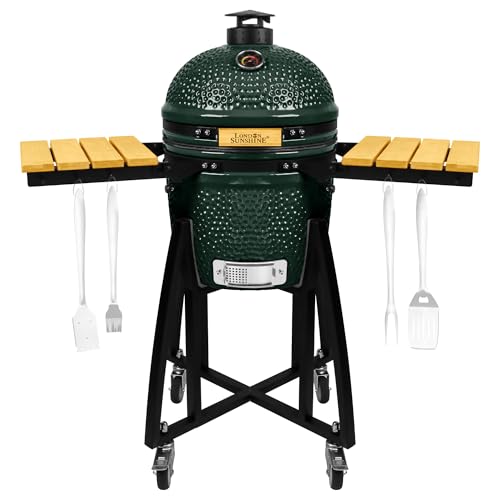
London Sunshine 15-Inch Ceramic Kamado — Best for Small Patios
London Sunshine’s 15-inch egg occupies the sensible middle. It is meaningfully more capable than the 13.5-inch portables — a whole chicken sits comfortably, a small brisket flat fits — while its tall stand and folding shelves keep the footprint patio-friendly. The locking casters matter on real-world sloped patios, and the working height is properly ergonomic, which owners of low-slung small kamados will appreciate immediately.
Strengths
- Real ceramic egg in a space-saving 15-inch format
- Tall stand with locking casters and folding shelves
- Stainless steel grates at a mid tier
Trade-offs
- Capacity still caps party cooking
- Newer brand — verify parts and warranty support
- Single colour option in current listings
| Format | 15-inch ceramic kamado egg |
| Stand | Tall stand, locking casters |
| Shelves | Foldable side shelves |
| Grates | Stainless steel |
Fifteen inches is the smallest size at which an egg still feels like a household’s main grill rather than a companion grill. Ribs need a rack or a cut in half; chickens, pork shoulders, steaks and pizzas for three or four all work natively. The ceramic walls give the same low-temperature composure as the big eggs, and the fuel economy is excellent — small eggs are the cheapest serious smoking you can do.
The diligence item is the brand’s youth in this market: confirm gasket availability and warranty terms at purchase, and buy through Amazon so the returns window protects you if anything arrives damaged. The hardware package suggests serious intent; the support check is simply what a careful buyer does with any newer name in a decades-long product category.
Best for: Small patios and households of two to four / Not suited for: Regular large gatherings
Check on Amazon — check price on Amazon before you buy, because grill-season pricing moves around.

Char-Griller AKORN Jr Portable Kamado — Best Budget Egg-Style
The AKORN Jr serves the camper, tailgater and budget buyer who wants kamado technique in a grill that can ride in a truck bed without anxiety. Triple-wall insulated steel holds heat far better than a plain kettle, the cast iron grate sears honestly, and the whole thing costs what a ceramic’s accessories might. It will not outlive you like a ceramic egg, and it does not claim to — it trades lifespan for price, weight and toughness.
Strengths
- Lowest-cost route into kamado-style cooking (check price on Amazon)
- Insulated steel shrugs off knocks that would crack ceramic
- Light and portable with a cast iron cooking grate
Trade-offs
- Not ceramic — heat stability and lifespan are a class below
- Steel body needs rust vigilance
- Small capacity, suited to two to three people
| Construction | Triple-wall insulated steel (per Amazon title) |
| Format | Portable kamado grill and smoker |
| Grates | Cast iron |
Judge the AKORN Jr against kettles, not against ceramic eggs, and it wins clearly: better insulation, better low-temperature manners, better searing grate, similar money. Judge it against ceramics and the gaps are equally clear — temperature drifts sooner in wind, the body will eventually rust where a ceramic would not, and resale value is minimal. Both judgements are true; which one matters depends on whether you are buying a three-to-five-year tool or a twenty-year fixture.
For renters, students, campers and the kamado-curious, we think the tool framing wins — it is also the grill in this guide we would lend to a friend without a briefing. Keep it covered, touch up finish chips before they rust, and it will teach you everything about vent control that transfers directly to a ceramic egg later.
Best for: Budget buyers, campers and the kamado-curious / Not suited for: Buyers seeking true ceramic performance and longevity
Check on Amazon — check price on Amazon before you buy, because grill-season pricing moves around.
Comparison Table
| Pick | Badge | Key spec | Best for |
|---|---|---|---|
| Kamado Joe Classic Joe I, 18 Inch | Best Overall Value | 18 in egg, 250 sq in, 2-tier | Buyers wanting the full egg experience at a sensible tier |
| Kamado Joe Classic Joe Series II, 18 Inch | Best Premium Egg | 18 in egg, 250 sq in, premium hardware | Long-term owners who cook weekly and value refinement |
| Kamado Joe Joe Jr, 13.5 Inch | Best Portable Egg | 13.5 in portable ceramic egg | Couples, balconies, tailgating and camping |
| GRILLA Grills Kong Ceramic Kamado Grill | Best Big Egg | 600 sq in ceramic egg format | Crowd cooking, whole briskets and pizza production |
| London Sunshine 15-Inch Ceramic Kamado | Best for Small Patios | 15 in ceramic egg on tall stand | Small patios and households of two to four |
| Char-Griller AKORN Jr Portable Kamado | Best Budget Egg-Style | Portable insulated-steel kamado | Budget buyers, campers and the kamado-curious |
Two names hover over this table without appearing in it. Big Green Egg is the original — excellent ceramics, a deep dealer network, and a package price that often excludes the cart and shelves its rivals include. Primo is the other heritage name, famous for its oval shape that fits briskets and two-zone cooking better than a round egg. Neither returned a confirmable listing in this round, so both are not linked here: research them at authorised dealers, and compare their complete package costs against the Kamado Joe bundles above before deciding the famous name is worth its premium.
Within the verified picks, the pattern is simple: Kamado Joe owns the 18-inch centre with two tiers of polish, the Joe Jr owns portable, the Kong owns capacity, London Sunshine owns the small-patio middle, and the AKORN Jr owns the budget door into the format. Pick by the constraint that actually binds you — space, crowd size, or budget — and the table chooses for you.
A final practical note on delivery: egg grills arrive as heavy freight, often on a pallet, and the box’s condition is your first inspection. Photograph the packaging before opening, check the ceramic body and firebox for cracks before assembling anything, and keep the packaging until the first cook is done — a cracked egg discovered early is a simple replacement, while the same crack found after assembly and a season of use becomes an argument. The verified retailers linked in this guide handle this process routinely, which is part of what you are buying.
And one habit ties the whole table together: whichever egg you choose, cook on it three times in the first week. Familiarity is the real accessory — vent settings, hot spots and timing become instincts fastest when the cooks come in a bunch, and an egg that feels familiar in week one gets used for years.
Treat the first season as tuition and the next decade as the dividend — that is the honest shape of egg ownership, and it is why so few owners ever sell theirs, even when a bigger patio finally tempts them to trade up in size.
How to Choose a Ceramic Egg Grill
Start with diameter, because on an egg it decides your menu. Thirteen to fifteen inches cooks brilliantly for one to three people and small cuts; eighteen inches is the family standard that fits whole chickens, rib racks and medium briskets; large formats exist for people whose parties demand them. There is no ‘future-proofing’ by oversizing — a too-big egg burns more charcoal and preheats slower for every small weeknight cook, so buy for your typical Tuesday, and handle the annual party with a second tier or a borrowed kettle.
Next, audit the package, not the grill. Eggs are platforms: the deflector for indirect cooking, a second grate tier, the cart or stand, side shelves, and a cover can double the headline price or be included in it. The Kamado Joe packages in this guide include carts and shelves; the famous unlinked brands often start bare. Build the full basket for each candidate — grill, stand, deflector, cover, ash tool — and compare those totals. That single exercise explains most of the apparent price chaos in this category.
Then judge the touch points: hinge effort, vent precision, gasket material, thermometer size. You will interact with these on every cook for a decade or more, while the ceramic body — the part marketing dwells on — simply sits there doing its quiet work on every brand. Finally, check parts support: gaskets, fireboxes and grates are wear items, and an egg is only a twenty-year grill if its maker still sells its parts in year ten.
Egg Grill vs Offset Smoker vs Pellet Grill: An Honest Comparison
The egg’s claim is versatility per square foot: one device that smokes all night, roasts like an oven and sears like a steakhouse broiler, in a patio footprint of a few square feet. An offset smoker beats it for pure barbecue capacity and for the craft of live-fire management, but demands space, fuel and attention the egg never asks for. A pellet grill beats everything for convenience — set the temperature and walk away — but cannot sear like an egg or match the charcoal flavour depth, and it needs electricity and moving parts that age.
Choose the egg if your cooking is varied and your space is limited; choose the offset if barbecue is a hobby in itself and volume matters; choose the pellet grill if weekday convenience outranks flavour ceiling. Many serious households end up with an egg plus one of the others, which tells you the egg is usually the last one they would sell.
Accessories That Actually Matter for an Egg Grill
Egg grills are platforms, and the accessory shelf is where money goes to be wasted or multiplied. Three accessories genuinely matter. The heat deflector is not optional if you smoke — it is the indirect-cooking system, and it should be in the first order, not the third. A second cooking tier is the highest-value capacity upgrade, effectively adding half a grill for ribs and wings. And a quality cover protects a porous ceramic body and its metal hardware from the weather that ages both.
Everything else is situational. Pizza stones matter if you bake; rotisseries are wonderful if you roast whole birds often; ash tools and baskets are conveniences that pay in minutes per week. The trap is the bundle bought in month one, half of which never leaves the garage. Buy the deflector, tier and cover first, cook for a season, and let your actual menu — not the accessory catalogue — nominate the next purchase. Egg ecosystems reward that patience because the good accessories stay available for years.
Egg Grill Safety and Placement: The Unglamorous Essentials
A ceramic egg is a heavy, hot, top-heavy object, and placement deserves the same care as the purchase. It belongs on a level, non-combustible surface, in its proper stand or cart, with the maker’s clearances to walls and fences — never on a wooden deck directly, never under a low overhang, and never where it must be rolled across grass or gravel to cook, because moving a hot or even warm egg is how eggs and toes break. Wheels are for repositioning a cold grill on hard surfaces, slowly, with two hands and a clear path.
Fire safety follows the charcoal rules with ceramic twists. Keep the spark screen in mind when opening the lid at high temperatures — the rush of oxygen into a hot egg can burp flame, so crack the lid an inch and pause before opening fully, a habit called burping the grill that every egg owner should learn on day one. Let ashes cool completely in a metal container before disposal, and never move or cover the grill until the body is cool to the touch. None of this is difficult; all of it is the difference between a twenty-year grill and an insurance story.
Two-Tier and Raised Cooking: How Egg Owners Beat the Diameter Limit
Every egg owner’s education includes the moment the grate fills up. The solutions form a hierarchy. A rib rack stands ribs on edge and triples rib capacity for the price of a wire accessory. A raised second tier — the systems built into the Kamado Joe picks in this guide, or add-on extender racks for other eggs — lifts a second surface into the dome, where the heat is gentler and the space was previously wasted air. Vertical thinking generally is the egg skill: chickens stand on racks, ribs stand in racks, and the dome’s height becomes cooking volume instead of headroom.
There is also a sequencing answer that costs nothing: cook in waves by temperature. Start the items that want low heat and time, and while they rest — as smoked meats should, wrapped and held — run the grill hot for the fast items. An egg holds and changes temperature so willingly that a well-sequenced menu for eight fits through an 18-inch grate without a single compromise dish. The diameter limit is real; for organised cooks, it is also mostly theoretical.
How Egg Grills Handle the Four Seasons
Spring is an egg’s home turf — mild air, long evenings, and a fire that behaves exactly as the books promise. Summer tests the cook more than the grill: the ceramic holds its temperature in heat that makes metal grills overshoot, and its efficiency means less time standing over a fire in August. The summer discipline is shade for the cook and a water bottle, not grill management. Autumn is smoking season, when the egg’s stability turns the year’s big cuts — shoulders, briskets, turkeys — into set-and-monitor cooks that leave the cook free for the rest of the feast.
Winter is where the egg separates itself from every rival. A metal grill in January is a heat leak with a fire inside it; cooks fight wind and ambient cold for every degree. The ceramic’s walls make ambient temperature nearly irrelevant — the same vent settings that held a summer smoke hold a winter one within a small adjustment, and the charcoal bill barely moves. For households in cold climates, that single fact justifies the category: the egg is the grill that keeps barbecue a twelve-month hobby instead of a three-season one. Keep the vents free of snow, store the cover where you can reach it with gloves on, and cook on.
How to Smoke Low and Slow on a Ceramic Egg Grill
Smoking is the egg’s signature skill. The method below turns any pick in this guide into an overnight-capable smoker, and it is mostly about what you do before the meat goes on.
- Start with a clean grill — old ash restricts the airflow you will depend on for the next ten hours.
- Load lump charcoal generously, mixing in three or four wood chunks buried at different depths so smoke arrives throughout the cook, not just at the start.
- Light in a single spot at the top centre of the pile; a small fire that grows slowly is the foundation of temperature stability.
- Assemble the indirect setup — deflector plates in, drip pan on the deflector, grate above — before the grill reaches temperature, so you are not rebuilding a hot grill.
- Close the lid and bring the grill up slowly, throttling the vents from about 50 degrees below your target; park it at temperature and wait twenty minutes to confirm it is stable, not passing through.
- Wait for the smoke to turn thin and pale before adding meat — thick white smoke at the start is normal, and food added then tastes acrid.
- Cook by internal temperature and tenderness, not by the clock; the egg’s job is to hold the environment steady while the meat decides when it is done.
- Resist opening the lid: every look costs heat and time, and an egg’s stability is wasted if you keep letting the weather in.
- At the end, close both vents fully to smother the fire and save the remaining lump for the next cook.
Keep a notebook for your first season: charcoal load, vent positions, weather, result. Egg grills are consistent machines, and owners who record their setups stop ‘learning to smoke’ within a few cooks because they can simply repeat what worked. The grill rewards that discipline more than any accessory you can buy for it.
Common Buying Mistakes
Comparing bare-grill prices. An egg without a stand, deflector and cover is not a finished purchase. Compare complete baskets or you will misjudge every brand in this category.
Overshooting temperature on the way up. A heat-soaked egg that overshoots takes an hour to forgive you. Approach slowly and throttle early — patience on the way up is the whole technique.
Using briquettes with additives or lighter fluid. Ceramic absorbs chemicals and returns them as flavour for weeks. Plain lump charcoal and natural starters only.
Lifting the lid to check constantly. Eggs hold heat superbly but recover dome temperature slowly after long openings. Trust the thermometer and the plan; look at the end, not throughout.
Leaving ash to accumulate. Ash is the silent cause of both ‘won’t get hot’ and ‘won’t stay lit’. A two-minute cleanout before each cook prevents most kamado complaints ever posted online.
Rolling the egg across the garden to cook in the sun. Eggs are top-heavy, fragile and heavier than they look. Choose the cooking spot once, on hard level ground, and move the shade to the cook — not the egg to the shade.
Final Recommendation
Buy the Classic Joe I if you want the egg experience at its most rational price; buy the Series II if the same grill will still be yours in fifteen years and you want every daily friction engineered out. Take the Joe Jr for portable and small-household duty, the Kong when capacity is the whole point, and the London Sunshine when the patio is small but the ambition is real. The AKORN Jr is the honest budget door into the format.
And if your research keeps pulling you toward the unlinked heritage brands — Big Green Egg for its dealer network, Primo for its oval — buy them through authorised dealers with full warranty, and only after comparing their complete package totals against the verified Kamado Joe bundles above. For the smoking-focused view of this same category, read Best Ceramic Smoker Grills; for the wider ceramic picture, Best Ceramic Bbq Grills covers the full field.
Best Ceramic Smoker Grills Best Ceramic Bbq Grills Best Kamado Grills
Frequently Asked Questions
Is a ceramic egg grill the same as a kamado?
Yes — ‘egg grill’ describes the shape, ‘kamado’ the tradition. All egg grills are kamado-style cookers: charcoal-fuelled, vent-controlled, heavily insulated. The terms are used interchangeably by most makers, with ‘egg’ forever associated with the Big Green Egg brand that popularised the format in the West.
Why are ceramic egg grills so expensive?
Three reasons: the ceramic body itself is heavy, fragile to ship and slow to manufacture; the hardware (hinges, carts, gaskets) must survive decades of heat cycles; and the market supports it because the product genuinely lasts — amortised over fifteen years, a premium egg often costs less per year than mid-tier gas grills replaced twice. The complete-package comparison in our buying guide shows where the money actually goes.
Can an egg grill replace my gas grill?
For most households, yes — with a change of rhythm. An egg needs twenty to thirty minutes to light and preheat where gas needs five, and charcoal management replaces knob-turning. In exchange you get smoking, baking and searing ability no gas grill matches. Many owners keep a small gas or tabletop grill for emergency weeknight speed and use the egg for everything else.
What size egg grill fits a whole brisket?
An 18-inch egg fits a trimmed brisket with the ends sometimes draped over a rib rack or foil ball until shrinkage pulls them in — workable, not spacious. If brisket is a regular event rather than an annual experiment, a large-format egg like the Kong, or an oval-shaped model from the unlinked Primo line, is the comfortable answer.
How long will a ceramic egg grill last?
The ceramic body can last decades; the wear items are the gasket (years), the firebox (many years, sometimes warrantied for life), grates and hardware. Longevity therefore depends on parts support, which is why this guide favours established makers and tells you plainly where a brand is newer and support should be verified before purchase.
Do egg grills need a lot of charcoal?
No — they are the most charcoal-efficient grills made. The insulation means most heat goes into the food, and unburned lump survives shutdown to be reused. A bag of lump lasts an egg owner far longer than a kettle owner cooking the same menu, which offsets some of the purchase premium over time.
Do egg grills work for weeknight cooking, or only weekends?
They work on weeknights once the routine is yours: light the egg when you walk in, prep while it preheats, and a chicken or a round of steaks is entirely feasible. The honest friction is the twenty-minute head start versus a gas grill’s five. Many egg households solve it exactly as this guide suggests — the egg for most cooking, and acceptance that its rhythm, once learned, stops feeling like a delay.
What is ‘burping’ an egg grill, and why does it matter?
At high temperatures, opening an egg’s lid suddenly admits a rush of oxygen that can flare into a fireball out of the lid gap — singed eyebrows are the classic injury. Burping means cracking the lid an inch or two, pausing a few seconds to let oxygen enter gradually and burn off, then opening fully. It is a two-second habit that every egg owner should make automatic before the first high-heat cook.
How much charcoal does an egg grill use per cook?
Far less than intuition suggests. A short grilling session may burn only the top layer of a modest load, and because closing the vents smothers the fire, the unburned lump is reused next time — many owners top up rather than refill for weeks. A long smoking cook uses a fuller firebox but still sips compared with a kettle, because the insulation wastes so little heat. The practical budget: a single bag of quality lump lasts a typical egg household through many weeks of regular cooking, which is why charcoal cost ranks so low in this category’s ownership ledger.
Are egg grills safe on a wooden deck?
Only with the right setup: the egg must sit in its proper stand or table, on a non-combustible surface or mat rated for the purpose, with the maker’s clearances from railings and walls — and never operated unattended. Many owners place a paver or grill mat under the stand as a matter of routine. If your deck setup cannot meet the clearances, a ground-level patio spot is the correct answer, not a compromise arrangement.
Best Ceramic Egg Grills Best Charcoal Grills Best Grills


