Disclosure: airfryerkitchensupply.com is reader-supported. When you buy through links on our site, we may earn an affiliate commission at no extra cost to you.
Where to buy
Shopping for the best ceramic bbq grills? Start with the verified shortlist below. Ceramic kamado grills are heavy, fragile freight, which makes Amazon’s delivery and returns handling genuinely valuable — a cracked firebox discovered on unboxing is a warranty claim, not a weekend project. Every linked pick below was confirmed against Amazon’s catalog data; use the links to check price on Amazon, because kamado pricing shifts hard around spring and holiday promotions and we do not print static prices. Big Green Egg, the brand many shoppers start with, could not be confirmed through the API in this round, so it is discussed honestly in prose rather than given an invented link.
- Kamado Joe Classic Joe Series II, 18 Inch — check price on Amazon
- GRILLA Grills Kong Ceramic Kamado Grill — check price on Amazon
- Kamado Joe Classic Joe I, 18 Inch — check price on Amazon
- London Sunshine 15-Inch Ceramic Kamado — check price on Amazon
- AUPLEX Yakitori Ceramic Charcoal Grill, 16 Inch — check price on Amazon
- Char-Griller AKORN Kamado, 20 Inch — check price on Amazon
The best ceramic bbq grills all share the same ancient idea — a thick-walled clay or ceramic egg that holds heat like a brick oven and sips charcoal like a miser — but the grills built around that idea differ enormously in price, hardware quality and how they treat you over a decade of ownership. A ceramic kamado will sear a steak at ripping heat, hold a low smoking temperature through the night, and bake bread and pizza better than most ovens, all on a few handfuls of lump charcoal. This guide ranks the ceramic options we could verify through Amazon’s own catalog, explains where the value actually sits, and is upfront about the famous name we could not confirm with a listing this round.
In this guide
Quick Picks
Kamado Joe Classic Joe Series II, 18 Inch — Best Overall
The most complete 18-inch ceramic package: counterbalanced hinge that makes the heavy lid feel light, a two-tier cooking system, an ash drawer that ends the shovel-and-vacuum era, and stainless grates. If you buy one ceramic grill for the next fifteen years, this is the default.
GRILLA Grills Kong Ceramic Kamado Grill — Best Large Ceramic
The capacity answer: roughly 600 square inches of cook space and a stated 700°F ceiling from a direct-to-consumer brand that undercuts the legacy names. If your complaint about 18-inch kamados is elbow room, the Kong is the pick.
Kamado Joe Classic Joe I, 18 Inch — Best Value Kamado Joe
The original Classic Joe: same ceramic body and two-tier cooking as its successor, simpler hardware, lower tier pricing. For buyers who care about the cook more than the conveniences, this is the smart-money Kamado Joe.
London Sunshine 15-Inch Ceramic Kamado — Best Compact Ceramic
A genuine ceramic kamado in a 15-inch footprint, on a tall stand with locking casters and foldable shelves. The pick for balconies, small patios and couples who want real kamado cooking without giving the garden to an 18-inch cart.
AUPLEX Yakitori Ceramic Charcoal Grill, 16 Inch — Best Tabletop Ceramic
A square Japanese-style ceramic tabletop grill built for yakitori and skewer cooking: thick 3.5cm ceramic walls, fast heat-up, adjustable airflow, and a bamboo heat shield so it can sit on a table. A specialist, and excellent at its specialty.
Char-Griller AKORN Kamado, 20 Inch — Best Budget Alternative (Insulated Steel)
Not ceramic — and we will not pretend otherwise. The AKORN copies the kamado shape in triple-wall insulated steel, cooks in the same style at a budget tier, and weighs a fraction of a ceramic. The honest entry point to kamado cooking.
How These Picks Were Chosen
We built the shortlist from ceramic kamado grills returned by Amazon listing data, checking each product’s Amazon title against the model we intended to cover before assigning any link.
The judging criteria were the ones that decide kamado ownership happiness. Heat range and control: a ceramic grill should hold low smoking temperatures steadily and still reach genuine searing heat, which comes down to gasket sealing and vent precision. Cooking area and expandability: whether the grill can add a second tier for big cooks. Hardware honesty: hinge quality, cart stability, grate material and whether the thermometer is a real instrument or a decoration. And total cost of ownership — ceramics last decades, but only if replacement gaskets, grates and fireboxes stay available, which favours established makers.
We also drew one deliberate line: insulated steel kamados are not ceramic, and we say so where one appears. The Char-Griller AKORN earns its place as a budget alternative precisely because it imitates the kamado shape in insulated steel — it is included with that caveat attached, not disguised as a ceramic grill.
The 6 Best Ceramic BBQ Grills You Can Buy

Kamado Joe Classic Joe Series II, 18 Inch — Best Overall
The Classic Joe II is for the buyer who wants the category’s best engineering without stepping up to oversize models. The Air Lift hinge is not a gimmick — ceramic lids are heavy, and a hinge that holds the lid at any angle changes how confidently you cook, especially with kids around. The Divide & Conquer two-level grate system lets you run direct and indirect zones at different heights simultaneously, which is how you grill vegetables and sear steaks in the same session without compromise.
Strengths
- Counterbalanced hinge makes the lid genuinely one-hand friendly
- Two-tier cooking system doubles useful capacity
- Slide-out ash drawer simplifies the worst kamado chore
Trade-offs
- Premium tier pricing within the 18-inch class (check price on Amazon)
- 250 square inches still fills up fast on big party cooks
- Heavy — choose its home carefully, it will not move often
| Cooking area | 250 sq in (per Amazon title) |
| Grill size | 18-inch ceramic charcoal grill and smoker |
| Grates | Stainless steel |
| Model | KJ-23RHC, cart with side shelves |
What separates the Series II from cheaper ceramics is not the shell — most thick ceramic bodies cook similarly — but the systems around it. The fibreglass mesh gasket seals better and lasts longer than old felt gaskets, which is what holds a low fire steady for hours instead of creeping. The top vent holds its setting when you open the lid, a small detail that anyone who has lost a smoking temperature to a swinging daisy wheel will appreciate. Temperature control on this grill feels like turning a dial rather than negotiating.
Capacity is the honest limitation. Eighteen inches is the right size for a family of four and most entertaining, but a full packer brisket or four racks of ribs will have you buying accessories and arranging carefully. Kamado Joe’s accessory ecosystem is the deepest in the category — rotisseries, pizza attachments, expander racks — which softens the limit over time, at extra cost. Budget for a cover and a bag of good lump charcoal from day one; both protect the investment.
Best for: Most families wanting one premium ceramic grill for everything / Not suited for: Regular cooks for eight or more people
Check on Amazon — check price on Amazon before you buy, because grill-season pricing moves around.

GRILLA Grills Kong Ceramic Kamado Grill — Best Large Ceramic
Choose the Kong if you entertain, cook multiple proteins at once, or simply refuse to play Tetris with ribs. Its cook space is in a different league from the 18-inch class, the adjustable vent gives real control at both ends of the range, and the wheeled base acknowledges that a grill this size still occasionally needs to move across the patio. It is a ceramic kamado aimed squarely at buyers who compared the famous brands and balked at the per-square-inch maths.
Strengths
- Around 600 sq in of cook space — the largest here
- Stated maximum temperature of 700°F for serious searing
- Wheeled EZ Glide base on a grill that needs it
Trade-offs
- Big footprint — measure your patio before ordering
- Smaller dealer and accessory network than Kamado Joe
- Large ceramic mass takes longer to cool down after a cook
| Cook space | 600 sq in (per Amazon title) |
| Max temperature | 700°F (per Amazon title) |
| Construction | Ceramic with adjustable vent |
| Mobility | EZ Glide wheel system |
Space changes what a kamado can do. On the Kong you can run a brisket on the main grate with a full second zone of vegetables beside it, or cook pizzas back-to-back for a party without the recovery pauses a small grill needs between pies. The large ceramic mass also stabilises temperature beautifully once it is heat-soaked — the flip side is that overshooting a target temperature takes longer to correct, so approach your set point slowly and let the vents do fine work.
GRILLA sells direct, which is how the price-per-inch works, and their support reputation is built on actually answering the phone. The compromises are ecosystem and resale familiarity: fewer third-party accessories are designed specifically for it, and the secondhand market knows the red grills better. For a buyer who cooks big and keeps grills for a decade, those are acceptable trades for this much ceramic at this tier. Check price on Amazon before buying — listings and bundles change.
Best for: Big families and entertainers who outgrew 18-inch kamados / Not suited for: Small patios or buyers who want the deepest accessory ecosystem
Check on Amazon — check price on Amazon before you buy, because grill-season pricing moves around.

Kamado Joe Classic Joe I, 18 Inch — Best Value Kamado Joe
The Classic Joe I suits the value-minded cook who wants genuine Kamado Joe ceramic quality and the two-tier system, and is willing to lift a heavier-feeling lid and clean ash the traditional way. It includes the cart and side shelves, arrives with the grill gripper and ash tool, and cooks — once the fire is lit — essentially identically to the Series II. The differences are in daily friction, not in the food.
Strengths
- Same ceramic shell and 2-tier cooking system as the II
- Lower tier than the Series II (check price on Amazon)
- Cart, side shelves and tools included in the box
Trade-offs
- Standard hinge — the lid feels its full weight
- Felt-style gasket era hardware needs more upkeep
- Ash removal is the older, messier routine
| Cooking area | 250 sq in (per Amazon title) |
| Grill size | 18-inch ceramic charcoal grill and smoker |
| System | 2-tier cooking system |
| Model | KJ23RH, with cart and side shelves |
Think of the Classic I as the same engine with an older dashboard. The ceramic body, firebox design and cooking geometry are the platform Kamado Joe built its name on, and low-and-slow stability — the thing ceramics are bought for — is fully present. Where you pay for the Series II is in the hinge, the gasket and the ash drawer; where you save with the Classic I is real money that buys a lot of lump charcoal and a good instant-read thermometer.
Ownership homework matters more here. Check the gasket each season and replace it when it frays — a leaking gasket is the difference between a grill that holds temperature for ten hours and one that needs babysitting. The included ash tool handles cleanout fine; it is simply a five-minute job instead of a one-minute drawer pull. For many households that trade is exactly right.
Best for: Value-focused buyers who want real Kamado Joe ceramic / Not suited for: Anyone who will resent a heavy lid and manual ash cleanout
Check on Amazon — check price on Amazon before you buy, because grill-season pricing moves around.
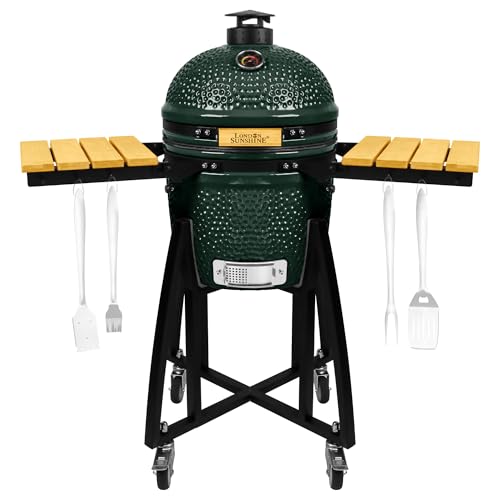
London Sunshine 15-Inch Ceramic Kamado — Best Compact Ceramic
London Sunshine’s 15-inch kamado is the compact answer that still cooks like a kamado — thick ceramic walls, real temperature range, stainless grates — in a size that suits two to four people. The tall stand puts the grate at a comfortable working height (many small kamados sit awkwardly low), the casters lock so it stays put on a slope, and the shelves fold away when the balcony is tight. It is a thoughtful small-grill package rather than a shrunken afterthought.
Strengths
- True ceramic construction in a compact 15-inch size
- Tall stand with locking casters suits small patios
- Foldable side shelves and stainless steel grates
Trade-offs
- Cooking area limits whole briskets and large rib racks
- Smaller brand — check parts availability before buying
- Green finish only, if colour matters to you
| Grill size | 15-inch ceramic kamado |
| Stand | Tall stand with locking casters |
| Shelves | Foldable side shelves |
| Grates | Stainless steel |
Small kamados are underrated smokers. The ceramic mass-to-cooking-space ratio is high, so once a 15-inch kamado settles at a low temperature it holds it with minimal charcoal and minimal attention — pork shoulder for two, a beer-can chicken, or a small rack of ribs all cook beautifully. Where you must adapt is format: choose smaller cuts, use a rib rack to stand ribs vertically, and accept that a full packer brisket is simply not this grill’s job.
As a newer brand in many markets, London Sunshine asks for one piece of diligence: confirm gasket and grate availability when you buy, and register the warranty. The hardware package — casters, shelves, stand — suggests a maker thinking about ownership rather than just the sale, and at the compact tier that matters more than a famous badge. Check price on Amazon, where this model is frequently bundled.
Best for: Couples, balconies and small patios wanting real ceramic / Not suited for: Feeding a crowd or cooking full packer briskets
Check on Amazon — check price on Amazon before you buy, because grill-season pricing moves around.

AUPLEX Yakitori Ceramic Charcoal Grill, 16 Inch — Best Tabletop Ceramic
Buy the AUPLEX if your favourite grill night is skewers, small cuts and vegetables cooked in quick rounds while people graze — the konro/yakitori format that Japanese izakayas are built on. The square 16-inch body concentrates charcoal heat under skewers, the thick ceramic throws that heat back evenly, and the stated fast heat-up suits weeknight cooking. The manufacturer sizes it for two to five people, which matches the format: this is social, cook-and-eat-as-you-go grilling.
Strengths
- Thick 3.5cm ceramic for even, radiant heat
- Fast stated heat-up — ready in about 15 minutes
- Bamboo heat shield and stand make it genuinely tabletop-safe
Trade-offs
- Skewer format does not suit large cuts or low-and-slow smoking
- Tabletop use demands a stable, heat-proof surface and supervision
- A specialist second grill for most households, not the only grill
| Size | 16-inch square tabletop (per Amazon title) |
| Ceramic thickness | 3.5cm (per Amazon title) |
| Heat-up | 350°C / 662°F in 15 min (per Amazon title) |
| Capacity | Fits 2–5 people (per Amazon title) |
Yakitori cooking is a different discipline from Western grilling: binchotan-style intense heat, constant turning, small pieces cooked in minutes and eaten immediately. The AUPLEX’s ceramic body is the enabler — it radiates heat from the walls as well as the coals, so skewers cook evenly without constant repositioning over hot spots. Adjustable airflow lets you throttle back for vegetables and mushrooms between meat rounds. If that rhythm sounds like your kind of evening, no kettle grill replicates it as well.
Set expectations correctly and it delights; buy it as a general-purpose BBQ and it will frustrate. There is no lid-driven smoking programme here, no brisket, no beer-can chicken. It is also a grill that lives on a table, which means thinking about surface protection, sparks and where children are standing. As a second grill for skewer nights — or a first grill for a small household that cooks this way — it is a genuinely distinctive pick.
Best for: Yakitori, skewers and small-batch social grilling / Not suited for: Low-and-slow barbecue or large cuts
Check on Amazon — check price on Amazon before you buy, because grill-season pricing moves around.

Char-Griller AKORN Kamado, 20 Inch — Best Budget Alternative (Insulated Steel)
The AKORN is for the buyer who wants kamado-style versatility — smoking, roasting, searing — at the lowest sensible cost, or who needs a kamado they can actually move. Insulated steel does not crack when a cart tips, does not weigh as much as a person, and heats and cools faster than ceramic. The cast iron grates sear properly, and the 20-inch size is generous. What you give up is the ceramic’s decades-long heat-soak stability and heirloom lifespan.
Strengths
- Kamado cooking style at a budget tier (check price on Amazon)
- Triple-wall insulated steel — light and crack-proof
- 20-inch cooking size with cast iron grates
Trade-offs
- Steel body, not ceramic — shorter lifespan and less heat stability
- Steel can rust if the finish is chipped and neglected
- Temperature overshoots correct faster but also drift sooner
| Construction | Triple-wall insulated steel (per Amazon title) |
| Size | 20-inch kamado-style grill and smoker |
| Grates | Cast iron |
Plenty of owners start on an AKORN, learn kamado fire management, and either stay happily for years or upgrade to ceramic knowing exactly why. That is a rational path: the cooking skills transfer completely, because the vent logic, charcoal loading and two-zone techniques are identical. The steel body is more forgiving of beginners in one way — it cools down faster after an overshoot — and less forgiving in another, since a neglected chip in the finish becomes a rust spot by next season.
Our placement of the AKORN in a ceramic guide is deliberate and labelled: it is the alternative for readers whose budget or living situation rules ceramic out, included so they get kamado cooking honestly rather than a fake ‘ceramic-style’ claim. If you can afford ceramic and will keep the grill for a decade, buy ceramic. If not, this is the budget pick we would buy ourselves.
Best for: Budget buyers and renters who need to move their grill / Not suited for: Buyers specifically wanting ceramic’s longevity and stability
Check on Amazon — check price on Amazon before you buy, because grill-season pricing moves around.
Comparison Table
| Pick | Badge | Key spec | Best for |
|---|---|---|---|
| Kamado Joe Classic Joe Series II, 18 Inch | Best Overall | 18 in, 250 sq in, two-tier grates | Most families wanting one premium ceramic grill for everything |
| GRILLA Grills Kong Ceramic Kamado Grill | Best Large Ceramic | 600 sq in ceramic, 700°F max | Big families and entertainers who outgrew 18-inch kamados |
| Kamado Joe Classic Joe I, 18 Inch | Best Value Kamado Joe | 18 in, 250 sq in, 2-tier system | Value-focused buyers who want real Kamado Joe ceramic |
| London Sunshine 15-Inch Ceramic Kamado | Best Compact Ceramic | 15 in ceramic on tall stand | Couples, balconies and small patios wanting real ceramic |
| AUPLEX Yakitori Ceramic Charcoal Grill, 16 Inch | Best Tabletop Ceramic | 16 in square ceramic tabletop, 3.5cm walls | Yakitori, skewers and small-batch social grilling |
| Char-Griller AKORN Kamado, 20 Inch | Best Budget Alternative (Insulated Steel) | 20 in insulated steel kamado-style | Budget buyers and renters who need to move their grill |
The table hides the category’s biggest truth: every true ceramic here cooks more alike than the prices suggest, because the physics of a thick ceramic egg dominates. What the money buys is hardware and capacity — hinges, gaskets, ash systems, grate tiers and square inches. Choose your size first (15, 18 or the Kong’s big format), then decide how much daily-friction engineering you want to pay for within that size.
And a note on the name missing from the table: Big Green Egg is the original ceramic egg and a fine grill, but it did not return a confirmable listing during this round, so it appears in this guide as discussion, not as a linked pick. If your heart is set on it, buy through an authorised dealer — the warranty is dealer-based anyway — and compare its total cost with the Kamado Joe packages above, which include carts and shelves the Egg often sells separately.
One last sizing truth the table cannot hold: ceramic grills are bought in inches but lived in meals. Before ordering, list the five dishes you will cook most and check each against the grate you are considering — not the biggest dish you can imagine, but the Tuesday chicken, the Friday steaks, the Sunday ribs. Every pick above was chosen because it covers a real household’s five dishes without strain; the moment a grill fails your list, no badge or discount repairs it.
How to Choose a Ceramic BBQ Grill
Size is the first and least reversible decision. An 18-inch kamado is the category’s centre of gravity: it handles a whole chicken, two racks of ribs with a rack, or a medium brisket, and it fits a normal patio. Drop to 15 inches only if space truly demands it or you cook for two; step up to a large-format grill like the Kong if you regularly cook for six-plus or want whole briskets with room to spare. Remember that ceramic grills are effectively permanent installations — you will not be swapping sizes next year.
Judge the hardware, because the ceramic is the easy part. The hinge takes the full weight of a heavy lid thousands of times; counterbalanced designs are worth real money. The gasket is a consumable — check what it is made of and what a replacement costs. Vents should move precisely and hold their setting when the lid opens. The thermometer should be large and replaceable. Ash management separates pleasant grills from chores: a drawer beats a shovel every single week of ownership.
Think in systems, not in grills. A two-tier grate doubles what an 18-inch grill can do; a deflector plate (essential for smoking) may or may not be included; rotisserie and pizza accessories exist for some ecosystems and not others. Price the whole system you will actually own in year two, not the bare grill in the cart today. Finally, weigh warranty and parts support heavily — a ceramic grill is a ten-to-twenty-year purchase, and the firebox, gaskets and grates you will need in year eight only exist if the maker still supports the model.
Ceramic vs Insulated Steel vs Kettle: Which Kamado Style Fits You?
True ceramic is the long game: unmatched heat stability, minimal charcoal use, and a body that can outlast its owner — at the highest cost, the greatest weight, and with a shell that can crack if dropped or struck. Insulated steel, as in the AKORN, imitates the shape at a fraction of the cost and weight, heats and cools faster, and asks for rust vigilance in exchange; it is the rational choice for budgets, rentals and anyone who moves house often. A classic kettle is cheaper still and grills brilliantly, but it burns more charcoal, drifts in wind and cold, and cannot match a kamado’s low-temperature composure for overnight smoking.
The deciding question is how you cook in winter and for how long. Kamado ceramics shrug off cold and wind that make kettles miserable, which is why northern grillers over-index on them. If your grilling is summer burgers, the ceramic premium buys you little; if your ambition is January brisket and wood-fired pizza in February, the egg earns its keep every month of the year.
What Can a Ceramic Grill Cook That Other Grills Cannot?
Three dishes make the ceramic case better than any specification. First, true wood-fired pizza at home: a ceramic grill with a stone, run at its highest temperatures with the stone soaked in the dome’s heat, produces leopard-spotted crusts that gas grills and ovens physically cannot, because the ceiling heat cooks the top while the stone cooks the bottom. Second, overnight brisket in bad weather: the insulation that ignores a January wind is not a luxury feature, it is the difference between cooking and not cooking for a third of the year in much of the country.
Third, and least discussed, is bread. A ceramic grill is a masonry oven in miniature — steady radiant heat from all sides, steam retained around the loaf, and a crust that shatters properly. Sourdough bakers who try their kamado rarely go back to a kitchen oven in summer. Add the reverse-sear workflow (smoke low in the same unit, then open the vents and sear over the same fire) and the ceramic’s real claim emerges: it is not that it grills better, it is that it replaces three appliances — smoker, oven, and grill — at a level each dedicated tool respects.
Ceramic Grill Ownership Costs: The Honest Ledger
The purchase price is the loud number; the quiet numbers decide whether a ceramic grill is expensive. On the cost side after purchase: lump charcoal, which ceramics sip so efficiently that a bag lasts weeks of regular cooking; gaskets, replaced every few years for the price of a pizza night; and accessories, which are optional but seductive — budget for the deflector and a cover as necessities and treat the rest as presents to yourself. Firebox cracks, when they occur, are typically covered under the ceramics warranties of established makers, which is another reason this guide weights brand support so heavily.
On the saving side: no propane refills, no burner replacements, no rusted-out firebox in year six, and a charcoal bill per cook that embarrasses kettles. Amortised over the ten-to-twenty-year life these grills routinely achieve, a premium ceramic’s annual cost lands close to a mid-range gas grill’s — with radically broader cooking ability. The ledger only fails for buyers who sell in year two, which is why our consistent advice is to buy the size and tier you will keep, once.
Your First Five Cooks on a Ceramic Grill: A Sensible Sequence
New ceramic owners should climb a deliberate ladder. Cook one: burgers and sausages at moderate heat — forgiving food while you learn how your grill’s vents map to temperature. Cook two: a whole chicken, indirect with the deflector, which teaches low-temperature holding and rewards you with the best roast chicken of your life. Cook three: ribs, low and slow for an afternoon, where the gasket and vent lessons become muscle memory. Cook four: pizza night, running the grill hot with a stone, learning the burping habit and the dome-heat technique. Cook five: a pork shoulder overnight — the graduation exercise, and the cook that converts owners into evangelists.
The sequence is designed so each cook adds exactly one new skill: vent control, indirect setup, patience, high heat, endurance. Owners who jump straight to an overnight brisket as cook one are stacking every lesson into a single expensive experiment. Owners who climb the ladder arrive at that brisket with a notebook of their grill’s settings and a feel for its responses — and their first brisket tastes like it.
Ceramic Grill vs Gas Grill for a Family of Four: The Two-Year View
Year one with a gas grill is pure convenience: instant light, predictable knobs, and a learning curve measured in one cook. Year one with a ceramic is an education — vent settings, charcoal loads, the deflector habit — repaid in food that tastes like a restaurant’s. By year two the ledger shifts. The gas grill has needed a burner inspection and perhaps new heat tents; the ceramic has needed a bag of charcoal every few weeks and nothing else. The gas grill cooks the same menu it cooked in month one; the ceramic household is smoking, baking bread and running pizza nights, because the tool kept suggesting new things to try.
Neither trajectory is wrong — they serve different definitions of a good Tuesday. If your family’s grilling is burgers and dogs twice a month, the ceramic’s education is tuition for a school you will not attend, and a good gas grill is the honest buy. If cooking is a household hobby and the patio is where weekends happen, the ceramic repays its tuition with interest and keeps paying for a decade. Size the decision by your calendar, and the grill will fit your life instead of arguing with it.
How to Set Up and Light a Ceramic Kamado Grill
Kamado technique is mostly charcoal discipline. Follow this sequence for your first cooks and the grill will feel predictable within two or three sessions — ceramics reward patience and punish rushing more than any other grill type.
- Clean out old ash first — airflow is everything in a kamado, and ash-choked vents are the top cause of ‘my grill won’t get hot’ and ‘my grill won’t stay low’.
- Fill the firebox with lump charcoal (not briquettes) to just below the fire ring for long cooks, or a half load for short grilling sessions.
- Light in one spot for low-and-slow cooking, or in two to three spots for high-heat grilling; use natural fire starters, never lighter fluid, which ceramic absorbs and flavours food with for weeks.
- Leave the lid open and both vents fully open for the first ten minutes to establish the fire.
- Close the lid and begin closing vents as you approach your target — start throttling about 50 degrees below target, because a heat-soaked ceramic overshoots easily and cools slowly.
- For smoking, add your deflector plates and a drip pan once the fire is stable, and wait for thin, pale smoke before food goes on; thick white smoke means the fire is still dirty.
- Adjust in small vent movements and wait ten minutes between changes — ceramic mass means every input arrives late.
- To shut down, close both vents completely; the fire will smother and the unburned lump can be reused next cook.
- Never use water to cool a ceramic grill, and never move it while hot — thermal shock and tipping are how ceramics die.
Your first three cooks should be forgiving ones — chicken, sausages, a pork shoulder — while you learn your grill’s vent settings. Write the settings down. Every kamado has its own personality at a given temperature, and the owners who love these grills are the ones who learned theirs deliberately instead of fighting it for a year.
Common Buying Mistakes
Using lighter fluid or self-lighting charcoal. Ceramic is porous and absorbs petroleum flavours permanently. Natural starters and plain lump charcoal are the only correct answer in a kamado.
Chasing temperature with big vent swings. Ceramic responds slowly, so aggressive adjustments create oscillation. Small moves, long waits — or you will spend the whole cook overshooting in both directions.
Buying the grill and forgetting the deflector. Indirect cooking is half of what a kamado is for, and on many models the heat deflector is a separate purchase. Price the full smoking setup before you buy.
Ignoring the gasket. A frayed gasket leaks air, and a leaking kamado cannot hold low temperatures. Inspect it each season; replacement is cheap and transforms a drifting grill.
Assuming bigger is better. An oversized ceramic burns more charcoal for small cooks and takes longer to come to temperature. Match the grill to your typical cook, not your biggest party of the year.
Letting the grill cool with the vents open ‘to dry out’. An open-vented ceramic invites rain, insects and ash-dampening humidity into the firebox. Shut it down fully, every time; the charcoal you save is the bonus, and the dry interior is the point.
Final Recommendation
For most buyers the Kamado Joe Classic Joe Series II is the answer: the best-engineered 18-inch ceramic package, with the hinge, gasket and ash system that make ownership pleasant for a decade. The Classic Joe I is the same cook for less money if you accept older hardware, and the GRILLA Kong is the move when capacity is your real problem. Small-space cooks should look hard at the London Sunshine, and budget buyers should take the AKORN honestly for what it is — an excellent steel alternative, not a ceramic.
Whichever egg you choose, budget for the unglamorous essentials alongside it: a cover, good lump charcoal, a deflector if it is not included, and a reliable instant-read thermometer. Then keep reading around the cluster: Best Ceramic Egg Grills compares the egg-shaped specialists head to head, and Best Ceramic Smoker Grills focuses purely on low-and-slow performance.
Best Ceramic Egg Grills Best Ceramic Smoker Grills Best Kamado Grills
Frequently Asked Questions
Are ceramic grills worth the money compared with a kettle?
For year-round, low-and-slow and high-heat versatility, yes. A ceramic kamado holds smoking temperatures for many hours on little charcoal, sears at temperatures a kettle cannot reach safely, and is barely affected by wind and cold. If you only grill burgers in summer, the premium buys little — a kettle does that job well for far less. The value case rests on how often and how widely you cook.
What size ceramic grill should I buy?
Eighteen inches is the right default for families of three to five and most entertaining. Choose 15 inches only for tight spaces and small households, and a large format like the Kong if you regularly cook for six or more or want to smoke full briskets with room around them. Remember a second cooking tier can add more usable space than a small step up in diameter.
Can a ceramic grill crack?
Yes, from impact or thermal shock — dropping the lid hard, striking the body, or dousing a hot grill with cold water. In normal use, cracking is rare and the inner firebox is the part most likely to develop cracks over years; reputable makers warranty the ceramics. Treat it like the masonry it is and it lasts decades.
How long does charcoal last in a kamado?
A full firebox of lump charcoal can run low-and-slow cooks well past ten hours, because the ceramic insulation wastes so little heat. When you close the vents the fire smothers, and the unburned lump — often half the load — can be reused next time. This efficiency is a real running-cost advantage over kettles and offsets.
Do ceramic grills work in winter?
They are the best winter grills made. The thick walls insulate the fire from ambient cold and wind, so a kamado holds temperature in January almost as it does in July — the main adjustments are a slightly longer preheat and keeping snow off the vents. Metal grills lose far more heat to cold air and need constant tending by comparison.
What is the difference between a ceramic kamado and the Big Green Egg?
Big Green Egg is a brand of ceramic kamado, not a different technology — the cooking principles, charcoal and techniques are the same across the category. Differences come down to hardware (hinges, gaskets, ash systems), included accessories, dealer networks and warranty handling. We could not confirm an Egg listing this round, so it is discussed in prose in this guide rather than linked.
How long does a ceramic grill take to light and preheat?
Plan on twenty to thirty minutes from lighting to cooking temperature for grilling, and a little longer to fully heat-soak for smoking stability — the ceramic mass that makes these grills steady takes time to charge. That is slower than gas and comparable to a charcoal kettle. Owners build the lighting into their routine — light the grill first, then prep the food — and stop noticing the wait within a few cooks.
Can I use regular charcoal briquettes in a ceramic grill?
You can, but lump is strongly recommended. Briquettes produce far more ash, which chokes the airflow a kamado depends on during long cooks, and some contain additives whose flavours the porous ceramic can hold. Lump charcoal burns cleaner, leaves little ash, and its unburned portion survives shutdown for reuse — the economics and the flavour both point the same way.
Can I leave a ceramic grill outside all year?
Yes, with a cover — that is how most owners keep them. The ceramic body itself shrugs off weather; the cover protects the gasket, the metal hardware and the cart from the moisture and UV that age them. In harsh winters, store the grates clean and lightly oiled, keep the vents closed, and check the cover after storms. The grill that dies of weather is almost always an uncovered one.
Best Ceramic Bbq Grills Best Charcoal Grills Best Grills


