Disclosure: airfryerkitchensupply.com is reader-supported. When you buy through links on our site, we may earn an affiliate commission at no extra cost to you.
Where to buy
If you are shopping for the best camping charcoal grills, the six verified picks below cover the whole honest range — every model was confirmed against a live Amazon listing, and every one is a true portable charcoal grill, sized and built to travel in a vehicle and cook over real coals at a site.
Charcoal camping is a deliberate choice: you trade the gas grill’s instant start for smoke, sear and ritual. The picks below respect that choice at every scale — the definitive 14-inch kettle, a rectangular pack-flat Weber, a portable ceramic kamado, two cast-iron hibachi-style grills and a budget kettle that costs less than the charcoal feast you will cook on it. Choose by group size and cooking style; the buying guide walks through both.
Prices in this category span from pocket money to premium-appliance territory, and the spread is honest: you are paying for enamel, iron, ceramic and engineering, in ascending order. What you are never paying for here is gimmickry — every pick is a proven format with a real following.
- Weber Smokey Joe 14-Inch Portable Charcoal Grill — Best Overall: check price on Amazon
- Weber Go-Anywhere Portable Charcoal Grill — Best Packable Design: check price on Amazon
- Kamado Joe Joe Jr 13.5-Inch Portable Ceramic Charcoal Grill (KJ13RH) — Best Premium and Best for Smoking: check price on Amazon
- Cuisinart 14-Inch Portable Charcoal Grill (CCG-190RB) — Best Budget: check price on Amazon
- Sungmor Compact Cast Iron Charcoal Grill — Best Compact Cast Iron: check price on Amazon
- GIANTEX Portable Hibachi Grill, Cast Iron — Best Hibachi for Small Groups: check price on Amazon
The best camping charcoal grills share a quality no specification sheet captures: they make the fire part of the trip. Lighting coals at dusk, banking them to one side, cooking over the exact heat you built — for a large share of campers that is not overhead, it is the evening’s main event, and the food tastes like it.
This guide takes charcoal seriously as a category, which means judging these grills on fire behaviour: how they light, how their vents control temperature, how their grates sear, how they handle ash, and how they pack when the coals are cold. The six picks span the formats that work outdoors — kettles for all-round cooking, a kamado for low-and-slow, hibachi-style cast iron for direct-heat searing, and one clever rectangular design that packs flatter than any kettle.
Every model was verified against a live Amazon listing, and specifications quoted here come from those listings. No prices or ratings are printed — both drift with the season — so use the listing links to check the current price on Amazon. One standing warning applies to the whole category: charcoal is restricted or banned at some sites in fire season, so check your destination before the kettle goes in the car.
If you are new to charcoal entirely, do not let the technique sections intimidate you. Everything in this guide reduces to three habits — light the coals in a chimney and wait for the ash, bank them to one side, and keep the ash cold and contained afterwards. A camper with those three habits will out-cook a patio full of gadgets, on any grill in this list, within two trips.
In this guide
Quick Picks
The Weber Smokey Joe is the default answer and earns it — the most complete small kettle ever made. The Kamado Joe Jr. is the premium outlier that smokes as well as it grills. The Cuisinart 14-inch is the budget door into charcoal camping that does not feel like a toy.
- Weber Smokey Joe 14-Inch Portable Charcoal Grill — Best Overall. The 14-inch kettle that defined portable charcoal: porcelain-enamelled steel, a Tuck-N-Carry lid lock that turns it into one carry-able unit, and cooking manners identical to its full-size brothers. — Check on Amazon
- Weber Go-Anywhere Portable Charcoal Grill — Best Packable Design. Weber’s rectangular traveller: folding legs that pivot up to lock the lid, a two-piece cooking grate and a briefcase shape that slides into packed vehicles where round kettles waste space. — Check on Amazon
- Kamado Joe Joe Jr 13.5-Inch Portable Ceramic Charcoal Grill (KJ13RH) — Best Premium and Best for Smoking. A true ceramic kamado at 13.5 inches, sold with its stand, heat deflectors and ash tool — the portable that roasts, smokes and bakes as confidently as it sears. — Check on Amazon
- Cuisinart 14-Inch Portable Charcoal Grill (CCG-190RB) — Best Budget. A 14-inch kettle-format grill with a dual air vent system, three lid locks for one-handed carrying and a listed 196 sq in of cooking area — the budget entry that still understands charcoal. — Check on Amazon
- Sungmor Compact Cast Iron Charcoal Grill — Best Compact Cast Iron. A 12 x 7-inch cast-iron tabletop grill with an adjustable-height grate and wooden handles, sized for one to three people — the hibachi-style searing tool for solo campers and couples. — Check on Amazon
- GIANTEX Portable Hibachi Grill, Cast Iron — Best Hibachi for Small Groups. A cast-iron hibachi with a double-sided grate, an air-regulating door, a fire gate and a grate lifter included — the fully-featured version of the classic Japanese-style camp grill. — Check on Amazon
How These Picks Were Chosen
Candidates had to be genuine portable charcoal grills: one-person carry from vehicle to site, a packed shape that survives a boot or truck bed, and a fire design meant for charcoal rather than adapted to it. Patio kettles, full-size kamados and disposable foil grills were all excluded. Each listing was verified live, so model names and headline specifications match the real products.
The six slots were balanced by format and brief: the classic small kettle as the all-rounder, a larger-capacity rectangular Weber for packability, a ceramic kamado for smoking and roasting, two cast-iron hibachi-style grills at different sizes for direct-heat specialists, and a budget kettle for new charcoal campers. Within each slot we judged vent control, grate material, coal access, ash handling and how the grill behaves in wind — the five things that decide whether a charcoal grill is a pleasure or a chore at a real site.
Specifications in the mini boxes come only from the verified listings. Where a listing is silent — and small charcoal grills often are — the review judges the grill on its design and format rather than inventing numbers, and the _SOURCES file records exactly what was verified.
The 6 Best Camping Charcoal Grills, Reviewed
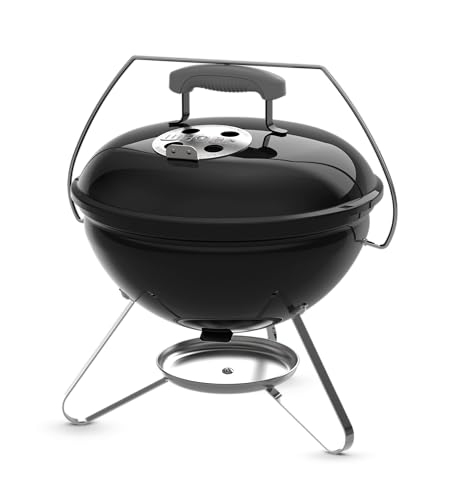
Weber Smokey Joe 14-Inch Portable Charcoal Grill — Best Overall
The Smokey Joe is the grill we recommend when someone asks for one camping charcoal grill and no follow-up questions. It cooks for two to three people beautifully — burgers, steaks, chicken pieces, a halved chicken under the dome — with the full kettle method: banked coals, two zones, lid on, vents doing the temperature work. The lid lock makes it a single grab from the car. It is not the grill for feeding six at once, and it will not smoke a brisket; within its brief, nothing else is as complete.
Check the current price on Amazon
Strengths
- True kettle cooking in miniature — vents, dome and coal behaviour scale down perfectly
- Tuck-N-Carry lid lock secures everything for one-handed transport
- Porcelain-enamelled steel shrugs off seasons of travel and weather
Trade-offs
- 14-inch grate means batch cooking for groups of four-plus
- Small coal bed burns through faster on long cooks — keep spare charcoal handy
- Legs are short; it wants a table, a tailgate or a heat-proof stand
| Grate size | 14-inch kettle |
| Fuel | Charcoal |
| Carry system | Tuck-N-Carry lid lock |
| Construction | Porcelain-enamelled steel (kettle format) |
The Smokey Joe’s genius is that Weber changed almost nothing when they shrank the kettle. The bowl depth, the vent placement, the way the dome turns radiant heat back onto food — it is the full-size cooking system at travel scale, which is why generations of campers learned charcoal on one and why its results embarrass larger, worse-designed grills.
Technique scales with it. A small chimney of briquettes banked to one side gives a searing zone and a safe zone; the lid turns the grill into an oven for chicken and thick chops; the vents — cracked, not cranked — hold the temperature where you set it. A camper who masters a Smokey Joe can cook on any charcoal grill on earth.
Ownership is equally scaled: a brush, a bag of briquettes and a metal bucket for ash are the entire support kit, and replacement grates are sold everywhere. In a category full of novelties, the Smokey Joe is the institution — and institutions earn that status one uneventful, delicious decade at a time.
Best for: Couples and small groups who want the definitive portable charcoal experience / Not suited for: Groups of five-plus, or campers wanting to smoke large cuts

Weber Go-Anywhere Portable Charcoal Grill — Best Packable Design
The Go-Anywhere solves the kettle’s one flaw — its shape. A round grill in a packed car wastes the corners around it; this rectangular box packs against flat surfaces, its legs fold to lock the lid shut, and the whole unit carries like a small suitcase. The rectangular grate suits skewers, sausages and long vegetables naturally, and the two-piece grate makes coal access mid-cook easy. It suits space-planned packers, van lifers and tailgaters. Kettle loyalists who roast whole chickens under a dome will find its lower lid less capacious.
Check the current price on Amazon
Strengths
- Rectangular, briefcase-style pack shape uses vehicle space efficiently
- Folding legs lock the lid for clean, secure transport
- Two-piece cooking grate allows easy coal adjustment mid-cook
Trade-offs
- Lower lid profile limits tall roasts compared with a kettle dome
- Rectangular fire needs arranging for even zones — a small learning curve
- Smaller following than the Smokey Joe, so fewer accessories chase it
| Format | Rectangular portable grill |
| Fuel | Charcoal |
| Grate | 2-piece cooking grate |
| Carry system | Folding legs lock the lid |
Packing geometry is a real specification for campers, and the Go-Anywhere is the only grill here designed around it. In a van drawer, a hatchback corner or a rooftop box, rectangles win — and a grill that packs well is a grill that comes on trips where a kettle gets left behind for space. That is not a minor virtue; it is the difference between grilling at the overlook and not grilling at all.
The cooking is properly Weber: enamelled steel, sensible vents, and a grate layout that rewards a banked fire. Long foods — skewer lines, corn rows, a butterflied chicken pressed flat — fit the rectangle better than a circle, and many owners quietly prefer it for exactly the foods camping menus repeat.
Choose it when the vehicle dictates, and do not apologise: the best camping grill is the one that is with you, and the Go-Anywhere is engineered to be with you more often than any kettle.
Best for: Van lifers, hatchback campers and anyone packing by geometry / Not suited for: Dome-roasting fans who cook tall items under the lid

Kamado Joe Joe Jr 13.5-Inch Portable Ceramic Charcoal Grill (KJ13RH) — Best Premium and Best for Smoking
The Joe Jr. is for the camper who refuses to leave kamado cooking at home. The ceramic body holds heat and moisture the way only a kamado does: ribs at a steady low temperature, a whole chicken roasted juicy, flatbreads baked against the stored heat — then a vent-open rampage to steakhouse searing. The included stand, deflectors and ash tool make it a complete system. The honest costs are weight and care: ceramic travels like the heavy, breakable material it is, so this is a car-and-basecamp grill for people who pack deliberately.
Check the current price on Amazon
Strengths
- Ceramic kamado heat retention — genuine low-and-slow plus fierce searing
- Heat deflectors included, enabling indirect cooking and smoking from day one
- Complete kit: stand and ash tool in the box
Trade-offs
- Ceramic is heavy and can crack if knocked — pack it like the investment it is
- 13.5-inch grate cooks for two to three, not a crowd
- Premium pricing, several times the kettle picks
| Grate size | 13.5-inch |
| Body | Ceramic kamado |
| Grate material | Stainless steel |
| Included | Grill stand, heat deflectors, ash tool |
| Model | KJ13RH |
Kamado cooking is a different physics: the ceramic mass absorbs heat and radiates it evenly, the sealed body sips charcoal and holds moisture, and the temperature — once settled — barely drifts. At a campsite, that means a pork shoulder can cruise while you hike, and a chicken roasts with a juiciness open grills cannot match. The Joe Jr. miniaturises that physics without diluting it.
The deflectors are the detail that separates a system from a toy. With them, the fire becomes indirect: smoke and gentle heat circulate, and the grill smokes. Without them, it is a direct searing machine. Both modes in one 13.5-inch footprint is why this little red egg has a cult following among serious campers.
The travel discipline is simple: transport it upright, padded, in its stand, and never move it hot. Campers who accept that treat it like the premium appliance it is and get a decade of remarkable food; campers who toss it in a boot with the recovery gear should buy the steel Smokey Joe instead.
Best for: Serious cooks who want smoking, roasting and searing in one portable / Not suited for: Rough-and-tumble packers, large groups, or budget-first buyers

Cuisinart 14-Inch Portable Charcoal Grill (CCG-190RB) — Best Budget
The CCG-190RB is the grill for the charcoal-curious: priced for experimentation, sized for two to four, and designed with the two features that matter at this tier — real vents for fire control and lid locks that make it carry like a single object. The dual vent system is not decoration; it is how you hold a temperature instead of chasing one. It suits new charcoal campers, students, and as a second grill for the beach or park. It will not match Weber’s enamel or longevity, and the chrome-plated grate asks for gentler care than cast iron.
Check the current price on Amazon
Strengths
- Dual air vent system gives genuine temperature control at a budget tier
- Three lid locks enable secure one-handed carrying
- Listed 196 sq in of cooking area — generous for a 14-inch class grill
Trade-offs
- Chrome-plated grate is less durable than enamelled steel or cast iron
- Lighter construction than the Weber kettles — a seasons grill, not a decade grill
- Ash management is basic; a metal bucket is a wise companion purchase
| Size | 14-inch portable charcoal grill |
| Cooking area (listing) | 196 sq in |
| Air control | Dual air vent system |
| Carry system | 3 lid locks, one-handed carrying |
| Grate | Chrome-plated |
| Model | CCG-190RB |
Budget charcoal grills usually fail in one of two ways: no vent control, so the fire does what it wants, or a lid that will not stay on in the car, so the grill travels in a bin bag. Cuisinart fixed both, which is why this little grill teaches charcoal properly — a new cook can learn banking, venting and lid discipline on it and produce genuinely good food in the first weekend.
The 196 sq in figure, as listed, counts the full grate; in practice it is a comfortable two-person surface and a patient four-person one. That is the honest size of the whole 14-inch class, and the Cuisinart delivers it without pretending otherwise.
Buy it as the experiment it is priced to be. If charcoal camping becomes your ritual — and for many it does — the upgrade path to a Weber or a kamado will be informed by everything this grill taught you. Few budget purchases pay that kind of tuition dividend.
It also earns a permanent second career even after an upgrade: as the beach grill, the park grill, the loaner for friends who want to try charcoal without buying in. Budget grills that teach well tend to stay in the kit for years in exactly these supporting roles, which makes its real cost-per-cook lower than grills twice its price that never leave the garage.
Best for: New charcoal campers and budget-first buyers who still want real fire control / Not suited for: Anyone expecting Weber-grade enamel and decade-long durability

Sungmor Compact Cast Iron Charcoal Grill — Best Compact Cast Iron
The Sungmor is the minimalist’s cast iron: a compact rectangular grill whose grate adjusts in height above the coals, giving the cook a heat control that fixed grills cannot match — drop it low to sear, raise it to gentle the heat. The listing sizes it honestly for one to three people: skewers, a couple of steaks, a row of vegetables. Wooden handles keep hands safe when repositioning. It suits solo campers, couples and balcony grillers. It does not suit anyone cooking for a family or wanting a lid.
Check the current price on Amazon
Strengths
- Adjustable grate height — direct heat control without moving coals
- Cast-iron construction delivers fierce, even searing
- Compact 12 x 7-inch footprint packs almost anywhere
Trade-offs
- Cooking area is genuinely small — one to three people, as listed
- No lid: direct grilling only, no roasting or smoking
- Cast iron needs drying and oiling to stay rust-free
| Cooking surface (listing) | 12 x 7 inches |
| Material | Cast iron |
| Grate | Adjustable height |
| Handles | Wooden |
| Intended for (listing) | 1–3 people |
Height adjustment is the hibachi tradition’s answer to temperature control, and it is more intuitive than vents: the food moves, not the fire. A steak starts an inch from the coals for its crust, then rises to finish gently; skewers hover at the height where they char at the edges without burning. Once a cook learns heat-by-distance, every other grill feels slightly blunt.
Cast iron at this size is also a lesson in thermal honesty. The Sungmor’s mass is small but real — it will sear two steaks properly, in sequence, all evening, on a modest pile of charcoal. Solo campers and couples do not need a bigger fire; they need a well-aimed one, and that is exactly what this grill builds.
Care is the familiar cast-iron contract, scaled down: dry it, oil it lightly, store it dry. The wooden handles make it pleasant to move while warm-ish — never hot — and the whole unit nests into a small storage box with its charcoal and tools, which is a complete camp kitchen in a shoebox.
Best for: Solo campers and couples who cook hibachi-style over direct heat / Not suited for: Families, lid-cooking fans, or anyone who neglects cast-iron care

GIANTEX Portable Hibachi Grill, Cast Iron — Best Hibachi for Small Groups
Where the Sungmor is minimal, the GIANTEX is equipped: the air-regulating door meters the fire, the fire gate makes adding charcoal a tidy operation, the double-sided grate offers two cooking surfaces in one casting, and the included grate lifter acknowledges that adjusting a hot grate is a real job. It suits hibachi enthusiasts cooking for small groups who want control as well as sear. It shares the format’s limits — no lid, direct heat, cast-iron weight and care — and adds a few more parts to keep track of.
Check the current price on Amazon
Strengths
- Air-regulating door gives fine fire control for an open grill
- Double-sided grate: two cooking surfaces in one casting
- Fire gate and grate lifter included — thoughtful, practical kit
Trade-offs
- More components to clean and keep together than minimalist hibachis
- Open, lidless format only cooks directly
- Cast-iron care rules apply in full
| Type | Portable hibachi charcoal grill |
| Material | Cast iron |
| Grate | Double-sided |
| Air control | Air-regulating door |
| Included | Fire gate, grate lifter |
The hibachi is the oldest portable grill design in this guide, and the GIANTEX shows what a mature version looks like: every frustration of the classic format has a designed answer. Fire too hot? Close the air door a notch. Coals fading mid-cook? Open the fire gate and add fuel without lifting the food. Grate needs raising? The lifter does it with the food undisturbed. It is control engineering in cast iron.
The double-sided grate is quietly the best feature: one side for the wide bars that mark steaks and chops, the other for the closer support that small items — prawns, asparagus, sliced vegetables — demand. At a campsite, where the grill is also the entertainment, that versatility keeps the whole menu on one small fire.
Like all cast iron here, it asks for the dry-and-oil routine and repays it with decades of service. Buy it if the hibachi style is your camp cooking; it is the most complete expression of the style in a portable body.
Best for: Hibachi enthusiasts who want maximum control in the classic format / Not suited for: Lid-cooking fans or campers wanting the lightest possible kit
Comparison Table
| Pick | Badge | Key spec | Best for |
|---|---|---|---|
| Weber Smokey Joe 14-Inch Portable Charcoal Grill | Best Overall | 14 in kettle, charcoal, Tuck-N-Carry lid lock | Couples and small groups who want the definitive portable charcoal experience |
| Weber Go-Anywhere Portable Charcoal Grill | Best Packable Design | Rectangular pack-flat body, charcoal, 2-piece grate | Van lifers, hatchback campers and anyone packing by geometry |
| Kamado Joe Joe Jr 13.5-Inch Portable Ceramic Charcoal Grill (KJ13RH) | Best Premium and Best for Smoking | 13.5 in ceramic kamado, deflectors + stand included | Serious cooks who want smoking, roasting and searing in one portable |
| Cuisinart 14-Inch Portable Charcoal Grill (CCG-190RB) | Best Budget | 14 in, 196 sq in (listing), dual vents, lid locks | New charcoal campers and budget-first buyers who still want real fire control |
| Sungmor Compact Cast Iron Charcoal Grill | Best Compact Cast Iron | 12 x 7 in cast iron, adjustable grate, tabletop | Solo campers and couples who cook hibachi-style over direct heat |
| GIANTEX Portable Hibachi Grill, Cast Iron | Best Hibachi for Small Groups | Cast-iron hibachi, double-sided grate, air door, lifter included | Hibachi enthusiasts who want maximum control in the classic format |
The table divides cleanly into two philosophies. The kettles and the kamado cook with a lid — roasting, smoking and baking are in their repertoire, and vents are their controls. The cast-iron pair cook open and direct — searing is their art, and grate height or air doors are their controls. Decide which philosophy matches your camp menu and the shortlist halves itself.
What every row shares matters too: real charcoal, real portability, and a verified listing behind it. There is no disposable foil tray and no patio grill in disguise anywhere in this guide.
A note on the two Weber picks sitting side by side: they are not redundant. The Smokey Joe is the better cooker in the abstract — deeper dome, classic kettle behaviour — while the Go-Anywhere is the better traveller, and which virtue matters more is decided by your vehicle and your menu, not by any ranking this guide could print. Many long-term campers end up owning both, one for the backyard-doorstep cooks and one that lives in the van.
How to Choose the Best Camping Charcoal Grills
Charcoal grills look simple and differ in the details that decide campsite happiness: format, vent control, grate material and ash handling. Work through these four and the right pick emerges.
Kettle, kamado or hibachi: which charcoal format fits your cooking?
Kettles are the all-rounders: a lidded bowl that grills, roasts and — with banked coals — gently smokes, with a learning curve measured in one cook. If you buy one charcoal grill for everything, buy a kettle. Kamados are the specialists in time: insulated bodies that hold low temperatures for hours and sear ferociously, at the price of weight, cost and (in ceramic) fragility. Hibachis are the specialists in heat: open cast-iron grills that sear like nothing else and do almost nothing else — no lids, no roasting, no mercy.
Match format to menu with honesty. Burgers-steaks-chicken campers are kettle people. Ribs-and-roasts campers are kamado people. Steak-and-skewers campers are hibachi people. The formats overlap at the edges, but each has a centre of gravity, and buying against yours is how grills end up in garage sales.
Vent control: the difference between cooking and firefighting
A charcoal fire is controlled by air, so the vents are the grill’s thermostat. Good designs give you an intake you can adjust in small increments and an exhaust that draws heat across the food; the Cuisinart’s dual vent system and the kettles’ dampers do exactly this. Kamados refine it further with precise top and bottom vents. Open hibachis substitute grate height and air doors — different mechanics, same principle.
The technique that matters: make small adjustments early and wait. Charcoal responds over minutes, not seconds, and the camper who cranks vents at every flicker spends dinner chasing the temperature. Set the fire up correctly — right coal count, banked for zones — and the vents become fine-tuning rather than rescue equipment.
How much charcoal, and which kind?
Briquettes are the camper’s friend: uniform, long-burning, predictable, and they stack neatly in a bag or bin. Lump charcoal burns hotter and cleaner-flavoured but varies piece to piece and burns faster — lovely for hibachi searing, fussier for a kettle roast. Quantities: a small kettle cook uses roughly a chimney of briquettes; a kamado uses strikingly less thanks to its insulation; hibachis sip fuel by the handful.
Pack charcoal dry — a sealed plastic bin in the vehicle — because damp charcoal lights badly and burns worse. And plan the fire’s end when you light it: coals for a one-hour grill should be a one-hour pile, so the ash you must cool and pack out is the minimum possible.
Ash, embers and site rules: the responsibilities
Charcoal’s one true cost is what remains. Ash must be completely cold — drowned and stirred if there is any doubt — before it leaves the grill, and it goes out with your waste or into a designated ash container, never scattered at the site and never, ever into a bin while warm. A small lidded metal bucket is the professional’s tool and appears in every experienced charcoal camper’s kit.
Rules sit above technique: many parks restrict charcoal during fire season, some ban it outright, and wind can make any open fire irresponsible regardless of rules. Check before you travel, respect the ban when it exists — the gas grill in the other guide is the standing plan B — and never leave a charcoal grill unattended while it holds heat.
The Two-Zone Fire: The Only Charcoal Technique You Must Learn
If this guide could teach one skill, it is the two-zone fire: all the lit coals banked to one side of the grill, leaving the other side coal-free. The hot zone sears; the cool zone finishes, holds and rescues. Chicken crisps over the coals and completes on the cool side without burning. Steaks sear hard, then rest in the gentle heat to the perfect centre. Vegetables char at the edge of the fire and soften away from it. Nearly every charcoal failure — burnt outside, raw inside — is a one-zone failure, and nearly every success is this simple arrangement.
Building it takes thirty seconds: light a chimney, pour it against one wall of the bowl, and set the grate. On the rectangular Go-Anywhere and the hibachis, bank along one end instead. On the kamado, the deflectors create the same effect vertically. Learn it on your first cook and charcoal stops being a gamble; it becomes the most controllable cooking you do outdoors.
Charcoal vs. Gas for Camping: An Honest Word from a Charcoal Guide
This guide loves charcoal and still insists on the honest comparison. Gas wins on speed, cleanliness, cold-morning breakfasts and legal access to restricted sites; it loses on smoke flavour and maximum sear. Charcoal wins on flavour, ritual and the quality of the evening around the fire; it loses on convenience, mess and rules. Neither victory is total, which is why so many experienced campers own one of each and choose per trip.
If you are buying your first camping grill and feel torn, decide by your scarcest resource. Short on time and patience at the end of long days? Gas. Short on flavour and ceremony in your outdoor life? Charcoal — and this guide’s Smokey Joe is where that road classically begins.
Keeping a Small Charcoal Grill Alive for a Decade
Portable charcoal grills die of neglect, not of use, and the neglect is always the same trio: ash left sitting in the bowl, moisture invited in, and grates stored dirty. Ash is hygroscopic and mildly corrosive — left in a kettle over a damp winter, it pastes itself to the enamel and eats the metal beneath. The fix takes two minutes: empty the ash once it is cold, every trip, no exceptions.
Grate care decides the second decade. Brush the grate hot after every cook and it never builds the carbonised layer that makes food stick; oil cast-iron grates and hibachi bodies lightly before storage and they cannot rust. Enamelled steel — the Webers here — asks only to be kept dry and not chipped by dropping the lid, which the lid locks on both Weber picks conveniently prevent in transit.
Store the grill somewhere dry with its vents open a crack so air moves, keep the charcoal in its own sealed bin rather than in the grill, and check the legs, handles and vent discs once a season for looseness. That is the entire maintenance programme. The Smokey Joe in a neighbour’s garage that still cooks at twenty years old is not a miracle — it is this paragraph, followed.
How to Light and Manage Charcoal at a Campsite
A reliable charcoal routine removes the only real friction in charcoal camping. This is the sequence experienced campers use, sized for the portable grills in this guide.
- Set the grill on firm, level, non-flammable ground, sheltered from wind and clear of tents, vehicles and dry vegetation.
- Fill a compact chimney starter with briquettes — roughly a full chimney for a kettle, less for a hibachi or kamado — and light it from below with a fire cube or scrunched paper.
- Wait until the top coals are edged with grey ash, about 15–20 minutes. Use the time to prep food; this pause is the charcoal ritual, not a delay.
- Pour the coals into the arrangement your cook needs: banked to one side for two-zone cooking, spread for direct grilling, or a small pile for the hibachi.
- Set the grate, close the lid with vents open, and let the grill preheat for five minutes. Brush the grate clean while it is hot.
- Cook with the lid on for kettle and kamado dishes, adjusting vents in small increments and waiting several minutes between changes.
- When cooking ends, close all vents to starve the fire. Let the grill cool completely — hours, not minutes — before handling ash.
- Transfer cold ash to a lidded metal container, confirm it is stone cold (drown and stir if in any doubt), and pack it out with your waste.
Followed once, the routine feels deliberate; followed for a season, it becomes as automatic as pitching the tent — and the food it produces is why charcoal campers never really convert.
Common Buying Mistakes
Using lighter fluid. It flavours food, flares unpredictably and is banned at some sites. A chimney starter lights coals cleanly every time — it is the correct tool and it is cheap.
Cooking over black, smoking coals. Coals are ready when they are ashed over and glowing. Food over still-flaming, smoking charcoal tastes of the fire’s worst minutes. Wait the extra five.
Spreading all the coals evenly, always. A single uniform fire gives you one temperature and no rescue zone. Bank the coals and gain a second climate — the two-zone fire is the whole craft.
Dumping ash at the site. Warm ash starts fires; even cold ash violates pack-out rules at most sites. Cool it fully, contain it in metal, and carry it out.
Ignoring a charcoal ban. Restrictions exist because the risk is real. When the site says no charcoal, the answer is the gas grill or the camp stove — not a smaller fire and hope.
Storing the grill with ash inside. Ash holds moisture against metal and turns to corrosive paste. Empty, dry and store clean, and a portable charcoal grill lasts for years.
Final Recommendation
Start where generations have started: the Weber Smokey Joe is the complete portable charcoal grill for most campers. Pack-conscious travellers take the Go-Anywhere; ambitious cooks take the Kamado Joe Jr.; hibachi searing fans choose between the compact Sungmor and the fully-featured GIANTEX; and new or budget-minded campers get a genuinely instructive grill in the Cuisinart CCG-190RB.
Learn the two-zone fire, respect the ash, and check the site rules — charcoal camping rewards exactly that much discipline with the best food in the outdoors.
A word on budget allocation for new charcoal campers: spend on the grill first, the chimney starter second, and a lidded metal ash bucket third — that trio, in that order, is a complete and safe charcoal camp kitchen. Everything else — fancy tools, exotic lump charcoal, a second grill for a different mood — is refinement that can wait for the second season, when you will know exactly which refinements your cooking actually wants.
Compare the finalists side by side on their live listings: Weber Smokey Joe 14-Inch Portable Charcoal Grill, Weber Go-Anywhere Portable Charcoal Grill, Kamado Joe Joe Jr 13.5-Inch Portable Ceramic Charcoal Grill (KJ13RH).
Keep researching with these guides from our grills program: Best Camping Bbq Grills, Best Camping Grills, Best Cast Iron Charcoal Grills.
Frequently Asked Questions
How long does charcoal take to be ready?
In a chimney starter, about 15–20 minutes until the top coals are ashed over. That window covers food prep comfortably, and it is the same every time — unlike lighter-fluid methods, which vary with the wind and the cook’s optimism.
Can I reuse leftover charcoal?
Yes — close the vents when you finish cooking to starve the fire, and the unburned coals can be shaken free of ash and relit next time, topped up with fresh briquettes. Kamados are especially good at this, which is part of their fuel economy. Reused coals light a little less eagerly and burn a little shorter than fresh ones, so blend them with new briquettes for an important cook and save the all-recycled fire for a casual one.
What is the best charcoal for camping?
Briquettes for most campers: uniform size, long steady burn, predictable behaviour in kettles. Lump charcoal burns hotter and is excellent for hibachi searing. Either way, keep it dry in a sealed bin — damp charcoal is the hidden cause of most bad fires.
Are charcoal grills allowed at campsites?
Often, but not always, and restrictions tighten in fire season. Check your destination’s rules before travelling, use provided fire rings or pads where required, and never leave a lit grill unattended.
How do I control temperature on a small charcoal grill?
With the vents and the coal arrangement, not with hope. Bank coals for two zones, adjust the intake vent in small steps, and wait several minutes for each change to register. A small grill responds faster than a big one, which makes it a good teacher. Start with fewer coals than you think you need — adding lit coals to a small grill is easy, while cooling an overheated one is a waiting game played in front of hungry people.
Is a kamado worth it for camping?
If you will smoke, roast and bake at camp — and you travel by vehicle with room to pack it carefully — the Joe Jr. delivers cooking no other portable here can match. If your camping is burgers at dusk after long drives, a kettle serves you better for a fraction of the cost and weight.
Related reading: Best Ceramic Bbq Grills, Best Camping Fire Grills, Best Affordable Charcoal Grills.


