Disclosure: airfryerkitchensupply.com is reader-supported. When you buy through links on our site, we may earn an affiliate commission at no extra cost to you.
Where to Buy
Our shortlist of the best blenders food processor combo systems starts here, with machines that ship a real processor bowl or chopper. Every system here was verified against its live Amazon listing, and each includes a genuine food processor bowl or chopper attachment in the box — not a blender jar with delusions of chopping.
- Ninja Kitchen System Pro BL770, 1500W, 72 oz + 8-Cup Processor — Best Overall — Check the current price on Amazon
- Ninja UltraCrush Pro Kitchen System BP401, 1500W, 72 oz — Best for Large Families — Check the current price on Amazon
- Braun MultiQuick 7 3-in-1 Immersion Blender & Food Processor — Best Immersion Processor Kit — Check the current price on Amazon
- Hamilton Beach Blender and Food Processor Combo 58163, 700W — Best Budget Combo — Check the current price on Amazon
- Breville BSB510XL Control Grip Immersion Blender with Chopper — Best Control and Ergonomics — Check the current price on Amazon
- Cuisinart Smart Stick CSB-179, 300W, with Chopper and Whisk — Best Compact Value Kit — Check the current price on Amazon
Combo contents are the most changeable part of any listing. Confirm the processor bowl, blades and cups included with each system on the product page before ordering.
The best blenders food processor combo systems answer a question every kitchen eventually asks: why do two appliances with motors, blades and bowls get to occupy two footprints of counter? A blender pitcher and a processor bowl want different shapes — one tall and narrow for vortex pureeing, one wide and shallow for even chopping — but they can absolutely share one honest motor base, and the systems in this guide are the ones that do it without crippling either job.
The category needs policing, because “combo” is a word marketing stretches. A true combo includes a processor bowl with its own blade, sized in cups, that chops, slices or kneads as a processor should. A blender whose pitcher can technically pulse an onion into soup is not a combo; it is a blender with a rumor attached. Every pick below ships the real bowl or a legitimate chopper attachment, and each review states the bowl’s size and what it genuinely does well.
The six verified systems split by scale. At the top are full kitchen systems — 1500W bases driving 72 oz pitchers and 8-cup processor bowls, the complete replacement for two appliances. In the middle is a versatile immersion-based processor kit for cooks who process in small batches and blend in the pot. At the accessible end are a budget blender-processor combo with a glass jar, and compact chopper kits that trade capacity for drawer storage.
Judge a combo by its weakest promised job, because that is the job that will disappoint you monthly. A great blender with a toy processor bowl is a great blender and a recurring annoyance. The reviews below score both jobs separately, name the capacities in cups and ounces, and reserve their badges for systems whose processor side is a tool rather than a token.
There is a second, quieter reason combos have won the modern kitchen, and it deserves stating before the picks: cooking itself has consolidated. The same household that once cooked separate meals now batch-preps on Sundays, blends breakfast daily, and processes vegetables for grain bowls, tacos and soups across the week — a rhythm that uses both vessels constantly and neither appliance occasionally. Separate machines made sense when each was a weekly guest. At daily rates, the shared base stops being a compromise and becomes the architecture the rhythm was asking for. The systems below were chosen for that rhythm: not the most specialized tools for a single feast day, but the most coherent pair of tools for the way a week of real cooking now unfolds.
In this guide
Quick Picks
Six verified blender-processor systems, from full 1500W kitchen systems to drawer-sized kits. Badges name the scale each system serves best.
- Ninja Kitchen System Pro BL770, 1500W, 72 oz + 8-Cup Processor — Best Overall: the benchmark combo — a 72 oz pitcher and a true 8-cup processor bowl that handles salsa and dough, on one 1500W base. — check price on Amazon
- Ninja UltraCrush Pro Kitchen System BP401, 1500W, 72 oz — Best for Large Families: the same true-combo architecture at maximum batch scale — full pitcher, full 8-cup bowl, Total Crushing power. — check price on Amazon
- Braun MultiQuick 7 3-in-1 Immersion Blender & Food Processor — Best Immersion Processor Kit: a different architecture — blend in the pot with the stick, process in the attachment bowl, store everything in a drawer. — check price on Amazon
- Hamilton Beach Blender and Food Processor Combo 58163, 700W — Best Budget Combo: the combo idea at a mainstream tier — glass blender jar, 3-cup chopper and travel cup on one modest base. — check price on Amazon
- Breville BSB510XL Control Grip Immersion Blender with Chopper — Best Control and Ergonomics: fifteen speeds and the best grip in immersion blending, with a chopper, whisk and a 42 oz jug in the kit. — check price on Amazon
- Cuisinart Smart Stick CSB-179, 300W, with Chopper and Whisk — Best Compact Value Kit: the drawer-sized combo at a friendly tier — variable-speed stick, chopper bowl and whisk, all in one small box. — check price on Amazon
How These Picks Were Chosen
The entry rule was the bowl: a system qualified only if a genuine food processor bowl or chopper attachment — a vessel designed for processing, with its own blade — is included in the box. Blender-only machines with “processing” language in their marketing were excluded, and the distinction is maintained in every review.
Every pick was verified against its live Amazon listing, and the vessel sizes, power figures and attachment lists quoted here come from those listings. Because bundle contents change, the where-to-buy section instructs you to confirm the bowl and attachments on the product page before ordering — with combos, the box contents are the product.
Ranking scored the two jobs separately and then together: blending quality, processing quality, and the coherence of the system — one base, sensible vessels, available parts. The immersion kits were judged within their format and badged for scale, so a small household is not pushed toward a countertop system it does not need.
Capacity claims were normalized during selection, because the category mixes them shamelessly: pitcher ounces, bowl cups and total-volume jar figures all appear in listings side by side. Every capacity in this guide is labeled with its vessel and unit, and the comparison table keeps them separate, so an 8-cup bowl is never silently compared with a 72-ounce pitcher as if they were the same kind of number.
The 6 Best Blenders Food Processor Combo Systems, Reviewed
Each review scores both jobs — blending and processing — because a combo fails at its weaker job, monthly, in front of witnesses.

Ninja Kitchen System Pro BL770, 1500W, 72 oz + 8-Cup Processor — Best Overall
The BL770 is the system this category is judged by, because both of its jobs are real. The 72 oz pitcher blends at full Ninja standard, and the 8-cup processor bowl is a genuine processor — wide, shallow, with the capacity and blade to chop vegetables evenly, turn out salsa with texture, and knead small batches of dough. Add two to-go cups for personal blending and you have one base honestly replacing a blender, a processor and a personal blender.
| Power | 1500W |
|---|---|
| Pitcher | 72 oz |
| Processor bowl | 8-cup |
| Extras | Two 16 oz to-go cups |
Strengths
- Real 8-cup processor bowl — even chopping, salsa and dough included
- 1500W base never feels shared or strained across vessels
- To-go cups make it a three-format system, not two
Trade-offs
- Three vessels plus base demand real storage
- Processor discs for slicing and shredding are not the system’s focus — chopping is
- Full-size footprint on the counter
The dough capability is the tell that the processor side is serious. Kneading is torque work that toy bowls cannot fake: the BL770’s bowl and blade pull a small pizza or bread dough together credibly, which moves the system from “blender plus chopper” into genuine second-appliance territory. Salsa is the other tell — distinct pieces in a loose matrix, not the puree-with-chunks a blender jar produces.
Longevity and support round out the overall case. The system has sold for years, replacement vessels are everywhere, and the wear items are the cheap parts. If a household can own one motorized prep appliance, this is the one that leaves the fewest jobs undone.
Best for: households replacing a blender and a food processor with one serious system / Not suited for: anyone needing slicing and shredding discs as a primary function
Check the current price on Amazon

Ninja UltraCrush Pro Kitchen System BP401, 1500W, 72 oz — Best for Large Families
The BP401 takes the proven kitchen-system formula and leans into volume and ice. The pitcher and the 8-cup processor bowl are full-size, the 1500W base is tuned around Total Crushing performance, and the result is the combo for households whose prep happens in family quantities: pitchers of frozen drinks, bowls of chopped vegetables for the week, salsa by the batch.
| Power | 1500W |
|---|---|
| Pitcher | 72 oz |
| Processor bowl | 8-cup |
| Extras | 18 oz to-go cup |
Strengths
- Full-size vessels on both jobs — no batch-splitting for family cooking
- Ice and frozen crushing is the design’s headline strength
- Processor bowl keeps meal-prep chopping in-house and even
Trade-offs
- One to-go cup rather than two
- The largest storage footprint in this guide
- Power and scale are surplus for one or two people
Between this and the BL770, choose by cups and emphasis rather than quality — both are complete systems on 1500W bases. The BP401 is the pick when the pitcher and bowl run full as a matter of routine; the BL770 when personal-cup versatility matters more. Neither leaves the processor job half-done, which is the entire point of the category.
Meal preppers should note the bowl arithmetic: an 8-cup processor turns a week of onions, peppers and herbs into one short session with even results a knife cannot match for speed. Paired with the pitcher’s batch blending, the BP401 is the closest thing here to a small catering station.
Best for: large families and meal preppers working in full batches / Not suited for: small households, who should take the BL770 or a compact kit
Check the current price on Amazon

Braun MultiQuick 7 3-in-1 Immersion Blender & Food Processor — Best Immersion Processor Kit
The MultiQuick 7 rejects the countertop-system premise entirely. Its blender is a stick that works in any pot or jug; its food processor is an attachment bowl the same motor drives; and the whole kit stores in a drawer. For cooks whose processing is frequent but small — herbs, nuts, onions, breadcrumbs, baby food — and whose blending is soups and sauces in the pot, this architecture fits better than any countertop system in the guide.
| Format | Immersion blender + food processor attachment |
|---|---|
| System | 3-in-1 MultiQuick 7 |
| Use | In-pot blending, bowl processing |
| Storage | Drawer-sized kit |
Strengths
- Blends directly in the cooking pot — no transfers, no pitcher washing for soups
- Processor attachment handles the daily small chopping jobs with even results
- Total storage footprint is a fraction of a countertop system’s
Trade-offs
- Processor capacity is small-batch — not a meal-prep bowl
- Immersion blending a large smoothie is slower than a pitcher
- No single-serve cup ecosystem like the Ninja systems
Braun’s MultiQuick line is the connoisseur’s immersion format, and the processor attachment is its quiet triumph: the bowl geometry is correct — wide relative to depth, blade low — so the chop is even in the way blender jars never achieve. Pesto, nut crumbs, chopped herbs and onions for two to four people all come out right, in the quantity small households actually cook.
The honest boundary is scale, stated once more because it decides satisfaction: this kit serves cooks, not caterers. If your processor jobs arrive in cups rather than quarts, the MultiQuick 7 delivers both jobs with the least ownership burden in this guide — nothing on the counter, everything in a drawer, both tools genuinely good.
Best for: small households that blend in the pot and process in small batches / Not suited for: families needing full-size pitcher and bowl capacity
Check the current price on Amazon
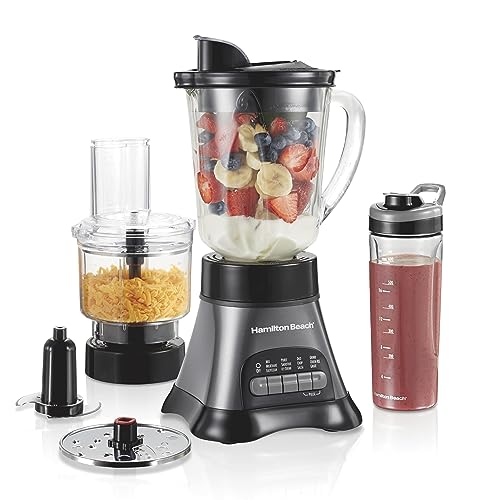
Hamilton Beach Blender and Food Processor Combo 58163, 700W — Best Budget Combo
Hamilton Beach’s combo is the budget expression of this category, and it is a respectable one: a 40 oz glass blender jar — glass, at this tier, is a genuine distinction — a 3-cup chopper with correct bowl geometry, and a travel cup for personal servings. It covers the combo brief completely for small households, at a fraction of the Ninja systems’ commitment.
| Power | 700W peak |
|---|---|
| Jar | 40 oz glass |
| Chopper | 3-cup chopper attachment |
| Extras | Travel cup included |
Strengths
- Glass jar resists staining and handles hot liquids better than budget plastic
- 3-cup chopper chops evenly for two-to-four-person cooking
- Lowest-cost complete combo in this guide
Trade-offs
- 700W peak power limits heavy frozen blending
- Chopper capacity means batch cooking happens in rounds
- No dough ambitions — chopping and light processing are the brief
Frequency is the lens for this pick. A household that blends a few smoothies a week and chops an onion a day will find the 58163 entirely sufficient, and will enjoy the glass jar every single day — it rinses clean of garlic, turmeric and tomato in a way plastic at this tier never does. The chopper’s even results, though small-scale, shame any amount of jar-pulsing.
Ambition is its ceiling: daily frozen green smoothies will find the power limit, and holiday cooking will find the chopper’s. Buy it for the cooking you actually do most weeks and it is the value champion of the category; buy it for Thanksgiving and it will file a complaint by the second batch.
Best for: small households wanting a complete, honest combo on a budget / Not suited for: heavy frozen blending or large-batch processing
Check the current price on Amazon

Breville BSB510XL Control Grip Immersion Blender with Chopper — Best Control and Ergonomics
The Control Grip is the immersion kit for cooks who care about feel: fifteen speeds under a trigger-style grip that reduces hand fatigue, a bell-shaped base designed to cut suction against pot bottoms, and a kit containing a chopper, a whisk and a 42 oz jug. Its processing side is the chopper attachment — small, correct and even — and its blending side is the most controllable in the immersion format.
| Power | 280W |
|---|---|
| Controls | 15 speeds |
| Attachments | Chopper, whisk |
| Jug | 42 oz blending jug |
Strengths
- 15-speed control is unmatched for emulsions and delicate sauces
- Ergonomic grip and anti-suction design make long blends comfortable
- Chopper and whisk attachments cover the small processing and baking jobs
Trade-offs
- 280W is modest — this is a control instrument, not a power tool
- Chopper scale is garnish-and-sauce, not meal prep
- Premium tier within the immersion format
Fifteen speeds sound like excess until you make mayonnaise, hollandaise or a vinaigrette that must not break: emulsion work is speed-discipline work, and the Control Grip gives finer low-end control than anything else here. The chopper follows the same philosophy — modest capacity, excellent manners — producing even small chops for sauces and garnishes.
As a combo, it is the specialist’s kit: blending and processing both done with precision at small scale. Cooks who value that precision — and there are many — will find it the most satisfying tool in this guide. Cooks who value volume should take a Ninja system and never look back.
Best for: precision cooks making sauces, emulsions and small-batch processing / Not suited for: volume cooking or power-first buyers
Check the current price on Amazon
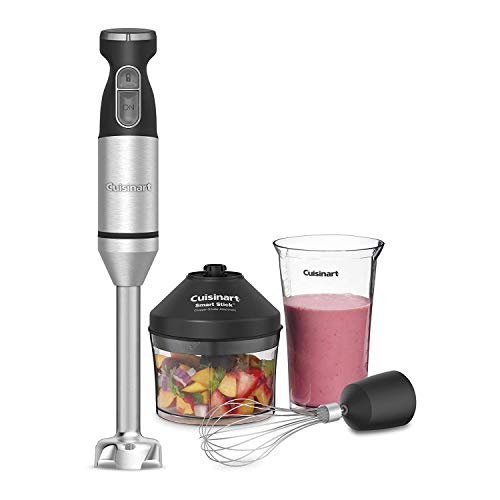
Cuisinart Smart Stick CSB-179, 300W, with Chopper and Whisk — Best Compact Value Kit
The CSB-179 is the compact value expression of the combo idea: a variable-speed immersion blender with a chopper attachment and whisk in the box. It blends soups in the pot, chops the daily small jobs in its bowl, whisks cream and eggs, and stores in a drawer. For one or two people, it covers the combo brief at the lowest ownership cost — money, space and washing — in this guide.
| Power | 300W |
|---|---|
| Shaft | 8 in blending shaft |
| Attachments | Chopper, whisk, measuring cup |
| Controls | Variable speed |
Strengths
- Complete small-scale combo: blend, chop and whisk from one kit
- Drawer storage — nothing lives on the counter
- Friendly tier price for the format
Trade-offs
- Chopper capacity is small by design
- Immersion format means no true pitcher blending
- Power suits its scale; thick, large loads are not its brief
The Smart Stick’s case is proportion. Most processing in a small household is an onion, a handful of herbs, a cup of nuts — jobs for which a full-size processor is theatrical overkill and a knife is slow. The chopper attachment does those jobs in seconds with even results, and the stick handles the soup pot directly. The combo is complete at the scale its buyers live at.
It will not meal-prep for six, blend a family smoothie pitcher, or knead anything — and it does not claim to. As the compact value pick, its job is to be the only prep motor a small kitchen needs, and at that job it is thoroughly convincing.
Best for: one and two-person households wanting a complete drawer-sized combo / Not suited for: families or batch cooks of any description
Check the current price on Amazon
Comparison Table
The processor column is the category’s truth serum. Compare bowl sizes and types before comparing watts.
| Pick | Badge | Key Spec | Best For |
|---|---|---|---|
| Ninja Kitchen System Pro BL770, 1500W, 72 oz + 8-Cup Processor | Best Overall | 1500W, 72 oz pitcher + 8-cup processor bowl | households replacing a blender and a food processor with one serious system |
| Ninja UltraCrush Pro Kitchen System BP401, 1500W, 72 oz | Best for Large Families | 1500W, 72 oz + 8-cup bowl, Total Crushing | large families and meal preppers working in full batches |
| Braun MultiQuick 7 3-in-1 Immersion Blender & Food Processor | Best Immersion Processor Kit | Immersion + processor attachment, 3-in-1 | small households that blend in the pot and process in small batches |
| Hamilton Beach Blender and Food Processor Combo 58163, 700W | Best Budget Combo | 700W peak, glass jar + 3-cup chopper | small households wanting a complete, honest combo on a budget |
| Breville BSB510XL Control Grip Immersion Blender with Chopper | Best Control and Ergonomics | 15 speeds, chopper + whisk + 42 oz jug | precision cooks making sauces, emulsions and small-batch processing |
| Cuisinart Smart Stick CSB-179, 300W, with Chopper and Whisk | Best Compact Value Kit | 300W immersion kit with chopper attachment | one and two-person households wanting a complete drawer-sized combo |
Power figures mix rated and peak values exactly as listed; vessel sizes are as listed. “Chopper attachment” systems process at small scale by design — that is a format, not a flaw.
How to Choose a Blender and Food Processor Combo
Size the processor bowl to your real cooking first, because it is the half of the combo most often undersized. An 8-cup bowl serves family cooking and meal prep; a 3-cup chopper serves daily small jobs for a few people; an immersion-kit chopper serves garnish-and-sauce scale. None is better in the abstract — but the wrong one for your life is a monthly irritation with a power cord.
Then confirm the blender half in the normal way: pitcher capacity for your batch habits, power for your frozen loads, and controls you will enjoy. Combos tempt buyers to accept a mediocre blender for the sake of the system; the top picks here refuse that trade, and so should you. The base is shared, so its quality is paid — or enjoyed — twice.
Finally, inventory the box against the listing on the day you order. Combo bundles are revised quietly: a cup added, a blade changed. The systems in this guide were verified with the vessels described, and a thirty-second check of the current listing keeps your purchase identical to the one reviewed.
What a Processor Bowl Does That a Blender Jar Cannot
Geometry is destiny. A blender jar is tall and narrow to sustain a vortex that liquefies; a processor bowl is wide and shallow so food falls sideways into a sweeping blade and is cut into pieces that remain pieces. That is why jar-pulsing produces onion soup with lumps while a modest 3-cup chopper produces an even dice: the vessels are solving opposite problems.
The bowl also unlocks jobs jars cannot attempt: kneading small doughs, shredding and slicing with discs where fitted, and emulsifying in controlled, visible batches. When you evaluate a combo, you are really evaluating whether its bowl is a processor that happens to share a base, or a garnish. The picks here were chosen to be the former, at their respective scales.
Combo vs. Two Separate Appliances: The Honest Ledger
A combo saves money, space and one motor’s worth of maintenance, and it guarantees the two tools match your kitchen’s scale. It costs you peak specialization: the finest standalone processors slice and shred with disc libraries no combo matches, and the finest blenders out-blend any system. For most households the combo’s adequacy at both jobs beats excellence at one and absence at the other.
The exception is the specialist household. Bakers who process daily, large families who shred by the kilo, and smoothie businesses-in-a-kitchen should buy separates without guilt. Everyone else — which is most kitchens — is better served by one strong system, honestly sized, than by two appliances competing for the same outlet and shelf.
Slicing, Shredding and the Disc Question
Every combo buyer eventually meets the disc question: can it slice and shred? Standalone food processors built their reputations on disc libraries — thin slice, thick slice, fine shred, julienne — while blender-processor combos concentrate on the chopping blade. The systems in this guide follow the combo pattern: their bowls chop, mix and (in the Ninja systems) knead excellently, and slicing-shredding is not their headline. Buyers should decide how much that matters before, not after, purchase.
The honest frequency test helps. Most home cooking chops daily and shreds weekly at most; cabbage for slaw, cheese for a casserole, potatoes for a gratin are real but occasional jobs, and a box grater covers them at zero storage cost. If your cooking inverts that ratio — a deli-style household, a kimchi or slaw production line, holiday cooking at scale several times a year — a disc-focused standalone processor is the correct primary tool and a combo becomes the backup.
For the majority pattern, the combo’s chopping blade covers the overwhelming share of processing life, and the disc gap is a theoretical limitation that never becomes a practical one. Judge by your last month of cooking, not by the most elaborate recipe you own. The bowl that chops your onions tonight is worth more than the disc that would slice a daikon in a hypothetical December.
Setting Up a Combo Station That Stays Organized
Combos fail socially before they fail mechanically: the vessels multiply, the blades migrate, and within a year the system is a blender plus a rumor of a processor bowl in a high cupboard. The fix is a station, set up once. One shelf zone or one deep bin holds the base’s entire family — pitcher, bowl, cups, blades nested inside their vessels, lids with their owners. When everything lives within one arm’s reach of the base, both jobs stay equally likely to happen.
Blade storage deserves its own rule because processor and blender blades are the sharpest unguarded objects in most kitchens. Nested inside their vessels is safest; a dedicated blade box is second. Loose in a utensil drawer is how stitches happen — and how blade edges dull against metal clutter, quietly degrading the chopping the system was bought for.
Finally, keep the manual’s vessel diagrams — a photo on your phone suffices. Combo systems have correct and incorrect assembly orders, and the household member who did not unbox the machine will guess. Thirty seconds of documentation at setup prevents the forced lid, the mis-seated bowl and the support call, none of which are the machine’s fault and all of which get blamed on it.
Meal Prep Day on a Combo System: A Realistic Walkthrough
Abstract claims about combos become concrete on prep day, so here is the system at work. The session opens with the processor bowl: onions, peppers and celery for the week’s cooking base, pulsed in two batches to an even chop — five minutes, including the rinse. Carrots and herbs follow for salads and garnishes. The bowl rinses clean between jobs in seconds because nothing has had time to set, which is the combo workflow’s hidden engine: vessels used in sequence, washed in the gaps, never stacked dirty.
Mid-session belongs to the mixtures: a salsa batch, a hummus or bean dip, a crumb base for the week’s dessert. The bowl handles the textured jobs; the pitcher takes the smoothie prep and a soup base, blended smooth while the bowl soaks. Personal cups close the session with the week’s dressings and sauces portioned for the fridge. Total motorized time across the whole session is measured in minutes; total elapsed time, under an hour for a week of cooking infrastructure.
Notice what did not happen: no second appliance was unboxed, no counter was surrendered to two bases, and no job waited for the other tool to be washed and stored. That is the combo proposition in its true form — not that one machine blends and processes, but that a household’s entire prep rhythm fits one base, one shelf zone and one washing routine. Households whose Sundays look like this are the ones combos were invented for.
How to Get the Best from a Blender-Processor Combo
Combos reward cooks who treat the two vessels as different instruments. These habits keep both halves performing at their best.
- Match the vessel to the texture you want. Liquid and smooth: pitcher. Pieces and texture: bowl. The most common combo disappointment is asking the jar to chop or the bowl to puree — each produces the other’s failure mode with great efficiency.
- Pulse the processor; run the blender. Chopping is controlled by short pulses with checks between — texture is subtracted, never added back. Blending is the opposite: commit to the run and let the vortex finish. Opposite jobs, opposite rhythms.
- Cut before you process. Even chunks, roughly one-inch, feed a processor bowl evenly. Dumping whole onions and hoping is how you get puree at the blade and boulders at the wall — in a bowl fully capable of better.
- Use the bowl for emulsions and doughs within its rating. Mayonnaise, dressings and small dough batches are the processor’s party tricks. Respect the stated capacities — an overfilled bowl strains the shared base that your blender also needs.
- Wash vessels promptly, store the system together. Combo parts multiply; a system stored together gets used, and a system scattered across cupboards quietly becomes a blender with rumors. Rinse blades immediately — processor blades are as sharp as blender blades and twice as exposed.
Master the vessel-matching habit and a combo stops feeling like a compromise and starts feeling like what it is: two correct tools that agreed to share a motor.
Common Buying Mistakes
Buying a “combo” with no real processor bowl
If the chopping happens in the blender jar, you have bought a blender and a description. Verify the bowl or chopper attachment exists, with a size in cups, before ordering — the reviews here state each system’s vessel explicitly.
Undersizing the processor bowl
A garnish-scale chopper in a family kitchen is a recurring frustration, not a saving. Size the bowl to your largest routine job — meal prep, salsa batches, holiday onions — not to your smallest.
Overfilling the processor
Bowls chop evenly at two-thirds full or less. Packed bowls reproduce the jar failure in miniature: mush below, chunks above. Batch two is faster than repairing batch one.
Expecting disc-processor performance from a chopping combo
Slicing and shredding discs are a specialty of larger standalone processors. The combos here chop superbly; if your cooking runs on shredded cabbage and sliced potatoes by volume, buy for that job specifically.
Neglecting the shared-base reality
One base means one point of failure and one maintenance routine. Keep the base clean and dry, seat vessels properly before running, and the system serves for years — abuse the coupling and both appliances retire together.
Washing the base like a vessel
Combo bases house the motor both appliances depend on, and they are wipe-clean only. Splashes during processing tempt a rinse under the tap; resist it. A damp cloth, immediate attention to spills, and keeping the coupling area dry are the whole maintenance program for the most important part of the system.
Final Recommendation
For most households the Ninja BL770 is the combo to buy: a true 8-cup processor, a full-size pitcher and personal cups on one proven 1500W base. The BP401 is its big-batch sibling for families and meal preppers who run every vessel full.
Choose the Braun MultiQuick 7 if your kitchen blends in the pot and processes small; the Breville Control Grip if precision and ergonomics are your religion; the Cuisinart Smart Stick for the complete drawer-sized kit at a friendly tier; and the Hamilton Beach if the budget is real but the combo brief is non-negotiable. Every one ships a real bowl or chopper — which, in this category, is the whole ballgame.
Buy the system whose bowl matches your Sundays and whose pitcher matches your mornings, and you will stop thinking about the purchase within a month — which is the highest praise a prep appliance can earn. The six systems above were chosen so that one of them disappears into your routine in exactly that way.
One final check before you order any system on this page: open the listing, scroll to the box contents, and read the vessel list aloud. If the bowl, blades and cups named in our review are the ones in that list, you are buying the machine we reviewed — and in this category, that thirty-second ritual is the difference between a combo and a misunderstanding.
Start with these three: Ninja Kitchen System Pro BL770, 1500W, 72 oz + 8-Cup Processor, Ninja UltraCrush Pro Kitchen System BP401, 1500W, 72 oz, Braun MultiQuick 7 3-in-1 Immersion Blender & Food Processor.
For a related shortlist, see Best Blenders Choppers And Grinders. For a related shortlist, see Best Blenders And Food Processors. For a related shortlist, see Best Blenders. For a related shortlist, see Best Blenders And Food Processors For Vegans. For a related shortlist, see Best Blenders Food Processors For Vegans.
Frequently Asked Questions
Is a blender food processor combo as good as separate appliances?
For most households, close enough that the savings in money and space win. The top systems here blend at full standard and process genuinely. Specialists — heavy bakers, high-volume shredders — still benefit from separates, but the average kitchen’s jobs are covered completely by a good combo.
What size processor bowl do I need?
An 8-cup bowl suits family cooking and meal prep. A 3-cup chopper suits daily jobs for two to four people. Immersion-kit choppers suit garnish and sauce scale. Size to your largest routine job, not your average one — headroom is what keeps results even.
Can these combos knead dough?
The full-size Ninja systems can handle small batches of pizza and bread dough in their processor bowls — a genuine processor capability. The immersion kits and budget chopper combos should not be asked to knead; their brief is chopping and light processing.
Why not just chop in the blender jar?
Because jar geometry liquefies at the bottom while leaving chunks at the top — the vortex that makes smoothies makes terrible chopping. A processor bowl’s wide shape and sweeping blade cut food into pieces that stay pieces. The bowl is not an accessory; it is the difference between chopping and pureeing.
Do combo systems last as long as single appliances?
The base carries two jobs’ worth of duty, so base quality matters doubly — which is why this guide weights proven systems and parts availability. Vessels are replaceable wear items; a well-chosen combo base serves for years with vessel renewals along the way.
Can an immersion blender kit replace a countertop combo?
For small households, yes: in-pot blending plus a chopper attachment covers soups, sauces and daily chopping with almost no storage cost. What it cannot replace is volume — family pitchers and meal-prep bowls belong to countertop systems.
Can a combo system grate cheese and slice vegetables?
Chopping-blade systems grate coarsely by pulsing hard cheese in small loads, which suits cooking but not presentation. True slicing and shredding need discs, which are the specialty of standalone processors rather than the combos here. If slicing is a weekly job in your kitchen, weigh that honestly before choosing a combo.
Is one motor base powerful enough for both jobs?
On the full-size systems here, yes — a 1500W-class base drives a pitcher and a processor bowl with authority, because the two jobs peak differently: blending wants sustained speed, processing wants torque in pulses. Smaller combos scale their motors to their vessels. The failure mode to avoid is a large vessel on a small motor, which none of these picks commits.
Can I buy extra bowls or cups for these systems later?
For the established systems here, yes — replacement and additional vessels are part of their ecosystems, and adding a second processor bowl is a legitimate meal-prep upgrade. Confirm the exact vessel compatibility for your model when ordering, since systems revise their couplings across generations.
Which combo is best for baby food?
The immersion kits and the Hamilton Beach serve the batch sizes baby food actually comes in — a few cups of puree at a time — while the Ninja systems suit households making large batches to freeze. Blend cooked vegetables smooth in the pitcher or with the stick, portion into trays, and the combo has covered the job completely.
How loud are these combo systems?
Full-size systems are assertive under load — blending ice and chopping hard vegetables are loud jobs on any machine — but they are brief: most tasks finish in under a minute. The immersion kits are the quiet option for early mornings and thin walls, trading volume for peace exactly as their format suggests.
Can I put the bowls and pitchers in the dishwasher?
Many vessels in these systems are dishwasher friendly, but ratings are per-part and per-model — check your system’s listing and manual rather than assuming. Blades are generally happier hand-washed and dried immediately, both for their edges and for the safety of whoever unloads the rack.
Do I need to register or do anything special to keep these systems under warranty?
Keep the receipt and the model number — a photo of both on your phone is the modern filing cabinet. Registration requirements vary by brand, but proof of purchase date is the document every warranty conversation eventually asks for, for combos and everything else.
Can I grind spices in a blender food processor combo?
Yes, in the smallest vessel the system offers — a to-go cup or the chopper — never in the big pitcher or bowl, where a small load escapes the blades. Dry spices only, pulsed in bursts with a shake between, and the cup dedicated or washed thoroughly afterward unless you enjoy cumin in your smoothies.


