Disclosure: airfryerkitchensupply.com is reader-supported. When you buy through links on our site, we may earn an affiliate commission at no extra cost to you.
Where to Buy
Our shortlist of the best blenders choppers and grinders starts with machines that genuinely cover more than one of the three jobs. This shortlist covers machines verified against live Amazon listings that genuinely cover more than one of the three jobs in the title — blending, chopping and grinding — through processor bowls, chopper attachments or dedicated grinder cups in the box.
- Ninja Kitchen System Pro BL770, 1500W, 72 oz + 8-Cup Processor — Best Overall — Check the current price on Amazon
- Ninja UltraCrush Pro Kitchen System BP401, 1500W, 72 oz — Best for Big Batches — Check the current price on Amazon
- AMPOIA 2000W Blender with 28 oz Grinder Cup — Best for Grinding — Check the current price on Amazon
- Hamilton Beach Blender and Food Processor Combo 58163, 700W — Best Budget Combo — Check the current price on Amazon
- Cuisinart Smart Stick CSB-179, 300W, with Chopper and Whisk — Best Compact Combo — Check the current price on Amazon
- Mueller Immersion Blender 800W 5-in-1 with Chopper — Best Immersion Kit — Check the current price on Amazon
Combo machines live and die by what is actually in the box, and bundle contents change. Confirm the processor bowl, chopper or grinder cup listed in each review is included on the product page before ordering.
The best blenders choppers and grinders are really three appliances arguing for the same patch of counter, and the smartest way to buy them is as one coordinated system rather than three separate compromises. A blender alone purees but cannot chop an onion evenly. A food processor chops and slices but turns soup into a leak-prone project. A grinder handles coffee, spices and nuts in quantities too small for either. The machines in this guide are the ones that cover at least two of those jobs properly, and the best of them cover all three.
Be skeptical of the category, because it attracts exaggeration. Plenty of blenders claim to “do it all” because the jar can, in theory, pulse an onion — producing onion soup at the bottom and raw chunks at the top. Real chopping needs a wide, shallow bowl where food falls back into the blades evenly. Real grinding needs a small, dedicated cup where a handful of spice seeds cannot escape the blade path. When a combo in this guide earns praise for chopping or grinding, it is because it ships the right vessel for the job, not because the marketing department found a synonym.
The lineup splits into three formats. Full-size kitchen systems pair a blender pitcher with a genuine processor bowl on one motor base — the Ninja systems here are the standard-bearers. Blender-grinder sets add a small grinding cup to a powerful countertop machine, which suits spice and coffee households. And immersion blender kits hide a chopper bowl in the box alongside the stick, trading capacity for storage so small it disappears into a drawer.
Every pick was verified against its live listing, and each review states exactly which of the three jobs the machine does well, which it does adequately, and which it should not be asked to do. That honesty matters more in combos than anywhere else: the right combo replaces three appliances, but the wrong one replaces them with three disappointments sharing one motor.
In this guide
Quick Picks
Six verified systems that blend, chop and grind in the combinations real kitchens use. Check each badge — the best choice depends on which of the three jobs dominates your cooking.
- Ninja Kitchen System Pro BL770, 1500W, 72 oz + 8-Cup Processor — Best Overall: the complete three-job system — 72 oz pitcher for blending, a real 8-cup processor bowl for chopping, and single-serve cups for small grinding tasks. — check price on Amazon
- Ninja UltraCrush Pro Kitchen System BP401, 1500W, 72 oz — Best for Big Batches: the same three-job formula as the BL770 with Total Crushing emphasis — the batch-cooking sibling for large households. — check price on Amazon
- AMPOIA 2000W Blender with 28 oz Grinder Cup — Best for Grinding: a 2000W countertop blender that ships a dedicated 28 oz grinder cup — the strongest grinding story in this guide. — check price on Amazon
- Hamilton Beach Blender and Food Processor Combo 58163, 700W — Best Budget Combo: the three-job idea at a mainstream tier — 40 oz glass jar, 3-cup chopper and a travel cup on one modest base. — check price on Amazon
- Cuisinart Smart Stick CSB-179, 300W, with Chopper and Whisk — Best Compact Combo: an immersion blender kit that hides a chopper bowl and whisk in the box — blending and chopping that store in a drawer. — check price on Amazon
- Mueller Immersion Blender 800W 5-in-1 with Chopper — Best Immersion Kit: the maximalist immersion kit — 800W, 12 speeds plus turbo, and chopper, whisk, frother and beaker attachments in one box. — check price on Amazon
How These Picks Were Chosen
The first filter for this guide was vessel honesty. A combo only earned consideration if the chopping or grinding it claims happens in a vessel designed for that job — a wide processor bowl, a chopper attachment, or a dedicated grinder cup. Blenders whose “food processor” claim rests on pulsing in the pitcher were excluded, because that technique produces uneven results that give the whole category a bad name.
Every surviving candidate was verified against its live Amazon listing, and the vessel contents quoted here — bowl sizes, cup counts, attachment lists — come from those listings. Bundle contents are the most changeable part of any combo, which is why the where-to-buy section tells you to confirm the box contents on the page before ordering.
Ranking weighed the three jobs in the order most households use them: blending first, chopping a close second, grinding third — except where a pick’s entire identity is grinding, like the AMPOIA, which was judged as a specialist. We also weighted storage honestly: two of the six picks are immersion kits because for small kitchens, a combo that lives in a drawer beats a better combo that has nowhere to live.
We also tested the claims against the vessels physically described in each listing — bowl capacities in cups, cup counts, grinder volumes — rather than accepting the word “combo” at face value. Two well-known systems were cut at this stage because their “processor” was a pitcher with a second blade: capable marketing, incapable chopping. What remains is the list above, and every vessel in it is named in its review so you can audit the claim yourself.
The 6 Best Blenders Choppers and Grinders, Reviewed
Each review scores the machine job by job — blend, chop, grind — because a combo is only as good as its weakest promised function. The verdict line tells you which job should drive your decision.

Ninja Kitchen System Pro BL770, 1500W, 72 oz + 8-Cup Processor — Best Overall
The BL770 is the machine this category is measured against, because it refuses the usual combo compromise: the processor bowl is a real processor bowl, wide and shallow with its own blade, not a blender jar pretending. On one 1500W base you get a 72 oz pitcher for smoothies and soups, an 8-cup bowl that chops onions evenly and handles salsa and dough, and two 16 oz cups for single servings and small grinding jobs like a week’s worth of spice rub.
| Power | 1500W |
|---|---|
| Pitcher | 72 oz |
| Processor bowl | 8-cup |
| Extras | Two 16 oz to-go cups |
Strengths
- Genuine 8-cup processor bowl chops evenly — no blender-jar onion soup
- 1500W base drives all three vessels without feeling strained
- To-go cups cover small-batch grinding of spices, nuts and coffee for a day or two
Trade-offs
- Three vessels plus base is a real storage commitment
- Cups grind small quantities only — not a bulk coffee grinder replacement
- Loud under full load, like every high-power system
What makes the BL770 the overall pick is balance across the three jobs rather than supremacy in one. Dedicated processors chop a little more delicately; dedicated grinders handle oily coffee beans a little more evenly. But no household in fifty notices those margins, while every household notices owning one base instead of three appliances. The processor bowl’s dough capability is the surprise bonus — pizza and bread dough in small batches, kneaded by blade, which most blender-first combos cannot touch.
For grinding specifically, set expectations correctly. The to-go cups with the stacked blade do respectable work on dry spices, flax, nuts and small coffee batches ground coarse-to-medium. What they will not do is espresso-fine, perfectly uniform coffee day after day — that remains a burr grinder’s job, and no honest review should pretend otherwise. As a system that blends superbly, chops genuinely and grinds usefully, the BL770 has no equal at its tier.
Best for: households wanting one base that honestly covers blending, chopping and everyday grinding / Not suited for: espresso perfectionists or anyone with almost no storage space
Check the current price on Amazon

Ninja UltraCrush Pro Kitchen System BP401, 1500W, 72 oz — Best for Big Batches
The BP401 is Ninja’s big-batch interpretation of the kitchen system: the same 1500W base concept, a 72 oz pitcher and an 8-cup processor bowl, tuned around Total Crushing performance for ice and frozen ingredients. If your chopping is measured in meal-prep trays and your blending in full pitchers for a household, this is the system sized to your life.
| Power | 1500W |
|---|---|
| Pitcher | 72 oz |
| Processor bowl | 8-cup |
| Extras | 18 oz to-go cup |
Strengths
- Full-size pitcher and processor bowl handle family-scale batches in one pass
- Ice and frozen fruit crushing is the headline strength and it delivers
- Processor bowl covers chopping for meal prep without a second appliance
Trade-offs
- One to-go cup rather than two — less grinding and single-serve flexibility than the BL770
- Large footprint on the counter and in the cupboard
- Power is wasted on genuinely small households
Choose between this and the BL770 by batch size and cup count, not by power — both run 1500W bases. The BP401 leans into volume: full pitchers of frozen drinks, processor bowls of chopped vegetables for the week. The BL770 leans into versatility with its pair of cups. Neither is a wrong answer; they are the same idea aimed at slightly different kitchens.
Grinding here follows the same honest pattern as the BL770: the to-go cup handles dry spices and small lots well, and bulk or fine coffee grinding stays a dedicated grinder’s job. Where the BP401 earns its badge is the household that cooks in volume — if your current blender forces you to blend soup in three batches, this system ends that arithmetic.
Best for: large households and meal preppers blending and chopping in full batches / Not suited for: small households that mostly blend single servings
Check the current price on Amazon

AMPOIA 2000W Blender with 28 oz Grinder Cup — Best for Grinding
Most combos treat grinding as an afterthought. The AMPOIA treats it as a headline: alongside a 70 oz pitcher sits a dedicated 28 oz grinder cup, sized for real quantities of coffee beans, spices, grains and nuts rather than a token tablespoon. The 2000W pure copper motor and high blade speed give dry ingredients the violence they need to powder instead of bounce.
| Power | 2000W, pure copper motor |
|---|---|
| Pitcher | 70 oz |
| Grinder | 28 oz dedicated grinder cup |
| Speed | Up to 32,000 RPM |
Strengths
- Dedicated 28 oz grinder cup — a genuine batch size, not a thimble
- High power and blade speed powder dry spices and grains convincingly
- 70 oz pitcher keeps full-size blending credentials intact
Trade-offs
- No processor bowl — chopping is blender-jar pulsing, the weakest of the three jobs here
- A newer brand without Ninja’s long retail track record
- Grinder cup is for dry goods; wet pastes need care and small batches
If your kitchen’s third job is grinding first and chopping a distant second — home spice blending, coffee for a household, grain flours, nut meals — this is the correct pick and the Ninja systems are not. The dedicated cup matters because grinding is a containment problem: in a big pitcher, a cup of spice seeds spends its energy flying around the walls; in a small cup, every seed crosses the blade path constantly. That is the whole physics of the category, and this machine is built around it.
The chopping caveat deserves equal clarity. Pulsing in the pitcher will get you a rough chop for soups and stews where evenness does not matter. It will not get you a uniform dice or a clean salsa texture. Buy the AMPOIA for blending plus serious grinding, and keep a knife — or accept the rough chop — for the rest.
Best for: spice blenders, coffee households and grain grinders who blend full pitchers too / Not suited for: anyone whose chopping needs are precise or frequent
Check the current price on Amazon
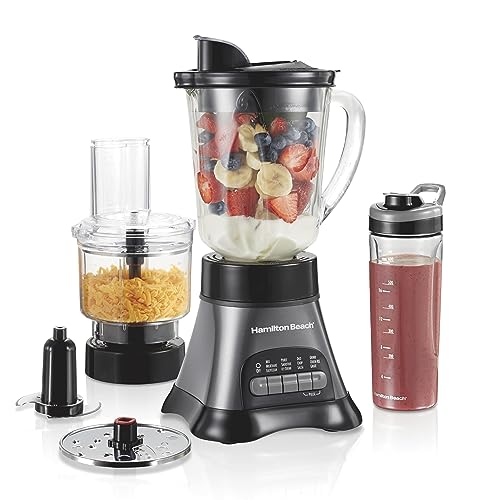
Hamilton Beach Blender and Food Processor Combo 58163, 700W — Best Budget Combo
Hamilton Beach’s combo is the budget conscience of this guide: a 40 oz glass blender jar, a 3-cup chopper and a travel cup sharing one 700W-peak base. It will not out-blend or out-chop the Ninja systems, and it does not pretend to. It exists for kitchens that need all three jobs done adequately, occasionally, without paying for power they will never use.
| Power | 700W peak |
|---|---|
| Jar | 40 oz glass |
| Chopper | 3-cup chopper attachment |
| Extras | Travel cup included |
Strengths
- Glass jar handles hot liquids and resists staining better than budget plastic
- 3-cup chopper is the right size for onions, herbs and salsa for two to four
- Lowest-cost route in this guide to owning all three functions
Trade-offs
- 700W peak power struggles with heavy frozen blends and large ice loads
- Chopper capacity is small — meal prep for a crowd means many batches
- Grinding is travel-cup scale: spices yes, bulk coffee no
The honest way to judge this machine is by frequency. A household that blends smoothies a few times a week, chops an onion most days and grinds spices occasionally will find it entirely sufficient, and the glass jar is a genuine quality-of-life advantage — it rinses clean of garlic and turmeric in a way budget plastic never does. The chopper, though small, uses the correct wide-bowl geometry, so its chop is even in a way jar-pulsing never achieves.
Where it will frustrate is ambition: daily green smoothies with frozen mango and kale stems will expose the power ceiling, and holiday-scale cooking will turn the 3-cup chopper into a bottleneck. Buy it for the kitchen you have, not the one in a cooking show, and it is the value pick of the page.
Best for: small households wanting all three functions at a budget tier / Not suited for: daily heavy smoothie makers or large-batch cooks
Check the current price on Amazon
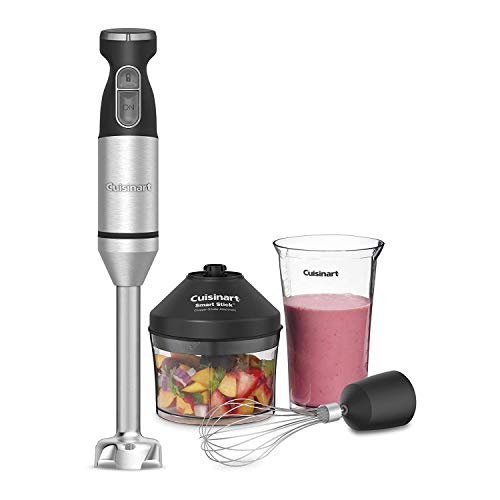
Cuisinart Smart Stick CSB-179, 300W, with Chopper and Whisk — Best Compact Combo
The Smart Stick CSB-179 reframes the combo question: instead of a countertop system, it is a variable-speed immersion blender whose box includes a chopper attachment and a whisk. It blends soup in the pot, chops herbs, nuts and onions in its bowl, and whisks cream — then the whole kit goes back in a drawer. For small kitchens, that storage story beats every countertop system here.
| Power | 300W |
|---|---|
| Shaft | 8 in blending shaft |
| Attachments | Chopper, whisk, measuring cup |
| Controls | Variable speed |
Strengths
- Blends directly in the pot — no transferring hot soup to a jar
- Chopper attachment handles the small, frequent chopping jobs countertop systems are overkill for
- Stores in a drawer; nothing lives on the counter
Trade-offs
- Chopper capacity is small — garnish and sauce scale, not meal-prep scale
- Grinding is limited to small dry quantities in the chopper bowl
- Immersion blending a big smoothie batch is slower than a countertop pitcher
Immersion kits win on the jobs that happen daily in small quantities. The chopper bowl that comes with the CSB-179 is exactly right for a clove-of-garlic-and-an-onion life: pesto, breadcrumbs, chopped nuts for baking, a quick salsa verde. Asking it to prep five onions for a freezer day is asking for tedium, and countertop systems exist for that. Judged on its own scale, the kit is complete and well-matched.
Grinding deserves the usual honesty: dry spices in small amounts work in the chopper bowl with pulsing and shaking; coffee for one or two cups is passable; anything more belongs to a real grinder. What this pick sells is not grinding supremacy — it is three useful tools that occupy six inches of drawer.
Best for: small kitchens, apartment cooks and anyone who blends in the pot / Not suited for: families who chop and blend in large daily volumes
Check the current price on Amazon

Mueller Immersion Blender 800W 5-in-1 with Chopper — Best Immersion Kit
If the Cuisinart is the restrained immersion kit, the Mueller 5-in-1 is the maximalist one: 800W of motor, twelve speeds plus turbo, and a box containing a chopper, a whisk, a milk frother and a beaker. It covers blending and chopping with genuine enthusiasm and adds coffee-drink frothing as a fourth talent none of the countertop systems offer.
| Power | 800W |
|---|---|
| Controls | 12 speeds + turbo |
| Attachments | Chopper, whisk, frother, beaker |
| Format | Immersion / hand blender kit |
Strengths
- Strongest immersion motor in this guide — handles thick mixtures without bogging
- Full attachment set covers chopping, whisking and frothing in one purchase
- Twelve speeds give fine control for emulsions and delicate sauces
Trade-offs
- Same small-chopper ceiling as any immersion kit
- More parts to wash and keep track of than a simple stick blender
- Still a drawer kit at heart — not a family smoothie solution
The 800W motor changes what an immersion blender can attempt. Where weaker sticks stall in thick hummus or a dense squash soup, this one keeps the vortex moving, and the turbo burst is genuinely useful for the last ten seconds of an emulsion. The chopper attachment follows the format’s rules — small batches, even results — and the frother is a small luxury that earns its drawer space in coffee households.
As with the Cuisinart, grinding is the honest footnote: small dry quantities in the chopper, pulsed and shaken, are fine for a spice blend tonight; a week of coffee beans is not its job. Within the immersion format, though, this is the most complete kit we verified, and for a one-or-two-person household it can legitimately be the only blending appliance owned.
Best for: solo and two-person households wanting one complete drawer-sized kit / Not suited for: families or anyone who blends full pitchers daily
Check the current price on Amazon
Comparison Table
Compare the vessels, not just the watts. The right-hand columns show what each system actually uses for chopping and grinding, which is where combos differ most.
| Pick | Badge | Key Spec | Best For |
|---|---|---|---|
| Ninja Kitchen System Pro BL770, 1500W, 72 oz + 8-Cup Processor | Best Overall | 1500W, 72 oz pitcher + 8-cup processor bowl | households wanting one base that honestly covers blending, chopping and everyday grinding |
| Ninja UltraCrush Pro Kitchen System BP401, 1500W, 72 oz | Best for Big Batches | 1500W, 72 oz + 8-cup processor, Total Crushing | large households and meal preppers blending and chopping in full batches |
| AMPOIA 2000W Blender with 28 oz Grinder Cup | Best for Grinding | 2000W, 70 oz pitcher + 28 oz grinder cup | spice blenders, coffee households and grain grinders who blend full pitchers too |
| Hamilton Beach Blender and Food Processor Combo 58163, 700W | Best Budget Combo | 700W peak, glass jar + 3-cup chopper | small households wanting all three functions at a budget tier |
| Cuisinart Smart Stick CSB-179, 300W, with Chopper and Whisk | Best Compact Combo | 300W immersion, chopper + whisk attachments | small kitchens, apartment cooks and anyone who blends in the pot |
| Mueller Immersion Blender 800W 5-in-1 with Chopper | Best Immersion Kit | 800W, 12 speeds, 5-in-1 attachment kit | solo and two-person households wanting one complete drawer-sized kit |
Power figures mix rated and peak watts exactly as the manufacturers list them; treat them as tier indicators rather than laboratory measurements. Vessel contents are the deciding column.
How to Choose a Blender, Chopper and Grinder Combo
Start by ranking your own three jobs. Most households blend daily, chop weekly and grind monthly — a pattern that argues for a blender-first system like the Ninja picks. Spice-heavy and coffee-heavy kitchens invert that order and should shop grinder-first. Occasional-everything kitchens should shop by storage: an immersion kit that gets used beats a countertop system that gets donated.
Then inspect the vessels with a skeptic’s eye. A processor bowl should be wide relative to its height, with a blade that sits low and a feed that lets food fall back evenly. A grinder cup should be small enough that a modest handful of seeds cannot escape the blade path. A chopper attachment should hold at least a chopped onion without packing. If a listing is vague about vessel sizes, that vagueness is itself information.
Finally, count the parts against your patience. Every vessel, blade, lid and gasket is a thing to wash, dry and store. The best combo is not the one with the most attachments — it is the one whose attachments you will still be using in a year. Two of the picks in this guide are deliberately minimal; two are deliberately maximal. Both philosophies are right, for different people.
Blender Jar vs. Processor Bowl: Why the Shape Decides the Result
A blender jar is tall and narrow because its job is circulation: ingredients ride a vortex down into fast blades and get finer with every pass. That same vortex is why jars chop badly — food at the bottom liquefies while food at the top rides the walls untouched. A processor bowl is wide and shallow because its job is distribution: food falls sideways back into a slow, sweeping blade and gets cut into pieces that stay pieces.
This is why “the blender can chop if you pulse it” is technically true and practically useless for anything where texture matters. Salsa, onions for cooking, nuts for baking — all of them expose the jar’s weakness within ten seconds. If chopping matters to your cooking, the bowl is not an accessory; it is the appliance. Choose combos that include one.
Grinding Truths: Coffee, Spices and the Limits of Blade Grinders
Every grinding solution in this guide is a blade system, and blade grinding has a fixed character: it produces a range of particle sizes rather than a uniform grind, and it generates heat if run long. For spices, nuts, seeds and grains, that character is perfectly acceptable — a slightly rustic spice powder still blooms in oil exactly as it should. Pulse-and-shake technique narrows the range considerably.
Coffee is where honesty is required. Blade-ground coffee makes a decent French press or cold brew and a disappointing espresso, because espresso extraction punishes inconsistency. If espresso is your daily ritual, no combo in this guide replaces a burr grinder, and any review claiming otherwise is selling you something. If coffee means a press pot on weekends, the cups and grinder attachments here will serve you fine.
One System or Three Appliances? The Counter-Space Ledger
The honest arithmetic starts with storage, not money. Three separate appliances — blender, processor, grinder — consume roughly three motor bases’ worth of cupboard, three cords, and three sets of accessories that migrate to different shelves. A combo system consumes one base and a stack of vessels that nest or share a bin. In a small kitchen that difference is not tidiness; it is whether the tools get used at all, because the appliance that must be excavated is the appliance that gets skipped.
Money tells a subtler story. A good combo costs less than three good separates and more than three mediocre ones — and mediocrity is where separates tempt you, one “good enough” purchase at a time. The combo forces the quality decision once, at the base, where it matters most. Where separates genuinely win is specialization and independence: a burr grinder out-grinds any combo attachment, and when a separate breaks, the other two still work. Households that cook daily and broadly often land on a hybrid — a strong combo for blending and chopping, one dedicated grinder — and this guide’s structure quietly supports that: the Ninja systems for the first two jobs, the AMPOIA or a standalone grinder for the third.
The deciding question is failure tolerance. A shared base is a single point of failure with a single point of maintenance. If your kitchen cannot pause — large family, small business, daily cooking obligations — separates or a backup plan deserve weight. If your kitchen is a normal household, the combo’s simplicity wins the ledger on most lines that matter.
Care and Cleaning for Multi-Vessel Systems
Combo systems multiply parts, and parts multiply the two cleaning risks: flavor transfer and the lost-attachment problem. Flavor transfer is the comic one — coffee ghosts in the smoothie cup, garlic in the whipped cream — and it is entirely solved by the immediate rinse. Every vessel in these systems rinses clean in seconds when fresh and becomes a scrubbing project when deferred, so the discipline that matters is not technique but timing.
The lost-attachment problem is structural: a chopper blade in the wrong drawer converts a combo into a blender with a rumor. Store each system as a kit — one bin or one shelf zone per system, blades nested in their vessels, lids with their bowls. Five minutes of organization at setup saves the slow attrition that makes owners conclude, wrongly, that combos are more trouble than they are.
Gaskets deserve their own sentence in any combo household: with several vessels in rotation, gaskets age at different rates and hide in different lids. A monthly pass — remove, wash, dry fully, reseat — keeps seals sealing and odors nonexistent across the whole system. It is the only scheduled maintenance these machines ask for, and it is the difference between a five-year system and a two-year disappointment.
What Each Job Actually Demands: A Cook’s Translation
Spec sheets describe combos in watts and cups; cooks experience them in tasks, so translate before you buy. Blending, in task terms, means a vortex sustained for thirty seconds to three minutes — the machine must not merely start a smoothie but finish it, which is why pitcher systems cluster around serious motors. When a listing pairs a large pitcher with a small motor, the task translation fails: the first ten seconds look fine and the last thirty are a stall. The systems in this guide were matched vessel-to-motor precisely to avoid that pairing.
Chopping, in task terms, is a hundred small decisions made by geometry. You are not buying “chopping power” — the weakest motor here can spin a chopping blade — you are buying a bowl shape that distributes food evenly and a blade that sweeps low. That is why the immersion kits, with their modest motors and correct little bowls, chop onions better than a powerful blender jar ever will. If a combo’s chopping story is told in watts, it is being told in the wrong language; ask for the bowl’s shape and capacity instead.
Grinding, in task terms, is containment plus patience. The vessel must be small enough that the load cannot escape the blades, and the cook must pulse, shake and rest rather than hold the button and cook the spices with friction heat. Every grinder in this guide succeeds when used that way and disappoints when used as a set-and-forget appliance. Buy the vessel, learn the rhythm, and the third job — the one most combos fake — becomes the one yours genuinely does.
How to Chop, Blend and Grind with One System Without Ruining Texture
Combos reward cooks who match technique to vessel. These steps cover the three jobs in the order mistakes usually happen.
- Chop in the bowl, in batches that breathe. Fill the processor bowl or chopper no more than two-thirds, cut food into rough, even chunks first, and pulse in short bursts, checking between them. Chopping is subtraction — you can always pulse again, and you can never un-pulse.
- Blend in the jar, liquids first. Liquid, then soft ingredients, then frozen or hard items last, gives the vortex its working medium from the first second. Start on low, climb steadily, and let the machine finish — most under-blended smoothies are simply stopped ten seconds early.
- Grind dry, grind small, pulse and shake. Grinder cups and chopper bowls must be bone dry — moisture turns spice powder into paste. Fill halfway at most, pulse in bursts, and shake the cup between bursts to redistribute. Rest the motor between long grinds to keep heat from cooking volatile spice oils.
- Wash the shared parts immediately. Combo parts cross-contaminate flavors: this morning’s coffee cup becomes this evening’s smoothie cup. A rinse now beats a scrub later, and it keeps garlic out of the milkshakes — a mistake every combo owner makes exactly once.
- Store the system as a system. Keep the vessels, blades and lids of one combo together, nested or in one bin. A processor bowl separated from its blade is not a spare part; it is clutter. Systems get used when they are findable.
Master the vessel-matching habit and a combo stops being a compromise and becomes the hardest-working purchase in the kitchen. Most combo regret traces back to one job done in the wrong vessel, repeated until the machine got blamed.
Common Buying Mistakes
Believing the pitcher can replace the processor bowl
It cannot, for the geometric reasons covered in the guide above. If a combo’s chopping happens in the blender jar, its chopping is a party trick. Check for a real bowl or chopper attachment before buying, every time.
Grinding wet ingredients in the grinder cup
Grinder cups are sealed for dry goods. Wet pastes leak into the blade housing, strain the motor and are miserable to clean. Wet grinding belongs in the blender jar or processor bowl, in small batches with added liquid.
Overfilling the chopper
A packed chopper bowl chops the bottom layer to mush while the top rides untouched — the same failure as the blender jar, in miniature. Two-thirds full, even chunks, short pulses. Batch two is always faster than fixing a ruined batch one.
Expecting espresso from a blade grinder
Blade grinding is inconsistent by nature, and espresso exposes it mercilessly. Combos grind coffee honestly for press, drip and cold brew. Espresso households need a burr grinder; no combo purchase changes that physics.
Buying maximum attachments, using none
A nine-piece system in a kitchen that needed three pieces is not versatility — it is a storage tax paid daily. Match the kit to your real cooking frequency, which is why this guide includes two-pick-minimal immersion kits alongside the full systems.
Running the grinder continuously until it smokes the spices
Blade grinding generates heat, and heat is flavor leaving. Spices ground in one long, heroic run taste flat and scorched compared with the same spices pulsed in bursts with shakes between. The motor dislikes it too. Pulse, shake, rest — the rhythm is the recipe.
Final Recommendation
For most households, the Ninja Kitchen System Pro BL770 is the correct answer to this entire category: a real processor bowl, a full-size pitcher and useful grinding cups on one proven base. Choose the BP401 instead if your cooking runs in family-size batches, and choose the AMPOIA if grinding — spices, coffee, grains — is the job you care about most after blending.
On a budget, the Hamilton Beach combo covers all three jobs adequately with a glass jar that punches above its tier. And if your kitchen has no counter to spare, the Cuisinart and Mueller immersion kits deliver blending and chopping from a drawer, with the Mueller the stronger, more complete kit and the Cuisinart the calmer, simpler one.
One last piece of advice for the undecided: photograph your counter and your cupboard before ordering. The right combo is the one that fits the space you actually have at the power your cooking actually needs — and every pick above was chosen so that one of them matches that photograph.
Start with these three: Ninja Kitchen System Pro BL770, 1500W, 72 oz + 8-Cup Processor, Ninja UltraCrush Pro Kitchen System BP401, 1500W, 72 oz, AMPOIA 2000W Blender with 28 oz Grinder Cup.
For a related shortlist, see Best Blenders Food Processor Combo. For a related shortlist, see Best Blenders And Food Processors. For a related shortlist, see Best Blenders. For a related shortlist, see Best Blenders And Food Processors For Vegans. For a related shortlist, see Best 1500 Watt Blenders.
Frequently Asked Questions
Can a blender really replace a food processor?
Only when the system includes a real processor bowl, as the Ninja picks here do. The bowl’s wide shape and sweeping blade produce even pieces; a blender jar’s vortex produces puree at the bottom and chunks at the top. A blender alone replaces a processor for soups and sauces, not for chopping.
What is the best combo for grinding coffee?
Within this guide, the AMPOIA’s dedicated 28 oz grinder cup handles the largest, most consistent blade-grind batches. Be honest about the ceiling, though: blade grinding suits French press, drip and cold brew. Espresso requires a burr grinder, which no blender combo replaces.
Are immersion blender kits real combos?
For small households, yes. A chopper attachment handles the daily small chopping jobs — onions, herbs, nuts, pesto — and the stick blends in the pot. What they cannot do is volume: family smoothie batches and meal-prep chopping belong to countertop systems.
How many watts does a combo system need?
For a full-size system driving a pitcher and processor bowl, the 1500W class of the Ninja picks handles everything including dough and ice without strain. Smaller combos at lower power work well within smaller vessels. Match power to vessel size, not to bragging rights.
Can I grind spices in a blender pitcher?
You can, but badly — a handful of seeds in a large pitcher mostly flies around the walls. Small cups and chopper bowls constrain the seeds into the blade path, which is why the picks here grind in cups, dedicated grinders or chopper attachments rather than pitchers.
Do combo systems knead dough?
Some do. A processor bowl with a suitable blade, like the BL770’s, kneads small batches of pizza and bread dough surprisingly well. Immersion kits and grinder-focused machines do not. If dough matters to you, it is a reason to choose a full kitchen system.
Can I grind coffee beans in a food processor bowl?
You can, but it is the worst vessel for it — a large bowl lets a small load of beans escape the blade path, producing a coarse, uneven grind slowly. Use the smallest vessel your system offers: a to-go cup or the dedicated grinder cup on the AMPOIA pick. Small vessel, dry beans, pulse and shake — that is the whole technique.
Which combo is best for salsa?
The Ninja systems, because salsa is a processor-bowl job: distinct pieces in a loose matrix. The BL770 and BP401 bowls pulse onions, peppers and tomatoes to a genuine salsa texture. A blender jar — any blender jar — gives you sauce with lumps instead, which is a fine product under the wrong name.
Can a combo system replace a stand mixer for dough?
No — and it should not try. Processor bowls knead small, soft doughs credibly, but sustained, heavy bread dough in quantity is a stand mixer’s home ground. Combos cover the pizza-night and flatbread scale happily; a weekly sourdough practice deserves its own machine.


