Disclosure: airfryerkitchensupply.com is reader-supported. When you buy through links on our site, we may earn an affiliate commission at no extra cost to you.
Where to Buy
Our shortlist of the best blenders can handle hot liquids starts here, with machines whose jars, lids and motors are genuinely built for the job. Every blender on this page was checked against its live Amazon listing before this guide was written, and every pick below is a model whose jar, lid and blade assembly are built to work with hot liquids — not a standard smoothie blender we are hoping will survive soup season.
- Vitamix 5200 Professional-Grade Blender, 64 oz, Black — Best Overall — Check the current price on Amazon
- Vitamix Propel Series 750, 64 oz, Black — Best for Preset Soup Programs — Check the current price on Amazon
- Blendtec Classic 575, WildSide+ Jar — Best for Hands-Free Cycles — Check the current price on Amazon
- Blendtec Total Blender Classic, FourSide Jar — Best Classic Alternative — Check the current price on Amazon
- ASTRALSHIP 1500W Professional Glass Blender with Heating — Best Heating Blender — Check the current price on Amazon
- Oster Pro 1200, Glass Jar with 24 oz Smoothie Cup — Best Budget Glass Jar — Check the current price on Amazon
Listings change and manufacturers quietly revise jar materials, so confirm the hot-liquid guidance on the product page before ordering. If a pick shows as unavailable, the buying guide further down explains exactly which specifications to look for in a substitute.
Finding the best blenders can handle hot liquids sounds simple until you read the fine print on most countertop machines: the majority of budget and mid-range blenders are designed for cold work only, and their jars, gaskets and lids are not built to take near-boiling soup, steaming sauces or hot nut milks without warping, leaking or venting steam in your face. Heat changes everything about how a blender behaves. Liquid expands, steam builds pressure under a sealed lid, thin plastic softens, and a vortex that behaves politely with cold smoothies can push hot liquid up and out of a badly designed jar.
The machines that genuinely handle hot work share a recognizable set of traits. Their jars are made from thick, heat-tolerant material with a vented lid that lets steam escape in a controlled way. Their motors can run long enough to friction-heat a soup from raw ingredients or to keep an already-hot puree moving without stalling. And their lids lock down with enough authority that a full jar of boiling tomato soup stays inside the jar, where it belongs, instead of decorating your ceiling.
This guide covers six verified machines across three honest tiers. At the top sit the high-speed blenders — Vitamix and Blendtec — that were engineered from the start for hot soup programs and remain the benchmark. In the middle is a heating blender that actually cooks while it blends, a different and genuinely useful approach. At the accessible end is a glass-jar Oster that handles hot liquids the old-fashioned way: a borosilicate-style glass jar that does not care about temperature the way thin plastic does. What you will not find here is a cheap personal blender with a note saying “probably fine for soup” — it is not, and pretending otherwise is how people get burned.
One honest warning before the picks: “can handle hot” is a spectrum, not a badge. Some machines can blend soup that is already hot. A smaller group can take cold ingredients and friction-heat them to steaming over several minutes of high-speed running. A third group — heating blenders — has an actual heating element. Each pick below states plainly which kind of hot work it does, because buying the wrong kind is the most common and most expensive mistake in this category.
In this guide
Quick Picks
Six verified blenders that can genuinely work with hot liquids, from friction-heating high-speed machines to a glass-jar budget pick. Badges here match the badges in the detailed reviews.
- Vitamix 5200 Professional-Grade Blender, 64 oz, Black — Best Overall: the benchmark hot-liquid blender — a 64 oz vented container, variable speed dial and enough sustained power to friction-heat soup from raw ingredients. — check price on Amazon
- Vitamix Propel Series 750, 64 oz, Black — Best for Preset Soup Programs: Vitamix hot-blending power with four preset programs, including a self-cleaning program — the set-and-forget option in this lineup. — check price on Amazon
- Blendtec Classic 575, WildSide+ Jar — Best for Hands-Free Cycles: preprogrammed cycles and a five-sided WildSide+ jar that pulls hot liquid down into the blades instead of letting it climb. — check price on Amazon
- Blendtec Total Blender Classic, FourSide Jar — Best Classic Alternative: the original Blendtec formula — ten speeds, six preprogrammed cycles and the FourSide jar — for buyers who like the classic control layout. — check price on Amazon
- ASTRALSHIP 1500W Professional Glass Blender with Heating — Best Heating Blender: a different approach entirely — a glass-jar blender with an actual heating function, 14 presets and 9 speeds, so it cooks the soup instead of just blending it hot. — check price on Amazon
- Oster Pro 1200, Glass Jar with 24 oz Smoothie Cup — Best Budget Glass Jar: the accessible route to hot blending — a glass jar that shrugs off temperature, seven speeds and a dual-direction blade, at a mainstream tier. — check price on Amazon
How These Picks Were Chosen
Every candidate for this guide had to pass one test before anything else was considered: is the jar, lid and blade assembly genuinely intended by its manufacturer for hot-liquid work? That single filter removes most of the blender market. Standard personal blenders, thin-walled budget jars and any machine whose documentation warns against hot liquids were excluded outright, no matter how powerful the motor — a strong motor in a jar that softens at temperature is a hazard, not a feature.
Surviving candidates were verified against live Amazon listings, and the specifications quoted in this guide come from those listings, not from memory or marketing summaries. We then ranked by the three things that decide hot blending in practice: steam and lid management, low-speed control for safe starts, and sustained power for smooth purees and friction heating. Cleaning earned real weight too, because hot, fatty soup residue is the least pleasant cleanup in the blender world.
We deliberately included three different philosophies — friction-heating high-speed machines, a true heating blender, and a traditional glass jar — because “can handle hot” means different things in different kitchens. Each review states which philosophy the machine follows, so you can match the pick to your actual cooking instead of buying the most expensive interpretation of the keyword.
One more screening note, because hot blending invites it: we excluded immersion blenders from this guide deliberately. A stick blender in an open pot is a legitimate hot tool, but it answers a different question — it cannot friction-heat, cannot run a sealed soup program, and splashes at scale. Readers who want that format will find it covered in our other guides; this page is for countertop machines that take hot liquid inside a jar, which is the harder engineering problem.
The 6 Best Blenders Can Handle Hot Liquids, Reviewed
Each review states plainly whether the machine friction-heats, blends pre-heated liquid, or cooks with a heating element — read that first line of analysis before the strengths, because it decides whether the pick fits your kitchen at all.

Vitamix 5200 Professional-Grade Blender, 64 oz, Black — Best Overall
The Vitamix 5200 is the machine most people picture when they think of a blender making soup, and it has earned that position the slow way: decades of the same basic design doing hot work in home and professional kitchens. The 64 oz container has a vented lid plug that lets steam escape while the lid itself locks down firmly, and the variable speed dial lets you start a hot puree slowly — the single most important technique for blending hot liquids safely — before ramping up to full speed.
| Container | 64 oz, vented lid |
|---|---|
| Controls | Variable speed dial + high-speed switch |
| Blades | Stainless steel |
| Programs | Manual control, self-cleaning cycle |
Strengths
- Friction-heats soup from raw ingredients on high speed, no stovetop needed first
- Vented lid and tall, narrow jar shape keep hot liquid contained and moving
- Variable speed dial gives the slow-start control hot blending demands
Trade-offs
- Fully manual controls — no preset soup program to press and walk away from
- Tall jar profile may not fit under low kitchen cabinets
- Premium tier pricing compared with every other pick here except its Vitamix sibling
What separates the 5200 from blenders that merely tolerate hot liquid is control at low speed. When you pour steaming soup into any blender and hit full power instantly, the vortex throws liquid against the lid and steam pressure spikes. The 5200 lets you begin at the lowest setting, get the mass moving gently, and climb the dial over ten or fifteen seconds. By the time you reach high speed, the contents are circulating as one body of liquid instead of exploding upward. That technique, plus a lid designed to vent rather than pop, is why this machine has been the default recommendation for hot blending for so long.
The friction-heating ability is real and worth understanding properly. Run raw vegetables, stock and seasoning on high for several minutes and the blade friction alone brings the soup to steaming. It will not brown anything and it does not replace a stove for every recipe, but for pureed soups — butternut squash, tomato, broccoli cheddar bases — it is a one-container process with one container to wash. The self-cleaning cycle matters more with hot, fatty soups than with smoothies: warm water and a drop of soap, run on high, and the jar comes clean without your hand going near the blades.
Best for: cooks who make pureed soups weekly and want the proven, controllable benchmark / Not suited for: anyone who wants a press-one-button soup program or has very low cabinets
Check the current price on Amazon

Vitamix Propel Series 750, 64 oz, Black — Best for Preset Soup Programs
The Propel Series 750 takes the same fundamental hot-blending competence as the 5200 and wraps it in preset programs. For hot work that trade matters more than it sounds: a soup program manages the speed ramp for you, starting gently so steam and liquid stay contained, then building to the sustained high speed that purees and friction-heats. If the manual dial of the 5200 sounds like one more thing to babysit on a weeknight, this is the Vitamix built for you.
| Container | 64 oz |
|---|---|
| Controls | 4 preset programs + pulse + variable speed |
| Programs | Includes self-cleaning program |
| Blades | Stainless steel |
Strengths
- Preset programs automate the slow-start speed ramp hot liquids need
- 64 oz container sized for family batches of soup
- Self-cleaning program handles greasy, hot residue with minimal effort
Trade-offs
- Programs run fixed durations — less flexible than a dial for odd batch sizes
- Sits in the premium tier alongside the 5200
- Low-profile container shape gives a slightly different vortex than the tall 5200 jar
The honest difference between the Propel 750 and the 5200 is philosophy, not power. Both will take a pot of simmering vegetables and stock and return a silky puree; both will friction-heat. The Propel simply removes the judgment calls. That is a genuine benefit with hot liquids specifically, because the dangerous moment in hot blending is the first five seconds, and a programmed ramp never forgets to start slow the way a distracted cook can. For households where several people use the blender — including teenagers making tomato soup — that built-in discipline is worth real money.
The wider, lower 64 oz container also deserves a mention for hot work. It fits under more cabinets, and its broader base suits thicker mixtures like hummus-warm dips and cheese sauce bases that need to keep moving rather than climb. The trade is that very small hot batches can splash around in a big jar; if you mostly blend one mug of soup at a time, no full-size machine is ideal, and the buying guide below covers how to judge minimum batch sizes honestly.
Best for: families who want Vitamix hot-soup ability with push-button programs / Not suited for: cooks who prefer full manual control over every second of the cycle
Check the current price on Amazon

Blendtec Classic 575, WildSide+ Jar — Best for Hands-Free Cycles
Blendtec approaches hot blending differently from Vitamix: instead of a tamper and a dial, you get preprogrammed cycles and a jar geometry that does the work. The WildSide+ jar has a fifth side that disrupts the vortex and folds ingredients — including hot, thin liquids that want to splash — back down into the blade path. The Classic 575 runs that jar with four preprogrammed cycles and a self-cleaning function, making it the most hands-free route to hot soup in this guide.
| Jar | WildSide+ (90 oz total capacity) |
|---|---|
| Controls | 5 speeds + pulse |
| Programs | Four preprogrammed cycles, self-cleaning |
| Design | Blunt safety blade, five-sided jar |
Strengths
- Five-sided jar design keeps hot liquid circulating instead of climbing the walls
- Preprogrammed cycles manage speed changes for you, start to finish
- Blunt blade design is easier and safer to clean around after hot, sticky blends
Trade-offs
- Jar capacity figure is total volume, not a sensible hot fill line — hot batches must stay well under it
- No tamper, so very thick hot mixtures rely entirely on jar geometry
- Cycle-based control is less precise for small adjustments mid-blend
The point that needs saying plainly about every large jar, and this one especially: the number printed on the box is not your hot-liquid capacity. Hot soup expands, foams and throws steam, and experienced Blendtec owners fill the WildSide+ jar only partway for hot work, blending big soups in two batches. That is not a defect — it is physics, and it applies to every pick here — but the big headline capacity makes the discipline easier to forget on this model. Respect the fill line and the jar rewards you with a puree that needs no straining and no tamper work.
Where the Classic 575 genuinely shines for hot duty is consistency. A programmed cycle ramps, holds and finishes the same way every time, so the soup that worked on Tuesday works identically on Friday. The self-cleaning cycle plus the blunt blade makes cleanup after a cheese-based soup — the worst residue in hot blending — a rinse rather than a scrub. For cooks who make soup in a weekly rhythm and value repeatability over manual finesse, this is arguably the smartest pick on the page.
Best for: weekly soup makers who want programmed, repeatable hot cycles / Not suited for: anyone who wants to blend a full jar of boiling liquid in one batch
Check the current price on Amazon

Blendtec Total Blender Classic, FourSide Jar — Best Classic Alternative
The Total Blender Classic is the machine that built Blendtec’s reputation, and for hot liquids it remains a serious tool: ten speeds for manual control, six preprogrammed cycles when you do not want to think, and the FourSide jar whose geometry keeps contents folding into the blades. It is the pick for buyers who find the Classic 575’s simplified interface too simple and want granular speed control for the delicate first seconds of a hot blend.
| Jar | FourSide (75 oz total capacity) |
|---|---|
| Controls | 10 speeds + pulse |
| Programs | Six preprogrammed cycles |
| Design | Blunt safety blade |
Strengths
- Ten discrete speeds give finer low-speed control for starting hot blends
- Six preprogrammed cycles cover soups and hot preparations repeatably
- Long-proven design with a deep base of replacement parts and jars
Trade-offs
- Older interface feels dated next to newer Blendtec and Vitamix models
- Same hot fill-line discipline as the WildSide+ — headline capacity is not hot capacity
- No dedicated self-cleaning branding, though the cleaning cycle approach is the same
Ten speeds sound like a spec-sheet flourish until you blend hot liquids regularly. The difference between speed one and speed three on a steaming puree is the difference between a gentle stir that keeps everything contained and an enthusiastic surge that tests the lid. The Total Classic lets you walk a hot blend upward in small, deliberate steps, which is exactly how cautious cooks — and professional kitchens — treat boiling liquid in a blender. The six cycles then cover the days you do not feel like being deliberate.
As with its sibling, be honest about batch size. The FourSide jar’s stated capacity is a total-volume figure; hot soup should occupy only a portion of it, with headroom for expansion and foam. Work within that and the machine is a durable, powerful hot blender with one of the longest track records in the category. Push past it and no lid design on earth will save your countertop.
Best for: control-minded cooks who want both fine manual speeds and preset cycles / Not suited for: buyers who want the newest interface or the largest jar in the Blendtec line
Check the current price on Amazon

ASTRALSHIP 1500W Professional Glass Blender with Heating — Best Heating Blender
Every other pick in this guide either blends liquid that is already hot or friction-heats it with blade speed. The ASTRALSHIP does something else: it heats. A heating function in a glass jar means raw ingredients and cold stock go in, and cooked, blended soup comes out — closer to an electric soup maker with serious blending power than to a conventional blender. For people whose hot blending is specifically about soup-making from scratch, that distinction is the whole ballgame.
| Power | 1500W |
|---|---|
| Jar | Glass |
| Controls | 9 speeds |
| Programs | 14 presets, includes heating function |
Strengths
- Heating function cooks as it blends — true one-jar soup from raw ingredients
- Glass jar is indifferent to hot temperatures and does not hold odors
- 14 presets and 9 speeds give more program variety than most heating blenders
Trade-offs
- Glass jar is heavier and breakable — a real consideration at a sink full of hot soup
- A newer brand without the decades-long track record of Vitamix or Blendtec
- Heating cycles take longer than friction-heating a high-speed blender
Judge this machine by the right standard. It will not match a Vitamix for raw blending violence on frozen desserts, and it is not trying to. Its question is narrower: do you want soup to happen inside the jar, start to finish? A heating element cooks evenly and gently, which suits delicate preparations — think bisques, porridge-style breakfasts, soy milk and baby food batches — that friction heating handles less gracefully. The glass jar also sidesteps every worry about hot liquid in plastic, which for some buyers is the entire reason they are reading this guide.
The cautions are equally clear. Glass plus hot liquid plus a wet sink is a combination that demands two-handed respect, and a heating blender’s cycle times are measured in tens of minutes, not the few minutes a friction-heating machine needs. Buy it as a soup-making appliance that also blends, keep a firm grip on that jar, and it fills a niche none of the other five picks addresses.
Best for: soup-from-scratch cooks who want cooking and blending in one glass jar / Not suited for: anyone who prioritizes raw blending power or dislikes heavy glass jars
Check the current price on Amazon
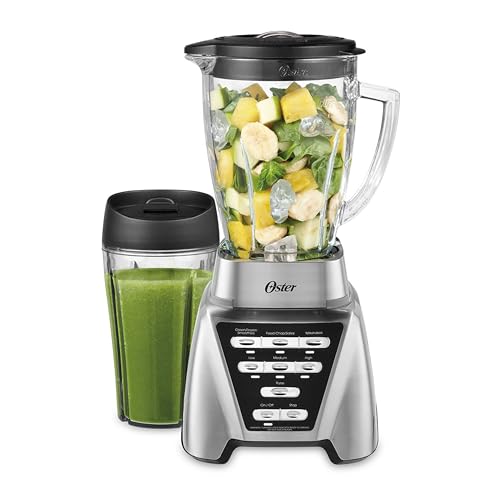
Oster Pro 1200, Glass Jar with 24 oz Smoothie Cup — Best Budget Glass Jar
Glass is the oldest answer to the hot-liquid problem, and the Oster Pro 1200 is the most sensible glass-jar blender in this guide. A glass jar does not soften, stain or absorb last week’s garlic soup, and it tolerates the temperature of freshly boiled stock without complaint. Seven speeds and a dual-direction blade — which reverses to pull food down and clear jams — give it more blending intelligence than most machines at its mainstream tier.
| Jar | Glass jar |
|---|---|
| Controls | 7 speeds |
| Blade | Dual-direction blade technology |
| Extras | 24 oz smoothie cup included |
Strengths
- Glass jar handles hot liquids without material worries or lingering odors
- Dual-direction blade reduces the stuck-and-shake routine with thick mixtures
- Mainstream tier pricing makes it the low-risk entry into hot blending
Trade-offs
- No friction-heating — soup must go in already hot from the stove
- Glass jar is heavy when full of soup and unforgiving if dropped
- Less sustained power than the high-speed picks for very fibrous purees
Be clear about what you are buying: this is a blend-it-hot blender, not a make-it-hot blender. Your soup cooks on the stove as it always has; the Pro 1200’s job is the puree, and with hot, softened ingredients that job is well within its ability. Where it will show its tier is raw kale stems and hard squash — ingredients the high-speed machines pulverize without cooking first. Cook first, blend second, and the results are genuinely smooth.
Two hot-specific habits matter with this pick. First, temper the jar: rinse it with hot tap water before pouring in boiling soup, because thermal shock is glass’s one real enemy. Second, use the low speeds to start, exactly as with the premium machines, and hold the lid with a towel — the venting is basic compared with a Vitamix lid. Follow those two habits and this is the best value on the page for stovetop-soup households.
Best for: stovetop soup makers who want glass-jar hot blending at a mainstream tier / Not suited for: anyone who wants the blender itself to cook or friction-heat the soup
Check the current price on Amazon
Comparison Table
The table below lines up the six picks by the specifications that matter for hot work. Note the “hot method” distinction carried in the key spec column — it is the most important column on the page.
| Pick | Badge | Key Spec | Best For |
|---|---|---|---|
| Vitamix 5200 Professional-Grade Blender, 64 oz, Black | Best Overall | 64 oz vented container, variable speed | cooks who make pureed soups weekly and want the proven, controllable benchmark |
| Vitamix Propel Series 750, 64 oz, Black | Best for Preset Soup Programs | 64 oz container, 4 programs incl. hot soup | families who want Vitamix hot-soup ability with push-button programs |
| Blendtec Classic 575, WildSide+ Jar | Best for Hands-Free Cycles | WildSide+ jar, 4 preprogrammed cycles | weekly soup makers who want programmed, repeatable hot cycles |
| Blendtec Total Blender Classic, FourSide Jar | Best Classic Alternative | FourSide jar, 10 speeds, 6 cycles | control-minded cooks who want both fine manual speeds and preset cycles |
| ASTRALSHIP 1500W Professional Glass Blender with Heating | Best Heating Blender | 1500W, glass jar, heating + 14 presets | soup-from-scratch cooks who want cooking and blending in one glass jar |
| Oster Pro 1200, Glass Jar with 24 oz Smoothie Cup | Best Budget Glass Jar | Glass jar, 7 speeds, dual-direction blade | stovetop soup makers who want glass-jar hot blending at a mainstream tier |
Capacities shown are the jar sizes from each listing. For hot liquids, treat roughly half to two-thirds of any jar as your working batch limit, whatever the headline number says — headroom is what keeps steam and foam inside.
How to Choose a Blender That Can Handle Hot Liquids
Start with the jar, because the jar is where hot blending succeeds or fails. Heat-tolerant options come in three forms: thick copolyester jars on high-speed machines, engineered with vented lids and rated by their makers for hot soup programs; glass jars, which ignore temperature entirely but add weight and breakability; and the jars of heating blenders, built around an element. What you must avoid is any thin, basic plastic jar without explicit hot-liquid guidance — heat plus pressure plus softening plastic is the failure mode behind most blender horror stories.
Next, look at the lid, not the motor. A hot blender lid needs two contradictory qualities: it must seal firmly enough that a vortex of near-boiling liquid cannot lift it, and it must vent steam so pressure never builds. The premium machines solve this with locking lids and removable vent plugs. On simpler machines, the technique is yours to supply: fill less, start slow, hold the lid down with a folded towel, and never — ever — blend a sealed jar of boiling liquid.
Motor questions come third, and the right question is not peak watts but sustained behavior. Friction-heating a soup means running at top speed for five or six minutes continuously; making a smooth puree of hot fibrous vegetables means holding high speed under load without thermal cut-out. High-speed machines from Vitamix and Blendtec are built for exactly this duty cycle. Mainstream machines can puree pre-cooked soup happily but should not be asked to friction-heat — they cannot, and trying only shortens their lives.
What Temperature Can a Blender Actually Handle?
There is no single number, because the limit lives in the jar and lid materials, not the motor. Glass jars tolerate boiling liquid outright, with thermal shock — cold jar, boiling soup — as the one caveat. The copolyester jars on premium high-speed blenders are rated by their manufacturers for the hot soup programs those machines run, which bring contents to steaming temperatures through friction. Basic plastic jars on budget blenders are the danger zone: many soften and stress-crack with repeated exposure to near-boiling liquid, and their makers often say so in the manual nobody reads.
A practical rule that covers nearly every kitchen: if the manufacturer does not explicitly market the machine for hot liquids or soup, treat it as a cold blender. That rule costs you nothing — the six machines in this guide exist precisely so you do not have to gamble — and it eliminates the entire category of “it worked fine the first three times” accidents.
Also respect the difference between hot and boiling. Soup off the stove at a rolling boil is at its most expansive and steamy. Letting it stand for two or three minutes before blending — still thoroughly hot, just past the violent stage — makes blending calmer in any machine and costs the final dish nothing. Professional cooks do this instinctively; home cooks should adopt it as a rule.
Friction Heating vs. Heating Elements vs. Stovetop-First: Which Do You Need?
Friction heating is the high-speed blender party trick that turns out to be genuinely useful: blade speed alone brings soup to steaming over several minutes. Its strengths are speed and simplicity — one jar, raw ingredients in, soup out. Its limits are real too: nothing browns, aromatics stay raw-tasting unless you pre-cook them, and the texture suits pureed soups far better than chunky ones.
Heating-element blenders cook more gently and evenly, closer to how a pot behaves, and they handle delicate jobs like soy milk and porridge that friction heating bulldozes. The cost is time: a cooked soup cycle runs far longer than a friction-heated one. Stovetop-first blending — cook in a pot, puree in any hot-safe blender, including the glass-jar budget pick — remains the most flexible method of all and the only one that lets you brown, reduce and season properly before blending. Choose by the soups you actually make, not by the most impressive mechanism.
Can a Blender Replace a Stovetop for Soup?
Partially — and knowing exactly where the line falls will save you from both disappointment and unnecessary purchases. A high-speed blender replaces the stovetop for the final stage of any pureed soup: the cooking-through and smoothing. Friction heat genuinely brings a puree to serving temperature, and for soups built on quick-cooking vegetables — squash, tomatoes, peas, roasted peppers from a jar — the blender can plausibly be the only heated appliance involved, start to finish.
Where the stove remains unbeaten is everything before the puree. Browning onions, blooming spices in oil, rendering aromatics, reducing a stock — these are flavor-building steps that require a pan, time and the Maillard reaction, none of which a blender jar provides. Raw-blended soup tastes raw in a specific, identifiable way: bright but shallow. Experienced soup makers split the difference — sauté the aromatics on the stove for five minutes, then let the blender do the cooking-through and pureeing. That hybrid uses each tool for its strength and produces soup neither could make alone.
The heating blender occupies the third position: it truly cooks, gently and evenly, but slowly, and without browning. Think of the three methods as a triangle — speed at the friction corner, depth at the stovetop corner, convenience at the heating corner — and choose per recipe rather than per ideology. Most households that blend hot regularly end up using all three across a month of soups, which is why this guide refused to crown a single mechanism.
Hot Blending for Sauces, Gravies and More Than Soup
Soup dominates the hot-blending conversation, but a hot-capable blender quietly upgrades half the sauce repertoire. Hollandaise and béarnaise — the emulsions that punish whiskers — come together in a hot blender with the motor doing the whisking while warm butter streams in, and the jar’s heat holds the emulsion at serving temperature. Cheese sauces for mac and cheese or nachos blend silky and stay pourable. Gravy made from hot pan drippings and stock purees lump-free in twenty seconds, a trick that rescues every holiday meal exactly once before becoming tradition.
Hot drinks and desserts belong on the list too. Mexican-style hot chocolate froths beautifully in a vented jar. Hot nut milks and golden milks blend smoother hot than cold. Fruit compotes and hot berry sauces for desserts puree without a single seed surviving — a texture stovetop mashing cannot reach. Each of these jobs uses the same safety discipline as soup: vent, half-fill, slow start. Learn it once for soup and you own it for all of them.
Baby and medical-soft foods deserve a mention as the least glamorous and most valued use. Hot purees of vegetables, grains and proteins — made in quantity, portioned and frozen — are a weekly reality for many households, and a blender that handles them hot, straight from the pot, halves the work. When you evaluate the picks in this guide, weigh this whole repertoire, not just the soup on the cover.
How to Blend Hot Liquids Safely, Step by Step
Most hot-blending accidents are technique failures, not equipment failures. These steps apply to every machine in this guide and will keep hot liquid inside whichever jar you own.
- Temper the jar first. Rinse a glass jar with hot tap water, or run a warm cycle in a cold high-speed jar, so boiling liquid does not meet a cold surface. Thermal shock is glass’s one weakness and sudden expansion stresses any jar.
- Fill to half, two-thirds at most. Hot liquid expands, foams and climbs. A half-full jar of soup blends faster, smoother and infinitely more safely than a brimful one. Blend big batches in two rounds.
- Vent the lid. Remove the small vent plug or crack the designated vent so steam escapes steadily instead of building pressure. Cover the opening loosely with a folded towel to catch any spray.
- Start at the lowest speed. Give the liquid ten to fifteen seconds of gentle motion before climbing. A slow start is the single most protective habit in hot blending — it prevents the surge that lifts lids.
- Ramp up gradually, then hold. Climb the speeds over several seconds. For purees, hold high speed for thirty to sixty seconds. For friction heating, follow your machine’s soup program or hold high for five to six minutes.
- Rest, then open away from your face. Stop the motor, wait twenty seconds for foam and steam to settle, and open the lid tilted away from you. The first breath of steam out of a hot jar is the one that scalds.
Followed in order, these steps make hot blending boring — and boring is exactly what you want from a jar of near-boiling soup. The machines in this guide are built for the job; your technique is the other half of the safety system.
Common Buying Mistakes
Filling the jar to its headline capacity
The number on the box is a cold-liquid total volume. Hot soup needs headroom for expansion, foam and vortex climb. Overfilling is behind nearly every “my blender exploded soup everywhere” story, and it happens with premium machines just as easily as cheap ones.
Sealing the lid tight on boiling liquid
A fully sealed jar of boiling liquid is a small pressure vessel. Steam must have somewhere to go: vent plug out, vent cracked, towel over the top. If your blender’s lid has no vent at all, that blender is not a hot blender, whatever the marketing implies.
Starting on high speed
Full power into still, steaming liquid creates an instant surge against the lid. Always start low and ramp. This is also why preset soup programs and variable dials earned so much weight in our rankings — they build the safe ramp in.
Assuming any powerful blender is a hot blender
Watts say nothing about jar material, gasket tolerance or lid venting. Plenty of strong smoothie blenders explicitly prohibit hot liquids. Power without hot-rated parts is how jars crack and warranties get voided.
Skipping the cool-down before opening
Opening a jar the second the motor stops releases a face-full of steam and can splash settled-but-still-climbing liquid. Twenty seconds of patience prevents the most common hot-blending burn.
Final Recommendation
If you buy one machine from this page, make it the Vitamix 5200. It is the most controllable, most proven hot blender here, and its manual dial teaches the slow-start technique that makes all hot blending safer. If your household prefers pressing a button, the Vitamix Propel Series 750 delivers the same hot competence with programs that manage the ramp for you.
Blendtec loyalists are well served twice over: the Classic 575 for hands-free cycles and the Total Blender Classic for finer manual speeds. Choose the ASTRALSHIP heating blender if your goal is soup cooked from raw inside the jar itself, and choose the Oster Pro 1200 if your soup already cooks on the stove and you simply need an honest glass jar to puree it in — that combination has fed families for generations and still works.
Start with these three: Vitamix 5200 Professional-Grade Blender, 64 oz, Black, Vitamix Propel Series 750, 64 oz, Black, Blendtec Classic 575, WildSide+ Jar.
For a related shortlist, see Best Blenders For Athletes. For a related shortlist, see Best Affordable Blenders For Pureeing Hot Soup. For a related shortlist, see Best Blenders. For a related shortlist, see Best 1500 Watt Blenders. For a related shortlist, see Best Blenders And Food Processors.
Frequently Asked Questions
Can you put hot soup in any blender?
No. Only blenders whose jar, lid and gaskets are designed and rated for hot liquids should be used. Many budget and personal blenders explicitly prohibit hot liquids, and using them for soup risks cracked jars, failed lids and burns. Every pick in this guide was chosen because hot work is part of its design.
How hot is too hot for a blender?
It depends on the jar material. Glass tolerates boiling liquid if the jar is tempered first. Premium copolyester jars are rated for their machines’ hot soup programs. Basic plastic jars are the risk — repeated near-boiling exposure can soften and crack them. When a manufacturer does not state hot-liquid capability, treat the limit as “not suitable” rather than guessing a temperature.
What is friction heating in a blender?
Friction heating is what happens when high-speed blades run long enough that the friction of the moving liquid raises its temperature to steaming. High-speed blenders like the Vitamix and Blendtec picks here use it to make pureed soup from raw ingredients in several minutes, with no stove involved. It purees beautifully but does not brown or caramelize anything.
Why does my blender lid pop or leak with hot liquid?
Steam pressure and an overfilled jar are the usual causes. Hot liquid expands and throws off steam; in a sealed or brimful jar that pressure has nowhere to go except past the lid. Fill to half, vent the lid, and start on the lowest speed — the combination fixes nearly every case.
Is a glass or plastic jar better for hot liquids?
Each wins somewhere. Glass ignores temperature, resists odors and stains, but is heavy and breakable and needs tempering against thermal shock. Premium copolyester jars are lighter, tougher and designed with vented lids for soup programs, but they belong only on machines rated for hot work. The worst choice is basic thin plastic, which offers neither advantage.
Can I make baby food or hot purees in these blenders?
Yes — hot purees are exactly the workload these machines suit. Blend cooked vegetables with their cooking liquid, starting low and venting steam, and you get smooth purees in under a minute. Let the puree cool before serving or storing, and freeze portions promptly for food safety.
Can I blend hot liquids in a personal or bullet blender?
No — personal blender cups are sealed, unvented and not rated for heat, which makes them the most dangerous vessel for hot liquid: steam pressure with nowhere to go. Hot blending requires a vented jar designed for it, like every countertop pick in this guide. For single servings of soup, blend in the big jar and pour; the extra washing is the price of the right tool.

