Disclosure: airfryerkitchensupply.com is reader-supported. When you buy through links on our site, we may earn an affiliate commission at no extra cost to you.
Where to buy
Shopping for the best and easiest microwaves? Ease starts here: the COMFEE’ EM720CPL-PM 0.7 Cu.Ft Countertop Microwave (Black) pairs one-touch buttons with a sound on/off switch, and the Toshiba EM131A5C 1.2 Cu.Ft Countertop Microwave (Stainless Steel) adds a humidity sensor and a mute function for households that want the oven to decide more and beep less. Every pick below was verified.
- COMFEE’ EM720CPL-PM 0.7 Cu.Ft Countertop Microwave (Black) — check price on Amazon
- Toshiba EM131A5C 1.2 Cu.Ft Countertop Microwave (Stainless Steel) — check price on Amazon
- BLACK+DECKER 0.7 Cu.Ft Countertop Microwave (Black) — check price on Amazon
- Chefman 0.7 Cu.Ft Countertop Microwave — check price on Amazon
- Farberware 0.7 Cu.Ft Countertop Microwave (Stainless Steel) — check price on Amazon
- Emerson 0.7 Cu.Ft Compact Countertop Microwave — check price on Amazon
Every linked pick in this guide was verified against Amazon’s catalog, so the model name you click is the model you land on. Prices move with finish, bundle and season, which is why this guide never prints a fixed price: use the links to check price on Amazon at the moment you are ready to buy.
The best and easiest microwaves are not the ones with the most buttons — they are the ones with the fewest decisions. An easy microwave reheats a plate in two presses, defrosts without a math problem, runs quietly enough for a sleeping baby or a late-night snack, and never requires a manual after the first week. That sounds simple, but the industry sells complexity: control panels with thirty presets nobody memorizes, nested menus for a cup of tea, and beep patterns that cannot be silenced. This guide ranks the opposite virtue. Every pick below was chosen because a tired, distracted or first-time user can walk up to it cold and succeed.
Ease has a few measurable ingredients, and we weighted them in that order. One-touch express cooking — press a number, get that many minutes at full power — is the single most-used convenience in real kitchens. A mute or sound on/off function decides whether the oven can live in a studio apartment, a nursery-adjacent kitchen or an open-plan office. Sensor and auto menus matter when they genuinely replace judgment, as Toshiba’s humidity sensor does, and matter not at all when they are twelve variations on popcorn. Finally, a child safety lock that is easy for adults and absolute for toddlers is the difference between a shared-household oven and a household argument.
All six picks sit in the compact-to-mid-size range, because ease and enormity rarely coexist: a smaller panel on a right-sized oven beats a cinema of options on a big one. Wattage runs from 700 to 1000, capacities from 0.7 to 1.2 cubic feet, and every model below keeps its controls on the front face where a new user expects them. If someone in your home says the microwave is complicated, one of these six is the apology.
In this guide
Quick Picks
Six ovens ranked by how little they ask of you: express buttons first, mute switches second, sensors that actually help third. The badge on each pick matches its full review below.
- Best Overall — COMFEE’ EM720CPL-PM 0.7 Cu.Ft Countertop Microwave (Black): One-touch buttons, a sound on/off switch, eco mode and a child lock in a compact black oven built for dorms, apartments and offices.
- Best for Hands-Off Cooking — Toshiba EM131A5C 1.2 Cu.Ft Countertop Microwave (Stainless Steel): A smart humidity sensor, 12 auto menus, a mute function and an easy-clean interior in a family-size 1.2 cu ft, 1000-watt oven.
- Best Express Cooking — BLACK+DECKER 0.7 Cu.Ft Countertop Microwave (Black): Six one-touch presets and true express cooking — press a number, get cooking — in a compact black oven with child safety and 10 power levels.
- Best for Beginners — Chefman 0.7 Cu.Ft Countertop Microwave: Six presets with one-touch express cook and a full 10 power levels in a friendly compact that teaches microwave basics without punishing mistakes.
- Best Familiar Controls — Farberware 0.7 Cu.Ft Countertop Microwave (Stainless Steel): The familiar dialect: 10 power levels, multi-stage cooking and 6 presets in a stainless compact that works the way most households already expect.
- Best Defrost Simplicity — Emerson 0.7 Cu.Ft Compact Countertop Microwave: Time and weight defrost spelled out plainly, with 6 presets and 10 power levels in a long-running compact that keeps defrosting foolproof.
How These Picks Were Chosen
We defined ease operationally before looking at a single model. A pick had to complete the three most common jobs — reheat a plate, cook a frozen entrée, warm a beverage — with the fewest reasonable key presses, and it had to offer either a mute function, a sensor that removes guesswork, or an express-cook row that a guest can use without instruction. Models that buried basic reheating inside menus were cut regardless of their other virtues.
Verification followed the program rule: each model was matched by brand and model, and the feature claims in this guide — one-touch buttons, sound on/off, mute, eco mode, express cooking — come from the returned listing titles, not from retailer marketing pages. If a listing did not state a feature, we did not credit the oven with it.
The final spread balances three kinds of easy. The COMFEE’, BLACK+DECKER and Chefman compacts are easy because they are simple. The Toshiba is easy because it is smart in one specific, useful way. The Farberware and Emerson are easy because they are familiar — the control dialect most American households already speak. Pick your kind of easy; the reviews say which is which.
The 6 Best and Easiest Microwaves, Reviewed in Detail

COMFEE’ EM720CPL-PM 0.7 Cu.Ft Countertop Microwave (Black) — Best Overall
The COMFEE’ EM720CPL-PM wins this guide because it understands that ease is mostly about subtraction. The one-touch buttons start cooking immediately — no separate cook-time entry, no start-button hunt for the common jobs — and the sound on/off function removes the single most annoying sound in small-space living, the end-of-cycle beep chorus, at the press of a control rather than through a hidden menu ritual. For a dorm room, a studio or a kitchen next to a nursery, that switch alone justifies the shortlist place.
Around those two headline features sits a sensibly trimmed compact: 0.7 cubic feet and 700 watts sized for mugs, bowls and single entrées, an eco mode that cuts standby draw for an appliance that spends most of its life waiting, and a child safety lock that makes it viable in family housing and shared rentals. The black cabinet disappears into most kitchens, and the panel layout is the standard dialect — a guest can reheat leftovers in your kitchen without a tutorial, which is the real-world definition of easy.
The limits are the compact class limits. Seven hundred watts reheats a mug quickly but works through a frozen family entrée slowly, and box directions written for stronger ovens need extra time and a stir halfway. The cavity fits bowls and mugs, not covered dinner plates. Within the reheat-and-beverage mission it is close to flawless; the Toshiba below is the step-up if your easy needs to include family-size plates and sensor judgment.
Strengths
- Sound on/off switch silences beeps without menu-diving
- One-touch buttons start common jobs in a single press
- Eco mode trims standby power in always-plugged small spaces
Trade-offs
- 700 watts is slow on large frozen loads
- 0.7 cu ft cavity excludes covered dinner plates
- Simplicity means no sensor cooking to rescue guesswork
| Capacity | 0.7 cu ft (per Amazon listing title) |
| Power | 700W (per Amazon listing title) |
| Controls | One-touch buttons, sound on/off, child safety lock |
| Finish | Black |
Best for: small households, dorms and light sleepers who want quiet, one-press reheating / Not suited for: families reheating full plates or anyone who needs sensor cooking
Check the current price on Amazon for the COMFEE’ EM720CPL-PM 0.7 Cu.Ft Countertop Microwave (Black). You can also see the full listing here to confirm finish, dimensions and what is in the box before you order.

Toshiba EM131A5C 1.2 Cu.Ft Countertop Microwave (Stainless Steel) — Best for Hands-Off Cooking
Where the COMFEE’ wins by subtraction, the Toshiba EM131A5C wins by delegation. Its smart humidity sensor watches steam escaping from the food and adjusts the cycle in real time, which turns the two hardest microwave judgments — reheating a mixed plate without rubberizing half of it, and cooking vegetables without drowning them — into one-button jobs. That is the rare smart feature that removes decisions instead of adding screens, and it is why this larger oven belongs in an ease guide at all.
The supporting cast is aimed at the same goal. A mute function keeps the big oven as apartment-friendly as the compacts. Twelve auto menus cover the standard rotation without requiring power-level arithmetic. The easy-clean interior acknowledges that the easiest microwave to own is also the easiest to wipe after a soup eruption, and the 12.4-inch turntable and 1.2 cubic foot cavity take a full dinner plate — the load that exiles the 0.7 cubic foot compacts. At 1000 watts, packaged-food timing works as printed.
Delegation has one honest cost: you must trust the sensor, and learning when to override it — very dry foods, tiny portions, covered dishes that trap steam — takes a few cycles of experience. The oven is also physically larger, so the small-counter kitchens that suit the compacts should measure first. For a household that wants family capacity with the fewest daily decisions, this is the easiest full-size answer in the guide.
Strengths
- Humidity sensor replaces guesswork on reheats and vegetables
- Mute function and eco mode keep a big oven small-space friendly
- Easy-clean interior and full dinner-plate capacity
Trade-offs
- Sensor cooking requires learning when to override it
- Larger footprint needs measuring on small counters
- More features to learn than the bare-bones compacts
| Capacity | 1.2 cu ft (per Amazon listing title) |
| Power | 1000W (per Amazon listing title) |
| Controls | Smart humidity sensor, 12 auto menus, mute function |
| Turntable | 12.4 inch (per Amazon listing title) |
Best for: families who want the oven to judge doneness on everyday reheats / Not suited for: minimalists who want the smallest possible panel and footprint
Check the current price on Amazon for the Toshiba EM131A5C 1.2 Cu.Ft Countertop Microwave (Stainless Steel). You can also see the full listing here to confirm finish, dimensions and what is in the box before you order.

BLACK+DECKER 0.7 Cu.Ft Countertop Microwave (Black) — Best Express Cooking
Express cooking is the purest form of microwave ease, and BLACK+DECKER builds this compact around it. Press 2 and the oven runs two minutes at full power, instantly, with no intermediate steps — the interaction that real people use for coffee, soup and leftovers ninety percent of the time. Six one-touch presets sit alongside for the packaged standards, 10 power levels wait underneath for the occasions that need them, and a child safety function keeps the whole simple surface safe in family housing.
The brand familiarity helps the ease case more than spec sheets admit. BLACK+DECKER panels follow a layout generations of renters, students and office workers already know, so the oven feels learned on the day it arrives. In black, at 0.7 cubic feet, it fits the dorm-and-apartment brief exactly, and its control surface resists the grime of shared kitchens better than a white panel does. For a first microwave — or the microwave you buy so guests stop asking how yours works — this is the natural default.
As with every 700-watt compact here, the ceiling is throughput: family-size frozen dishes are slow, and the cavity is a bowl-and-mug environment. There is also no mute function in the listing, so the end-of-cycle signal is part of the deal — the COMFEE’ above is the pick if silence is non-negotiable. Judged purely on how fast a stranger can reheat lunch, though, nothing in the guide beats express cooking done this directly.
Strengths
- True express cooking: one press starts timed full-power cooking
- Six one-touch presets cover the packaged-food standards
- Familiar BLACK+DECKER layout feels learned on day one
Trade-offs
- No mute function listed, so cycle beeps remain
- 700 watts and 0.7 cu ft limit it to small loads
- No sensor help for mixed plates
| Capacity | 0.7 cu ft (per Amazon listing title) |
| Power | 700W (per Amazon listing title) |
| Controls | 6 one-touch presets, express cooking, 10 power levels |
| Finish | Black |
Best for: first-time buyers, offices and anyone who lives on express reheating / Not suited for: light sleepers who need a mute function
Check the current price on Amazon for the BLACK+DECKER 0.7 Cu.Ft Countertop Microwave (Black). You can also see the full listing here to confirm finish, dimensions and what is in the box before you order.

Chefman 0.7 Cu.Ft Countertop Microwave — Best for Beginners
Beginners need two things from a first microwave: success on the common jobs and forgiveness on the uncommon ones. The Chefman 0.7 cubic foot compact delivers both halves. Six cooking presets with one-touch express cook handle the daily rotation — the mug, the bowl, the frozen entrée for one — while the full 10 power levels underneath give a new cook room to learn the one skill that transfers to every microwave they will ever own: matching power to food instead of blasting everything at maximum.
That learning curve is where this pick quietly outperforms simpler rivals. Softening butter at low power, defrosting without cooked edges at mid power, reheating rice gently instead of welding it — these are beginner lessons the Chefman makes available without adding menu complexity on top. The compact footprint suits first apartments and dorms, and the control layout keeps the express row where a nervous first-timer looks for it: front, top, obvious.
The class limits apply unchanged: 700 watts means patience on dense frozen food, and 0.7 cubic feet means dinner plates stay in the cupboard. There is no mute or sensor in the listing, so this is a learn-the-basics oven rather than a set-and-forget one. For a first kitchen, that is arguably the right trade — buy the Toshiba when you want the oven to think; buy this when you want to learn to.
Strengths
- Express cook for daily jobs plus 10 levels for learning control
- Six presets cover the beginner rotation without menu clutter
- Compact size suits first apartments and dorm rooms
Trade-offs
- No mute function or sensor cooking in the listing
- 700 watts is slow on dense frozen meals
- Small cavity excludes full dinner plates
| Capacity | 0.7 cu ft (per Amazon listing title) |
| Power | 700W (per Amazon listing title) |
| Controls | 6 cooking presets, one-touch express cook, 10 power levels |
Best for: first-time microwave owners who want easy now and learnable depth later / Not suited for: buyers who want sensor automation or silent operation
Check the current price on Amazon for the Chefman 0.7 Cu.Ft Countertop Microwave. You can also see the full listing here to confirm finish, dimensions and what is in the box before you order.
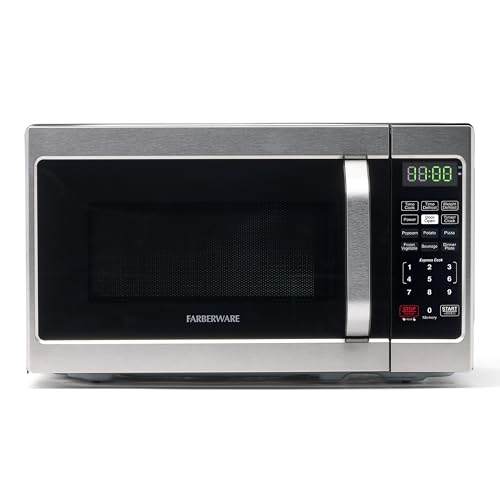
Farberware 0.7 Cu.Ft Countertop Microwave (Stainless Steel) — Best Familiar Controls
Some shoppers do not want the simplest microwave; they want the microwave that works the way microwaves have always worked, with no new dialect to learn. That is the Farberware compact’s entire case. Ten power levels, six preset options and multi-stage cooking — set a defrost stage followed by a cook stage and walk away — arranged in the classic layout that anyone who has used a countertop oven in the last twenty years can operate from memory. Ease, here, means zero relearning.
Multi-stage cooking deserves the spotlight because it is the one advanced feature that genuinely reduces effort for a specific, common job: frozen food that must defrost and then cook. Instead of hovering to restart the oven mid-cycle, you program both stages once. Paired with the stainless finish — the one compact in this guide that matches a steel appliance suite — it makes the Farberware the pick for a replacement buyer: the old oven dies, this one arrives, and dinner proceeds on schedule with no household retraining program.
The familiar path has familiar potholes. There is no mute function and no express-cook emphasis in the listing, so the interaction model is the deliberate classic one — enter time, enter power, press start — rather than the one-press model of the BLACK+DECKER. At 700 watts and 0.7 cubic feet it shares the compact ceiling on load size and speed. Choose it when continuity is the ease you value; choose the express models when seconds and silence matter more.
Strengths
- Multi-stage cooking automates defrost-then-cook in one program
- Classic layout requires zero relearning for experienced users
- Stainless finish matches steel appliance suites
Trade-offs
- Deliberate classic controls, not one-press express cooking
- No mute function in the listing
- Compact 700W ceiling on speed and load size
| Capacity | 0.7 cu ft (per Amazon listing title) |
| Power | 700W (per Amazon listing title) |
| Controls | 10 power levels, multi-stage cooking, 6 preset options |
| Finish | Stainless steel |
Best for: replacement buyers who want the classic control dialect in stainless / Not suited for: one-press express fans or anyone who needs a mute switch
Check the current price on Amazon for the Farberware 0.7 Cu.Ft Countertop Microwave (Stainless Steel). You can also see the full listing here to confirm finish, dimensions and what is in the box before you order.

Emerson 0.7 Cu.Ft Compact Countertop Microwave — Best Defrost Simplicity
Defrosting is where beginners ruin dinner — chicken with cooked edges and a frozen core, ground beef that steams at the rim while the center stays icy — and the Emerson compact earns its badge by making that one job as foolproof as the class allows. Both defrost dialects are present and plainly labeled: time defrost for the cook who works by the clock, and weight defrost for the cook who can read a package label. Enter the weight, and the oven apportions the cycle instead of asking you to guess minutes per pound.
The rest of the oven is the proven compact formula, executed without novelty: 0.7 cubic feet, 700 watts, 10 power levels and 6 cooking presets covering the everyday rotation. Emerson has sold versions of this compact for years, and that longevity shows up as a control panel with no experimental gestures — every button does the obvious thing in the obvious place. In a rental, a break room or a grandparent’s kitchen, obvious is a feature that outranks clever.
You give up the modern comforts found elsewhere in this guide: no mute, no sensor, no express row in the listing’s terms, and the same 700-watt patience tax on big frozen loads. The cavity is for bowls, mugs and single portions. But if the household pain point is specifically defrost roulette — the nightly frozen protein that decides whether dinner is easy — this is the compact that removes it most directly.
Strengths
- Both time and weight defrost, plainly labeled
- Proven, obvious control layout with no experimental gestures
- 6 presets and 10 levels cover the everyday rotation
Trade-offs
- No mute, sensor or express emphasis in the listing
- 700 watts is slow on large frozen loads
- Compact cavity limits loads to single portions
| Capacity | 0.7 cu ft (per Amazon listing title) |
| Power | 700W (per Amazon listing title) |
| Controls | 10 power levels, 6 cooking presets, time and weight defrost |
Best for: households whose nightly bottleneck is defrosting frozen protein / Not suited for: buyers who want mute, sensor or one-press express features
Check the current price on Amazon for the Emerson 0.7 Cu.Ft Compact Countertop Microwave. You can also see the full listing here to confirm finish, dimensions and what is in the box before you order.
Comparison Table
Ease is not one feature, so read the Key spec column as a menu of shortcuts: sound on/off for quiet homes, a humidity sensor for judgment-free reheats, express rows for one-press speed, and weight defrost for the nightly frozen protein.
| Pick | Badge | Key spec | Best for |
|---|---|---|---|
| COMFEE’ EM720CPL-PM 0.7 Cu.Ft Countertop Microwave (Black) | Best Overall | 0.7 cu ft, 700W, sound on/off | Quiet one-touch reheating |
| Toshiba EM131A5C 1.2 Cu.Ft Countertop Microwave (Stainless Steel) | Best for Hands-Off Cooking | 1.2 cu ft, 1000W, humidity sensor | Hands-off family reheating |
| BLACK+DECKER 0.7 Cu.Ft Countertop Microwave (Black) | Best Express Cooking | 0.7 cu ft, 700W, express cook | One-press reheating |
| Chefman 0.7 Cu.Ft Countertop Microwave | Best for Beginners | 0.7 cu ft, 700W, express cook | Beginners and first apartments |
| Farberware 0.7 Cu.Ft Countertop Microwave (Stainless Steel) | Best Familiar Controls | 0.7 cu ft, 700W, multi-stage | Zero-relearning replacement |
| Emerson 0.7 Cu.Ft Compact Countertop Microwave | Best Defrost Simplicity | 0.7 cu ft, 700W, weight defrost | Foolproof defrosting |
How to Choose the Easiest Microwave for Your Household
Match the shortcut to the friction. If the daily irritation is noise — beeps at midnight, a baby woken by a finished cycle — the shortcut is a mute or sound on/off function, and the COMFEE’ and Toshiba in this guide are your shortlist. If the irritation is judgment — plates that come out half cold, vegetables that drown — the shortcut is a humidity sensor, and the Toshiba stands alone here. If the irritation is steps — too many presses for a cup of coffee — the shortcut is express cooking, where a number key starts a timed full-power cycle instantly. And if the irritation is defrosting, the shortcut is weight defrost with the math built in. Naming your friction first turns a wall of similar ovens into a two-model decision.
Then check the unglamorous basics that decide whether easy stays easy. Controls should sit on the front face at a readable size, with the express row or presets reachable without reading glasses or a phone flashlight. The door should open with a push or a light pull that works with full hands. The interior should wipe clean — a smooth, easy-clean finish is worth more over five years than a twelfth preset. Finally, size honestly: the easiest oven is the one that fits your actual plates, because an oven that demands a smaller plate has added a step to every single meal.
- List your household’s top friction — noise, judgment, steps or defrosting — before comparing models
- Count the presses for your three most common jobs on any panel you consider
- Confirm a mute or sound control exists if anyone sleeps near the kitchen
- Measure your dinner plate against the cavity and turntable, not the brochure
Which Easy Features Are Actually Worth Having?
Express cooking is worth having, unconditionally: it is the most-used convenience in real kitchens because it matches how people actually reheat. A mute function is worth having in any home where the kitchen shares air with sleepers, studiers or open-plan living. A humidity sensor is worth having if your reheating is varied — mixed plates, fresh vegetables, casseroles — because that is exactly where fixed timers fail. Weight defrost is worth having if frozen protein is a weeknight routine rather than an emergency measure.
The features that rarely pay rent are long preset menus — beyond the first six, presets duplicate each other and go unmemorized — and app connectivity on a countertop oven, which adds an account, a password and a firmware lifecycle to an appliance whose whole virtue is immediacy. This guide’s picks were filtered accordingly: every headline feature above is one you will use weekly, and the panels stay short enough to learn by Friday.
How Can I Make Any Microwave Easier for Kids, Guests and Older Relatives?
The easiest microwave is partly a purchase and partly a household system, and the system half is free. Start by standardizing: choose the household’s three core interactions — express for drinks and leftovers, the sensor or a named preset for plates, weight defrost for protein — and teach only those, in person, once. Write the defrost sequence and the household’s standard reheat times on a card inside the cabinet door nearest the oven; a guest who can find instructions without asking experiences the kitchen as easy, and a grandparent who can read them in large print experiences it as respectful. Complexity that lives on a card does not live on the panel.
Then remove the small physical frictions. Keep the microwave-safe cover stored on top of or beside the oven, not in a distant cupboard, so covering food is the path of least resistance. Keep a dedicated mug for water-based tests and reheats at the oven’s elbow. If an older relative struggles with a membrane panel, favor the picks in this guide whose express row starts cooking from a firm number-key press, and test the door together — a push-button door release is meaningfully easier for arthritic hands than a pull handle that fights back. Ease, audited this way, is a dozen small decisions that compound into an appliance nobody in the house thinks about.
- Standardize on three interactions and teach those, not the whole panel
- Post the household’s sequences inside the nearest cabinet door
- Store the cover and the test mug at the oven, not across the kitchen
- Choose push-button door release for users with limited grip strength
What Is the Easiest Way to Reheat Leftovers Evenly?
Even reheating is a technique problem that easy ovens support but cannot fully solve, and the method matters more than the model. Arrange food in a ring with the center empty, because microwave energy penetrates a limited depth and a mound’s middle is always the last to heat. Sprinkle a spoonful of water over rice, pasta and grains — surface moisture turns to steam and rescues texture that dry reheating ruins. Cover the plate, always: a cover traps steam, evens the temperature and keeps the cavity clean, three victories for one habit. Then use the oven’s strengths: a sensor reheat if yours has one, or express time in two shorter bursts with a stir or a plate rotation between them, rather than one long blast that scorches the rim while the center warms.
Finish with the step everyone skips: standing time. Two minutes under the cover lets temperatures equalize by conduction, turning a plate of hot edges and a cool center into a plate that is simply hot. It feels like waiting; it is actually the second half of the cooking, and it is the difference between leftovers that taste reheated and leftovers that taste cooked. Build the ring, the sprinkle, the cover, the bursts and the stand into one household routine and even the simplest compact in this guide will reheat like a far more expensive oven.
Easy for Whom? Matching the Pick to the Person
Ease is personal in ways spec sheets flatten, so here is the guide re-sorted by the person walking up to the oven. For the night-shift worker and the new parent — anyone whose cooking happens beside sleeping people — the mute is the whole decision: the COMFEE’ for a compact, the Toshiba for family size, and no other feature outranks silence at 3 a.m. For the college student and the first-apartment cook, the decision is forgiveness: express cooking and presets that succeed without knowledge, which is the BLACK+DECKER and Chefman territory, with the Chefman’s full power-level range quietly teaching the skills the next decade of cooking will use.
For the older relative whose kitchen confidence matters more than any feature, the decision is familiarity and legibility: a classic layout like the Farberware’s, a display that reads across the room, and a household that standardizes on two or three interactions and writes them on the cabinet card this guide recommends. For the household that defrosts nightly — the batch cookers, the freezer economists — the decision is the Emerson’s weight defrost or the Toshiba’s sensor judgment, because that household’s friction lives in one specific job. Read the badges through the person, not the product, and the shortlist usually collapses to one name. That collapse is what ‘easiest’ actually feels like from the buyer’s side of the counter.
One Last Test Before You Buy: The Three-Job Rule
Stand in the shop — or sit with the listing — and walk the panel through your household’s three real jobs in order: the morning mug, the evening plate, the weekly defrost. Count the presses for each, out loud, including the hunt for the right button. If any job needs a menu dive, a manual or a remembered combination, that oven is not the easy one, whatever its brochure claims. The picks in this guide were subjected to exactly this walk-through logic: express rows and one-touch starts for the first two jobs, weight defrost or a sensor for the third. An oven that passes the three-job rule in the shop will feel easy for years, because ease was never a feature list — it is the distance between wanting a hot drink and holding one, measured in presses, beeps and decisions. Buy the shortest distance.
How to Set Up a New Microwave for Effortless Daily Use
Ten minutes of setup on day one decides whether a microwave feels easy for the next five years. The routine below works for every pick in this guide.
- Unbox on a clear counter, remove every piece of packing material from the cavity — including the cardboard waveguide cover protector if present — and place the turntable ring and glass tray so the tray seats and rotates freely by hand.
- Position the oven with the clearances the manual specifies on the sides, top and rear. Blocked vents are the top cause of a new oven that cooks unevenly and shuts down mid-cycle.
- Set the clock, then immediately find and test the sound control: run a 10-second cycle with a cup of water and confirm whether the mute or sound on/off setting silences the end signal the way you expect.
- Learn your express row: run a mug of water using a single number key and confirm the oven starts instantly at full power. This is the interaction you will use most; make it muscle memory first.
- Calibrate your expectations with the water test: time how long your oven takes to bring a measured cup of room-temperature water to steaming. That personal baseline tells you how to adjust packaged-food directions written for a different wattage.
- Program the two jobs you actually repeat — your defrost weight routine and your standard reheat — and note the exact key sequence on a card inside the nearest cabinet door for guests and family.
- Wipe the cavity and door seals, check that the door latches with a positive click, and register the warranty while the model and serial numbers are in front of you.
After setup, resist reorganizing the panel in your head around features you do not use. Easy microwaves reward households that standardize on two or three interactions — express for drinks and leftovers, sensor or preset for plates, weight defrost for protein — and let the rest of the panel sit quietly unused.
Common Buying Mistakes
Most ‘this microwave is complicated’ complaints trace back to a buying mistake, not a using mistake. These are the five that matter.
Buying the longest preset menu. Thirty presets do not make an oven easier; they make the panel harder to scan. Beyond about six honest presets, you are buying duplicates. Count the jobs you do weekly and buy the panel that does those in the fewest presses.
Forgetting the mute until the first midnight. If anyone sleeps within earshot of the kitchen, a mute or sound on/off function is a requirement, not a luxury. It cannot be added later, so check for it before the oven is on your counter.
Trusting box directions at the wrong wattage. Packaged-food times assume a wattage class. A 700-watt compact needs more time and a mid-cycle stir; pretending otherwise produces cold centers and a false verdict that the oven is weak.
Skipping the plate measurement. An easy oven that cannot fit your dinner plate adds a step to every meal forever. Measure the plate, compare it to the cavity and turntable diameter, and size up to a 1.2 cubic foot model like the Toshiba if it is close.
Burying the manual before learning defrost. Defrost is the one function where the manual’s weight tables genuinely save dinners. Read that single page, learn whether your oven wants weight in pounds or ounces, and the nightly frozen-protein problem disappears.
Final Recommendation
Buy the COMFEE’ EM720CPL-PM 0.7 Cu.Ft Countertop Microwave (Black) if quiet, one-touch compact living is the brief — it is the easiest oven in this guide for small spaces. Step up to the Toshiba EM131A5C 1.2 Cu.Ft Countertop Microwave (Stainless Steel) when the household reheats full plates and wants sensor judgment plus a mute at family size. The BLACK+DECKER is the express-cooking purist’s pick, the Chefman the beginner’s teacher, the Farberware the zero-relearning replacement, and the Emerson the defrost specialist. Ease is personal, but every pick here removes a real friction instead of adding a decorative one.
Compare these easy picks against the wider microwave field by size, finish and setting in the companion guides below.
If you want the short version: start with COMFEE’ EM720CPL-PM 0.7 Cu.Ft Countertop Microwave (Black), Toshiba EM131A5C 1.2 Cu.Ft Countertop Microwave (Stainless Steel), BLACK+DECKER 0.7 Cu.Ft Countertop Microwave (Black). Each is one click away from its live listing, where you can check price on Amazon and confirm the exact configuration.
Best Apartment Microwaves Best American Made Microwaves Best Bargain Microwaves Best 1.1 Cu Ft Microwaves Best Black Countertop Microwaves
Frequently Asked Questions
What makes a microwave easy to use?
Three things: express cooking that starts a timed cycle with one press, controls a guest can operate without instruction, and the absence of friction features — beeps you cannot silence, menus you must navigate for a cup of tea. Sensor cooking adds a fourth kind of ease by removing doneness guesswork. Every pick in this guide was ranked on those measures rather than on preset count, which usually works against ease.
Is a mute function on a microwave worth it?
In any home where the kitchen shares air with sleepers — studio apartments, nurseries, open-plan houses, night-shift households — yes, absolutely. The end-of-cycle signal is the most frequent sound a microwave makes, and a mute or sound on/off control, like the ones on the COMFEE’ and Toshiba picks in this guide, removes it permanently. In a detached kitchen in a house of early risers, it matters far less.
Are sensor microwaves really easier?
For reheating and vegetables, yes. A humidity sensor reads steam from the food and adjusts the cycle, which replaces the two judgments beginners get wrong most often: how long a mixed plate needs, and when vegetables are done. Sensors help less with very small portions and tightly covered dishes that trap steam. The Toshiba in this guide is the sensor pick; the compacts are easier in the different sense of having almost nothing to learn.
What size is easiest for a small apartment?
A 0.7 cubic foot compact is the easiest fit — it suits mugs, bowls and single entrées and leaves counter for everything else. Step up to a 1.2 cubic foot model only if you regularly reheat full dinner plates, because the larger cavity is the one upgrade that changes daily life. Measure your largest regular plate against the turntable before deciding; that single measurement settles most apartment microwave regrets.
How do I defrost without cooking the edges?
Use weight defrost when your oven offers it and enter the true package weight; the oven apportions low-power bursts with rest periods that let cold migrate inward. Remove food from foam trays and packaging first, separate pieces as soon as they loosen, and flip or break up ground meat at each pause signal. For time defrost, work in short bursts at low power rather than one long run. The Emerson pick in this guide builds both methods in plainly.
Do I need an app or WiFi for an easy microwave?
No — and for most households connectivity works against ease by adding accounts, passwords and updates to an appliance whose virtue is immediacy. Connected models earn their place when you specifically want scan-to-cook or remote monitoring. For pure ease, the express row, a mute switch and a good sensor outperform an app every day of the week.

