Disclosure: As an Amazon Associate, airfryerkitchensupply.com earns from qualifying purchases. Links to Amazon on this page are affiliate links; they cost you nothing extra. Listing details such as price and availability change often, so check the current Amazon listing before you buy.
The best microfiber dish towels are the ones that pick up water quickly, leave glass and steel free of fuzz and still feel fine after many washes. If you want a short answer, the Amazon Basics Microfiber Cleaning Cloth is the easiest all round pick for a busy sink, the E-Cloth General Purpose Cloth suits people who care most about a polished finish, and the Norwex Enviro Cloth is the premium option for shoppers who like a long term cloth.
This guide covers six real products that people use as micro fiber dish towels, plus the details that decide whether a cloth will suit your kitchen. You will find a quick picks table, a section for each product with three strengths and one honest limitation, a comparison table, a buying checklist and the mistakes that lead to disappointment. We rely on maker listings and published descriptions, so confirm pack count and size on each page before you order.

In this guide
Quick Picks for Microfiber Dish Towels
| Pick | Best for | Link |
|---|---|---|
| Best overall: Amazon Basics Microfiber Cleaning Cloth | A large pack for sink, counter and glassware | Check on Amazon |
| Best for a streak free finish: E-Cloth General Purpose Cloth | Glass, steel and polished surfaces | Check on Amazon |
| Best premium option: Norwex Enviro Cloth | Buyers who want one dependable cloth | Check on Amazon |
| Best value for money wording: MR.SIGA Microfiber Cleaning Cloth | Households that go through many cloths | Check on Amazon |
| Best for small spaces: Scotch-Brite Microfiber Cleaning Cloth | Small kitchens that need only a few cloths | Check on Amazon |
| Best for tough kitchen cleanup: Bar Keepers Friend Microfiber Cleaning Cloths | Cooktops, sinks and stainless steel | Check on Amazon |
What Makes a Microfiber Dish Towel Different From Cotton
A cotton towel absorbs water into the thread itself, which is why a thick terry towel feels heavy when wet. A microfiber cloth works differently. It is knit from very fine synthetic strands, usually a blend of polyester and polyamide, and the spaces between the strands draw water in and hold it. The result is a thinner cloth that can take on a surprising amount of moisture and dries quickly on a hook afterward.
The same fine structure is why microfiber is popular for glasses, mirrors and appliances. Cotton can leave small fibers behind, particularly when it is new. A well made microfiber cloth is far less likely to do that, which is why shoppers who want a lint free finish often move to it. The trade off is feel: microfiber can seem slick or slightly clingy, and it is not designed to carry hot pans the way a thick cotton towel can.
It also helps to understand that not every cloth sold as a dish towel is shaped like one. Many microfiber products are sold as general cleaning cloths, and people use them in the kitchen because the fabric works well there. That is fine, but it means you should read the size and pack count carefully rather than assuming a towel shape.
1. Amazon Basics Microfiber Cleaning Cloth
Who it suits: Anyone who wants a big, simple pack of cloths so that there is always a clean one ready.
The Amazon Basics Microfiber Cleaning Cloth is sold as a multi pack of general purpose cloths in a handy square size. It does not try to look decorative. The point is volume and convenience, and for a kitchen that goes through towels quickly that is a real advantage.
- The large pack lets you dedicate cloths to different jobs, such as glassware, counters and the sink area.
- The microfiber fabric dries quickly on a hook or over a faucet.
- The square size folds easily into a pad for wiping or a quick wrap around a glass.
Honest limitation: It is a general cloth, not a thick dish towel, so it is not meant to handle hot cookware and may feel thin compared with terry.
A practical way to use a pack like this is to assign colors. Keep one color for dishes and glasses, another for counters, and a third for appliances. Because a pack gives you plenty of spares, you can retire one from the glass duty to the counter duty as it ages. Check the listing for the pack count and the size before you order.
Choose it if you want a simple, practical bundle for the whole kitchen. Skip it if you want a thick towel with a hanging loop.
2. E-Cloth General Purpose Cloth
Who it suits: Shoppers who want a polished, streak free look on glass, steel and stone with little effort.
E-Cloth is a brand built around a specific idea: a densely knit cloth that works with water alone. The General Purpose Cloth is the best known piece in the range and is sold in several colors. People often buy it for glass and stainless steel, which show every streak.
- The tight knit surface is designed for a clean, polished finish on glass and shiny surfaces.
- It is sold in a few color choices, which makes it easy to organize by task.
- The maker presents the cloth as long lasting and reusable, which suits shoppers who dislike frequent replacement.
Honest limitation: It is built for wiping and polishing rather than for soaking up a pile of wet plates, so pair it with a larger towel if you dry a lot of dishes by hand.
Many buyers use one E-Cloth as a finishing cloth. They dry the bulk of the dishes with a larger towel and then use this one to buff wine glasses, the faucet and the sink rim. That division of labor keeps the cloth in good shape and gives the best look. Read the listing for the cloth size and the care instructions.
Choose it if you care about shine and clarity. Skip it if you want a single towel to do all the drying.
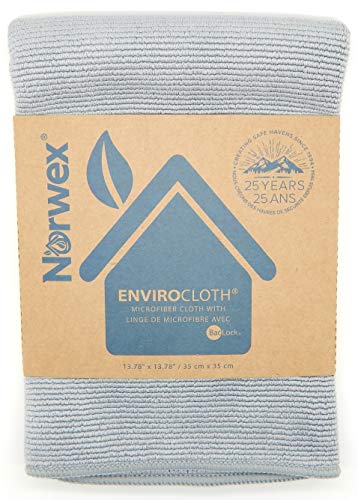
3. Norwex Enviro Cloth
Who it suits: Buyers who prefer to own a small number of cloths and keep them for a long time.
Norwex is a direct selling brand, and the Enviro Cloth is its signature microfiber cloth. It is positioned as a reusable cleaning cloth, and kitchen users often keep one by the sink for wiping and polishing. It is a more considered purchase than a big multi pack.
- The cloth is marketed as a reusable item meant to replace a steady stream of disposable wipes.
- The maker describes a specific fabric construction, which gives it a distinct feel from commodity cloths.
- One cloth is easy to store, hang and wash, which suits a minimalist kitchen.
Honest limitation: It sits at the premium end of this list and is sold as a single cloth, so the cost per cloth is higher than in a bulk pack. Availability through resellers can also vary.
If you already know you like microfiber, this is the type of cloth you buy after you have worn out a few basic packs and want something you can rely on. Look closely at the listing to confirm that you are seeing the genuine cloth, the size and the number of pieces included.
Choose it if you want a premium reusable cloth. Skip it if you want a large pack for rotating through all week.
4. MR.SIGA Microfiber Cleaning Cloth
Who it suits: Large households and anyone who likes to use a clean cloth every day and wash in batches.
The MR.SIGA Microfiber Cleaning Cloth is a popular multi pack that appears in many kitchens and garages alike. The cloths are lightweight, easy to wring and sold in a quantity that suits everyday rotation.
- A generous pack means you can put several cloths in the wash and still have clean ones in the drawer.
- The lightweight cloth dries fast, which helps on a busy sink.
- The simple look suits a kitchen that does not need decorative towels.
Honest limitation: A basic microfiber cloth like this can feel thinner than premium options, and it may need more passes to dry a stack of plates.
The best use is as an everyday workhorse for countertop wiping, spills and quick drying of dishes that do not need a heavy towel. Because there are plenty of cloths in a pack, you can wash them as a batch each weekend and keep a stack ready. Check the listing for the pack size, colors and cloth dimensions.
Choose it if you want quantity and simplicity. Skip it if you want one thick, plush towel.
5. Scotch-Brite Microfiber Cleaning Cloth
Who it suits: Small kitchens, apartments and anyone who prefers a household name and a smaller pack.
Scotch-Brite is a familiar cleaning brand, and its microfiber cloth is sold in packs of modest size. It is made for general household cleaning, including wiping counters and drying glass, and it comes from a line that many shoppers already know from sponges and scrub pads.
- A small pack suits a kitchen that does not need dozens of cloths.
- The brand is easy to find in stores and online, which makes replacements simple.
- The cloth is designed to pick up dust and spills without harsh scrubbing.
Honest limitation: A smaller pack means fewer clean cloths between wash days, so a large household may run short.
It is a sensible choice if you want to try microfiber without committing to a bulk bundle. Use one cloth for drying, one for wiping and keep a spare in the drawer. If you like it, you can add more later. Look at the listing for the pack count and size.
Choose it if you prefer a small, familiar pack. Skip it if you need a lot of cloths on hand.

6. Bar Keepers Friend Microfiber Cleaning Cloths
Who it suits: Cooks who like to keep stainless steel, cooktops and sinks looking tidy and want a cloth made for that job.
Bar Keepers Friend is known for its cleaning powder and cleanser for sinks and cookware. The Microfiber Cleaning Cloths are a companion product that fits the same routine, meant for wiping and buffing kitchen surfaces after cleaning.
- The brand is associated with kitchen cleaning, so it feels natural next to the sink.
- The cloths work well for buffing steel and chrome after a wipe down.
- Microfiber dries fast, so the cloths are ready for the next round.
Honest limitation: These are positioned as cleaning cloths rather than classic dish towels, so they are best for surfaces more than for drying a full load of plates.
Think of this pack as part of a cleaning routine. After you scrub the sink and rinse it, a clean cloth removes water spots from the faucet and the basin. Review the listing for the number of cloths and the size.
Choose it if you want a cloth that fits a surface care routine. Skip it if you want the cloth to double as a thick dish towel.
Side by Side Comparison
| Product | Size | Material | Key feature | Best use | Link |
|---|---|---|---|---|---|
| Amazon Basics Microfiber Cleaning Cloth | Square, multi pack | Microfiber | Large pack | Everyday kitchen rotation | Check on Amazon |
| E-Cloth General Purpose Cloth | Single cloth | Dense microfiber | Streak free finish | Glass and steel | Check on Amazon |
| Norwex Enviro Cloth | Single cloth | Microfiber | Reusable, premium | Long term sink cloth | Check on Amazon |
| MR.SIGA Microfiber Cleaning Cloth | Multi pack | Microfiber | High quantity | Large households | Check on Amazon |
| Scotch-Brite Microfiber Cleaning Cloth | Small pack | Microfiber | Familiar brand | Small kitchens | Check on Amazon |
| Bar Keepers Friend Microfiber Cleaning Cloths | Multi pack | Microfiber | Surface buffing | Sinks and cooktops | Check on Amazon |
How to Choose Microfiber Dish Towels
- Decide how much drying you do by hand. If you dry a full rack every day, you need more absorbent, larger cloths or a bigger pack. If you mostly wipe, a smaller set will do.
- Check the pack count. A single premium cloth and a bulk bundle serve different habits. Count the cloths and think about how many wash cycles you want between uses.
- Look at the size. A square cloth folds easily, while a towel shaped cloth hangs better. Compare the stated dimensions with a towel you already own.
- Think about lint. Microfiber is chosen for a clean finish, but any new cloth benefits from a wash before first use. Follow the care label.
- Consider color. Color coding helps you keep glassware cloths separate from counter cloths.
- Plan for heat. Microfiber is synthetic and is not a pot holder. Keep it away from hot pans and open flames, and use a proper oven mitt for hot cookware.
- Read the care label. Many makers recommend skipping fabric softener, so check the guidance before you wash.
Common Buying Mistakes
The most common mistake is expecting a cleaning cloth to behave like a thick terry towel. Microfiber is thin by design and works by capillary action, so it feels different in the hand. If you want weight and plushness, you may prefer a cotton waffle or terry towel for the bulk of your drying and a microfiber cloth for the finishing touches.
Another is buying the largest pack without thinking about storage and laundry. A pack of dozens of cloths is only helpful if you have somewhere to keep them and enough habit to wash them in batches. Smaller kitchens often do better with a set of six to ten.
A third is washing microfiber with fabric softener or high heat. Makers commonly advise against both, because softener can coat the fibers and heat can damage them. Read the label and follow it.
The last is ignoring the intended use. A cloth designed for glass and steel may not suit a stack of wet pans, and a thick cloth may leave marks on a polished faucet. Match the cloth to the job.
Building a Simple Dish Drying Routine
Good towels matter less than a good routine. A workable setup for most kitchens uses three layers. First, let dishes drain on a rack or mat so that most of the water runs off by itself. Second, use a larger absorbent cloth to take care of the plates, bowls and pans that you want to put away right now. Third, use a dense, smooth cloth for the last pass over glasses, cutlery and the faucet, where streaks and spots show most.
With that arrangement, you do not need every cloth to do every job. A multi pack like the Amazon Basics or MR.SIGA option can serve as the second layer, and a single E-Cloth or Norwex cloth can serve as the finishing layer. Small kitchens can compress the routine into two cloths and still get a clear result.
It also helps to decide where cloths live. A hook near the sink for the working cloth, a drawer for clean spares and a small basket or bin for used ones keeps the system tidy. When the basket fills, wash the load and reset the drawer. That habit is easier to keep than trying to remember which cloth is fresh.
Finally, keep dish cloths separate from the ones you use on floors, appliances or the car. Mixing roles shortens the life of a cloth and makes it harder to trust the finish on glassware. Color coding is the simplest fix, and every product in this guide is offered in more than one color or can be paired with a differently colored pack.
Care and Daily Use
Wash microfiber cloths with other light fabrics rather than heavy items like jeans, which can shed fibers onto them. Use a mild detergent and avoid bleach unless the label allows it. Air dry or tumble on low if the label permits, and keep them away from fabric softener sheets.
Between washes, hang a damp cloth where air can reach it. A cloth left in a bunch on the counter takes longer to dry and can develop a stale smell. Rotating two or three cloths through the week solves that without extra effort.
When a cloth reaches the end of its useful life for glassware, do not throw it out straight away. Demote it to a lower stakes job such as wiping the stove top or the inside of a cabinet. That way you get full value from every cloth, and your best ones stay reserved for the places where a clean finish counts. Mark demoted cloths with a different color or a small stitch so you never mix them up with the glass cloths.
Final Recommendation
Match your pick to your kitchen:
- Best all round: Amazon Basics Microfiber Cleaning Cloth for a simple, large pack.
- Best finish: E-Cloth General Purpose Cloth for glass and steel.
- Best premium: Norwex Enviro Cloth for a long term reusable cloth.
- Best for a big household: MR.SIGA Microfiber Cleaning Cloth for quantity.
- Best for tidy surfaces: Bar Keepers Friend Microfiber Cleaning Cloths.
If you are unsure, begin with the Amazon Basics pack and add an E-Cloth for glassware. Open the listings, compare the pack counts and sizes, and place your order today so your sink stays dry and clear.
Choosing Microfiber Dish Towels With More Care: The Details That Matter Most
The main guide above covers the essentials. This section goes one level deeper, into the details that separate a towel you are happy with for a month from one you are happy with for years. A microfiber dish towel is a piece of technology disguised as a cloth: thousands of split fibers doing with structure what cotton does with bulk. Work through these four checks and most buying mistakes in this category simply never happen.
Fiber split and density
Microfiber works because each fiber is split into fine channels that trap water and grease. Denser, well-split cloth picks up more and leaves less behind; cheap, loosely made microfiber behaves like a smooth rag and gives the whole category a bad name. The hand test is real: good microfiber has a slight grab on dry skin, a feeling of countless tiny hooks. If a cloth feels like a satin scarf, it will wipe like one.
Size and thickness for dish work
Dish duty needs a cloth that wraps a plate, bunches into a glass’s neighborhood and survives being wrung fifty times. Very small cloths disappear into the hand; very large ones drag. A mid size with some body suits most kitchens, and a touch of thickness helps the cloth hold water through a whole rack rather than surrendering at the third plate. Buy one size for dishes and keep the tiny free cloths for the car.
Edge quality
Microfiber edges are laser-cut, stitched or bound, and the difference shows in the wash. Poor edges curl, fray and shed; good edges lie flat for years. Curled edges are not just ugly — they reduce the working surface and catch on everything. Inspect the border before the body of the cloth; in microfiber, the edge is the honest part of the construction.
Lint performance on glass
Microfiber’s party trick is a lint-free finish, but only decent cloth delivers it. Poor cloth sheds its own fibers onto the glass it just polished. Test a new cloth on a dark glass or a phone screen under a lamp: the truth appears instantly. For households that dry glassware daily, this single test should decide the purchase, because it is the job where microfiber must beat cotton or justify nothing.
Microfiber Dish Towels in Everyday Life
Specifications are tidy; real life is not. Here is how the choice plays out in the situations where these towels actually earn their keep.
The nightly rack of dishes
Microfiber’s speed shows at the rack: it drinks fast, wrings nearly dry, and keeps pace with a full load without the swap-to-a-fresh-towel ritual cotton demands. Work glasses last with the cloth at its driest, or keep a second cloth purely for glass. By the end of the rack the cloth will be carrying the evening’s grease — it goes to the wash, not back on the hook, and a fresh cloth starts tomorrow.
Stainless steel and the fingerprint war
On steel appliances microfiber is close to magic: a barely damp cloth lifts fingerprints and smears that cotton smears wider, and a dry pass leaves the surface clear. This is the job that converts skeptics. Keep one cloth dedicated to steel and glass — never let it near grease or the floor — and the fronts of your appliances will look serviced rather than wiped.
A small kitchen with minimal storage
Microfiber folds to nothing, dries on a hook in an hour and washes in a corner of any load. For a small kitchen where the towel drawer is a fantasy, a stack of microfiber cloths is a complete dish system in the space of one cotton towel. The discipline required is laundry separation — microfiber must not wash with linty cotton — which in a small household is one extra small load, honestly traded for the space saved.
Getting Ready for Guests, Seasons and Busy Weeks
Towels are never really tested on an ordinary Tuesday. A microfiber dish towel is a piece of technology disguised as a cloth: thousands of split fibers doing with structure what cotton does with bulk. They are tested when guests arrive, when the cooking doubles, when the weather turns humid for a week — the moments when demand spikes and drying slows down at exactly the same time. A little preparation keeps those weeks comfortable instead of chaotic.
Build a small reserve and keep it ready
Hold back a modest reserve of your best towels, washed and stored ready, rather than running your entire stock in daily rotation. When guests come or a busy week lands, the reserve comes out and daily life continues at the same standard; when the week ends, everything is washed and the reserve is rebuilt. The reserve also covers the small disasters — a washing machine fault or a spilled suitcase — that otherwise turn into an emergency purchase of whatever is available.
Plan for slow drying
In humid weather or a crowded house, towels dry more slowly, which means each position needs changing more often, not less. This is the week to shorten the rotation: swap towels sooner, spread them wider to dry, and run the laundry in smaller, more frequent loads so nothing waits damp in a pile. If you know a particular season is always damp in your home, that season — not the easy weeks — is the true measure of how many towels you need.
Reset afterwards
After the busy period, give the whole working set one honest review: wash everything, check for the stains and smells that crept in, demote what has dropped a level and note what needs replacing while the lesson is fresh. Ten minutes of reset after a hard week is what stops one hard week from permanently lowering the standard of the whole drawer.
How Many Towels You Actually Need: Building a Rotation That Works
Most towel problems are really rotation problems. A microfiber dish towel is a piece of technology disguised as a cloth: thousands of split fibers doing with structure what cotton does with bulk. Too few towels means each one is used while still damp, washed too hard and replaced too soon. Too many means money sitting in a drawer. The right number comes from your own routine, and it is easy to work out.
Count backwards from laundry day
Start with how often the towel is used, and how often you wash. If a towel is changed daily and laundry happens twice a week, each position in your home — each sink, stove side or bathroom rail — needs enough towels to cover the longest gap between washes, plus one in use and one in the wash itself. For most spots that lands between three and five towels per position. Busy households, homes with children and anyone who cooks several times a day should lean to the top of that range; a single person with a small kitchen can sit at the bottom.
Rest is part of the system
A towel that is allowed to dry completely between uses lasts longer and smells fresher than one that never fully dries. Rotation is what makes that rest possible. When every towel in the drawer is in constant service, none of them ever quite recover, and the whole set ages together. A working rotation spreads the wear: each towel is washed a little less often, dried a little more thoroughly, and the set as a whole can serve for far longer before any single piece looks tired.
Retire in stages, not all at once
When a towel finally fades, thins or loses its edge, demote it rather than binning it. Yesterday’s best towel becomes the backup for messy jobs, then the garage or pet towel, and only then a rag. Staging replacements this way means you only ever buy a few new towels at a time, your best positions always hold your best towels, and you always have something expendable on hand for the jobs that would ruin a good towel in a single afternoon.
Odor and Stain Troubleshooting, Step by Step
Sooner or later every working towel meets a stain that sets or a smell that survives the wash. A microfiber dish towel is a piece of technology disguised as a cloth: thousands of split fibers doing with structure what cotton does with bulk. The order in which you tackle these problems matters more than any special product: act early, treat before you wash, and never let heat set what water could have removed.
Smells: strip the build-up first
A towel that smells fine out of the wash but turns sour as soon as it gets wet is usually carrying a build-up of detergent, body oils and minerals rather than a hygiene problem. The fix is a reset wash: hot water as the care label allows, a normal measure of detergent, and an extra rinse — or, if the build-up is heavy, a first wash with no detergent at all so the rinse water can carry the residue away. Then dry the towel completely and promptly. If the smell survives two honest reset washes, the fibers are holding damage no routine will reverse, and the towel belongs in the demotion pile.
Stains: cold, quick and patient
For stains, speed beats strength. Rinse or blot the mark with cold water as soon as you can — heat, including a hot wash or the dryer, can set many common stains permanently. Work from the back of the fabric so the stain is pushed out the way it came in rather than deeper. A little detergent worked in gently and left to sit before washing handles most everyday marks. Colored towels deserve a cautious approach: test any stronger treatment on a hidden corner first, and accept that a faint shadow on a hard-working towel is a badge of service, not a failure.
Prevention that actually works
Most odor and stain trouble is prevented by three unglamorous habits: hang the towel to dry the moment its job is done instead of leaving it in a heap, wash working towels promptly rather than letting them sit damp in a hamper for days, and keep one older towel assigned to the messiest jobs so your good towels never meet them. Prevention is boring, but it is the whole secret.
How the Picks in This Guide Differ in Practice
The reviews above describe each pick on its own terms. This section puts them side by side in the way a buyer actually decides — by priority. The picks covered are Amazon Basics Microfiber Cleaning Cloth, E-Cloth General Purpose Cloth, Norwex Enviro Cloth, MR.SIGA Microfiber Cleaning Cloth, Scotch-Brite Microfiber Cleaning Cloth and Bar Keepers Friend Microfiber Cleaning Cloths. None of them is the right answer for everyone; each earns its place for a different kind of household, and the honest differences between them matter more than any ranking.
Start with your dominant job. Every household has one task that accounts for most of its towel use, and the right pick is the one that performs that task best, even if it is merely adequate at the others. Buyers who choose by their rarest, most glamorous use case end up with a towel that is wrong fifty weeks a year. Read the per-pick reviews again with your dominant job in mind and notice how quickly the shortlist shortens itself.
Next, weigh the ownership experience rather than the first impression. Some picks ask more of you — a particular wash routine, a rotation, a little patience while they settle in — and repay that effort for years. Others ask nothing and give steady, unremarkable service. Neither profile is superior; the match between the towel’s demands and your household’s habits is what decides satisfaction. The most common disappointment in this category is a good towel living in the wrong routine.
Finally, consider buying in the order of your needs. If two picks appeal, the one that covers your daily work comes first; the specialist can follow later, when you know exactly which gap it fills. A drawer built this way — workhorse first, specialist second — ends up smaller, cheaper and better matched than a drawer bought all at once from a single afternoon’s enthusiasm.
Care Notes Specific to Microfiber Dish Towels
Microfiber care is specific and non-negotiable: wash separately from cotton and other lint-producers, use modest detergent, and never add softener or dryer sheets, which coat the split fibers and switch off the very mechanism you paid for. Moderate heat only — fierce heat can damage the fine fibers. A cloth that has lost its grab after bad washes can sometimes be revived by a hot, detergent-light wash, but prevention is far more reliable. Hang cloths to dry between uses; microfiber dries fast and rewards the habit with freshness.
Test a New Towel at Home Before You Commit to a Full Set
Listings can tell you a towel’s size, fiber and pack count, but they cannot tell you how it will behave in your own routine. A microfiber dish towel is a piece of technology disguised as a cloth: thousands of split fibers doing with structure what cotton does with bulk. A short home test, done in the first few days while returns are still simple, tells you more than any product photo. You do not need special equipment — just the jobs you already do every day, done a little more deliberately than usual.
Start with the first wash
Wash the towel once, following the care label, before you judge anything. New towels often carry a light finish from manufacturing that makes them feel smoother in the packet than they will in use, and that finish can also make water bead on the surface at first. After one wash you are testing the towel you will actually live with. Note how much lint comes away in the wash and the dryer, whether the color stays even, and whether edges and hems lie flat or start to curl. A small amount of lint early on is normal for many fabrics; lint that keeps shedding heavily after several washes is a sign the towel will thin out faster than you want.
Run the jobs you actually do
Next, put the towel through your three most common tasks, not the tasks in an advertisement. Dry the same kind of load you dry most often. Wipe the surface you wipe every day. Use it the way you will really use it, at the speed you really work. Pay attention to how quickly it picks up water, whether it pushes moisture around instead of absorbing it, how it feels when it is fully wet, and whether it is still comfortable to hold when the job is done. A towel that performs beautifully on a light task but gives up halfway through your biggest regular job is the wrong towel for you, however nice it looks folded.
Check the details that listings hide
Finally, look at the finishing. Seams and hems take the strain every time a towel is wrung, hung or pulled from a hook, so tug them gently and look for loose threads. Hold the fabric up to the light: thin, uneven patches in a new towel only get thinner. Check that the towel hangs the way you need it to hang — on your hook, rail or handle — without dragging or bunching. If the towel passes your wash, your jobs and your finishing check, ordering more of the same is a safe decision. If it fails one of them, you have learned that cheaply, with a single towel instead of a whole set.
More Mistakes That Shorten a Towel’s Life
Beyond the buying mistakes covered earlier in this guide, these are the everyday errors that quietly undo good microfiber dish towels — each one easy to avoid once it has been pointed out.
Washing microfiber with the cotton towels
One mixed load can lint-coat every microfiber cloth in it. Separate loads are the category’s one commandment.
Adding softener out of habit
Softener films the split fibers and the cloth becomes a smooth rag. If it smells nice and absorbs nothing, this is why.
Using one cloth for dishes and the floor
Microfiber traps particles deep in its structure. The floor cloth must never meet the dishes again, however well washed it looks.
Judging all microfiber by a free cloth
The flimsy cloths given away with products are not the category. A dense, well-made dish cloth is a different species.
Habits That Make the Difference
Give the towel air between jobs
The single most effective habit costs nothing: never leave a used towel in a heap. A towel spread over a rail, a tap or the back of a chair dries in a fraction of the time of the same towel balled on the counter, and drying is what stands between a fresh towel and a sour one. Build the hang into the end of every job — the last motion of wiping up is putting the towel where air can reach both its faces. In humid homes this habit matters more than any washing product you can buy, because a towel that dries fully every day rarely develops the deep, returning smell that forces early retirement.
Keep one honest spare within reach
Every towel system eventually faces the moment when the working towel is soaked, soiled or simply missing — and what happens next defines the system. If a clean spare is within arm’s reach, the moment costs two seconds. If it is in another room, the working towel gets used past its limit, or a good towel from another job gets conscripted. One spare, stored at the point of use and replaced whenever it is taken, is the cheapest insurance in the whole drawer.
Read the listing’s quiet details
The glamorous parts of a listing — the photographs, the headline claims — are the least useful parts. The dimensions, the fiber content, the pack composition and the care instructions are where the truth lives, and two minutes with them prevents most disappointments. Measure your space and compare real numbers rather than impressions of size. Check what a pack actually contains size by size. Towels are simple products; almost every regret in this category was visible in the small print before purchase.
Teach the system to the whole household
A towel routine known by one person is a hobby; known by everyone, it is a system. The rules worth teaching are few and physical: which towel lives where, what never crosses between jobs, and where a finished towel goes. Position teaches better than instruction — people follow the towel that is already hanging in the right place. When a new towel type joins the house, its place and its job should be decided on day one, not discovered by trial and error over a month.
Expect a break-in period
Many good towels are not at their best on day one. Finishes wash out, fibers relax, weaves settle — and the towel at week three is the towel you actually bought. Judge new towels after several washes rather than at first touch, and resist returning a sound towel for a first impression it was never going to keep. The exception is construction: loose hems, uneven weave and dye that will not settle are present from the start and do not improve. Learn to tell settling-in from genuine faults, and you will keep good towels and return bad ones with equal confidence.
Frequently Asked Questions
Are microfiber dish towels really lint free?
They are far less likely to leave fuzz than new cotton, but a fresh cloth can still shed a little. Washing it once before first use helps.
Can I use these to dry hot dishes?
Lukewarm or cooled dishes are fine. Do not use microfiber to handle hot cookware, and keep it away from flames and hot burners.
How many should I buy?
A pack of six to ten works for most homes. If you wash weekly, aim for enough cloths to cover seven days.
Do I need a different cloth for glass?
It helps. A dense cloth like the E-Cloth is designed for a streak free finish, and keeping it for glassware only protects that finish.
What about fabric softener?
Many makers advise against it because it can leave a coating on the fibers. Follow the care label on your cloth.
Can I return a cloth if I do not like it?
Return terms depend on the seller and the listing. Check the policy on the product page before you buy so you know what to expect.
Are these cloths suitable for the kitchen only?
No. Many people also use them on glass, appliances and the car, but keep a kitchen set dedicated to the kitchen.
Why does my microfiber cloth push water around on dishes?
Almost always the fibers are coated — softener, dryer sheet residue, or grease build-up from kitchen work. Wash it hot with a small amount of detergent and no additives, rinse well, and test again. If the grab returns, your laundry routine was the fault. If it does not, the cloth’s fibers were never well split to begin with, and it belongs in the car kit, not at the sink.
Can microfiber dish towels be sanitized in the wash?
A hot wash with detergent handles the ordinary hygiene of dish duty well. What matters more is the routine around the wash: cloths changed daily in busy kitchens, dried fully between uses, and retired from dish work once they have served rougher duty. A cloth’s cleanliness is a system, not a single wash temperature.
Do microfiber cloths scratch delicate items?
Clean microfiber is famously gentle — it is used on lenses and car paint. The risk is never the fiber; it is the grit a used cloth has trapped. Shake cloths out, rinse them through the day, and keep a pristine cloth for the most delicate glass and steel. A gritty cloth of any material scratches; microfiber’s virtue is that it also releases grit well when rinsed.
How many microfiber dish cloths does a kitchen need?
More than cotton logic suggests, because they are small and cheap to rotate: four to six lets you run dishes, glass and steel as separate assignments with spares in the wash. The rotation also enforces the category’s hygiene — a fresh cloth is always available, so no cloth is asked to work a second dirty day.
Can I tumble dry microfiber dish cloths?
Yes, on moderate heat — and they dry quickly, which is part of their appeal. Avoid high heat, which can damage the fine split fibers over time, and keep dryer sheets out of the load entirely. Many owners simply hang them: an hour on a hook and they are ready, which makes the dryer optional for this category altogether.


