Disclosure: As an Amazon Associate, airfryerkitchensupply.com earns from qualifying purchases. Links to Amazon on this page are affiliate links; they cost you nothing extra. Listing details such as price and availability change often, so check the current Amazon listing before you buy.
The best craft chairs for a sewing room or hobby studio are seats that adjust, roll quietly and let you reach in several directions without dragging your whole setup around. A crafting chair has a different job from a dining chair: you spin between a machine, a cutting table and an ironing board, lean in to see small work and sit for stretches while projects come together. This guide compares six well-known adjustable office style chairs and explains which suits which craft room.
It is written for quilters, sewists, scrapbookers, jewelry makers, model builders and anyone who turns a spare room into a studio. You will find a quick pick table, a profile of every chair with strengths and one honest limitation, a comparison table, a buying checklist and answers to common questions. Information comes from maker descriptions and general product knowledge, so read the current listing for adjustments, dimensions and options before you order.


In this guide
Quick Picks for Craft Room Chairs
| Pick | Product | Why it stands out | Link |
|---|---|---|---|
| Best overall for varied tasks | HAG Capisco Puls 8010 | Saddle style seat with many sitting positions | Check on Amazon |
| Best for adjustable arms | Steelcase Gesture | Arms that move with you | Check on Amazon |
| Best for a no-lever setup | Herman Miller Setu | Flexing frame with few controls | Check on Amazon |
| Best for a simple home studio | IKEA ALEFJALL Office Chair | Straightforward adjustable swivel chair | Check on Amazon |
| Best for breathable mesh | Alera Elusion Series Mesh Mid-Back Swivel Tilt Chair | Mesh back that stays airy | Check on Amazon |
| Best for a flexing back | Haworth Fern | Back that moves as you shift | Check on Amazon |
How These Chairs Were Chosen
We have not sat in any of these chairs ourselves and we make no claims about how they feel after an afternoon at the sewing machine. The picks come from maker descriptions, the features each listing highlights and the practical needs of a craft room. We looked for chairs with adjustable height, a swivel, rolling bases and arm options that suit people who reach, lean and turn all day.
We left out fixed height dining chairs and heavy executive chairs that dominate a small room. Where a detail matters, such as seat height range, caster type or fabric choice, we ask you to confirm it on the listing, since many of these chairs come in multiple versions.
6 Best Craft Room Chairs
HAG Capisco Puls 8010
The Capisco is known for a saddle style seat that lets you sit in more than one position, facing forward, sideways or even astride the seat with your arms on the back. The Puls version has a fabric covered seat and a back with a distinct hook shape. In a craft room, where you move between tasks, that variety of positions is its main appeal.
- A shaped seat allows several sitting positions, which suits switching between machine and table.
- A hook shaped back gives you a place to hang a bag or apron.
- Seat height options help you match different tables.
The honest limitation is that its look is unusual and some people need time to find a favorite position. Choose it if your work varies through the day. Skip it if you prefer a classic padded office chair.
Steelcase Gesture
The Gesture is built around arms that move in several directions, designed with modern device use in mind. In a craft room, adjustable arms matter because your hands go to the machine, the tablet showing a pattern, the cutting mat or a small tool tray. It is a full featured office chair with many adjustments.
- Arms move to follow different hand positions.
- A full range of seat and back adjustments lets you tailor it to your table.
- A solid, finished look suits a studio you also use for client visits.
It is a big, premium chair that takes more space than a simple model, and it may be more than a casual crafter needs. Choose it if you spend long hours in the room and like to fine tune. Skip it if your studio is tiny or your use is occasional.

Herman Miller Setu
The Setu has a flexible lattice frame that moves with you and almost no levers or knobs. It has a slim profile and an open feel, which makes it appealing in a small craft room where you do not want a bulky chair. It comes in several colors that look at home in a studio.
- A flexing frame follows your movement with few controls to set.
- A slim profile keeps the chair from dominating a small room.
- Color choices let it match a bright craft space.
With few adjustments, it offers less fine tuning than a full featured chair. Choose it if you want a simple, slim seat. Skip it if you like to adjust every detail or need a particular arm setup.

IKEA ALEFJALL Office Chair
ALEFJALL is a straightforward swivel chair with adjustable height and a tilting back, offered with different upholstery. It lacks the fancy mechanisms of a premium chair, which can be an advantage for a hobby room: fewer controls to learn, and a familiar shape that works with most tables.
- An adjustable height lets you match a sewing table or a cutting counter.
- A simple tilt and swivel make it easy to turn between tasks.
- Upholstery options let you match the room.
It offers fewer adjustments than the premium chairs, and arm options are simpler. Choose it if you want a no-fuss studio chair. Skip it if you need a highly adjustable setup.
Alera Elusion Series Mesh Mid-Back Swivel Tilt Chair
Alera’s Elusion is a mesh back chair with a padded seat, a swivel base and a tilt mechanism. Mesh is open and airy, which some crafters prefer in a warm room with a hot iron and a lamp. It is a practical, widely used office model.
- A mesh back is open and lets air move around it.
- A swivel base and tilt make turning simple.
- Arm options let you choose a setup that fits your table.
Mesh is a different feel from fully padded fabric, and arms may not tuck under every table. Choose it if you like an airy back and a conventional shape. Skip it if you prefer a plush, fully upholstered seat.

Haworth Fern
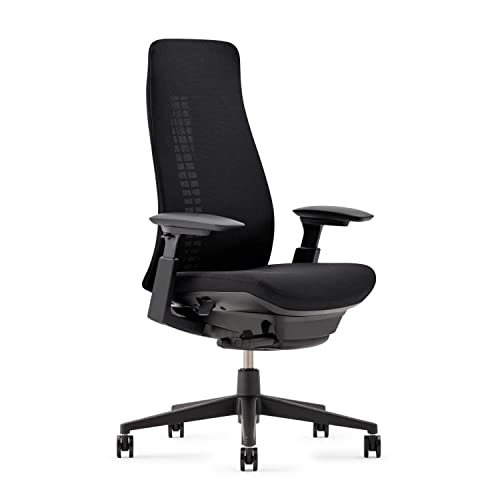
Fern is a slim chair with a back that flexes as you move, designed to adapt without too many manual controls. It is popular in offices that want a lighter look, and its form suits a studio where you want an uncluttered profile. It comes in several colors.
- A flexible back adjusts as you shift position.
- A slim shape fits close to a table.
- A range of colors keeps the studio cheerful.
It is a design driven chair, and that look may not suit every room. Choose it if you like movement and a clean shape. Skip it if you prefer a classic padded form.

Best Chairs for a Sewing Table and Machine
A sewing machine sits at table height, so a chair that adjusts up and down helps you get the right relationship between your seat, your elbows and the needle plate. Look for a stable base with smooth casters that do not roll away when you press a foot pedal. Chairs with adjustable arms, like the Gesture, can be set so they clear the table edge.
Many sewists keep a pair of chairs, a main office style chair for the machine and a stool or secondary seat for the ironing station. The Capisco moves between those roles with ease. Check the listing for the base type, since hard floors and rugs call for different casters.
Think about the foot pedal as well. A chair that is too low may force your leg into an awkward reach, and one that is too tall may leave your feet dangling, so the seat height range on the listing is worth a careful read. If you also run a serger or an embroidery unit, the same chair has to serve two machines, so a smooth swivel and a wide, stable base are more useful than extra padding. Some sewists keep a small foot rest or a low box beside the table to fine tune the position.
Quiet is a quality that people forget until they own a squeaky chair. A chair that creaks every time you lean to snip a thread becomes distracting, especially if you listen to audiobooks or a podcast while you work. Look for chairs from makers with a long record in office seating, keep the screws snug and apply any lubricant the maker recommends to moving parts.
Best Chairs for Quilting, Scrapbooking and Hobbies
Quilting and scrapbooking mean long, close work at a flat table. A chair that gets you near the table edge without arms hitting it is useful. Slim chairs like the Setu and the Fern slide close, while chairs with fixed wide arms may keep you away. If you work in short bursts and then stand to cut or press, an easy rise and an adjustable height make a difference.
For jewelry making or model building, you may sit close to a bench with small parts. A chair with a stable base and quiet casters keeps you from nudging the table. Place a mat under the chair so small parts that fall are easier to find.
Floors, Casters and Mats in a Craft Room
Craft rooms have hard floors as often as carpet. Hard casters suit carpet, while soft casters suit hard floors, and many chairs offer both. A chair mat protects the floor and gives you a smooth rolling area. Pins and needles fall to the floor, so a mat also makes them easier to spot and pick up with a magnet.
Check that your chair does not scratch the floor when it rolls, and follow the maker’s guidance on caster choice. If your floor is uneven, a mat with a thick edge can help the chair move without catching.
Comparison Table
| Product | Seat style | Material | Key feature | Best use | Link |
|---|---|---|---|---|---|
| HAG Capisco Puls 8010 | Saddle style | Fabric seat, shaped back | Several sitting positions | Varied hobby work | Check on Amazon |
| Steelcase Gesture | Full office chair | Upholstered or fabric options | Moving arms | Long studio sessions | Check on Amazon |
| Herman Miller Setu | Slim flexing frame | Lattice frame, fabric pad | Few controls | Small craft rooms | Check on Amazon |
| IKEA ALEFJALL Office Chair | Basic swivel | Upholstered seat | Simple adjustment | Home hobby studios | Check on Amazon |
| Alera Elusion Series Mesh Mid-Back Swivel Tilt Chair | Mesh back | Mesh and padded seat | Airy back | Warm craft rooms | Check on Amazon |
| Haworth Fern | Flexing back | Frame and fabric | Adaptive movement | Slim studio setups | Check on Amazon |
How to Choose a Craft Room Chair
- Measure your table height and the clearance beneath it.
- Check the seat height range on the listing.
- Decide on arms: fixed, adjustable or none.
- Pick the right casters for your floor.
- Think about fabric. Craft rooms collect threads, so choose something that is easy to brush.
- Consider space. Measure turning room, including the path to the ironing board.
- Read the listing for dimensions, options and what is included.
Common Buying Mistakes
- Buying a chair with arms that will not slide under the table.
- Ignoring floor type and choosing casters that mark the floor.
- Choosing a pale fabric in a room full of colored thread and dye.
- Forgetting turning room around the chair.
- Skipping a mat, then finding pins in the carpet.
- Assuming every adjustment is available on every version.
Care and Cleaning in a Craft Room
Brush threads and lint from the seat and wheels often, because thread wraps around casters and can slow them. Wipe mesh and plastic with a damp cloth, and vacuum fabric. Check screws and levers from time to time and read the care notes for each model.
Make cleaning part of the end of the session. Keep a small lint brush or a roller beside the chair and run it over the seat before you leave the room. Every month or so, tip the chair on its side and clear the casters with scissors or tweezers, removing threads, hair and dust. Wipe the stem and base, and look for loose bolts under the seat. If you use glue, resin or dye, cover the seat with a cloth while you work and wipe spills immediately, following the cleaning advice on the listing. A few small habits keep a studio chair looking neat and rolling smoothly for years of projects.
Layout: Where the Chair Fits in a Working Studio
The best craft rooms are planned around a triangle: the sewing or working table, the cutting surface and the pressing or storage area. Your chair is the vehicle that moves you around that triangle, so it needs open floor to travel. Aim for at least a three foot clear path between the main stations, and avoid placing a rug with a thick edge where the chair rolls.
Put the table where natural light falls across your work, not directly into your eyes, and add a task lamp on an arm so you can aim it where needed. Keep tools you reach for most within arm’s length of the seated position, with the rest on shelves and in carts you can roll over. A pegboard on the wall beside the table holds scissors and rulers so you do not need to stand up for them.
If your chair has adjustable arms, set them to clear the table edge. If it does not, choose a table with a cutout or an edge that allows the arm to slide under. Small adjustments to layout are often more effective than buying a new chair, so try moving the table and lamp before you decide.
Craft Chairs for Small Rooms and Shared Spaces
Many people craft in a corner of a bedroom, a dining room or a guest room, where the chair must fit into a larger scheme. In those spaces, a slim chair like the Setu or the Fern is easy to live with, because it does not look like an office. A chair with a neutral color and a simple shape slips into a living area without drawing attention.
If the room is shared, think about who else sits there. A chair with wide height adjustment suits two people of different heights. A chair that rolls quietly keeps the peace if someone is working on a video call nearby. When the project is done, you can slide the chair under the table and the corner looks tidy again.
Storage matters in shared spaces. A basket under the table for current projects keeps the chair area clear, and a narrow cart beside the seat holds supplies. Choose furniture that closes up or folds away, so the room still serves its other purposes.
Setting Up Your Chair Before a Long Project
Take a minute to set the chair before you begin a big project. Adjust the seat height so your forearms are roughly level with the worktop, set the arms if you have them, and check that you can reach the pedal or tools without stretching. Move the lamp, the mat and the supplies where you want them. These small steps cost little and make the session more pleasant.
Use the chair’s features. If the seat tilts, set the tilt so you can lean forward to see small stitches and sit back to rest. If there is a lock, use it. If the chair allows you to change positions, change them from time to time, and get up for a short walk every so often. Follow the maker’s instructions for every adjustment, and ask the seller if anything is unclear.
At the end of the day, push the chair in, brush threads off the seat and note anything that needs fixing. A tidy end to the session means a faster beginning the next time.
Fabric, Mesh or Leather: Choosing a Seat Surface
Craft rooms are not gentle on upholstery. Thread, pins, scissors, glue and dye all find their way to the seat, so surface choice matters. Mesh sheds lint and brushes clean, and it stays cool in a warm room. Tight woven fabric hides marks and is easy to vacuum, though pins can catch loose weaves. Smooth leather or vinyl wipes clean, but it may feel less airy.
Color is practical, too. A mid-tone, patterned or textured fabric hides threads and spots better than a pure white or black. If you plan to use a chair cover or a seat pad, check that it fits the shape of the seat and stays in place. Read the care notes on each listing before using any cleaner on the chair, and test a hidden corner first.
Final Recommendation
- For varied tasks, pick the HAG Capisco Puls 8010.
- For long hours with many adjustments, pick the Steelcase Gesture.
- For a slim, no-lever chair, pick the Herman Miller Setu.
- For a simple home studio, pick the IKEA ALEFJALL Office Chair.
- For an airy mesh back, pick the Alera Elusion Series Mesh Mid-Back Swivel Tilt Chair.
- For a flexing slim chair, pick the Haworth Fern.
If you want one that fits most studios, look at the Capisco for variety or the ALEFJALL for simplicity. Open the listings below to confirm current options.
Posture for Makers: Sitting Through Long, Detailed Work
Craft work is unusually demanding on a chair because it mixes postures. You lean in close over a sewing machine or a cutting mat, sit back to assess a quilt layout, perch forward to thread a needle, then roll sideways to a storage bin. A chair that only supports one of those positions will tire you out across a long project session, even if it feels wonderful for the first ten minutes. As you read the reviews above, judge each chair against the full cycle of movements your own craft involves.
Your feet are the foundation. For machine sewing, both feet flat on the floor with one on the pedal gives you controlled, even feeding; a chair set too high leaves you pointing your toes and tensing your calves, which shows up later as a sore back. Adjust the chair so your pedal foot works without reaching, then check that your forearms rest roughly level when your hands are at the machine bed or table surface.
Eye distance matters as much as back support. Detailed work pulls your head forward, and no chair can fully prevent that, but a seat that lets you sit close to the table edge, with your weight supported rather than perched on the front lip, reduces how far you crane. Take short, deliberate breaks to stand and look across the room; the best chair in this guide still works better with a two-minute reset every half hour or so.
Finally, think about the end of the session. Makers often judge a chair by how they feel standing up from it after two hours: stiff and creaky, or ready to keep going. A supportive seat, a back that meets you when you lean back to think, and smooth rolling to your supplies all add up to that fresher finish.
Arms or No Arms? Settling the Craft Room Debate
Armrests divide crafters more than any other feature. Sewists and quilters often remove or avoid arms because they catch on fabric, block the chair from sliding close to the table and get in the way when you guide bulky layers through a machine. Desk-based crafters, paper crafters and anyone who reads patterns or works on a laptop between making sessions tend to love arms for the rest they give shoulders during pauses.
The honest answer depends on your table. If your chair must tuck fully under the table to save space, fixed arms that sit higher than the table underside will stop it short every time. Measure that clearance before falling for an armchair design. Adjustable or flip-up arms, where offered, solve the conflict, but check that they feel solid in the position you will actually use, not just in the showroom position.
Consider also how you get in and out of the chair dozens of times a session. Arms give you leverage to lower and raise yourself, which matters on long days and for makers with sore knees. Armless chairs let you slide in sideways from a storage shelf or ironing board without a shuffle. Walk through your own routine mentally: the route you repeat most should decide the question.
If you remain torn, choose the chair whose arms interfere least with your primary craft and add support another way, such as a lumbar cushion you can move. It is easier to add a cushion than to work around an armrest that blocks your table approach every single day.
Rolling Around a Real Studio: Casters, Floors and Thread
A craft room chair lives on its wheels. You roll to the fabric shelf, the ironing board, the window light and back, often with your hands full. Large, smooth casters roll over floor protectors, rug edges and the inevitable stray pin with less drama than small hard wheels. On hard floors, softer wheels are quieter and kinder; on carpet, a chair mat under your main work zone makes rolling predictable instead of a workout.
Thread and fibre are the enemy of caster axles. Spun thread wraps around wheels and builds up until the chair drags. Build a tiny habit: every few weeks, turn the chair over, pull wrapped thread free with tweezars or small scissors, and check that each wheel spins freely. Five minutes of this prevents the gritty, lopsided rolling that makers often blame on the chair itself.
Decide where the chair parks. A defined parking spot keeps walkways clear and stops the chair drifting into your cutting layout. In shared rooms, a chair that tucks neatly under the table protects both the room and the chair’s upholstery from passing traffic, vacuum cleaners and curious pets.
If your studio floor is precious, test any new chair’s wheels in a discreet corner first. Some casters can mark softwood or pale vinyl until they wear in. A simple chair mat in the work zone removes the worry entirely and, as a bonus, defines your sewing or crafting footprint in the room.
One Chair, Many Crafts: Adapting Your Seat to Each Project
Few makers do only one thing, and the chair that serves sewing week must also serve scrapbooking, model building or gift wrapping. The trick is a small set of adjustments you repeat per project: seat height for the table in use, a cushion added or removed for perch-style work, and the chair’s position relative to your light. Write your preferred settings on a card taped inside a drawer until they become automatic.
For precision work at a high cutting table, you may sit higher and more forward; for relaxed hand stitching, lower and more reclined with your feet supported. Chairs in this guide with easy height adjustment handle that switching gracefully, while fixed chairs ask you to adapt with cushions and footrests. Neither approach is wrong, but know which maker you are before choosing.
Lighting interacts with seating more than people expect. If your chair height changes, your eye line to the work changes, and shadows from a fixed lamp move. After adjusting for a new project type, check your light before you start rather than squinting through the first hour and blaming your eyes.
Keep a small project-side kit within rolling reach: a cushion, a footrest if you use one, and a clip-on light. When everything you need to adapt the chair lives in one basket, you will actually make the adjustments instead of enduring a poor setup for a whole afternoon.
Making a Small or Shared Craft Space Work
When the craft room is also a guest room, a dining corner or half of a bedroom, the chair has to earn its footprint twice. Prioritise a chair that tucks away, rolls easily to a wall and does not visually dominate the room when the sewing machine is packed up. A slimmer profile chair from this list often serves a shared room better than the most adjustable studio chair.
Think vertically about the space around the chair. Wall shelves you can reach by rolling a short distance keep the floor clear for the chair’s turning circle. Measure that circle honestly: swivel chairs need room behind for the back to swing when you turn to grab supplies, and forgetting that space is how walls and chair backs both get scuffed.
In shared spaces, fabric choice becomes diplomacy. A chair that wipes clean after glue or ink accidents, and that does not collect glitter in deep seams, keeps the peace with everyone else who uses the room. Keep a washable throw over the chair during messy projects rather than buying a second, sacrificial chair.
Finally, plan the reset. The best shared-space setup returns to a tidy room in under ten minutes: chair tucked in, project boxed, floor swept of pins and thread. If your chair fights that reset by being heavy, awkward or too wide for its parking spot, you will feel the friction every single day.
Organising the Chair’s Orbit: Storage Within Rolling Reach
A craft chair does not work alone; it works inside an orbit of tools, materials and surfaces. Arrange that orbit deliberately and the chair becomes twice as useful. The supplies you touch every session should live within one easy roll or a single step: the current project’s box, your basic tools, a waste bin for thread and trimmings, and the iron or press if your craft uses one. Everything else can live further away without costing you anything.
Think in zones rather than furniture. A making zone around the table, a pressing or finishing zone, a storage zone along the wall. The chair travels between them all session, so keep its routes clear and wide enough for the chair plus the project in your hands. A route blocked by a storage box will be stepped over a hundred times before it is moved, so move it on day one.
Small mobile storage transforms a chair’s usefulness: a narrow trolley that parks beside the table, a rolling drawer unit that doubles as a side surface, a basket that rides with the project. These pieces let the chair stay the centre of the room while everything it needs comes to hand, instead of the maker commuting across the studio for every pair of scissors.
Review the orbit whenever your craft changes season. The quilting layout of winter needs different reach patterns from the garment sewing of spring. Fifteen minutes of rearranging at the change of projects saves small frustrations in every session that follows, and keeps the chair working as the studio’s hub rather than its obstacle.
Chair Care in a Messy Room: Glue, Ink, Fibre and Dust
Craft rooms are chemically and physically messy places, and chairs collect the evidence: fibre dust in the seams, glue on the arm, ink on the seat edge, glitter in places glitter should never be. A realistic care routine accepts the mess and manages it in small doses. Keep a damp cloth and a small bin at the table so spills and threads are dealt with in the moment, not discovered set hard a week later.
Choose your chair’s protection according to your craft. A washable throw or seat cover during painting, dyeing or glue-heavy work costs little and saves the upholstery beneath. Makers who sew mostly fabric will care more about fibre and pin management: a magnetic pin dish on the table, never the chair, and a weekly vacuum of the seat so stray pins are found by the nozzle rather than by the next sitter.
The chair’s mechanism deserves the same realism. Fibre and dust work into height mechanisms and caster axles, so a monthly wipe underneath and around the base keeps the adjustments moving freely. If the chair begins to sink, squeak or roll unevenly, clean and inspect before assuming failure; studio debris explains more chair problems than wear does.
Finally, give the chair a proper clean between big projects: vacuum every seam, wipe every surface according to its material, clear the casters, and check every adjustment. Starting a new project in a clean chair in a reset room is one of the small pleasures of making, and it costs only half an hour.
Ergonomics for Different Crafts: Sewing, Paper, Paint and Fibre
Each craft loads the body differently, and the chair that serves them all is adjusted, not merely bought. Machine sewing asks for a level forearm, a supported pedal foot and the freedom to lean close; the chair sits at the machine’s height and the maker sits tall. Hand quilting and embroidery invite a softer, longer sit, often with work in the lap, so back support and a seat that lets you shift matter more than precision height.
Paper crafting and scrapbooking spread materials wide and involve constant small reaches: to the cutter, the adhesive, the paper stack. A chair that swivels smoothly saves your spine a hundred twists an hour, and casters that roll a short distance without drama keep the workflow unbroken. Painting adds leaning and standing intervals, so a chair that is easy to leave and return to, without it rolling away behind you, earns its place.
Knit, crochet and other fibre crafts often migrate around the house, and the craft chair may be asked to serve at a sofa as much as a table. In that case its life is about comfort in a relaxed posture and arms that support elbows during long rows of stitches. Judge the chairs in this guide against your main craft first, then check they forgive your second craft, rather than seeking a mythical chair that is perfect for everything.
Whatever the craft, the session’s last ten minutes tell the truth: if you stand up stiff, something in the setup needs to change, and the chair’s height is the first dial to try. Small ergonomic experiments, one variable at a time, will tune any of these chairs closer to your body than a new purchase made on hope.
Budgeting a Studio Chair: Where the Money Actually Goes
A craft chair is a tool you will use for thousands of hours, and thinking of it as cost-per-session clarifies the purchase. A chair that serves you comfortably for years of weekly making costs very little per project, while a cheap chair that hurts will be replaced, avoided, or worst of all, endured, quietly taxing every session. Buy for the maker you are now and the one you are becoming, not for a single project.
The money in a good chair goes to the parts you cannot see: a sound mechanism, a frame that stays true, foam or mesh that keeps its character, and casters that roll after years of thread and dust. Finishes and styling are the visible part, but the invisible engineering is what you sit on. When comparing picks in this guide, weight the build details at least as heavily as the look.
Protect the investment with the cheap accessories that do heavy work: a chair mat for the floor, a washable cover for messy crafts, and five minutes of monthly maintenance. These small spends preserve the chair’s comfort and appearance far beyond their cost, and they are easier to replace than the chair itself.
If the budget is tight, buy the best chair you can once rather than a sequence of disappointing ones, and consider timing the purchase with the start of a big project, when its comfort will be proven daily. A chair that carries you happily through one long quilt or garment has already justified itself.
Setting Up for Your Next Big Project: A Chair-Led Reset
Before a major project begins, reset the studio around the chair. Clear its rolling routes, position it at the freshly cleared table, adjust its height for the work ahead and place the project’s materials within the chair’s orbit. That twenty-minute ritual marks the boundary between projects, clears the previous work’s debris from both the room and your mind, and starts the new piece with everything, including you, in the right position.
Check the chair itself as part of the reset: casters clear of the last project’s thread, mechanism moving freely, cushion brushed down, any adjustments working as they should. A chair maintained in these small moments between projects never surprises you in the middle of one, when stopping to fix furniture would break the concentration you have worked to build.
Arrange the light while you are at it. Projects change the direction you face and the distance your eyes work at, and the lamp that served the last piece may glare on the next. Sit in the reset chair, hold the new project’s materials at working distance and move the light until the surface is bright and your eyes are relaxed. Two minutes here saves hours of squinting later.
Finally, set one comfort intention for the project: a cushion for the long piecing sessions, a timer for stretch breaks during marathon cutting days, a footrest for the hand-finishing stage. Makers plan materials and measurements meticulously and comfort hardly at all; planning comfort with the same care is what keeps the making joyful from the first cut to the final press.
Frequently Asked Questions
Do I need a chair with arms for sewing?
Not necessarily. Arms can get in the way of the table, so many crafters choose armless or adjustable arms. Check clearance first.
What seat height works for a sewing table?
It depends on the table. Compare the seat height range on the listing with the height of your table and leave room for your knees.
Will casters mark my floor?
Hard casters can mark hard floors. Choose soft casters for hard floors, add a mat and follow the maker’s care guide.
Can I use a stool instead of a chair?
Yes for short tasks, but a chair with a back suits long sessions. Many crafters keep both.
How do I keep thread out of the wheels?
Brush the casters regularly and cut away wrapped thread with scissors. A mat helps keep threads from reaching the wheels.
What if the chair is not right?
Return terms depend on the seller. Read them on the product page and keep the packaging until you are sure.
Are these chairs hard to assemble?
Most arrive in parts and need simple tools. Follow the maker’s instructions and read the listing for details.
What chair height works best for a standard craft table?
Aim for a seat height that lets your forearms rest roughly level on the table with your shoulders relaxed and your feet flat on the floor. Standard tables sit higher than many people expect, so measure your table first and compare it with each chair’s adjustment range in the listing. If you are between settings, a firm cushion raises you slightly and a footrest supports your feet.
Is a saddle-style chair good for sewing?
Saddle seats encourage an upright, forward-working posture that many machine sewists find comfortable for guiding fabric, and they take up little room. They offer less back support for long, relaxed sessions, so they suit makers who move and perch more than they recline. If your crafting mixes machine work with long hand-finishing, a conventional chair with a back may serve the whole session better.
How do I stop my chair rolling away while I sew?
Check that your floor is level and that all casters spin and swivel freely; a single dragging wheel makes a chair wander. A chair mat with a slight texture also calms rolling. When you use a sewing pedal, plant the other foot firmly, which anchors you. If the chair still creeps, locking casters or a simple wedge under one wheel during machine work solves it without replacing the chair.
Mesh or padded seat for a craft room?
Mesh breathes well through long summer sessions and does not hold pins, glitter or fibre the way deep upholstery can. Padded seats feel softer for multi-hour sitting and are warmer in a cold studio. Consider your climate and your mess: painters and glue users usually prefer surfaces that wipe clean, while quilters who sit for hours often prioritise padding.
Can one chair serve both a sewing table and a desk?
Yes, if its height range covers both surfaces and it rolls easily between them. Measure both tables, because desk and craft table heights often differ by enough to matter. Choose the chair that fits the surface you use most, then bridge any small gap at the other with a cushion or footrest rather than compromising your main workstation.
How do I keep a craft chair clean around fabric and thread?
Vacuum seams and the underside regularly, because fibre dust collects where you cannot see it. Clear wrapped thread from caster axles every few weeks so the chair keeps rolling straight. Treat spills immediately according to the maker’s care guidance for that surface, and keep a small lint roller in the room; a minute of upkeep after messy sessions prevents most long-term grime.
What can I do if my craft chair keeps sinking slowly?
First clean around the base and mechanism, because packed fibre and dust can interfere with moving parts. Then check the maker’s guidance for your model, since some mechanisms can be serviced or replaced. If the chair is otherwise sound and suits your studio, a replacement mechanism is often a better spend than a whole new chair.