Disclosure: airfryerkitchensupply.com is reader-supported. When you buy through links on our site, we may earn an affiliate commission at no extra cost to you.
Where to buy
The six cast iron Dutch ovens below were each verified through the site’s Amazon catalog data — capacity, material, and form confirmed from the listing title before a link was earned. The set spans enamel and bare iron, round and oval, heirloom and everyday tiers. Check the current price on Amazon for the exact colour and size you want, because enamel pricing varies by finish.
- Le Creuset Enameled Cast Iron Round Dutch Oven, 7.25 qt, Cerise — Check the current price on Amazon
- Staub Cast Iron 7-qt Round Cocotte, Dark Blue — Check the current price on Amazon
- Lodge Essential Enamel Cast Iron Dutch Oven, 6 Quart, Island Spice Red — Check the current price on Amazon
- Lodge Enameled Cast Iron Oval Dutch Oven, 7 Quart, Oyster White — Check the current price on Amazon
- Lodge Cast Iron Dutch Oven with Loop Handle, 7 Quart — Check the current price on Amazon
- Amazon Basics Enameled Cast Iron Dutch Oven, 6-Quart, Blue — Check the current price on Amazon
The best cast iron dutch ovens earn the title the slow way: they sear hard without hot spots, hold a bare simmer for hours without attention, move from stovetop to oven without a thought, and come out of all of it ready to do the same again tomorrow. Cast iron’s mass is the whole point — it is a heat battery as much as a pot — and the best cast iron dutch ovens pair that mass with a lid that seals, handles you can grip with mitts, and a surface, enamel or seasoned iron, that suits how you cook.
This guide verifies six of them across the real decision points: French enamel at the top, American enamel in the middle, bare iron for the traditionalists, and an oval for the cooks whose roasts never fit a round pot. No invented specifications, no phantom models — every pick below is a real, listed product with its trade-offs stated plainly.
In this guide
Quick Picks
Ranked for the typical home cook who braises, bakes, and stew-cooks weekly. Premium enamel leads on refinement, Lodge leads on value and versatility, and the bare-iron and oval picks serve the cooks the rounds do not.
- Le Creuset Enameled Cast Iron Round Dutch Oven, 7.25 qt, Cerise — Best Overall: The benchmark: 7.25 quarts of French enamel with the best lid seal and finish in the category, sized for crowds and built to be inherited. Check the current price on Amazon.
- Staub Cast Iron 7-qt Round Cocotte, Dark Blue — Best for Browning and Braising: Staub’s 7-quart French cocotte in dark blue, made in France — the braising specialist whose heavy lid and dark interior sear and self-baste beautifully. Check the current price on Amazon.
- Lodge Essential Enamel Cast Iron Dutch Oven, 6 Quart, Island Spice Red — Best Value Enamel: Six quarts of Lodge enamel with a moisture-sealing lid — the everyday-priced pot whose listing names bread baking, braising, marinating, and slow cooking. Check the current price on Amazon.
- Lodge Enameled Cast Iron Oval Dutch Oven, 7 Quart, Oyster White — Best Oval for Roasts: A 7-quart oval in oyster white with dual handles — the shape that fits whole chickens, pork shoulders, and leg roasts a round pot crowds. Check the current price on Amazon.
- Lodge Cast Iron Dutch Oven with Loop Handle, 7 Quart — Best Bare Iron: Seven quarts of pre-seasoned bare cast iron with a loop handle — PFAS-free, oven-safe, and ready for any heat source you own, including the campfire. Check the current price on Amazon.
- Amazon Basics Enameled Cast Iron Dutch Oven, 6-Quart, Blue — Best Budget Enamel: A 6-quart enamel Dutch oven in blue with dual handles, listed for stews, roasting, and baking — the lowest-commitment route into the category. Check the current price on Amazon.
How These Picks Were Chosen
Each candidate was confirmed against live Amazon catalog data, with the listing title matched word for word to the product described here — brand, capacity, material, and shape. Judgement then followed the criteria that decide a decade of cooking: lid fit and seal, heat evenness from the iron’s mass, handle design under mitts, surface care requirements, and size honesty — a pot’s stated quarts measured against what a family actually cooks. Anything that could not be verified was excluded, however famous the name.
Enamel versus bare iron runs through this guide as an honest fork, not a hierarchy. Enamel is the lower-maintenance surface for acidic, everyday cooking; bare iron is the indestructible surface for high heat, open flame, and minimal fuss about tools. The picks are labelled so you can follow your own cooking style to the right one.
The 6 Best Cast Iron Dutch Ovens for Braising, Baking, and Everyday Cooking

Le Creuset Enameled Cast Iron Round Dutch Oven, 7.25 qt, Cerise — Best Overall
Le Creuset’s round Dutch oven is the reference point for this entire category, and the verified 7.25-quart Cerise listing is the fullest expression of it. The enamel is thick and even, the lid seats with a precision that keeps braising liquid in the pot instead of on your stovetop, and the iron distributes heat so steadily that a low oven braise becomes a set-and-forget exercise. It is a premium object, and it cooks like one.
Strengths
- Category-defining enamel quality and lid seal — minimal evaporation over long braises
- 7.25 quarts handles a whole chicken, a large loaf, or a double batch of stew
- Even, steady heat from stovetop sear to low oven without hot-spot drama
Trade-offs
- Premium tier commitment, and the weight to match — a full pot is a serious lift
- Enamel care rules apply: no thermal shock, no metal scouring pads
- Cerise is a signature colour, not a neutral one
| Specification | Detail |
|---|---|
| Capacity | 7.25 qt |
| Material | Enameled cast iron |
| Colour | Cerise |
| Form | Round |
What separates this pot in daily use is not any single feature but the absence of friction: the handles fit mitts, the knob tolerates oven heat, the interior releases fond for deglazing and then cleans with a soak, and the colours hold their gloss through years of service. Cooks who buy it tend to stop owning other large pots. If your cooking life centres on the stove — Sunday braises, holiday roasts, weekly bread — the cost spreads across decades of dinners.
Size it with clear eyes: households of two who cook small should look at the 6-quart Lodge below and bank the difference. This is the pot for people who cook big or cook for keeps.
Ownership economics deserve one plain paragraph. A pot at this tier is bought against the alternative of replacing a mid-tier pot several times across the same decades — and against the daily difference of cooking in an object that never makes you work around it. The enamel’s stain resistance matters more in year six than week one; the lid seal matters in every braise. None of that obliges anyone to buy it: the Lodge below exists precisely because most of the cooking result is available for far less commitment. But the cooks who do buy this pot rarely describe it as expensive in hindsight, and that retrospective is the honest data point.
Best for: Serious cooks who want the benchmark enamel pot in a crowd-capable size / Not suited for: Small households and budget-tier shoppers
Check on Amazon — check price on Amazon before ordering, and confirm the listing details match the verified model described here.

Staub Cast Iron 7-qt Round Cocotte, Dark Blue — Best for Browning and Braising
Staub is the other great French name in enamelled iron, and its 7-quart round cocotte takes a slightly different philosophy from Le Creuset: a heavier, tighter lid and a dark matte interior that browns meat superbly and hides the patina of use instead of showing every stain. The verified listing confirms the 7-quart capacity, the dark blue finish, and its French manufacture.
Strengths
- Heavy, close-fitting lid keeps braising moisture circulating over the food
- Dark interior sears beautifully and looks better with age, not worse
- Made in France with the fit and finish the tier promises
Trade-offs
- Among the heaviest pots in this guide — plan your lifts
- Premium tier, like its French rival
- The dark interior makes judging fond colour slightly harder for beginners
| Specification | Detail |
|---|---|
| Capacity | 7-qt |
| Material | Cast iron, enameled |
| Colour | Dark Blue |
| Origin | Made in France (per verified listing title) |
Braisers gravitate to Staub for a reason: short ribs and shanks emerge with the deep, even browning that only a heavy lid and steady moisture return produce, and the pot goes to the table looking like it belongs there. The interior’s forgiveness matters too — a decade of tomato sauces leaves a Le Creuset-style light interior politely stained, while the Staub simply looks seasoned. Choose between the French pair on exactly these grounds: light interior and gloss, or dark interior and browning.
The dark interior has one more subtle advantage worth naming: it teaches better cooking. Fond — the browned layer that becomes a sauce — is judged by colour against a light pan, but against Staub’s dark enamel you learn to judge by smell and by the way the fond releases when deglazed, which are the more reliable senses anyway. Cooks raised on this pot develop a feel for browning that transfers to every other pan they own. It is an unexpected educational benefit from a colour choice, and long-time owners mention it often.
Best for: Braising devotees who want maximum browning and a forgiving dark interior / Not suited for: Anyone who finds heavy cookware hard to handle
Check on Amazon — check price on Amazon before ordering, and confirm the listing details match the verified model described here.

Lodge Essential Enamel Cast Iron Dutch Oven, 6 Quart, Island Spice Red — Best Value Enamel
Lodge’s Essential Enamel is where most households should start: six honest quarts, a moisture-sealing lid, dual handles, and enamel that frees you from seasoning rituals entirely. The verified listing’s stated uses — bread baking, braising, marinating, slow cooking — read like a week in a real kitchen, and the pot handles all of them without the premium tier’s price of entry.
Strengths
- The versatile 6-quart size suits loaves, chickens, and family stews alike
- Enamel surface: no seasoning, no acid anxiety, easy cleanup
- Moisture-sealing lid performs well above its tier in braises and bakes
Trade-offs
- Enamel is a step below the French pots in chip resistance — treat it kindly
- Deep round form needs a parchment sling for delicate bread doughs
- Island Spice Red is a commitment to a colour
| Specification | Detail |
|---|---|
| Capacity | 6 quart |
| Material | Enameled cast iron |
| Lid | Moisture-sealing, dual handles |
| Stated uses | Bread baking, braising, marinating, slow cooking |
The honest summary is that this pot delivers most of the French experience at an everyday tier: the sear is even, the simmer is steady, the bread crusts properly, and the interior scrubs clean. What you give up is refinement at the margins — enamel that demands a little more care, a lid seal that is very good rather than perfect. For a first Dutch oven, or the household’s hardworking second pot, those margins are exactly the right trade.
Consider this pot’s role as a household’s second teacher: it is the Dutch oven you hand to a teenager learning to make chili, the one that goes to a holiday rental, the one that handles the experimental curry without anyone hovering over the enamel. Premium pots can inhibit exactly the relaxed, frequent cooking that makes a household good at cooking. A capable, affordable pot that nobody is precious about gets used more — and use, not reverence, is what a Dutch oven is for.
Best for: Most households wanting one enamel pot for everything / Not suited for: Heirloom hunters who want the top tier’s finish
Check on Amazon — check price on Amazon before ordering, and confirm the listing details match the verified model described here.
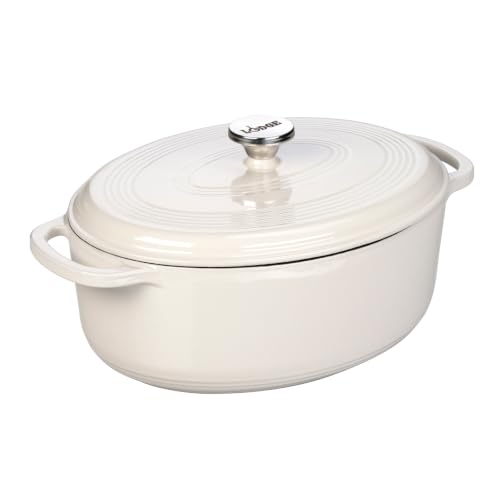
Lodge Enameled Cast Iron Oval Dutch Oven, 7 Quart, Oyster White — Best Oval for Roasts
Some food is oval, and this is the pot for it. Lodge’s 7-quart oval Dutch oven in oyster white takes a whole chicken lengthwise, a pork shoulder without folding, or a leg roast with room for the vegetables around it — the family-size cooking the verified listing describes, with dual handles for the heavy lift to the table.
Strengths
- Oval shape fits whole birds and long roasts that round pots force you to truss and squeeze
- Seven quarts of family capacity with enamel’s easy care
- Oyster white is a table-ready neutral that suits the serve-from-the-pot style
Trade-offs
- Oval pots sit awkwardly on round burners — expect to rotate for even searing
- Seven quarts of iron plus food is the heaviest carry in this guide
- Storage footprint is larger than a round pot’s
| Specification | Detail |
|---|---|
| Capacity | 7 quart |
| Material | Enameled cast iron |
| Form | Oval, dual handles |
| Colour | Oyster White |
The oval earns its keep on celebration cooking: the bird browns in the pot it roasts in, the shoulder braises with its liquid actually surrounding it, and the whole production serves at the table from one handsome vessel. Day to day, it is also a fine — if large — stew and soup pot. Just confirm your oven and your storage shelf can take its length before ordering; ovals surprise people in both places.
One technique unlocks the oval on a round burner: sear in stages and rotate the pot a quarter turn between them, so each part of the base takes its turn over the flame’s heart. Two minutes of attention at the searing stage buys the even browning the shape seems to deny, and once the lid is on and the pot is in the oven — where ovals behave perfectly — the point is moot. Cooks who learn that single habit stop finding the shape a compromise at all.
Best for: Roast-and-braise households cooking whole birds and big joints / Not suited for: Small ovens, small shelves, and small households
Check on Amazon — check price on Amazon before ordering, and confirm the listing details match the verified model described here.

Lodge Cast Iron Dutch Oven with Loop Handle, 7 Quart — Best Bare Iron
For the traditionalist, this is the Dutch oven in its original form: bare cast iron, pre-seasoned, with a loop handle, in a full 7-quart size. The verified listing confirms the essentials — cast iron construction, oven-safe, PFAS-free, 7 quarts. No enamel to chip, no coating to baby: just iron that sears fiercely, simmers gently, and improves every year you cook in it.
Strengths
- Indestructible format — any heat source, any utensil, any decade
- Bare iron sears as hard as cookware gets and holds heat superbly
- No enamel care rules and nothing to peel, craze, or stain
Trade-offs
- Seasoning habits required: dry it, oil it lightly, avoid long soaks
- Acidic, hours-long tomato braises can strip seasoning — use enamel for those
- Heavy, and the loop handle wants mitts and two hands when full
| Specification | Detail |
|---|---|
| Capacity | 7 quart |
| Material | Cast iron, PFAS-free per listing title |
| Handle | Loop handle |
| Use | Oven-safe |
Bare iron rewards a particular cooking temperament: high heat, patience, and a respect for tools that outlive their owners. Stews, chilis, pot roasts, and campfire cooking are its home ground, and the seasoning you build becomes a genuinely non-stick surface for eggs-in-the-lid style tricks and skillet breads. If your kitchen already has an enamel pot, this is its perfect counterpart; if it does not, weigh the acid limitation honestly against your menu.
Bare iron has a sensory honesty its owners prize: you hear the sear, smell the seasoning polymerising faintly over years, and watch the surface darken into a record of meals. Maintenance, stated plainly one more time, is a ninety-second ritual — wash, heat-dry, whisper of oil — and the cooks who keep it describe it the way cast-iron skillet people do, as a pleasure rather than a chore. If that temperament is yours, no enamel pot in this guide will satisfy you the way this one will.
Best for: High-heat cooks, campers, and traditionalists who want iron in its pure form / Not suited for: Anyone unwilling to keep basic seasoning habits
Check on Amazon — check price on Amazon before ordering, and confirm the listing details match the verified model described here.

Amazon Basics Enameled Cast Iron Dutch Oven, 6-Quart, Blue — Best Budget Enamel
The Amazon Basics 6-quart is the category’s entry ticket: enamelled cast iron, round, with dual handles, in a friendly blue, and a verified listing that names stews, roasting, and baking as its work. It will not match the French pots’ finish, and this guide will not pretend otherwise — but as a first Dutch oven that cooks real food from day one, it is a rational purchase.
Strengths
- Accessible tier with the full enamel convenience: no seasoning, easy cleanup
- Six quarts is the most useful size in the category
- Dual handles and a straightforward round form — nothing to learn
Trade-offs
- Enamel and casting finish a clear step below Lodge and the French brands
- Long-term chip resistance is the open question at this tier
- A functional object rather than a handsome one
| Specification | Detail |
|---|---|
| Capacity | 6-quart |
| Material | Enameled cast iron |
| Colour | Blue |
| Stated uses | Stews, roasting, baking |
Judge it on the cooking, and it acquits itself: the iron mass is real, so searing and simmering behave as they should, and the enamel makes weeknight cleanup a soak and a wipe. The sensible ownership strategy is to cook in it for a year, learn what your household actually braises and bakes, and then — if the habit sticks — let a future premium pot be an informed upgrade rather than a guess. Many cooks find they never need to.
The smart buyer’s framing for this pot is cost per year of the habit it builds. A first Dutch oven is partly an experiment — does this household actually braise, bake, and stew weekly? — and an accessible pot answers that question at the lowest possible stake. If the answer turns out to be yes and the habit outgrows the pot, it retires gracefully to second-pot duty, where its honest iron still earns its shelf. If the answer is no, you have learned it cheaply. Either way the experiment was well designed.
Best for: First-time Dutch oven buyers and spare-pot shoppers / Not suited for: Buy-it-for-life shoppers who want top-tier enamel now
Check on Amazon — check price on Amazon before ordering, and confirm the listing details match the verified model described here.
Comparison Table
| Pick | Badge | Key spec | Best for |
|---|---|---|---|
| Le Creuset Enameled Cast Iron Round Dutch Oven, 7.25 qt, Cerise | Best Overall | 7.25 qt enamel round, Cerise | Serious cooks who want the benchmark enamel pot in a crowd-capable size |
| Staub Cast Iron 7-qt Round Cocotte, Dark Blue | Best for Browning and Braising | 7-qt enamel cocotte, dark blue, France | Braising devotees who want maximum browning and a forgiving dark interior |
| Lodge Essential Enamel Cast Iron Dutch Oven, 6 Quart, Island Spice Red | Best Value Enamel | 6 qt enamel, moisture-sealing lid | Most households wanting one enamel pot for everything |
| Lodge Enameled Cast Iron Oval Dutch Oven, 7 Quart, Oyster White | Best Oval for Roasts | 7 qt enamel oval, oyster white | Roast-and-braise households cooking whole birds and big joints |
| Lodge Cast Iron Dutch Oven with Loop Handle, 7 Quart | Best Bare Iron | 7 qt bare cast iron, loop handle | High-heat cooks, campers, and traditionalists who want iron in its pure form |
| Amazon Basics Enameled Cast Iron Dutch Oven, 6-Quart, Blue | Best Budget Enamel | 6 qt enamel, blue, dual handles | First-time Dutch oven buyers and spare-pot shoppers |
How to Choose a Cast Iron Dutch Oven
Start with the surface. Enamel suits acidic sauces, easy cleanup, and cooks who do not want seasoning rituals; bare iron suits high heat, open flame, and cooks who enjoy maintaining a tool. Neither is better in the abstract — the right answer is the one that matches your menu and your habits, and this guide’s picks cover both honestly.
Then size and shape. Five to six quarts is the household sweet spot for stews, loaves, and chickens; seven quarts and up serves crowds and big braises but weighs accordingly. Round is the default for stovetop evenness; oval is the specialist for whole birds and long roasts, at the cost of burner fit. Buy for the meals you cook monthly, not the feast you cook yearly.
Finally, the details that decide daily satisfaction: a lid that seats tightly, handles that admit a mitt, and a knob rated for oven heat. Check those on the listing, confirm the capacity, and check the current price on Amazon for your colour — enamel pricing genuinely varies by finish.
Caring for Cast Iron So It Outlives You
Enamel care is three rules: let the pot cool before washing to avoid thermal shock, use non-metal tools and non-scratch sponges, and soak rather than scour. Bare iron care is also three rules: wash briefly and dry on the heat, wipe in the thinnest film of oil while warm, and never leave it soaking in the sink. Neither regime takes five minutes; both are the difference between a pot that ages gracefully and one that does not.
Store any Dutch oven with the lid ajar or a cloth between lid and pot — trapped moisture is the enemy of both enamel gloss and iron seasoning.
Sizing a Dutch Oven to Your Household
Capacity claims are measured to the brim, but a working pot is filled to two-thirds at most — so read every size in this guide down a notch in your head. A 5-to-6-quart pot serves three to five people in real meals; 7 quarts and above serves six to eight or a household that cooks for the freezer. Bread bakers should size to the loaf instead: the standard home boule wants 5 to 6 quarts of snug chamber, and a 7-quart pot is for large or double loaves.
Weight scales with size, and a full pot is the heaviest object most kitchens ask anyone to lift out of an oven. If anyone in the household has grip or wrist limitations, a 5-to-6-quart enamel pot is not a compromise — it is the correct engineering decision, and every recipe in this guide’s world cooks in it happily.
Stovetop Searing: Getting the Most from the Iron
Cast iron’s sear is a partnership between mass and patience. Preheat the pot over medium heat longer than instinct suggests — iron heats slowly and evenly, and a rushed pot has a hot centre and cool shoulders. Add the oil when the pot is hot, the food when the oil shimmers, and then leave the food alone: the crust forms by contact, and moving meat early tears it. Work in batches that leave space between pieces, because the moisture from a crowded batch drops the surface temperature below searing and into steaming.
Deglaze while the pot is still hot from the sear and the fond — the flavour layer — lifts into your sauce with a splash of liquid and a wooden spoon. That sequence, sear then deglaze then braise, is the foundational technique of Dutch oven cooking, and every pot in this guide performs it; the differences are in surface care afterwards, not in the cooking itself.
Enamel Care in Practice: Stains, Chips, and Long Life
Light enamel interiors will show the evidence of a cooking life — faint staining from turmeric, tomato, and a hundred deglazings. Most of it lifts with a soak and a paste of baking soda; what remains is patina, not damage, and it has no effect on cooking. Chips are the real enemy and they come from impacts and thermal shock, both avoidable: no cold water in a hot pot, no metal percussion on the rim, no sliding the pot across a grate with a full load shifting inside.
Treated that way, enamel’s realistic lifespan is measured in decades, which is why the premium pots’ warranties and reputations exist. Bare iron sidesteps the entire topic — it cannot chip because there is nothing to chip — at the cost of its own small rituals. Choose the care style you will genuinely keep; a pot’s longevity is decided by its owner’s habits more than by its price tier.
Dutch Ovens Beyond Dinner: Bread, Beans, and Batch Cooking
The pot’s second résumé is worth a section, because versatility is half its value. Beans cook in a Dutch oven with a depth of flavour a thin pot cannot match, the low oven doing in hours what a stovetop does unevenly with stirring. Rice pilafs, whole grains, and steamed puddings all exploit the same sealed, even environment. Batch cooking — the double chili, the Sunday sauce — is where the 7-quart picks justify their shelf: one cook, four dinners, and a pot that goes from stove to fridge to stove without transferring.
Even the humble boiled egg and the steamed vegetable behave better under a heavy lid that does not rattle and leak. None of this is exotic; it is the accumulation of small reliabilities that makes a Dutch oven the most-used vessel in serious kitchens, outranking pans that cost more and do less.
Buying Second-Hand and Vintage Cast Iron
The used market is full of Dutch ovens, and the informed buyer can do well there — with checks. For enamel: inspect the interior in good light for chips down to the iron and for crazing, and reject any pot whose cooking surface is chipped, however charming the exterior. For bare iron: surface rust is cosmetic and curable; cracks, warping that rocks on a flat surface, and a lid that seats badly are not. Test the lid fit with a sheet of paper — it should resist being pulled out evenly all around.
Price any used premium pot against the new picks in this guide with their warranties and verified listings, and let the gap be meaningful before you gamble. A sound vintage pot is a treasure; a chipped one is a liability wearing nostalgia. The verified route exists for buyers who would rather cook than gamble, and there is no shame in either temperament — only in confusing them.
One Pot, Four Seasons: A Year of Dutch Oven Cooking
Spring asks for braised artichokes, lemony chicken, and the first asparagus steamed under the lid. Summer moves the pot outdoors in spirit — campfire stews in bare iron, no-knead bread for picnic sandwiches, corn chowder when the crop lands. Autumn is the pot’s high season: short ribs, cider braises, beans, and the return of serious bread. Winter is batch season — the big chili, the long ragu, the pudding — with the pot living semi-permanently on the stove.
That calendar is the real answer to whether a Dutch oven earns its cupboard: there is no month in which the right one is idle. Choose the pot in this guide that matches your household’s version of that year, and the purchase stops being about cookware and becomes about how your kitchen eats.
The Lid as a Tool: What a Good Lid Actually Does
It is worth pausing on the lid, because Dutch oven cooking is lid cooking. A heavy, well-seated lid traps the moisture the food releases and returns it as gentle, even basting — the self-braising effect that makes a three-hour short rib possible without a single check. It keeps bread steam in its chamber for the first half of the bake. It turns the pot into a small oven within the oven, buffering the thermostat’s swings with the iron’s own mass. When this guide praises a lid’s fit, it is praising the mechanism of the entire cuisine.
Lid design details follow from that: a knob you can grip with a mitt and that tolerates oven heat, an underside that sheds condensate back over the food rather than onto its centre, and a rim that seats without rocking. Judge any Dutch oven — in this guide or beyond it — by those three, and you will rarely be fooled by a handsome pot with a lazy lid.
From Stovetop to Table: Serving from the Pot
Serving from the Dutch oven is not laziness; it is temperature management. A stew carried to the table in its cooking vessel stays hot through second helpings, its sauce at the consistency the stove left it, and the cook washes one vessel instead of two. The enamel picks in this guide were partly chosen for exactly this — finishes that belong at a table, in colours that flatter food rather than compete with it.
Protect the table with a proper trivet, warn the table about the handles once — they stay hot long after the food is served — and let the pot be the centrepiece it was designed to be. Bare iron serves just as well in a rustic register; only the aesthetic changes, never the physics.
Matching Burner to Base: A Small Stovetop Physics Lesson
A Dutch oven’s base should roughly match the burner beneath it. A pot much wider than the flame concentrates heat in a ring and scorches the centre’s contents less than the edges’ — actually the reverse problem of a pot much smaller than the burner, which wastes heat up the sides and overheats the handles. Cast iron’s mass forgives a mismatch better than any other material, spreading the heat given time, but the sear stage is where the mismatch shows: give a wide pot a wide burner, or sear in stages as the oval section of this guide describes.
Induction owners should confirm a flat, magnetic base — cast iron is inherently magnetic, enamelled or bare, but a warped vintage base will rock and couple poorly. Glass-top owners should lift rather than slide: a full cast iron pot dragged across glass is the one genuinely risky move in this cookware’s life, for the glass rather than the pot. Small physics, daily dividends.
The Two-Pot Kitchen: Pairing Your Dutch Oven
Most serious home kitchens converge on a pair: one enamel pot for the acidic, the everyday, and the table, and one bare-iron pot for the fierce, the flame-kissed, and the fireside. The picks in this guide were assembled with that pairing in mind — the Lodge Essential and the bare-iron Lodge are natural partners, as are a French enamel anchor with an affordable iron second. Owning the pair ends the small daily compromises: no more tomato sauce apologised to a seasoning layer, no more campfire trip taken with fingers crossed over enamel.
If the budget allows only one this year, buy for your dominant cooking — the guide’s value picks make either starting point honourable — and let the second pot be the informed purchase your first year of cooking teaches you to specify. That sequence, experience before expansion, is how kitchens end up with tools that are all used and none regretted.
A Last Word on Colour, Handles, and the Pot as Furniture
It may seem frivolous to end a technical guide on looks, but a Dutch oven is furniture: it lives on stoves and tables, in photographs of family dinners, in the background of a household’s life. The colour you choose will be seen ten thousand times. Choose the one that still pleases you in year five, not the one that merely matches this year’s kitchen towels — the French picks’ classic colours and Lodge’s rotating palette both reward that longer view.
Handles deserve the same long view: you will grip them with mitts, full pot, hundreds of times. Roomy, confident handles are a safety feature disguised as a design detail, and every pick in this guide was checked for them. Beauty and grip, colour and capacity — a Dutch oven asks you to choose all of it once and live with it for decades, which is exactly why choosing carefully, once, is the bargain this category offers.
How to Braise in a Dutch Oven: The Core Technique
1. Brown first, in batches, in the dry, hot pot with a little oil. Colour is flavour, and crowding is the enemy — the meat should sear, not steam. Set each batch aside.
2. Soften the aromatics in the rendered fat, then deglaze with wine, stock, or water, scraping the fond — the browned layer — into the liquid. That fond is the sauce’s foundation.
3. Return the meat with liquid to roughly two-thirds up its sides, lid on, and move the pot to a low oven. The oven’s surrounding heat is steadier than any stovetop simmer and needs no babysitting.
4. Cook until the meat yields to a fork with no resistance — time varies by cut, tenderness does not lie. Rest the meat, then reduce or finish the sauce on the stovetop to the consistency you want.
5. Serve from the pot. That is half the reason it is handsome.
Common Buying Mistakes
Buying by looks alone. Lid fit, handle room, and honest capacity decide a decade of cooking; colour decides a photograph.
Crowding the sear. Wet meat in an overloaded pot steams grey. Batch it, always.
Thermal-shocking enamel. Cold water into a hot enamel pot is the classic way to craze it. Patience first, washing second.
Soaking bare iron. A long soak undoes seasoning and invites rust. Wash, dry on heat, oil lightly.
Ignoring the weight. A full 7-quart pot is a planned, two-handed lift. If that is a problem, size down — a 5-quart pot you use beats a 7-quart pot you avoid.
Final Recommendation
The short version: the Le Creuset 7.25-quart is the benchmark if you cook big and buy for keeps; the Staub is its equal and opposite for braising devotees who prefer a dark interior; the Lodge Essential 6-quart is the value centre most households should choose; the Lodge oval owns roast day; the bare-iron Lodge owns high heat and the campfire; and the Amazon Basics is the honest entry ticket. Every one of them will cook dinner tonight and for years after.
Confirm your size and colour on the listing, check the current price on Amazon, and then put the pot to work the week it lands — cast iron improves with use, and the first braise is the beginning of that.
Related guides in this series: Best Bread Dutch Ovens, Best Dutch Ovens, Best Enamel Dutch Ovens.
Frequently Asked Questions
Is enamel or bare cast iron better for a Dutch oven?
Enamel is easier: no seasoning, no acid worries, simple cleanup. Bare iron is tougher: any heat, any tool, generations of life with basic care. Match the surface to your menu — tomato-heavy cooks lean enamel; high-heat and campfire cooks lean bare iron.
What size Dutch oven should I buy first?
Six quarts is the most versatile first size for most households — loaves, whole chickens, and family stews all fit. Move to 7 quarts and above for crowds, and down to 5 for couples who cook small.
Why does lid fit matter so much?
A tight lid keeps braising liquid and bread steam in the pot, which keeps food moist and cooking even. A loose lid quietly dries out long braises and weakens a loaf’s crust.
Can cast iron Dutch ovens go in the oven?
Yes — oven use is core to the category, which is why braising in a low oven works so well. Check the listing for the knob and handle details of the specific model, and always use mitts: the whole pot is a hot object.
How long will a cast iron Dutch oven last?
Decades, with the basic care described in this guide. Bare iron is effectively immortal; enamel lasts as long as it is protected from chips and thermal shock.
Is a heavier pot always better?
Mass gives even heat and steady simmers, but the pot must still be liftable when full of stew. Buy the heaviest pot you can handle confidently, not the heaviest pot made.

