Disclosure: airfryerkitchensupply.com is reader-supported. When you buy through links on our site, we may earn an affiliate commission at no extra cost to you.
Where to buy
Every product in this guide to the best built gas grills was verified as a current Amazon listing before inclusion, or is clearly marked as a recommendation without a link where no listing could be confirmed with confidence. Models in this category are sold in several sizes, finishes and model years, so use the links below to check the current price on Amazon and confirm the exact configuration before ordering.
Quick links to the picks in this guide: Weber Genesis E-415 Gas Grill, Propane; Weber Genesis S-415 Gas Grill, Stainless Steel; Weber Spirit E-435 Gas Grill, Propane; Char-Broil Pro Series Amplifire Infrared 4-Burner Gas Grill; Monument Grills 77352 6+1 Burner Stainless Grill with Rotisserie; Nexgrill Deluxe 5-Burner Gas Grill with Ceramic Side Burner.
Ask for the best built gas grills and you are asking a question with a longer fuse than it first appears: a gas grill’s build decides whether it cooks evenly in year one and whether it cooks at all in year eight. Burners corrode from the inside, ignition systems meet grease and weather, and thin fireboxes warp until lids stop seating. The grills that earn the word ‘built’ are the ones whose burners, firebox, grates and frames are made from materials — and to tolerances — that survive that environment.
This guide ranks six current gas grills on construction first: burner and firebox materials, grate weight, lid and frame rigidity, and the availability of replacement parts for the components that do eventually wear. It spans four-burner family grills, a stainless flagship configuration, an infrared specialist and a large cabinet grill, because ‘best built’ means different things at different sizes and tiers.
One principle runs through every review: in gas grills, repairability is build quality. Burners and igniters are consumables on a five-to-ten-year horizon even in good grills. The brands that design for replacement — and stock the parts — give you a grill for fifteen years; the ones that do not give you a grill until the first burner fails.
A word about this guide’s brand concentration, because it is deliberate and it is evidence. Gas grill durability is not a bell curve across makers; it clusters where companies design for service and stock parts for a decade. The alternatives included here earned their places by making a genuinely different construction case — infrared, stainless at scale, or honest value — not by filling a brand quota. If a future edition finds more makers building to this standard, it will happily be a more various list.
In this guide
Quick Picks
Weber Genesis E-415 Gas Grill, Propane — Best Overall: The current benchmark for a well-built family gas grill: four PureBlu burners under porcelain-enamelled cast-iron grates, in a firebox and frame built to be repaired, not replaced. — Check the current price on Amazon
Weber Genesis S-415 Gas Grill, Stainless Steel — Best Stainless Build: The Genesis formula in stainless: four PureBlu burners, stainless-steel cooking grates and the finish that shrugs off coastal air and weather better than any painted alternative. — Check the current price on Amazon
Weber Spirit E-435 Gas Grill, Propane — Best Built Mid-Size: Four burners, a boosted sear zone and a side burner in the smaller Spirit footprint — Weber build and parts support at a step down in size and tier from the Genesis. — Check the current price on Amazon
Char-Broil Pro Series Amplifire Infrared 4-Burner Gas Grill — Best Infrared Build: Infrared emitter plates between burners and food: no flare-ups, very even heat and juicier results — a genuinely different build philosophy, in a cabinet grill with a side burner. — Check the current price on Amazon
Monument Grills 77352 6+1 Burner Stainless Grill with Rotisserie — Best Large-Format Build: Six main burners plus a side burner, a cabinet body in stainless and a rotisserie kit in the box — the big-occasion grill whose build case is format and completeness. — Check the current price on Amazon
Nexgrill Deluxe 5-Burner Gas Grill with Ceramic Side Burner — Best Value Big Grill: Five burners and a ceramic side burner at a value tier — the build case is honest specification and format for the money, with ownership expectations set fairly. — Check the current price on Amazon
How These Picks Were Chosen
Each model was verified against the current Amazon catalogue connection, with only listings whose returned title matched the exact model linked. Construction judgements rely on what those verified listings state — burner counts, grate materials, named burner and ignition systems — and on each maker’s long public record for parts support.
Candidates were excluded if their listings could not be verified, if the firebox and burner specification was too vague to judge, or if the design is a known short-life pattern: uncoated thin burners with no parts channel. Size alone earned no place here; every pick had to make a construction case.
The result is deliberately brand-concentrated at the top — durability in gas grills is not evenly distributed across the market — with credible alternatives included where their build story is genuinely different, such as infrared emitters or a rotisserie cabinet format.
Two common designs were deliberately excluded and the exclusions are worth explaining. The first is the very cheap big-box grill with impressive burner counts: its firebox and burner construction cannot support the lifespan its size implies, and no parts channel rescues it. The second is the luxury badge without a service network in your market — a superb grill you cannot buy a burner for is, in this guide’s accounting, not a well-built grill at all. Construction includes the system that keeps the grill constructed.
The 6 Best Built Gas Grills

Weber Genesis E-415 Gas Grill, Propane — Best Overall
Check the current price on Amazon
The Genesis line is where Weber’s build philosophy is clearest: a deep, rigid firebox that holds heat evenly, four PureBlu burners designed for consistent flame along their length, and porcelain-enamelled cast-iron grates heavy enough to sear properly and to be replaced individually years from now. The E-415’s four burners give genuine multi-zone control — sear, roast and hold zones side by side — for family-scale cooking.
Strengths
- PureBlu burner design aims at even flame and clog resistance across the whole tube
- Porcelain-enamelled cast-iron grates are heavy, durable and individually replaceable
- Deep Weber parts ecosystem: burners, grates, igniters and valves all serviceable
Trade-offs
- Premium tier pricing — you are paying for longevity, and should keep it long enough to collect
- Cast-iron grates need seasoning care to keep their enamel and surface at their best
- No side burner on this configuration; check the variant if that matters to you
| Specification | Detail |
|---|---|
| Burners | 4 PureBlu burners |
| Grates | Porcelain-enamelled cast-iron |
| Fuel | Propane |
| Finish | Black |
The ownership argument is the strongest part. Weber supports its grills with parts for years, publishes the diagrams, and designs assemblies that come apart with ordinary tools. A Genesis at year nine with a fresh set of burners cooks like a Genesis at year one — that is what ‘best built’ should mean in a gas grill, and few competitors match it.
Choose the E-415 if you grill several times a week for a household and expect to keep the grill a decade. It is the default recommendation of this guide, against which the alternatives below each make one specific case: stainless finish, infrared searing, or maximum format.
The E-415’s four-burner layout also future-proofs your cooking: as households drift toward mixed grilling — meat, vegetables, plant-based options at different temperatures — independent zones stop being a luxury and become the whole method.
Genesis owners should learn the two-zone default early: two burners lit, two off, food migrating as needed. It is the setup that makes the grill’s evenness and control tangible within one cook.
Best for: households wanting a decade-grade four-burner grill with full parts support / Not suited for: buyers who replace grills every few seasons regardless of quality

Weber Genesis S-415 Gas Grill, Stainless Steel — Best Stainless Build
Check the current price on Amazon
The S-415 takes the E-415’s architecture — four PureBlu burners, the same deep firebox and large cooking area — and builds it in stainless steel, with stainless cooking grates. Stainless is not a vanity finish on a grill that lives outdoors: it is the material that resists the rust cycle longest, particularly in coastal or humid climates where painted steel and even enamel are under constant attack.
Strengths
- Stainless construction resists corrosion in coastal and humid environments
- Stainless-steel grates are durable, low-maintenance and heat evenly
- Same Genesis parts support and repairability as the E-415
Trade-offs
- The highest tier in this guide — stainless costs, in grills as in everything
- Stainless shows heat discolouration over time; it is cosmetic, but perfectionists should know
- Requires stainless-appropriate cleaning to keep its appearance, though not its function
| Specification | Detail |
|---|---|
| Burners | 4 PureBlu burners |
| Grates | Stainless steel |
| Body | Stainless steel |
| Fuel | Propane |
Functionally, the stainless grates trade a little of cast iron’s searing mass for durability and easier care — no seasoning, no enamel to chip, and a surface that can be scrubbed hard without consequence. For many long-term owners that is the better bargain, particularly where the grill cannot live under cover.
Buy the S-415 if your grill lives in hard weather, near the sea, or simply if you intend this to be a fifteen-year purchase and want the material with the longest outdoor record. The premium over the E-415 buys environment resistance, not cooking performance.
Stainless ownership has one more quiet dividend: when the grill eventually does retire, its materials hold scrap and resale value that painted steel does not — a small but real part of the lifetime arithmetic.
For the S-415, a stainless polish a few times a year keeps the showroom depth; skip it and the grill still performs identically — the choice is purely cosmetic, which is stainless ownership in one sentence.
Best for: owners in coastal or humid climates planning a very long ownership / Not suited for: sheltered patios where the E-415’s enamel and cast iron will age just as well

Weber Spirit E-435 Gas Grill, Propane — Best Built Mid-Size
Check the current price on Amazon
The Spirit E-435 is the build-quality sweet spot for smaller households and patios: four burners with a Sear Zone with Boost for genuine steak temperatures, porcelain-enamelled cast-iron grates, Snap-Jet style ignition convenience in the current Spirit generation, and a side burner for sauces and sides. It is built by the same company, to the same repairable philosophy, as the Genesis — in a frame sized for everyday family cooking rather than parties.
Strengths
- Four burners plus a boosted sear zone cover weeknight and steak-night cooking alike
- Side burner adds a real second station for pans, sauces and sides
- Weber parts support applies here too — the longevity argument survives the step down
Trade-offs
- Smaller firebox and grate area than the Genesis — large parties cook in batches
- Spirit frames are lighter than Genesis frames; solid, but a class below in heft
- Sear-zone boost is a feature to use deliberately, not a default setting
| Specification | Detail |
|---|---|
| Burners | 4, with Sear Zone with Boost |
| Extra | Side burner |
| Grates | Porcelain-enamelled cast-iron |
| Fuel | Liquid propane |
The Spirit’s construction story is about where the money went: burners, grates, firebox and ignition — the parts that decide cooking and lifespan — with the savings taken in frame weight and trim. That is the correct order of priorities, and it is why the Spirit line has been the sensible default in its class for years.
Choose it over the Genesis if your cooks are four to six people and your patio is honest-sized. Choose the Genesis if you cook for crowds, want the heavier frame, or plan the longest possible ownership. Either way, you keep the parts ecosystem that makes ‘built’ a fifteen-year word.
The Spirit’s sear zone is best used as a finishing tool: cook through in the main zones, then give steaks and chops a short, fierce stay over the boosted burner. Used that way, it replaces a separate searing station entirely.
The Spirit’s side burner is sized for real pans, not just sauce pots: a skillet of mushrooms or a kettle for a low-country boil both belong there while the grates work.
Best for: smaller households wanting Weber longevity without Genesis size or price / Not suited for: regular hosts of large grill parties

Char-Broil Pro Series Amplifire Infrared 4-Burner Gas Grill — Best Infrared Build
Check the current price on Amazon
The Amplifire system puts perforated emitter plates over the burners, converting direct flame into radiant infrared heat. The construction consequences are real: hot air and flame never touch the food, so flare-ups effectively disappear; heat across the grate is unusually even; and the emitter plates themselves become the wear component to maintain, since their perforations must stay clear for the system to work.
Strengths
- Amplifire infrared emitters eliminate flare-ups and even out grate temperature
- Cabinet format with side burner makes a complete outdoor station
- Radiant heat is notably kind to chicken, fish and other flare-prone foods
Trade-offs
- Emitter plates need regular cleaning — clogged perforations undo the system’s point
- Infrared behaves differently; committed flame-sear traditionalists should try before committing
- Char-Broil parts support is good, though the ecosystem is not as deep as Weber’s
| Specification | Detail |
|---|---|
| Burners | 4, Amplifire infrared |
| Format | Cabinet with side burner |
| Model | 463281024 |
Build quality here means system quality: the emitters, burners and cabinet are a designed whole, and owners who keep the emitters clean report the most even cooking in this guide. The trade is maintenance attention — five minutes with a brush on the plates is part of the routine, as integral as emptying ash is on a charcoal grill.
Pick the Amplifire if flare-ups have been your enemy — fatty burgers, chicken thighs, oily marinades — or if evenness across the whole grate matters more to you than open-flame character. It is the specialist build in this guide, and it earns its place by solving a real problem properly.
Amplifire owners should adopt one habit from day one: after fatty cooks, run the grill hot for ten minutes and brush the emitters. The system’s evenness is preserved in those ten minutes, not in any annual deep clean.
Amplifire’s emitters also forgive the commonest grilling sin — the oily marinade — because drips vaporise on the plates instead of flaring, which is why chicken emerges from this grill unusually juicy.
Best for: cooks plagued by flare-ups who value even, radiant heat / Not suited for: buyers who will not maintain emitter plates

Monument Grills 77352 6+1 Burner Stainless Grill with Rotisserie — Best Large-Format Build
Check the current price on Amazon
Some households genuinely need the big grill: extended-family gatherings, club cooking, a rotisserie bird while the grates are full. The 77352 answers with six main burners in a stainless cabinet, a side burner, a built-in thermometer and a rotisserie kit included rather than sold as an afterthought. Monument’s build approach at this tier emphasises the stainless cabinet and the completeness of the package.
Strengths
- Six burners give true multi-zone cooking at party scale
- Rotisserie kit included — a complete large-format station in one purchase
- Stainless cabinet construction suits a permanent outdoor position
Trade-offs
- A grill this size needs a permanent home and a big cover — measure first
- More burners and parts mean more long-term maintenance items by definition
- Party-scale capacity is wasted on small households, however well built
| Specification | Detail |
|---|---|
| Burners | 6+1 (six main, one side) |
| Body | Stainless steel cabinet |
| Extras | Rotisserie kit, built-in thermometer |
Judge a large grill by zone discipline: with six burners, you can run a sear zone, a roasting zone and a warming zone simultaneously, and the cabinet format keeps tools, tanks and the rotisserie gear in one station. The rotisserie is not a gimmick at this size — it is the best way to cook whole birds and roasts evenly, and having it in the box changes what the grill gets used for.
Choose the Monument if your cooking regularly involves crowds and whole-muscle rotisserie work, and you have the patio for it. Its build case is honest at its tier: stainless where it shows and matters, complete where competitors nickel-and-dime the accessories.
With a rotisserie in the box, plan the first cook simply — a chicken, balanced carefully on the spit — and the Monument’s party trick becomes a monthly habit rather than a party gamble.
The Monument’s cabinet earns its keep in winter: tanks, tools and the rotisserie kit live inside, protected, instead of colonising the garage — a large grill that stores its own ecosystem.
Best for: large households and entertainers who cook whole roasts and party batches / Not suited for: small patios and small households
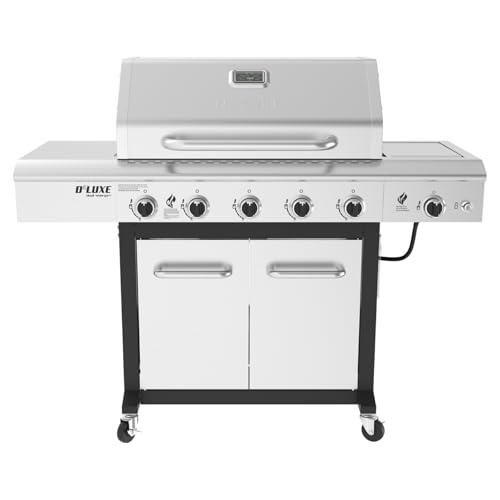
Nexgrill Deluxe 5-Burner Gas Grill with Ceramic Side Burner — Best Value Big Grill
Check the current price on Amazon
The Deluxe 5-Burner is the value entry in a guide of premium builds, included because its specification is honest for its tier: five burners with output the listing states plainly, a ceramic side burner — a genuinely useful, high-heat station for searing and woks — a side table and a built-in thermometer. Nexgrill’s grills are built to a price, and this one’s money visibly went to burners and format rather than trim.
Strengths
- Five-burner format and ceramic side burner are a lot of station for the tier
- Ceramic side burner reaches searing heat a standard side burner cannot
- Straightforward construction keeps assembly and basic service simple
Trade-offs
- Materials and finish are a class below the Weber picks — expect a shorter cosmetic life
- Parts support exists but is thinner; keep model numbers and receipts
- Value-tier burners are the first maintenance item — budget for eventual replacement
| Specification | Detail |
|---|---|
| Burners | 5, plus ceramic side burner |
| Output (listing) | 65000 BTU total |
| Extras | Built-in thermometer, side table |
The honest way to buy a value big grill is with eyes open: you are trading ultimate longevity for format and features now. Kept covered, with burners brushed and the grease tray managed, a grill like this serves well for years; neglected outdoors, its thinner materials will show it sooner than a Genesis would. The ceramic side burner, notably, is a feature the premium picks mostly reserve for higher models.
Pick the Nexgrill if the budget is real and the need — five burners, a serious side station, party capacity — is now. It earns its place as the value build, provided its owner plays the cover-and-care game that every grill in this guide quietly assumes.
The Nexgrill’s ceramic side burner is its sleeper feature: it reaches the fierce, focused heat that makes it a genuine wok and searing station, a capability the main box’s value pricing would never lead you to expect.
Nexgrill owners can extend the grill’s best years with one upgrade habit: when the first burner eventually tires, replace the set together and the grill’s heat pattern resets to new.
Best for: budget-conscious buyers who need a big, complete grill now / Not suited for: buyers expecting fifteen-year cosmetic perfection
Comparison Table
| Pick | Badge | Key spec | Best for |
|---|---|---|---|
| Weber Genesis E-415 Gas Grill, Propane | Best Overall | 4 PureBlu burners, cast-iron grates | households wanting a decade-grade four-burner grill with full parts support |
| Weber Genesis S-415 Gas Grill, Stainless Steel | Best Stainless Build | Stainless body and grates, 4 PureBlu burners | owners in coastal or humid climates planning a very long ownership |
| Weber Spirit E-435 Gas Grill, Propane | Best Built Mid-Size | 4 burners, sear zone boost, side burner | smaller households wanting Weber longevity without Genesis size or price |
| Char-Broil Pro Series Amplifire Infrared 4-Burner Gas Grill | Best Infrared Build | Amplifire infrared, 4 burners, cabinet | cooks plagued by flare-ups who value even, radiant heat |
| Monument Grills 77352 6+1 Burner Stainless Grill with Rotisserie | Best Large-Format Build | 6+1 burners, stainless cabinet, rotisserie kit | large households and entertainers who cook whole roasts and party batches |
| Nexgrill Deluxe 5-Burner Gas Grill with Ceramic Side Burner | Best Value Big Grill | 5 burners, ceramic side burner | budget-conscious buyers who need a big, complete grill now |
How to Choose a Well-Built Gas Grill
Start with the firebox and burners, because they are the grill. A deep, rigid firebox holds heat evenly and keeps the lid seating true; burners should be substantial, evenly ported, and — critically — replaceable, with parts you can actually buy. The PureBlu burners in the Weber picks and the Amplifire emitter system in the Char-Broil are two different, legitimate answers to the same problem: even, durable heat delivery over years.
Grates come next. Heavy matters: porcelain-enamelled cast iron (Genesis E-415, Spirit) sears hardest and lasts with basic care; stainless steel (S-415) trades a little searing mass for the easiest long-term maintenance and the best corrosion record. Thin porcelain-coated wire grates, by contrast, are a reliable sign of a grill built to a season rather than a decade.
Then count zones, not burners. Four burners that let you run sear, roast and hold zones simultaneously are worth more than six burners on a grill you fill twice a year. Match the format — Spirit for families, Genesis for regular crowds, Monument for events, Nexgrill for value format — to the cooking you demonstrably do.
Gas Grill Materials, Decoded: What Actually Survives Outdoors
Stainless steel is not one material but a family, and its grill use is about corrosion resistance: it is the right choice where salt air, humidity or uncovered storage attack everything else. It will discolour with heat — that is normal and cosmetic — and it still rewards an occasional clean, but structurally it is the longest-lived skin a grill can wear. Porcelain enamel over steel or cast iron is the other proven system: glass fused to metal, excellent while intact, and worth touching up if chipped to bare metal.
Burners live the hardest life in the grill: flame on one side, grease and moisture on the other, heated and cooled hundreds of times. Their enemies are clogging and corrosion, and the defences are design (protected, evenly ported tubes like the PureBlu pattern), material, and the owner’s brush. Plan on burners as a mid-life service item in any grill; the built ones make that service possible and affordable.
Frames and cabinets decide whether the grill still stands square in year eight. Flex at the frame becomes lids that do not seat, doors that do not close and casters that fail. When you see a grill in person, the push test — a firm shove on the lid handle — tells you more about its tenth year than any feature list.
Ownership Costs: The Part of ‘Built’ Nobody Puts on the Box
A well-built gas grill’s running costs are modest and predictable: a cover, a brush, an occasional igniter or burner set, and propane. A cheap grill’s costs are the same list, plus a replacement grill. That arithmetic is the whole argument of this guide, and it is why the premium picks concentrate where they do: they are bought once, serviced occasionally, and kept.
Protect the investment with three habits. Keep the grill covered when cool and dry. Brush burners and clear ports seasonally, and keep the grease tray emptied — grease management is both a safety and a corrosion issue. And store the model number and a photo of the rating label; when a part is needed in year seven, that photograph is the difference between a ten-minute order and a dead grill.
Budget tiers, stated qualitatively: the Spirit tier buys the repairable philosophy at family size; the Genesis tier adds frame, firebox and grate substance for heavier use; stainless adds environmental insurance; infrared adds a cooking system; and the value tier — Nexgrill — buys format now with a shorter cosmetic horizon. None of those is the wrong answer. The wrong answer is paying a premium tier for a grill with no parts channel, whatever its badge says.
Ignition, Valves and the Small Parts That Decide Year Eight
Ask a grill repairer what actually ends gas grills’ lives and the answer is rarely dramatic: it is igniters that stop clicking, valves that stiffen, regulator hoses that perish, and burners that rot — small parts, accumulating. This is why this guide weighs the parts channel so heavily. A grill whose igniter module, burner set and valve assembly can be ordered by model number, and fitted with a screwdriver, is a grill with no built-in expiry date. A grill without that channel is a countdown.
The premium picks here are designed around that service reality. Burner assemblies lift out; ignition is modular; grates are individual. The value pick, fairly, is a step behind — parts exist, but the ecosystem is thinner — and its review prices that in rather than hiding it. When you compare any two grills, asking ‘show me the burner for this model, for sale, today’ is the single most revealing question in the category.
Your side of the bargain is small: keep the model number, brush the burner ports before they clog rather than after, and exercise the valves occasionally in the off-season so nothing sits seized for a year. Gas grills die of neglect in the small parts far more often than of failure in the big ones.
Even Heat: What It Actually Takes, From Firebox to Grate
Advertised evenness is easy; engineered evenness is a system. It starts with burner design — ports sized and spaced so flame output is uniform along the tube, as the PureBlu pattern pursues — continues through the firebox, whose depth and shape distribute that heat instead of funnelling it, and ends at the grate, whose mass smooths the remaining variation before food ever feels it. Remove any layer and the hot spots return, whatever the brochure says.
Infrared takes the other road to the same destination: the Amplifire’s emitter plates intercept the burners’ output entirely and re-radiate it as a uniform field. It is genuinely even — and it moves the system’s maintenance to the plates, whose perforations must stay open. Neither approach is cheating; they are two honest engineering answers, and this guide includes both because different cooks will prefer different maintenance bargains.
The home test, once you own any of these, is the bread test: cover the grate with slices of white bread, run the grill at medium for a few minutes, and read the toast pattern like a map. Every grill has some pattern; the well-built ones have a gentle one, and knowing yours lets you place delicate food in the calm zones and searing work on the hot ones — turning even a small unevenness into a tool.
Propane Practicalities: Tanks, Regulators and Honest BTU Talk
BTU figures are the gas category’s favourite distraction. A grill’s total BTU is simply the sum of its burners’ maximum consumption; it says nothing about how evenly that heat is delivered, how well the firebox holds it, or how low the grill can run — and low control matters as much as high heat for real cooking. A well-built 4-burner with a deep box and heavy grates will out-cook a flimsy grill advertising twice the BTU, at every temperature, for fifteen years. Judge the system, not the sum.
The tank and regulator are part of the system too. A standard 20-pound propane tank is the fuel unit every pick here is built around; keeping a spare is the difference between a cookout and a story. Regulators and hoses perish in sunlight and time — inspect them seasonally, replace at cracking or stiffness, and treat a soapy-water leak check as part of spring setup. These are five-minute habits on the small-parts list that decides, as this guide keeps arguing, how long a gas grill lives.
Storage completes the practical picture: a grill stored covered, on a level surface, with its tank valve closed and its burners brushed, starts spring as the same grill that ended autumn. The premium picks reward that care with decade-plus service; even the value pick will double its cosmetic life under the same regime. Build quality and owner routine are, in the end, the same variable measured from two sides.
When to Repair, When to Replace: The Honest Threshold
A well-built grill earns repair almost indefinitely: burners, igniters, grates, valves and hoses are all service items, and replacing them costs a fraction of a new grill while restoring the old one’s performance. The threshold is the structure — a firebox that has rusted through or a frame that no longer stands square. Those are the grill’s skeleton, and when the skeleton goes, the honest answer is replacement, however good the parts channel is.
This is, once more, why construction dominates this guide’s judgements. Every pick here puts its money into the skeleton — firebox, frame, lid — precisely so that the replaceable parts remain the only things you ever replace. A cheap grill inverts the economics: its skeleton fails while its knobs still shine, and no burner set can save it. Buy the skeleton; maintain the rest.
How to Set Up, Season and Maintain a Gas Grill for a Long Life
On delivery, assemble on a level surface and take your time with the frame: a cabinet or cart built square keeps lids seating and doors closing for years, while a racked frame never quite recovers. Before the first cook, run the grill empty on high for fifteen minutes to burn off manufacturing residues, then season cast-iron grates with a thin coat of high-heat oil as they cool. Check every burner lights and burns with an even, mostly blue flame; a lazy yellow flame on day one is a setup issue to fix now, not a personality trait.
For everyday cooking, preheat with the lid down for ten to fifteen minutes — a well-built firebox rewards patience with an evenly hot grate — and cook in zones: a hot zone for searing, a medium zone for cooking through, burners off entirely under delicate or finished food. On the Amplifire, remember the emitters are the system: keep their perforations brushed clear and the evenness the design promises actually arrives.
Maintenance is short and seasonal. Brush grates after each cook while warm; empty the grease tray before it is full; once a season, brush burner ports clear, check ignition, and inspect for rust starting at the firebox and frame joints. Cover the grill when it is cool and dry — never trap a wet grill under a cover. Do those things and the grills in this guide measure their lives in decades of service rather than seasons.
Common Buying Mistakes
Buying burner count instead of build. Six cheap burners in a thin firebox lose to four good ones in a rigid box, every year of ownership.
Ignoring the parts channel. If you cannot buy a replacement burner or igniter for the model, its lifespan is set by its weakest part.
Never cleaning the grease tray. A full tray is a fire risk and a corrosion source. Empty it as routine, not as a project.
Leaving the grill uncovered in hard weather. Even stainless rewards a cover; painted and enamelled grills require one.
Judging stainless by showroom shine. Heat discolouration is normal and cosmetic. Judge stainless by corrosion resistance, not by whether it stays mirror-bright.
Skipping the preheat. A heavy, well-built grate needs its ten minutes. Impatience, not the grill, causes most sticking and weak sear marks.
Final Recommendation
If one grill answers this guide’s question for most people, it is the Weber Genesis E-415: substantial, even, repairable, and supported for the long term. Choose the S-415 for stainless permanence in hard climates, the Spirit E-435 for the same philosophy at family size, the Char-Broil Amplifire if flare-ups are your enemy, the Monument for party scale with rotisserie, and the Nexgrill when the budget is the honest deciding factor.
Whichever you buy, buy it as a ten-year object: check the parts channel, plan the cover, and do the small seasonal maintenance. That is how a gas grill earns the word ‘built’.
If the choice still feels difficult, simplify it to the question this guide opened with: which of these grills will still be cooking evenly in year eight, in your weather, at your frequency? Answer that honestly for your household and the ranking usually resolves itself — Genesis for the decade plan, Spirit for the family plan, stainless for the coastal plan, infrared for the flare-up plan, Monument for the crowd plan, Nexgrill for the budget plan.
Then protect the decision with the three habits: cover it, brush the burners, keep the model number. A gas grill’s life is written jointly by its maker and its owner, and the picks here are the ones whose makers have held up their half of that bargain for years.
Related guides in this series: Best Built Charcoal Grills Best Built Charcoal Grills And Smokers Best Gas Grills Best Stainless Steel Gas Grills Best 4 Burner Gas Grills
Frequently Asked Questions
What is the most important part of a gas grill’s build?
The firebox and burners together: a rigid, deep firebox that seats its lid and holds heat evenly, and burners that are substantial, evenly ported and replaceable. Grates come next — heavy cast iron or stainless — and then the frame. Features like side burners matter only after those foundations are right.
Are stainless steel grills worth the premium?
Where the grill lives decides. In coastal, humid or uncovered conditions, stainless construction’s corrosion resistance can add years of life and is worth its premium. On a sheltered patio, a porcelain-enamelled grill like the Genesis E-415 will age just as gracefully for less.
How long should a well-built gas grill last?
A decade or more of regular use is a fair expectation for the premium picks here, with burners, igniters or grates replaced along the way. That repairability is the point: the grill’s life is set by its frame and firebox, not by its first worn part.
Is infrared better than conventional burners?
Different, not simply better. Infrared emitters, as in the Char-Broil Amplifire, give very even heat and virtually no flare-ups, which suits chicken, fish and fatty foods beautifully. Conventional burners give the classic open-flame character many grillers prefer. The infrared system asks for its emitter plates to be kept clean in return.
Why do burners fail, and can they be replaced?
Burners live between flame, grease and weather, so ports clog and metal fatigues over years. On well-built grills they are a designed service item: replacements are available and fitting them is a basic job. A grill whose burners cannot be replaced has its whole life set by that one part.
How many burners do I actually need?
Enough to run zones: for most households, four burners allow a sear zone, a cooking zone and a holding zone at once, which covers nearly all real cooking. More burners help when you regularly fill a very large grate — party cooking — rather than improving everyday results.
Should I buy propane or natural gas?
The grills in this guide are propane models as verified. Natural gas suits a permanent installation with a gas line — no tanks, ever — while propane keeps the grill movable and independent. Conversion is model-specific and must use the maker’s kit; never improvise it. Choose by your patio’s permanence, not by the fuel’s cooking quality, which is effectively identical.
Does a well-built gas grill need a cover, really?
Yes — it is the cheapest longevity device in the category. A cover keeps rain out of the firebox, slows corrosion on every material including stainless, and keeps igniters dry and willing. The exception proves the rule: only a grill stored under a roof, in a dry climate, can reasonably skip it, and even there a cover costs little.
How often should gas grill burners be replaced?
There is no fixed interval — condition decides. Brush ports seasonally, and replace a burner when its flame is persistently uneven, its ports will not clear, or the metal is visibly thinning or splitting. On the premium picks here, that moment typically arrives after many seasons of regular use, and the replacement restores the grill’s original heat pattern.


