Disclosure: airfryerkitchensupply.com is reader-supported. When you buy through links on our site, we may earn an affiliate commission at no extra cost to you.
Where to buy
Every linked pick in this guide to the best boat gas grills was confirmed against Amazon’s catalogue data for this site in fresh catalogue searches run for this guide on 2026-11-21. Marine gas grills run on propane canisters or a boat’s LPG system through manufacturer regulators, and their mounts are usually separate purchases — use the links below to check the current price on Amazon for the exact grill, and plan its mount and fuel hardware in the same decision, rather than relying on any figure printed elsewhere.
- Magma Catalina Infrared Gas Boat Grill, 12 x 18 Inch — Check on Amazon
- Magma Marine Kettle Gas Boat Grill, Original Size 15-Inch — Check on Amazon
- Kuuma 316 Elite Gas Grill — Check on Amazon
- Kuuma Stow N’ Go 160 Gas Grill with Regulator, Thermometer and Igniter — Check on Amazon
- Magma Marine Kettle3 Combo Stove and Gas Grill, Party Size 17-Inch — Check on Amazon
- Halbtrocken Stainless Steel Marine Gas Grill with Rod Holder Mount and Cover — Check on Amazon
Gas is not merely the popular fuel for boat grills; it is effectively the only fuel the marine world endorses, and understanding why shapes the whole purchase. Aboard a boat, cooking happens metres from fuel tanks, canvas, and the people you love, in a space that moves and a breeze that shifts. Propane grills light instantly, extinguish completely the moment the valve closes, produce no embers or ash to dispose of at sea, and — in the marine-grade stainless designs ranked here — are built to be mounted securely and used attended at anchor. Charcoal aboard fails every one of those tests, which is why this guide’s companion piece on boat BBQ grills reaches the same conclusion from the other direction. Within gas, the decisions are about heat style (conventional burner versus infrared), size, ignition and thermometers, and how the grill integrates with your boat’s propane arrangements. This guide ranks the six best boat gas grills verified for this site and treats the gas system itself — canisters, regulators, storage, leak discipline — as part of the product.
The two specialist houses, Magma and Kuuma, anchor the list, joined by one challenger whose proposition is bundling: a stainless marine grill sold with its rod-holder mount and cover in the box. Between them they cover the kettle traditionalists, the rectangular organisers, the infrared searing enthusiasts, and the fishing boats that want a grill living in a rod holder. Read the gas-system section before choosing, because on a boat the grill is the visible third of the purchase.
In this guide
Quick Picks
Short on time? These are the six best boat gas grills, each matched to the job it does best. Full reviews below carry the trade-offs and ownership details.
- Magma Catalina Infrared, 12 x 18 — Best Infrared Boat Grill: infrared propane cooking for even, high-heat results in marine-grade stainless. Check on Amazon
- Magma Marine Kettle, Original Size 15-Inch — Best Overall Gas Kettle: the classic 15-inch marine kettle with even heating for boats, pontoons and RVs. Check on Amazon
- Kuuma 316 Elite — Best High-Capacity Gas: Kuuma’s Elite flagship format for bigger boats and crews. Check on Amazon
- Kuuma Stow N’ Go 160 — Best Equipped Compact: 13,000 BTU with regulator, thermometer and igniter in the box. Check on Amazon
- Magma Marine Kettle3 Combo — Best Stove-Grill Combo: a dual-purpose propane stove and grill in Party Size 17-inch, in marine-grade stainless. Check on Amazon
- Halbtrocken Marine Gas Grill — Best Rod-Holder Ready: 12,000 BTU, 304 stainless steel, 200 sq. in., with rod holder mount and cover included. Check on Amazon
How These Picks Were Chosen
Four tests shaped the list. First, genuine marine gas design: marine-grade stainless construction and propane systems designed for boats, not camping grills photographed near water. Second, gas-system completeness: ignition quality, thermometer provision, and regulator compatibility with the manufacturer’s own parts — Magma’s genuine Type 1 low-output regulator for its kettles and rectangular grills surfaced in the same verification work and is referenced in this guide as the correct adaptation path. Third, heat style spread: conventional and infrared models are both represented, with their real differences explained rather than marketed. Fourth, mounting reality: rail, pedestal and rod-holder routes all appear, because a boat gas grill’s mount is its foundation. Land-only gas portables and charcoal models were excluded for the marine-safety reasons stated in the introduction.
The 6 Best Boat Gas Grills

Magma Catalina Infrared Gas Boat Grill, 12 x 18 Inch — Best Infrared Boat Grill
The Catalina Infrared brings the infrared burner concept to the water: instead of a flame heating the grate directly, the infrared system radiates intense, even heat across the 12″ x 18″ surface, which in marine conditions buys two things boat cooks value — strong searing despite the anchorage breeze stealing convective heat, and evenness across a rectangular grate where corners usually lag. It is built in marine-grade stainless steel for boats, RVs and tailgating. It suits cooks who sear seriously aboard — steaks, tuna, chops — and boats with the rail or pedestal station to give it a home. It does not suit minimalists who want the simplest possible burner to maintain, because infrared systems reward keeping their emitter surfaces clean.
Strengths
- Infrared propane heat for even, high-heat cooking aboard
- 12″ x 18″ rectangular format suits fillets and rows
- Marine-grade stainless steel construction
Trade-offs
- Infrared emitter needs regular cleaning to stay even
- Mount is a separate purchase in the Magma system
- High-heat focus is wasted on cooks who only warm and toast
| Mini spec box — verified from catalogue title | |
|---|---|
| Size | 12″ x 18″ |
| System | Infrared gas boat grill |
| Fuel | Propane |
| Construction | Marine grade stainless steel |
| Model | A10-1218-2GS |
Infrared’s marine case deserves one more paragraph, because it is about wind as much as searing. A conventional burner heats air, and moving air carries that heat away; an infrared emitter heats the food and grate by radiation, which the breeze cannot blow off course. In the real anchorage — grill on the stern rail, evening breeze building — that physics is the difference between a steak that sears and a steak that stews in its own patience. The discipline in return is cleanliness: drippings baked onto an infrared surface create the very unevenness the system exists to prevent, so brush it, keep the drip management clear, and the Catalina Infrared will cook like the flagship of Magma’s rectangular line that it is.
Check the current price on Amazon, and confirm the -2GS infrared model code on the listing, since the Catalina family also includes the Classic version ranked in this programme’s boat BBQ guide.
Best for: searing-focused boat cooks wanting infrared evenness in a breeze. / Not suited for: low-maintenance minimalists or kettle loyalists. Check on Amazon

Magma Marine Kettle Gas Boat Grill, Original Size 15-Inch — Best Overall Gas Kettle
The Original Size 15-inch Marine Kettle is the default boat gas grill — the one against which the category is measured. Its domed kettle design heats evenly, behaves in wind, latches for travel, and mounts on the rail systems that define the Magma ecosystem, in marine-grade stainless steel sized for boats, pontoons and RVs. Fifteen inches is the couple-and-small-crew class: a whole chicken in the round, burgers for four to five, fish for the cockpit table, all from a grill that stows and handles like the compact it is. It suits the widest range of boats in this guide. It does not suit raft-up hosts, who should take the 17-inch Party Size from the companion guide, or rectangular-format cooks.
Strengths
- The proven marine kettle format with even heating
- 15-inch size balances capacity, stowage and handling
- Marine-grade stainless steel with the full Magma mount ecosystem
Trade-offs
- Round grate limits long, straight items
- Mount and any LPG adaptation parts are separate purchases
- Crews above five will cook in batches
| Mini spec box — verified from catalogue title | |
|---|---|
| Size | Original Size, 15-inch |
| Fuel | Propane gas |
| Construction | Marine-grade stainless steel |
| Use | Boats, pontoons and RVs |
| Model | A10-205 |
What the Original kettle offers that no specification captures is maturity: decades of production mean the mounts fit, the regulators match (Magma’s genuine Type 1 low-output regulator serves this kettle family), the covers exist, and every failure mode has been found and engineered out by someone else’s season before yours. For a gas system on a boat — where a regulator mismatch or a mount that almost fits is a safety matter, not an annoyance — that maturity is the product. Buy the kettle, its correct rail mount for your measured rail diameter, and a spare canister, and you own the complete, classic boat grilling system in one order.
Check the current price on Amazon; the Original kettle is the range’s anchor, and its live price is the benchmark the larger and infrared models must argue against.
Best for: most boats wanting the classic, proven marine gas kettle. / Not suited for: crowd cooking or rectangular-format menus. Check on Amazon
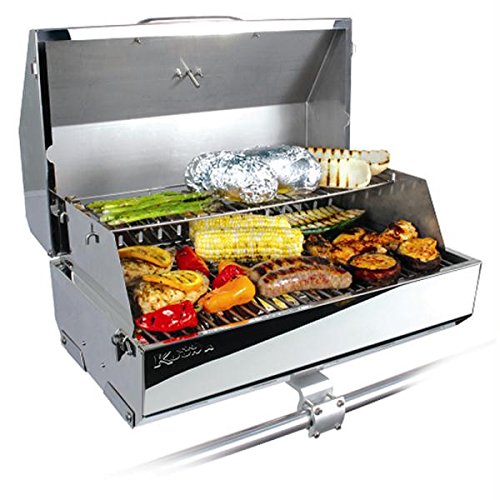
Kuuma 316 Elite Gas Grill — Best High-Capacity Gas
Kuuma’s 316 Elite is the big-gas answer in the stowable-box format: the Elite line’s flagship, sized for larger boats and crews, with the rectangular layout that organises serious onboard cooking into rows and zones. Where Magma’s big answer is a kettle, Kuuma’s is a box — and the box has its own logic: flat stowage, a lid that behaves like furniture, and a grate that takes fillets, skewers and pans in the geometry galleys think in. It suits larger cruisers, centre-consoles with a grill station, and owners who also deploy the grill dockside. It does not suit small boats, where its footprint is a commitment their lockers cannot honour.
Strengths
- Elite-line capacity for bigger crews and boats
- Rectangular format organises full-meal cooking
- Stowable box design doubles dockside and aboard
Trade-offs
- Largest storage and mounting commitment in this guide
- Rectangular lids need breeze discipline at anchor
- Mount hardware is a separate purchase
| Mini spec box — verified from catalogue title | |
|---|---|
| Line | 316 Elite gas grill |
| Fuel | Gas (propane) |
| Format | Rectangular marine grill |
Capacity aboard is a system property, not a grate measurement: the 316 Elite earns its badge because its size arrives with the Kuuma ecosystem of mounts and the box format that protects the grill between uses. Crews who cook full dinners aboard — protein, vegetables and a pan of something warming, simultaneously — will feel the difference in every service. Plan its home before purchase: the pedestal corner or the locker it will actually occupy, measured. A big marine grill with a planned home is a galley; without one, it is cargo.
Check the current price on Amazon, noting that Kuuma lists the 316 Elite in more than one catalogue entry — the linked ASIN is the verified pick for this guide.
Best for: larger boats and crews wanting maximum rectangular gas capacity. / Not suited for: small boats or minimal stowage. Check on Amazon

Kuuma Stow N’ Go 160 Gas Grill — Best Equipped Compact
The Stow N’ Go 160 is the compact for buyers who read feature lists: 13,000 BTU of output with the regulator, thermometer and igniter all part of the verified package — the three gas-system items that compact-grill owners otherwise hunt separately. The thermometer in particular elevates a small marine grill from guesswork to cooking, and a proper igniter in an anchorage breeze is worth more than any grate upgrade. It suits small-to-midsize boats, careful owners who value a complete kit, and campers who share the grill ashore. It does not suit crews above four to five without batching.
Strengths
- Regulator, thermometer and igniter included in the package
- 13,000 BTU output honestly matched to its size
- Stow N’ Go format folds into real locker spaces
Trade-offs
- Compact capacity — batch cooking for larger crews
- More components to rinse and maintain in salt air
- Mount remains a separate, boat-specific purchase
| Mini spec box — verified from catalogue title | |
|---|---|
| Output | 13,000 BTU |
| Included | Regulator, thermometer and igniter |
| Line | Stow N’ Go 160 gas grill |
The 160’s completeness is its argument against its own sibling, the classic Stow and Go in the companion guide: that grill is the simpler, cheaper classic, while the 160 arrives with the gas hardware and instrumentation that make a compact grill a precision tool. On the water, where a thermometer reading replaces the land cook’s sixth sense (the wind lies to your hand), that instrumentation changes results measurably. Keep the igniter dry, the thermometer lens clean, and the regulator connection leak-checked at every setup, and the 160 runs like the equipped little system it is.
Check the current price on Amazon and compare it with the classic Stow and Go’s live price — the gap is the price of the included hardware, and for most owners it is worth paying once.
Best for: compact-boat owners wanting a complete, instrumented gas kit. / Not suited for: larger crews or absolute minimalists. Check on Amazon

Magma Marine Kettle3 Combo Stove and Gas Grill, Party Size 17-Inch — Best Stove-Grill Combo
The Kettle3 Combo answers a different onboard question: what if the grill could also be the stove? This dual-purpose propane unit works as both a stove and a grill in the Party Size 17-inch format, in marine-grade stainless steel, for boats, camp and RVs. Aboard small boats without a proper galley — or as the cockpit’s outdoor second burner beside one — the combo earns its rail space twice: morning coffee and a pan breakfast on the stove function, evening burgers on the grill. It suits small cruisers, camper-boats and minimalist galleys. It does not suit cooks who want a dedicated grill’s full grate with nothing shared.
Strengths
- Dual-purpose stove and grill in one marine unit
- Party Size 17-inch format for crew-size batches
- Marine-grade stainless steel construction
Trade-offs
- Combo design shares its surface between two jobs
- Round kettle format limits straight, long items
- Mount is separate, as across the Magma range
| Mini spec box — verified from catalogue title | |
|---|---|
| Size | Party Size, 17-inch |
| Function | Combo stove and gas grill, dual purpose |
| Fuel | Propane |
| Construction | Marine grade stainless steel |
| Model | A10-217-3 |
The combo’s real value emerges on boats where every mounted item must justify itself against the rail it occupies. A pure grill on a small cruiser is a single-purpose guest; the Kettle3 is crew. Kettle mornings — a pot for coffee, a pan for eggs, both over the same burner family that will grill the evening’s fish — simplify provisioning, gas logistics and stowage in one stroke. Judge it as the small-boat galley appliance it is, and its Party Size capacity is a bonus; judge it as a pure grill against the dedicated kettles, and the shared surface is the compromise you accept for the second job.
Check the current price on Amazon, and plan the mount and canister supply with the purchase — combo units get used more, and use consumes propane.
Best for: small boats wanting one mounted unit that grills and works as a stove. / Not suited for: dedicated-grill purists or rectangular menus. Check on Amazon

Halbtrocken Stainless Steel Marine Gas Grill with Rod Holder Mount — Best Rod-Holder Ready
The Halbtrocken is the challenger with a bundle for an argument: a marine gas grill in thickened 304 stainless steel, 12,000 BTU, 200 sq. in. of cooking area sized for four to five people, sold with its rod holder mount and a cover in the box, and promising a three-minute setup. For fishing boats, that proposition is precisely aimed — the grill lives in a rod holder like the rest of the boat’s working gear, deploys in minutes, and the two purchases every other pick in this guide leaves separate (mount, cover) are simply included. It suits anglers, fishing-centre-consoles and buyers who want the complete kit in one order. It does not suit buyers who prioritise the decades-deep parts ecosystems of the two established marine houses.
Strengths
- Rod holder mount and cover included in the box
- 304 stainless steel construction, 200 sq. in. cooking area
- 12,000 BTU with fast, even heating brief and quick setup
Trade-offs
- Newer brand without Magma/Kuuma’s parts depth
- Rod-holder mounting suits fishing layouts, not every stern
- Confirm holder compatibility with your boat’s rod holders
| Mini spec box — verified from catalogue title | |
|---|---|
| Output | 12,000 BTU |
| Construction | 304 stainless steel |
| Cooking area | 200 sq. in. cooking area |
| Capacity | For 4-5 people |
| Included | Rod holder mount and cover |
The rod-holder concept deserves respect rather than novelty status: on a fishing boat, rod holders are the one mounting infrastructure that certainly exists, is certainly strong, and sits exactly where a grill wants to be — at the stern, outboard-facing, clear of the cockpit’s work. A grill engineered for that socket, in proper 304 stainless, with its cover included for the ride home, is a coherent product rather than a bundle of parts. The honest caveat is ecosystem: when a valve or igniter eventually needs replacing, the established houses answer from a catalogue, and a challenger brand’s support is a question to weigh at purchase. For anglers whose alternative is no grill at all, the trade is easy to accept.
Check the current price on Amazon, and verify your rod holders’ fit against the listing’s mount description before ordering.
Best for: fishing boats wanting a complete rod-holder grill kit in one purchase. / Not suited for: buyers prioritising long-established marine parts support. Check on Amazon
Comparison Table
| Pick | Badge | Key spec | Best for |
|---|---|---|---|
| Magma Catalina Infrared | Best Infrared | 12×18 infrared, marine stainless | Searing in a breeze |
| Magma Marine Kettle 15″ | Best Gas Kettle | 15-inch kettle, even heating | Most boats, classic system |
| Kuuma 316 Elite | Best Capacity | Elite line, rectangular | Big boats, full meals |
| Kuuma Stow N’ Go 160 | Best Equipped Compact | 13,000 BTU, regulator + thermometer | Complete compact kit |
| Magma Kettle3 Combo | Best Combo | 17-inch stove + grill | Small-boat galleys |
| Halbtrocken Marine Grill | Best Rod-Holder Kit | 12,000 BTU, mount + cover included | Fishing boats |
How to Choose a Boat Gas Grill
Begin with heat style. Conventional burners are simple, tolerant and easy to maintain; infrared — the Catalina’s system — sears harder and resists the breeze’s theft of heat, at the price of emitter cleanliness. Most boat cooks are best served by conventional heat and a lidded design; searing devotees and breezy cruising grounds argue for infrared. Next, size by crew and stowage together: a grill that fits your crew but not your locker will be left ashore, which is the most expensive outcome of all. Then decide the gas architecture: canister-only simplicity for occasional use, or a manufacturer-regulator adaptation to the boat’s LPG system for liveaboards and heavy users — using only the grill maker’s genuine regulator parts, as with Magma’s Type 1 low-output regulator for its kettle and rectangular families.
Mounting is the fourth decision and the one to make with a tape measure in hand: rail diameter for kettle clamps, pedestal position for rectangular stations, rod-holder fit for the fishing-boat route. Finally, count the complete kit before comparing prices — grill, mount, cover, spare canisters, and any regulator adaptation — because headline grill prices in this category exclude the system every boat actually needs. The cheapest complete system is frequently not the cheapest grill, and the comparison table above is organised to help you see each pick as the system it implies.
The Boat Gas System: Canisters, Regulators and Leak Discipline
Propane is heavier than air, and that single fact organises all marine gas safety: leaked propane sinks and pools in bilges rather than dispersing, so storage, connections and vigilance are designed around it. Canisters live in a vented locker that drains overboard, never in the cabin or an unvented lazarette. Every setup follows the same liturgy: inspect the regulator and hose for cracking or corrosion, connect firmly, open the valve, and leak-test every joint with soapy water — bubbles are a stop order, not a note for later. Light with the lid open, confirm ignition visually, and never leave a lit grill unattended; at the end, close the valve at the canister first and let the burner consume the line’s remainder before closing the grill’s control.
For boats with plumbed LPG systems, adapting a grill through the manufacturer’s own regulator — the genuine-parts route — keeps pressures correct for the grill’s valves; improvised fittings and hardware-store regulators are how marine gas gets its rare but serious accidents. Carry a spare canister on any trip where dinner depends on the grill, store spares with the same vented discipline, and treat any smell of gas aboard as an emergency drill, not a nuisance: valves closed, no switches touched, ventilation opened, source found before any flame is lit again. None of this is burdensome — it is thirty seconds of habit wrapped around each cook — and it is the entire difference between propane as the marine standard and propane as a hazard. The grills in this guide were designed inside that discipline; use them inside it too.
How to Set Up and Cook With a Boat Gas Grill at Anchor
Setup begins before ignition: mount locked and load-tested with a firm hand, grill level and outboard-facing, fuel connected and leak-checked, a clear zone established where no line, towel or guest’s arm crosses the grill’s space. Preheat with the lid closed for a shorter time than a patio grill needs — marine grills are compact and come to temperature quickly — and cook lid-down wherever the food allows, because the lid is your windbreak, your heat bank and your flare-up suppressor in one piece of stainless. Keep a spray-free zone around fuel vents and fills, and assign one person to the grill for the whole service; on a boat, the cook does not also dock, swim-supervise or mix drinks.
Cooking technique at anchor favours the decisive: foods that grill in minutes, marinades that do not drip fire, and a mise en place staged in containers that cannot slide. Fish — the anchorage’s natural menu — wants a hot, oiled grate, a confident lay-down and a single turn; burgers want the lid’s patience; vegetables want a grill basket or foil packet rather than a game of chase-the-asparagus across a moving grate. When service ends, burners off, canister valve closed, grill cooled completely before cover or stowage, and the mount’s fasteners checked with the same hand that will thank itself next weekend. Run that routine and a boat gas grill becomes what it should be: the most reliable appliance on the vessel, and the centre of its best evenings.
Conventional vs Infrared Heat on the Water
The heat-style choice deserves one direct comparison, because it is the decision buyers most often make on marketing rather than physics. A conventional marine burner heats the grate and the air above it; the food cooks in that hot air and by contact. It is simple, forgiving, tolerant of imperfect cleaning, and — with the lid down — entirely adequate for the anchorage repertoire of fish, burgers, chicken and vegetables. Its weakness is exposure: moving air is its cooking medium, so a building breeze taxes it, and its searing ceiling is set by how much hot air a compact burner can sustain against the weather.
An infrared system replaces the hot-air middleman with a radiant surface that glows and throws its energy directly at the food. Wind cannot intercept radiation, recovery after the lid opens is fast, and searing temperatures arrive with an authority conventional marine burners do not match. The costs are a narrower gentle range — infrared wants to be hot — and the cleanliness discipline already described. The honest summary: conventional is the better all-rounder and the better first boat grill; infrared is the specialist upgrade for cooks whose menu is built on seared proteins and whose anchorages are breezy. Both appear in this guide’s picks because both answers are right — for different skippers.
Winterising and Long-Term Care of a Marine Gas Grill
A marine gas grill’s enemies are salt, moisture and neglect, in that order, and the care routine answers each in turn. In season: rinse or wipe the exterior with fresh water after salt-air weekends, brush the grate hot, empty and wash the drip management before residue varnishes, and dry the grill before any cover goes on — a cover over a wet grill is a corrosion chamber with good intentions. Check the igniter after wet trips; it is the component salt air reaches first, and a dried, clean igniter is the difference between push-button confidence and a lighter held into the wind.
At season’s end, remove the grill from the boat if your programme allows, wash it completely, inspect the burner and regulator hose, operate every control once, and store it dry ashore with the canister removed and stored separately under the same vented discipline. Recommission in spring with the full leak-test liturgy and a fastener check across grill and mount. Owners who keep that rhythm report the marine grill outlasting electronics, canvas and sometimes engines — stainless and simplicity are a longevity strategy, and the two houses that dominate this guide have been refining exactly that strategy for decades. The challenger in this list will be judged by the same standard over time; its 304 construction and included cover suggest it intends to be.
Choosing Between the Magma and Kuuma Systems
Because five of the six picks come from two houses, the brand-level decision deserves a direct treatment. Magma’s system is the deeper catalogue: kettles in two sizes, rectangular classics and infrareds, a stove-grill combo, and the genuine-parts shelf — regulators, mounts, covers — that long-term ownership eventually shops from. Its centre of gravity is the mounted, permanent installation, perfected over decades. Kuuma’s system is the stowable philosophy: rectangular boxes that fold, stow and circulate between boat, dock and campsite, with the Elite line scaling the idea up and the equipped compacts (thermometer, igniter, regulator in the box) scaling it in sophistication. Its centre of gravity is the grill as versatile gear rather than fixed station.
Neither philosophy is superior; they fit different boating lives. The boat with a dedicated stern station and a ten-year horizon buys Magma and never thinks again. The boat whose gear circulates — dinghy to beach, boat to dock, locker to cockpit table — buys Kuuma and enjoys the circulation. The Halbtrocken exists for the third life, the fishing boat, where the rod holder is the station. Identify your boating life honestly and the shortlist in this guide collapses to one or two names, which is what a buying guide is for.
One further variable separates satisfied owners from the rest, and it is neither brand nor burner: it is whether the grill was ever properly introduced to the boat. The good pattern is a dockside commissioning — mount fitted and load-tested, gas connected and leak-checked in daylight, first lighting done with the manual open, hot spots learned on a sacrificial round of sausages — before the grill is ever asked to perform at anchor with guests aboard and the light going. Boats are unforgiving places to debug equipment, and the half hour at the dock is the cheapest insurance in this entire guide. Every pick here rewards that introduction identically: a system that works the first evening, and therefore gets used every evening after.
Common Buying Mistakes
The first mistake is buying the grill and forgetting the system — mount, cover, canisters, regulator — then discovering the true price at the dock. The second is adapting a grill to a boat’s LPG supply with improvised fittings instead of the manufacturer’s genuine regulator parts. The third is storing propane canisters below deck or in unvented lockers. The fourth is choosing by grate size alone while ignoring ignition and thermometers, the two features that decide whether a small marine grill cooks precisely in a breeze.
Fifth, buyers assume any stainless is marine stainless; the picks here state marine-grade or 304 construction in their verified titles, and land-grade steel in salt air is a one-season purchase. Sixth, they skip the leak check as a ritual because it is quick — it is quick, and it is the ritual that matters. Seventh, they mount where the grill fits rather than where heat and drips fall safely outboard. And eighth, they buy infrared for its headline without accepting its one demand — a clean emitter — then blame the technology for the maintenance they skipped.
Final Recommendation
For most boats, the Magma Marine Kettle Original 15-Inch is the boat gas grill to buy: the proven system, the mature mount and regulator ecosystem, and the size most crews actually need. Searing-focused cooks should step to the Catalina Infrared; big boats to the Kuuma 316 Elite; compact-boat owners to the fully equipped Stow N’ Go 160; small-boat galleys to the Kettle3 Combo; and fishing boats to the Halbtrocken’s complete rod-holder kit. Whichever you choose, buy the whole system in one decision — grill, mount, cover, fuel hardware — leak-check it like a seaman, and it will feed your crew for seasons.
More from the grill cluster: Best Boat Bbq Grills · Best Marine Grills · Best Portable Gas Grills · Best Infrared Grills · Best Grills
A closing observation from the way experienced cruising couples actually equip their boats: the grill is rarely the purchase that disappoints — the afterthoughts are. The mount bought a size off, the cover never ordered, the spare canister forgotten in a garage, the regulator adaptation improvised instead of specified. Every one of those failures is prevented by treating this purchase the way this guide has framed it throughout: as a small, complete system, bought in one decision, installed with a tape measure and a leak test, and maintained with a rinse and a rhythm. Do that, and any of the six grills above will be remembered not as equipment but as evenings — which is the only metric the anchorage has ever used.
And if the choice still feels close between the kettle and rectangular finalists, settle it with your menu book rather than your imagination. List the last ten meals you cooked or wished you had cooked aboard. If the list runs to whole chickens, roasts and pan breakfasts, the kettle’s dome is your shape. If it runs to fillets, skewers, asparagus in rows and burgers in formation, the rectangle is. If it runs to both in equal measure, the boat is telling you it wants the larger station and the storage commitment that comes with it — and on a boat, as at sea generally, it is wise to listen to what the vessel is telling you.
Budget, finally, like a boat owner: in total cost of seasons, not in the price of the first box. A marine gas grill bought once, in genuine marine stainless, with its correct mount and a cover, is cheaper across five seasons than a land grill replaced twice and a mount improvised once. The sea taxes improvisation and rewards specification — which is, in one sentence, the complete argument for every pick in this guide and for the way this guide has asked you to buy.
Frequently Asked Questions
Why do boat grills use propane instead of charcoal?
Propane lights instantly, extinguishes completely at the valve, and produces no embers, ash or sustained carbon-monoxide source — the properties that matter metres from fuel tanks and canvas. Charcoal fails each of those tests aboard, which is why marinas commonly restrict it and why every pick in this guide is gas.
Can I connect a boat grill to my boat’s LPG system?
Often, yes — through the grill manufacturer’s own regulator designed for that adaptation, such as Magma’s genuine Type 1 low-output regulator for its kettle and rectangular grill families. Use only the maker’s parts, have the work checked by a qualified marine gas technician, and leak-test every joint. Never improvise gas fittings aboard.
Where should I store propane canisters on a boat?
In a locker that is vented and drains overboard, isolated from living spaces and ignition sources — never below deck in the cabin or in an unvented compartment. Propane is heavier than air and pools where it leaks, so storage geometry is a safety system, not a tidiness preference. Carry a spare, stored with the same discipline.
Is infrared worth it on a boat grill?
For searing-focused cooks and breezy cruising grounds, yes: infrared heats by radiation, which wind cannot strip the way it strips convective heat, and it produces the strongest sear in the marine category. The cost is discipline — the emitter must be kept clean to stay even. Gentle cooks who mostly warm, toast and grill fish gently can save the premium and buy conventional.
How do I leak-test a boat grill?
With the connections made and the valve open (burner controls off), brush soapy water over every joint and watch for bubbles. Any bubbling means gas is escaping: close the valve, remake or repair the connection, and test again before lighting. Make it a ritual at every setup — it takes thirty seconds and it is the core habit of safe marine gas use.
What size boat gas grill do I need?
Count the crew you anchor with. Two to four: the compact class (Stow N’ Go 160, Cabo-class rectangles, the 15-inch kettle). Five to eight: the 17-inch Party Size formats or the Catalina class. Regular raft-up hosting: the Kuuma 316 Elite. Then confirm the chosen grill fits your locker and your mount position — aboard, storage is half the size decision.
How long does a small propane canister last on a boat grill?
Long enough that planning, not capacity, is the issue: a canister covers several typical anchorage cooks, but consumption varies with wind, temperature and how much searing you do. The professional habit is simple — start every trip with a fresh canister on the grill and a sealed spare in the vented locker, and retire partial canisters to shore duty rather than gambling a dinner on one.
Can I use a boat gas grill on the dock or at home?
Yes — most models here double as tabletop grills ashore, which is part of their value: the same grill serves the boat at anchor, the dock box party and the campsite. Use it on a stable, heat-safe surface away from combustibles, with the same leak-check habit, and never use a marine grill indoors or in an enclosed space.
Which is better for a first boat grill: kettle or rectangular?
For a first installation, the kettle is the more forgiving teacher — it handles wind and motion best, mounts simply, and its dome covers the widest menu of forgiving foods. Rectangular grills reward owners who already know their menu runs to fillets and rows. Either is a sound first grill when it is properly mounted; the mistakes that matter are in mounting and gas discipline, not in shape.
Do boat gas grills work in the rain?
Light rain, yes — these are outdoor marine appliances, and a lidded grill at anchor does not stop for a shower. Heavy weather is a seamanship question rather than a grilling one: secure the boat first, keep gas connections and igniters as dry as conditions allow, dry the grill thoroughly afterwards, and never let concern for a dinner schedule outrank the vessel’s safety.
What should I check before the first trip of the season?
The whole system, in dockside daylight: mount fasteners torqued and gripping, regulator and hose sound, every joint leak-tested, igniter firing, burner burning evenly, canister fresh and spare aboard. Fifteen minutes in spring prevents the entire catalogue of first-anchor failures.

