Disclosure: airfryerkitchensupply.com is reader-supported. When you buy through links on our site, we may earn an affiliate commission at no extra cost to you.
Where to buy
Every linked pick in this guide to the best boat bbq grills was confirmed against Amazon’s catalogue data for this site in fresh catalogue searches run for this guide on 2026-11-21. Marine grills are specialist items whose mounts are usually sold separately, so use the links below to check the current price on Amazon for the exact grill — and budget its mount in the same decision — rather than relying on any figure printed elsewhere.
- Magma Marine Kettle Gas Boat Grill, Party Size 17-Inch — Check on Amazon
- Magma Catalina II Classic Gourmet Series Gas Grill — Check on Amazon
- Kuuma 316 Elite Gas Grill, 316 Sq. In. Cooking Area — Check on Amazon
- Camco Kuuma Stow N’ Go 216 Elite Propane Grill — Check on Amazon
- Magma Cabo Portable Gas Grill, 9 x 18 Inch — Check on Amazon
- Kuuma Stow and Go Propane Tabletop and Mountable Grill — Check on Amazon
The best boat bbq grills are not small versions of patio grills, and treating them as such is how boats end up with rusted, rattling regrets. A marine grill lives in salt air, cooks in a moving anchorage, mounts to a rail or pedestal rather than standing on a deck, runs on small propane canisters or a boat’s LPG system, and must be safe in an environment where fuel, canvas and people share close quarters. Two specialist makers dominate this world — Magma, with its kettle and rectangular gourmet lines, and Kuuma, with its Stow N’ Go and Elite series — and this guide ranks the six verified models worth buying across both, from the party-size kettle that has fed raft-ups for decades to the compact rectangular grills that stow in a locker. Mounts are a separate purchase on most models, and this guide treats the mount as part of the grill decision, because on a boat, it is.
Safety framing, stated once and plainly: grilling aboard is a privilege governed by your marina’s rules, your insurer’s terms and your own seamanship. Use only grills designed for marine use, mount them securely overboard-facing where drips and heat cannot reach decks, canvas or fuel vents, never leave a lit grill unattended, and never grill in an enclosed space or near refuelling. Every pick here is a gas grill — the marine standard — because open charcoal aboard carries fire and carbon-monoxide risks that most marinas and experienced skippers reject outright.
In this guide
Quick Picks
Short on time? These are the six best boat bbq grills, each matched to the job it does best. Full reviews below carry the trade-offs and ownership details.
- Magma Marine Kettle, Party Size 17-Inch — Best Overall Boat BBQ: the classic round marine kettle in its larger party size, in marine-grade stainless steel. Check on Amazon
- Magma Catalina II Classic Gourmet Series — Best Rectangular Grill: Magma’s gourmet rectangular format for boats, RVs and serious onboard cooking. Check on Amazon
- Kuuma 316 Elite — Best Large Boat Grill: 316 sq. in. of cooking area in Kuuma’s Elite line for bigger boats and crews. Check on Amazon
- Kuuma Stow N’ Go 216 Elite — Best Featured Compact: built-in thermometer, push-button igniter, fold-away legs and a removable warming rack. Check on Amazon
- Magma Cabo 9 x 18 — Best Compact Rectangular: a 9″ x 18″ propane BBQ with tabletop legs in marine-grade stainless for boats and RVs. Check on Amazon
- Kuuma Stow and Go — Best Classic Mountable: the 13,000 BTU stainless tabletop-and-mountable original for camping and boating. Check on Amazon
How These Picks Were Chosen
The shortlist applied four marine-specific tests. First, genuine marine construction: marine-grade stainless steel stated in the verified title, because plated or painted patio steel dies in a season of salt air. Second, mount ecosystem: a boat grill is only as good as its rail, pedestal or rod-holder mount, so models from the two makers with deep, verified mount ranges were favoured. Third, size honesty across the real boat range — compact rectangular grills for small cockpits, kettles and the big Kuuma for raft-up duty. Fourth, onboard practicality: canister propane operation, lids that behave in a breeze, and stowage footprints that fit lockers. Charcoal boat grills and land-only portables that appeared in searches were excluded from the linked picks on the safety and construction grounds stated in the introduction.
The 6 Best Boat BBQ Grills
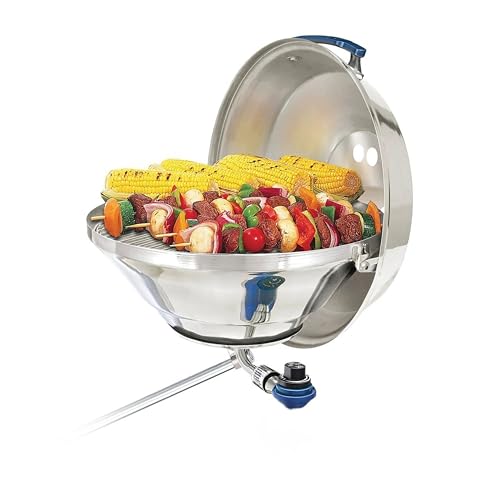
Magma Marine Kettle Gas Boat Grill, Party Size 17-Inch — Best Overall Boat BBQ
The Marine Kettle is the boat grill archetype — the round stainless kettle on a rail mount that defines raft-up cooking — and the 17-inch Party Size is its most useful form: enough grate for burgers and fish for a crew of six to eight, in marine-grade stainless steel, running on propane with the even heating the kettle’s domed design is known for. The round format with its hinged, latching lid behaves well in the breezes that make rectangular lids sail, and the kettle shape sheds the wind that cools flat grills at anchor. It suits sailboats and powerboats with rail space, raft-up hosts, and crews who grill as the centre of the anchorage evening. It does not suit boats without a suitable rail or mount point, or cooks who need rectangular capacity for long items like ribs and whole fish fillets laid straight.
Strengths
- Party Size 17-inch grate feeds a full crew in one or two batches
- Marine-grade stainless steel construction for salt-air life
- Kettle design with domed lid cooks evenly and handles breeze well
Trade-offs
- Mount is a separate purchase — budget rail or pedestal hardware
- Round grate fits round thinking: long items need cutting or angling
- Premium specialist pricing versus land portables
| Mini spec box — verified from catalogue title | |
|---|---|
| Size | Party Size, 17-inch |
| Fuel | Propane gas |
| Construction | Marine-grade stainless steel |
| Use | Boats, pontoons and RVs |
| Model | A10-215 |
On the water, the big kettle’s virtues compound. The dome lets whole chickens and roasts cook in the round, convection-style; the kettle’s wind behaviour means the anchorage’s evening breeze is a nuisance to the cook, not a shutdown of the grill; and the format’s decades of production mean every mount, cover and replacement part a boat could need exists in the catalogue ecosystem — the searches for this guide surfaced Magma’s own regulators and pedestal mounts alongside the grills, which is what a mature marine system looks like. Buy the mount with the grill, choose the rail size honestly (measure your rail diameter; do not guess), and position the kettle so its heat and drips fall outboard, never over deck, canvas or a swim platform in use.
Check the current price on Amazon, and add the correct mount to the same order — a kettle without its mount is deck cargo, not a grill.
Best for: raft-up hosts and crews wanting the classic, capacious marine kettle. / Not suited for: boats without a mount point or cooks needing rectangular grates. Check on Amazon

Magma Catalina II Classic Gourmet Series Gas Grill — Best Rectangular Grill
The Catalina II is Magma’s answer for boats that cook seriously: a rectangular gourmet-series grill whose shape fits the food boats actually serve — fish fillets laid straight, skewers in rows, vegetables in a line — and whose format doubles happily for RV and dockside duty. Rectangular marine grills mount on pedestals and rails with a more furniture-like presence than the kettles, and the Catalina’s gourmet positioning shows in its role as the boat’s primary cooker rather than an accessory. It suits larger powerboats, trawlers and liveaboards with a stern or rail station, and cooks who grill whole meals aboard. It does not suit small sailboats where a rectangular grill’s wind profile and footprint fight the cockpit.
Strengths
- Rectangular grate fits fillets, skewers and rows naturally
- Gourmet-series format works as a boat’s primary grill
- Magma mount ecosystem, including pedestal options
Trade-offs
- Larger footprint and wind profile than the kettles
- Mount sold separately, as with all picks here
- Rectangular lids need disciplined handling in a breeze
| Mini spec box — verified from catalogue title | |
|---|---|
| Series | Catalina II Classic, Gourmet Series |
| Fuel | Gas grill |
| Model | A10-1218-2 |
The Catalina II’s case strengthens the longer a boat stays out. On a weekend, any grill cooks burgers; on a two-week cruise, the rectangular gourmet format is where breakfasts, fish dinners and vegetable sides happen in an organised line, and its compatibility with pedestal mounting — Magma’s double-locking pedestal mount appeared in this guide’s catalogue verification — turns a stern corner into a galley annex. Choose it when the boat has the rail or pedestal real estate to give it a permanent, outboard-facing home, and pair it with the mount rated for its size from day one.
Check the current price on Amazon, and confirm the exact model code A10-1218-2 on the listing, since the Catalina family includes an infrared sibling covered in this programme’s boat gas guide.
Best for: larger boats wanting a rectangular, primary-cooker marine grill. / Not suited for: small cockpits or minimal-rail sailboats. Check on Amazon

Kuuma 316 Elite Gas Grill — Best Large Boat Grill
The Kuuma 316 Elite is the capacity pick of the Kuuma world: 316 sq. in. of cooking area in the Elite line, sized for bigger boats, bigger crews and the dockside gatherings that gather around them. Kuuma’s design language is boxier and more locker-friendly than Magma’s — grills that stow flat, mount when needed, and present a straightforward stainless box to the weather — and the 316 is that idea at full size. It suits larger centre-consoles, cruisers and houseboats, plus owners who also want a serious portable for the dock box or RV. It does not suit small boats, where its size is a storage problem looking for a locker that does not exist.
Strengths
- 316 sq. in. cooking area is the largest in this guide
- Elite-line Kuuma build in a stowable box format
- Doubles as a serious dockside and RV grill
Trade-offs
- Size demands a real storage and mounting plan aboard
- Rectangular profile needs breeze awareness at anchor
- Mount and accessories are separate purchases
| Mini spec box — verified from catalogue title | |
|---|---|
| Cooking area | 316 sq. in. cooking area |
| Line | 316 Elite gas grill |
| Fuel | Gas |
Judge the 316 Elite by the meals that justify it: a full crew’s burgers without a second batch, a row of fish fillets with vegetables alongside, breakfast for the raft-up cooked on one boat. Its box format also makes it the easiest big grill here to protect — a rectangular cover, a flat locker, a simple rinse-and-dry routine. As with every pick, the mount decision is part of the purchase: confirm the pedestal or rail hardware matched to this grill’s footprint before the season starts, not at the dock with guests aboard.
Check the current price on Amazon; large Kuuma Elites move in and out of stock seasonally, and the live listing is the authority.
Best for: bigger boats and crews wanting maximum marine grill capacity. / Not suited for: small boats or locker-poor cockpits. Check on Amazon

Camco Kuuma Stow N’ Go 216 Elite Propane Grill — Best Featured Compact
The 216 Elite is the compact Kuuma with the grown-up features: a built-in thermometer, a push-button igniter, fold-away legs and a removable warming rack, in a grill that works on a tabletop ashore and mounts aboard. The thermometer matters more on a boat than anywhere — marine grills cook in wind and motion that make guesswork expensive — and push-button ignition in a breeze, with one hand on the boat, is a safety feature disguised as a convenience. It suits small-to-midsize boats, couples and small crews, and owners who move the grill between boat, dock and campsite. It does not suit raft-up hosts feeding eight.
Strengths
- Built-in thermometer for honest temperature judgement aboard
- Push-button igniter for one-handed, breeze-friendly lighting
- Fold-away legs and removable warming rack for stowage and capacity
Trade-offs
- Compact class capacity — family batches, not crowd batches
- Features add parts to rinse and maintain in salt air
- Mount hardware is a separate decision and purchase
| Mini spec box — verified from catalogue title | |
|---|---|
| Line | Stow N’ Go 216 Elite |
| Features | Built-in thermometer and push-button igniter |
| Legs | Fold away legs |
| Rack | Removable warming rack |
| Model | 58155 |
The 216 Elite is the pick for the boat that grills often and stores carefully: legs folded, it slides into the locker spaces that actually exist on midsize boats, and deployed — on a mount underway at anchor, or on its legs at the dock picnic table — it cooks with a completeness the basic portables lack. The warming rack earns its place on a boat, where cooked food cannot queue on a counter: burgers hold above the fire while the last batch finishes. Rinse it fresh after salt-air weekends, dry it before it goes back in the locker, and the Elite features will keep working instead of becoming the first casualties of corrosion.
Check the current price on Amazon, and note the model number 58155 on the listing — the Stow N’ Go family spans several sizes and feature levels.
Best for: midsize boats wanting compact size with thermometer, ignition and warming rack. / Not suited for: crowd-scale raft-up cooking. Check on Amazon

Magma Cabo Portable Gas Grill, 9 x 18 Inch — Best Compact Rectangular
The Cabo is Magma’s compact rectangular: a 9″ x 18″ propane BBQ in marine-grade stainless steel with tabletop legs, made for boats, tailgating and RVs. The long, narrow format is smarter aboard than it looks — it fits stern corners and rail-adjacent spots that round kettles waste, lays skewers and fillets in an efficient line, and stows flat in lockers that reject deeper boxes. It suits small boats, couples, and as a second grill beside a kettle on larger boats. It does not suit whole chickens or crowd batches.
Strengths
- 9″ x 18″ format fits tight stern spaces and stows flat
- Marine-grade stainless steel construction
- Tabletop legs for dock and cockpit-table use
Trade-offs
- Narrow grate limits large or round items
- Compact class heat — plan batches for more than four
- Magma mount options apply; legs are the tabletop route
| Mini spec box — verified from catalogue title | |
|---|---|
| Size | 9″ x 18″ |
| Fuel | Propane BBQ |
| Construction | Marine-grade stainless steel |
| Legs | Tabletop legs |
| Model | A10-703 |
The Cabo’s natural habitat is the small-boat evening: two to four people, fish caught that afternoon, vegetables in a row, everything cooked within sight of the helm and eaten in the cockpit. Its even-heat design brief matters in the narrow format, where a single hot spot would dominate; and because it is a true marine Magma, the mount and parts ecosystem stands behind it when the season’s wear arrives. Owners who buy it as their only grill for a six-person crew will batch and grumble; owners who match it to its brief call it the most-used gear on the boat.
Check the current price on Amazon before ordering, and decide the legs-versus-mount question in the same purchase — most Cabo owners end up wanting both.
Best for: small boats and couples wanting a compact, stowable rectangular marine grill. / Not suited for: crowds or large-format cooking. Check on Amazon

Kuuma Stow and Go Propane Tabletop and Mountable Grill — Best Classic Mountable
The original Stow and Go is the Kuuma that built the line: a stainless steel gas grill with foldable legs, 13,000 BTUs, designed from the start to be both a tabletop grill and a mountable one — for boating, camping and picnics alike. That dual citizenship is its enduring value: one grill that lives on the boat’s mount at anchor, on a picnic table ashore, and in a locker between, without adapters or apology. It suits versatile owners whose grilling moves between boat, dock, campsite and garden, and smaller boats that cannot dedicate a permanent station. It does not suit cooks wanting the Elite features or the 316’s capacity.
Strengths
- Tabletop and mountable in one classic design
- 13,000 BTUs of propane heat in a compact stainless body
- Foldable legs for genuine locker stowage
Trade-offs
- Base feature set — no built-in thermometer at this level
- Compact capacity, like all stowable marine grills
- Mount is a separate purchase matched to your rail or pedestal
| Mini spec box — verified from catalogue title | |
|---|---|
| Output | 13,000 BTUs |
| Format | Tabletop and mountable grill |
| Construction | Stainless steel gas grill |
| Legs | Foldable legs |
| Model | 58130 |
There is a reason this design persists: it solves the small-boat problem completely. Mounted, it is a proper marine grill; unmounted, it is the dock party’s second cooker; folded, it disappears. The 13,000 BTU output is honestly matched to its size — enough to sear, not so much that a small grate becomes a flare-up machine in a breeze. Buy it with its mount, rinse it like all marine stainless, and it will serve across boats, which is more than most gear can claim: owners routinely report these grills moving from a first boat to a second while the boats themselves change around them.
Check the current price on Amazon; the Stow and Go is the value anchor of this guide, and its live price against the 216 Elite frames the features-versus-simplicity decision cleanly.
Best for: versatile owners wanting one mountable, stowable grill for boat and shore. / Not suited for: feature-seekers or crowd cooking. Check on Amazon
Comparison Table
| Pick | Badge | Key spec | Best for |
|---|---|---|---|
| Magma Marine Kettle Party Size 17″ | Best Overall | 17-inch kettle, marine stainless | Crews and raft-ups |
| Magma Catalina II Classic | Best Rectangular | Gourmet series, A10-1218-2 | Primary-cooker boats |
| Kuuma 316 Elite | Best Large | 316 sq. in. cooking area | Big boats, big crews |
| Kuuma Stow N’ Go 216 Elite | Best Featured Compact | Thermometer, push-button igniter | Midsize boats |
| Magma Cabo 9 x 18 | Best Compact Rectangular | Marine stainless, tabletop legs | Small boats, couples |
| Kuuma Stow and Go | Best Classic Mountable | 13,000 BTU, foldable legs | Boat-and-shore versatility |
How to Choose a Boat BBQ Grill
Start with the mount, because it decides where grilling can happen. Walk your boat with a tape measure: rail diameter and straight runs, stern corners, rod-holder positions, swim-platform adjacency. Rail mounts suit the kettles beautifully; pedestal mounts turn a stern corner into a station for the rectangular grills; rod-holder mounts (where the maker offers them) are the quick-deploy option for fishing boats. The grill must sit outboard-facing, with heat and drips falling clear of decks, canvas, lines and — critically — fuel fills and vents. If no mounting position on your boat satisfies that geometry, the honest purchase is a stowable tabletop model used ashore, not a mounted grill used badly.
Size by crew, realistically counted at anchor rather than at the dock party you imagine. Two to four: the compacts (Cabo, Stow N’ Go) are perfect and stowable. Five to eight: the Party Size kettle or the 216 Elite class. Raft-up scale: the 316 Elite or the big kettle, with the understanding that you have volunteered as the anchorage’s grill boat. Then weigh the ownership system: canister propane logistics (carry spares; a grill that dies mid-cook for want of a small canister is a planning failure), fresh-water rinsing access, and locker dimensions measured, not estimated. Finally, check your marina’s and insurer’s rules on open-flame and grill use aboard before the purchase, not after — most marinas permit marine gas grills used responsibly, but the document, not the dock gossip, is what counts.
Mounts, Fuel and Setup: The Marine Grill System
A boat grill is a system of four parts — grill, mount, fuel and routine — and the guides that only rank the first part fail their readers. Mounts divide into rail clamps (measure your rail’s diameter and confirm the clamp range), pedestals (deck or rail-mounted posts that hold rectangular grills at working height; Magma’s double-locking pedestal mount is the verified example in this guide’s catalogue work), and rod-holder mounts that drop into fishing hardware. Whichever you choose, the mount must lock positively: a grill that can rotate, sag or detach in a wake is a burn and a lost dinner waiting for the same wave. Test the mounted grill with a firm hand before the first lighting, every season.
Fuel aboard is small-canister propane for most of these grills, with some installations adapting to a boat’s LPG system via the manufacturer’s regulator — Magma’s Type 1 low-output regulator for its kettles and rectangular grills appeared in this guide’s verification results as a genuine part, which is the correct way to adapt: factory parts, not hardware-store improvisation. Store canisters in a vented locker that drains overboard, never below deck in living spaces, and keep a spare aboard. Setup routine at anchor: mount and lock the grill, confirm it sits level and outboard, connect fuel and leak-check the joint with soapy water, light with the lid open, and preheat with the lid closed while someone remains in attendance. That five-minute liturgy, repeated every time, is what safe boat grilling actually consists of.
How to Grill Safely and Well at Anchor
Grilling at anchor is cooking in a gentle, constant motion with a breeze that changes its mind, and the technique adapts accordingly. Secure everything: trays that cannot slide, tools that cannot roll, and a clear path between grill and cockpit that nobody crosses with a lit grill behind them. Cook with the lid down as much as the recipe allows — it conserves heat against the breeze, reduces flare-ups, and keeps sparks and splatter contained. Keep fatty drippings managed; a grease flare over a fibreglass deck is a different event from the same flare over a patio, and leaner marinades, trimmed cuts and a watchful cook are the marine way. Assign the grill to one person whose only job is the grill, especially with guests and children aboard.
When the cooking ends, the safety routine continues: burners off, valve closed at the canister, grill cooled before any cover or stowage, and the mount checked while you are there. Never move a hot grill, never stow a warm grill in a locker, and never grill during refuelling or with fuel being transferred anywhere on the boat. Those rules are not caution theatre — they are the accumulated seamanship of the marine grilling world, and skippers who follow them grill at anchor for decades without incident. The reward is considerable: there is no restaurant on land with the anchorage’s view, and dinner cooked aboard, eaten in the cockpit as the light goes, is half the reason the boat exists.
Life Aboard With a Grill: Storage, Rinsing and the Seasonal Routine
Marine grills fail in lockers, not at rails, and the ownership routine is what separates the ten-year kettle from the two-season disappointment. After each use aboard, let the grill cool fully, wipe the grate and interior of grease while they are still faintly warm, and — whenever a fresh-water hose is within reach — rinse the exterior and the mount hardware, then dry before stowing or covering. Salt left sitting on stainless does its quiet work between trips, not during them. In the locker, the grill rides secured: a stowable model like the Kuuma line lies flat and lashed, a kettle hangs on its mount or sits in a padded spot where it cannot become a stainless wrecking ball in a seaway. Anything stored loose in a boat eventually damages the boat, the gear, or both.
Seasonally, the routine deepens by thirty minutes. Remove the grill from its mount, wash it fully with fresh water and mild detergent, inspect the burner for blockage and the regulator hose for cracking, check every fastener on grill and mount for crevice corrosion, and operate the valves and igniter before the first trip depends on them. Replace suspect canisters’ seals, confirm the spare canister is aboard and stored correctly, and re-check the mount’s grip on the rail with the season’s first installation. Owners who run that half-hour each spring discover their problems on the dock, where they are errands — rather than at anchor, where they are stories told with gestures.
What to Cook Aboard: Menus That Suit a Moving Kitchen
Boat grilling has its own cuisine, shaped by motion, breeze and the absence of a counter. The anchorage classics succeed for structural reasons: burgers and sausages are forgiving of temperature wobbles; fish fillets cook fast enough to beat a shifting wind and benefit from the lid-down technique; skewers present maximum surface to the heat and minimum risk to the deck; and foil-packet vegetables cook in their own steam wherever there is a spare corner of grate. Breakfasts — the kettle’s dome makes a superb oven for a frittata pan — are the raft-up host’s glory, and they run on the same principle: one pan, lid down, no juggling.
What to avoid is equally instructive. Very fatty cuts that flare for minutes, marathon low-and-slow cooks that assume a patio’s stability, and anything requiring constant saucing over an open lid all fight the environment instead of using it. Marinate leaner, choose quicker cuts, and let the grill’s lid do the work while the crew swims. The boats that grill happily every evening are not the ones with the biggest grills; they are the ones whose menus were chosen for the water, cooked by a designated grill hand, and eaten in the cockpit while the anchorage settles — which is, in the end, the entire point of carrying a barbecue on a boat.
Kettle vs Rectangular: The Two Marine Shapes, Decided
Every grill in this guide is one of two shapes, and the choice between them is the category’s real fork. The kettle — Magma’s round format — is the wind and motion champion: its dome sheds breeze, its round grate suits round food and pan cooking, its latching lid travels and stores as one secure unit, and its rail-mounted silhouette is the smallest ask of a crowded stern. Choose the kettle when your boat is small, your anchorage breezy, your menu centred on burgers, chicken, fish steaks and pan breakfasts, and your storage a hanging mount rather than a locker. The 17-inch Party Size is the kettle perfected for crews; the same line’s smaller original size serves couples.
The rectangular grills — Catalina, the Kuumas, the Cabo — are the organisation champions: food in rows, fillets laid straight, skewers aligned, a warming rack’s worth of staging, and a box that stows flat and doubles ashore without a costume change. Choose rectangular when your menu runs to fillets and kebabs, when the boat offers a pedestal corner or a flat locker, and when the grill will also work the dock and the campsite. Neither shape is the category’s winner; they are answers to different boats. The skippers who choose well are the ones who picture their actual stern, their actual locker and their actual menu — and buy the shape that fits the picture, rather than the shape in the photograph that sold them.
One more consideration belongs in every boat grill decision and appears in too few guides: the dinghy test. Gear that must move between boat, dock and shore — for the beach barbecue, the marina picnic, the borrowed slip — should be judged by how it travels. The stowable Kuuma models and the Cabo were designed for exactly that circulation, legs folding and bodies flattening into the loads a dinghy actually carries. A permanently pedestal-mounted Catalina is the better grill station and the worse traveller. Neither fact is a criticism; they are the two honest poles of marine grilling, and knowing which life your grill will live — station or traveller — resolves most of the choices in this guide before price is ever discussed.
Wind deserves its own paragraph in any marine guide, because it is the variable land grillers never budget for. At anchor the boat weathervanes, the breeze finds the grill from changing quarters, and a grill that cooks beautifully in the marina can sulk in an open roadstead. The defences are positioning and patience: swing the boat’s stern so the grill sits in the lee of the cabin where possible, cook lid-down, allow preheats to run longer, and choose the kettle shapes when your cruising grounds are famously breezy. None of the picks in this guide is defeated by normal anchorage weather — they were designed on the water, by the two companies that have equipped it for decades — but the cook who respects the wind eats on schedule, and the cook who curses it eats late.
Common Buying Mistakes
The first mistake is buying a land portable for boat duty: painted steel, no mount system, and a lid that sails in the first anchorage breeze. Marine grills cost more because salt air and motion are expensive problems. The second is forgetting the mount in the budget and the plan, then improvising one. The third is measuring nothing — rail diameter, locker dimensions, stern geometry all guessed — and discovering the truth at the dock. The fourth is oversizing for the raft-up you host once a year and storing the problem for the other fifty weekends.
Fifth, owners neglect the rinse: salt air corrodes even marine stainless that is never rinsed, and the five-minute fresh-water wipe after a salt weekend is the difference between a ten-year grill and a three-year one. Sixth, they store propane canisters below deck, which no safety guidance anywhere endorses. Seventh, they grill wherever the grill happens to fit rather than where heat and drips fall safely outboard. And eighth, they skip the marina and insurance check — the one mistake that can convert a pleasant purchase into a prohibited one after the money is spent.
Final Recommendation
For most boats, the Magma Marine Kettle Party Size is the boat BBQ to buy: the classic format, crew-sized, in marine stainless, backed by the deepest mount ecosystem in the category. Rectangular cooks and larger boats should choose between the Catalina II as a primary station and the Kuuma 316 Elite for maximum area. Midsize boats get the most complete compact in the 216 Elite; small boats and couples get the Cabo or the endlessly versatile Stow and Go. Whichever you choose, buy the correct mount in the same order, measure everything twice, and grill like a seaman: attended, outboard, and by the rules of your marina.
More from the grill cluster: Best Boat Gas Grills · Best Marine Grills · Best Portable Gas Grills · Best Grills · Best Camping Grills
Finally, a note on buying for the boat you have rather than the boat you want. Marine catalogues are seductive, and a flagship grill on a 22-foot weekender is the same category error as a party kettle on a daysailer: the gear must fit the vessel’s rails, lockers, crew and cruising pattern, or it becomes ballast with a burner. Every pick in this guide has a boat it belongs on, named in its verdict line. Buy for that boat, measure for that boat, and the grill will disappear into the rhythm of your cruising — which is the highest compliment any piece of marine equipment can earn.
Guests deserve a sentence too, because raft-ups put unfamiliar hands near your equipment. Brief guests the way you would brief crew: the grill area is the grill hand’s station, hot surfaces stay hot long after the flame is out, and nothing gets set down on the grill’s lid or mount. Boats are sociable, moving, occasionally slippery places, and the thirty-second briefing at the first lighting is the difference between a grill that serves the party and a party that has to work around an accident. Skippers who grill well are, without exception, skippers who run the grill like part of the vessel — because aboard, that is exactly what it is.
Frequently Asked Questions
Do I need a special mount for a boat grill?
Almost always, yes — mounts are sold separately across both Magma and Kuuma ranges, matched to rail diameter, pedestal or rod-holder fitting. Budget the mount with the grill, measure your rail or holder before ordering, and choose a locking mount rated for your grill’s size. A marine grill without its proper mount is not safely usable aboard.
Can I use a regular portable grill on my boat?
It is strongly discouraged. Land portables lack marine-grade stainless, marine mount systems and lids designed for anchorage conditions, and they corrode quickly in salt air. Marinas and insurers also look unfavourably on non-marine cooking gear aboard. The price difference buys construction and mounting designed for the environment.
Is charcoal grilling allowed on boats?
Generally, experienced skippers and most marinas say no: open charcoal brings ember, ash and carbon-monoxide risks that sit badly aboard, and many marinas prohibit it outright. That is why every linked pick in this guide is a gas grill. Always check your own marina’s rules and your insurance terms regardless of fuel.
How do I stop a marine grill from rusting?
Buy marine-grade stainless (every pick here), rinse or wipe it with fresh water after salt-air use, dry it before stowing, keep it covered or lockerside between trips, and treat fasteners and mounts to the same rinse. Marine stainless resists corrosion superbly but is not maintenance-free; the rinse habit is the whole secret.
What fuel do boat grills use?
Most run on small disposable propane canisters, with manufacturer regulators available to adapt some models to a boat’s LPG system — use only the grill maker’s own regulator parts for any adaptation. Store canisters in a vented locker that drains overboard, never in living spaces below deck, and always carry a spare.
How big a grill does my boat need?
Count the crew you actually anchor with. Two to four people: the compact Cabo or Stow N’ Go class. Five to eight: the Party Size kettle or 216 Elite class. Regular raft-up hosting: the Kuuma 316 Elite or the big kettle, accepting the storage commitment. Oversized marine grills punish small boats twice — once in the locker, once at the rail.
Can I leave my boat grill mounted all season?
Many owners do, especially kettle owners on rail mounts in home marinas — but the grill will last longer and look better if it is rinsed regularly, covered between uses, and removed for winter storage ashore. Check the mount’s fasteners monthly in season; vibration and weather loosen hardware that was tight in spring.
What size rail mount do I need?
The one that matches your rail’s measured diameter — measure with calipers or a wrap of tape, never by eye, and confirm the clamp range on the mount’s listing before ordering. A mount that is almost right will rotate under load, which at anchor means a hot grill moving when the boat does. When between sizes, follow the grill maker’s guidance for shims or alternate clamps rather than improvising.
What is the best all-round size for a cruising couple?
The compact class in this guide — the Cabo, the Stow N’ Go models, or the smaller kettle format — matches a couple’s cooking and a small boat’s storage honestly. Couples who host often at anchor should step up one class to the Party Size kettle or 216 Elite and accept the stowage commitment that comes with feeding the anchorage.
Should I choose Magma or Kuuma?
Choose by shape and system rather than badge loyalty: Magma’s kettles are the wind-and-motion specialists with the deepest mount catalogue, while Kuuma’s rectangular, stowable boxes suit locker-based boats and shore-circulating gear. Both build genuine marine stainless; the right answer is always the one whose shape fits your stern and whose mount fits your rail exactly.


