Disclosure: airfryerkitchensupply.com is reader-supported. When you buy through links on our site, we may earn an affiliate commission at no extra cost to you.
Where to buy
Every pick in this guide is sold through Amazon, and blender model names repeat across generations, so use the links below to confirm the exact model and the 64 oz container in the listing title before you order. If the container size in the title is not 64 oz, you are looking at a different variant of the same blender family. The verified picks in this guide are: Vitamix 5200 Professional-Grade Blender, 64 oz, Black; Vitamix Propel Series 750, 64 oz, Black; Oster Extreme Mix Blender, 1500W, 64 oz Tritan; nutribullet Full-Size Blender Combo NBF50500, 1200W; Oster Extreme Mix Blender, 8-Cup Glass Jar, 1600W; Vitamix Explorian Blender, 64 oz Low-Profile (Renewed Premium). When you are ready, check the current price on Amazon from any of these links rather than trusting a price quoted elsewhere, because listings in this category are repriced constantly.
The best blenders 8 cup models start from a simple equivalence every shopper should know: eight cups is 64 ounces, and 64 ounces is the classic full-size blender batch. It is the smoothie round for a family, the big soup, the party frozen drink run — the size this product category was built around. Shoppers type this query have usually already decided against personal blenders and compact jars; what they need is not a size lecture but a separation of the genuine 64 oz machines by power, jar material, and control style.
That separation is what this guide does. All six picks were verified, with the 64 oz container confirmed in the listed title of each one — no 56 oz or 72 oz jar has been quietly rounded into the 8-cup class. Within the class, the real differences are the ones the reviews focus on: manual dial versus preset programs, Tritan versus glass versus low-profile containers, new versus renewed, and the mid-range value challenge to the premium benchmarks.
One honest note on expectations: at 64 ounces, every pick here will make a good smoothie. The differences that justify the tiers appear on the hard jobs — fibrous greens blended truly smooth, frozen fruit without a jam, nut butters, and hot soups — and on the tenth year of ownership rather than the tenth day. Read the reviews with your hardest regular job in mind, not your easiest one.
In this guide
Quick Picks
Short on time? These are the six verified 64 oz picks, from the long-term benchmark to the glass-jar and renewed options. The reviews below explain the control, jar, and tier differences that actually separate machines of identical capacity.
- Vitamix 5200 Professional-Grade Blender, 64 oz, Black — Best Overall: The reference 8-cup blender: a 64 oz container, variable speed with a high-speed switch, stainless blades, and a self-cleaning routine — the machine this size class is judged against. — Check on Amazon
- Vitamix Propel Series 750, 64 oz, Black — Best with Preset Programs: The programmed 8-cup Vitamix: the same 64 oz class with four programs including a self-cleaning cycle, plus pulse and variable speed for when you take over. — Check on Amazon
- Oster Extreme Mix Blender, 1500W, 64 oz Tritan — Best Value High-Speed: The value disruptor of the 8-cup class: 1500 watts of turbo power, a 64 oz Tritan jar, anti-jam technology, and iBlend auto programs at a mid-range tier. — Check on Amazon
- nutribullet Full-Size Blender Combo NBF50500, 1200W — Best with Single-Serve Option: The flexible 8-cup pick: a 64 oz pitcher for family batches plus a 24 oz tumbler cup for single servings, on a 1200W base that covers both jobs. — Check on Amazon
- Oster Extreme Mix Blender, 8-Cup Glass Jar, 1600W — Best Glass Jar: The glass-jar 8-cup pick: a full 8-cup glass jar, 1600W motor, 10-point stainless blade, and iBlend technology for buyers who want glass at full batch size. — Check on Amazon
- Vitamix Explorian Blender, 64 oz Low-Profile (Renewed Premium) — Best Renewed Entry to Vitamix: The refurbished route into the premium tier: a professional-grade Vitamix with a 64 oz low-profile container that fits under cabinets, in Renewed Premium condition. — Check on Amazon
How These Picks Were Chosen
Picks were chosen by verifying each model: search by brand and model, match the listed title, take the ASIN from the listing response. Only listing-confirmed 64 oz models carry Amazon links. Capacity verification mattered most for this search, because blender families reuse one name across 48, 56, 64, and 72 oz variants, and a guide that reviews the wrong jar has failed before the first paragraph.
Selection then balanced the four axes buyers actually decide on: control style (manual dial, presets, or auto programs), jar material (Tritan, glass, low-profile), tier (mid-range value versus premium benchmark), and condition (new versus structured renewed). Immersion blenders and personal bullet blenders were excluded by definition — they cannot hold eight cups — and 72 oz machines were left to their own guides rather than rounded down into this one.
A word on the spec boxes in the reviews: they contain only facts stated in the listed titles — container size, wattage where the brand publishes it, program counts, and included containers. Where a brand does not publish a figure through the API, the box omits it rather than importing a number from a retailer page that may describe a sibling variant. That restraint is deliberate. In a category where one model name covers five jar sizes, a smaller spec box that is certainly right beats a complete one that is approximately right.
The 6 Best Blenders 8 Cup: Full Reviews

Vitamix 5200 Professional-Grade Blender, 64 oz, Black — Best Overall
The Vitamix 5200 is the machine that defines the best blenders 8 cup category, because 64 ounces — eight cups — is the classic full-size blender batch, and the 5200 is the classic full-size blender. Its formula has barely changed across its long production run because it does not need to: a powerful motor, a 64 oz container, variable speed control with a dedicated high-speed switch, stainless steel blades, and a self-cleaning routine that turns cleanup into a thirty-second blend of warm water and a drop of soap. There are no presets to memorise and no screen to fail; there is a dial, and the dial always works.
Who it suits: households that blend daily and in full batches — family smoothies, big soups, nut butters, frozen desserts — and buyers who measure an appliance in decades. The tall 64 oz container creates the vortex that pulls fibrous greens and frozen fruit down into the blades, which is why green smoothies from a 5200 come out genuinely smooth rather than flecked. The variable dial gives real control for tasks presets handle badly, like easing into a hot soup or stopping a hummus at chunky instead of pureed.
The trade-offs are the known ones. The tall container on the motor base makes a tall total package that may not slide under every kitchen cabinet — measure your clearance or store the container beside the base. It is a loud machine at full speed, as every blender in its power class is. And it asks the buyer to drive: cooks who want a button that runs a perfect smoothie cycle unattended should take the Propel 750 below. For everyone else, the 5200 remains the 8-cup benchmark because its simplicity is exactly what survives twenty years of daily use.
Ownership economics complete the case. The 5200 has no proprietary pods, no filters, and no consumables; its wearing parts are a container and a drive socket, both replaceable on a mature parts pipeline. Owners routinely report the same machine crossing a decade of daily smoothies, soups, and nut butters, which reframes its premium tier as a low annual cost. That is the standard the rest of this guide is measured against: not whether a rival can match one smoothie — several can — but whether it can match the decade.
Strengths
- 64 oz container and vortex design produce genuinely smooth full-batch green smoothies
- Variable speed dial plus high-speed switch gives control presets cannot match
- Self-cleaning routine and a famously durable build suit daily, long-term use
Trade-offs
- Tall container and base may not fit under low cabinets — measure first
- No preset programs; the cook drives every blend manually
- Full-speed operation is loud, like every machine in this power class
| Spec | Detail (verified) |
|---|---|
| Container | 64 oz (8-cup) |
| Controls | Variable speed, high-speed switch |
| Blades | Stainless steel |
| Cleaning | Self-cleaning |
Best for: daily blenders and full-batch households who want the long-term benchmark / Not suited for: cooks who want one-touch preset cycles or have very low cabinet clearance
Check on Amazon — check the current price on Amazon for the exact model named here.

Vitamix Propel Series 750, 64 oz, Black — Best with Preset Programs
The Vitamix Propel Series 750 answers the one criticism of the 5200 — that it makes the cook do everything — by adding four preset programs, including a self-cleaning program, on top of the same 64 oz full-batch platform. In a best blenders 8 cup shortlist it is the pick for households that blend on autopilot: load the container, select the smoothie program, and walk away to make coffee while the machine ramps, pauses, and finishes on its own timing. When the program ends, the texture is the repeatable texture, which matters in households where three different people make the morning smoothie.
Who it suits: busy families who value repeatability over ritual, and Vitamix buyers who want the modern interface without moving to the larger smart-platform models. Crucially, the Propel keeps pulse and full variable speed alongside the programs, so it never traps an experienced cook inside the presets — the dial is still there for hot soups, nut butters, and the chunky salsa that no program understands. The 64 oz container handles the same family batches as the 5200.
The compromise is complexity and what it implies for longevity. Programs mean electronics, and electronics are the part of a blender most likely to age first, while the 5200’s appeal is precisely that there is almost nothing to age. The Propel also costs a step up within the premium tier. Buyers should choose honestly: if your household will use the programs daily, they are worth it every morning; if you will override them out of habit, the simpler machine is the smarter purchase and this one is a well-made answer to a question you are not asking.
Strengths
- Four preset programs deliver repeatable smoothies and soups hands-free
- Retains pulse and full variable speed, so experienced cooks are never locked out
- Same 64 oz full-batch capacity and self-cleaning convenience as the 5200
Trade-offs
- Program electronics add a failure point the purely manual 5200 avoids
- A step up in tier over the 5200 for features some cooks will rarely use
- Tall full-size format shares the 5200’s cabinet-clearance measurement homework
| Spec | Detail (verified) |
|---|---|
| Container | 64 oz |
| Programs | 4 programs including self-cleaning program |
| Controls | Pulse, variable speed |
| Use | Smoothies, soups and more |
Best for: busy households that want repeatable one-touch results in a full 8-cup batch / Not suited for: minimalists who prefer a purely manual machine with nothing to age
Check on Amazon — check the current price on Amazon for the exact model named here.

Oster Extreme Mix Blender, 1500W, 64 oz Tritan — Best Value High-Speed
The Oster Extreme Mix is the pick that stops the best blenders 8 cup conversation from being a two-brand affair. Its verified spec is aggressive for its tier: 1500 watts of turbo power, a 64 oz Tritan jar, a 10-point blade, anti-jam technology, and iBlend auto programs. In plain terms, Oster has built the high-speed, full-batch formula — big motor, big jar, multi-point blade, programmed cycles — and priced it in the mid-range tier where the premium brands sell their smaller or simpler machines. For buyers whose budget stops below the Vitamix line, this is where the performance-per-tier argument is strongest.
Who it suits: smoothie and frozen-drink households that blend full 8-cup batches daily and want programmed cycles without entering the premium tier, and anyone whose Oster loyalty comes from the brand’s long history in exactly this product. The Tritan jar is light, tough, and resists the clouding that ages cheaper plastic jars, and anti-jam technology addresses the most annoying high-speed failure — a frozen load that bridges over the blades and spins air while the motor races.
The honest reservations are about refinement and the long term. Oster’s current high-speed line does not carry the multi-decade track record of the Vitamix 5200, and fit-and-finish details like dial feel and lid seal are a step behind the premium machines. High wattage claims across the industry are measured differently by every brand, so treat 1500 watts as a class signal rather than a laboratory figure. None of that overturns the value case: judged on verified specification against tier, the Extreme Mix is the hardest pick in this guide to argue against.
Strengths
- 1500W and a 10-point blade bring true high-speed blending to a mid-range tier
- 64 oz Tritan jar is light, tough, and resists clouding
- iBlend auto programs plus anti-jam technology cover the frozen-drink workload
Trade-offs
- Long-term track record is shorter than the Vitamix benchmarks
- Fit and finish trail the premium machines in small details
- Wattage figures are not standardised across brands, so compare within class, not across badges
| Spec | Detail (verified) |
|---|---|
| Power | 1500W Turbo Power |
| Container | 64 oz Tritan jar |
| Blade | 10-point blade |
| Technology | Anti-Jam Technology, iBlend Auto Programs |
Best for: full-batch smoothie households that want high-speed performance below the premium tier / Not suited for: buyers who prioritise a decades-long track record over value
Check on Amazon — check the current price on Amazon for the exact model named here.

nutribullet Full-Size Blender Combo NBF50500, 1200W — Best with Single-Serve Option
The nutribullet Full-Size Blender Combo solves the quiet inefficiency of the 8-cup category: most households do not blend eight cups most of the time. They blend one smoothie on weekdays and a family batch on weekends, and a pitcher-only machine makes the weekday smoothie in a 64 oz container that then needs washing for a 16 oz drink. This combo pairs the full 64 oz pitcher with a 24 oz tumbler cup on the same 1200W base, so the single serving blends in its own cup — drink from it, rinse it, done — while the pitcher waits for batch duty.
Who it suits: mixed-pattern households, couples with different morning routines, and anyone whose blending is eighty percent single-serve and twenty percent family batches. The 1200W motor is a genuine full-size power level, not a personal-blender motor stretched over a big pitcher, so the 64 oz pitcher handles frozen fruit and ice for smoothies credibly when the weekend batch arrives. Dishwasher-safe parts keep both containers in the easy-clean category.
The trade-offs sit at the top end of performance. Serious nut butters, very hot large soups, and the silkiest possible green smoothies are the home turf of the Vitamix picks, whose vortex and blade design out-blend this combo on the hardest jobs. The tumbler system also adds parts to store. But for the household whose real pattern is weekday singles plus weekend batches, the combo matches the machine to the life better than any pitcher-only pick here, and that match is worth more than a spec-sheet victory on jobs you rarely run.
There is also a portion-control argument that households discover after purchase: blending a smoothie in the cup you will drink from ends the quiet overproduction of pitcher blending, where the extra eight ounces nobody wanted becomes either waste or an unplanned second serving. For households blending for one or two with different recipes per person — a green smoothie for one, a protein shake for the other — the tumbler workflow is not a convenience but the entire point, and the full-size pitcher becomes the weekend tool it should be.
Strengths
- 64 oz pitcher plus 24 oz tumbler covers batch and single-serve blending on one base
- 1200W is true full-size power, so the big pitcher is not underpowered
- Dishwasher-safe containers keep the two-container system easy to live with
Trade-offs
- Hardest jobs — nut butters, silkiest greens — still belong to the Vitamix picks
- Two containers and lids mean more parts to store and keep track of
- No preset program library comparable to the Propel or Oster iBlend sets
| Spec | Detail (verified) |
|---|---|
| Power | 1200W |
| Containers | 64 oz pitcher, 24 oz tumbler cup |
| Format | Full-size blender combo |
| Cleaning | Dishwasher-safe parts |
Best for: households blending single servings on weekdays and family batches on weekends / Not suited for: dedicated nut-butter and hot-soup blenders who need maximum vortex power
Check on Amazon — check the current price on Amazon for the exact model named here.
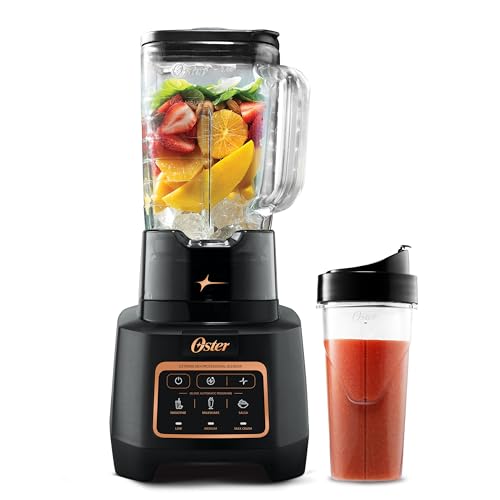
Oster Extreme Mix Blender, 8-Cup Glass Jar, 1600W — Best Glass Jar
Glass-jar buyers are usually told to accept a smaller or weaker machine, which is why this second Oster Extreme Mix earns its place in the best blenders 8 cup guide: it is a full 8-cup glass jar on a 1600W motor with a 10-point stainless steel blade and iBlend technology, plus a Blend-N-Go cup in the box. Glass brings the properties its loyalists want — it does not stain with turmeric or tomato, does not hold odours from last week’s garlic soup, does not cloud, and handles hot liquids with a confidence that makes soup households relax. At eight cups, it does all of that at genuine family batch size.
Who it suits: soup makers first, because hot blending in glass is the classic use case; cooks bothered by stained or scented plastic jars; and buyers who like the weight and stability of glass on the counter. The 1600W headline and 10-point blade put it in the same high-speed class as its Tritan sibling for frozen drinks and smoothies, so the glass choice here does not cost the frozen performance that glass-jar models traditionally surrender. The included Blend-N-Go cup adds a single-serve option the pitcher-only glass machines lack.
Glass physics is the trade-off, as always. A full 8-cup glass jar is heavy empty and seriously heavy full of soup, it asks for a two-handed pour, and it is the one jar material here that can break if dropped on tile. It also needs the standard hot-liquid discipline: never fill a sealed jar to the brim with boiling liquid, and vent as the manual directs. Buyers who accept weight and care in exchange for a jar that looks and smells new for years will find this the most satisfying 8-cup pick in the guide.
Strengths
- Full 8-cup glass jar resists stains, odours, and clouding indefinitely
- 1600W motor and 10-point blade keep frozen-drink performance in the high-speed class
- Blend-N-Go cup included, adding single-serve flexibility glass models usually lack
Trade-offs
- A full 8-cup glass jar is heavy and wants a careful two-handed pour
- Glass can break if dropped — the only fragile jar material in this guide
- Hot-liquid blending still needs standard venting discipline and headroom in the jar
| Spec | Detail (verified) |
|---|---|
| Power | 1600W |
| Container | 8-cup glass jar |
| Blade | 10-point stainless steel blade |
| Technology | iBlend Technology, Blend-N-Go cup included |
Best for: soup makers and glass loyalists who want full 8-cup capacity / Not suited for: anyone who finds a heavy full jar hard to lift, or households with tile floors and small children at counter height
Check on Amazon — check the current price on Amazon for the exact model named here.

Vitamix Explorian Blender, 64 oz Low-Profile (Renewed Premium) — Best Renewed Entry to Vitamix
The Vitamix Explorian in Renewed Premium condition is the honest shortcut in this best blenders 8 cup guide: a professional-grade Vitamix with the 64 oz low-profile container, renewed through a formal refurbishment channel rather than bought as an unknown second-hand gamble. The low-profile container matters more than it sounds — it is the 64 oz format that actually slides under standard kitchen cabinets, solving the single most common ownership complaint about the tall 5200 container, while still blending the full eight-cup batch.
Who it suits: buyers who want Vitamix blending performance — the vortex, the texture on greens and frozen fruit, the hot-soup capability — at a lower tier than a new premium machine, and who are comfortable with renewed goods from a structured program. Renewed Premium is the grade to look for in this market: inspected, cleaned, and sold as a defined condition rather than an individual seller’s optimism. For renters and first premium buyers, it is also a lower-commitment way to learn whether the Vitamix style of manual, powerful blending suits their cooking before the full new-machine decision.
The reservations are the standard renewed ones and should be stated plainly. Cosmetic condition can vary within the grade, warranty terms on renewed units differ from new and should be read on the listing before purchase, and you are buying the Explorian platform rather than the newest generation. None of that affects the blending itself, which is the reason for the purchase. Buyers who want a pristine unboxing and the longest factory warranty should buy new; buyers who want the performance per tier should give this pick serious attention.
Strengths
- Professional-grade Vitamix performance at a renewed tier below new premium models
- 64 oz low-profile container fits under standard cabinets, unlike tall containers
- Renewed Premium grade means inspected condition rather than a private-sale gamble
Trade-offs
- Cosmetic condition varies within the renewed grade
- Warranty terms differ from new machines — read them on the listing first
- Explorian platform rather than the newest Vitamix generation
| Spec | Detail (verified) |
|---|---|
| Container | 64 oz low-profile container |
| Grade | Professional-grade |
| Condition | Renewed Premium |
| Model | Explorian series, model 65542 |
Best for: buyers who want Vitamix performance at a lower tier and accept renewed condition / Not suited for: buyers who want a pristine new machine with the longest factory warranty
Check on Amazon — check the current price on Amazon for the exact model named here.
Comparison Table
All six picks hold the same 64 oz, so the table compares what differs: power class, jar material and format, and the household each serves best. Capacity is the entry ticket here, not the decision.
| Pick | Badge | Key spec | Best for |
|---|---|---|---|
| Vitamix 5200 Professional-Grade Blender, 64 oz, Black | Best Overall | 64 oz (8-cup) container, variable speed, self-cleaning | daily blenders and full-batch households who want the long-term benchmark |
| Vitamix Propel Series 750, 64 oz, Black | Best with Preset Programs | 64 oz container, 4 programs, pulse, variable speed | busy households that want repeatable one-touch results in a full 8-cup batch |
| Oster Extreme Mix Blender, 1500W, 64 oz Tritan | Best Value High-Speed | 1500W, 64 oz Tritan jar, 10-point blade, iBlend programs | full-batch smoothie households that want high-speed performance below the premium tier |
| nutribullet Full-Size Blender Combo NBF50500, 1200W | Best with Single-Serve Option | 1200W, 64 oz pitcher + 24 oz tumbler cup | households blending single servings on weekdays and family batches on weekends |
| Oster Extreme Mix Blender, 8-Cup Glass Jar, 1600W | Best Glass Jar | 1600W, 8-cup glass jar, 10-point blade, Blend-N-Go | soup makers and glass loyalists who want full 8-cup capacity |
| Vitamix Explorian Blender, 64 oz Low-Profile (Renewed Premium) | Best Renewed Entry to Vitamix | 64 oz low-profile container, professional-grade, Renewed Premium | buyers who want Vitamix performance at a lower tier and accept renewed condition |
How to Choose the Best Blenders 8 Cup for Your Kitchen
Start with your hardest regular job, because that is what separates these machines. If it is green smoothies with kale, ginger, and frozen fruit, prioritise vortex power — the Vitamix picks and the high-wattage Osters — because fibrous blends expose weak motors within a week. If it is hot soup, jar material and format move to the front: glass handles heat with confidence, and any 64 oz jar needs headroom and venting for boiling liquids. If it is frozen drinks for a crowd, blade design and anti-jam behaviour matter more than raw wattage claims.
Then choose your control philosophy honestly. Manual variable speed, as on the Vitamix 5200, rewards cooks who blend by eye and ear and want a machine with almost nothing electronic to age. Preset programs, as on the Propel 750 and the Oster iBlend models, reward households that want the same smoothie from whoever makes it, with nobody learning technique. Neither is better in the abstract; the right one is the one your household will actually use at 7 a.m. on a weekday.
- Match power to your hardest job: greens, nuts, and ice need the high-speed class.
- Choose jar material by use: glass for hot soups, Tritan for light toughness, low-profile for cabinet fit.
- Measure under-cabinet clearance before choosing a tall-container model.
- Decide manual versus presets by who blends on weekday mornings, not by feature lists.
- Consider renewed premium if performance matters more than a pristine unboxing.
Finally, check the unglamorous fit facts. A 64 oz container on its base is a tall appliance; the low-profile Explorian exists because standard cabinets reject taller combinations. Jar weight matters too — a full glass 8-cup jar of soup is a two-handed pour. The best blender is the one that fits your cabinets, your hands, and your hardest recipe, in that order.
How to Use an 8 Cup Blender: Loading, Hot Liquids, and Cleaning
Loading order is the free skill that transforms full-size blending. Liquids first, then soft ingredients, then leafy greens, then frozen and hard items last, nearest the top. That order lets the vortex form immediately and pull the hard material down progressively, instead of the blades spinning in a pocket under a frozen bridge. For an 8-cup batch the temptation is to fill to the line; resist it for anything that expands or foams, and never fill beyond about two-thirds for hot liquids, which need headroom for steam and movement.
Hot soup technique deserves its own discipline because 64 oz of near-boiling liquid is a serious quantity. Start on the lowest speed and ramp up gradually, keep the lid firmly held with a towel, and use the vented lid position the manual specifies so steam escapes instead of pressurising the jar. Glass jars, like the Oster pick, tolerate the heat confidently; with any jar, let a boiling blend settle for a moment before pouring, and pour away from yourself in a steady stream. These habits are not fine print — they are the difference between soup-making as a pleasure and soup-making as an incident.
Cleaning is where the 8-cup class shines if you use the self-cleaning pattern: immediately after emptying, add warm water to about a third of the jar with a drop of washing-up liquid, and run the self-cleaning program or high speed for thirty to sixty seconds. The vortex scrubs the walls and blades without a hand going near them. Rinse, air-dry with the lid ajar, and the jar never develops the cloudy, scented film that makes owners dread the machine. Dried-on nut butter is the exception — soak that jar for ten minutes first, then run the same cycle.
Sound management is the last practical skill, because every high-speed 8-cup machine is loud at full power and pretending otherwise helps nobody. Blend the frozen portion of a morning smoothie the night before where the recipe allows, keep the machine off shared walls in flats, and never run a full-speed cycle longer than the recipe needs — most smoothies finish well inside a minute, and the extra thirty seconds of noise buys no texture. Households blending at dawn for sleeping children should weight the preset picks, whose ramps are gentler at the start, or blend in the furthest room from the bedrooms. These are small courtesies, but they decide whether a powerful blender remains welcome in a shared home.
Jar Materials at 64 Ounces: Glass, Tritan, and Low-Profile Formats
Jar material is a lifestyle decision disguised as a specification. Glass is the traditionalist’s choice: inert, stain-proof, odour-proof, and confident with hot liquids, at the cost of weight and fragility. A full 8-cup glass jar is the heaviest object in this guide, and households should be honest about wrists, high shelves, and tile floors before choosing it. Tritan and similar modern copolyesters answer with lightness and toughness — they survive drops that would end a glass jar, and quality Tritan resists the clouding that disfigured older plastic jars — while asking hot-liquid users to follow the maker’s temperature guidance. The low-profile format is not a material but a shape answer: the same 64 oz spread wider and shorter, trading a slightly different vortex geometry for the cabinet fit that decides whether the blender lives on the counter or in a cupboard. A blender stored in a cupboard gets used weekly; a blender on the counter gets used daily. Choose the format that keeps yours on the counter.
Batch Planning with an 8 Cup Blender: Soups, Sauces, and Freezer Prep
The 8-cup format earns its counter space on prep day, when one batch replaces four small ones. A single 64 oz blend of tomato or squash soup, cooled and portioned, covers two family dinners; a double batch of marinara or curry base freezes flat in bags and turns future weeknights into defrost-and-boil-pasta exercises. Smoothie households use the same logic in reverse: blend one full pitcher on Sunday, freeze it in single portions, and re-blend or thaw each morning — a pattern that only works because the pitcher holds a week of singles at once. The nutribullet Combo pick formalises that pattern with its tumbler cup, but the discipline belongs to every machine in this guide.
Two planning rules keep batch blending honest. First, blend for texture at serving time, not at freezing time: soups destined for the freezer should be blended slightly less silky than you like, because reheating and a quick re-blend at serving restores the finish better than a long freeze of a fully aerated puree. Second, label with the blend date and the recipe name, because frozen green purees are indistinguishable and a month-old kale soup base does not improve a Tuesday. Batches also change the economics of premium machines: a Vitamix-class blender used for weekly prep plus daily smoothies amortises its tier over thousands of blends, while the same machine bought for occasional milkshakes never justifies itself. Buy the 8-cup class for the batch habit, and the batch habit will repay whichever pick you chose.
Longevity planning belongs in the same conversation, because a batch-worked blender lives a harder life than a milkshake machine. Expect years of daily service from any pick here when it is loaded sensibly and self-cleaned promptly; expect the premium manual machines to outlast the programmed ones, simply because a dial and a switch present fewer ageing components than a program board. None of the picks in this guide is a disposable appliance, and a blender that fails inside its first year of normal use has failed the basic test this category is supposed to pass — which is why verified models from identifiable makers fill this list and anonymous high-wattage listings do not.
Common Buying Mistakes
Mistake 1: Buying a 72 oz or 56 oz variant by name alone. Blender families reuse one name across many jar sizes. Confirm the 64 oz container in the listing title — as every pick here was confirmed through the API — or you will own a different machine from the one you researched.
Mistake 2: Filling a full jar with hot liquid. Hot liquids expand and pressurise. Keep hot blends to about two-thirds of the jar, vent the lid as directed, and start at low speed. An 8-cup jar makes this mistake eight cups big.
Mistake 3: Loading frozen ingredients first. Frozen-first loading creates a bridged pocket the blades spin inside uselessly. Liquids and soft items first, frozen last, and let the vortex do the pulling.
Mistake 4: Judging blenders by wattage alone. Wattage is measured differently by every brand and says nothing about blade design or vortex geometry. Use it as a class signal, then judge by the job tests described in the reviews.
Mistake 5: Storing the blender in a cupboard because it does not fit the counter. If tall containers defeat your cabinets, that is a format problem with a format solution — the low-profile pick exists for exactly this kitchen. A counter-resident blender gets used; a cupboard blender gets replaced by takeaway smoothies.
Mistake 6: Hand-washing around the blades. The self-cleaning cycle exists to keep hands away from the blade assembly. Use it immediately after blending, and reserve careful hand-washing for the lid and tamper only.
Final Recommendation
If you want one recommendation: take the Vitamix 5200. It is the benchmark because it does the hardest jobs in the class with the simplest possible machine, and its 64 oz format is the original 8-cup standard. Households that want the same batch size with walk-away programs should take the Propel 750 instead, and should not feel they have compromised — they have chosen a different control philosophy, not a lesser blender.
On a mid-range tier, the Oster Extreme Mix in Tritan is the value pick of the guide, and its glass sibling is the soup household’s pick. The nutribullet Combo is the right answer when most blends are single servings with weekend batches, and the renewed Explorian is the smart route into premium performance under low cabinets. At eight cups, capacity is equal — choose on power, jar, and control, in that order.
Related guides in this series: Best Blenders; Best 10 Cup Blenders; Best 1000 Watt Blenders; Best 1500 Watt Blenders.
Frequently Asked Questions
Is 8 cups the same as 64 oz in a blender?
Yes. Eight fluid cups equal 64 fluid ounces, so an 8-cup blender and a 64 oz blender describe the same container size — the classic full-size batch. Every pick in this guide was verified with the 64 oz container stated in its listed title, because blender families sell the same model name with several different jar sizes.
How many smoothies does an 8 cup blender make at once?
A full 64 oz batch makes roughly four generous smoothies or five to six smaller servings, depending on how much ice and frozen fruit displaces liquid. In practice most households fill to about three-quarters for smoothies, which lands at three to four full servings per batch — one round for a family, with no second blending session.
Can an 8 cup blender handle hot soup safely?
Yes, with technique: fill no more than about two-thirds, vent the lid as the manual directs, hold the lid with a towel, and start at the lowest speed before ramping up. Glass jars tolerate the heat especially confidently. The Vitamix models are also known for friction-heating soups from raw ingredients on long high-speed blends, which is a different, manufacturer-supported use.
Glass or Tritan jar — which is better at this size?
Glass wins on stains, odours, and hot liquids, and loses on weight and fragility. Tritan wins on lightness and drop survival, and modern Tritan resists clouding well. At 64 oz the weight difference is significant when the jar is full, so households that pour large hot batches daily should weigh that literally before choosing glass.
Do I need presets, or is a manual dial enough?
A manual dial is enough for any blending job — presets add repeatability, not capability. Choose presets if several people blend and you want identical results without technique, or if weekday mornings reward walk-away operation. Choose the manual dial if you blend by eye, make varied recipes, and prefer a machine with minimal electronics to age.
Is a renewed Vitamix a sensible purchase?
A structured renewed grade like the Renewed Premium Explorian in this guide can be very sensible: the unit is inspected and sold in a defined condition at a lower tier, with the same blending platform. Read the renewed warranty terms on the listing before buying, expect possible cosmetic variation, and the performance-per-tier case is strong — especially with the low-profile container that fits standard cabinets.


