Disclosure: airfryerkitchensupply.com is reader-supported. When you buy through links on our site, we may earn an affiliate commission at no extra cost to you.
The best bidets to install on low water flush toilets start from a reassuring fact: a bidet does not flush. Low water flush toilets — the 1.28, 1.1 and 0.8 gallon-per-flush models, dual-flush designs, and pressure-assist fixtures — move waste with a carefully engineered small volume of water, and a bidet attachment or seat taps the supply line before the tank, drawing its own modest flow only while you wash. Fitted correctly, a bidet changes nothing about how your toilet flushes. Fitted carelessly — the wrong T-valve, a disturbed fill valve, a seat that props the lid against a compact tank — it can. This guide is about fitting one correctly.
Why does the pairing deserve its own guide at all? Because low-flush toilets concentrate three sensitivities. Their tanks and fill valves are tuned, so anything that steals supply pressure mid-refill or leaves a joint weeping matters more. Their bowls are often compact, leaving less room at the rear for attachment plates and hose routing. And their owners chose them to save water, so a bidet that drips, or a wash habit that triggers double-flushing, defeats the purpose. Every pick below is a non-electric model — deliberate, because non-electric bidets draw no power, heat no water, and place the smallest, simplest demand on the supply line.
The honest headline is that this is one of the easiest bidet pairings to get right. The attachment format dominates the picks because it adds the least hardware to a tuned fixture, and the single non-electric seat pick covers households that want a finished seat. What you will not find here is an electric seat: not because they cannot work on low-flush toilets — they can — but because their pumps and heaters add supply and electrical demands that this search’s buyers, optimising a water-saving fixture, are usually trying to avoid. If you want warm water on a low-flush toilet, the electric route exists; this guide serves the simpler, colder, very reliable one.
Where to buy
All six confirmed picks are sold through Amazon, where you can check the current price on Amazon for each model, confirm the nozzle configuration and included fittings on the listing, and arrange delivery. Start with these confirmed options:
- LUXE Bidet NEO 120 Bidet Attachment — Best Overall: Check the current price on Amazon
- LUXE Bidet NEO 185 Bidet Attachment — Best Dual Nozzle: Check the current price on Amazon
- Bio Bidet SlimEdge Bidet Attachment — Best Slim Profile: Check the current price on Amazon
- TUSHY Classic 3.0 Bidet Attachment — Best Pressure and Angle Control: Check the current price on Amazon
- Bio Bidet Slim Zero Non-Electric Bidet Seat, Elongated — Best Non-Electric Seat Option: Check the current price on Amazon
- SAMODRA Ultra-Slim Bidet Attachment — Best Budget: Check the current price on Amazon
Always re-check the listing for what is in the box — specifically the T-valve and hose. Low-flush installs go smoothly when the included fittings match your supply line; if your toilet uses an unusual supply connection, confirm compatibility on the listing before ordering rather than mid-install.
In this guide
Quick Picks
- Best Overall: LUXE Bidet NEO 120 Bidet Attachment — A single self-cleaning nozzle, adjustable pressure and the simplest possible install — the least a bidet can ask of a low-flush toilet, and all most people need. Check price on Amazon
- Best Dual Nozzle: LUXE Bidet NEO 185 Bidet Attachment — Dual self-cleaning nozzles for rear and feminine wash with adjustable pressure — the full attachment wash on the same low-interference plate. Check price on Amazon
- Best Slim Profile: Bio Bidet SlimEdge Bidet Attachment — Dual nozzles in an edge-slim body designed to fit nearly all toilets — the attachment for compact low-flush bowls with the least rear clearance. Check price on Amazon
- Best Pressure and Angle Control: TUSHY Classic 3.0 Bidet Attachment — Adjustable pressure plus nozzle angle control in a design-led attachment — the most tunable wash you can put on a low-flush toilet without electricity. Check price on Amazon
- Best Non-Electric Seat Option: Bio Bidet Slim Zero Non-Electric Bidet Seat, Elongated — A complete low-profile seat with dual nozzles and a slow-close lid — no plate under an old seat, no electricity, minimal supply fuss. Check price on Amazon
- Best Budget: SAMODRA Ultra-Slim Bidet Attachment — Ultra-slim body, dual nozzles and adjustable pressure at a budget tier — the low-cost way to test a bidet on a water-saving toilet. Check price on Amazon
How These Picks Were Chosen
Every linked model was verified through the airfry site Amazon listing data, with the Amazon title confirming the non-electric format and nozzle configuration stated here. From that verified shortlist, picks were ranked on low-flush-specific criteria: how little the install disturbs the toilet’s tuned waterworks, the slimness of the mounting plate on compact low-flush bowls, pressure adjustability — because supply pressure behaviour differs on water-saving fixtures — and the quality of the included shutoff and fittings, since a weeping joint wastes the very water the toilet was bought to save.
Three filters shaped the list. First, electric models were excluded by design, for the supply-simplicity reasons in the introduction. Second, bulky attachments with thick mounting plates were cut: compact low-flush bowls and close-coupled tanks leave little rear clearance, and a plate that lifts the seat noticeably or fouls the tank is a bad pairing. Third, models without a proper pressure control were cut — on any toilet, but especially on a water-saver where the household is flow-conscious, the ability to run the wash gently is a feature, not a luxury.
A note on what verification cannot tell you: whether your specific toilet is pressure-assist. Pressure-assist low-flush models keep a sealed vessel inside the tank and have different supply behaviour; attachments still fit them in most cases because the T-valve sits outside the tank, but if your toilet flushes with a whoosh and a visible inner vessel, read the pressure-assist section of the buying guide before ordering, and consider the seat-format pick, which disturbs the supply arrangement least at the bowl.
The 6 Best Bidets to Install on Low Water Flush Toilets

LUXE Bidet NEO 120 Bidet Attachment — Best Overall
The NEO 120 is the default recommendation for a low water flush toilet because it is the least invasive bidet that exists: one nozzle, one control, a slim plate under the seat, and a T-valve on the supply line. Nothing about it touches the tank, the fill valve or the flush mechanism, so a 1.28 or dual-flush toilet flushes exactly as its engineers intended. It suits water-saver households that want the bidet habit with the smallest possible footprint on a tuned fixture — which is to say, most readers of this guide.
Strengths
- Single nozzle and slim plate — minimal hardware on a compact bowl
- Adjustable pressure lets you run the wash gently and save water
- Self-cleaning nozzle rinses itself before and after use
Trade-offs
- Rear wash only; no feminine nozzle
- Cold water only, as with every non-electric model
- Single-nozzle simplicity means no nozzle-position adjustment
| Format | Attachment, non-electric (per Amazon title) |
| Nozzle | Single, self-cleaning, rear wash (per Amazon title) |
| Control | Adjustable water pressure (per Amazon title) |
The engineering argument for the NEO 120 on a low-flush toilet is subtraction. Every component an attachment adds is a component that can foul a compact bowl’s rear curve, stress a seat hinge, or complicate the supply plumbing — and the 120 adds almost nothing. Its plate is slim, its hose run is short, and its single nozzle parks behind a guard that keeps it out of the flush’s way entirely. On a dual-flush toilet where the light flush is genuinely light, keeping the bowl’s rear geometry unobstructed is not pedantry; rim flow patterns on water-savers are designed, and the 120 respects them.
Water behaviour is the other half of the case. The wash draws from the supply line only while the knob is open, at a rate you set — run it gently and a wash uses a fraction of what even a light flush uses, which is how bidet households on low-flush toilets end up using less water overall despite adding a device: the wash replaces flushes that used to be spent on hygiene top-ups and reduces tissue, which reduces clog-driven second flushes.
Install it on a Saturday morning and the low-flush pairing proves itself: valve off, seat bolts out, plate on, T-valve in, slow leak check, done. If your household later wants dual nozzles or warm water, this pick will have taught you the habit for the price of a pizza night — and it can retire to a second bathroom and serve another decade there.
Best for: any low water flush toilet where minimal interference and maximum simplicity are the priorities / Not suited for: users who need a feminine wash nozzle or warm water

LUXE Bidet NEO 185 Bidet Attachment — Best Dual Nozzle
Choose the NEO 185 over its single-nozzle sibling when the household wants both washes: a rear nozzle and a feminine nozzle, each self-cleaning, with adjustable pressure throughout. For low-flush toilets the relevant point is that the upgrade costs the fixture nothing — the mounting plate, supply connection and bowl clearance are the same minimal arrangement as the NEO 120, so a compact 1.28 or dual-flush bowl accepts it just as easily. It suits couples and families where one attachment must serve different users’ needs properly rather than approximately.
Strengths
- Dual nozzles cover rear and feminine wash in one unit
- Same slim, low-interference install as the single-nozzle model
- Self-cleaning nozzles and adjustable pressure included
Trade-offs
- A second nozzle is a second aperture to keep clean in hard-water homes
- Cold water only
- Control knob selects between nozzles — one more thing for guests to learn
| Format | Attachment, non-electric (per Amazon title) |
| Nozzles | Dual, self-cleaning — rear and feminine wash (per Amazon title) |
| Control | Adjustable water pressure (per Amazon title) |
Dual nozzles on a water-saving toilet raise a fair question — does the second nozzle change the water maths? No: only one nozzle runs at a time, at the pressure you set, for the seconds you choose. The feminine nozzle is angled and gentler by design, and for postpartum, menstrual and general hygiene use it is the difference between an attachment a household shares happily and one that serves only half of it. On a low-flush fixture the conservation story stays intact: the wash still replaces tissue and hygiene flushes rather than adding to them.
Between the two LUXE models, the decision is purely about who uses the bathroom. A solo user who wants a rear wash should save the difference and take the 120. A shared bathroom — partner, family, regular guests — should take the 185, because a bidet that only serves some users tends to fall out of use entirely, and an unused bidet on a low-flush toilet is just plumbing jewellery.
Ownership mirrors the 120 with one addition: in hard-water areas, give both nozzle tips a periodic check and a gentle descale per the manual, because two apertures narrow at the same rate and an uneven spray is usually mineral, not damage. Do that, keep the plate area wiped during normal cleaning, and the 185 will outlast the toilet’s fill valve — which, on a water-saver, is saying something.
Best for: shared bathrooms on low-flush toilets needing both rear and feminine wash / Not suited for: solo users who only need a rear wash — the NEO 120 is the leaner buy
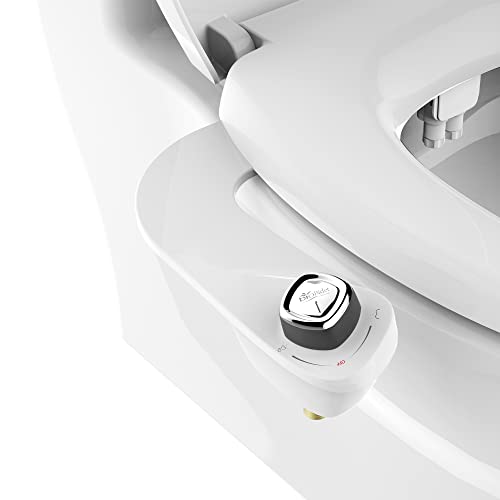
Bio Bidet SlimEdge Bidet Attachment — Best Slim Profile
The SlimEdge exists for the bowls the other attachments struggle with. Low water flush toilets often pair their small flush with a compact bowl and a close-coupled tank, leaving minimal room at the rear — and a thick attachment plate there can tilt the seat or foul the tank. Bio Bidet’s slim-edged design keeps the plate’s profile down while still delivering dual nozzles for front and rear wash with adjustable pressure. If your low-flush toilet is a compact model in a small bathroom, measure the rear clearance and then look here first.
Strengths
- Slim plate profile suits compact bowls and tight tank clearance
- Dual nozzles for front and rear wash despite the slim body
- Made to fit nearly all toilets, per the maker — helpful for unusual bowls
Trade-offs
- Cold water wash only
- Slim hardware means a compact control that some hands find small
- Like all attachments, seat must sit flat with the plate installed
| Format | Attachment, non-electric (per Amazon title) |
| Nozzles | Dual — front and rear wash (per Amazon title) |
| Control | Adjustable water pressure (per Amazon title) |
Fit is this pick’s whole argument, so let us be specific about the failure it prevents. An attachment plate that is too thick for the bowl’s rear geometry props the seat up at the back; the seat then flexes, the bumpers stop sharing load, and hinges creak and eventually crack — a slow failure owners blame on the seat. On compact low-flush bowls the margin for plate thickness is smallest, which is exactly where a slim-profile design earns its place. The SlimEdge keeps the seat’s posture honest.
Its wash offering is full-size despite the slim body: dual nozzles, front and rear, with pressure adjustment. Nothing about the water-saver pairing changes — supply-line draw only during the wash, no tank involvement, no flush interference — and the maker’s fit-nearly-all-toilets brief is genuinely useful for the less common low-flush bowls fitted in small bathrooms and cloakrooms, where a standard attachment’s plate can overhang the bowl’s rear curve.
Choose the SlimEdge by measurement, not by preference: if your bowl’s rear is compact, your tank sits close, or a trial dry-fit of a standard plate leaves the seat tilted, this is your attachment. If your low-flush toilet is a full-size elongated model with generous clearance, the LUXE picks give you the same wash with a longer track record in this guide’s ranking — but they cannot beat physics, and neither can you.
Best for: compact low-flush bowls and small bathrooms where rear clearance is tight / Not suited for: full-size bowls where a standard attachment already fits flat — unless you prefer the slim look

TUSHY Classic 3.0 Bidet Attachment — Best Pressure and Angle Control
The TUSHY Classic 3.0 is for the user who wants to aim. Its adjustable-pressure nozzle also offers angle control — a feature most attachments skip — and on a low water flush toilet that adjustability has a specific virtue: compact and water-saving bowls vary in geometry more than standard bowls, so a nozzle you can angle compensates for a bowl shape that a fixed nozzle might serve poorly. Add a self-cleaning sprayer and a brushed-nickel control that looks deliberate rather than clinical, and this is the attachment for buyers who care how the bathroom looks as well as how it works.
Strengths
- Nozzle angle control compensates for varied low-flush bowl shapes
- Adjustable pressure for a gentle, water-conscious wash
- Design-led controls in brushed nickel suit modern bathrooms
Trade-offs
- Single sprayer format rather than dual nozzles
- Cold water only
- Style and control features place it above basic attachments in tier
| Format | Attachment, non-electric (per Amazon title) |
| Nozzle | Self-cleaning sprayer, adjustable pressure, angle control (per Amazon title) |
| Finish | Brushed nickel control (per Amazon title) |
Angle control sounds like a flourish until you have lived with a fixed nozzle on an unusually shaped bowl. Low-flush design moves water differently — steeper bowl angles, different rear shelves — and the seated position relative to a fixed spray varies accordingly. A nozzle that angles lets each household set the wash to land correctly once, rather than asking every user to shuffle into the spray. For households with a user who has limited mobility and cannot shuffle, that set-once precision is not a flourish at all; it is the feature that makes the bidet usable.
TUSHY’s other contribution is presentational, and it should not be dismissed: attachments that look like medical equipment get resisted by partners and removed by landlords of the aesthetic. A control knob in brushed nickel that reads as a design choice keeps the bidet installed — and an installed bidet on a low-flush toilet is the only kind that saves water and tissue. The self-cleaning sprayer keeps the hygiene story equal to the LUXE picks.
Install follows the standard pattern with the usual low-flush courtesies: slim plate check, slow valve work, leak test, then spend two minutes dialling in angle and a gentle default pressure with the seat occupied by its actual user. Of all the attachments here, this is the one to choose when the bowl is an odd shape or the user needs the aim set precisely — and the one design-conscious bathrooms will keep.
Best for: unusually shaped low-flush bowls, users needing precise aim, and design-conscious bathrooms / Not suited for: buyers who specifically want separate dual nozzles for front and rear wash

Bio Bidet Slim Zero Non-Electric Bidet Seat, Elongated — Best Non-Electric Seat Option
Some low-flush households should skip attachments entirely and replace the seat. The Slim Zero is a full non-electric bidet seat in elongated fit with a low profile, dual nozzles and a slow-close lid. The low-flush argument for it is neatness: instead of a plate, hoses and a side knob added to a compact fixture, the whole wash system lives inside a seat designed for it, the supply connection is a single tidy line, and the seat sits exactly as a seat should. It suits elongated low-flush toilets whose owners want the finished result and are happy to retire their old seat.
Strengths
- Complete seat — no attachment plate, no seat-tilt risk on compact bowls
- Low profile keeps the finished seat height modest
- Dual nozzles and slow-close lid in a non-electric design
Trade-offs
- Elongated only — round low-flush bowls need a different answer
- Cold water only, and no heated seat
- Replaces your seat, so storage or disposal of the old one is on you
| Fit | Elongated (per Amazon title) |
| Profile | Low profile, slow-close lid (per Amazon title) |
| Nozzles | Dual (per Amazon title) |
| Power | Non-electric (per Amazon title) |
The seat format quietly solves the two attachment compromises that matter on water-savers. There is no plate, so the seat cannot sit propped at an angle on a compact bowl’s rear; and the nozzle housing is engineered into the seat’s rear, positioned for the elongated bowl it was designed around, rather than clipped under a seat of unknown geometry. On an elongated low-flush toilet — a very common modern pairing — that designed-in fit is the most robust install of any pick in this guide.
Low profile is the second half of the design brief and it matters on comfort-height water-savers, which already sit tall: the Slim Zero adds as little extra height as a bidet seat can, keeping feet planted and the sitting posture the toilet’s designer intended. The slow-close lid, mundane as it sounds, is the feature households mention most after a month — no slamming at night, no cracked-seat impacts on a ceramic rim.
Choose it when the toilet is elongated, the household wants a finished look, and cold water is acceptable — the same cold-water honesty as every pick here. If your low-flush toilet is round-front, this specific seat will not fit and the attachments above are your route; do not let a tidy concept talk you into the wrong shape, because a bidet seat in the wrong shape is worse than an attachment in the right one.
Best for: elongated low-flush toilets where a clean, integrated non-electric seat is preferred over an attachment / Not suited for: round-front low-flush toilets, or anyone wanting warm water

SAMODRA Ultra-Slim Bidet Attachment — Best Budget
The SAMODRA is the experiment-friendly pick: an ultra-slim attachment with dual nozzles for frontal and rear wash and adjustable fresh-water pressure, at the budget end of the market. For a low water flush toilet its ultra-slim body is the relevant spec — it asks little rear clearance of a compact bowl — and its price tier makes it the rational way to test whether a household takes to bidet washing before committing to a seat. Renters with a water-saver in a second bathroom, and the bidet-curious generally, start here.
Strengths
- Ultra-slim body suits compact low-flush bowls
- Dual nozzles and adjustable pressure at a budget tier
- Easy install makes it a low-risk first bidet
Trade-offs
- Budget build; controls and fittings feel lighter than premium picks
- Cold water only
- Long-term durability is the open question at this tier
| Format | Attachment, ultra-slim (per Amazon title) |
| Nozzles | Dual — frontal and rear wash (per Amazon title) |
| Control | Adjustable water pressure (per Amazon title) |
Budget attachments live or die on whether they cut the right corners, and the SAMODRA protects the essentials for this search: slimness for compact bowls, two nozzles rather than one, and a pressure control — the three things a low-flush pairing actually needs. Where the tier shows is in the hand: knob feel, hose and fitting finish, the small tactile qualities that separate a decade-long fixture from a trial device. For a first bidet, that trade is correct; you are buying information about your household’s habits as much as hardware.
The water story is unchanged from the premium picks, because physics does not charge by the tier: supply-line draw during the wash only, no tank involvement, no effect on the flush. A budget attachment that leaks, however, would waste a water-saver’s savings drip by drip — so the install discipline in this guide’s how-to matters most exactly here. Fit the T-valve carefully, leak-test slowly, and re-check the joints a day later; budget hardware rewards careful installation disproportionately.
Buy the SAMODRA to learn, with a plan: if the household converts — most do — upgrade the main bathroom to the LUXE or the Slim Zero seat in a year and let the SAMODRA serve a guest toilet. If the household does not convert, you have spent a budget-tier sum to find out, and the toilet’s water-saving mission continues undisturbed either way.
Best for: first-time bidet users and renters wanting a budget test on a low-flush toilet / Not suited for: buyers furnishing a forever bathroom who want premium fittings from day one
Comparison Table
| Pick | Badge | Key spec | Best for |
|---|---|---|---|
| LUXE Bidet NEO 120 Bidet Attachment | Best Overall | Single nozzle, non-electric, slim plate | any low water flush toilet where minimal interference and maximum simplicity are the priorities |
| LUXE Bidet NEO 185 Bidet Attachment | Best Dual Nozzle | Dual nozzle, non-electric | shared bathrooms on low-flush toilets needing both rear and feminine wash |
| Bio Bidet SlimEdge Bidet Attachment | Best Slim Profile | Slim plate, dual nozzle | compact low-flush bowls and small bathrooms where rear clearance is tight |
| TUSHY Classic 3.0 Bidet Attachment | Best Pressure and Angle Control | Angle + pressure control | unusually shaped low-flush bowls, users needing precise aim, and design-conscious bathrooms |
| Bio Bidet Slim Zero Non-Electric Bidet Seat, Elongated | Best Non-Electric Seat Option | Elongated non-electric seat, low profile | elongated low-flush toilets where a clean, integrated non-electric seat is preferred over an attachment |
| SAMODRA Ultra-Slim Bidet Attachment | Best Budget | Ultra-slim, dual nozzle, budget tier | first-time bidet users and renters wanting a budget test on a low-flush toilet |
How to Choose the Best Bidets to Install on Low Water Flush Toilets
Start by identifying exactly what your toilet is, because ‘low water flush’ covers three different machines. Gravity dual-flush models offer a light and full flush from a conventional tank. Single-flush high-efficiency models use 1.28 gallons or less through a tuned fill valve and flapper or tower. Pressure-assist models hide a sealed vessel in the tank and flush with a pressurised whoosh. Attachments and non-electric seats suit the first two without qualification. For pressure-assist, the T-valve still sits on the supply line outside the tank and attachments generally fit, but clearances are tighter and the stakes of a sloppy install are higher — the seat-format pick, or professional fitting, is the prudent route.
Next, measure the bowl’s rear. Compact low-flush bowls leave little room between the seat’s rear bolts and the tank; that measurement decides between a standard attachment, a slim-profile attachment and a replacement seat. Dry-fit thinking helps: your existing seat must still sit flat on its bumpers with the plate beneath it. If the seat rocks or tilts in your mental picture of the install — curved rear, close tank, sculpted seat — go straight to the slim picks or the seat.
Then set your wash requirements honestly. Rear-only washing satisfies most single users; shared households should default to dual nozzles. Pressure adjustability is non-negotiable on a water-saver, both for comfort and because the household’s whole point is flow discipline — a wash you can run gently is a wash that fits the toilet’s philosophy. Angle control is the tiebreaker feature for oddly shaped bowls and users with limited mobility. Buy in that order — fit, nozzles, pressure, angle — and the low-flush pairing will feel designed rather than improvised.
Will a Bidet Affect a Low Flush? The Water Maths, Honestly
The fear behind this search is that a bidet somehow borrows from the flush. It cannot: the bidet’s T-valve taps the supply line that feeds the toilet, and the bidet draws water only while its control is open — which is while you are seated, not while the toilet refills. The one moment of overlap is theoretical: if a wash ran during a tank refill, both would share supply pressure briefly, and a refill might take a few seconds longer. In practice the wash happens before or after flushing, and even pressure-assist vessels recharge from the same line without noticing an attachment’s existence.
Run the conservation numbers and the pairing looks better still. A gentle bidet wash uses a small fraction of a gallon. Households typically find that the wash replaces one or more hygiene flushes a day — the rinse-flush, the tissue-heavy second flush after a poor first result — and sharply cuts tissue use, which itself reduces the clog risk that causes double-flushing on low-volume fixtures. A 0.8 or 1.28 gallon toilet’s weakness is bulky tissue loads; a bidet directly attacks that weakness. Net water use in bidet households on low-flush toilets generally falls, provided the install does not drip — which is why this guide treats the leak check as a conservation measure, not just plumbing hygiene.
The exceptions deserve naming. A bidet left running by a child, a knob knocked open, or a perished hose washer wastes water exactly as any leak does; choose models with positive-feel controls and check joints monthly. And a macerating or upflush toilet — a different machine that pumps waste — should get its manufacturer’s guidance before any attachment is fitted, because its bowl and refill behaviour are not standard. For the mainstream gravity and pressure-assist low-flush toilets this guide addresses, the maths is settled: fit it properly and the bidet is the water-saver’s ally, not its enemy.
Pressure-Assist and Dual-Flush: Pairing Notes
Pressure-assist toilets flush hard with little water, and their owners reasonably ask whether an attachment changes that. The flush engine lives inside the tank and is sealed; an attachment lives outside it. The interactions to manage are physical, not hydraulic: the tank on a pressure-assist model can sit close to the seat’s rear, so plate slimness matters; and the supply stop and line on some installs are less accessible, so allow more time and better light for the T-valve work. If access is genuinely poor, the non-electric seat pick minimises the bowl-side hardware, and a plumber’s half-hour is money well spent rather than a defeat.
Dual-flush toilets pair with bidets almost philosophically: the household already thinks in terms of using the right amount of water for the job, and a bidet extends that thinking to washing. One practical note — on dual-flush models the light flush is calibrated for liquid waste, and bidet users often find the light flush sufficient more often, because the wash has already done the hygiene work. That is where the pairing quietly saves the most water over a year.
For both types, keep the toilet’s own maintenance schedule after fitting a bidet. Low-flush mechanisms reward owners who replace fill-valve seals and flappers on schedule; a bidet neither extends nor shortens those intervals, but the install is a good moment to inspect the supply line, the stop valve and the tank fittings you are working beside — you are there, the water is off, and a perished supply washer replaced today is a leak that never happens.
Keeping the Pairing Leak-Free and Efficient
A bidet on a water-saving toilet should be audited like the conservation device it is. Monthly, run a dry fingertip around the T-valve, hose ends and the toilet’s own supply joint; any dampness gets attention the same week. Every few months, confirm the attachment’s shutoff behaviour: the wash should stop fully when the control closes, with no lingering drip from the nozzle — a drip usually means grit in the valve or a washer asking to be replaced, both cheap fixes that protect the toilet’s water budget.
Nozzle care is the other half of efficiency. A mineral-narrowed nozzle sprays unevenly, users compensate with more pressure and longer washes, and the water maths quietly worsens. In hard-water homes, a gentle nozzle descale on the maker’s schedule keeps the spray as designed; the self-cleaning cycles on these picks handle the daily rinse, not the mineral. Soft-water households can relax — an annual look is plenty.
Finally, teach the household the gentle-default habit: set the pressure control to the lowest effective setting as the home position, especially with children, whose instinct is maximum. The pairing of a low-flush toilet and a bidet is a small system for using less water well; a household that understands it that way will keep both halves of the system honest for years.
How to Install a Bidet Attachment on a Low Water Flush Toilet
The install takes about half an hour and disturbs nothing inside the tank. Work slowly at the supply valve — on a water-saving toilet, the leak check at the end is a conservation measure as much as a plumbing one.
- Turn off the water at the toilet’s supply stop and flush to empty the tank. On a dual-flush model use the full flush. Sponge out residual tank water so disconnecting the supply line does not spill.
- Disconnect the supply line from the tank inlet and fit the T-valve in its place, keeping washers seated correctly. Reconnect the toilet’s supply to the T-valve’s outlet and the bidet hose to its branch. Hand-tighten, then a careful quarter turn — no more.
- Remove the toilet seat bolts and lift the seat. Position the attachment plate over the mounting holes with the nozzle toward the bowl rear, checking on compact bowls that the plate clears the bowl’s rear curve and does not foul the tank.
- Refit the seat over the plate and tighten the bolts evenly. Sit on the closed lid and confirm the seat rests flat on its bumpers with no tilt or rock — on a low-flush compact bowl this flatness check is the difference between a good install and a cracked hinge next year.
- Route the hose in a gentle curve with no kinks and no tension at either end, keeping it clear of the flush lever’s travel and any tank hardware.
- Open the supply stop slowly — a quarter turn at a time — and inspect every joint you touched with a dry fingertip and then a tissue, which shows damp earlier than skin does. Tighten any weeping joint a fraction and re-test.
- Run the wash with the seat down and a hand in the bowl to feel the spray: confirm it starts and stops cleanly with the control, lands centrally, and set a gentle default pressure as the household’s home position.
- Return after 24 hours and repeat the fingertip check on every joint. Fittings settle; a joint that is dry on day two is a joint you can trust, and on a water-saving toilet that check protects the savings the fixture was bought for.
Common Buying Mistakes
Working inside the tank unnecessarily. A bidet install touches the supply line and the seat bolts — nothing else. Owners who open a tuned low-flush tank ‘while they are there’ and disturb the fill valve create the very flush problems they feared from the bidet.
Over-tightening the T-valve. Hand-tight plus a quarter turn seals a washer joint. Cranking harder cracks fittings and deforms washers, turning a water-saving install into a slow leak.
Skipping the seat-flatness check. On compact low-flush bowls, a plate that props the seat up will crack hinges over time. If the seat cannot sit flat, switch to a slim-profile pick or the seat format instead of forcing it.
Leaving the pressure at maximum. A bidet on a water-saver should default to the lowest effective pressure. Maximum pressure wastes the water the toilet saves and makes first-time users — especially children — wary of the device.
Ignoring a weeping joint because it is ‘only a drip’. On any toilet a drip is waste; on a low-flush toilet it is the entire point undone, drip by drip. Fix weeps the week you find them.
Fitting an attachment to a macerating toilet without checking. Upflush and macerating fixtures behave differently from gravity and pressure-assist toilets. Confirm compatibility with the fixture maker before fitting anything to one.
Final Recommendation
For most low water flush toilets, the LUXE NEO 120 is the right first answer: the least hardware, a self-cleaning nozzle, adjustable pressure, and zero interference with the flush. Shared households should step to the NEO 185 for dual nozzles; compact bowls with tight clearance belong to the Bio Bidet SlimEdge; odd-shaped bowls and users needing precise aim belong to the TUSHY’s angle control. Elongated low-flush toilets that deserve a finished seat get the Slim Zero, and the bidet-curious start with the SAMODRA and upgrade once converted.
Hold the pairing’s two rules and it will serve the toilet’s mission rather than undermine it: disturb nothing inside the tank, and treat every joint’s dryness as a conservation duty. Fitted that way, a bidet does not compete with a low flush — it completes it, taking over the hygiene work that water volume was never good at, and letting the small flush do the one job it was designed for.
If you take one number away from this guide, let it be the direction of the water maths: a gentle wash uses a fraction of even a light flush, and it replaces flushes and tissue rather than adding to them. The low-flush toilet was bought to waste less. A properly fitted bidet is how it wastes less still.
- LUXE Bidet NEO 120 Bidet Attachment — Best Overall: Check the current price on Amazon
- LUXE Bidet NEO 185 Bidet Attachment — Best Dual Nozzle: Check the current price on Amazon
- Bio Bidet SlimEdge Bidet Attachment — Best Slim Profile: Check the current price on Amazon
Keep researching the cluster: Best Bidets Best Bidet Attachments Best Bidets For Long Toilets Best 0.8 Gpf Toilets Best 1.28 Gpf Toilets Best Dual Flush Toilets
Frequently Asked Questions
Will a bidet attachment reduce my toilet’s flush power?
No. The attachment draws water from the supply line only while you wash, and it connects outside the tank. The flush mechanism — flapper, tower or pressure vessel — receives exactly the water it was designed for. Flush performance after a correct install is identical to before it.
Can I fit a bidet to a pressure-assist toilet?
Generally yes, because the T-valve sits on the supply line outside the sealed pressure vessel. The cautions are physical: tank clearance at the bowl rear can be tight, favouring slim plates or the seat-format pick, and supply access is sometimes awkward. If access is poor, a plumber’s short visit is the sensible route.
Does a bidet waste the water my low-flush toilet saves?
Fitted without leaks, the opposite happens. A gentle wash uses a small fraction of a gallon and typically replaces hygiene flushes and reduces tissue loads — a common cause of double-flushing on low-volume toilets. The waste risk is a dripping joint or a nozzle left running, which is why this guide insists on leak checks.
Why are all the picks in this guide non-electric?
Deliberately. Non-electric models place the smallest demand on the supply line, need no outlet, and heat no water — matching the simplicity that low-flush buyers usually want. Electric seats can work on low-flush toilets, but their pumps and heaters add complexity this search’s readers are generally trying to avoid.
My low-flush toilet is a compact model. Which pick fits best?
Start with the slim-profile options: the Bio Bidet SlimEdge attachment or, for elongated bowls, the Slim Zero seat. Measure the rear clearance between seat bolts and tank first, and whatever you choose, confirm the seat sits flat on its bumpers after fitting — that check decides compact installs.
What about macerating or upflush toilets?
Treat them as a separate case. Their bowls, refill behaviour and pumping systems are not standard, so confirm bidet compatibility with the fixture manufacturer before fitting an attachment. This guide’s picks and instructions address gravity dual-flush, high-efficiency and pressure-assist low-flush toilets.


