Disclosure: airfryerkitchensupply.com is reader-supported. When you buy through links on our site, we may earn an affiliate commission at no extra cost to you.
Where to buy
Shopping for the best bbq grills under 500 dollars starts with verified listings, not with the loudest discount banner. Every pick was verified against a live Amazon listing, and specifications are quoted only from those listings. This guide prints no prices, because grill pricing moves too often for print to stay honest — check the current price on Amazon for each pick, and read the under-$500 figure as the budget frame these models are positioned within.
- Weber Spirit E-310 Gas Grill (Best Overall) — Check the current price on Amazon
- Traeger Pro 22 Wood Pellet Grill & Smoker (Best Pellet Grill) — Check the current price on Amazon
- Nexgrill Deluxe 5-Burner Gas Grill with Ceramic Side Burner (Best for Big Families) — Check the current price on Amazon
- Royal Gourmet GA5401T 5-Burner BBQ Propane Gas Grill with Side Burner (Best Value 5-Burner) — Check the current price on Amazon
- Char-Griller AKORN 20-Inch Kamado Charcoal Grill and Smoker (Best Kamado) — Check the current price on Amazon
- Weber Lumin Compact Portable Electric Grill (Best Electric) — Check the current price on Amazon
The Best BBQ Grills Under 500 Dollars: Premium Gas and the First Pellet Grills Arrive
The best bbq grills under 500 dollars mark the tier where grilling’s two modern promises arrive at once. The premium gas lines begin here — the Weber Spirit in this guide, with cast-iron grates and an ignition system built like it matters — and the first pellet grills from real brands appear beside them, offering set-and-forget smoking that charcoal cannot match for convenience. The best bbq grills under 500 are not bigger versions of the cheap tiers; they are the entry to a different class of ownership, where build quality, parts support and cooking systems replace raw size as the things your money buys.
Notice what the money does to the gas category. At lower frames, gas picks came with apologies about firebox steel and grate coatings. The Spirit E-310 needs none: porcelain-enameled cast-iron grates that sear and endure, three burners under a compact footprint, and the deepest parts and accessory ecosystem in the industry behind it. Beside it, the Traeger Pro 22 introduces pellet cooking honestly — 572 square inches, a meat probe, and the wood-fired flavor that has converted a generation of gas owners.
Charcoal does not disappear at this frame; it specializes. The kamado remains the efficiency and versatility pick, and the big five-burner value gas grills serve the crowd-feeders. But the center of gravity has shifted: this tier is where most buyers should land if grilling is a weekly habit and the grill is a five-to-ten-year purchase. The reviews below are written for that buyer.
In this guide
Quick Picks
Six picks, six different jobs. Every model below was verified on Amazon, and each badge is used consistently through the reviews that follow, so you can scan this list now and read the reasoning after.
Weber Spirit E-310 Gas Grill — Best Overall. The premium gas benchmark: three burners, porcelain-enameled cast-iron grates and Snap-Jet ignition in a compact footprint — the gas grill this tier exists to buy. Check on Amazon
Traeger Pro 22 Wood Pellet Grill & Smoker — Best Pellet Grill. The original pellet workhorse: 572 square inches, 6-in-1 versatility, a meat probe and an 18 lb hopper — wood-fired smoking with the thermostat doing the tending. Check on Amazon
Nexgrill Deluxe 5-Burner Gas Grill with Ceramic Side Burner — Best for Big Families. Five burners, 65,000 BTU and a ceramic side burner: the crowd-capacity gas pick, sized and powered for households that cook for eight as a habit. Check on Amazon
Royal Gourmet GA5401T 5-Burner BBQ Propane Gas Grill with Side Burner — Best Value 5-Burner. Five burners, 61,000 BTU and a side burner in stainless, at the value end of the frame: the capacity-per-dollar champion for buyers who prioritize size done sensibly. Check on Amazon
Char-Griller AKORN 20-Inch Kamado Charcoal Grill and Smoker — Best Kamado. The insulated steel kamado holds its place in this tier on merit: smoking, roasting and searing in one fuel-sipping body for charcoal cooks who value control. Check on Amazon
Weber Lumin Compact Portable Electric Grill — Best Electric. Weber’s compact electric: a lightweight, small-space grill with premium-brand backing, for balconies and patios where flame is banned but standards are not. Check on Amazon
How These Picks Were Chosen
Selection at this tier inverted the budget logic: instead of asking what a grill includes, we asked what it will cost to own. Each pick had to come from a brand with a mature parts catalog, a warranty culture and a model line stable enough that a grate or igniter ordered in five years will fit. We then matched each surviving grill to the job it does best — premium gas, pellet smoking, crowd capacity, kamado versatility, electric convenience — because at this money, a grill is a long relationship and fit matters more than rank.
All six picks were verified against their live listings, with specifications quoted from the listings themselves. Models that reached this frame on feature lists rather than build — extra burners on thin fireboxes, electronics without parts support — were excluded, and the reviews say why their category rivals made the cut instead. What remains is a short list of grills we would each own, assigned to the households they suit, with the non-buyers named as carefully as the buyers.
The 6 Best BBQ Grills Under $500

Weber Spirit E-310 Gas Grill — Best Overall
The Spirit E-310 is for the household that grills two to four times a week and wants gas to feel like a quality appliance rather than a seasonal toy. Its cast-iron grates are the headline: they hold heat for real sear marks, they are porcelain-enameled against rust, and they will outlast several sets of the coated grates on cheaper carts. The compact three-burner layout fits normal patios while still zoning properly, and the Weber Works rails hint at the accessory ecosystem that makes this a platform, not just a grill.
Strengths
- Porcelain-enameled cast-iron grates sear and endure
- Snap-Jet ignition and a refined burner design
- Deepest parts and accessory support in the industry
Trade-offs
- Three burners — big-party capacity lives elsewhere
- No side burner on this model
- Premium brand pricing within the frame
| Specification | Detail (from the Amazon listing) |
|---|---|
| Fuel | Propane gas |
| Burners | 3 |
| Grates | Porcelain-enameled cast iron |
| Ignition | Snap-Jet |
| Extras | Weber Works rails |
What you are buying with the Spirit is the absence of the usual gas-grill decay curve. The firebox is built to resist the rust that kills cheap carts, the ignition is a system rather than a button of hope, and when something does wear in year six, the part exists and fits. Cooking-wise it is everything a three-burner should be: fast preheats, even zones, and grates that put steakhouse marks on a ribeye. Households that measure a grill in dinners per week and years per purchase will find this the most satisfying gas spend in the guide series so far.
Best for: Frequent gas grillers who want premium build, cast-iron grates and decade-grade parts support / Not suited for: Hosts who need five-burner capacity or a side burner included

Traeger Pro 22 Wood Pellet Grill & Smoker — Best Pellet Grill
The Traeger Pro 22 is for the cook who wants smoked food on a schedule rather than as a project. Load the hopper, set the temperature, insert the probe, and the grill feeds pellets and holds its band while you work, host or sleep. Its 6-in-1 brief — smoke, grill, bake, roast, braise, barbecue — is honest within its 450°F ceiling: it is a superb smoker and roaster, a good baker, and a moderate searing tool. Weeknight pellet owners are made by exactly this reliability.
Strengths
- Set-and-forget temperature control for long smokes
- 572 sq. in. fits briskets, rib racks and whole birds
- Meat probe and 18 lb hopper support overnight cooks
Trade-offs
- 450°F ceiling limits hard searing
- Pellet consumption is a real running cost
- Needs electricity and dry pellet storage
| Specification | Detail (from the Amazon listing) |
|---|---|
| Fuel | Wood pellets |
| Cooking area | 572 sq. in. |
| Max temp | 450°F |
| Hopper | 18 lb |
| Extras | Meat probe, 6-in-1 versatility |
Pellet grilling’s bargain is attention: you trade the romance of fire-tending for repeatability, and the Pro 22 is the machine that defined the trade. Brisket at a steady low band for twelve hours, ribs that need no wrapping decisions at 3 a.m., chickens roasted with wood flavor while you make the sides — this is its native country. The ceiling is searing; finish steaks in a cast-iron pan or over the kamado if you own both. As a first pellet grill or a household’s dedicated smoker, it remains the reference point everything else in the class is compared against.
Best for: Smoke lovers who want wood flavor with thermostat convenience and overnight capability / Not suited for: Sear-first cooks or off-grid users without reliable power
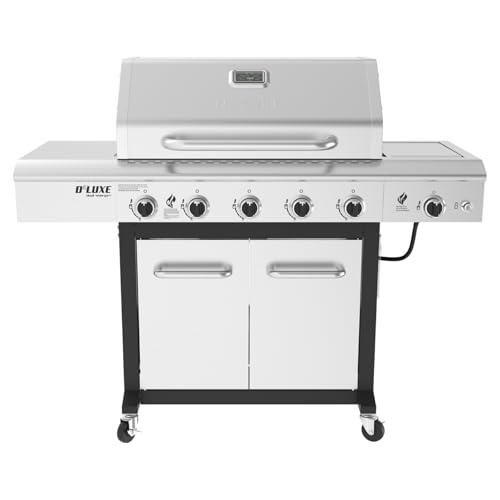
Nexgrill Deluxe 5-Burner Gas Grill with Ceramic Side Burner — Best for Big Families
Choose the Deluxe 5-Burner if your normal cook is a crowd: five main burners spread serious output across a wide grate, the ceramic side burner handles the pot work, and the side table gives you landing space that big cooks always run out of. It suits big families, team parents and entertainers whose grill is a production station, and who would rather own capacity they use weekly than elegance they admire.
Strengths
- Five burners and 65,000 BTU for genuine crowd capacity
- Ceramic side burner for pots, sauces and sides
- Built-in thermometer and side table for workflow
Trade-offs
- Large footprint anchors a patio corner
- More burners to clean and maintain
- Charcoal and pellet picks here beat it on flavor
| Specification | Detail (from the Amazon listing) |
|---|---|
| Fuel | Propane gas |
| Burners | 5 + ceramic side burner |
| Output | 65,000 BTU |
| Extras | Built-in thermometer, side table |
Capacity grills fail in two ways: not enough output for the grate, or zones too narrow to use. This one avoids both — the output matches the acreage, and five burners zone into a searing field, a roasting field and a warming field simultaneously, which is how you feed ten people food that is all hot at once. The ceramic side burner is more than a spec: it boils corn and simmers beans at real power while the main grate works. It is a lot of grill, and households that will use it as such get their money’s worth every single weekend.
Best for: Big families and entertainers cooking for crowds every week / Not suited for: Small households or flavor-first cooks choosing a single grill

Royal Gourmet GA5401T 5-Burner BBQ Propane Gas Grill with Side Burner — Best Value 5-Burner
The GA5401T serves the buyer who needs five-burner room but would rather keep the premium-brand money in the bank. Its formula is capacity with the essentials right — strong total output, a side burner, stainless construction — without paying for a badge or an accessory ecosystem. For a big household adding a grill station for parties and family volume, it is the pragmatic route to a wide grate.
Strengths
- Five burners plus side burner at a value position
- 61,000 BTU output suits the grate size
- Stainless steel body for outdoor life
Trade-offs
- Parts ecosystem thinner than the premium brands
- Fit and finish a step below the Spirit class
- No headline cooking system — it is a straightforward cart
| Specification | Detail (from the Amazon listing) |
|---|---|
| Fuel | Propane gas |
| Burners | 5 + side burner |
| Output | 61,000 BTU |
| Body | Stainless steel |
Value five-burners live or die on whether the basics were funded, and here they were: the output is proportioned, the layout zones sensibly, and the stainless body suits a covered patio life. What you give up against the premium lines is refinement — ignition feel, grate heft, the depth of parts support in year seven. For a household whose grill works hard for five seasons of parties rather than posing for a decade, that can be the right trade. Buy it with a cover, keep the burners brushed, and it will feed a crowd without drama.
Best for: Capacity-first households wanting five burners and a side burner without premium pricing / Not suited for: Decade-horizon buyers who prize parts depth and refinement

Char-Griller AKORN 20-Inch Kamado Charcoal Grill and Smoker — Best Kamado
The AKORN’s presence in a tier with premium gas and pellet stars is a statement about range: no other pick here smokes as efficiently, sears as fiercely and roasts as evenly on a bag of lump charcoal. It suits the charcoal cook who looked at pellet convenience and still prefers a real fire — one that, thanks to insulation, needs almost as little attention. As a second grill beside gas, it is the flavor instrument; as an only grill, it is the versatile one.
Strengths
- Triple-wall insulation for steady, fuel-thrifty cooks
- Cast iron grates and genuine high-heat searing
- No electricity, no pellets, no gas lines — just lump charcoal
Trade-offs
- 20-inch grate versus the gas picks’ acreage
- Charcoal startup time on every cook
- Steel body requires cover discipline
| Specification | Detail (from the Amazon listing) |
|---|---|
| Fuel | Charcoal (kamado) |
| Grill size | 20-inch kamado |
| Body | Triple-wall insulated steel |
| Grates | Cast iron |
Kamado economics sharpen at this tier: against pellet running costs and gas refill cycles, the AKORN’s handful-of-lump per cook is the cheapest serious cooking in the guide, and its flavor is the reference the others chase. Its discipline is the familiar one — set vents early, trust the walls, keep it covered. Households deciding between this and the Traeger are really deciding between tending a small fire beautifully and not tending one at all; both are honorable, and this is the finest version of the first at anywhere near this money.
Best for: Charcoal cooks who want kamado range and efficiency as a primary or second grill / Not suited for: Set-and-forget households that prefer a thermostat to a fire

Weber Lumin Compact Portable Electric Grill — Best Electric
The Lumin Compact is for the buyer under a flame ban who refuses the disposable-appliance route. It is deliberately small — a compact, lightweight unit designed for small spaces — and deliberately Weber, which means design care and parts support behind an electric grill, a category usually abandoned by its makers. Couples and small households on balconies get a tidy, store-able grill that behaves like an appliance and cooks like it means it.
Strengths
- Compact and lightweight — stores indoors easily
- Premium brand design and support behind an electric
- Legal anywhere an outlet is allowed
Trade-offs
- Compact surface means batch cooking for groups
- Electric heat cannot match charcoal’s crust
- Cord dictates placement
| Specification | Detail (from the Amazon listing) |
|---|---|
| Fuel | Electric |
| Format | Compact portable, lightweight |
| Fit | Designed for small spaces |
Electric grills are usually bought apologetically; the Lumin is the one to buy on purpose. Its compact format is the feature — it lives on a small balcony, stores in a closet, travels to a cabin — and its heat management is a cut above the category’s steaming norm, giving small batches of burgers, fish and vegetables a proper grilled character. It will not feed a party or smoke a shoulder, and it does not pretend to. For the small-space household that grills for two, it is the most honest tool in this tier.
Best for: Small households and balcony cooks under flame bans who want quality in a compact electric / Not suited for: Crowd feeders or anyone expecting charcoal-style searing
Comparison Table
| Pick | Badge | Key spec | Best for |
|---|---|---|---|
| Weber Spirit E-310 Gas Grill | Best Overall | Fuel: Propane gas; Burners: 3 | Frequent gas grillers who want premium build, cast-iron grates and decade-grade parts support |
| Traeger Pro 22 Wood Pellet Grill & Smoker | Best Pellet Grill | Fuel: Wood pellets; Cooking area: 572 sq. in. | Smoke lovers who want wood flavor with thermostat convenience and overnight capability |
| Nexgrill Deluxe 5-Burner Gas Grill with Ceramic Side Burner | Best for Big Families | Fuel: Propane gas; Burners: 5 + ceramic side burner | Big families and entertainers cooking for crowds every week |
| Royal Gourmet GA5401T 5-Burner BBQ Propane Gas Grill with Side Burner | Best Value 5-Burner | Fuel: Propane gas; Burners: 5 + side burner | Capacity-first households wanting five burners and a side burner without premium pricing |
| Char-Griller AKORN 20-Inch Kamado Charcoal Grill and Smoker | Best Kamado | Fuel: Charcoal (kamado); Grill size: 20-inch kamado | Charcoal cooks who want kamado range and efficiency as a primary or second grill |
| Weber Lumin Compact Portable Electric Grill | Best Electric | Fuel: Electric; Format: Compact portable, lightweight | Small households and balcony cooks under flame bans who want quality in a compact electric |
How to Choose Among the Best BBQ Grills Under 500
This tier’s first question is gas or pellet, because the two headline picks embody opposite philosophies. Gas (the Spirit) is instant, precise and flavor-neutral: it grills tonight’s dinner superbly and asks for a tank refill now and then. Pellet (the Traeger) is scheduled and flavorful: it smokes and roasts with wood character and thermostat calm, and asks for pellets, power and a higher running cost. Households that grill more than they smoke should take gas; households that smoke more than they grill should take pellet; households that do both heavily are the two-grill households this tier often creates, with the kamado as the flavor-focused alternative to either.
The second question is horizon. At this money you are buying five-to-ten-year appliances, so weight the ownership factors: parts availability, grate material, ignition design, cover fit. The premium brands earn their frame position on exactly these unglamorous axes. Third, be honest about capacity: the five-burner picks are production stations for households that cook big weekly; for a family of four, the Spirit’s three burners will never feel small, and its build will feel better every single day. Buy the grill your calendar describes, at the build level your horizon demands.
Pellet Grills Explained: What the Convenience Actually Costs
A pellet grill is a wood-fired oven with a thermostat: an auger feeds compressed wood pellets into a fire pot, a fan stokes the fire, and a controller holds the set temperature the way your kitchen oven does. The flavor is real wood smoke, gentler and cleaner than charcoal smoke, and the skill shifts from fire management to planning — choosing pellets, timing cooks, trusting probes. For brisket, ribs, pork shoulder and whole poultry, it is the most forgiving serious cooking method ever sold, which is why the category keeps converting charcoal owners who got busy.
The costs are equally real. Pellets are a consumable you buy by the bag forever, and consumption rises in cold weather as the grill burns fuel to hold temperature. The grill needs household power, dry pellet storage, and periodic vacuuming of ash from the fire pot. Its ceiling temperature — 450°F on the Pro 22 — sears politely, not fiercely. None of this diminishes the Traeger’s case; it defines it. Buyers who want smoke flavor with weekday reliability accept the running costs gladly. Buyers who grill steaks twice a week and smoke twice a year should buy the gas or kamado pick and rent the smoke experience occasionally instead.
Cast-Iron Grates and Other Build Details Worth Paying For
At this frame the specification sheet matters less than the materials list, and one item leads it: the grates. Porcelain-enameled cast iron, as on the Spirit, is the gas standard worth paying for — heavy enough to hold searing heat when cold food lands, enameled against the rust that eats bare iron, and durable enough to be a decade part. Thin porcelain-coated steel, by contrast, is a consumable wearing a costume. When you compare any two grills in this tier, lift the grate story first: it predicts both the sear and the service life.
After grates, audit the ignition (a named system beats a generic button), the firebox (formed and coated to resist rust-through), the grease path (a tray you can actually remove and clean beats a cup you cannot reach), and the parts page (if the brand sells grates, burners, igniters and covers for your exact model, you are buying into a product line). These are the details that separate this tier from the ones below, and they are all present in the picks above — which is precisely why those picks, and not their longer-feature-listed rivals, are the ones in this guide.
How to Smoke a Brisket on a Pellet Grill (and Adapt It to the Kamado)
Pellet brisket is a study in doing less, correctly. Trim the brisket to a smooth shape with the fat cap at about a quarter inch, season it generously with salt and coarse pepper, and let it sit while the grill comes to a low smoking temperature with the hopper full. Place the brisket fat-side toward the heat source, insert the meat probe, close the lid, and then honor the pellet grill’s whole philosophy: do not open it to look. The controller holds the band, the pellets feed themselves, and your job reduces to watching the probe and planning the rest — wrapping when the bark is set and the temperature stalls, if that is your method, and resting the finished brisket, wrapped, for at least an hour before slicing.
On the AKORN kamado in this guide, the same cook runs on the snake-like discipline of kamado smoking: a full firebox of lump with wood chunks, one small lit point, vents closed down early so the insulated body settles into the band from below. The kamado will use a fraction of the fuel and ask for a fraction more faith, since there is no controller — only your vent settings and the walls’ stability. Either way, the transferable lessons are identical: temperature stability beats temperature drama, the probe beats the clock, and the rest is not optional. Brisket forgives many things; impatience is not one of them.
Two Households, Two Answers: A Tale of This Tier
Consider two households spending this frame. The first grills four nights a week — chicken thighs on Monday, salmon on Wednesday, burgers on Friday, a roast on Sunday — and its enemy is friction: slow preheats, unreliable ignition, grates that rust between cooks. For them the Spirit E-310 is not a purchase but a removal of obstacles: it lights, it sears on cast iron, it zones, it cleans down in minutes, and its tenth year is visible from its first. Their second choice, honestly weighed, was the kamado — declined not on merit but on arithmetic: charcoal’s lighting time, multiplied by two hundred weeknight cooks a year, was the one cost they would pay daily.
The second household cooks outdoors twice a month, but cooks events: a brisket that starts Friday night, ribs for the extended family, a turkey at the holiday. Their enemy is attention — nobody wants to babysit a fire through the night — and for them the Traeger Pro 22 is the same kind of removal: the hopper filled, the probe set, the temperature held by the machine while the household sleeps. Their second choice was the AKORN, declined on the mirror-image arithmetic: its tending is light, but it is not zero, and zero was the point. Both households bought correctly, and neither could have swapped grills without regret — the cleanest demonstration in this series that at this tier, fit is the whole game.
The remaining picks serve the households around those poles: the big-family Nexgrill and value Royal Gourmet for volume as a lifestyle, the Lumin for the small balcony with high standards. If you are still undecided after the reviews, borrow the method: write down your last twenty outdoor cooks — the real ones, with dates — and buy the grill that would have made the majority of them easier. The list never lies, and at this money it should be obeyed.
The Five-Year Ledger: What This Tier Really Costs to Own
Run the five-year numbers honestly and this tier’s economics clarify. The Spirit’s ledger is the shortest: propane at a household rhythm, a set of wear parts somewhere in the middle years, a cover — and no second grill purchase, which is where cheaper tiers quietly spend their savings. The Traeger’s ledger is the most itemized: pellets are a real line, bag after bag, joined by power, foil, and the occasional igniter or auger part from a catalog that stocks them; in exchange it deletes the most expensive input of all, the cook’s attention, from hundreds of hours of smoking. Both ledgers are defensible. What is not defensible is the ledger nobody writes — the cheap grill replaced twice in the same five years, each time with a season of declining cooks before it.
The value picks complicate the story usefully. The Royal Gourmet’s five-year ledger can beat the Spirit’s on paper for a household that cooks big and often — capacity used weekly is value realized weekly — provided its parts are ordered when needed rather than mourned. The Nexgrill Deluxe splits the difference. And the AKORN’s ledger remains the minimalist poem of the series: lump charcoal, a gasket someday, a grate eventually — the lowest running cost of any serious cooker we have ever priced, for households whose time beside a fire is pleasure rather than cost.
The point of the ledger is not to crown a winner; it is to move the decision from the showroom to the calendar. A grill at this frame is a five-to-ten-year appliance whose purchase price is merely its first line. Choose the ledger whose shape matches your household — attention-rich or attention-poor, volume or intimacy, fuel-indifferent or fuel-devoted — and the model chooses itself, which is what a buying guide is for.
Assembly Day and Your First Three Cooks
Premium assembly has a different texture: the parts fit the way appliance parts should, and the sessions reward method over speed. The Spirit’s build is the benchmark — clear sequencing, hardware that threads true — finishing with the leak test and a first ignition that should light every burner, every time; if it does not, that is a day-one warranty conversation, not a quirk to live with. The Traeger’s assembly ends with its own ritual: the initial burn-in, run hot and empty to cure the interior and season the system, and the first pellet load — prime the auger as directed, and store the rest of the bag sealed and dry from that moment forward, because pellet discipline starts on day one or not at all. The big value carts want the full two-person session; the AKORN wants its gasket test; the Lumin wants a wiped surface and one patient preheat.
Debut cooks at this tier should be signatures at full voice. The Spirit debuts with steaks on its cast iron — the sear is the reason for the grates, and the first cook should hear it. The Traeger debuts with the cook that justifies the category: ribs or a shoulder, probe in, lid closed, the household doing other things — the debut is the absence of the cook from the patio, and it should be experienced immediately. The Nexgrill Deluxe debuts at volume, a full family load zoned across five burners. The Royal Gourmet debuts the same way, proving its throughput claim. The AKORN debuts low. The Lumin debuts small and perfect: two servings, properly browned, on a balcony that was never allowed a grill before.
By the third cook, owners at this level should be building the records the decade will use: the Spirit’s zone map for your common loads, the Traeger’s pellet consumption per cook in your climate, the kamado’s vent settings by season. This sounds like homework and functions like wealth — every future cook draws on it. Premium grills are instruments with long lives, and the households that treat the first three cooks as calibration get a decade of repeatability in exchange for a weekend of attention.
Close assembly day with the ownership setup: warranties registered, model plates photographed, covers fitted, the spare tank or pellet store established, and the maintenance calendar from our other guides pinned inside a kitchen cabinet. At this frame the grill is joining the household’s appliance fleet — treat its paperwork like the furnace’s, and its service life will resemble the furnace’s too: long, boring and exactly as intended.
Placement, Clearances and Safe Habits at This Tier
Premium equipment concentrates heat and value in one place, and placement should honor both. The Spirit and the big carts sit on level, non-combustible ground with the manufacturer’s clearances respected — premium fireboxes run hot by design, and the space behind the grill is a working corridor, not storage for the tank cover and the charcoal bag. The Traeger adds its own geography: pellets stored dry and indoors-adjacent, the hopper never filled from a damp bag, the grill itself positioned so its fan-driven exhaust drifts clear of seating, and its cord routed dry. The kamado keeps its corner and its long cooling hours. The Lumin, smallest here, wants the firmest rule of all: a stable surface and a circuit that can carry it without sharing with the patio’s other ambitions.
The safety program at this level is mostly the maintenance program wearing its other hat. Grease trays emptied on schedule are fire prevention; burners brushed and ports clear are flare prevention; the pellet fire pot vacuumed on rhythm is the difference between a controlled burn and a hopper incident — pellet owners should treat that single chore as sacred. Gas connections get the soapy-water test at season start and tank changes, without exception, at every tier but with flagship consequences here. Keep the extinguisher current and reachable, keep the lit grill attended, and teach the hot zone to every guest the way you teach it to your own household. Premium grills reward premium habits with decades; the habits are the cheaper half of the bargain.
Common Buying Mistakes
Buying pellet capacity for a grilling habit
A pellet grill used only for burgers is an expensive, slow-preheating oven. If your logbook is weeknight grilling, the Spirit serves you better; pellets earn their keep on households that smoke and roast regularly.
Judging gas grills by burner count instead of grate material
Five burners over thin coated grates cook worse, and age faster, than three burners under cast iron. At this frame, grate material and firebox build are the specification; burners are the layout.
Letting pellets get damp
Pellet grills are only as reliable as their fuel. Pellets stored in a humid garage swell, crumble and jam augers. Store them sealed and dry, and empty the hopper before long wet spells if the grill lives outdoors.
Skipping the cover on a premium grill
Premium build delays weather damage; it does not repeal it. A fitted cover on a Spirit, Traeger or AKORN is the cheapest decade you will ever buy, and grease trays emptied on schedule prevent the flare-ups that age a grill from inside.
Expecting one grill to sear like charcoal and smoke like a pellet
Every pick here has a native country. The Traeger’s ceiling is searing; the Spirit’s is smoke. Buy for your majority menu and borrow the minority skill — a cast-iron pan, a smoker tube — rather than demanding both from one firebox.
Final Recommendation
The Weber Spirit E-310 is this tier’s default: the premium gas grill against which the frame is measured. Smoke-first households should take the Traeger Pro 22 and its thermostat calm, crowd-feeders the Nexgrill Deluxe 5-Burner or the value Royal Gourmet GA5401T, charcoal loyalists the AKORN, and flame-banned small spaces the Weber Lumin Compact. Every one of them is a five-year answer rather than a one-season purchase.
Still calibrating the budget? The frame below, Best Bbq Grills Under $350, completes the charcoal story for less, while Best Bbq Grills Under $600 and Best Bbq Grills Under $1000 deepen the premium gas and pellet fields. Buyers torn between gas and charcoal in a single unit should read Best Bbq Combo Grills before committing to either fuel alone.
If you are ready to buy, start with the top of the list: Weber Spirit E-310 Gas Grill, Traeger Pro 22 Wood Pellet Grill & Smoker, Nexgrill Deluxe 5-Burner Gas Grill with Ceramic Side Burner — and check the current price on Amazon for the configuration you choose.
Frequently Asked Questions
Gas or pellet — which is the better buy at this tier?
It depends on your logbook. Gas wins for frequent, fast grilling with minimal running cost and no power requirement. Pellet wins for smoking, roasting and wood flavor with minimal attention. Count your last twenty outdoor cooks: the majority fuel is your answer, and both headline picks here are the reference models of their kind.
How long will a Spirit-class grill actually last?
With a cover and routine care — grates brushed, grease tray emptied, burners checked yearly — a premium three-burner should serve a decade, with igniters and flavorizer-style wear parts replaced along the way from a deep parts catalog. Longevity is this tier’s whole argument, and the Spirit class is built to make it.
Can a pellet grill be my only grill?
For households that roast and smoke more than they sear, yes. Its 450°F ceiling on the Pro 22 handles burgers and chicken happily, but steakhouse crusts want a hotter finish — a cast-iron pan on the stove or a charcoal chimney starter setup covers that gap cheaply. Sear-first households should keep gas or charcoal as the primary.
Are five burners worth it for a family of four?
Usually not. Three burners zone perfectly for four servings and preheat faster on less fuel. Five burners earn their footprint when eight-plus servings are a weekly event. Buy the capacity your calendar uses; unused burners are just more parts to clean.
What pellets should I buy, and does the wood type matter?
Food-grade hardwood pellets from an established maker; avoid heating pellets entirely. Wood type matters gently — oak and hickory for beef, fruitwoods for pork and poultry — but freshness and dryness matter more. A mid-quality pellet stored dry outperforms a premium pellet stored damp every time.
Is the Lumin worth it beside full-size electrics?
For small households, its compactness is the value: it stores indoors, lives on a small balcony and still carries premium design and support. If you regularly cook for four or more under a flame ban, a larger electric surface suits you better; for one to three servings, the Lumin’s size is a feature, not a limit.
Do pellet grills work in the rain?
Light rain, under a cover between cooks, is normal life for a pellet grill; the Z Grills in our wider guides even bundles a rain cover. What pellets cannot survive is moisture in the fuel itself — a damp hopper load swells and jams. Keep the grill covered, the pellets sealed and dry, and weather becomes a footnote rather than a failure mode.
Spirit E-310 or the five-burner value picks — how do I decide?
Count servings honestly. If eight-plus is a weekly reality, capacity wins and the value picks serve you. If four is the norm and eight is a holiday, the Spirit’s build, grates and support will please you every single day, and holidays can be cooked in two calm batches. Frequency beats peak: buy for the cook you repeat.
Is it worth buying a cover and accessories from the same brand?
The cover, yes, when a fitted version exists: it is cut for the vents, handles and shelves of your exact model, sheds water instead of pooling it, and stays on in weather that removes generic tarps to the neighbor’s yard. Other accessories should be bought on merit rather than badge — a probe thermometer, spatula or brush is a tool, and the best tool wins regardless of logo. The exception is replacement parts, where the brand’s own catalog is the only safe source. Think of it as three categories: fit-critical items from the brand, tools from whoever makes them best, and parts from the brand always. That rule will serve every tier in this series, and it starts mattering exactly here, where the equipment becomes worth fitting properly.


