Disclosure: airfryerkitchensupply.com is reader-supported. When you buy through links on our site, we may earn an affiliate commission at no extra cost to you.
Where to buy
Shopping for the best bbq grills under 1000 dollars starts with verified listings, not with the loudest discount banner. Every pick was verified against a live Amazon listing, and all specifications are quoted from those listings alone. This guide deliberately prints no prices — at this level they vary by configuration and season — so check the current price on Amazon for the exact model you want, and read the under-$1000 figure as the budget frame these grills are positioned within.
- Weber Genesis E-415 Gas Grill (Best Overall) — Check the current price on Amazon
- Weber Spirit E-435 Gas Grill (Best All-Rounder) — Check the current price on Amazon
- Pit Boss 850 Navigator Series Wood Pellet Grill & Smoker (Best Pellet Grill) — Check the current price on Amazon
- Char-Broil Pro Series Amplifire Infrared 4-Burner Propane Gas Grill Cabinet (Best Infrared) — Check the current price on Amazon
- Traeger Pro 22 Wood Pellet Grill & Smoker (Best Pellet Classic) — Check the current price on Amazon
- Nexgrill Deluxe 5-Burner Gas Grill with Ceramic Side Burner (Best Value Capacity) — Check the current price on Amazon
The Best BBQ Grills Under 1000 Dollars: The Genesis Class and Connected Pellet Grills
The best bbq grills under 1000 dollars are where grilling becomes a serious appliance purchase — and where the best bbq grills under 1000 reward buyers who think in decades. The Weber Genesis leads this guide: four PureBlu burners under porcelain-enameled cast iron, in a firebox built with the heft that separates a ten-year grill from a five-year one. Around it gather the connected pellet grills with WiFi control, the four-burner Spirit with its sear zone and side burner, and the infrared and value stations that give this frame its range. This is the tier where ‘buy it once’ stops being a slogan.
What the money buys here is not primarily size — several picks below this frame are physically larger. It buys construction depth: thicker fireboxes, better burners, cast-iron grates, ignition systems engineered rather than assembled, and parts catalogs that will still answer in a decade. It also buys integration: pellet grills that report to your phone, gas grills with work-surface ecosystems. The enthusiast who cooks three times a week will feel the difference in this tier every single cook, in the preheat speed, the zone evenness and the absence of small annoyances.
It is also the tier where honesty about the top matters: above this frame sit the statement grills — built-ins, luxury kamados, commercial-scale pellet machines. For a freestanding patio grill bought on Amazon, this frame is effectively the summit for most households, and the picks below are the ones we would defend at a decade’s distance.
In this guide
Quick Picks
Six picks, six different jobs. Every model below was verified on Amazon, and each badge is used consistently through the reviews that follow, so you can scan this list now and read the reasoning after.
Weber Genesis E-415 Gas Grill — Best Overall. The Genesis E-415: four PureBlu burners, porcelain-enameled cast-iron grates and flagship Weber construction — the decade grill this frame exists for. Check on Amazon
Weber Spirit E-435 Gas Grill — Best All-Rounder. Four burners, a Sear Zone with Boost and a side burner in the Spirit line: the most complete single gas package in this guide, feature for feature. Check on Amazon
Pit Boss 850 Navigator Series Wood Pellet Grill & Smoker — Best Pellet Grill. The 850 Navigator: WiFi and Bluetooth control, an LCD controller and the Flame Broiler lever that gives pellet cooking a genuine direct-flame sear. Check on Amazon
Char-Broil Pro Series Amplifire Infrared 4-Burner Propane Gas Grill Cabinet — Best Infrared. The Amplifire cabinet holds its seat at this level on the strength of its system: flare-up-free infrared evenness, four burners and a side burner in a tidy cabinet. Check on Amazon
Traeger Pro 22 Wood Pellet Grill & Smoker — Best Pellet Classic. The Pro 22’s proven platform — 572 square inches, probe, 18 lb hopper — remains the pellet choice for buyers who value the ecosystem over the interface. Check on Amazon
Nexgrill Deluxe 5-Burner Gas Grill with Ceramic Side Burner — Best Value Capacity. Five burners, 65,000 BTU and a ceramic side burner: in this frame it is the value play — near-flagship capacity for households that cook big and often. Check on Amazon
How These Picks Were Chosen
Selection at this level began with construction audits: firebox material and forming, burner design, grate weight and material, ignition system, and the parts catalog behind each model. Only grills that passed as decade appliances advanced. We then assigned the survivors to the roles this frame actually fills — the premium gas flagship, the sear-and-side-burner all-rounder, the connected pellet flagship-class pick, the infrared alternative, the pellet classic, and the value big grill — so that the six read as a considered patio strategy rather than a pile of expensive metal.
Every pick was verified against its live listing, with the ASIN recorded and specifications quoted only from the listing. We excluded built-in heads and commercial units that technically fit the frame but not a patio brief, and we excluded any model whose premium was cosmetic — stainless cladding over budget bones. What remains are six grills whose prices are explained by their construction, which is the only justification this tier accepts.
The 6 Best BBQ Grills Under $1000

Weber Genesis E-415 Gas Grill — Best Overall
The Genesis is for the buyer who has already owned the five-year grill and is done with that cycle. Four PureBlu burners deliver the even, flare-resistant heat distribution the line is known for, across a grate sized for family-plus cooking, under a lid with the weight and seal that make the grill behave like an oven when you need one. It suits the household that grills constantly, entertains regularly, and wants the next decade of that life to run on one purchase.
Strengths
- PureBlu burners for even, consistent heat across the grate
- Porcelain-enameled cast-iron grates — the durable searing standard
- Flagship construction and the deepest support ecosystem in grilling
Trade-offs
- Four burners is family-plus, not event scale
- No side burner on this configuration
- Charcoal and pellet picks here still win their specialty contests
| Specification | Detail (from the Amazon listing) |
|---|---|
| Fuel | Propane gas |
| Burners | 4 PureBlu burners |
| Grates | Porcelain-enameled cast iron |
The Genesis difference is cumulative rather than theatrical: the way the lid seals, the way the burners light every time, the way the grates look in year four. PureBlu burners are engineered to deliver consistent flame along their length, which is why Genesis owners talk about evenness the way kettle owners talk about flavor. As an indirect oven it is superb — roasts and casseroles under that sealed lid cook with a steadiness cheap fireboxes cannot hold. If you buy one gas grill in this entire guide series and keep it for a decade, this is the one, and the frame’s other picks are specialists orbiting its standard.
Best for: Frequent grillers and entertainers who want a flagship gas grill for the decade / Not suited for: Event-scale hosts needing six burners, or buyers wanting a side burner in the base model

Weber Spirit E-435 Gas Grill — Best All-Rounder
The E-435 answers the buyer whose checklist has everything on it: four burners for zoning at family-plus scale, a dedicated sear zone for steaks, and a side burner for the sauces and sides that complete a meal outdoors. It is the Spirit line at full specification, which makes it the natural pick for the household that wants one gas grill to be the whole outdoor kitchen — searing station, oven and stovetop in a single cart.
Strengths
- Sear Zone with Boost plus a side burner — the full layout
- Four burners zone generously for family-plus loads
- Spirit build quality and parts support
Trade-offs
- Genesis above it is the heavier construction class
- Side burner and sear zone add cleaning surfaces
- Pellet picks smoke better; charcoal chars better
| Specification | Detail (from the Amazon listing) |
|---|---|
| Fuel | Propane gas |
| Burners | 4 + side burner |
| Extras | Sear Zone with Boost |
Completeness is this grill’s argument, and it is a strong one: most households’ outdoor cooking is exactly this shape — something seared, something roasted, something simmering — and the E-435 does all three simultaneously without borrowing the kitchen stove. Against the Genesis, it trades construction class for capability breadth; against the E-325 below, it adds the fourth burner and the side burner that bigger households use weekly. Choose it when your menu is wide and your patio wants one appliance to cover it, and it will feel less like a grill than like the second kitchen it was designed to be.
Best for: Households wanting one gas grill that sears, roasts and simmers at once / Not suited for: Buyers prioritizing flagship construction over feature breadth

Pit Boss 850 Navigator Series Wood Pellet Grill & Smoker — Best Pellet Grill
The Pit Boss 850 Navigator is for the pellet buyer who refused to accept the class’s searing compromise. Its Flame Broiler lever slides open a plate over the fire pot, exposing food to direct flame — the closest thing pellet grilling has to a charcoal finish — while the WiFi and Bluetooth control and LCD interface run the long smokes from your phone. It suits the connected cook who smokes on weekends and still wants a weeknight sear without lighting a second grill.
Strengths
- Flame Broiler gives pellet cooking a real direct-sear option
- WiFi and Bluetooth control with an LCD controller
- Navigator-series capacity for family smoking
Trade-offs
- Connectivity adds systems to maintain
- Pellet consumption and power needs as with the class
- Direct-flame mode is a section, not the whole grate
| Specification | Detail (from the Amazon listing) |
|---|---|
| Fuel | Wood pellets |
| Control | LCD digital controller, WiFi & Bluetooth |
| Extras | Flame Broiler direct-sear lever |
Pellet grills have always asked buyers to choose between smoke and sear; the Navigator is the class’s most practical refusal of that choice. The Flame Broiler will not turn it into a kettle, but it crisps chicken skin, finishes steaks and chars burgers with genuine flame contact, which removes the pellet grill’s most common regret. Add remote monitoring for the overnight brisket — the phone alert when the probe hits target is a small luxury that becomes a habit — and you have the most complete pellet proposition in this frame. For the one-grill household that leans smoke, this is the pick.
Best for: Pellet households wanting remote control plus a genuine direct-flame searing option / Not suited for: Purists who prefer pellet smoking without electronics, or gas-speed cooks

Char-Broil Pro Series Amplifire Infrared 4-Burner Propane Gas Grill Cabinet — Best Infrared
Infrared’s case does not expire at higher budgets; it sharpens. The Amplifire Pro Series remains the pick for the cook whose food is chicken, fish, burgers and vegetables — the flare-up-prone menu — and who wants them cooked with a calm, even intensity that open flame cannot match. The cabinet format keeps the station tidy, the side burner covers the pot work, and the system’s kindness to lean proteins is a weekly dividend rather than a spec-sheet claim.
Strengths
- Infrared emitter ends flare-ups and evens the heat
- Cabinet storage keeps the station self-contained
- Side burner included for full-meal cooking
Trade-offs
- Emitter maintenance is a standing obligation
- No open-flame char character
- Genesis-class construction sits a level above
| Specification | Detail (from the Amazon listing) |
|---|---|
| Fuel | Propane gas |
| Burners | 4 + side burner |
| Heating | Amplifire infrared technology |
| Format | Cabinet style |
At this frame the Amplifire is a deliberate alternative philosophy: control over drama. Its owners tend to be converts — cooks who lost one too many chicken breasts to a flare-up and discovered that radiant evenness produces juicier food more reliably than heroic flame management. Against the Genesis it concedes construction class; against the Spirit E-435 it concedes the sear zone’s ferocity. What it never concedes is dinner: night after night, its food comes off evenly cooked in a way that makes its owners quietly evangelical. If that is your priority list, it outranks flagships.
Best for: Evenness-first cooks whose menu is chicken, fish and burgers without flare-ups / Not suited for: Char seekers or anyone who will neglect emitter cleaning

Traeger Pro 22 Wood Pellet Grill & Smoker — Best Pellet Classic
In a frame with connected flagships, the Pro 22 is the classicist’s pellet pick: the established platform, the enormous owner community, the parts and accessories that will exist in ten years, and controls that ask nothing of your phone. It suits the smoker who wants wood-fired reliability with the least technological surface area — set the dial, trust the probe, and let a decade-proven design do what it has done for a generation of owners.
Strengths
- The most proven pellet platform in the class
- Deep parts, accessory and recipe ecosystem
- Simple, durable control scheme
Trade-offs
- No WiFi control at a frame where rivals include it
- 450°F ceiling — no direct-flame searing
- Smaller capacity than the Navigator class
| Specification | Detail (from the Amazon listing) |
|---|---|
| Fuel | Wood pellets |
| Cooking area | 572 sq. in. |
| Max temp | 450°F |
| Hopper | 18 lb |
| Extras | Meat probe, 6-in-1 versatility |
Longevity is a feature, and the Pro 22 is its pellet embodiment. Every wear part is catalogued, every problem has a documented fix, every accessory fits. Its cooking is the pellet standard: steady smoke, honest roasting, wood flavor as a background to everything. Buyers cross-shopping it against the Navigator are really choosing between platform maturity and feature modernity — both defensible, and this guide’s position is that a ten-year smoker purchase should weigh the platform heavily. The Pro 22 is how you buy pellet once.
Best for: Pellet buyers who prize platform maturity and parts depth over connectivity / Not suited for: Cooks wanting app control or a direct-flame sear from their pellet grill
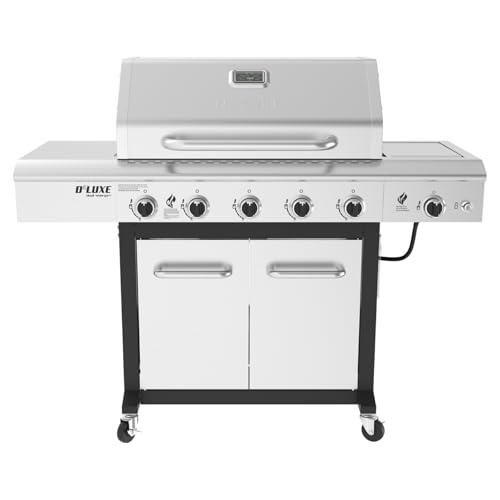
Nexgrill Deluxe 5-Burner Gas Grill with Ceramic Side Burner — Best Value Capacity
The Deluxe 5-Burner appears in this guide as the capacity pragmatist: the household that genuinely cooks for eight-plus weekly gets flagship-scale room and output here, with the ceramic side burner as a working tool, while keeping the budget’s remainder for the rest of the patio. It is the pick for volume cooks who measure value in servings per season rather than in construction class.
Strengths
- Five burners and 65,000 BTU for true crowd throughput
- Ceramic side burner with real power
- Built-in thermometer for lid-down control
Trade-offs
- Construction class below the Genesis standard
- Brand ecosystem thinner than the flagships’
- Large footprint and upkeep scale
| Specification | Detail (from the Amazon listing) |
|---|---|
| Fuel | Propane gas |
| Burners | 5 + ceramic side burner |
| Output | 65,000 BTU |
| Extras | Built-in thermometer, side table |
Judged as a production tool, this grill’s arithmetic is compelling: it zones like a station, sears a loaded grate, and simmers the sides, season after season, for households whose grill is infrastructure. Judged as a decade heirloom, it concedes to the Genesis — and its buyers, honestly, usually are not asking for an heirloom; they are asking for throughput now. Buy it with a cover, maintain the burners, and it will feed a small crowd every weekend without ever being the bottleneck. That is a complete answer to a real brief.
Best for: High-volume households wanting flagship capacity at a value position / Not suited for: Decade-heirloom buyers who rank construction class first
Comparison Table
| Pick | Badge | Key spec | Best for |
|---|---|---|---|
| Weber Genesis E-415 Gas Grill | Best Overall | Fuel: Propane gas; Burners: 4 PureBlu burners | Frequent grillers and entertainers who want a flagship gas grill for the decade |
| Weber Spirit E-435 Gas Grill | Best All-Rounder | Fuel: Propane gas; Burners: 4 + side burner | Households wanting one gas grill that sears, roasts and simmers at once |
| Pit Boss 850 Navigator Series Wood Pellet Grill & Smoker | Best Pellet Grill | Fuel: Wood pellets; Control: LCD digital controller, WiFi & Bluetooth | Pellet households wanting remote control plus a genuine direct-flame searing option |
| Char-Broil Pro Series Amplifire Infrared 4-Burner Propane Gas Grill Cabinet | Best Infrared | Fuel: Propane gas; Burners: 4 + side burner | Evenness-first cooks whose menu is chicken, fish and burgers without flare-ups |
| Traeger Pro 22 Wood Pellet Grill & Smoker | Best Pellet Classic | Fuel: Wood pellets; Cooking area: 572 sq. in. | Pellet buyers who prize platform maturity and parts depth over connectivity |
| Nexgrill Deluxe 5-Burner Gas Grill with Ceramic Side Burner | Best Value Capacity | Fuel: Propane gas; Burners: 5 + ceramic side burner | High-volume households wanting flagship capacity at a value position |
How to Choose Among the Best BBQ Grills Under 1000
At this frame, choose your construction class first and your features second. The Genesis represents the flagship gas class: buy it if gas is your primary cooking and the grill is a decade purchase. The Spirit E-435 represents the capability class: buy it if one cart must sear, roast and simmer simultaneously. The pellet pair splits by philosophy — Navigator for connectivity and direct-flame versatility, Pro 22 for platform maturity. The Amplifire is the system alternative for evenness-first cooks, and the Nexgrill Deluxe is the capacity value. Every one is defensible; the indefensible purchase at this money is a cosmetic premium over budget bones, which is why none appears here.
Then run the decade audit on your finalist: Are the grates cast iron? Is the ignition a named system? Does the brand list burners, grates and controllers for this exact model? Is there a fitted cover? A grill that passes all four is a ten-year appliance; one that fails two is a five-year one wearing this frame’s clothes. Finally, consider the patio as a system — this is the tier where a flagship plus a kettle, or a pellet grill plus a griddle, becomes a genuinely complete outdoor kitchen for a combined spend not far above a single pick here.
Connected Pellet Grills: What WiFi Actually Buys You
WiFi on a pellet grill buys three concrete things: remote temperature changes when a cook runs long or the weather turns, probe alerts that free you from the patio during overnight smokes, and a cook history that makes your successes repeatable. For the brisket-at-midnight household, those are real quality-of-life gains, and the Navigator in this guide delivers them in a mature implementation. What WiFi does not buy is better smoke, better bark or better judgment — the fire does not know you are watching it from the couch.
The costs are modest but real: another account, another app, firmware that occasionally wants attention, and electronics living outdoors that a dial never has to survive. That is why this guide carries both the connected Navigator and the unconnected Pro 22 without ranking one philosophy above the other. Choose connectivity if your cooks are long and your attention is divided; choose the classic if your smoker lives at a cabin, your WiFi is theoretical, or you simply prefer appliances that cannot receive updates. Both cook the same brisket.
The Decade Grill: A Maintenance Calendar for Premium Hardware
Premium grills repay a small, regular maintenance rhythm that budget grills never live long enough to need. Monthly in season: brush the grates hot, empty the grease tray, wipe the exterior, and check that the lid seal and hinges run true. Seasonally: inspect burners for blocked ports and corrosion, test the ignition, vacuum the pellet fire pot and ash if you run pellets, and clean the infrared emitter if you run infrared. Annually: a deep clean of the firebox, a check of hoses and regulators on gas, and a cover inspection — a torn cover is a roof leak for a grill.
None of this is burdensome — it totals perhaps two hours a year — and it is precisely the difference between the decade these grills are built for and the five disappointing years owners blame on brands. Keep a simple log with the grill: dates of deep cleans, part replacements, pellet or tank notes. When a wear part finally does fail in year seven, the log tells you what to order, and the brands in this guide will have it. That is what buying at this frame actually purchases: not immunity from maintenance, but maintenance that works.
How to Rotisserie and Roast Indirectly on a Premium Gas Grill
A flagship gas grill’s sealed lid and even burners make it a genuine roasting oven, and the indirect method is the key that unlocks it. For a whole chicken or roast: light the outer burners only, place a drip pan over the unlit center, preheat until the dome temperature settles in the roasting band, and set the food over the pan. The burners heat the firebox air, the heavy lid holds it evenly, and the food roasts in convection rather than over direct flame — no scorched bottom, no raw top, and drippings captured for gravy instead of fueling flare-ups. Turn the food once if your grill lacks a rotisserie; with PureBlu-style even burners, many cooks find even that optional.
The disciplines are temperature patience and probe trust. Manage the dome temperature with small knob adjustments and long waits — a heavy firebox is a flywheel, not a sports car — and cook to the probe’s reading in the thickest part, not to the clock. Rest roasts under foil for a full fifteen minutes; the juices you keep are the difference between a good roast and a great one. Master this and your gas grill quietly absorbs most of your oven’s Sunday work, with better browning and a kitchen that stays cool — the outcome this frame’s construction was purchased to deliver.
Roasting this way also changes how a household plans its week, in a manner worth one paragraph. A Sunday roast on the flagship, cooked with slack and rested properly, becomes Monday’s sandwiches and Tuesday’s hash without a whisper of compromise — the indirect method’s even cooking keeps the meat’s texture generous through its second and third lives. Households that discover this stop thinking of the grill as an event appliance and start thinking of it as the oven that happens to live outside, with better browning and a kitchen that stays cool. That reframing, more than any single feature, is what flagship money actually purchases over a decade of Sundays, one roast at a time.
The Flagship at Work: A Year in the Life of a Genesis-Class Grill
Spring: the cover comes off, the burners light on the first attempt — as they did last year — and the season opens with the cook the flagship was born for, a mixed grill for eight where four zones run like a kitchen line. Summer: the grill becomes infrastructure, lit most evenings, its cast-iron grates accumulating the black polish of constant use; a whole fish on Tuesday, burgers for the team on Thursday, a casserole roasted indirect on Sunday while the kitchen stays cool. Nothing about the summer is remarkable, which is precisely the flagship experience: the absence of incident, repeated daily, is the luxury being purchased.
Autumn is the flagship’s finest season, because roasting is its secret talent: chickens, squash, a leg of lamb under the sealed lid, the dome temperature held by burners that distribute heat like they were designed by people who roast. The pellet partner — if the patio runs the two-grill system — takes the brisket weekends, and the two appliances divide the calendar the way the guide’s strategy section describes. Winter: shorter preheats than expected, a cover that earns its price weekly, and the deep-clean weekend where the firebox is emptied, the burners brushed, the grease path cleared — two hours that buy the next year.
Multiply the year by ten and you have the flagship proposition, which no specification sheet can state: ten springs of first-attempt ignition. The cheaper tiers are not dishonest — they simply amortize differently, in incidents. Buyers at this frame are purchasing the incident-free decade, and the year above is what it feels like from inside: unremarkable, delicious, and repeatable on demand.
Accessories and Upgrades at the Flagship Level: What Earns It
Flagship grills attract accessory ecosystems the way flagships do, and this frame’s buyers deserve the filtered list. Earns it, first: the fitted cover, sized to the exact model — at this level a generic tarp is a false economy that traps moisture against a serious appliance. Second: a quality probe thermometer setup, ideally with a grate-level air probe, because flagship indirect cooking is precise cooking and deserves precise data. Third: the platform accessories you will actually use — for the Weber lines, the work-surface and storage pieces that turn a cart into a station; for pellet owners, the insulation blanket if your winters are real, and a dedicated dry pellet store.
Fourth, and quietly the most valuable: the spare-parts pre-purchase. An igniter and a set of heat deflectors on the shelf in year four convert a mid-season failure from a lost fortnight into a lost afternoon — the flagship owner’s version of a spare tire. What does not earn it: cosmetic stainless upgrades to parts that were already stainless, gadgetry that duplicates the grill’s own systems, and any accessory whose primary function is to signal the frame you shopped in. The flagship philosophy is functional to the end: every dollar after the grill should buy capability, information or insurance — the same three currencies the grill itself was bought with.
Commissioning a Flagship: Assembly, Burn-In and the First Three Cooks
Flagship assembly is a pleasure that should still be taken seriously: parts machined to fit, instructions written for adults, and a finished weight that announces the construction class before the first cook does. The Genesis commissioning ends with the full audit — every PureBlu burner lit and observed for the even flame the line promises, the lid’s seal checked by eye and by the preheat’s behavior, the leak test performed on principle. The E-435 adds its sear zone and side burner to the audit; light everything, in sequence, and confirm the whole layout before the cover ever goes on. The Navigator commissions through its electronics: burn-in run, controller paired, probe verified against a known temperature, the flame broiler slid open and closed so its motion is familiar before it is hot. The Pro 22 and the Amplifire follow their tier patterns — platform simplicity in one, emitter inspection in the other — and the Nexgrill Deluxe wants its two-person build and zone audit.
Debut cooks at the flagship level are statements, and should be cooked like them. The Genesis debuts with the mixed grill for the full household — the cook that uses its evenness, its grate and its oven-seal in one service. The E-435 debuts in courses: seared, roasted, simmered, simultaneously, because simultaneity is its thesis. The Navigator debuts overnight — the brisket that sleeps while you do, the probe alert as the morning’s first message — because that is the connected promise, and it should be redeemed immediately. The Pro 22 debuts with the classic long smoke. The Amplifire debuts with the chicken that made its owner a convert-in-waiting.
The third cook is calibration: the flagship’s indirect roast with notes taken, the pellet grill’s second long cook with consumption logged, the infrared’s fish. By now the maintenance calendar should be pinned up, the cover routine automatic, the notebook started. Flagships reward this commissioning discipline out of proportion, because their service life is measured in decades of cooks — and the habits of the first weekend are, empirically, the habits of the decade. Owners who commission carefully almost never become the cautionary tales in other people’s reviews.
The paperwork, at this level, is asset management: warranties registered, serials photographed, receipts filed with the household’s appliance records, and the parts catalog bookmarked for the exact model. A flagship grill is among the most expensive cooking appliances a household owns, and it will be serviced like one — by owners who can identify it precisely. Five minutes of administration on commissioning weekend is the entire premium on that insurance policy, and this tier’s buyers, of all buyers, should pay it gladly.
Placement, Clearances and Safe Habits at the Flagship Level
Flagship placement is patio design: these are heavy, hot, long-lived appliances, and their corners should be chosen like a kitchen’s. Level, non-combustible ground; clearances respected above and behind; a work triangle between grill, prep surface and door that a cook carrying a hot roast can walk without turning sideways past a hot firebox. The pellet flagships add dry fuel storage within a few steps and exhaust that drifts clear of the seating they serve. The infrared pick keeps its downward discipline — nothing stored beneath, its grease path serviced. Gas flagships want their shutoffs reachable and their hoses routed where feet, mower wheels and weather do not age them invisibly.
At this level the safety program and the maintenance calendar are the same document, and it should be run like one. Grease systems emptied before they are full — on a flagship, a grease fire is a choice made by calendar neglect. Burners and ports inspected seasonally; pellet fire pots vacuumed on rhythm; the flame broiler’s mechanism kept clean so it moves as designed. Connections leak-tested at tank changes without exception. An extinguisher rated for grease, current and reachable, and a household that knows the lid — closed, calmly — is the first answer to flame. Flagships are the safest grills ever sold when their calendars are kept, precisely because everything about them is maintainable. Keep the calendar; the grill does the rest.
Common Buying Mistakes
Paying a cosmetic premium at a construction price
Stainless cladding over a thin firebox is the classic trap of this frame. Audit the firebox, burners and grates — the parts that decide the decade — before admiring the finish.
Buying connectivity you will not use — or skipping it when you would
Overnight smokers gain real freedom from probe alerts and remote control; weekend burger cooks gain nothing. Match the electronics to your cook lengths, honestly assessed.
Neglecting the grease system on a powerful grill
More output means more drippings managed. A neglected grease tray on a flagship is a fire risk and a flavor problem. Empty it on schedule; it takes two minutes.
Assuming premium means maintenance-free
Premium means maintainable. The grills here will reward two hours of care a year with a decade of service, and punish total neglect almost as surely as cheap ones. The calendar in this guide is the whole secret.
Filling the frame with size instead of class
A six-burner value cart and a four-burner flagship can share this frame’s neighborhood. For most households the flagship’s construction serves longer and cooks better than the extra acreage. Buy class first, size second.
Final Recommendation
The Weber Genesis E-415 is the recommendation this frame is built around: the flagship gas grill for the decade. Households wanting the full sear-roast-simmer layout should take the Spirit E-435, pellet cooks the connected Pit Boss 850 Navigator or the classic Traeger Pro 22 by philosophy, evenness-first cooks the Amplifire, and volume households the Nexgrill Deluxe 5-Burner. Any of them, maintained on the simple calendar in this guide, is a ten-year answer.
For completeness, look at the frame above — Best Bbq Grills Under $2000 — where statement grills and luxury versions of these ideas live, and the frame below — Best Bbq Grills Under $600 — where the sear-zone and PID technologies first appear for less. If your needs split across fuels, Best Bbq Combo Grills covers the dual-fuel compromise honestly.
If you are ready to buy, start with the top of the list: Weber Genesis E-415 Gas Grill, Weber Spirit E-435 Gas Grill, Pit Boss 850 Navigator Series Wood Pellet Grill & Smoker — and check the current price on Amazon for the configuration you choose.
Related reading: Best Bbq Grills Under $500; Best Basic Grills.
Frequently Asked Questions
Is the Genesis worth it over the Spirit at this frame?
For frequent grillers, yes: the construction class — firebox, burners, lid seal — is a level up, and it compounds over a decade of cooks in evenness, preheat speed and longevity. The Spirit E-435 counters with the fuller feature layout. Buy construction if you grill constantly; buy features if your menu needs the side burner and sear zone daily.
WiFi pellet grill or classic pellet grill?
Choose WiFi if your cooks are long and your attention divided — overnight briskets with probe alerts are a genuine lifestyle upgrade. Choose the classic if you value platform maturity, simplicity and parts depth over remote control. The smoke does not care either way; your schedule should decide.
Can a pellet grill with a flame broiler replace charcoal for searing?
It replaces the need, not the experience. The Navigator’s direct-flame section crisps and chars convincingly for weeknight purposes. A dedicated charcoal fire still produces the deepest crust and smoke character. Most households find the pellet’s version sufficient; purists keep a kettle beside it, cheaply.
How long should a grill at this price last?
A decade or more for the flagship gas class with basic care; pellet grills similar for the body, with controllers and auger parts as the long-term service items from catalogs that support them. The maintenance calendar in this guide — roughly two hours a year — is the difference between that decade and half of it.
Is infrared still relevant at this price?
Yes, for the menu it serves. Flare-up-free evenness on chicken, fish and lean proteins is a weekly benefit that flagship open-flame grills do not replicate. It is a system choice, not a budget compromise, and its owners at this level chose it deliberately.
What else should I budget for with a premium grill?
A fitted cover, a quality probe thermometer, a spare propane tank or a stocked pellet supply in dry storage, and — for gas — a natural-gas conversion conversation with a professional if your home has a line. Together they complete the appliance you just bought; none is optional in spirit, whatever the receipts say.
Does the Genesis class really preheat faster?
In practice, yes — burner output matched to the firebox, a lid that seals, and grates with thermal mass add up to a grill that is ready sooner and recovers faster when loaded. It is one of the flagship differences owners mention most, because it is felt on every single cook rather than admired on a specification sheet.
How do I choose between the Navigator’s connectivity and the Pro 22’s simplicity?
By your longest cooks and your household’s technology temperament. If overnight smokes are monthly and probe alerts would genuinely free you, connectivity earns its keep. If your smokes are weekend afternoons and you prefer appliances that never update, the classic platform is the wiser decade. Both were kept in this guide because both answers are right — for different households.
What is the smartest way to time a flagship purchase?
Grill pricing follows the seasons: demand peaks in spring, and the deepest movement usually arrives as summer ends and retailers clear floor space. A buyer who can wait for the shoulder season often does better — but weigh the discount against the cooks: a flagship bought in April cooks all summer, and a season of dinners is worth real money too. This guide prints no prices precisely so the decision stays yours and current: check the current price on Amazon for the exact configuration, compare it with your patience, and remember that at the decade horizon this grill represents, the difference between a good price and a great one is a rounding error against ten years of service. Buy it when your cooking needs it; the calendar is a tiebreaker, not a strategy.


