Disclosure: airfryerkitchensupply.com is reader-supported. When you buy through links on our site, we may earn an affiliate commission at no extra cost to you.
Where to buy
The fastest way to buy any pick in this guide is through Amazon, where stock, colours and bundle configurations change often, so check the current price on Amazon on the product page rather than relying on any number printed elsewhere. These are the verified picks in this guide to the best bbq cookers:
- Weber Original Kettle Premium Charcoal Grill, 22-Inch — Check on Amazon
- Weber Spirit E-310 Gas Grill — Check on Amazon
- Traeger Pro 22 Wood Pellet Grill & Smoker — Check on Amazon
- Char-Griller AKORN 20-Inch Kamado Charcoal Grill and Smoker — Check on Amazon
- Royal Gourmet CC1830S BBQ Charcoal Grill and Offset Smoker — Check on Amazon
- Coleman RoadTrip 285 Portable Propane Grill — Check on Amazon
Availability in this category moves quickly, especially for seasonal colours and smaller brands. If a first choice is out of stock, the alternatives in this guide are ranked so that the next pick down is a sensible substitute rather than a compromise, and every linked pick below was confirmed against Amazon’s own catalogue data before this guide was written.
The best bbq cookers are not a single kind of machine, and any guide that pretends otherwise is selling you its own inventory. Barbecue cooking spans charcoal kettles that sear a steak and smoke a brisket on the same afternoon, gas grills that light at a button press for Tuesday burgers, pellet cookers that hold temperature like an oven while burning real wood, kamado-style cookers that sip fuel and hold heat like a kiln, offset barrel combos built for smoke, and portable grills that turn a tailgate into a kitchen. The right choice is the one that matches how you actually cook — your fuel temperament, your weeknight patience, your crowd size — and this guide is organised around exactly those differences.
Each fuel asks something of you and gives something back. Charcoal asks for twenty minutes and a chimney and returns the deepest fire flavour and the best sear. Gas asks for nothing and returns convenience, at some cost to smoke character. Pellets ask for electricity and a hopper and return set-and-forget temperature control with genuine wood smoke. Kamados ask for a learning curve and return extraordinary fuel economy and range, from low smoking to pizza-oven heat. None of these is the correct answer for everyone, and the reviews below are written to help you hear which one is yours, with strengths and trade-offs stated as plainly as we can state them.
Prices are not printed anywhere in this guide — check the current price on Amazon on each listing — because grill prices swing hard with seasons and sales events. What stays constant is build quality, cooking character and ownership cost, and those are the grounds on which the six picks below were chosen: one benchmark per major style, each the machine we would point a friend to in its category.
In this guide
Quick Picks
If you are short on time, these are the six picks that matter for best bbq cookers, each with the job it does best. The detailed reviews further down explain the reasoning, the trade-offs and the ownership details behind every line here.
- Weber Original Kettle Premium Charcoal Grill, 22-Inch — Best Overall BBQ Cooker: The 22-inch kettle that defined backyard barbecue: porcelain-enamelled bowl and lid, built-in thermometer, hinged grate and an ash system that makes charcoal civilised. — Check on Amazon
- Weber Spirit E-310 Gas Grill — Best Gas BBQ Cooker: A three-burner propane grill with porcelain-enamelled cast iron grates: instant ignition, even heat and Weber build quality in a footprint for ordinary patios. — Check on Amazon
- Traeger Pro 22 Wood Pellet Grill & Smoker — Best Pellet BBQ Cooker: The pellet benchmark: 572 square inches, a meat probe, an 18-pound hopper and six-in-one versatility that holds smoking temperatures while you sleep. — Check on Amazon
- Char-Griller AKORN 20-Inch Kamado Charcoal Grill and Smoker — Best Kamado-Style Value: Kamado cooking without the ceramic price: triple-wall insulated steel, cast iron grates and a temperature range from gentle smoking to pizza-furnace heat. — Check on Amazon
- Royal Gourmet CC1830S BBQ Charcoal Grill and Offset Smoker — Best Offset Smoker Combo: A barrel charcoal grill with an offset smoker chamber and 783 square inches of total cooking space: maximum smoke room and work surfaces at a value tier. — Check on Amazon
- Coleman RoadTrip 285 Portable Propane Grill — Best Portable BBQ Cooker: A three-burner portable propane grill on a folding stand with wheels: real grilling power that travels to tailgates, campsites and balconies. — Check on Amazon
How These Picks Were Chosen
Selection started with the cooking, not the catalogue. Each style of barbecue cooker had to be represented by a model that does its style’s defining job excellently: the kettle that smokes and sears, the gas grill that lights instantly and cooks evenly, the pellet cooker that holds temperature for a twelve-hour brisket without supervision, the kamado that stretches a small bag of charcoal across a whole weekend, the offset combo that gives charcoal cooks maximum smoke space, and the portable that travels without apology. Models that were merely adequate at everything were passed over for models that are genuinely good at their thing.
Build quality was the second filter, applied ruthlessly because outdoor cookers live hard lives. We looked for porcelain-enamelled or properly finished steel, grates with some mass to them, lids that seal, dampers and valves that move positively, and brands with parts support — replacement grates, burners, igniters and covers available years later. Every linked pick was verified by brand and model before it earned a place.
Finally, we ranked by total ownership experience: fuel cost and availability, cleaning burden, weather tolerance and the likelihood that the cooker is still in regular use in five years. A barbecue cooker is a habit machine; the best one is the one whose routine fits your life so well that cooking outside becomes the default rather than the event. That lens explains several choices below, including why the simplest cooker in the list takes the top charcoal honour.
The 6 Best BBQ Cookers

Weber Original Kettle Premium Charcoal Grill, 22-Inch — Best Overall BBQ Cooker
There is a reason the kettle is the default answer to ‘what grill should I buy’. The 22-inch Weber Premium grills burgers and steaks with a proper charcoal sear, then, with the coals banked and the lid down, smokes ribs, chickens and even brisket with a competence that surprises people who think smoking needs a dedicated smoker. The Premium trim adds the details that matter daily: a hinged grate for adding coals mid-cook, a lid thermometer, a lid holder and the enclosed ash catcher that keeps the patio clean and the fire safe. If you will own one barbecue cooker, this is the one the evidence supports.
Strengths
- Grills and smokes brilliantly in a single, simple machine
- Porcelain-enamelled steel lasts for decades outdoors
- Hinged grate, thermometer and ash catcher make charcoal easy
Trade-offs
- Charcoal means lighting time and ash to manage
- Capacity suits families, not large parties, without cooking in rounds
- Two-zone mastery takes a few cooks to learn
| Specification | Detail |
|---|---|
| Size | 22-inch kettle |
| Fuel | Charcoal |
| Features | Built-in thermometer, hinged cooking grate |
| Finish | Porcelain-enamelled steel |
The kettle’s genius is thermal simplicity. The deep, rounded bowl moves air around food the way it should, the dampers give you honest control — more air, more fire — and the whole system has been refined over so many years that there is nothing left to go wrong. Searing is fierce and direct; indirect cooking, with coals banked to the sides and a drip pan beneath, turns the same machine into a gentle roaster and smoker. Generations of technique exist for it, from the snake method for long smokes to the two-zone fire that should be every griller’s first skill, and that depth of shared knowledge is itself a feature no new cooker can buy.
Ownership is where the Premium justifies its name. Ash management, the historical annoyance of charcoal, is solved by the enclosed catcher and one-touch sweeping system; the grates are replaceable; the enamel shrugs off weather that would eat painted steel. It will not cook for thirty people at once, and it will never light itself, but as the single most capable, longest-lived, best-supported barbecue cooker at its tier, it takes Best Overall in this guide without serious contest.
Best for: Almost everyone: families who grill weekly and smoke occasionally / Not suited for: Huge parties or cooks who refuse to light charcoal
Check on Amazon — check the current price on Amazon before you decide, because configurations and included accessories vary by listing.

Weber Spirit E-310 Gas Grill — Best Gas BBQ Cooker
The Spirit E-310 is for the household that grills on weeknights, which is to say it is for most households. Three burners under porcelain-enamelled cast iron grates give you a hot zone and a gentle zone, ignition is a button rather than a ritual, and the whole cook — light, grill, eat — fits inside the time a charcoal fire takes to ash over. Weber’s build quality shows in the evenness of the heat and the way the grill still lights first time in its fifth season. If your barbecue life is burgers on Wednesday, chicken on Friday and the occasional weekend feast, this is your machine.
Strengths
- Push-button ignition and fast preheat suit weeknight cooking
- Three burners allow genuine two-zone grilling
- Porcelain-enamelled cast iron grates hold and mark heat beautifully
Trade-offs
- Gas gives convenience, not charcoal’s depth of fire flavour
- Propane bottles need swapping or refilling at the worst moments
- Burners and flavouriser bars are wear parts over the years
| Specification | Detail |
|---|---|
| Burners | 3, propane |
| Grates | Porcelain-enamelled cast iron |
| Style | Cabinet gas grill |
| Brand | Weber |
What separates the Spirit from cheaper gas grills is what happens in year three. The ignition still works, the burners still burn in even blue rows rather than patchy yellow islands, and the grates have kept their enamel. Cheap gas grills are a false economy measured in burners and rust; the Spirit is built to be repaired rather than replaced, with parts available and a firebox that resists the corrosion that kills rivals. In daily use it is simply easy: predictable hot spots you learn in two cooks, a warming rack for the buns and the resting meat, and a grease system that contains the mess.
Flavour honesty is required: gas will not give you charcoal’s sear perfume or a pellet grill’s smoke. A cast-iron grate at full heat still produces excellent burgers and steaks, and a smoker box can add a whisper of wood, but buyers whose barbecue dreams are smoky should choose accordingly. For the household whose dream is grilled dinner on a Tuesday without planning, the Spirit E-310 is the best-executed answer in this guide.
Best for: Weeknight grillers and families who value speed and reliability / Not suited for: Smoke purists or charcoal romantics
Check on Amazon — check the current price on Amazon before you decide, because configurations and included accessories vary by listing.

Traeger Pro 22 Wood Pellet Grill & Smoker — Best Pellet BBQ Cooker
The Pro 22 is the machine that converted a generation of cooks to pellets, and the formula remains compelling: fill the hopper, set the dial, and the cooker feeds wood pellets to a fire pot under electronic control, holding smoking temperatures for as long as the cook demands. Six-in-one versatility — smoke, grill, bake, roast, braise and barbecue — is marketing language for a true fact, which is that a pellet cooker behaves like a wood-fired convection oven and will happily cook everything from brisket to pizza to a tray of brownies. The meat probe takes the guesswork out of doneness, and the cooking area suits family-plus cooking.
Strengths
- Set-and-forget temperature control for long, unattended smokes
- Real wood smoke flavour with oven-like convenience
- Meat probe and generous hopper make brisket genuinely easy
Trade-offs
- Needs electricity and a supply of food-grade pellets
- Maximum temperature sears adequately rather than fiercely
- More moving parts — auger, fan, controller — than any rival here
| Specification | Detail |
|---|---|
| Cooking area | 572 sq. in. |
| Hopper | 18 lb pellet capacity |
| Max temperature | 450°F per Amazon listing |
| Features | Meat probe, 6-in-1 versatility |
The pellet experience is best understood as delegation. You trade the charcoal cook’s craft for consistency: the Pro 22 will hold a smoking temperature through a windy night with a steadiness no human with a damper can match, and the brisket that results is not a compromise but a genuinely excellent piece of barbecue. Smoke flavour is cleaner and lighter than a barrel or offset — some call it subtle, purists call it faint — and the top temperature means searing is competent rather than spectacular, a trade most owners happily accept for the overnight freedom.
Ownership involves a supply chain: pellets in flavours you enjoy, stored dry, plus a cover and the occasional vacuuming of the fire pot. The electronics are proven — Traeger has built this pattern for years — but they exist, and a cooker with an auger will never match a kettle’s thirty-year simplicity. Judged on results per unit of effort, though, the Pro 22 remains the pellet pick: the brisket is real, the ribs are real, and you slept through both.
Best for: Low-and-slow cooks who want wood smoke without fire management / Not suited for: Sear-first grillers or anyone far from a pellet supply
Check on Amazon — check the current price on Amazon before you decide, because configurations and included accessories vary by listing.

Char-Griller AKORN 20-Inch Kamado Charcoal Grill and Smoker — Best Kamado-Style Value
Kamado cookers are the range-extenders of barbecue: insulated like a kiln, they smoke low for hours on a handful of charcoal and then, vents open, climb to temperatures that blister pizza and sear steaks like a steakhouse broiler. The AKORN delivers that experience in triple-wall insulated steel rather than ceramic, which makes it lighter, tougher against knocks and dramatically more affordable than the ceramic names. Cast iron grates, a removable ash pan and a locking lid round out a package aimed at the cook who wants one cooker with the widest possible repertoire.
Strengths
- Insulated body sips charcoal and holds temperature in any weather
- Huge temperature range: low smoking to very high-heat searing and pizza
- Steel construction is lighter and more knock-resistant than ceramic
Trade-offs
- Kamado temperature control has a learning curve; overshooting is easy, correcting is slow
- Steel insulation is excellent but not the equal of thick ceramic for marathon holds
- Smaller cooking area than its price rivals in kettle form
| Specification | Detail |
|---|---|
| Size | 20-inch kamado |
| Construction | Triple-wall insulated steel |
| Grates | Cast iron |
| Fuel | Lump charcoal |
The AKORN’s party trick is economy. A load of lump charcoal that a kettle would spend on one long cook can carry the AKORN through a smoke, a rest with vents closed, and a second cook on the relight, because the insulated walls waste so little heat. That same insulation makes winter smoking a pleasure rather than an endurance test, and makes the cooker unusually forgiving of wind. At the top end, the heat is serious: pizzas with leopard-spotted crusts and steaks with a genuine crust are both on the menu, which no other single cooker in this guide can claim alongside its smoking credentials.
The discipline kamados demand is foresight. Heat soaked into all that insulation does not leave quickly, so you approach temperature from below, in small steps, and a cook who overshoots by a hundred degrees will spend an hour negotiating back down. Steel also asks for a cover and dry storage to protect its finish across years. Learn the vents, though, and the AKORN becomes the most versatile charcoal cooker per dollar in this guide — the value route into kamado cooking that loses remarkably little to its ceramic elders.
Best for: Versatile cooks wanting kamado range without ceramic cost / Not suited for: Impatient beginners who adjust first and think later
Check on Amazon — check the current price on Amazon before you decide, because configurations and included accessories vary by listing.

Royal Gourmet CC1830S BBQ Charcoal Grill and Offset Smoker — Best Offset Smoker Combo
Some cooks want space and smoke above all, and the CC1830S is built for them. The main barrel grills over charcoal in the classic style, while the offset firebox feeds heat and smoke through the chamber for true indirect smoking — and adds its own grate space when the crowd demands it. The combined cooking area, 783 square inches, dwarfs everything else in this guide, and the front and side tables acknowledge a practical truth: barbecue for a crowd is as much about somewhere to put the tray as about the fire. This is the party cooker and the aspiring pitmaster’s practice ground in one frame.
Strengths
- 783 sq. in. total cooking area handles serious gatherings
- Offset firebox gives genuine indirect smoking capability
- Front and side shelves provide real working space
Trade-offs
- Thin steel leaks heat and smoke; expect higher fuel use and some tinkering
- Offset smoking demands regular fire attention, unlike a barrel or pellet cooker
- Large footprint and more assembly than simpler cookers
| Specification | Detail |
|---|---|
| Cooking area | 783 sq. in. total |
| Style | Barrel grill with offset smoker |
| Fuel | Charcoal |
| Features | Front and side tables, adjustable fire grates |
Honesty about offset cooking at this tier is essential, because the CC1830S is both a lot of cooker for the money and a machine with known compromises. The steel is thinner than premium offsets, so heat escapes, temperatures swing more with the weather, and a long smoke will consume charcoal generously and ask for regular tending. Many owners treat that as the hobby itself — sealing joints with gaskets, adding a baffle, learning their firebox — and emerge with a cooker that performs well above its station and skills that transfer to any smoker. The grill side, meanwhile, is immediately excellent: a big barrel of direct charcoal heat with room to feed everyone at once.
Buy it as what it is: the most cooking space and the most authentic offset experience available at a value tier, with a learning curve priced in. If your temperament runs to set-and-forget, the barrel cookers in their own guide or the pellet pick above will make you happier. If your idea of a Saturday is a fire, a chair and a chamber full of ribs, the Royal Gourmet gives you the largest, most sociable route into that life in this guide.
Best for: Hosts and aspiring pitmasters who want maximum smoke space / Not suited for: Hands-off cooks or small households
Check on Amazon — check the current price on Amazon before you decide, because configurations and included accessories vary by listing.
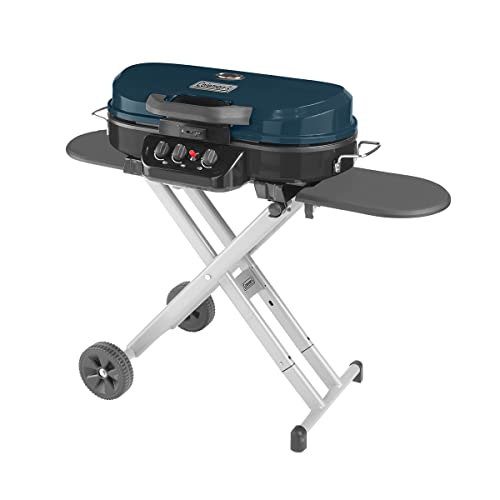
Coleman RoadTrip 285 Portable Propane Grill — Best Portable BBQ Cooker
The RoadTrip exists because barbecue does not only happen in backyards. It folds onto a wheeled stand, lights with matchless ignition, and puts three burners of genuine propane power under a grate big enough for a family’s burgers — at the tailgate, the campsite, the beach picnic or the small apartment balcony where a full grill cannot live. Coleman has refined this format for years, and the current 285 is the mature version: sturdy legs, a locking lid for transport and heat that treats it as a real grill rather than a camping toy.
Strengths
- Folds onto a wheeled stand for genuine portability
- Three burners give real cooking zones, rare in a portable
- Instastart ignition works reliably outdoors
Trade-offs
- Portable capacity still means cooking in rounds for big groups
- Runs on small propane canisters or an adaptor hose for full bottles
- Not a smoker; this is a grill that travels
| Specification | Detail |
|---|---|
| Burners | 3, propane |
| Output | 20,000 BTU per Amazon listing |
| Ignition | Instastart push-button |
| Style | Folding stand portable grill |
The test of a portable grill is whether the food tastes like a compromise, and the RoadTrip passes it. Three burners under a proper grate produce real sear marks and real two-zone control, so chicken cooks through without cremating, and burgers for six come off in two relaxed rounds rather than a panicked shuffle. The engineering of the travel side is equally convincing: the stand scissoring down, the lid locking, the wheels handling a car park’s gravel without complaint. Setup at a site takes minutes, and the whole thing hoses down and folds away while a charcoal portable would still be cooling.
Its limits are the honest ones of the format. Propane canisters are a consumable to manage, wind steals heat from any portable, and nobody is smoking a brisket on it. But as the cooker that extends barbecue beyond the backyard — and doubles, for many owners, as the balcony grill, the power-cut backup and the holiday rental upgrade — the RoadTrip 285 earns its place as this guide’s portable pick on the strength of doing one job completely well.
Best for: Tailgaters, campers, travellers and small-space households / Not suited for: Low-and-slow smoking or very large gatherings
Check on Amazon — check the current price on Amazon before you decide, because configurations and included accessories vary by listing.
Comparison Table
| Pick | Badge | Key spec | Best for |
|---|---|---|---|
| Weber Original Kettle Premium Charcoal Grill, 22-Inch | Best Overall BBQ Cooker | 22-inch kettle | Almost everyone: families who grill weekly and smoke occasionally |
| Weber Spirit E-310 Gas Grill | Best Gas BBQ Cooker | 3, propane | Weeknight grillers and families who value speed and reliability |
| Traeger Pro 22 Wood Pellet Grill & Smoker | Best Pellet BBQ Cooker | 572 sq. in. | Low-and-slow cooks who want wood smoke without fire management |
| Char-Griller AKORN 20-Inch Kamado Charcoal Grill and Smoker | Best Kamado-Style Value | 20-inch kamado | Versatile cooks wanting kamado range without ceramic cost |
| Royal Gourmet CC1830S BBQ Charcoal Grill and Offset Smoker | Best Offset Smoker Combo | 783 sq. in. total | Hosts and aspiring pitmasters who want maximum smoke space |
| Coleman RoadTrip 285 Portable Propane Grill | Best Portable BBQ Cooker | 3, propane | Tailgaters, campers, travellers and small-space households |
Read the table as a shortlist, not a ranking carved in stone: the right answer for best bbq cookers depends on the size of your household, the space you actually have and how you really cook week to week, which is exactly what the buying guide below works through.
How to Choose the Best BBQ Cooker for How You Cook
Choose by fuel temperament first, because it decides your weekly experience more than any specification. If the ritual of charcoal — the chimney, the wait, the smell — is part of the pleasure, buy charcoal and never apologise. If barbecue in your house competes with homework and bedtime, gas’s button-press start will triple how often you cook outside. If your heart is in brisket and ribs but your schedule has no room for fire-tending, pellets were invented for you. The best cooker is the one whose routine you will still be enjoying in August, not the one with the longest feature list in April.
Size second, and size for your ordinary crowd plus a little. Most households cook for two to six, which the kettle, Spirit and Pro 22 in this guide cover perfectly. Chronic over-buying — the eight-burner monument for a family of three — wastes money, fuel and patio, and big grills cook small meals badly. Chronic under-buying is rarer and more forgivable, since cooking in two rounds is a minor inconvenience. Portable cooks should be honest about how often the cooker will truly travel; a portable that never leaves the patio is just a small grill.
- Fuel you enjoy managing, available locally at sane cost
- Cooking area matched to your ordinary crowd
- Grates with real mass for searing and longevity
- A lid that seals and dampers or burners that adjust positively
- Parts availability: grates, burners, igniters, covers
- A cleaning routine you will actually perform
Finally, budget for the whole system, described here in tiers rather than printed prices because grill pricing swings with the seasons. The cooker is the headline, but the cover, the tools, the fuel and the replacement parts are the subscription. A mid-tier cooker from a brand with a deep parts shelf will out-value a feature-stuffed bargain whose burners cannot be replaced. Every pick in this guide passed that test, which is why the names are familiar: in outdoor cooking, longevity is a feature.
Charcoal, Gas, Pellet and Kamado: The Flavour and Effort Ledger
Charcoal gives the deepest fire flavour and the fiercest sear, and asks for lighting time, ash handling and a modest learning curve. Its fuel is cheap and universally available, its cookers are mechanically simple enough to last decades, and its technique ceiling is the highest in barbecue — which is why enthusiasts rarely leave it. Gas gives speed and cleanliness: light, preheat, cook, close the lid and walk away. The flavour is honest grilled food without smoke’s bass note, and for weeknight cooking that trade wins more households than any other.
Pellets give wood smoke with oven manners. The flavour is real but gentler than charcoal or offset smoke, the temperature control is the best in this guide, and the costs are electricity, a pellet supply kept dry, and more moving parts to maintain. Kamado cooking gives range and economy: no other style smokes at dawn and blisters pizza at noon on the same small pile of lump charcoal. Its costs are the learning curve of insulated heat and, in ceramic form, weight and fragility — the steel AKORN in this guide exists precisely to soften those costs.
There is no hierarchy here, only fit. The cook who grills four nights a week should buy gas or pellets; the cook who lives for Saturday smoke should buy charcoal in kettle, kamado or barrel form; the cook who travels should buy the portable and be the hero of every campsite. This guide’s picks are the benchmarks of each tribe, and the final recommendation below maps them to households rather than declaring a single winner.
Heat Management: The Skill Every BBQ Cooker Rewards
Whatever fuel you choose, barbecue is the management of two fires: a hot zone and a gentle zone. On a kettle, bank the coals to one side. On a gas grill, run one burner high and one low. On a kamado or pellet cooker, use the deflector and the grate levels. Two-zone cooking lets you sear over the fierce heat and finish in the gentle zone, which is the entire secret behind chicken that is charred outside and cooked through, thick steaks with a crust and a blushing centre, and vegetables that caramelise instead of incinerating.
Temperature is information, and the cheapest upgrade to any cooker is a decent thermometer habit: a lid thermometer for the chamber and an instant-read probe for the meat. Cook to temperature and tenderness rather than to the clock, rest meat properly so juices redistribute, and keep a simple log for your first season — fuel, weather, settings, results. Every cooker in this guide becomes dramatically more predictable once its owner has ten logged cooks, and that predictability, not the hardware, is what guests actually taste.
How to Set Up a Two-Zone Fire and Grill With Confidence
This method works, with small adaptations, on every cooker in this guide, and it is the single technique that most improves barbecue results.
- Arrange the heat on one side only: coals banked in a kettle or barrel, one burner lit on gas, the fire pot’s hot zone respected on a pellet cooker
- Preheat with the lid closed until the cooking grate is properly hot, then oil the grate lightly
- Sear food over the hot zone to build crust and colour, turning as needed rather than by a timer
- Move food to the gentle zone, close the lid, and let it finish to temperature in the indirect heat
- Check doneness with an instant-read thermometer at the thickest point, cooking poultry and ground meats to safe temperatures
- Rest meat on a warm plate for at least a few minutes before slicing, and slice against the grain
Charcoal cooks should light with a chimney starter — no lighter fluid, ever, because its taste survives into the food — and should let coals ash over before cooking. Gas cooks should preheat longer than impatience suggests; a grate that has heat-soaked for ten minutes sears, while a merely warm one steams. Pellet and kamado cooks should approach their target temperature gradually, because overshooting an insulated or automated cooker costs more time than patience does. Master the two zones and the thermometer, and the specific cooker in front of you becomes almost a detail.
Common Buying Mistakes
Buying for the biggest party of the year. A cooker sized for thirty cooks badly for three, fifty weeks a year. Buy for your ordinary crowd; borrow or batch for the exceptional one.
Cooking everything over direct heat. One fierce zone with no gentle refuge is why chicken burns outside and stays raw inside. Two zones fix most barbecue failures at a stroke.
Trusting cooking times instead of temperatures. Wind, fuel and meat thickness move every timeline. An instant-read thermometer is the cheapest insurance in barbecue.
Neglecting ash, grease and covers. Ash corrodes, grease flares and weather eats finishes. Ten minutes of care after a cook adds years to a cooker’s life.
Using lighter fluid or softwood. Fluid flavours the food and softwood flavours it worse. A chimney, natural starters and proper charcoal or hardwoods are the whole answer.
Final Recommendation
Most households should start with the Weber Kettle Premium: it grills, it smokes, it lasts, and it teaches the craft. If weeknight speed rules your life, take the Spirit E-310 and grill three times as often. If brisket is the dream and Saturdays are spoken for, the Traeger Pro 22 will smoke while you live your life, and if range is what excites you — smoke at dawn, pizza at noon — the AKORN is the value route into kamado cooking. Party hosts should look at the Royal Gourmet’s sheer space, and travellers at the RoadTrip, which turns any patch of ground into a kitchen.
Underneath the variety, the advice is one sentence: buy the cooker whose fuel and routine fit your real life, from a brand that sells its parts, and learn its two zones. Do that and the best bbq cookers question answers itself at your table, repeatedly, for years.
Related guides in this series: Best Barrel Cookers Best Charcoal Grills Best Gas Grills Best Pellet Grills Best Kamado Grills
A Year of BBQ Cooker Care: The Calendar That Adds Years
Outdoor cookers rarely die in action; they die in the off-season, in the rain, under a cover that trapped the damp it was meant to shed. A light calendar of care prevents almost all of it. After every cook, the habits are minutes long: burn off and brush the grates while they are hot, empty ash once it is fully cold — ash is hygroscopic and will rust a firebox from inside — and wipe grease from the places it pools. Gas cooks should check burner flames for the even blue pattern that says the ports are clear; pellet cooks should vacuum the fire pot on a rhythm rather than a crisis; charcoal cooks should confirm the dampers still move freely before they are asked to.
Monthly, in season, go one level deeper. Inspect gas hoses and connections with soapy water for leaks, clear spider webs from venturi tubes — the classic cause of the grill that will not light in June — and check that igniters spark with conviction. Kamado and kettle owners should look at gaskets and enamel chips, touching up bare metal before rust takes the invitation. Pellet owners should run the hopper low between long gaps and store pellets indoors and dry, because a swollen, damp pellet will jam an auger with total commitment. None of this is workshop labour; it is the outdoor equivalent of wiping down a hob, and it is the difference between a cooker that ages and one that merely gets older.
Once a year, give the cooker its service: a deep clean of the firebox and grease system, a check of every fastener, a look at the parts that wear — grates, burners, flavouriser bars, gaskets, igniters — and an honest decision about replacements while they are cheap and available. This is where the brands in this guide repay their selection, because their parts shelves are stocked years deep. A cooker maintained on this calendar does not merely last longer; it cooks better every single season, because clean burners, true dampers and sound gaskets are cooking performance by another name. The best bbq cookers are not only bought. They are kept.
Check on Amazon · Check on Amazon · Check on Amazon — the shortlisted picks most relevant to this section, with current pricing on their Amazon pages.
Accessories deserve the same discipline as the cooker itself, because barbecue is a hobby that attracts gadgets the way a grill attracts wasps. The short list that genuinely earns its storage is: a chimney starter for charcoal cooks, a reliable instant-read thermometer, long tongs and a stiff brush or scraper for the grates, a cover that fits, and heat-proof gloves. Everything beyond that list should have to argue its case against a cook you have actually attempted. Buy the short list with the cooker, cook for a season, and let your own menu — not a catalogue — nominate the next purchase. The best-equipped barbecue cooks are rarely the ones with the most tools; they are the ones whose few tools are exactly where their hands expect them to be.
Frequently Asked Questions
What is the best all-round BBQ cooker for a beginner?
The charcoal kettle, specifically the Weber Premium in this guide. It grills and smokes, forgives mistakes, costs a fair tier and teaches skills that transfer to every other cooker. Beginners who know they will never light charcoal should start with the Spirit gas grill instead.
Can a gas grill produce real barbecue flavour?
It produces excellent grilled flavour and, with a smoker box of wood chips, a light smoke note. It will not match charcoal, offset or pellet smoke depth. For most weeknight cooking the difference matters less than the fact that the grill actually gets used.
Are pellet grills worth it for occasional cooks?
Pellets shine on long cooks — brisket, pork shoulder, ribs — where their temperature control removes hours of tending. If you mostly grill burgers and steaks, a kettle or gas grill gives better searing for less complexity. Occasional smokers who dream of brisket are exactly who pellets serve best.
How much cooking area do I actually need?
Enough for your ordinary crowd in one round: a family’s burgers, or two chickens, or a brisket with room for air to circulate. The 22-inch kettle and the mid-size picks in this guide cover most households; buy the offset or pro sizes only if gatherings are your normal, not your exception.
What fuel is cheapest to run?
Charcoal in an insulated kamado is remarkably economical, and standard charcoal in a kettle is cheap per cook. Gas is convenient and moderate, especially on a full bottle. Pellets cost more per cook than charcoal but buy you unattended hours. In all cases the cooker you use weekly is cheaper per meal than the premium one gathering rust.
How long should a good BBQ cooker last?
A porcelain kettle can serve for decades with replacement grates. Gas and pellet cookers last many years when burners, igniters and electronics are replaceable — which is why this guide favours brands with deep parts support and advises a cover from day one.


