Disclosure: airfryerkitchensupply.com is reader-supported. When you buy through links on our site, we may earn an affiliate commission at no extra cost to you.
Where to buy
The fastest way to buy any pick in this guide is through Amazon, where stock, colours and bundle configurations change often, so check the current price on Amazon on the product page rather than relying on any number printed elsewhere. These are the verified picks in this guide to the best basic slow cookers:
- Crock-Pot Manual Slow Cooker, 3-Quart — Check on Amazon
- Hamilton Beach 3-Quart Slow Cooker 33231 (Matte Black) — Check on Amazon
- Crock-Pot Oval Manual Slow Cooker, 7-Quart Stainless Steel — Check on Amazon
- Hamilton Beach 6 Quart Slow Cooker (33665G) — Check on Amazon
- bella 6.0 Qt Manual Slow Cooker (Oatmilk) — Check on Amazon
- Elite Gourmet MST-250XS 1.5 Qt Slow Cooker — Check on Amazon
Availability in this category moves quickly, especially for seasonal colours and smaller brands. If a first choice is out of stock, the alternatives in this guide are ranked so that the next pick down is a sensible substitute rather than a compromise, and every linked pick below was confirmed against Amazon’s own catalogue data before this guide was written.
The best basic slow cookers make a quiet argument: a dial with low, high and warm, a heavy stoneware crock and a glass lid are all slow cooking has ever really needed. No control board to fail, no display to fade, no firmware, no app begging for an account. You turn the knob in the morning, the pot does its slow work, and dinner happens. In an era of appliances that behave like phones, there is something deeply sensible about a machine whose entire interface can be understood by a tired person in four seconds, and whose most likely failure mode, decades from now, is a dropped crock — which you can replace.
Basic does not mean crude, and this guide is strict about the distinction. A good basic cooker still needs thick, even-heating stoneware, a lid that seals well enough to hold moisture across an eight-hour cook, handles that stay cool enough to lift the base safely, and a warm setting that holds food without cremating it. What it does not need is a countdown. The honest trade is stated plainly: a manual cooker will not switch itself to warm when a cook finishes, so it suits people who are home, or home by dinnertime, or cooking forgiving dishes that tolerate extra time. If your schedule regularly strands finished food for hours, the programmable guide in this series is the better buy, and this article will keep pointing you there rather than oversell the dial.
Every pick below is a manual, dial-controlled cooker confirmed against Amazon’s catalogue data for this site, spanning one and a half quarts for dips and two-person stews up to seven quarts for family batch cooking. Prices are not printed — check the current price on Amazon — because the entire appeal of this category is value, and value judgements need today’s real number, not a stale one. What follows concentrates on the things that do not change: build quality, crock behaviour, size honesty and the small design details that decide whether a simple cooker becomes a thirty-year kitchen companion.
In this guide
Quick Picks
If you are short on time, these are the six picks that matter for best basic slow cookers, each with the job it does best. The detailed reviews further down explain the reasoning, the trade-offs and the ownership details behind every line here.
- Crock-Pot Manual Slow Cooker, 3-Quart — Best Overall Basic: The archetypal basic cooker: three quarts, a simple dial with high, low and warm, removable oven-safe stoneware and decades of category heritage. — Check on Amazon
- Hamilton Beach 3-Quart Slow Cooker 33231 (Matte Black) — Best Small-Household Value: A three-quart manual cooker in a smart matte black finish, with dishwasher-safe crock and lid and Hamilton Beach’s reputation for honest value. — Check on Amazon
- Crock-Pot Oval Manual Slow Cooker, 7-Quart Stainless Steel — Best Large Basic: Seven quarts of manual slow cooking in stainless steel: an oval stoneware pot that takes large joints and whole birds, with the same simple dial philosophy. — Check on Amazon
- Hamilton Beach 6 Quart Slow Cooker (33665G) — Best Family All-Rounder: Six quarts, three cooking settings and dishwasher-safe stoneware: the family-size manual cooker that covers the most ground for the most households. — Check on Amazon
- bella 6.0 Qt Manual Slow Cooker (Oatmilk) — Best Nonstick Basic: A six-quart manual cooker whose ceramic nonstick stoneware pot releases food easily, with cool-touch handles and a cord wrap that shows someone thought about storage. — Check on Amazon
- Elite Gourmet MST-250XS 1.5 Qt Slow Cooker — Best Mini Basic: A one-and-a-half-quart mini with low, high and keep warm: the dip, sauce and two-person stew specialist that earns counter space year-round. — Check on Amazon
How These Picks Were Chosen
The filter for this guide was mechanical simplicity with genuine build quality. Each candidate had to be a true manual cooker — a dial or knob selecting off, low, high and warm — with a removable stoneware or ceramic crock and a glass lid, both dishwasher safe. We excluded anything whose ‘basic’ label hid a fragile electronic board, because the whole point of the category is that there is almost nothing to go wrong.
Ranking weighed crock quality first. In a slow cooker the stoneware is the appliance; the base is a heating jacket around it. Thick, evenly glazed stoneware heats without hot spots, resists cracking across years of thermal cycles and goes from cooker to table gracefully. Lid fit came next, because a rocking lid leaks the moisture that slow cooking depends on. Then came the practicalities: handle comfort, cord length, how the warm setting behaves over a long hold, and whether replacement crocks and lids are sold for the model — the truest test of whether a basic cooker is a long-term proposition or a disposable one.
Sizes were chosen deliberately across the range rather than clustered at the popular middle. A household of one needs a different ‘basic’ from a family of six, and a cooker run half-empty or stuffed to the brim cooks badly whatever its badge. The six picks therefore run from a mini one-and-a-half-quart model through the three and four-quart small-household sizes to the six and seven-quart family machines, with a nonstick alternative for buyers whose priority is painless washing up.
The 6 Best Basic Slow Cookers
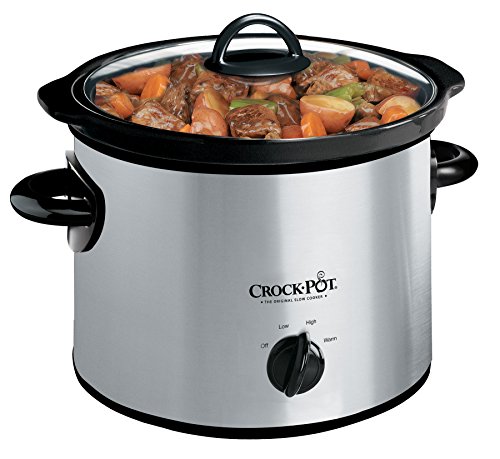
Crock-Pot Manual Slow Cooker, 3-Quart — Best Overall Basic
If someone says ‘slow cooker’ and you picture a specific object, it is probably this one. Three quarts is the sweet spot for households of two or three — a stew, a small chicken, a batch of soup — without the leftovers fatigue of a big pot or the cramped compromise of a mini. The controls are a single dial offering high, low and warm, the stoneware lifts out for serving and washing and can go in the oven, and the whole machine has the unhurried solidity of a design that has been refined rather than reinvented. For most people shopping for a basic cooker, this is where the search should start and very possibly end.
Strengths
- Dead-simple dial control with high, low and warm
- Oven-safe removable stoneware doubles as a serving dish
- Three-quart size matches small households perfectly
Trade-offs
- No timer, so finished food waits at cooking temperature until you return
- Too small for large joints or double batches
- Manual warm management requires a little planning
| Specification | Detail |
|---|---|
| Capacity | 3 quart, serves 3+ |
| Controls | Manual dial: high, low, warm |
| Crock | Removable stoneware, oven safe |
| Cleanup | Dishwasher-safe crock and lid |
The Crock-Pot’s case is accumulated trust. This pattern of cooker — heavy stoneware, wraparound heating, glass lid — is the one that generations of cooks have learned on, and its behaviour is correspondingly predictable: low is genuinely gentle, high gets a stew moving without violence, and warm holds a finished dish through a delayed dinner without turning it to mush in the first hour. The stoneware deserves particular mention, because at this tier some rivals thin the crock to save cost; this one feels like pottery, heats evenly and has the replacement availability of a model the maker expects to support for years.
Living with it is correspondingly plain. There is nothing to programme, nothing to reset after a power cut — a point worth pausing on, because a manual cooker simply resumes when power returns, while some electronic models sit idle — and nothing to clean except a crock and a lid. The absence of a timer is the one real consideration, and it is a scheduling question rather than a quality one. If you are home to eat within a reasonable window of the food finishing, the dial is not a limitation at all. Judged as the basic cooker against which others are measured, this Crock-Pot earns Best Overall on merit and heritage alike.
Best for: Households of two or three wanting the classic, dependable cooker / Not suited for: Anyone who needs the cooker to switch itself to warm unattended
Check on Amazon — check the current price on Amazon before you decide, because configurations and included accessories vary by listing.
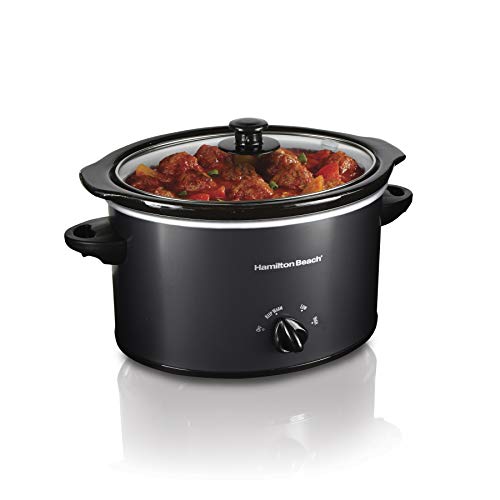
Hamilton Beach 3-Quart Slow Cooker 33231 (Matte Black) — Best Small-Household Value
Hamilton Beach has built a loyal following by making the appliance you actually need at a price that feels fair, and this three-quart cooker is a textbook example. It covers the same small-household ground as the Crock-Pot pick — stews, soups, small roasts for two or three people — in a matte black finish that suits modern kitchens better than the retro patterns basic cookers often wear. The crock and lid are dishwasher safe, the controls are a straightforward dial, and the whole package is aimed squarely at buyers who want slow cooking without ceremony or overspend.
Strengths
- Clean matte black finish suits contemporary kitchens
- Dishwasher-safe crock and lid keep ownership effortless
- Trusted brand value with widely available support
Trade-offs
- Same honest limitation as all manual cookers: no automatic warm switch
- Three quarts will not stretch to family batch cooking
- Design is understated rather than a counter statement
| Specification | Detail |
|---|---|
| Capacity | 3 quart |
| Controls | Manual dial |
| Finish | Matte black |
| Cleanup | Dishwasher-safe crock and lid |
In use, the Hamilton Beach does the simple things with unusual tidiness. The crock heats evenly, the lid seats properly without the wobble that plagues the cheapest cookers, and the dial has the positive, notched feel that tells your fingers the setting without looking. Small cookers live or die on these details because their owners use them constantly — this size is the weeknight workhorse, not the holiday specialist — and the 33231 feels engineered by people who understood the assignment. The matte finish also proves practical, hiding the minor scuffs and splashes of weekly use better than gloss.
As a value proposition it is best understood against its own category. You are paying for stoneware, a sound heating base and a brand that will still exist when you want a replacement lid, and not a cent for electronics. Cooks who later fall for slow cooking sometimes add a programmable model for workdays and keep a manual cooker like this for weekends, which says something about the format’s enduring usefulness. For a small household buying one basic cooker, the choice between this and the Crock-Pot above is mostly taste; both are right answers, and this one wears the smarter suit.
Best for: Couples and small families who value tidy design and easy cleaning / Not suited for: Batch cooks or anyone feeding five or more
Check on Amazon — check the current price on Amazon before you decide, because configurations and included accessories vary by listing.

Crock-Pot Oval Manual Slow Cooker, 7-Quart Stainless Steel — Best Large Basic
Big and basic is a combination the market oddly neglects, pushing large-capacity buyers towards electronic models whether they want them or not. This seven-quart Crock-Pot is the correction: a family-size oval stoneware cooker with a plain dial, high, low and warm, and room for the roasts, hams and double stew batches that smaller pots refuse. The oval shape matters at this size because the food that needs seven quarts — a whole chicken, a long joint, a turkey breast — is rarely round. Stainless steel wraps the base in a finish that suits its scale and wipes clean after a long cook.
Strengths
- Seven-quart oval crock fits whole birds and large joints
- Simple manual dial at a size rivals usually make electronic
- Stainless exterior and removable stoneware keep it practical
Trade-offs
- Large and heavy, especially full; plan the lift to the sink
- No timer for unattended finish management
- Needs a household that will actually fill it regularly
| Specification | Detail |
|---|---|
| Capacity | 7 quart, serves 8+ |
| Controls | Manual dial: high, low, warm |
| Crock | Removable oval stoneware |
| Finish | Stainless steel |
The cooking character is classic big-pot behaviour: a large thermal mass that comes up to temperature steadily and holds it with authority. That mass is forgiving — a big stew in this crock shrugs off a late start or an extra hour in a way small pots cannot — and the oval stoneware distributes heat around a joint evenly enough that one end does not dry while the other dawdles. For holiday cooking it quietly becomes the second oven: the ham or the mulled batch or the mountain of mashed potatoes holding warm while the oven does everything else. Appliances that earn holiday duty tend to be the ones still in the kitchen a decade later.
The considerations are physical. Seven quarts of food is heavy, the crock is a two-hand lift, and storage needs a real cupboard, not a hopeful shelf. It also shares the manual format’s scheduling honesty: no timer, so plan cooks around your presence. But for a large household that cooks at home — precisely the people who benefit most from slow cooking’s economy — this is arguably the highest-value machine in the guide, delivering family capacity and Crock-Pot stoneware with nothing electronic to age. Simple, capacious and built for years: the large basic brief, fully answered.
Best for: Large families and holiday cooking without electronic complexity / Not suited for: Small households or anyone short on cupboard space
Check on Amazon — check the current price on Amazon before you decide, because configurations and included accessories vary by listing.

Hamilton Beach 6 Quart Slow Cooker (33665G) — Best Family All-Rounder
Six quarts is the size most families actually need — a whole chicken with vegetables, a stew that feeds five with leftovers worth having, a batch of soup for the freezer — and this Hamilton Beach delivers it in the basic format with three cooking settings and the brand’s usual common sense. It is the pick for the household graduating from a small cooker, or buying its first, that wants one machine for both weeknight dinners and weekend batches. The silver finish is neutral, the crock and lid go in the dishwasher, and the controls could not be simpler.
Strengths
- Six-quart capacity is the true family all-rounder size
- Three settings cover cooking and holding without complexity
- Dishwasher-safe stoneware and lid for painless cleanup
Trade-offs
- Manual control means no automatic switch to warm
- Silver finish is functional rather than distinctive
- Too large for efficient one-person cooking
| Specification | Detail |
|---|---|
| Capacity | 6 quart |
| Controls | Manual, 3 cooking settings |
| Crock | Stoneware, dishwasher safe |
| Lid | Glass, dishwasher safe |
What makes this cooker easy to recommend is the absence of a wrong note. The stoneware is properly heavy, the heating is even enough that a full pot of beans cooks uniformly, and the warm setting is calibrated for holding rather than continued cooking — a detail cheaper large cookers often get wrong, slowly reducing sauces while you wait for everyone to come home. The size hits the practical maximum for a standard kitchen: any bigger and the full crock becomes a genuine lift; any smaller and the whole chicken stops fitting. Hamilton Beach has sold variations of this machine for years, and the maturity shows in the lid fit and the handle design.
For families weighing basic against programmable, this is the model that frames the question best. If a parent is home, or home by the time food finishes, the dial does everything required and the saving against programmable equivalents buys a lot of ingredients. If the household’s evenings are unpredictable, the timer guide exists for a reason. Either way, as a manual family cooker this is the balanced choice: right size, right build, right level of simplicity, from a brand whose spares shelf is well stocked.
Best for: Families of four to six wanting one cooker for almost everything / Not suited for: Solo cooks or schedule-driven buyers who need a timer
Check on Amazon — check the current price on Amazon before you decide, because configurations and included accessories vary by listing.

bella 6.0 Qt Manual Slow Cooker (Oatmilk) — Best Nonstick Basic
bella’s take on the basic cooker asks a fair question: if the format is simple, why should cleaning it be hard? The answer is a stoneware pot with a ceramic nonstick coating, so the cheese sauce, the sugary glaze and the oatmeal ring release with a sponge instead of a soak. Around that pot bella wraps the thoughtful small stuff — cool-touch handles, a tangle-free cord wrap for tidy cupboards, a tempered glass lid — in a soft oatmilk finish that looks deliberately designed rather than inherited. It is the basic cooker for people who like their simplicity with a little polish.
Strengths
- Ceramic nonstick coating makes the worst slow-cooker washing up easy
- Cool-touch handles and cord wrap show real design care
- Six-quart family capacity with three temperature settings
Trade-offs
- Nonstick surface needs gentle utensils and no abrasive scouring
- Coating is a wear surface in a way plain stoneware is not
- Style-led colours may not suit every kitchen
| Specification | Detail |
|---|---|
| Capacity | 6.0 quart |
| Controls | Manual, 3 temperature settings |
| Pot | Stoneware with ceramic nonstick coating |
| Details | Cool-touch handles, tangle-free cord wrap |
The coating is the story, and it changes the ownership experience more than any electronic feature could. Slow cooking’s dirtiest jobs are the sticky ones, and a pot that wipes clean in seconds gets used more often — which is the entire economics of a basic appliance. The ceramic surface also makes the pot a better serving vessel, since food releases onto plates instead of clinging. bella backs the concept with sensible hardware: the handles genuinely stay manageable, the lid is tempered glass, and the cord wrap is the kind of detail you appreciate every single time you put the cooker away.
The trade-off is the standing one for all coated cookware: the surface is superb while it lasts and it will not last forever, whereas plain stoneware is effectively immortal. Use silicone or wooden tools, avoid thermal shock and skip the scouring pad, and the coating should give years of easy evenings. Buyers who want a cooker to hand down should choose the uncoated Crock-Pot picks; buyers who want the cooker they will actually enjoy cleaning, weekly, for years, should choose this one. In a basic lineup, that is a legitimate and popular definition of best.
Best for: Frequent slow cooks who prioritise effortless cleanup / Not suited for: Buyers wanting an uncoated crock that lasts indefinitely
Check on Amazon — check the current price on Amazon before you decide, because configurations and included accessories vary by listing.

Elite Gourmet MST-250XS 1.5 Qt Slow Cooker — Best Mini Basic
Every slow-cooker household eventually discovers the mini. One and a half quarts is too small for dinner for four and exactly right for the jobs big cookers do badly: hot dips that stay hot, sauces and gravies held at serving temperature, oatmeal for one, a stew for two without a week of leftovers, or the side dish that frees the main cooker for the main event. Elite Gourmet’s MST-250XS is the category’s long-running standard, with adjustable low, high and keep-warm settings, a removable ceramic crock and a stainless finish, in a footprint that lives happily on the counter rather than demanding cupboard diplomacy.
Strengths
- Perfect size for dips, sauces, sides and two-person meals
- Low, high and keep warm settings in a counter-friendly footprint
- Removable ceramic crock is dishwasher safe
Trade-offs
- Far too small to serve as a household’s only cooker
- No timer, like the rest of the manual family
- Mini crocks tempt overfilling, which slow cookers dislike
| Specification | Detail |
|---|---|
| Capacity | 1.5 quart |
| Controls | Manual: low, high, keep warm |
| Crock | Removable ceramic, dishwasher safe |
| Finish | Stainless steel |
Judge the MST-250XS by how often it will be used rather than how much it holds and it becomes one of the hardest-working appliances in this guide. Game-day dips, holiday gravy, a small batch of mulled drinks, steel-cut oats for a single early riser — the mini’s repertoire is the set of jobs that recur weekly in real kitchens. The ceramic crock heats gently and evenly at this scale, the keep-warm setting is precisely calibrated for holding dips without scorching them, and the whole machine cleans in a minute under the tap. Elite Gourmet has sold this model for years, which in the mini category — full of novelty electronics — is its own recommendation.
Its role should be understood honestly: this is a second cooker or a small household’s specialist, not a family machine. Bought for the right jobs it is a bargain in the purest sense, a small price for a tool used constantly. Bought as a primary cooker for a family it would frustrate within a week. The guide places it last in size and first in its niche, and households that entertain even occasionally will find it quietly indispensable by the second party.
Best for: Dips, sauces, sides and one-to-two-person cooking / Not suited for: Anyone needing it to feed a family as a main cooker
Check on Amazon — check the current price on Amazon before you decide, because configurations and included accessories vary by listing.
Comparison Table
| Pick | Badge | Key spec | Best for |
|---|---|---|---|
| Crock-Pot Manual Slow Cooker, 3-Quart | Best Overall Basic | 3 quart, serves 3+ | Households of two or three wanting the classic, dependable cooker |
| Hamilton Beach 3-Quart Slow Cooker 33231 (Matte Black) | Best Small-Household Value | 3 quart | Couples and small families who value tidy design and easy cleaning |
| Crock-Pot Oval Manual Slow Cooker, 7-Quart Stainless Steel | Best Large Basic | 7 quart, serves 8+ | Large families and holiday cooking without electronic complexity |
| Hamilton Beach 6 Quart Slow Cooker (33665G) | Best Family All-Rounder | 6 quart | Families of four to six wanting one cooker for almost everything |
| bella 6.0 Qt Manual Slow Cooker (Oatmilk) | Best Nonstick Basic | 6.0 quart | Frequent slow cooks who prioritise effortless cleanup |
| Elite Gourmet MST-250XS 1.5 Qt Slow Cooker | Best Mini Basic | 1.5 quart | Dips, sauces, sides and one-to-two-person cooking |
Read the table as a shortlist, not a ranking carved in stone: the right answer for best basic slow cookers depends on the size of your household, the space you actually have and how you really cook week to week, which is exactly what the buying guide below works through.
How to Choose the Best Basic Slow Cooker
Begin with the crock, because in a basic cooker the stoneware is the product. Pick it up if you can, or judge by specification and reputation: you want thick, evenly glazed stoneware that feels like pottery rather than crockery. Thick walls heat evenly, resist the thermal shock of years of use and hold temperature steadily. Check the glaze for evenness, confirm the crock is removable — a fixed pot makes washing and serving miserable — and confirm it is dishwasher safe and, ideally, oven safe, which turns the crock into a serving and finishing dish as well.
Size honestly. Slow cookers cook best half to two-thirds full, so the right capacity is the one your typical meal fills properly. One and a half to two quarts covers dips, sauces and one or two people; three quarts is the small-household sweet spot; four to five quarts serves three or four; six quarts is the family all-rounder; seven quarts and above is batch and crowd territory. Buying two sizes too large ‘for flexibility’ is the classic basic-cooker mistake, because a thin layer of stew in a huge crock dries at the edges and cooks unevenly.
- Thick removable stoneware crock, dishwasher safe
- A lid that sits flat without rocking or rattling
- Low, high and a warm setting that holds rather than cooks
- Handles that let you lift the base securely
- A model with replacement crocks and lids available
- A footprint your cupboard can actually accommodate
Finally, think in decades. A basic cooker’s promise is longevity, so favour model families with a track record and a spares shelf. The brands in this guide have sold these patterns for years, which means a cracked lid in year six is a small purchase, not a new appliance. That, more than any feature list, is what makes a basic cooker the best-value appliance in the kitchen.
Manual vs Programmable: An Honest Comparison
The manual cooker’s advantages are durability, simplicity and price. With no control board, there is almost nothing to fail; after a power interruption a manual cooker simply resumes cooking when the power returns, where some programmable models switch off and stay off. The dial is operable by anyone, including guests and grandparents, and the saving versus programmable equivalents is real money across a household budget.
The programmable cooker’s advantage is one feature with outsized impact: it switches itself to warm when cooking ends. If your work regularly keeps you out hours beyond a recipe’s finish, that feature protects both the food’s quality and, over very long holds, its safety margin. The bargain-with-timers guide in this series exists for exactly those households. Neither format cooks better than the other — the pots and heating are the same — so the decision is purely about your schedule. Choose by your calendar, not by which box lists more features.
Many settled kitchens end up with one of each: a programmable machine for workdays and a basic cooker, often a different size, for weekends, sides and gatherings. If budget forces a single choice and your evenings are unpredictable, buy the timer. If you are reliably home, buy the dial and spend the difference on ingredients.
Getting the Best From a Dial: Timing Without a Timer
Cooking on a manual cooker is an exercise in matching recipe length to your day, and slow cooking is forgiving enough to make that easy. Most dishes have a window rather than a moment: a stew that is ready in seven hours on low is usually fine at nine. Choose recipes whose window covers your absence, favour low for long cooks — low’s gentleness is the format’s greatest strength — and use warm as a short bridge, not a second cooking stage. If you are regularly stretching windows, that is the signal to add a programmable model, not to blame the dial.
A plug-in outlet timer is sometimes suggested as a hack, and it deserves a caution. Cutting power to a cooker mid-recipe leaves food cooling through temperatures it should not linger in, and restarting later does not undo that. Use the cooker’s own settings and recipe windows instead; they were designed for the job. The one timer worth using with a manual cooker is your own kitchen clock, checked when you get home, with warm engaged while you change, pour a drink and lay the table — which is, in the end, the pace slow cooking was invented for.
How to Use a Basic Slow Cooker Well
A basic cooker asks for technique instead of programming. These habits, none of them complicated, are the difference between good slow cooking and the grey, watery results that give the method a bad name.
- Fill the crock between half and two-thirds full for even cooking
- Layer dense vegetables at the bottom near the heat, meat above, and liquids to barely cover
- Resist lifting the lid; each peek releases the heat the cooker spent an hour building
- Cook on low for long, gentle results whenever time allows, and use high for shorter cooks and getting thick stews moving
- Add dairy, fresh herbs and quick-cooking vegetables in the final stretch to keep them vivid
- Switch to warm only for the final wait before serving, then refrigerate leftovers promptly in shallow containers
Two flavour habits matter as much as the mechanics. First, brown meat and bloom spices when a recipe deserves it; a slow cooker will not do that work for you, and five minutes in a pan transforms a stew. Second, finish actively: a squeeze of lemon, a handful of herbs, a swirl of cream or a knob of butter at the end wakes up flavours that long cooking inevitably melds. Slow cooking is a method of patience, not passivity, and the dial-controlled cooker rewards the cook who treats it that way.
Care is equally simple. Let stoneware cool before washing, soak rather than scour, never immerse the heating base, and store the crock with the lid inverted or a cloth between them to protect the glaze. A basic cooker maintained this way is not an appliance with a lifespan so much as a piece of kitchen furniture that happens to cook.
Common Buying Mistakes
Filling the crock to the brim or barely covering its base. Slow cookers are engineered for the half-to-two-thirds zone. Outside it, cooking turns uneven and lids lift or edges dry.
Treating warm as a cooking setting. Warm holds finished food; it does not cook raw food safely or well. Start on low or high, always.
Peeking constantly. The glass lid exists so you can look without opening. Every lift costs the cooker significant time to recover.
Putting a cold crock straight onto high heat. Thermal shock cracks stoneware. Let a fridge-cold crock stand a while, and never pour cold water into a hot one.
Buying basic to save money, then resenting the missing timer. If your schedule needs an automatic warm switch, the saving is false economy. Match the format to your calendar first.
Final Recommendation
Start where most households should: the Crock-Pot Manual 3-Quart for small households, or the Hamilton Beach 6 Quart for families, both proven patterns with replaceable crocks and nothing electronic to age. Add the Elite Gourmet mini when dips, sauces and sides enter your life regularly, step up to the seven-quart Crock-Pot if your cooking is genuinely large-scale, and choose the bella if easy cleaning is what will decide whether the cooker gets used. The Hamilton Beach 3-Quart remains the tidy alternative for small kitchens that like their appliances handsome.
The deeper recommendation is the format itself. A basic slow cooker is one of the last appliances that can plausibly serve you for decades, and every pick in this guide was chosen to honour that promise: thick stoneware, sound lids, honest sizing and brands that sell the spare parts. Buy the size you will fill, cook on low, and let the dial do the rest.
Related guides in this series: Best Bargain For Slow Cookers With Timers Best Big Slow Cookers Best Small Slow Cookers Best 3 Quart Slow Cookers Best 6 Quart Slow Cookers
The Recipes That Suit a Basic Slow Cooker Best
A dial-controlled cooker has a natural repertoire, and cooking inside it makes the format feel less like a compromise and more like a speciality. Braises lead the list: beef shin, pork shoulder, lamb shanks and chicken thighs all emerge from a long, low cook with the silkiness that is slow cooking’s founding promise, and all of them tolerate the timing windows a manual cooker asks you to work within. Soups and bean pots follow closely — dishes whose flavour deepens rather than deteriorates with an extra hour — and steel-cut oats, set up the night before on low or first thing in the morning, turn the humblest cooker in this guide into a breakfast machine.
Dips, sauces and holding duties form the second repertoire, the one that makes basic cookers indispensable at gatherings. A manual cooker on warm is the best serving vessel in the house: queso that stays molten, meatballs that stay glazed, mulled drinks that stay at the edge of steaming without ever boiling away their character. The mini Elite Gourmet in this guide exists for exactly these jobs, and households that entertain learn to reach for it the way they reach for the good serving spoon. None of these tasks needs a timer, a probe or a programme; they need steady, gentle heat and a pot that looks presentable on the table, which is the basic format described in one sentence.
What the repertoire excludes is equally instructive. Delicate fish, quick vegetables, dairy-heavy sauces that split under long heat and anything whose excellence depends on a precise finish minute all belong to other tools. A basic slow cooker is not a lesser appliance for those exclusions; it is a specialised one, and the cook who stocks its repertoire with forgiving, deepening, holding-friendly dishes will never feel the absence of electronics. Match the food to the format and the dial stops being a limitation you accepted for the price. It becomes the reason the food is good.
Check on Amazon · Check on Amazon · Check on Amazon — the shortlisted picks most relevant to this section, with current pricing on their Amazon pages.
One more consideration belongs in any honest basic-cooker guide: the second-cooker effect. Households that buy a basic cooker for its simplicity often discover, a season later, that they want a second one in a different size — the mini for dips beside the family pot, or the large oval for holidays beside the everyday three-quart. This is not upselling; it is how the format is actually lived with, because manual cookers are inexpensive enough, and durable enough, that a pair of them in complementary sizes covers more real cooking than a single feature-laden machine. If your budget stretches, plan the pair from the start and buy the size you will use weekly first. The second cooker, bought with experience, is almost always the best-judged appliance in the kitchen.
Frequently Asked Questions
Are basic slow cookers safe to leave on while I am out?
Slow cookers are designed for unattended cooking on a stable, heat-safe surface with clearance around them, and generations of cooks have used them exactly that way. The manual format’s caveat is scheduling rather than safety: it will not switch to warm when cooking ends, so choose a recipe whose cooking window covers your absence.
What is the difference between low, high and warm?
Low and high reach similar final temperatures at different speeds — low takes roughly twice as long — while warm simply holds cooked food at serving temperature. Warm is not a cooking setting and should never be used to cook raw food.
Why does my slow cooker food taste watery?
Usually too much liquid and too much peeking. Slow cookers lose very little moisture, so recipes need less liquid than stovetop versions, and lifting the lid both cools the pot and condenses extra water back into the dish. Finish with a brief uncovered simmer or a cornflour slurry if a sauce needs body.
Can the stoneware crock go in the oven and dishwasher?
On the picks in this guide, yes to the dishwasher, and the Crock-Pot stoneware is oven safe as well. Always respect the maker’s temperature guidance, avoid broiler-level heat unless specified, and let the crock cool before washing to prevent thermal shock.
How long should a basic slow cooker last?
With kind treatment, decades. There is no control board to fail, so lifespan is set by the stoneware surviving drops and thermal shock. Choosing a model with replacement crocks and lids available extends that further, which is why this guide favours long-running model families.
Is a basic slow cooker cheaper to run than an oven?
Yes, substantially. A slow cooker draws modest power over its long cook and heats the kitchen far less. For stews, braises and beans it is one of the most economical cooking methods in the house, which is part of the format’s enduring appeal.


