Disclosure: airfryerkitchensupply.com is reader-supported. When you buy through links on our site, we may earn an affiliate commission at no extra cost to you.
Where to buy
All six picks in this guide to the best and safest toaster ovens are sold on Amazon. Safety features are model-specific — a brand may offer auto shutoff on one oven and a stay-on dial on its sibling — so use the links in the Quick Picks, the reviews, and the comparison table to confirm you are looking at the exact model number reviewed here, and check price on Amazon on that exact listing before ordering. If a listing bundles a different model under a similar name, back out and navigate from the model number, not the product photo.
What actually makes a toaster oven safe?
When people search for the best and safest toaster ovens, they are usually worried about one of three things: a fire, a burn, or an oven left running by accident. Those are the right worries. A toaster oven is a high-wattage heating appliance that sits on a counter at hand height, often in a kitchen where kids reach, towels hang, and mornings run on autopilot. The good news is that modern countertop ovens have quietly accumulated real safety engineering — automatic shutoff timers, doors designed to keep hot glass away from forearms, insulated walls, enclosed heating elements, and crumb management that removes the most common ignition source in the category. The bad news is that these features are unevenly distributed, rarely headlined, and sometimes undermined by a single design choice like a stay-on dial with no timer backstop.
This guide ranks six ovens primarily on safety architecture, then on cooking competence — because the safest oven is only a good recommendation if a household will actually use it correctly. Every pick below has at least one meaningful, verifiable safety feature drawn from its confirmed product data: auto shutoff, a roll-top door that removes the hot-door reach-over, infrared elements sealed inside a compact cavity, or a short-cycle timer that cannot be left running indefinitely. We also explain, in the buying-guide sections, the safety features that marketing inflates, the habits that matter more than any feature, and the placement rules that prevent most countertop oven incidents before they start.
One framing note: no countertop oven is “fireproof,” and none of the picks below should be run unattended as a habit, operated on a damaged cord, or wedged into a space smaller than its manual allows. Safety in this category is a partnership between appliance design and user behavior. This guide covers both halves honestly — what the ovens do for you, and what you still have to do for yourself. Read the picks with your own household in mind: the right answer for a careful solo cook, a house full of kids, and an aging parent cooking alone are three different ovens, and all three are on the list below. Where two picks seem close, let the tiebreaker be the user, not the spec sheet: the oven whose controls the least confident cook in the house will use correctly on a tired morning is the safer oven, whatever its feature list says.
In this guide
Quick Picks
- Best Overall for Safety — Hamilton Beach Easy Reach 4-Slice Toaster Oven. The roll-top door lifts the hot door up and away instead of dropping it toward your wrists, and auto shutoff backs up forgetful users. The benchmark safe design in this category. Check price on Amazon
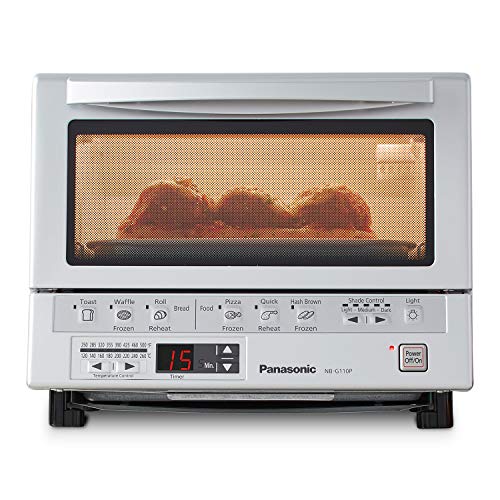
- Best for Small Kitchens — Panasonic FlashXpress NB-G110P. Double infrared heating inside a compact, sealed-feeling cavity, six auto cook options, and precise temperature control — fast cooking with no long preheat and a small footprint that keeps required clearances achievable. Check price on Amazon
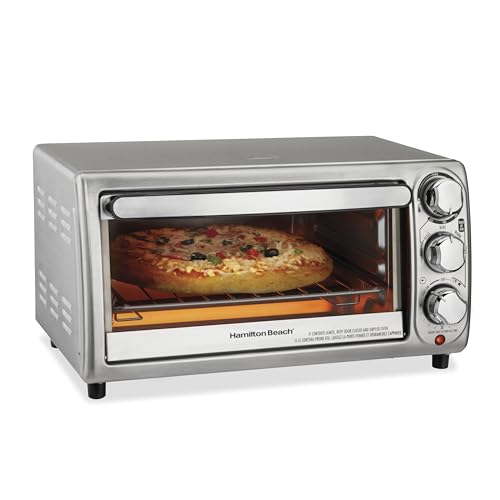
- Best Budget with Auto Shutoff — Hamilton Beach 31143J 4-Slice Toaster Oven. Five cooking modes, stay-on and auto shutoff options, two rack positions, and a 200–450°F range at a budget tier — proof that the most important safety feature does not require a premium price. Check price on Amazon
- Best Simple Controls for Seniors — Proctor Silex 31260G 4-Slice Toaster Oven. A 30-minute timer with automatic shutoff and plain dials: the oven turns itself off half an hour after it starts, every time, which is exactly the backstop many households are shopping for. Check price on Amazon
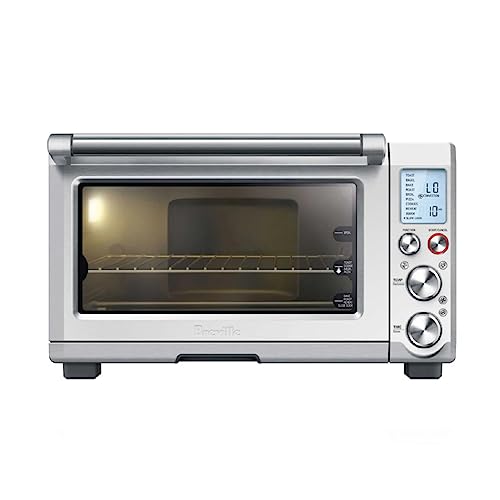
- Best Premium — Breville Smart Oven Air Fryer Pro BOV900BSS. Thirteen functions, convection that cuts cook times, and Breville’s heavily insulated, precisely controlled cavity design — the premium pick for cooks who want capability with disciplined temperature management. Check price on Amazon
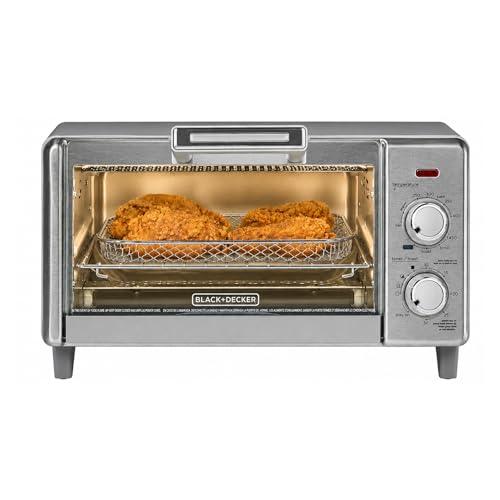
- Best Compact — BLACK+DECKER TO1745SSG 4-Slice Toaster Oven. Even Toast technology, four functions, a removable crumb tray that tackles the category’s biggest ignition source, and a timer in a small, simple box for tight counters. Check price on Amazon
How These Picks Were Chosen
We began with the full field of countertop ovens verifiable connection to Amazon — searching by brand and model, matching each returned listing title to the exact product, and only then assigning purchase links. On top of that verified base, we applied a safety-first screen. To make this list, an oven needed at least one structural safety advantage that could be confirmed from its product data rather than from advertising copy: automatic shutoff, a door design that removes the reach-over hazard, a short maximum timer cycle, infrared elements in an enclosed cavity, or a removable crumb tray paired with a timed (not stay-on-only) control scheme.
We also screened out designs whose primary control is an always-on dial with no timer and no shutoff — the configuration behind most “I forgot the oven was on” stories — unless the oven offered compensating features, and we favored models whose temperature ranges and functions are stated plainly in their listings. Cooking quality acted as the second filter: even heating, sane rack geometry, and interiors that clean easily, because an oven that smokes from baked-on grease is a safety problem wearing a cooking problem’s clothes.
Two standing rules apply throughout. No fixed prices appear in this guide — countertop oven prices change too often for print; use the links to check the current price on Amazon. And no star ratings or review counts appear, for the same reason. Specifications in the mini spec boxes come only from the verified listing data for each model; where a commonly advertised feature could not be verified for a specific model, we did not print it.
The 6 Best and Safest Toaster Ovens

Hamilton Beach Easy Reach 4-Slice Toaster Oven — Best Overall for Safety
The Easy Reach earns the top spot in a safety guide for one mechanical reason: its door rolls up over the top of the oven. Every conventional toaster oven door folds down toward you, placing a sheet of hot glass exactly where your hands and forearms travel when loading and unloading food. The roll-top design removes that entire category of contact burn, and it also keeps the door off the counter, away from the crumbs and spills that would otherwise bake onto it. Add auto shutoff and a 200–450°F range behind simple controls, and this is the oven we would hand to a household with kids, older parents, or anyone who has ever caught a wrist on a hot door.
Strengths
- Roll-top door eliminates the reach-across-hot-glass hazard that defines most toaster oven burns.
- Auto shutoff provides a backstop against the most common countertop oven accident: an oven simply forgotten.
- Open, unobstructed access to the rack makes loading heavy or awkward dishes steadier and less spill-prone.
Trade-offs
- Four-slice capacity suits couples and small families; larger households should look at the 6-slice Easy Reach design instead.
- Dial controls are approximate — fine for toast and reheating, less satisfying for precision baking.
- The roll-top mechanism deserves a periodic wipe of its track so crumbs do not make the door action gritty.
Key specs (verified): 4-slice capacity; roll-top door; bake, broil, and toast functions; 200–450°F adjustable temperature; auto shutoff; silver finish.
Beyond the door, the Easy Reach is a competent everyday oven: it toasts evenly, reheats without the rubbery microwave effect, and broils adequately for its size. The safety case and the cooking case point the same direction here, which is why it leads the guide. Households that cook for more people can apply the same logic one size up; the design philosophy — access first, shutoff always — is what we are endorsing, and this 4-slice model is its cleanest, most affordable expression. Check price on Amazon
Best for: households with kids or older users, and anyone who has been burned by a drop-down oven door. / Not suited for: large families or precision bakers.
Panasonic FlashXpress NB-G110P — Best for Small Kitchens
The FlashXpress takes a different route to both speed and safety: double infrared heating. Instead of exposed quartz or metal elements cycling on and off, its infrared system heats food directly and almost instantly, which eliminates preheating for most tasks and shortens the total time the appliance runs hot. The cavity is compact and enclosed, the controls offer six auto cook options with precise temperature management, and at 1300W it draws less than the 1800W class while cooking faster on the small foods it is sized for. For apartments, dorms-adjacent setups, and small kitchens where clearance space is precious, a smaller oven that is easier to place correctly is a genuinely safer oven.
Strengths
- Infrared heating means near-instant heat and no preheat cycle for most foods — less total hot time per meal.
- Compact footprint makes it realistically possible to honor the clearance distances that safety depends on.
- Precise temperature control and six auto cook options reduce the guess-and-check door opening that causes steam and heat escapes.
Trade-offs
- Four-slice, small-cavity sizing is real: this is a toast, reheat, and small-meal oven, not a casserole oven.
- Infrared intensity browns fast — new owners should watch the first few batches of toast until they learn its pace.
- Premium positioning for its size; you pay for the heating technology, not for capacity.
Key specs (verified): 1300W; double infrared heating; 6 auto cook options; precise temperature control; 4-slice compact size; silver finish.
The FlashXpress has a devoted following for toast quality, and the safety lens explains part of why it works so well in real kitchens: it is the rare countertop oven that fits where it is supposed to fit, runs for shorter periods, and asks for less door-open hovering because its programs are accurate. If your kitchen is small and your cooking is breakfasts, lunches, snacks, and two-person dinners, it is arguably the most sensible oven in this entire guide — safety included. Check price on Amazon
Best for: small kitchens, apartments, and one-to-two-person households that value speed and placement flexibility. / Not suited for: family-size cooking or buyers who need a 12-inch pizza fit.
Hamilton Beach 31143J 4-Slice Toaster Oven — Best Budget with Auto Shutoff
The 31143J exists to disprove a lazy assumption: that safety features are premium features. This budget-tier Hamilton Beach offers five cooking modes — bake, broil, toast, keep warm, and bagel — across a 200–450°F range, with both a stay-on option and auto shutoff, two rack positions, and a stainless steel finish. The stay-on mode is there for experienced users running long, attended bakes; the auto shutoff is there for everyone else, and its presence at this price is exactly what a safety guide should celebrate.
Strengths
- Auto shutoff at a budget tier — the single most valuable safety feature in the category, without a premium attached.
- Five modes including a dedicated bagel setting cover the real daily workload of a small oven.
- Two rack positions give enough geometry flexibility for both toast and taller dishes.
Trade-offs
- The stay-on mode must be used deliberately; households with forgetful users should treat the timer as the default, always.
- No convection fan, so roasting and baking run a little slower and less even than the fan-equipped picks.
- Four-slice capacity and a compact cavity limit it to small-batch cooking.
Key specs (verified): 4-slice capacity; 5 cooking modes (bake, broil, toast, keep warm, bagel); stay-on and auto shutoff; 2 rack positions; 200–450°F; stainless steel.
As a cooking appliance the 31143J is unpretentious and adequate: toast comes out even, frozen snacks crisp acceptably, and the bagel mode’s top-heavy heating is a small daily pleasure. Its role in this guide is to be the floor — the least a household should accept when shopping on a budget — and it sets that floor correctly by refusing to drop the shutoff. If your budget is firm and your household is small, buy this class of oven with confidence and put the savings toward a surge-protected outlet setup and a small kitchen fire extinguisher, which is a genuinely safety-literate way to spend the difference. Check price on Amazon
Best for: budget shoppers who refuse to give up auto shutoff, and small households. / Not suited for: convection cooking or family-size batches.

Proctor Silex 31260G 4-Slice Toaster Oven — Best Simple Controls for Seniors
Proctor Silex, Hamilton Beach’s value sibling brand, builds the 31260G around the simplest safety architecture in this guide: a 30-minute timer with automatic shutoff. There is no way to run this oven indefinitely. Every cooking session is a timed session, and when the timer ends, the oven stops — a design that directly answers the most common reason families shop this search, which is a parent or grandparent who occasionally walks away from a running appliance. The dials are large, the functions are the essential three (bake, broil, toast), and the temperature spans 200–450°F.
Strengths
- 30-minute maximum timer with automatic shutoff — the oven cannot be left running for hours by accident.
- Minimal, legible controls with no menus, presets, or digital interface to learn or misread.
- Compact 4-slice format suits one-to-two-person cooking, the exact use case it is bought for.
Trade-offs
- The 30-minute ceiling rules out long, slow bakes; anything beyond half an hour needs a second timed cycle and a check-in.
- No convection, no air fry, no digital precision — deliberately, but keen cooks will feel the limits.
- Basic fit and finish consistent with its value positioning.
Key specs (verified): 4-slice capacity; bake, broil, toast; 200–450°F adjustable temperature; 30-minute timer; automatic shutoff; black and silver.
Judged as a cooking appliance, the 31260G is a simple, honest toaster oven that handles breakfast and reheating duties without fuss. Judged as a safety appliance — which is how its buyers judge it — it is one of the strongest designs in the category, because its protection does not depend on the user remembering to choose a safe mode. The protection is the design. For adult children equipping a parent’s kitchen, or for anyone who knows their own attention wanders, that distinction is the whole purchase. Check price on Amazon
Best for: seniors, forgetful users, and anyone who wants a timer that cannot be overridden. / Not suited for: long bakes, convection cooking, or households cooking for more than two.
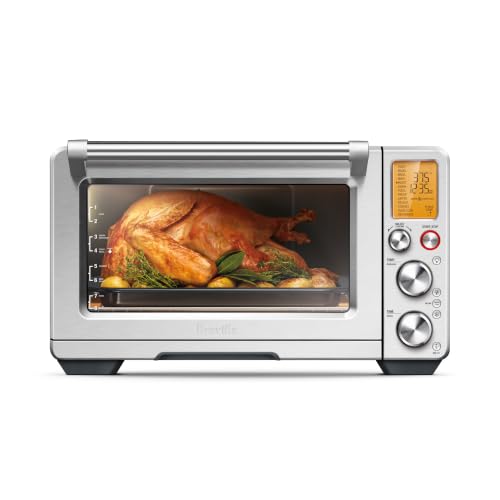
Breville Smart Oven Air Fryer Pro BOV900BSS — Best Premium
Breville’s flagship countertop oven approaches safety from the engineering end: precise electronic temperature control across thirteen functions, convection that reduces cook times by up to 30 percent (less time at temperature for the same result), and the kind of heavy, well-sealed cavity construction that keeps heat where it belongs — inside the oven, working on food. It is the largest-capability pick in this guide, an air fryer, roaster, dehydrator, and slow-cooking-capable oven in one brushed stainless body, and it suits serious cooks who will use that range weekly.
Strengths
- Precise, sensor-managed temperature control reduces the overshoot-and-scorch cycle of crude thermostats.
- Convection shortens cook times by up to 30 percent, cutting total hot-running time per meal.
- Thirteen functions in one appliance removes the need for multiple heating gadgets crowding outlets and counters.
Trade-offs
- Premium tier, full stop — this is the most expensive class of countertop oven in the guide.
- Large footprint demands real counter commitment and honest clearance planning.
- Capability depth means a learning curve; casual toast-only users will never touch most of it.
Key specs (verified): 13 cooking functions including roast, bake, and dehydrate; convection setting reduces cook time by up to 30%; brushed stainless steel.
The premium case here is control. Cheap ovens create their own hazards through imprecision — elements glowing at full blast to recover temperature, hot spots that char food edges into smoke, timers that bear little relation to doneness and invite constant door-opening. The Breville’s disciplined heating removes much of that drama, and its size means holiday cooking happens in a controlled countertop cavity rather than through improvised arrangements. Buyers paying this tier should still apply every habit in the safety sections below; the oven’s contribution is precision, not invincibility. Check price on Amazon
Best for: serious home cooks who want premium capability with disciplined temperature control. / Not suited for: tight budgets, small counters, or toast-only households.

BLACK+DECKER TO1745SSG 4-Slice Toaster Oven — Best Compact
The TO1745SSG closes the list with a feature that sounds like housekeeping and is actually fire prevention: a removable crumb tray. Crumbs and grease drippings accumulating on a toaster oven floor are the category’s most common ignition and smoke source, and the ovens that make tray removal effortless are the ovens whose trays actually get emptied. This compact BLACK+DECKER pairs that tray with Even Toast technology, four functions (bake, broil, toast, keep warm), and a timer, in a footprint sized for small counters and small households.
Strengths
- Removable crumb tray makes the single most important cleaning habit in this category nearly effortless.
- Timer-based operation keeps cooking sessions bounded rather than open-ended.
- Even Toast technology and a compact body suit daily breakfast-and-reheat routines in small kitchens.
Trade-offs
- No auto shutoff headline feature comparable to the Hamilton Beach picks — the timer is the protection, so use it every time.
- Four functions and 4-slice capacity define a deliberately basic appliance.
- No convection; roasting results are serviceable rather than excellent.
Key specs (verified): 4-slice capacity; Even Toast technology; 4 functions (bake, broil, toast, keep warm); removable crumb tray; timer.
For a single person, a couple, an office kitchenette, or a camper-adjacent setup, this is the sensible compact buy: it does the daily jobs, its tray slides out in seconds, and its simplicity leaves little to misuse. Pair it with the crumb discipline described in the how-to section — empty the tray after crumbly foods, wipe drips while the oven is warm but not hot — and a basic oven becomes a responsibly safe one. Check price on Amazon
Best for: small households and tight counters that need simple, timer-bounded cooking with easy crumb control. / Not suited for: users who want auto shutoff as a guaranteed backstop or convection performance.
Comparison Table
| Pick | Badge | Key spec | Best for |
|---|---|---|---|
| Hamilton Beach Easy Reach 4-Slice | Best Overall for Safety | Roll-top door, auto shutoff, 200–450°F | Kids, older users, burn-free access |
| Panasonic FlashXpress NB-G110P | Best for Small Kitchens | Double infrared, 1300W, 6 auto cook options | Small kitchens and fast small meals |
| Hamilton Beach 31143J | Best Budget with Auto Shutoff | 5 modes, auto shutoff, 2 rack positions | Budget shoppers who want the shutoff |
| Proctor Silex 31260G | Best Simple Controls for Seniors | 30-minute timer, automatic shutoff | Seniors and forgetful users |
| Breville Smart Oven Air Fryer Pro | Best Premium | 13 functions, convection cuts cook time up to 30% | Serious cooks wanting precise control |
| BLACK+DECKER TO1745SSG | Best Compact | Removable crumb tray, Even Toast, timer | Small households, easy crumb control |
How to Choose a Safe Toaster Oven
Shop the shutoff first. Automatic shutoff — whether through a timer that always ends the cycle or a dedicated shutoff feature — is the highest-value safety specification in this category, because it protects against the failure mode no amount of careful intention fully eliminates: human forgetfulness. Decide which style fits your household. Timer-only ovens like the Proctor Silex above make every session bounded by design. Ovens with both a stay-on mode and auto shutoff, like the Hamilton Beach 31143J, offer flexibility but ask the household to build a timer-first habit. Either is defensible; an oven with only a stay-on dial and no shutoff at all is the configuration this guide recommends against for most homes.
Next, examine the door. Drop-down doors are the category standard and the source of its most common injury. If anyone in the household is young, elderly, unsteady, or simply cooks while distracted, a roll-top door design meaningfully changes the risk profile of every single use. French doors are a reasonable middle ground on larger ovens. Whatever the design, check that the handle stays cool enough to grip without a towel and that the door closes positively — a door that drifts open leaks heat onto the counter and the user.
Then think about heat management. Precise temperature control is a safety feature in disguise: ovens that overshoot char food, smoke kitchens, and train users to open doors mid-cycle. Convection helps by evening out cavity temperature. Infrared designs like the Panasonic replace exposed-element cycling with fast, direct heat. And size itself is a safety variable — an oven small enough to place with its full manufacturer clearances honored is safer in a real kitchen than a larger “safer-featured” oven wedged against a wall. Measure your space, read the clearance requirement before you buy, and let the smaller oven win when the fit is honest.
Finally, weigh cleanability as safety. A removable crumb tray, an interior you can reach with a cloth, and a door that comes clean without disassembly determine whether the grease-and-crumb fuel load inside your oven stays near zero or quietly accumulates. The safest oven on paper becomes ordinary when it is dirty; the ordinary oven stays safe when it is clean.
Which safety features matter — and which are marketing?
Worth paying for: automatic shutoff, a maximum timer cycle, a roll-top or otherwise stay-clear door, precise temperature control, and a removable crumb tray. These map to real incident patterns — forgotten ovens, contact burns, scorched food smoking, and crumb ignition — and each one removes or reduces a specific mechanism of harm.
Worth having but not decisive: cool-touch exteriors (genuinely helpful, but every countertop oven’s top and door still get hot enough to demand respect), interior lights (they reduce door-opening, a small real benefit), and cord storage (tidiness that keeps cords off hot surfaces). Treat these as tiebreakers between otherwise equal ovens, not reasons to buy.
Mostly marketing: vague claims like “advanced safety system” with no named mechanism, “fire-resistant” language applied to ordinary steel construction, and app connectivity sold as supervision — an oven you can watch from your phone is still an oven running in an empty kitchen. The test for any safety claim is simple: ask what physically happens when something goes wrong. If the answer is a named mechanism — the oven turns off, the door is not in your way, the crumbs come out — the claim is real. If the answer is an adjective, it is not.
What do UL and ETL marks on a toaster oven actually certify?
Every pick in this guide comes from a major brand whose appliances carry third-party safety certification, and it is worth understanding what that little mark on the rating label represents. In North America, countertop ovens are typically tested to UL 1026 (the standard for household electric cooking appliances) or an equivalent standard by a Nationally Recognized Testing Laboratory — UL itself, Intertek (whose mark is ETL), or CSA. Certification means a sample of the exact model was tested for electrical safety, temperature limits on surfaces and components, abnormal-operation behavior such as a stalled fan or blocked vents, and construction requirements like cord strain relief — and that the factory is subject to follow-up inspections so production units match the tested sample.
What certification does not mean is equally important. It does not mean the oven cannot burn you — door glass and top surfaces are permitted to get hot within tested limits. It does not mean the oven is safe in any placement; the same standard assumes the clearances and conditions in the manual. And it does not evaluate cooking quality at all. Certification is a floor of electrical and fire-safety engineering, verified by an independent lab — a genuinely meaningful floor, and one reason this guide sticks to established brands whose model numbers, labels, and listings can be checked. When you compare any countertop oven, look for the certification mark on the physical rating label and be wary of listings that show no mark, a mark from an unrecognized body, or a model number that does not match the manufacturer’s own catalog.
One more label worth reading is the wattage and circuit information. Most countertop ovens draw between 1,200 and 1,800 watts — close to the practical limit of a standard household circuit once anything else shares it. The rating label tells you exactly what your model draws, and matching that number to your kitchen’s wiring reality (one heating appliance at a time per circuit) prevents the nuisance trips and, in older wiring, the overheating that no appliance feature can protect against. Two minutes with the label is the cheapest safety upgrade in this entire guide.
How to Set Up and Use a Toaster Oven Safely
Placement comes first. Put the oven on a flat, heat-resistant surface with the clearances its manual specifies on all sides and above — typically several inches — and never directly under low cabinets that trap heat. Plug it into a wall outlet, not a lightweight extension cord or a power strip shared with other heating appliances; countertop ovens draw serious wattage, and the circuit should not be shared with a kettle or microwave running simultaneously. Keep towels, paper, wooden utensils, and curtains out of the heat zone, and give the cord a route that does not drape across the oven’s hot top surface.
On first use, run the empty oven through the burn-off cycle the manual describes, with the kitchen ventilated, so manufacturing residues clear before food is involved. For everyday cooking, default to the timer every time — even when a stay-on mode exists — and treat the timer’s end as the end of the session, not a suggestion. Keep the crumb tray emptied: after anything crumbly or drippy cooks, let the oven cool to warm, slide the tray out, and empty it. Wipe interior drips while they are fresh; baked-on grease is both a smoke source and the reason ovens develop “that smell.”
During cooking, use the window and interior light instead of opening the door to check food, keep a clear landing zone of counter beside the oven for the hot tray, and use dry oven mitts — a wet mitt conducts heat almost instantly. Teach every household member the two house rules that prevent most incidents: nothing goes on top of the oven, ever, and the oven is never the last thing running when the house empties or the kitchen closes for the night. If the glass door ever cracks, the cord frays, or the oven behaves erratically — cycling wildly, smelling of electrical heat — stop using it and replace or professionally assess it; heating appliances do not heal.
Safety by household: kids, seniors, dorms, and offices
Households with children should optimize for access and surfaces. Kids get burned by toaster ovens in two predictable ways: reaching across a hot drop-down door, and touching a top surface that an adult forgot was hot. A roll-top door like the Easy Reach’s addresses the first; placement addresses the second — put the oven where small hands do not travel, keep its top permanently empty so nobody treats it as a shelf, and make the timer a household rule from the first day. Children old enough to use the oven should learn it on the simplest model in the house, with the crumb tray habit taught as part of the cooking lesson, not as an afterthought.
Households shopping for seniors should optimize for forgiveness. The relevant risks are forgetfulness, reduced grip strength, and controls that demand fine vision or menu navigation. A timer-capped oven such as the Proctor Silex 31260G forgives the walk-away completely. Large dials forgive eyesight. A lightweight door and a front-access crumb tray forgive grip and reach. When equipping a parent’s kitchen from a distance, choose the oven whose safe behavior requires the fewest remembered steps — ideally one remembered step: set the timer.
Dorms and shared housing add a different variable: other people’s habits. Many dormitories restrict countertop ovens entirely, so check the housing rules before buying anything. Where they are allowed, compact size, a bounded timer, and an oven that one person can clean completely in two minutes are the features that survive communal use. The Panasonic FlashXpress fits this pattern well: small, fast, enclosed, and quick to wipe down. Offices and break rooms follow the same logic at slightly larger scale — choose the oven the least careful colleague cannot easily misuse, which in practice means auto shutoff and no stay-on dial.
Rental kitchens and first apartments deserve one extra check: the circuit. Older buildings may pair the kitchen outlets on a single modest circuit, and a toaster oven plus a kettle will find its limit. Run the oven alone on its circuit while it cooks, learn which outlets share a breaker, and treat a frequently tripping breaker as information — the wiring is telling you the load is too much, and the answer is scheduling appliances, not a bigger breaker installed casually.
Toaster oven vs. microwave vs. basket air fryer: which is safer for what?
Each countertop appliance fails differently, and matching the appliance to the food is itself a safety practice. Microwaves heat without hot exterior surfaces or exposed elements, which makes them the lowest-burn-risk way to reheat soups and leftovers — but they superheat liquids unevenly and turn some foods into steam-burn hazards, and they cannot crisp anything. A toaster oven reheats pizza, fries, and baked goods far better, at the cost of genuinely hot surfaces that demand the door, clearance, and shutoff discipline this guide describes.
Basket air fryers sit between the two: their heating element and fan live inside a closed drawer, so the burn profile during cooking is lower than an open-door oven’s, and most have aggressive auto shutoff behavior because their cycles are fully programmed. Their risks concentrate at the ends of the cycle — a very hot basket handled over a sink or a lap — and in grease accumulation inside a cavity many owners rarely inspect. A toaster oven’s risks are more visible and therefore, for many households, more manageable: you can see the crumbs, reach the tray, and watch the food.
The practical conclusion is not that one appliance wins. It is that a household should own the combination it will maintain. A toaster oven with a clean tray, honest clearances, and a shutoff habit is a safe appliance; a neglected air fryer drawer full of old grease is not, whatever its spec sheet says. Choose based on the foods you cook weekly, then apply the maintenance and placement rules for the appliance you picked — that pairing, not the category, determines your real risk.
Common Buying Mistakes
The first mistake is shopping for safety by adjective — buying the oven whose page says “safe” most often rather than the one with a shutoff, a timer ceiling, and a door design you can describe. Mechanisms protect you; adjectives do not. The second mistake is ignoring the stay-on trap: a flexible stay-on mode is genuinely useful for attended long bakes, but in a household with distracted or elderly users it quietly cancels the protection the buyer thought they purchased. Match the control scheme to the least attentive realistic user, not the most careful one.
Third, buyers oversize. A big oven placed without its required clearances is a less safe appliance than a smaller oven placed correctly, and oversized ovens also run longer preheats for small foods. Fourth, crumb neglect: choosing an oven without a removable tray, or never removing the tray the oven came with, rebuilds the category’s main ignition source one meal at a time. Fifth, outlet improvisation — extension cords, multi-plug adapters, and circuits shared with other heating appliances are behind a steady share of countertop appliance incidents, and no oven feature compensates for them. Buy the placement and the circuit discipline along with the oven.
Final Recommendation
For most households, the Hamilton Beach Easy Reach 4-Slice is the safest sensible buy: the roll-top door removes the category’s signature burn, and auto shutoff covers the forgotten-oven scenario. Small kitchens should choose the Panasonic FlashXpress, whose compact infrared design fits honestly and cooks fast. Budget shoppers keep the essential protection with the Hamilton Beach 31143J; households shopping for a senior should go straight to the timer-capped Proctor Silex 31260G. Serious cooks who want premium control get it from the Breville Smart Oven Air Fryer Pro, and compact simplicity with easy crumb control lives in the BLACK+DECKER TO1745SSG. Pair any of them with the placement and habits above, and you have addressed this category’s real risks rather than its advertised ones.
Related guides in this cluster: Best American Made Toaster Ovens, Best Air Frying Toaster Ovens, Best Airfryer Toaster Ovens, Best Toaster Ovens For Small Spaces, Best Toaster Ovens Easy To Clean.
Frequently Asked Questions
Can a toaster oven catch fire?
Yes, though it is uncommon when the oven is used and maintained correctly. The typical causes are accumulated crumbs and grease igniting, food left cooking unattended until it chars and smokes heavily, towels or paper contacting hot surfaces, and electrical faults from damaged cords or overloaded circuits. Auto shutoff, regular crumb-tray emptying, correct clearances, and never leaving the oven as the last appliance running address nearly all of the realistic risk.
Is auto shutoff really the most important safety feature?
For most households, yes. Burns come from doors and trays, but the serious incidents — smoke damage and fires — usually begin with an oven left on and forgotten. An oven that turns itself off caps the worst case of every cooking session. Door design matters most for households with children or unsteady users, which is why our top pick combines both protections.
Is it safe to leave a toaster oven plugged in?
A modern oven in good condition draws no meaningful power while off, and leaving it plugged in is standard practice. The sensible cautions are condition-based: unplug an oven with a damaged cord, cracked door glass, or erratic behavior, and unplug any countertop oven for long absences from home. What matters far more than the plug is never leaving the oven running unattended as a routine.
Are infrared toaster ovens safer than conventional ones?
They change the risk profile rather than eliminating it. Infrared models like the Panasonic FlashXpress heat almost instantly, skip preheating, and finish small meals faster, which means less total time at temperature and an enclosed, compact cavity. Their intensity also means food browns and can scorch faster, so the first uses deserve attention. For small households, the net effect is favorable; for family-size cooking, capacity limits dominate the decision.
What clearance does a toaster oven need?
Follow the specific manual for your model — requirements vary — but plan on several inches of open space above and on each side, with nothing stored on top of the oven and no low cabinet directly over the vents. If your only available spot cannot provide the specified clearance, choose a smaller oven. Correct placement is a safety feature you install yourself.
How often should I clean the crumb tray?
Empty it after any session involving bread, pastries, or drippy foods, and give it a wash weekly in an active kitchen. The habit takes seconds with a removable tray and removes the most common fuel source for smoke and ignition in this category. Also wipe interior drips while the oven is warm (not hot) so grease never builds into a baked-on layer.