Disclosure: As an Amazon Associate, airfryerkitchensupply.com earns from qualifying purchases. Prices and availability change; check Amazon for the latest.
A cold brew coffee maker steeps coarse coffee grounds in cold or room-temperature water for many hours, then filters the result into a smooth, low-acid concentrate or ready-to-drink coffee. The large-batch versions are built for households that drink iced coffee every day, offices, and anyone who prefers to brew once and enjoy a fridge-full over several days.
The six makers below cover large-format pitchers, a classic bucket-style system and a countertop machine, along with a smaller pot for comparison. We have not used these products ourselves, so descriptions stay general. Please confirm capacity, included filters and dimensions on the current listing before buying, since sizes and bundles change and a large brew vessel needs real fridge space.
As an Amazon Associate we earn from qualifying purchases. Links below are affiliate links, and they do not change the product information we give.
In this guide
Quick Picks
- Toddy Cold Brew System
- Filtron Cold Water Coffee Concentrate System
- OXO Good Grips Cold Brew Coffee Maker
- Takeya Deluxe Cold Brew Coffee Maker
- Hario Mizudashi Cold Brew Coffee Pot
- Cuisinart Automatic Cold Brew Coffee Maker
What to Look For
| Feature | Why it matters |
|---|---|
| Capacity | Larger vessels make more per batch, but need more fridge room and more coffee |
| Filter type | Mesh, felt and paper filters differ in how clean and how fast the brew drains |
| Concentrate or ready-to-drink | Concentrate stores compactly and is diluted at serving; ready-to-drink needs no mixing |
| Material | Glass, BPA-free plastic and stainless steel each have different durability and odor behavior |
| Fit and shape | Pitchers should fit in your fridge door or shelf |
| Cleaning | Wide openings and few parts save time on a routine you repeat often |
The right size depends on how much you really drink. A big batch is only worthwhile if you finish it while it is still fresh, so many households choose a vessel that matches about a week of use at most.
Specs at a Glance
| Product | Style | Filter | Notes |
|---|---|---|---|
| Toddy Cold Brew System | Bucket-style concentrate maker | Reusable felt filters | Makes concentrate; check the listing for the batch size |
| Filtron Cold Water Coffee Concentrate System | Large concentrate maker | Included filter pad | Built for volume; check the size |
| OXO Good Grips Cold Brew Coffee Maker | Brewer with rainmaker lid and carafe | Mesh and paper filter | Compact stand and carafe |
| Takeya Deluxe Cold Brew Coffee Maker | Pitcher | Fine-mesh infuser | Available in more than one size |
| Hario Mizudashi Cold Brew Coffee Pot | Glass pitcher | Fine-mesh filter | Smaller than the others; for comparison |
| Cuisinart Automatic Cold Brew Coffee Maker | Countertop machine | Check the listing | Faster cycle than steeping |
The 6 Best Cold Brew Coffee Makers for Large Batches
Top pickBest for big concentrate batches
1. Toddy Cold Brew System
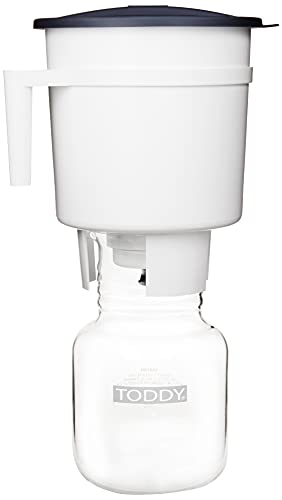
The Toddy is a long-running classic. It uses a bucket-style brewing container with a reusable filter and a glass decanter, and it is designed to make a strong concentrate that you dilute with water or milk when serving. A single batch yields a lot of coffee once diluted.
It suits households that want a lot of iced coffee from one steep, and anyone who prefers to store a small bottle of concentrate in the fridge rather than a big pitcher. Because it makes concentrate, it also works well for coffee-based cocktails, baking and mixing with milk.
Check the listing for the batch capacity and which filters are included, since felt filters need replacing over time. The trade-off is process: it takes more steps than a simple pitcher, and the filters need careful rinsing to avoid off flavors.
Suits: big concentrate batches. Strengths: a proven design and compact storage. Weaknesses: more steps and filter upkeep. Skip it if you want a simple pitcher.

Best for high-volume brewers
2. Filtron Cold Water Coffee Concentrate System
The Filtron is a well-regarded concentrate maker that has been used by home brewers and cafes for years. It uses a large brewing vessel with a filter pad and a drain system, and it is known for producing a clean, strong concentrate in volume.
It suits enthusiasts who make a lot of cold brew and are comfortable with a somewhat hands-on routine. If you drink iced coffee daily or serve it to guests, a larger concentrate system can save you from brewing every few days.
Check the listing for the size, what is included and the replacement filter details. The trade-off is space and setup: it is bulkier than a pitcher, and the process takes a little learning.
Suits: high-volume brewers. Strengths: large output and a clean concentrate. Weaknesses: bulky and hands-on. Skip it if storage space is tight.
View Filtron Cold Water Coffee Concentrate System on Amazon
Best for a tidy, mid-size batch
3. OXO Good Grips Cold Brew Coffee Maker
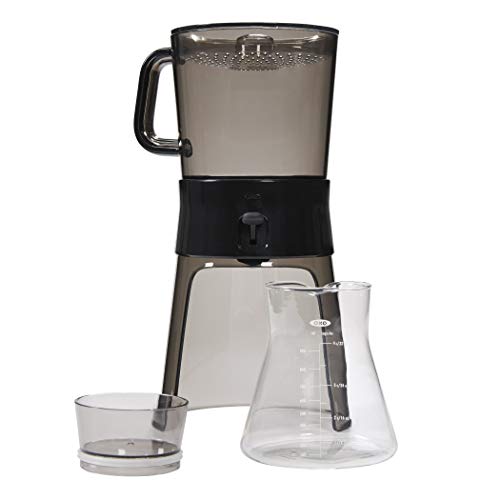
The OXO system pairs a brewing container with a lid that distributes water evenly over the grounds, which the maker calls a rainmaker design, and a mesh filter plus a paper filter for a clean pour. When the steep ends, you place the brewer on the carafe and the coffee drains through.
It suits people who want a tidy, mess-light workflow with a good-looking carafe that goes straight into the fridge. The design is aimed at making concentrate, and the stand and carafe set cuts down on drips.
Check the listing for the stated capacity, since it is better for a batch that lasts a few days than for a very large crowd. The trade-off is that it is not the largest option here, so heavy daily drinkers may want one of the bigger pitchers or systems.
Suits: a tidy, mid-size batch. Strengths: an even-saturation lid and an easy drain. Weaknesses: not the largest capacity. Skip it if you need a very big batch.
Best for simple ready-to-drink batches
4. Takeya Deluxe Cold Brew Coffee Maker
Takeya’s cold brew pitcher is one of the most familiar ready-to-drink designs. It is a pitcher with a fine-mesh infuser that sits inside, a sealing lid and a body sized to fit in a typical refrigerator. You add coffee grounds to the infuser, fill the pitcher with water, steep and remove the infuser.
It suits households that want a simple, no-filter-paper routine and a ready-to-pour pitcher. The product has been sold in more than one size, so choose the larger one if big batches are the goal.
Check the listing for the exact size and the material of the pitcher and lid. The trade-off is that fine mesh can let some sediment pass, so the brew may be a little less clear than a paper-filtered coffee, and a large pitcher needs a spot in the fridge.
Suits: simple ready-to-drink batches. Strengths: easy use and a fridge-friendly pitcher. Weaknesses: some fine sediment. Skip it if you want a paper-filtered, very clear cup.
View Takeya Deluxe Cold Brew Coffee Maker on Amazon

Best for glass lovers and smaller batches
5. Hario Mizudashi Cold Brew Coffee Pot
The Mizudashi is a glass pitcher with a fine-mesh filter basket, from a Japanese brand known for coffee gear. It is a smaller, simpler option than the others on this list and is included as a comparison for people who are not sure how much they need.
It suits smaller households and anyone who prefers glass, since glass does not hold onto odors. It can be a sensible starter before committing to a bigger system, and it is popular for tea as well.
Check which size the listing offers, since Hario has sold the pot in several capacities. The trade-off is plain: glass can break, and even the larger versions may fall short for very heavy daily drinking.
Suits: glass lovers and smaller batches. Strengths: a simple build that does not hold odors. Weaknesses: breakable and smaller. Skip it if you truly need the biggest batch.

Best for faster cold brew
6. Cuisinart Automatic Cold Brew Coffee Maker
This is a countertop appliance designed to speed up cold brewing, so you do not need to wait a full day. Machines like this typically circulate cold water through the grounds to extract coffee in a shorter cycle, and they often include a pitcher or carafe.
It suits people who want cold brew on a tighter schedule, or who like the idea of an appliance that handles the work. It can be convenient for offices and busy mornings.
Check the listing for the exact model name, capacity and cycle time, and make sure it is currently available, because small appliances are updated often. The trade-off is cost and counter space, and some coffee fans feel an automatic cycle can taste different from a slow, long steep.
Suits: faster cold brew. Strengths: a shorter cycle and less hands-on work. Weaknesses: counter space and a different taste. Skip it if you prefer the classic slow method.
View Cuisinart Automatic Cold Brew Coffee Maker on Amazon
Concentrate Versus Ready-to-Drink
Concentrate systems, like the bucket-style ones, make a strong coffee that you dilute at serving time. The big advantage is storage: you keep a smaller container in the fridge and make many glasses from it. You can also adjust each glass to taste, adding more water, milk or ice.
Ready-to-drink pitchers brew at drinking strength, so there is no math at the glass. They are easy and forgiving, but they take more fridge space for the same number of servings.
If you are new to cold brew, a ready-to-drink pitcher is the easiest place to begin. If you drink a lot and want to save fridge space, a concentrate system pays off. Either way, use a consistent ratio of coffee to water so your results are repeatable.
Grind and Coffee Ratio
Cold brew works best with a coarse grind, similar to coarse sea salt. A grind that is too fine makes the brew cloudy, bitter and slow to drain, and it can clog filters. Many coffee shops will grind to coarse if you ask for a French press grind.
Ratios depend on the system. Concentrate makers use more coffee per volume of water, while ready-to-drink pitchers use less. Follow the maker’s guidance for your specific model, then adjust slightly to your taste across a few batches.
Fresh, good-quality beans make a noticeable difference. Medium and dark roasts are popular for cold brew because they give a smooth, chocolatey profile, but lighter roasts can make fruity, tea-like cold brew if you like that.
Storage and Freshness
Store finished cold brew in a sealed container in the refrigerator. Many makers suggest finishing a batch within about one to two weeks, though guidance varies, and you should follow the instructions that come with your brewer.
Keep the lid tight, since coffee absorbs fridge odors, and do not leave grounds sitting in the brew after the steep time ends. Over-steeping can make the coffee harsh.
If a batch smells sour or off, throw it out. Wash the pitcher, lid and filter promptly with warm, soapy water, and let everything dry fully, because old coffee oils can leave a stale taste in the next batch.
Care and Setup
- Rinse paper or felt filters before first use to remove any papery taste.
- Replace felt and mesh filters when they stop draining cleanly or begin to smell.
- Wash removable parts by hand unless the maker states they are dishwasher-safe.
- Measure your coffee and water rather than guessing, to keep batches consistent.
- Label the container with the brew date so you know how fresh it is.
Mistakes to Avoid
- Using a fine grind that clogs the filter and tastes bitter.
- Buying a huge pitcher that will not fit in your fridge.
- Leaving a batch for weeks until it tastes flat or sour.
- Skipping the filter rinse or cleaning, which leaves stale coffee flavors.
- Forgetting to dilute concentrate before drinking it.
- Steeping far longer than the maker suggests.
A Checklist for Brewing Cold Coffee at Volume
Making cold brew for a household, an office or a small cafe asks different questions from making a single glass. The container, the steeping space and the storage plan all matter more as the batch grows. Use this checklist before you choose equipment, and read the maker’s pages for exact capacities and dimensions.
- Decide how much finished cold coffee you want per batch and per week, then compare it with the stated capacity of the pitcher or system.
- Check the footprint and height, especially if the batch must steep in a refrigerator with limited shelf space.
- Look at how the grounds are held. A fine mesh filter, a bag or a sock each affects how easily you can remove the grounds.
- Find out how the batch is strained, and whether a second filter is useful for a cleaner result.
- Read the lid and seal details, since a leak in the fridge is more than an annoyance.
- Check whether the container can be washed in a dishwasher, and which parts are dishwasher friendly.
- Think about where you will store a finished batch and how long you expect to keep it.
Equipment Styles for Larger Batches
| Style | Typical strength | Considerations |
|---|---|---|
| Large pitcher with a filter | Simple, fits in a refrigerator door or shelf | Limited batch size |
| Bucket or tub with a spigot | Large batches and easy dispensing | Needs counter or shelf space |
| Keg or dispenser system | High volume and service in a cafe or office | Requires equipment and cleaning routines |
| Bag-in-container system | Easy removal of grounds | Bags need washing or replacing |
Scaling a Recipe Without Losing the Balance
When you move from one glass to a big batch, the proportions stay the same but the handling changes. Weigh your coffee and your water if you can, since a scale is more reliable than a scoop at larger volumes. Keep the grind consistent, because uneven grounds steep unevenly, and stir gently to wet all the grounds at the outset. Choose a steeping time that suits your taste and your coffee, and taste a small sample before you strain the full batch.
Write down your ratio, grind and time, along with the result. A batch that tastes perfect is easy to repeat if you recorded what you did. If a batch turns out too strong, you can dilute it when serving, which gives you flexibility.
A Short Glossary for Cold Brew Pages
- Steeping: soaking coffee grounds in water for an extended time.
- Coarse grind: large particles that suit long steeping and are easier to filter.
- Ratio: the proportion of coffee to water, often stated by weight.
- Immersion: a method where the coffee sits in water instead of water dripping through grounds.
- Sock or mesh filter: the fabric or metal filter that holds the grounds.
- Dilution: adding water, milk or ice to a strong brew before serving.
Cleaning, Hygiene and Handling Big Containers
Large batches create large cleaning jobs. Rinse filters and parts straight after use, and let them dry completely. Wash containers with warm soapy water and a long brush, paying special attention to corners, spigots and gaskets. Follow the maker’s guidance on whether any parts need special cleaning products. A container that smells stale or looks cloudy should be cleaned thoroughly before the next batch.
Be careful with the weight of a full container, which may be heavy to lift and could slip. Keep finished coffee cold according to official food safety guidance, label it with the date, and discard anything that smells or tastes off.
Concentrate or Ready-to-Drink: Choosing How You Serve It
Large batches of cold brew can be made as a strong concentrate that you dilute, or as a drink-strength brew that you pour straight into a glass. A concentrate takes up less fridge space and stretches further, since each serving needs only a splash mixed with water, milk or ice. A ready-to-drink brew is simpler to serve and suits an office tap or a party, but it needs more room and more containers. Think about where the batch will live and how people will use it.
Whichever route you choose, label the container with the date and the strength, so that everyone knows whether to dilute it. A short note on the lid about the suggested serving ratio prevents mistakes and wasted coffee.
Grind, Water and Time: Three Levers to Adjust
Three levers shape a cold brew: the grind size, the water temperature and the steeping time. A coarser grind slows extraction and eases filtering, while a finer grind speeds it up but can lead to bitterness and cloudiness. Cool or room temperature water is the usual choice for immersion brews, and the steeping time is typically measured in many hours, so plan ahead. Change one factor at a time, and record the results.
Fresh coffee tends to give more lively flavor, and the roast date on the bag helps you plan. If you buy beans in bulk, store them in a sealed container away from heat and light and grind just before brewing if you can.
- Stir gently once at the outset to wet all the grounds.
Going Deeper: Judging a Cold Brew Coffee Maker For Large Batches by Your Real Routine
The reviews above describe each pick on its own terms. This section steps back to the judgements underneath them, with particular attention to balancing batch size against fridge space, choosing a filter system you will happily clean, and keeping concentrate fresh through the week. Work through these points honestly and the shortlist usually narrows itself, because most appliance disappointment is not about quality — it is about a mismatch between a machine’s habits and a household’s habits.
Placement first: where it will actually live
Before comparing any features, decide where this cold brew coffee maker for large batches will live and work. Measure the space it must fit, including room to open, lift, pour, load or clean whatever it handles, and the clearance the maker asks for around it. Think about what is nearby: water, sockets, storage for its accessories, and the surfaces it will share a counter or a room with. A machine that fits its place gracefully gets used daily; one that must be dragged out, assembled and put away for every use quietly stops being used at all, whatever its abilities. Several picks above differ mainly in footprint and format, and for many households that difference, not performance, is the decision.
Controls and the learning curve you will actually climb
Every appliance asks you to learn something: a control layout, a sequence, a set of presets, an app, or simply the timing that turns out right in your kitchen or your routine. Be honest about how much learning your household will enjoy. Some people delight in dialling in a process; others want two buttons and predictability, and both are right. The reviews above indicate where each pick sits on that spectrum. Remember that other people will use this machine too — a partner in a hurry, a teenager, a guest — and a control scheme that only its owner understands is a hidden cost that shows up on busy mornings.
Capacity and size, translated into your portions and your people
Capacity claims only mean something when translated into your servings, your pans, your loads or your group size. Think about your largest regular job, not your largest imaginable one: buying for a rare feast burdens every ordinary day with a bigger machine, more washing up and more storage. Equally, a machine that handles your everyday job only in multiple batches teaches you to dread it. Use the descriptions in the reviews above to picture your own typical load inside each pick, and prefer the size that swallows the typical load whole with a little room to spare — that little room is where ease lives.
Batch size is a fridge-space decision
Large-batch cold brew sounds simple until the vessel meets your refrigerator. A generous brewer that must live in the fridge needs a shelf it fits, a shape that does not dominate it, and a pouring arrangement that does not require moving everything else twice a day. Counter-steeping designs shift the space question but add a transfer step. Before choosing from the picks above, measure the actual shelf or counter the brewer will occupy and picture a full, heavy vessel being lifted and poured by your least strong household member. The best large-batch maker is the one whose full size fits your kitchen’s real geography.
The filter system you will happily clean
Cold brew makers divide by how they separate grounds from concentrate: paper, metal mesh, cloth or proprietary filters, each with a feel, a cost rhythm and a cleaning personality. Fine filters tend to give a cleaner cup and a recurring consumable; reusable mesh asks for thorough rinsing and occasional deep cleaning to stay sweet. Neither is virtuous in itself. The right choice is the system whose cleaning you will perform cheerfully after every batch, because a filter cleaned reluctantly flavours the next batch — and in a large-batch household, there is always a next batch.
Cleaning: the feature that decides year two
Ask, for each pick, what cleaning actually involves after a normal use — not a showroom use. Which parts come off, which go in a dishwasher or must be hand-washed, which corners trap residue, and what the maker says about descaling, filters or deep cleans. Then imagine doing it on a tired evening. A cold brew coffee maker for large batches whose cleaning you accept will be cleaned often and will perform as described for years; one whose cleaning you resent will be cleaned late, and its performance and hygiene will drift. This is the least glamorous criterion in the guide and, in our judgement, the most predictive of long-term satisfaction.
Noise, heat and the small frictions of daily use
Appliances share your home’s air and hours. A machine used early in the morning, in an open-plan room, or while someone works nearby needs manners as well as power: tolerable noise, no alarming smells, controls that do not demand full attention, and a finish that does not show every fingerprint and splash. These frictions are rarely decisive alone, but they accumulate daily, and they are exactly what owners mention when they say a machine is fine but somehow annoying. The reviews above flag the character of each pick; trust those flags, because you will live with the character long after you have forgotten the feature list.
A Cold Brew Coffee Maker For Large Batches in Everyday Life: Scenarios That Settle the Choice
The weekly household supply
The core large-batch scenario is a household that drinks cold brew daily and wants a rhythm: brew, decant, refrigerate, drink through the week, repeat. This rewards capacity matched to a week’s drinking — no more, because concentrate is best fresh — plus a vessel that pours cleanly into storage bottles. Work backwards from your household’s glasses-per-week to the batch size you need, and favour the pick whose described routine makes the weekly cycle feel like one calm task rather than a project with stages.
Iced coffee for gatherings and guests
A gathering drinks cold brew at a different scale and speed: a pitcher on the table, refills, perhaps a choice of strengths as guests dilute to taste. Brewing a stronger concentrate ahead, as the guide above discusses, turns service into simple dilution, and a maker that produces concentrate cleanly and stores it well serves a party better than one designed only for daily glasses. If entertaining is your scenario, judge by concentrate quality and storage grace, and plan the fridge space for the pitcher before the guests arrive, not during.
The office, studio or shared kitchen
Shared spaces run on other people’s habits: the brewer will be filled by whoever remembers, cleaned by whoever cares most, and raided by everyone. Simplicity and robustness beat refinement here — a system whose steps are obvious, whose parts survive communal handling, and whose cleaning rota can be pinned to the fridge door. If your cold brew maker will live a shared life, choose the pick whose routine a newcomer can learn from one demonstration, and agree the rhythm as a household, not as a hope.
Experimenting with beans and recipes
Some large-batch brewers are really experimenters: different beans, ratios and steep times, tasted side by side across a week. That scenario favours a maker that is easy to clean thoroughly between batches — yesterday’s dark roast haunting today’s light one ruins the experiment — and a routine consistent enough that the only variable changing is the one you chose. Keep notes on ratio, grind and time; cold brew’s long, quiet steep forgives much, but it rewards record-keepers with a recipe that becomes unmistakably theirs.
Living With It: Setup, Care and Troubleshooting in Detail
When the machine arrives, resist the first use for the length of one careful read: the maker’s setup instructions exist because the first run often involves a cleaning cycle, a priming step, a part fitted in a particular order, or packaging hidden in a place you would not think to look. Set it up in its real home, not on a temporary surface, and run its simplest job first so you learn its sounds, smells and signals while nothing important depends on the result. Keep the box and packaging until that first successful use is behind you; returning or exchanging any appliance is dramatically easier with its packaging intact.
Cold brew equipment stays sweet with prompt, simple care: discard grounds soon after steeping rather than letting them sit, rinse every part that touched coffee, and wash regularly as the maker directs, because coffee oils cling and turn stale in a way that flavours future batches. Let parts dry fully before reassembly and storage, keep seals and filters in good condition, and refrigerate finished concentrate in a clean, closed container. If a batch ever tastes tired or a vessel smells of old coffee, a thorough wash and a fresh start is the cure — cold brew should taste clean and sweet, and your equipment should never be the reason it does not.
Build cleaning into the use itself rather than treating it as a separate chore: the rinse, wipe or emptying done in the minute after use is almost always easier than the same job done dried-on, cooled-down or forgotten tomorrow. Keep the few cleaning things the maker recommends within reach of where the machine lives, because a brush or cloth stored in another room is a brush that will not be used. And keep the manual findable — a photo of its key pages on your phone is enough — because error signals, cleaning reminders and part names are all far easier to deal with in the maker’s own words than by guesswork and forums.
When something goes wrong, troubleshoot in a calm order before assuming the worst. Check the obvious physical things first: power, water, doors or lids properly closed, parts seated correctly, filters or reservoirs due for attention, and the settings you actually selected rather than the ones you meant to select. Then consult the manual’s troubleshooting section for that exact symptom, because most faults in most appliances are known, named and fixable at home. If a problem involves damage, burning smells, leaking where leaking should never happen, or anything electrical misbehaving, stop using the machine and contact the maker or a qualified professional — that boundary is not caution for its own sake, it is where home troubleshooting properly ends.
The Picks in This Guide, Compared in Plain Language
Comparison tables are useful, but they compress a lot. What follows restates, pick by pick, the role each option in this guide was chosen for, using only the positioning already given in the reviews and the comparison table above. Read it as a shortlist-narrowing exercise: find the description that sounds most like your household and your habits, then go back and re-read that product’s full review with fresh eyes. If two picks both sound right, the deciding factor is usually not a headline feature but a small everyday detail — how a cold brew coffee maker for large batches is cleaned, where it will live, or who else will use it.
Toddy Cold Brew System. In the guide above, this pick is presented as the choice for bucket-style concentrate maker, with the main point being reusable felt filters. That positioning matters more than any single feature. If that description matches the way you actually live — the room, the people, the routine — then the compromises noted in its review are the ones you are most likely to accept happily. If it does not match, a nominally stronger pick on paper will still feel like the wrong purchase a month later, so let the fit with your routine lead and the feature list follow.
Filtron Cold Water Coffee Concentrate System. In the guide above, this pick is presented as the choice for large concentrate maker, with the main point being included filter pad. That positioning matters more than any single feature. If that description matches the way you actually live — the room, the people, the routine — then the compromises noted in its review are the ones you are most likely to accept happily. If it does not match, a nominally stronger pick on paper will still feel like the wrong purchase a month later, so let the fit with your routine lead and the feature list follow.
OXO Good Grips Cold Brew Coffee Maker. In the guide above, this pick is presented as the choice for brewer with rainmaker lid and carafe, with the main point being mesh and paper filter. That positioning matters more than any single feature. If that description matches the way you actually live — the room, the people, the routine — then the compromises noted in its review are the ones you are most likely to accept happily. If it does not match, a nominally stronger pick on paper will still feel like the wrong purchase a month later, so let the fit with your routine lead and the feature list follow.
Takeya Deluxe Cold Brew Coffee Maker. In the guide above, this pick is presented as the choice for pitcher, with the main point being fine-mesh infuser. That positioning matters more than any single feature. If that description matches the way you actually live — the room, the people, the routine — then the compromises noted in its review are the ones you are most likely to accept happily. If it does not match, a nominally stronger pick on paper will still feel like the wrong purchase a month later, so let the fit with your routine lead and the feature list follow.
Hario Mizudashi Cold Brew Coffee Pot. In the guide above, this pick is presented as the choice for glass pitcher, with the main point being fine-mesh filter. That positioning matters more than any single feature. If that description matches the way you actually live — the room, the people, the routine — then the compromises noted in its review are the ones you are most likely to accept happily. If it does not match, a nominally stronger pick on paper will still feel like the wrong purchase a month later, so let the fit with your routine lead and the feature list follow.
Cuisinart Automatic Cold Brew Coffee Maker. In the guide above, this pick is presented as the choice for countertop machine, with the main point being check the listing. That positioning matters more than any single feature. If that description matches the way you actually live — the room, the people, the routine — then the compromises noted in its review are the ones you are most likely to accept happily. If it does not match, a nominally stronger pick on paper will still feel like the wrong purchase a month later, so let the fit with your routine lead and the feature list follow.
Large pitcher with a filter. In the guide above, this pick is presented as the choice for simple, fits in a refrigerator door or shelf, with the main point being limited batch size. That positioning matters more than any single feature. If that description matches the way you actually live — the room, the people, the routine — then the compromises noted in its review are the ones you are most likely to accept happily. If it does not match, a nominally stronger pick on paper will still feel like the wrong purchase a month later, so let the fit with your routine lead and the feature list follow.
Bucket or tub with a spigot. In the guide above, this pick is presented as the choice for large batches and easy dispensing, with the main point being needs counter or shelf space. That positioning matters more than any single feature. If that description matches the way you actually live — the room, the people, the routine — then the compromises noted in its review are the ones you are most likely to accept happily. If it does not match, a nominally stronger pick on paper will still feel like the wrong purchase a month later, so let the fit with your routine lead and the feature list follow.
Keg or dispenser system. In the guide above, this pick is presented as the choice for high volume and service in a cafe or office, with the main point being requires equipment and cleaning routines. That positioning matters more than any single feature. If that description matches the way you actually live — the room, the people, the routine — then the compromises noted in its review are the ones you are most likely to accept happily. If it does not match, a nominally stronger pick on paper will still feel like the wrong purchase a month later, so let the fit with your routine lead and the feature list follow.
Bag-in-container system. In the guide above, this pick is presented as the choice for easy removal of grounds, with the main point being bags need washing or replacing. That positioning matters more than any single feature. If that description matches the way you actually live — the room, the people, the routine — then the compromises noted in its review are the ones you are most likely to accept happily. If it does not match, a nominally stronger pick on paper will still feel like the wrong purchase a month later, so let the fit with your routine lead and the feature list follow.
One honest way to finish the comparison is to write down, in a single sentence, the job you most need this cold brew coffee maker for large batches to do, and then check which pick’s stated role answers that sentence with the fewest conditions attached. Buyers who do this tend to be more satisfied than buyers who chase the longest feature list, because everyday satisfaction comes from the match between one main job and one well-chosen product, repeated daily, rather than from rarely used extras.
More Questions Buyers Ask About Cold Brew Coffee Maker For Large Batchess
How long does a large batch stay fresh?
Kept refrigerated, covered and clean, cold brew concentrate holds its quality for days rather than weeks, with the earliest glasses usually the brightest. The practical approach is to size batches to your household’s drinking, as this guide suggests, so freshness is built into the rhythm instead of tested at its limit. If a batch has been sitting long enough that you are asking the question with suspicion, trust your nose and taste over any calendar — and brew the next batch a little smaller.
Should I steep on the counter or in the fridge?
Both work, and the guide above discusses the trade-off: counter steeping is often a little faster and more forgiving of fridge space, while fridge steeping is calmer, colder and tidier for households with room. Temperature changes the pace of extraction, so keep your chosen method consistent while you learn your recipe, and adjust time when you switch. Consistency, more than the location itself, is what makes a recipe repeatable.
What grind should I use for large batches?
A coarse, even grind is the usual starting point for cold brew, because it filters cleanly and extracts gently over the long steep; very fine grinds can over-extract, clog filters and leave sediment. Treat that as a starting point to adjust by taste, in small steps, as the guide’s discussion of grind, water and time explains. In large batches especially, an even grind matters, because uneven particles extract unevenly across a long steep and muddy the result.
Can I make a half batch in a large maker?
Usually yes, keeping the coffee-to-water ratio the same and accepting that some designs behave best within a sensible fill range, as their manuals describe. Half batches are a sensible way to learn a new maker or a new bean without committing a fridge shelf to an experiment. Once your recipe is settled, full batches restore the rhythm that makes large-batch brewing worthwhile — one effort, many glasses.
How do I choose between two picks that both seem right?
Break the tie with routine and upkeep rather than features. Compare where each one lives in your home, what each asks of you in cleaning, how each one’s controls suit the least technical person who will use it, and which one’s compromises — stated plainly in its review above — you would mind least on an ordinary busy day. If it is still tied, choose the pick whose main job, as positioned in the comparison in this guide, matches the single sentence that describes what you most need this cold brew coffee maker for large batches to do. Ties broken by daily-life fit age far better than ties broken by a longer feature list.
What should I check in the first days of ownership?
Run the machine through its main jobs while returns are still simple, and pay attention to fit, noise, cleaning and results rather than to novelty. Check that every included part was in the box, that removable parts come off and go back as the manual describes, and that nothing about its everyday use surprises you unpleasantly. Photograph and report any damage or defect promptly rather than working around it. A machine that suits your routine will usually prove it within the first week of honest use.
Cold Brew Coffee Maker FAQ
How long should cold brew steep?
Many recipes suggest roughly twelve to twenty-four hours, but the best time depends on your brewer and taste. Follow the instructions for your model.
Should I steep in the fridge or on the counter?
Both work. The fridge is slower and gives a cleaner, milder brew, while room temperature is faster. Either way, use clean equipment and follow the maker’s guidance.
What grind is best?
A coarse grind is usually best, as it drains cleanly and avoids bitterness. Very fine grounds can clog filters and make the coffee cloudy.
How long does cold brew last?
Many makers suggest finishing a batch within about one to two weeks if kept sealed and cold. Discard it if it smells or tastes off.
Can I heat cold brew concentrate?
Yes, many people dilute concentrate with hot water for a smooth, mellow hot coffee. Take care when handling hot liquids.
Do I need paper filters?
It depends on the model. Some use mesh only, some use felt, and some combine mesh with paper for a cleaner result. Check what your chosen brewer requires.
Is glass better than plastic?
Glass resists odors and stains but can break. Plastic and stainless are lighter and tougher, and the best choice depends on how you will use the pitcher.
How much coffee do I need for a large batch?
It depends on the vessel and whether you are making concentrate. Use the ratio recommended by the maker and scale it for your batch size.
The Short Version
For a classic concentrate batch, the Toddy Cold Brew System. For high volume, the Filtron Cold Water Coffee Concentrate System. For a tidy mid-size workflow, the OXO Good Grips Cold Brew Coffee Maker. For a simple ready-to-drink pitcher, the Takeya Deluxe Cold Brew Coffee Maker. For a glass pot at a smaller size, the Hario Mizudashi. For a faster automatic cycle, the Cuisinart Automatic Cold Brew Coffee Maker.
Related Guides
- 6 Best Turkish Coffee Pots: Cezves by Material and Size (2026)
- 6 Best Portable Espresso Makers for Travel (Manual and Battery)
- 6 Best Breville Espresso Machines: Barista and Bambino (2026)
- 6 Best De'Longhi La Specialista Espresso Machines (2026)
- 6 Best Gaggia Espresso Machines: Manual and Automatic (2026)


