Disclosure: airfryerkitchensupply.com is reader-supported. When you buy through links on our site, we may earn an affiliate commission at no extra cost to you.
Where to buy
Every model in this guide to the best bar bq grills was confirmed against a live Amazon listing before it was shortlisted, so each link below opens the exact grill reviewed — the right fuel type, the right size, the right configuration. Grill prices shift with the season and with retailer promotions, so check the current price on Amazon for each pick and confirm what is included in the box before ordering.
- Weber Spirit E-310 Gas Grill — Check the current price on Amazon
- Weber Original Kettle Premium Charcoal Grill, 22-Inch — Check the current price on Amazon
- Traeger Pro 22 Wood Pellet Grill & Smoker — Check the current price on Amazon
- Blackstone 1883 Original 28-Inch Omnivore Griddle with Hood — Check the current price on Amazon
- Coleman RoadTrip 285 Portable Propane Grill — Check the current price on Amazon
- Char-Griller AKORN 20-Inch Kamado Charcoal Grill and Smoker — Check the current price on Amazon
Introduction: “Bar BQ” Means Every Fuel, Every Style
People searching for the best bar bq grills are rarely looking for one specific fuel — they are looking for the right grill, full stop, and they want the honest comparison across gas, charcoal, pellet, and griddle before they commit. That is exactly what this guide does. Barbecue in the broad sense covers weeknight burgers on a gas grill, a Sunday brisket holding low and slow on a pellet smoker, steaks over live charcoal, and a full breakfast cooked on a flat-top griddle — and no single grill does all of those jobs equally well. The right question is not “which grill is best” but “which grill is best at the way I actually cook.”
So this list is organized by job, not by brand. There is one best overall pick — the grill we would hand to a household that could only own one — and then the best specialist for each major style: charcoal for flavor purists, pellet for set-and-forget smoking, a griddle for the foods a grate handles badly, a portable for people whose barbecues happen at parks and campsites, and a kamado for the cook who wants one charcoal grill that can sear at steakhouse heat and smoke all afternoon. Every pick was verified against a current Amazon listing, and every review is frank about what that style of grill does badly as well as what it does brilliantly, because a barbecue grill is a multi-year purchase and surprises are expensive.
It is also worth knowing that the six picks below were chosen to be genuinely different from one another. A list of six similar gas grills would be easier to write and far less useful. Here, each slot is a different answer to a different cooking life, and the overlap between them is deliberate: several of these grills pair beautifully as a household’s two-grill setup, which the final recommendation touches on.
One framing note: this guide uses “barbecue grill” the way most shoppers do — as the umbrella term for outdoor grills of every fuel. Where fuel choice changes the advice, we say so directly, and the buying guide below walks through the gas-versus-charcoal-versus-pellet decision in plain terms before you spend anything.
In this guide
Quick Picks
- Best Overall — Weber Spirit E-310 Gas Grill: the one-grill answer for most households — three burners, cast-iron grates, instant-on convenience, and parts support measured in decades. Check the current price on Amazon
- Best Charcoal — Weber Original Kettle Premium Charcoal Grill, 22-Inch: the classic kettle with a built-in thermometer and hinged grate — live-fire flavor with the rough edges engineered out. Check the current price on Amazon
- Best Pellet — Traeger Pro 22 Wood Pellet Grill & Smoker: 572 square inches, a meat probe, and 6-in-1 versatility for set-and-forget smoking and roasting. Check the current price on Amazon
- Best Griddle — Blackstone 1883 Original 28-Inch Omnivore Griddle with Hood: a big flat top with a hood for smash burgers, breakfasts, and everything a grate drops or dries out. Check the current price on Amazon
- Best Portable — Coleman RoadTrip 285 Portable Propane Grill: three burners and 20,000 BTU on a folding stand that goes from truck bed to campsite in minutes. Check the current price on Amazon
- Best Kamado — Char-Griller AKORN 20-Inch Kamado Charcoal Grill and Smoker: insulated-steel kamado cooking — sear, roast, and smoke — at a fraction of ceramic kamado prices. Check the current price on Amazon
How These Picks Were Chosen
We began with the verified field of bar bq grills on Amazon across all four fuel families — gas, charcoal, pellet, and electric/griddle — confirming every candidate model so names, sizes, and headline specifications match real listings. Then we applied a simple editorial rule: one pick per job, chosen as the strongest representative of its category rather than the most expensive or the most heavily marketed.
Within each category we weighed the same fundamentals. Heat performance: can the grill sear properly, and can it hold a low temperature steady? Build: what are the firebox, grates, and moving parts made of, and how long will they realistically last outdoors? Livability: how long from deciding to cook to food on the grate, how annoying is cleanup, and how much storage and patio space does the grill consume? Support: can you buy replacement grates, burners, igniters, and gaskets for this exact model years from now? And honesty of sizing: cooking area counted on the main grate, with warming racks treated as the bonus space they are.
We also weighted flavor honestly. Gas is the convenience champion and tastes clean; charcoal adds the live-fire character many people mean when they say “barbecue flavor”; pellets add genuine wood smoke with thermostat convenience; a griddle trades smoke for crust and versatility. None of these is the “right” answer for everyone, which is why the reviews below are organized around who each grill suits — and who should walk past it to a different pick on the same list.
The 6 Best Bar BQ Grills

Weber Spirit E-310 Gas Grill — Best Overall
If a household can own exactly one barbecue grill, this is the one we recommend most often. The Spirit E-310 is a three-burner propane grill with porcelain-enameled cast-iron grates and Snap-Jet ignition, sized for family dinners and small gatherings. It lights in seconds, reaches searing temperature in about ten minutes, and cooks evenly enough that beginners get good results while experienced grillers are not fighting the equipment. That combination — speed, evenness, and a support network that will sell you a replacement grate a decade from now — is what “best overall” means in practice.
Strengths
- Porcelain-enameled cast-iron grates that hold heat, mark food properly, and shrug off the rust that ruins cheap grates.
- Three burners make real two-zone cooking easy — sear on one side, finish gently on the other.
- Weber’s parts and accessory ecosystem is the deepest in grilling; ownership over ten years is straightforward.
Trade-offs
- Gas flavor is clean but neutral — it will not give you charcoal character or wood smoke on its own.
- No side burner, so pots and sauces compete for grate space or stay in the kitchen.
- Three burners will feel small for parties beyond about ten people.
Mini spec box: 3 burners · porcelain-enameled cast-iron grates · Snap-Jet ignition · Weber Works accessory rails · liquid propane.
What makes the E-310 the overall pick is how rarely it frustrates. Preheat is quick, hot spots are minimal, the lid holds roasting temperatures for whole chickens, and grease management is tidy. Weeknight cooking — the cooking that actually determines whether a grill gets used — is where gas wins, and this is the gas grill that does weeknights best without wasting money on gimmicks. Add a smoker box or a pellet tube if you occasionally want smoke flavor, and you have covered ninety percent of what most households will ever cook outdoors.
Best for: most households — anyone who wants one dependable grill for weeknights and weekends alike. / Not suited for: purists who want live-fire flavor as the default, or hosts cooking for very large crowds. Check the current price on Amazon

Weber Original Kettle Premium Charcoal Grill, 22-Inch — Best Charcoal
The 22-inch kettle is the most proven shape in barbecue, and the Premium version is the one to buy: it adds a built-in lid thermometer, a hinged cooking grate for adding coals mid-cook, and Weber’s One-Touch ash-sweeping system to the classic bowl. Charcoal cooking takes more involvement than gas — you light coals, wait for them to ash over, and manage vents instead of knobs — and in exchange you get the flavor and the high, dry heat that define grilled food for a great many people.
Strengths
- Live-fire flavor and searing heat that gas grills cannot fully imitate, especially with lump charcoal.
- Hinged grate and One-Touch cleaning make the charcoal routine far less fiddly than on basic kettles.
- Simple, nearly indestructible design — a kettle has almost nothing on it that can break.
Trade-offs
- Twenty-plus minutes from decision to cooking, versus ten on gas — charcoal is a plan, not an impulse.
- Temperature control is a skill: vents, coal arrangement, and experience replace the thermostat.
- Ash and coal disposal are part of every cook, and the grill needs a safe cool-down spot.
Mini spec box: 22-inch kettle · built-in lid thermometer · hinged cooking grate · One-Touch cleaning system · charcoal fuel.
The kettle’s genius is versatility per dollar. Bank the coals to one side and you have a two-zone grill for steaks and chicken; spread them thin and you can roast; add a water pan and patience and it will smoke ribs respectably. The 22-inch size is the sweet spot — big enough for a family plus guests, small enough to heat efficiently for two. If your image of barbecue is fire you can see and food that tastes like it, the Premium kettle is the benchmark charcoal pick, and it costs a fraction of the gas and pellet grills on this list.
Best for: flavor-first cooks, charcoal traditionalists, and anyone who enjoys tending a fire. / Not suited for: cooks who want weeknight speed or precise set-and-forget temperatures. Check the current price on Amazon

Traeger Pro 22 Wood Pellet Grill & Smoker — Best Pellet
The Pro 22 is the pellet grill that introduced a generation of cooks to real wood-smoked barbecue without the all-day fire-tending. It offers 572 square inches of cooking space, a meat probe, temperatures up to 450°F, and an 18-pound pellet hopper, with the 6-in-1 versatility Traeger built its name on: smoke, grill, bake, roast, braise, and barbecue from one thermostat-controlled fire. You set a temperature; an auger feeds hardwood pellets to the fire pot; a fan keeps the fire honest. The cook’s job becomes seasoning and timing instead of vent management.
Strengths
- Genuine wood smoke flavor with oven-like temperature stability — brisket and pork shoulder become weeknight-plausible projects.
- 572 square inches handles a brisket, multiple racks of ribs, or a party load of chicken.
- The included meat probe and simple controller make long cooks repeatable instead of guesswork.
Trade-offs
- Searing is its weak suit: 450°F and indirect pellet heat will not match a charcoal kettle’s crust on a steak.
- It needs electricity for the auger and fan, so placement near an outlet matters and it is not an off-grid cooker.
- Pellets are an ongoing consumable, and the grill and its electronics want a cover and dry storage.
Mini spec box: 572 sq. in. cooking area · 18 lb hopper · meat probe included · max 450°F · wood pellet fuel.
Where the Pro 22 shines is the long cook. A pork shoulder set in the morning holds its temperature through weather wobbles that would have a charcoal cook adjusting vents all day, and it emerges with real smoke ring and bark. It also bakes and roasts beautifully — pellet-grilled pizza, roasted vegetables, and whole chickens are all in its comfort zone. Buy it as a smoker-roaster first and a grill second, pair it mentally with the kettle above if steak searing is a priority, and it will change the way you barbecue more than any other pick on this list.
Best for: aspiring pitmasters, brisket and rib cooks, and anyone who wants smoke flavor without tending a fire. / Not suited for: high-heat sear devotees or off-grid cooking. Check the current price on Amazon

Blackstone 1883 Original 28-Inch Omnivore Griddle with Hood — Best Griddle
A flat-top griddle is not a compromise grill — it is a different and in some ways better cooking surface that happens to live outdoors. The Blackstone 1883 pairs a 28-inch Omnivore griddle plate with a hood and counter-height side shelves, giving you a diner line on your patio. Smash burgers with lacy crusts, a full breakfast of eggs, bacon, and pancakes at once, fried rice, cheesesteaks, fajitas, delicate fish, and vegetables that would fall through a grate — the flat top handles all of it, with no flare-ups because drippings never reach an open flame.
Strengths
- Enormous usable surface: every square inch cooks, and small or chopped foods that defeat grates are easy here.
- The hood traps heat for melting cheese, steaming vegetables, and faster cooks — a real upgrade over open flat tops.
- Batch cooking is unmatched: breakfast for eight comes off the griddle in one round.
Trade-offs
- No smoke, no grill marks, no live-fire flavor — a griddle is its own cuisine, not a kettle substitute.
- The steel plate needs seasoning and a light oil coat after cooks to stay rust-free.
- It is a dedicated footprint; households with tiny patios must choose between this and a grate grill.
Mini spec box: 28-inch Omnivore griddle plate · hood included · counter-height side shelves · propane fuel.
The learning curve is short and joyful: season the plate, learn its heat zones (hotter in the center over the burners, gentler at the edges), keep a scraper and squeeze bottles of water and oil at hand, and you are cooking like a short-order pro within a weekend. Cleanup is a scrape, a wipe, and a whisper of oil — no grates to scrub, no ash to dump. For families whose outdoor cooking leans toward burgers, breakfasts, and big mixed batches, the Blackstone is not the alternative pick; it is the main event.
Best for: breakfast lovers, smash-burger fans, and big-batch cooks. / Not suited for: cooks whose priority is smoke flavor or classic grill-marked steaks. Check the current price on Amazon
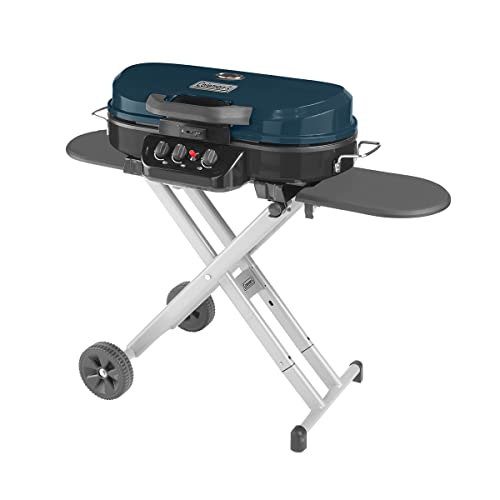
Coleman RoadTrip 285 Portable Propane Grill — Best Portable
The RoadTrip 285 is the portable grill that behaves like a real grill: three burners, 20,000 BTU, and Instastart ignition on a stand that folds flat enough to ride in a trunk or truck bed and sets up in minutes at the campsite, tailgate, or park. Unlike tiny tabletop portables that cook for two, the 285 has the grate space and burner flexibility to feed a group, and its stand puts the cooking surface at a comfortable height without needing a picnic table.
Strengths
- Three independently controlled burners — rare in a portable — allow two-zone cooking away from home.
- Folding stand with wheels: rolls like luggage, stands like a patio grill.
- Runs on portable 1-pound cylinders or, with an adapter hose, a full-size tank for long base-camp stays.
Trade-offs
- Heavier and bulkier than tabletop portables — it is “car portable,” not “carry it a mile” portable.
- Open stand design offers no wind protection; cooking in a breeze costs heat and fuel.
- Grate and firebox materials are portable-grade, not decade-grade; it wants a garage corner, not year-round weather.
Mini spec box: 3 burners · 20,000 BTU · Instastart ignition · folding wheeled stand · 1 lb cylinder or 20 lb tank with adapter.
On the road, the 285 earns its badge with flexibility. Burgers and dogs for the team after a game, pancakes on the optional griddle surface at camp, chicken finished on the low zone while steaks sear — the three-burner layout travels well. Setup is genuinely quick, the legs lock solidly, and the whole unit wipes down and folds before the cooler is packed. If your barbecue life happens away from your backyard at least half the time, this is the pick that respects that reality.
Best for: campers, tailgaters, RVers, and apartment dwellers who grill at parks. / Not suited for: backpackers, or buyers wanting a permanent patio centerpiece. Check the current price on Amazon

Char-Griller AKORN 20-Inch Kamado Charcoal Grill and Smoker — Best Kamado
Kamado cooking — a heavily insulated, egg-shaped charcoal firebox that sips fuel, holds low smoking temperatures for hours, and still climbs to steakhouse searing heat — usually costs ceramic money. The AKORN delivers the kamado experience in triple-wall insulated steel with cast-iron grates, at a price that undercuts ceramic rivals dramatically. It is the value door into the most versatile charcoal format there is.
Strengths
- Insulation makes it remarkably fuel-efficient and stable: one load of charcoal can hold smoking temperatures for a long cook.
- Temperature range runs from low-and-slow smoking to a fierce sear without changing equipment.
- Steel body is far lighter and less fragile than ceramic — no cracked firebox anxiety when moving it.
Trade-offs
- Steel insulation is excellent but not ceramic-equal in extreme cold or very long cooks; expect slightly more attention on a winter brisket.
- Painted steel exterior needs the cover habit to keep rust away over the years.
- 20-inch class cooking space is generous for a kamado but smaller than the big kettle or pellet picks for crowd cooking.
Mini spec box: 20-inch kamado · triple-wall insulated steel · cast-iron grates · charcoal fuel.
Cooking on the AKORN teaches you kamado discipline quickly: light a small fire, approach your target temperature slowly (insulated cookers overshoot easily and come back down slowly), and then enjoy hours of stability. Pizzas bake with a properly crisped crust at high heat; ribs ride low and steady; steaks sear over a concentrated charcoal bed. For the cook who wants one charcoal grill that can genuinely do everything, the AKORN is the smart-money answer.
Best for: charcoal cooks who want kamado versatility without ceramic prices. / Not suited for: cooks who need maximum grate space, or anyone who will skip the cover and invite rust. Check the current price on Amazon
Comparison Table
| Pick | Badge | Key spec | Best for |
|---|---|---|---|
| Weber Spirit E-310 | Best Overall | 3-burner propane, cast-iron grates | One-grill households |
| Weber Original Kettle Premium 22″ | Best Charcoal | 22-inch kettle, hinged grate, thermometer | Live-fire flavor |
| Traeger Pro 22 | Best Pellet | 572 sq. in., 18 lb hopper, meat probe | Set-and-forget smoking |
| Blackstone 1883 28″ Griddle | Best Griddle | 28-inch flat top with hood | Breakfasts, smash burgers, batches |
| Coleman RoadTrip 285 | Best Portable | 3 burners, 20,000 BTU, folding stand | Camping and tailgating |
| Char-Griller AKORN | Best Kamado | Insulated steel kamado, cast-iron grates | Sear-to-smoke versatility |
How to Choose Between Gas, Charcoal, Pellet, and Griddle
The fuel decision decides your barbecue life more than any brand choice, so make it deliberately. Ask how you cook on a normal week, not on your most ambitious Saturday.
Choose gas if weeknight speed matters. A propane grill lights instantly, preheats in about ten minutes, and turns off when you are done — which is why gas grills get used two or three times as often as any other type in real households. Flavor is clean and lets the food and its seasoning speak. The Spirit E-310 is this guide’s gas standard-bearer. Choose three burners for family flexibility, insist on cast-iron grates, and check that replacement burners exist for the model you buy.
Choose charcoal if flavor and fire are the point. Charcoal asks for twenty minutes of startup and a modest skill investment in vent and coal management, and repays it with searing heat and the taste most people picture when they say “barbecue.” The kettle is the flexible, affordable form; the kamado is the insulated, efficient, do-everything form. Budget for charcoal as an ongoing consumable and a chimney starter as essential equipment.
Choose pellet if smoking is the dream and weekends are busy. A pellet grill is a wood-fired convection oven: genuine smoke, thermostat control, and long cooks that mostly run themselves. It will not sear like charcoal and it needs electricity and dry pellet storage. For brisket, ribs, pork shoulder, and roasted anything, nothing else is as forgiving.
Choose a griddle if your menu is burgers, breakfast, and anything chopped, delicate, or saucy. A flat top is the highest-throughput home cooking surface there is, with the easiest cleanup in this guide. It complements a grate grill beautifully and replaces one entirely for households whose cooking style fits it.
Size and space, briefly: measure your patio or balcony, check local rules (some buildings restrict charcoal or all open-flame grills), and count mouths honestly. A family of four with occasional guests is perfectly served by a three-burner gas grill or a 22-inch kettle. Regular crowds justify the pellet’s 572 square inches or a four-burner gas grill. Portables like the RoadTrip 285 solve the no-yard problem outright.
How to Set Up a New Bar BQ Grill and Cook Your First Meal on It
- Assemble carefully and keep the manual. Whatever the fuel, build on a flat surface, do not force fittings, and store the manual and model number where you can find them — you will want both for parts someday.
- Gas grills: leak-test, then burn off. Brush soapy water on hose and regulator connections, open the tank valve with burners off, and watch for bubbles. Then run the grill on high for 15–20 minutes to burn off factory coatings before food ever touches the grates.
- Charcoal grills: season and learn the vents. Burn one chimney of charcoal with no food to cure the interior, and note how vent openings map to temperature. Mark your damper positions with a paint pen if it helps — every kettle and kamado has its own personality.
- Pellet grills: follow the initial burn-in exactly. Pellet grills require a priming and burn-off cycle so the auger feeds correctly and manufacturing oils clear. Fill the hopper with food-grade pellets stored dry; damp pellets are the number one cause of pellet grill misbehavior.
- Griddles: season the plate in thin layers. Heat the plate, apply a whisper-thin layer of high-smoke-point oil, let it smoke off, and repeat three to five times until the surface darkens evenly. Thin layers are the whole secret — thick layers turn gummy.
- Cook something forgiving first. Burgers, sausages, or chicken thighs teach you a new grill’s hot spots and temperament far better than an expensive steak or a twelve-hour brisket. Map the hot zones with the white-bread toast test if you want the full picture in five minutes.
- Stock the basics: long tongs, a wide spatula, an instant-read thermometer, a bristle-free brush for grates or a scraper for griddles, and a cover that fits. The thermometer matters most — it turns guessing into cooking.
Barbecue Techniques That Work on Every Grill in This Guide
Hardware gets the attention, but technique decides dinner. These fundamentals transfer across gas, charcoal, pellet, and griddle, and mastering them will improve your results more than upgrading any single piece of equipment.
Two-zone fire is the master skill. On gas, light one side and leave the other off or low. On charcoal, bank coals to one side. On a pellet grill, the whole surface is indirect by design, so use the edges and the upper rack as your gentle zones. On a griddle, run one burner low as a holding area. Sear where it is hot, finish where it is gentle, and hold where it is warm — nearly every protein benefits from at least two of those three stages, and bone-in chicken demands all three.
Preheat fully, then be patient. Grates and griddle plates need to reach temperature and stabilize; food added to a half-hot surface sticks and steams. Once food is on, leave it alone until it releases naturally. Meat that is ready to flip lets go of the grate; meat that is not, tears. The crust you want forms in that undisturbed contact.
Cook to temperature, not to time. Recipes give times because they must; your grill, your weather, and your cut of meat all differ from the test kitchen’s. An instant-read thermometer removes the guesswork from chicken, pork, burgers, and steaks alike. Pull thick cuts a few degrees early and rest them — carryover heat finishes the job while juices redistribute, and rested meat is juicier meat on every fuel type.
Manage the lid like an oven control. Lid down means convection heat, faster cooking, and more smoke contact; lid up means radiant grilling and slower, more direct char. Most cooks do best with the lid down for anything thicker than a burger patty or a skewer, and the lid up for quick-searing thin cuts and vegetables they are actively tending.
Season simply and sauce late. Salt ahead — an hour for thick cuts, or even overnight in the fridge — and keep sugary sauces for the final minutes, because sugar burns long before meat finishes. A dry rub plus a late glaze gives you bark and shine without the scorched bitterness that ruins more barbecue than any equipment flaw.
Cleaning and Care, by Fuel Type
Every grill in this guide will serve longer and cook better with a small, fuel-appropriate routine. The work differs by type, and knowing your type’s routine before you buy prevents the most common ownership regret: the grill that became unpleasant to use.
Gas: burn off residue on high for ten minutes after cooking, brush the grates, and empty the grease tray monthly in season. Once a season, lift the grates and heat tents, scrape the firebox clean, and check burner ports for blockages. The Spirit’s components are built for exactly this routine and parts are easy to replace when they eventually wear.
Charcoal kettles: the One-Touch system sweeps ash into the catcher in seconds; empty the catcher when it fills, and never store a kettle with wet ash inside — ash plus moisture becomes corrosive paste that eats the bowl. Grates get the same burn-and-brush treatment as gas.
Kamados: ash removal through the lower vent keeps airflow honest, and the gasket — the felt or mesh seal between body and lid — is the wear item to inspect each season. The AKORN’s steel body wants a cover and a quick wipe of the exterior to keep the finish ahead of the weather.
Pellet grills: vacuum the fire pot and interior ash after every few cooks, keep the grease bucket and drain path clear, and store pellets bone-dry. The Pro 22’s electronics and auger are reliable when dry and unhappy when wet, so the cover is not optional equipment.
Griddles: while the plate is still warm, scrape food residue into the grease cup, wipe with a damp towel (carefully — steam), and finish with the thinnest possible coat of oil. A properly seasoned Blackstone plate is nearly nonstick and rust-resistant; a neglected one rusts at the edges first, which is your early warning.
Common Buying Mistakes
- Buying for the fantasy, not the routine. A smoker you use twice a year loses to a gas grill you use twice a week. Match the grill to your real cooking pattern.
- Assuming one grill must do everything. Many happy households pair a modest gas grill with a kettle, or a pellet grill with a griddle. Two right tools beat one compromised one.
- Judging size by advertised total area. Warming racks and secondary surfaces inflate the number. Compare primary cooking area.
- Ignoring building and HOA rules. Balcony charcoal bans and open-flame restrictions are common. Check before you buy, not after the first complaint.
- Forgetting the consumables budget. Charcoal and pellets are ongoing costs; propane is cheap but not free. Factor a season of fuel into the purchase decision.
- Skipping the cover. Every fuel type in this guide lives longer under a cover — pellet electronics and griddle plates most of all.
Safety and Placement Basics for Any Bar BQ Grill
Every fuel in this guide involves real fire, and a few placement habits keep barbecue a pleasure instead of an incident report. Place any grill on a level, non-combustible surface, well clear of siding, fences, deck rails, and overhanging branches or eaves — manufacturers specify clearances, and they mean them. Never grill inside a garage or enclosed porch: carbon monoxide from gas, charcoal, and pellets alike is odorless and dangerous, and “the door was open” is not ventilation.
Keep a clear zone around the grill while cooking — no foot traffic through the cook’s workspace, no children reaching across a hot lid, no dog stationed hopefully under the grease path. Know where your shutoffs are: the tank valve on gas and pellet-adjacent propane setups, the vents that starve a charcoal fire, the power cord on a pellet grill. A small fire extinguisher rated for grease fires, kept within reach but not within the flames’ reach, belongs in every grilling household; water on a grease fire makes it worse, so smother, shut off fuel, or extinguish — never splash.
Finally, manage the cool-down. Charcoal ash can hide live coals for a day or more; let ash cool fully in the grill, then transfer it to a metal container before disposal. Gas and griddle surfaces stay burn-hot long after the knobs are off. Build these habits into the routine from the first cook and they become invisible — which is exactly what good safety looks like.
Accessories Worth Buying — and the Ones to Skip
A barbecue grill’s sticker is not its real cost; a short list of accessories completes the purchase, and a longer list of gadgets quietly wastes money. Here is the honest split, applicable to every pick in this guide.
Worth it, for every grill: a fitted cover sized to your model; an instant-read thermometer (the single highest-value tool in outdoor cooking); long-handled tongs and a sturdy wide spatula; a bristle-free grill brush for grates — wire bristles can shed and are a genuine safety concern — or a scraper and squeeze bottles for a griddle. Charcoal cooks should add a chimney starter, which lights coals evenly with newspaper and no lighter fluid taste, ever. Pellet cooks should budget for a shop vacuum dedicated to ash and a sealed bin that keeps pellets dry.
Worth it for specific picks: a smoker box or pellet tube for the Spirit E-310 if you want occasional smoke on a gas grill; a cast-iron plancha insert for the kettle if you love smash burgers but are not buying the Blackstone; a front shelf or side table for the Traeger if your patio lacks a landing zone for trays; a 20-pound tank adapter hose for the RoadTrip 285 if your camps are long and your 1-pound cylinders are adding up; heat-resistant gloves for kamado and kettle cooks who adjust vents and grates mid-cook.
Skip or delay: oversized tool sets with fourteen pieces you will never touch — buy the three good tools separately instead. Beer-can chicken stands and novelty gadgets solve problems technique solves free. Cheap no-name replacement grates are a false economy that rusts in a season; when the original grate finally wears, buy the manufacturer’s. And delay the rotisserie, the pizza oven insert, and the specialty racks until you have cooked a season and know which direction your barbecue life is actually heading — the best accessory is the one bought for a dish you already cook and love.
The pattern across this whole section is the pattern of the guide itself: spend on the fundamentals that touch the food and protect the equipment, and let the gimmicks keep their shelf space at the store.
Final Recommendation
For most households, the answer is the Weber Spirit E-310: fast, even, durable, and supported for the long haul. If your heart is with live fire, the Weber Original Kettle Premium is the charcoal benchmark and the Char-Griller AKORN is the versatile kamado upgrade. If smoked brisket and ribs are the goal, the Traeger Pro 22 makes them genuinely easy. If your outdoor menu is breakfast and burgers for a crowd, skip the grate entirely and take the Blackstone 1883. And if your barbecue happens wherever you park, the Coleman RoadTrip 285 is the portable that cooks like a real grill. There is no wrong pick on this list — only the wrong match between a grill and a cook, and the reviews above are written to help you avoid exactly that.
Drill into the cluster next: Best Barbecue Grills To Buy for the general buying shortlist, Best Barbecue Grills Propane if you have settled on gas, Best Bang For Buck Propane Grills for the value-focused propane list, Best Barbecue Grills Under $500 for a firm mid-range ceiling, and Best Barbecue Grills For Women To Use for the easy-handling, easy-cleaning angle on the same category.
Frequently Asked Questions
Which fuel tastes best for barbecue?
Charcoal and wood pellets add flavors gas cannot — charcoal gives a live-fire, slightly smoky char, and pellets give true wood smoke that varies with the pellet wood. Gas tastes clean and neutral, which many cooks prefer for seafood, vegetables, and anything where the marinade should lead. “Best” depends on the food and the cook; that is why this guide picks a champion per fuel.
Can one grill really replace a smoker?
A pellet grill like the Traeger Pro 22 is a smoker by design. A kamado like the AKORN smokes excellently with charcoal and wood chunks. A kettle can smoke with a two-zone setup and patience. A gas grill can add light smoke with a smoker box but will not match the others for brisket. Match the tool to how deep into smoking you plan to go.
How much cooking space do I need?
As a working rule, plan roughly 100 square inches of primary grate per person for a full meal cooked at once. Four people need about 400 square inches; the pellet pick’s 572 covers a family plus guests. Remember that sides cooked in batches or in the kitchen reduce the space you truly need.
Are pellet grills safe to leave running for long cooks?
They are designed for long, thermostat-controlled cooks, and the Pro 22’s controller and probe make them manageable. Follow the manufacturer’s clearance rules, keep the grease system clean — neglected grease is the main fire risk on any grill — and never leave any live-fire appliance completely without periodic checks.
What is the easiest grill type to clean?
The griddle wins: scrape, wipe, oil, done. Gas grills are next with a burn-off and brush routine plus a grease tray to empty. Pellet grills add ash vacuuming after several cooks. Charcoal asks for ash disposal after every cook, which the kettle’s One-Touch system makes a ten-second job.
Can I barbecue on a small balcony?
Often, yes — but check your building’s rules first, because many leases and HOAs restrict or ban charcoal and open-flame grills on balconies while allowing gas or electric. If gas is allowed, a compact two-burner or a portable like the RoadTrip 285 on its stand fits most balconies. Keep the grill clear of the railing and siding, never leave it unattended, and store propane cylinders according to your local fire code — many buildings limit cylinder size or storage location. When in doubt, the property manager’s written answer beats a neighbor’s guess.
Should my first grill be gas or charcoal?
If you are learning and want to cook often with minimal friction, start with gas — you will grill more, and frequency builds skill. If you are drawn to fire and flavor and do not mind a learning curve, start with the kettle; it is inexpensive, nearly indestructible, and teaches fundamentals that transfer to every other grill type.


