Disclosure: airfryerkitchensupply.com is reader-supported. When you buy through links on our site, we may earn an affiliate commission at no extra cost to you.
Where to buy
Shopping for best backpacking grills? The fastest way to buy any grill in this guide is through Amazon, where the verified picks below are listed with current configuration details. Use these links to check price on Amazon and confirm the exact model, fuel type and included accessories before ordering:
- Kuvik Titanium Camping Grill (Best Overall): Check on Amazon
- Vargo Titanium Bifold Campfire Grill (Best with Legs): Check on Amazon
- Woodsman Titanium Grill (Arcadia Gear) (Best Minimalist): Check on Amazon
- iBasingo Mini Pure Titanium Grill Plate Ti2021C (Best Stove Plate): Check on Amazon
- Branded Boards Portable Bushcraft Stainless Folding Grill (Best Stainless Value): Check on Amazon
- ZipSeven Camping Bushcraft Backpacker Grill (Best Budget): Check on Amazon
Backpacking grill listings live and die by their stated weight and packed size — and small sellers measure both optimistically. Use the links below to check price on Amazon and confirm the current listing’s weight, dimensions and what is actually included (grate only, or grate plus legs and case) before ordering.
The best backpacking grills weigh less than your water bottle and cook over fires you are already making. That is the whole category: ultralight grates and plates — mostly titanium, some stainless — that turn a campfire or a backpacking stove into a grill for the food that makes a trail day end well. Nobody is carrying a hibachi up a mountain, and this guide will not pretend the folding charcoal boxes in other categories belong here.
The honest trade is stated up front: a backpacking grill gives you a cooking surface, not a cooker. The fire is yours to build and manage, the heat control is moving food and raising stones, and capacity is one or two people eating in the cook-and-eat rhythm. In exchange, the weight penalty is measured in grams and the packed size in centimetres — the only terms on which backpacking equipment is allowed to exist.
The six verified picks are all real, currently listed ultralight grills: titanium plates, folding titanium grills with legs, and stainless bushcraft grates for the weight-tolerant. Each review gives the format, the fire it wants, and the kind of trip it suits — from thru-hike minimalism to basecamp comfort.
In this guide
Quick Picks — The Best Backpacking Grills at a Glance
Six ultralight grills that earn their pack space: titanium plates for stove and fire, a folding titanium grill with its own legs, and stainless grates for campers who trade grams for durability.
Kuvik Titanium Camping Grill — Best Overall: Titanium’s virtues compound on trail. It cannot rust in a wet pack, it shrugs off direct flame that would sag aluminium, and its weight is so low that the decision to carry a grill stops being a decision. The included ca… Check on Amazon
Vargo Titanium Bifold Campfire Grill — Best with Legs: Anyone who has balanced a grate on two rocks while dinner slid toward the fire understands this product instantly. The bifold legs set a stable, level surface at a sensible height over embers, fold flat for the pack, and… Check on Amazon
Woodsman Titanium Grill (Arcadia Gear) — Best Minimalist: Its appeal is subtraction. There is nothing to deploy, nothing hinged, nothing that can fail at mile forty — you build the fire lay the way bushcraft teaches, set the grill, and cook. The titanium takes direct coal conta… Check on Amazon
iBasingo Mini Pure Titanium Grill Plate Ti2021C — Best Stove Plate: Over a stove, grates waste the flame’s edges and lose small food; a plate captures the heat and keeps the food. Eggs, flatbreads, sliced vegetables, a single steak with its juices retained — the plate repertoire is the s… Check on Amazon
Branded Boards Portable Bushcraft Stainless Folding Grill — Best Stainless Value: Weight is a budget as well as a number, and plenty of trips — a two-mile walk-in, a paddle camp, a car boot — can afford stainless grams in exchange for steel’s strength and price. The folding grate sets up over a fire r… Check on Amazon
ZipSeven Camping Bushcraft Backpacker Grill — Best Budget: Mesh is its quiet advantage — vegetables, mushrooms and small pieces that fall through bar grates stay put, which for vegetarian trail cooking is the entire ballgame. The welded construction at this tier is respectable, … Check on Amazon
How These Picks Were Chosen
Verification came first, as always in this series: each pick has a confirmed current listing via the site’s product data feed, matched to its listing title. The ultralight category is full of identical-looking imports under rotating names, so only listings with clear material, size and inclusion details were kept.
Judging weighted the backpacker’s actual currencies: weight, packed size, and stability over an uneven fire — a grill that dumps dinner into the ashes fails regardless of its grams. Material was scored honestly: titanium for minimum weight and corrosion immunity, stainless for strength and price, each with its real trade-offs. Dual use counted too — a plate that works over a canister stove in a fire ban earns its place twice.
What was excluded matters as much: every ‘portable grill’ over roughly a kilogram, every charcoal box needing assembly hardware, and every product whose listing could not say what it was made of. Backpacking is a discipline of exclusions, and the guide applied it.
The 6 Best Backpacking Grills — Full Reviews
Each review states the format, the fire or stove it pairs with, and the trip style it serves. Weights are described comparatively — check the listing for the current figure, as small makers revise them.

Kuvik Titanium Camping Grill — Best Overall
Best Overall. The Kuvik is the category distilled: a titanium grill surface with a case, light enough to forget you packed it and useful every single night.
Titanium’s virtues compound on trail. It cannot rust in a wet pack, it shrugs off direct flame that would sag aluminium, and its weight is so low that the decision to carry a grill stops being a decision. The included case is not a luxury — a soot-blackened grate loose in a pack is a laundry disaster, and Kuvik clearly camps.
Cooking on it rewards the fire skills this category assumes: a flat ember bed or a low stove flame, food moved through the heat rather than parked, small pieces cooked in sequence. Steak for one, trout for two, vegetables and flatbreads for anyone — it handles the backpacking repertoire completely, at a weight that embarrasses steel.
Strengths
- Titanium: the lightest credible grill material, immune to rust
- Carrying case keeps soot off the rest of the pack
- Works over open fire and as a stove-top grill plate
Trade-offs
- Titanium transmits heat fast — hot spots need food movement
- Surface suits one to two people, in batches
- Premium material at a premium-for-its-size tier
Key specs: Titanium, corrosion resistant, carry case included
Check on Amazon — check price on Amazon before you order, since configurations and included accessories change.
Best for: weight-conscious backpackers and bikepackers / Not suited for: groups cooking communally — carry two, or cook in relays

Vargo Titanium Bifold Campfire Grill — Best with Legs
Best with Legs. The Vargo solves the grate’s oldest problem — what does it sit on — with folding legs, and remains light enough to justify them.
Anyone who has balanced a grate on two rocks while dinner slid toward the fire understands this product instantly. The bifold legs set a stable, level surface at a sensible height over embers, fold flat for the pack, and the cooking area is honestly sized for two people’s full meal cooked together rather than in shifts.
Vargo’s backpacking pedigree shows in the details: no loose parts to lose in the leaf litter, nothing to assemble with cold hands. It costs and weighs a little more than a bare plate, and returns that investment the first night the fire ring offers no cooperative stones.
Strengths
- Legs make it a grill, not just a grate — no stone engineering needed
- Bifold packs flat against a pack panel
- Sixty-plus square inches is real cooking room at this weight
Trade-offs
- Legs add grams the plate-only picks avoid
- Hinges are the long-term wear point
- Premium tier among titanium options
Key specs: Titanium bifold with legs, 60+ sq in cooking surface
Check on Amazon — check price on Amazon before you order, since configurations and included accessories change.
Best for: backpackers who cook over fires most nights / Not suited for: absolute minimalists counting single grams
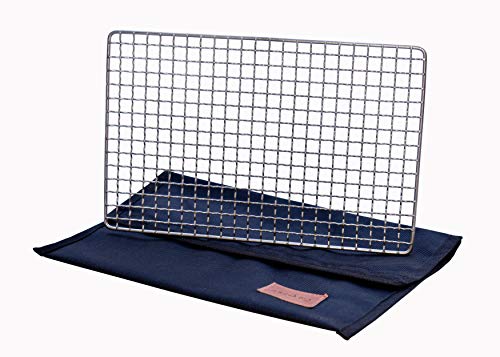
Woodsman Titanium Grill (Arcadia Gear) — Best Minimalist
Best Minimalist. The Woodsman is the original ultralight titanium bushcraft grill: a surface, a fire, and a cook who knows what they are doing.
Its appeal is subtraction. There is nothing to deploy, nothing hinged, nothing that can fail at mile forty — you build the fire lay the way bushcraft teaches, set the grill, and cook. The titanium takes direct coal contact that would destroy lesser metals, and the format has the devoted following that only genuinely proven trail gear accumulates.
That same minimalism is its filter: if your fire skills are new, the legged Vargo or a plate over a stove will forgive more. If your skills are the point of the trip, the Woodsman is the connoisseur’s pick in this guide.
Strengths
- Bare-essentials design — nothing to break, bend or lose
- Titanium durability in a format sized for real food
- Works across fire, coals and stove
Trade-offs
- No legs: your fire lay provides the support
- Minimalist surface means minimalist capacity
- Bushcraft style assumes fire skills beginners may lack
Key specs: Titanium, original ultralight bushcraft format
Check on Amazon — check price on Amazon before you order, since configurations and included accessories change.
Best for: experienced fire cooks and bushcraft practitioners / Not suited for: beginners — choose the legged or stove-friendly picks first

iBasingo Mini Pure Titanium Grill Plate Ti2021C — Best Stove Plate
Best Stove Plate. A plate rather than a grate, sized for one: the iBasingo turns a backpacking stove into a tiny griddle, and that is a genuinely different capability.
Over a stove, grates waste the flame’s edges and lose small food; a plate captures the heat and keeps the food. Eggs, flatbreads, sliced vegetables, a single steak with its juices retained — the plate repertoire is the solo hiker’s luxury menu, cooked on the stove already in the pack, legal in many places where open fire is not.
It works over embers too, as a griddle surface, though its size writes the menu: one person, cooking attentively. At its tier for titanium it is the easiest entry in this guide, and solo hikers may find it the most-used item they carry.
Strengths
- Plate format excels over a stove flame — no grate gaps for small food
- Titanium at a notably accessible tier for the material
- Doubles as a griddle for trail breakfasts and flatbreads
Trade-offs
- Smallest cooking surface among the titanium picks
- Plate edges are open — juices run, as plates allow
- One-person capacity, honestly stated
Key specs: Titanium plate, 25 x 11 cm, stove and open-fire use
Check on Amazon — check price on Amazon before you order, since configurations and included accessories change.
Best for: solo hikers and stove-first cooks / Not suited for: couples and groups — size up to the Kuvik or Vargo

Branded Boards Portable Bushcraft Stainless Folding Grill — Best Stainless Value
Best Stainless Value. The stainless alternative: heavier in the hand, lighter on the wallet, and tough enough for car camps, canoe trips and short hikes.
Weight is a budget as well as a number, and plenty of trips — a two-mile walk-in, a paddle camp, a car boot — can afford stainless grams in exchange for steel’s strength and price. The folding grate sets up over a fire ring without ceremony, and the burlap bag keeps the soot civilised.
This guide places it honestly: it is the value pick for campers whose packs travel mostly by vehicle. Judged on those trips it is excellent. Judged on a thru-hike it fails the only test that matters there — which is why the titanium picks lead this guide and this one serves a different, larger tribe of campers.
Strengths
- Stainless strength at an entry tier
- Folding design with a proper carry bag
- Forgiving surface for learning fire cooking
Trade-offs
- Stainless weighs multiples of the titanium picks
- Folding joints need a rinse after muddy trips
- Not a thru-hike item — know its trip type
Key specs: Stainless folding grate, burlap carry bag included
Check on Amazon — check price on Amazon before you order, since configurations and included accessories change.
Best for: car campers, canoeists and short-haul hikers / Not suited for: long-distance backpackers counting grams

ZipSeven Camping Bushcraft Backpacker Grill — Best Budget
Best Budget. The ZipSeven is the invitation pick: a welded mesh grate at a tier so low that trying backpack grilling costs almost nothing.
Mesh is its quiet advantage — vegetables, mushrooms and small pieces that fall through bar grates stay put, which for vegetarian trail cooking is the entire ballgame. The welded construction at this tier is respectable, and the included bag shows the maker understands the soot problem.
Its limits are structural honesty: do not park a full pot on it, do not expect titanium’s immortality, and pack it where it will not be crushed. As a first grill for a new backpacker — or a spare for group trips — it is the easiest recommendation in the guide to make.
Strengths
- Lowest tier in the guide — the cost of one trail meal
- Welded mesh handles small food that bar grates lose
- Carry bag included at a tier that usually omits it
Trade-offs
- Mesh sags under heavy pots — it is a grill, not a pot stand
- Stainless weight, like all steel picks
- Thin construction rewards gentle packing
Key specs: Welded stainless mesh grate, carry bag included
Check on Amazon — check price on Amazon before you order, since configurations and included accessories change.
Best for: beginners and budget-first campers / Not suited for: heavy-duty or ultralight extremes — other picks serve both better
Comparison Table — Best Backpacking Grills
| Pick | Badge | Key spec | Best for |
|---|---|---|---|
| Kuvik Titanium Camping Grill | Best Overall | Titanium, corrosion resistant, carry case included | ultralight backpackers who grill over fire and stove alike |
| Vargo Titanium Bifold Campfire Grill | Best with Legs | Titanium bifold with legs, 60+ sq in cooking surface | campers who want a self-standing grill over any fire |
| Woodsman Titanium Grill (Arcadia Gear) | Best Minimalist | Titanium, original ultralight bushcraft format | bushcraft-leaning backpackers who build proper fire lays |
| iBasingo Mini Pure Titanium Grill Plate Ti2021C | Best Stove Plate | Titanium plate, 25 x 11 cm, stove and open-fire use | solo hikers who cook mainly over a canister stove |
| Branded Boards Portable Bushcraft Stainless Folding Grill | Best Stainless Value | Stainless folding grate, burlap carry bag included | car campers and weight-tolerant backpackers on a budget |
| ZipSeven Camping Bushcraft Backpacker Grill | Best Budget | Welded stainless mesh grate, carry bag included | new fire cooks who want to try grill-camping at the lowest tier |
Read the table as a map, not a ranking: every pick here earned its place for a stated household, and the badge column tells you which household that is. Specifications are limited to details verified in the product listings; confirm the current configuration before ordering.
How to Choose the Best Backpacking Grills: Grams, Fires and Honesty
Start with your fire reality. If your trips allow wood fires most nights, a grate or legged grill is the tool. If you hike where fire bans are common, a plate that works over your stove — the iBasingo, or the Kuvik used stove-top — is the only pick that will actually be used. Equipment bought for fires you are not allowed to light is dead weight in the most literal sense.
Choose material by trip length. Titanium’s premium buys grams that matter over hundreds of miles and corrosion immunity that matters in wet climates. Stainless buys strength and savings that matter on short trips. There is no universal winner — there is a winner per itinerary, and this guide’s reviews are written to that standard.
Size to your party’s rhythm. Solo and duo cooking in sequence suits every pick here. Groups should either carry two small grills — still lighter than one big one — or accept a basecamp product from outside this category. A backpacking grill stretched past its surface cooks badly and eats fuel and patience.
Fire Craft for Grill Cooking in the Backcountry
Grilling wants embers, not flames — the same rule as every charcoal tradition in this series, compressed. Build the fire early, let it collapse to a flat bed of coals, and set the grill at a height where your hand at food level counts several seconds of tolerable heat. A bed of embers the size of your grill, not the size of the fire ring, is the target.
Leave-no-trace disciplines the whole practice: use established fire rings where they exist, keep fires small, burn only small dead wood, and drown and stir ashes until cold to the touch. In fire bans, the stove plate is not a compromise — it is the trip continuing legally and safely.
Seasoning on trail is logistics: salt, oil in a leak-proof mini bottle, and one spice blend do the work of a kitchen rack. Food safety matters more, not less, without refrigeration — cook fresh ingredients on the first nights and shelf-stable foods later, the classic backpacking order.
Weight Budgets: Where a Grill Fits in a Pack
Backpackers budget weight by systems — sleep, shelter, kitchen — and a grill must argue its grams against the kitchen system’s total. The titanium picks in this guide argue easily: they weigh less than the meal they cook, ride flat against a pack panel or inside a pot, and replace nothing because they add a capability — grilling — that a stove alone cannot honestly claim.
The stainless picks argue differently: they belong to trips where the kitchen system travels by car, canoe or a short trail, and where grams are cheap. Misclassifying your trip is the only real error available here; a steel grate on a weekend walk-in is a pleasure, and the same grate at mile three hundred is a resentment you carry in both directions.
Volume matters alongside weight. Flat plates disappear into a pack’s structure; folding grills with legs need a defined slot; mesh grates roll or fold into odd corners. The grill that packs where nothing else fits is, in practice, the lightest grill of all — because it displaces nothing.
Stove Cooking vs Fire Cooking on Trail
Fire cooking is the romance and, where permitted, the economy: fuel is gathered, evenings lengthen around the ring, and the grill turns found wood into dinner. Its costs are time, smoke in everything you own, and absolute dependence on conditions and rules — a wet week or a fire ban rewrites the menu completely.
Stove cooking is the reliability: flame in ninety seconds, dinner in ten minutes, legal in far more places and seasons. The plate picks exist to give stoves a grill’s repertoire — seared, crisped, griddled food rather than the boiled and rehydrated defaults of stove cookery. For many hikers the plate-over-stove method is not a compromise but the main event.
The resilient trip carries both options when weight allows: a plate that serves the stove nightly and the fire when the fire is permitted. That dual-use logic is why dual-use picks lead this guide, and why the pure fire grates are recommended to the campers whose routes are reliably fire country.
Trail Menu Planning for Grill Cooks
Plan the grill’s work by night. Night one carries the fresh weight — a steak, trout, chicken — eaten while it is still a food-safety citizen. Night two takes the hardy fresh: halloumi, cured sausage, dense vegetables. Later nights belong to the shelf-stable repertoire the plate still transforms: flatbreads crisped to order, tortillas blistered, cheese melted onto anything, and the morale event of hot, browned food at the end of a long day.
Ingredients should be chosen for the surface: even thickness, quick cooking, tolerant of direct heat. Marinades travel in leak-proof bags and double as sauce; oil travels in a small rigid bottle, because a leaked oil bottle is a pack-wide disaster that outlasts the trip. Salt and one spice blend outperform a rack of single spices at a tenth of the weight.
Portions on trail run larger than kitchen instinct suggests — hiking appetites are not a myth but a metabolic fact — and the cook-and-eat rhythm of grilling suits them: batch after batch, eaten as it lands, until the fire and the company agree the evening is done.
Care, Repair and Leave No Trace
Ultralight gear survives by gentleness: titanium grills bend back from minor insults but work-harden if abused, mesh grates tear at snags, and hinges clog with ash if never brushed. A thirty-second brush-down at pack-up is the whole maintenance programme, plus a home wash between trips. Nothing here needs oil, seasoning or ceremony — the category’s maintenance honesty is part of its appeal.
Repairs in the field are improvisation with wire and pliers: a bent leg straightened by hand, a torn mesh corner folded flat. Design your expectations accordingly — these are single-purpose surfaces, and their failure modes are benign precisely because there is so little to fail. The spare-part strategy for a twenty-gram grill is a second twenty-gram grill on group trips.
Leave No Trace binds it all: fires only where permitted and contained, wood small and dead and down, ashes drowned cold and scattered or packed per local guidance, and every crumb of food waste packed out — grilled food smells travel, and the visitors they attract are not hypothetical. The grill leaves no trace when its cook decides it will not.
Key Takeaways for Backpacking Grill Shoppers
The category is a surface, not a cooker: you bring the fire or the stove, the grill brings the possibility of seared, crisped, real food at the end of a trail day. Judge every pick by weight, packed size and stability over an uneven fire — in that order — and let menu dreams come after the arithmetic.
Titanium is for distance, stainless is for proximity, and plates are for stoves and fire bans. The most-used grill is the one matched to your actual routes and rules, which is why this guide leads with dual-use titanium and still recommends steel without irony to the car camper.
Fire discipline is the price of the whole pleasure: embers not flames, established rings, bans obeyed, ashes cold. A backpacking grill used carelessly is a liability with a carry case; used well, it is the lightest luxury in the pack.
What Titanium Does and Does Not Do
Titanium’s trail virtues are specific: it is the lightest strong metal available at sane prices, it cannot rust, and it tolerates direct flame indefinitely. Those three properties are the entire case for its premium, and for long-distance hikers they are decisive — every gram is carried thousands of times, and a rust-proof grill survives the wet week that defines a season.
Its limits are equally specific. Titanium conducts heat quickly and unevenly compared with steel, so food must move — a technique, not a flaw, but beginners should know the first cook will teach it. It also discolours with heat into blues and straws; that rainbow is cosmetic, permanent and, to its owners, a badge. And it costs what it costs: the same geometry in steel is a fraction of the price and several times the weight.
The decision rule is distance. Multiply the weight difference by your annual miles and the answer announces itself: thru-hikers buy titanium once and stop thinking; weekend campers buy steel and spend the difference on better food to put on it. Both are correct, and this guide refuses to pretend otherwise.
A Complete Trail Dinner, Fire to Sleep
Ninety minutes before dark: camp is pitched first, because grilling is an evening art and tents raised in the dark by headlamp are nobody’s memory of a good trip. The fire is laid small in the established ring — twigs and small dead wood, nothing sawn, nothing living — and lit while food preparation happens beside it, so the ember bed matures exactly as the ingredients are ready.
At ember point: the grill is set and tested for stability with a push, the surface preheats for a minute, and the first items go on — the fresh protein of night one, cooked with the attention that a whole day of walking has earned. Vegetables and flatbreads rotate through the edges; the cook eats the first piece standing, which is a trail right older than any guide.
Through the meal: batches follow appetite rather than a plan, because hiking hunger does not read menus. The ember bed is fed in twigs, never logs — a grilling fire is a maintained instrument, not a bonfire — and the last items cook as the light finishes, which in practice means the grill’s working day is about forty minutes long and entirely glorious.
Shutdown is Leave No Trace in action: the grill cools in minutes (titanium’s quiet gift), is brushed and bagged; the fire is drowned, stirred and drowned again until the ashes are cold to a bare hand’s test; the ring is left cleaner than it was found. The hiker sleeps having eaten better than the restaurant in the last trail town, at a cost of grams this guide has already counted for you.
That evening is the product. Every pick in this guide exists to make it repeatable — the plate on a stove when fires are banned, the grate over embers when they are not — and the lightest one that fits your routes is the best one, full stop.
Troubleshooting Trail Grilling
Problem: food slides off the grate into the fire. The grill was not level or not stable — the two sins this guide’s setup step exists to prevent. Rebuild the platform before rebuilding dinner: stones settled, legs planted, the push test performed. A grate that moves under a spatula will move under a steak, and the mountain keeps what it catches.
Problem: everything tastes of smoke in the harsh way. The fire was too young — flames and green wood instead of embers — or the fuel included resinous softwood, bark or, worst of all, treated timber scraps. There is no seasoning that covers fuel error. Wait for the ember bed, burn only clean dead hardwood or use the stove plate, and let the first test piece — a vegetable, a corner of flatbread — judge the fire before the steak commits.
Problem: the grill warps or sags. A pot was parked on a mesh grate, or a plate was left empty over a fierce flame until it overheated. These surfaces are designed for food’s weight and a food-buffered temperature. The correction is usage, not warranty: grill food, rest pots on stones or a stove, and let an empty grill sit at the fire’s edge rather than in its heart.
Problem: the pack smells of smoke and old food. The grill went back unbagged or unbrushed. Burn off residue over the fire, brush it, let it cool fully, and bag it in its case before it touches the pack — and keep that case on the outside pocket where a hint of soot harms nothing. Trail hygiene is a system, and the grill’s place in it is decided once, correctly, on the first trip.
Food Safety Without a Fridge
Backpacking food safety is a timetable discipline. Fresh meat and fish are first-night foods, carried frozen-solid from home where possible so they thaw into the evening’s cook, and cooked through their safe temperatures with the same seriousness as a home kitchen — a small probe thermometer weighs little and settles arguments that guessing starts.
The danger window is warmth plus time: raw ingredients that spend a warm afternoon in a pack are a risk no fire fully redeems. Carry fresh items against a frozen water bottle or in the pack’s shaded core, keep raw and cooked implements separate — one set of tongs, washed or heated between duties — and treat hand hygiene with the same soap-and-distance-from-water discipline as every other camp practice.
Hard cheeses, cured meats and dense vegetables are the safe travellers that make later nights generous without risk, which is why this guide’s menu planning puts them there. The grill improves their safety as well as their flavour: thorough, direct heat, eaten immediately, with no lukewarm holding period in between.
Water for washing follows camp rules — carried away from sources, strained, scattered — and the grill itself is cleaned by fire and brush rather than by soap near a stream. A safe trail kitchen is mostly a set of small, consistent habits; the grill simply joins the set.
Packing the Kitchen System Around the Grill
A grill does not travel alone, and its companions decide whether it gets used. The complete grilling kitchen is compact: the grill and its case, a fire kit or stove with fuel, a small knife, one utensil that serves as spatula and tongs in the ultralight manner or a honest pair where weight allows, a leak-proof oil bottle, salt and a spice blend, and the pot that boils the water for everything else. Each item earns its place against the system’s total, and the grill — lightest member of the set — is rarely the one that should be cut.
Packing order matters to morale: the grill rides where soot can do no harm even in its case, the oil bottle rides upright in its own sealed bag because experience is a strict teacher, and the first night’s fresh food rides where the day’s heat reaches it last. A kitchen packed in the same order every trip sets up in minutes at a tired hour, which is when systems prove themselves.
At home between trips, the system is washed, dried, audited and repacked as a unit — fuel checked, oil refilled, spice blend replenished. The hiker whose kitchen is always ready says yes to more trips; readiness, in the end, is the heaviest thing a grill can carry, and it weighs nothing at all.
One Last Word on the First Night
Every grilling backpacker remembers their first trail-grilled dinner with a clarity usually reserved for summits, because it rearranges what the backcountry is allowed to feel like. The planning that produces it is unglamorous — fresh food carried frozen, the fire laid before the tent is admired, the grill tested level before the steak commits — and the result is the opposite of unglamorous: hot, seared, real food where the map said only pouches would be.
Protect that first night and the habit forms itself. Choose the forgiving menu, the established fire ring, the early start. The grill will do the rest, at a weight your shoulders will never report. That is the whole promise of this category, kept one ember bed at a time.
How to Grill Over a Campfire with an Ultralight Grill
Step one: build for embers. Make a small fire in the established ring and let it burn down while you prepare food. You want a flat, glowing bed slightly larger than your grill — flames licking the food means waiting longer, not starting sooner.
Step two: set the grill stable and level. Legged models plant directly; plates and grates rest on stones or green logs at the fire’s edge, tested with a push before food commits you. A wobbling grill is corrected now, not with dinner on it.
Step three: preheat the surface and oil the food, not the grill — oil on food survives the trip to the heat; oil on a hot grate mostly burns. Lay food in the hottest zone first for searing items, gentler edges for delicate ones.
Step four: cook small and sequential. Thin trail cuts, trout, vegetables and flatbreads all cook in minutes over embers. Eat in the cook-and-eat rhythm, keep raw and cooked apart, and manage the ember bed with small additions rather than new logs.
Step five: close camp properly. Let the grill cool before it touches the pack — titanium cools fast, another trail virtue — brush it clean, bag it in its case, and drown the fire completely, stirring until the ashes are cold. The morning inspection should find a cold ring and no trace but footprints.
Common Buying Mistakes
Carrying a ‘portable grill’ that is not backpacking weight. A two-kilogram charcoal box is car-camping gear wearing a costume. If it weighs more than your shelter, it does not belong in this category or your pack.
Grilling over flames. Soot, flare and raw centres. Embers are the medium; patience is the technique — on trail exactly as at a parrilla.
Ignoring fire bans. A ban converts your grill into litter you carried. Check conditions, and carry the stove-plate option when bans are likely.
Packing a sooty grill loose. One unbagged grate blackens a pack’s entire contents. The case or bag is part of the product — use it, or improvise one.
Putting pots on mesh grates. These surfaces grill food; they are not pot stands. A sagging mesh under a litre of boiling water is a burn looking for a victim.
Final Recommendation
The Kuvik Titanium is the recommendation for most backpackers: lightest credible format, case included, equally at home over embers or a stove. Take the Vargo instead if you cook over fires nightly and value legs over the last grams. Best Asian Grills
The Woodsman serves the skilled minimalist, the iBasingo plate the solo stove cook, and the two stainless picks — Branded Boards for strength, ZipSeven for budget — serve campers whose trips can carry steel. Every one of them beats the true enemy of trail cooking, which is another night of food you do not look forward to. Best Apartment Patio Grills
Pack the grill, build the ember bed, and eat like the trip deserves. At these weights, good food is no longer a luxury item — it is a rounding error with a carry case. Best Backyard Bbq Grills Best Argentine Grills
Quick recap with links:
- Kuvik Titanium Camping Grill (Best Overall): Check on Amazon
- Vargo Titanium Bifold Campfire Grill (Best with Legs): Check on Amazon
- Woodsman Titanium Grill (Arcadia Gear) (Best Minimalist): Check on Amazon
Frequently Asked Questions
How much should a backpacking grill weigh?
Titanium plates and grates in this guide sit in the ultralight class — a small fraction of a kilogram. Stainless options weigh several times more and suit short trips. The honest test: if the grill weighs more than the food it cooks on a given night, reconsider it for long distances.
Can I use a backpacking grill over a canister stove?
Plates can — that is their second purpose — and flat grates can sit over a stove with care for stability. Keep the canister itself away from radiant heat, never enclose a stove under a large plate in still air, and follow the stove maker’s guidance. In fire-ban country this is the standard technique.
Titanium or stainless for backpacking?
Titanium for distance and wet climates: lightest, rust-proof, expensive. Stainless for short trips and tight budgets: strong, cheap, heavy. Both cook identically well over the same ember bed — the difference is entirely in the carrying.
What food grills best on trail?
First-night fresh items — a steak, trout, chicken — then hardy foods: halloumi, cured sausages, flatbreads, corn, peppers and mushrooms. Small, even pieces over embers are the whole technique. Anything requiring an hour of roasting belongs to a different category of trip.
How do I clean a grill in the backcountry?
Burn off residue over the fire, brush with a twig brush or scour pad once warm, and wipe with a dedicated cloth. No soap near water sources; pack out everything. The grill’s own case keeps the remaining soot off your gear.
Are these grills allowed everywhere?
The grill is just metal — the fire is what is regulated. Open-fire rules, bans and stove-only periods decide what you may burn. Check your route’s current rules, and default to the stove-plate method whenever fire is restricted.


